
Wi Trace CentimeterLevel Passive Gesture Tracking Using Wi

- Slides: 22
Wi. Trace: Centimeter-Level Passive Gesture Tracking Using Wi. Fi Signals Lei Wang*, Ke Sun*, Haipeng Dai*, Alex X. Liu*^, Xiaoyu Wang* Nanjing University*, Michigan State University^ SECON'18 June 13 th, 2018
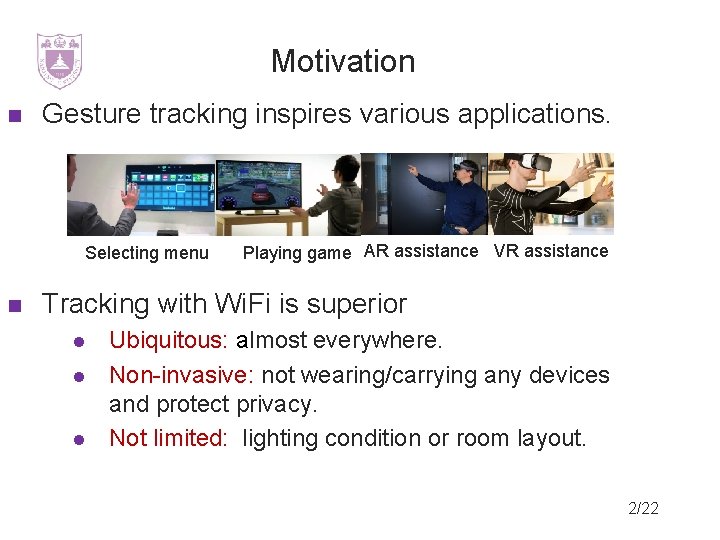
Motivation Gesture tracking inspires various applications. Selecting menu Playing game AR assistance VR assistance Tracking with Wi. Fi is superior Ubiquitous: almost everywhere. Non-invasive: not wearing/carrying any devices and protect privacy. Not limited: lighting condition or room layout. 2/22
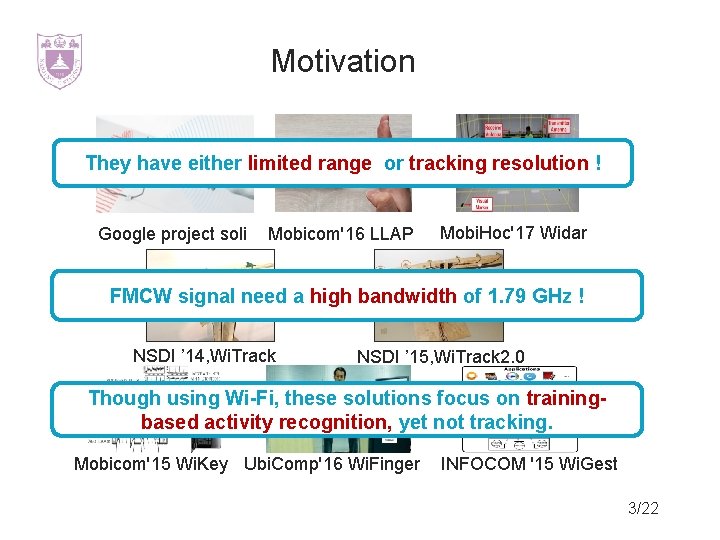
Motivation They have either limited range or tracking resolution ! Google project soli Mobicom'16 LLAP Mobi. Hoc'17 Widar FMCW signal need a high bandwidth of 1. 79 GHz ! NSDI ’ 14, Wi. Track NSDI ’ 15, Wi. Track 2. 0 Though using Wi-Fi, these solutions focus on trainingbased activity recognition, yet not tracking. Mobicom'15 Wi. Key Ubi. Comp'16 Wi. Finger INFOCOM '15 Wi. Gest 3/22
Problem Statement Can we build a gesture tracking system: Using Wi. Fi signals? With high precision With large working range 4/22
CSI Phase Model Challenge-1: Solution: What characteristics of Wi. Fi can be leveraged to achieve cm-level tracking precision? CSI phase Advantage: CSI provides more information than other Wi. Fi characteristics (RSSI). CSI Phase has higher precision over CSI amplitude. 5/22
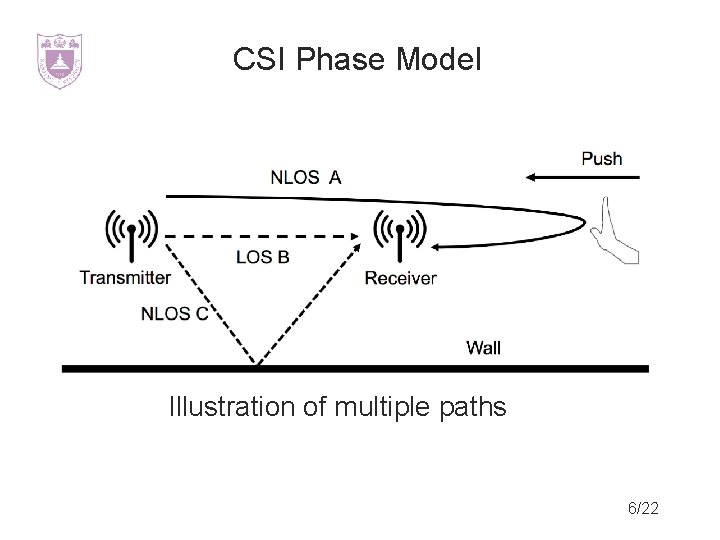
CSI Phase Model Illustration of multiple paths 6/22
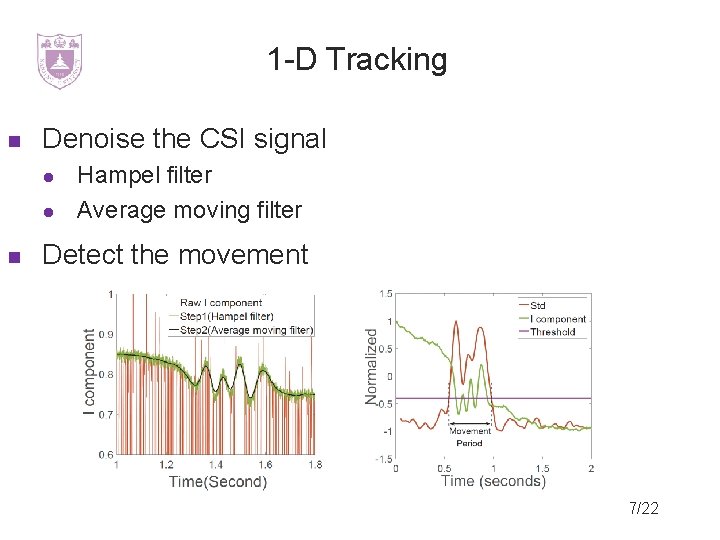
1 -D Tracking Denoise the CSI signal Hampel filter Average moving filter Detect the movement 7/22
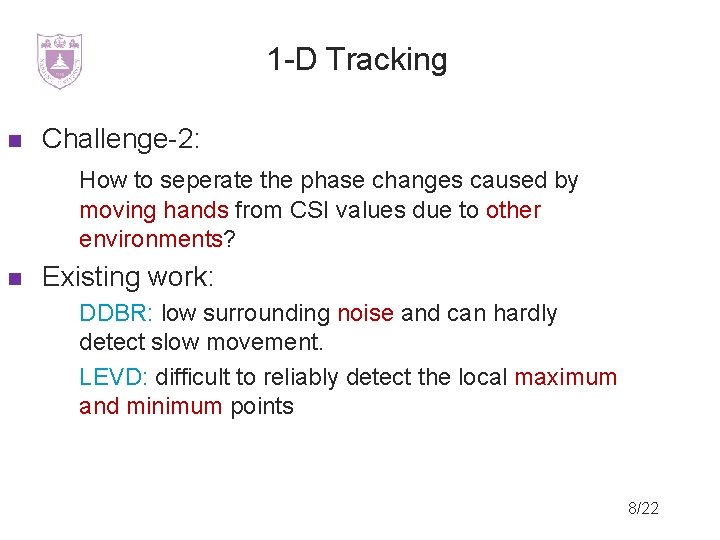
1 -D Tracking Challenge-2: How to seperate the phase changes caused by moving hands from CSI values due to other environments? Existing work: DDBR: low surrounding noise and can hardly detect slow movement. LEVD: difficult to reliably detect the local maximum and minimum points 8/22
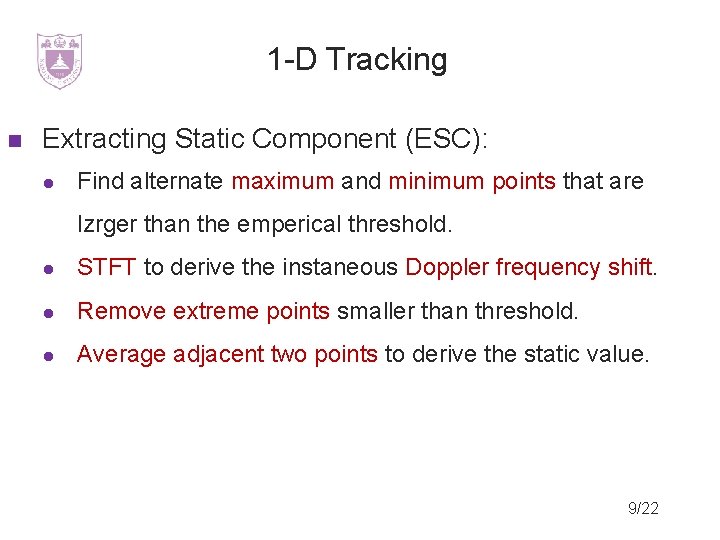
1 -D Tracking Extracting Static Component (ESC): Find alternate maximum and minimum points that are lzrger than the emperical threshold. STFT to derive the instaneous Doppler frequency shift. Remove extreme points smaller than threshold. Average adjacent two points to derive the static value. 9/22
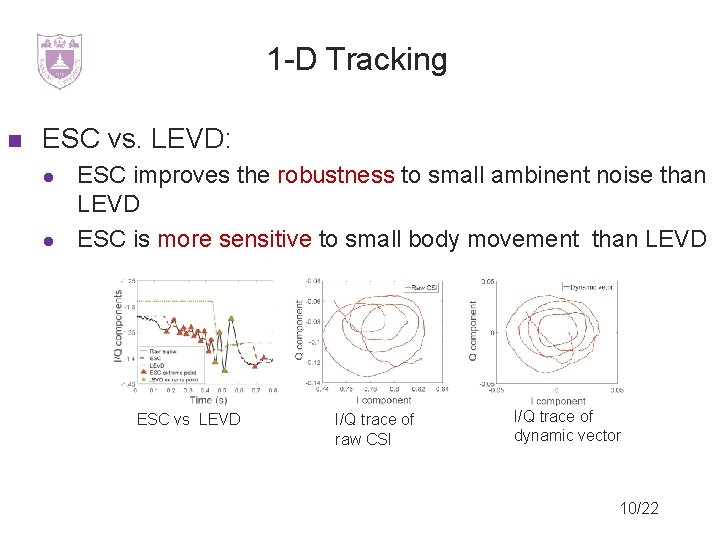
1 -D Tracking ESC vs. LEVD: ESC improves the robustness to small ambinent noise than LEVD ESC is more sensitive to small body movement than LEVD ESC vs LEVD I/Q trace of raw CSI I/Q trace of dynamic vector 10/22
2 -D Tracking Challenge-3: How to estimate the initial position of hand in 2 -D space? Existing work: m. Track: discrete beam scanning mechanism to pinpoint the object's initial localization. LLAP: IDFT to process CFR signals for all subcarriers to estimate the absolute position. Basic idea: Two preamble gestures to measure the initial position of hand. 11/22
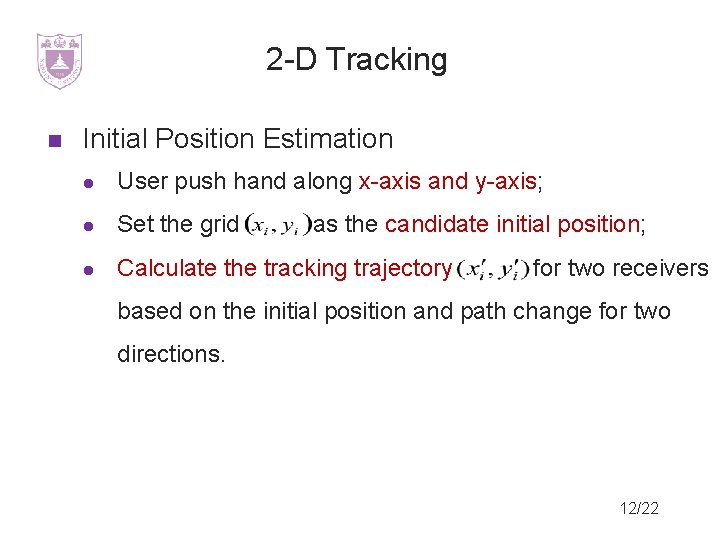
2 -D Tracking Initial Position Estimation User push hand along x-axis and y-axis; Set the grid Calculate the tracking trajectory as the candidate initial position; for two receivers based on the initial position and path change for two directions. 12/22
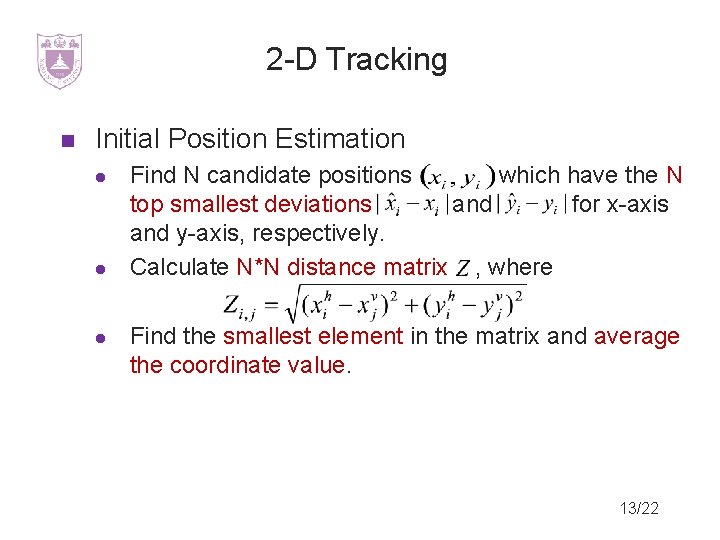
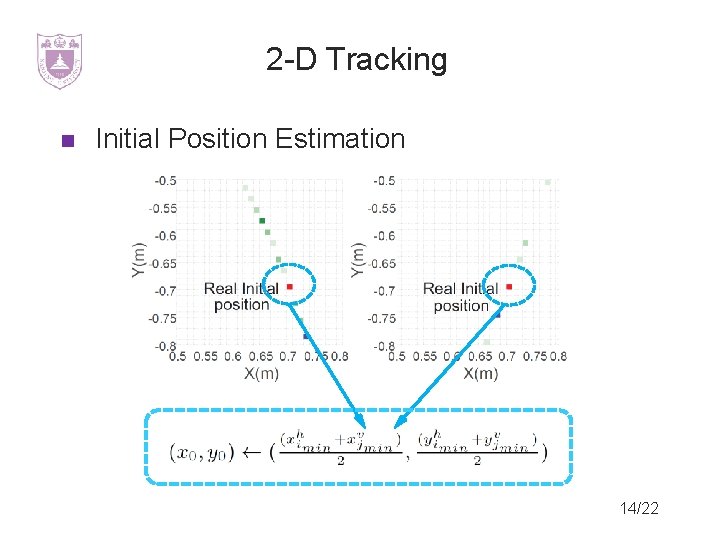
2 -D Tracking Initial Position Estimation Find N candidate positions which have the N top smallest deviations and for x-axis and y-axis, respectively. Calculate N*N distance matrix , where Find the smallest element in the matrix and average the coordinate value. 13/22
2 -D Tracking Initial Position Estimation 14/22
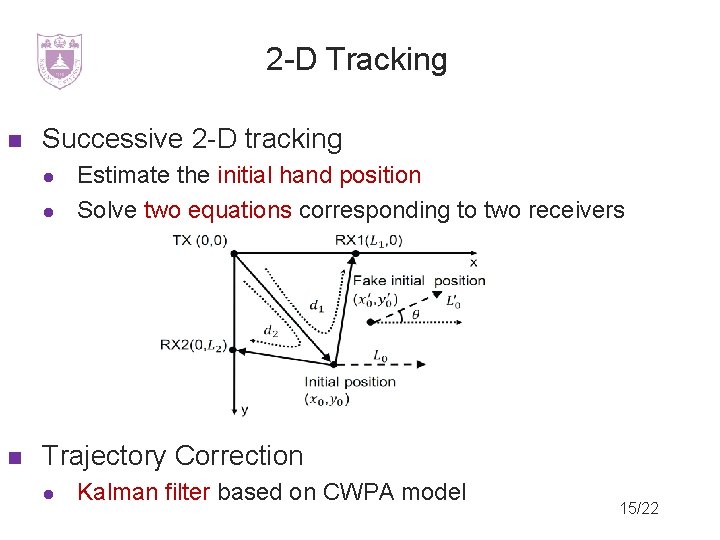
2 -D Tracking Successive 2 -D tracking Estimate the initial hand position Solve two equations corresponding to two receivers Trajectory Correction Kalman filter based on CWPA model 15/22
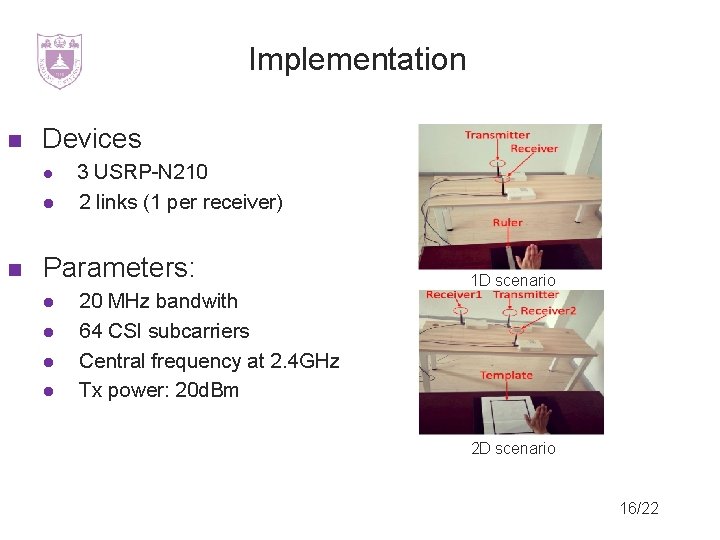
Implementation Devices 3 USRP-N 210 2 links (1 per receiver) Parameters: 1 D scenario 20 MHz bandwith 64 CSI subcarriers Central frequency at 2. 4 GHz Tx power: 20 d. Bm 2 D scenario 16/22
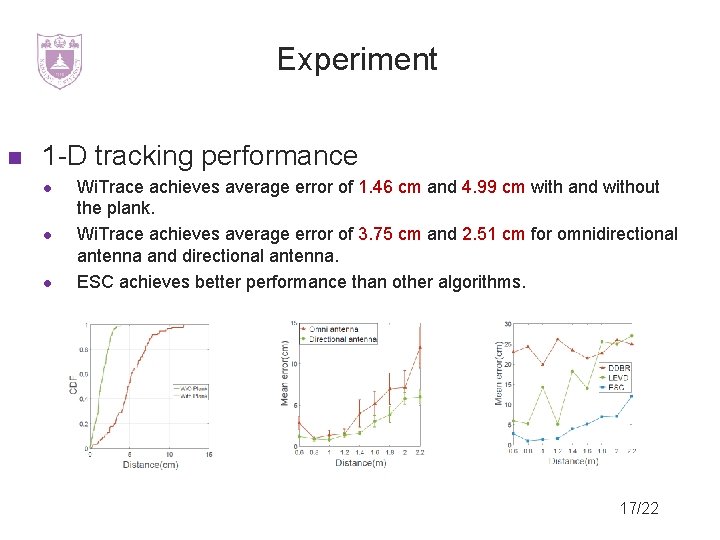
Experiment 1 -D tracking performance Wi. Trace achieves average error of 1. 46 cm and 4. 99 cm with and without the plank. Wi. Trace achieves average error of 3. 75 cm and 2. 51 cm for omnidirectional antenna and directional antenna. ESC achieves better performance than other algorithms. 17/22
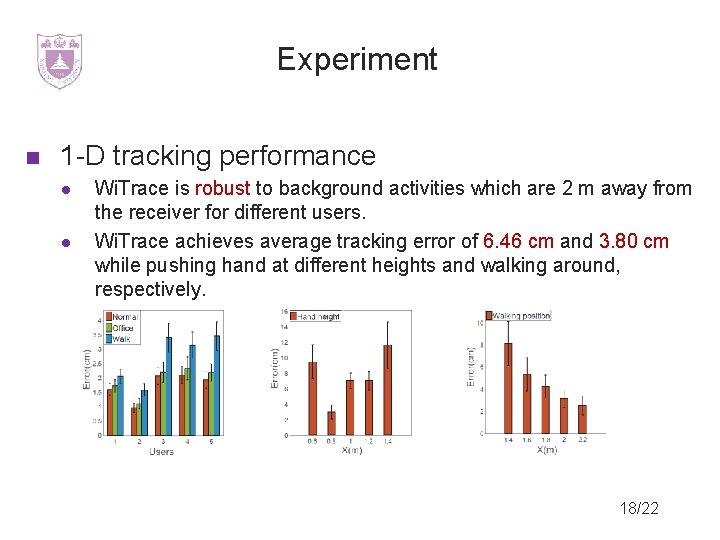
Experiment 1 -D tracking performance Wi. Trace is robust to background activities which are 2 m away from the receiver for different users. Wi. Trace achieves average tracking error of 6. 46 cm and 3. 80 cm while pushing hand at different heights and walking around, respectively. 18/22
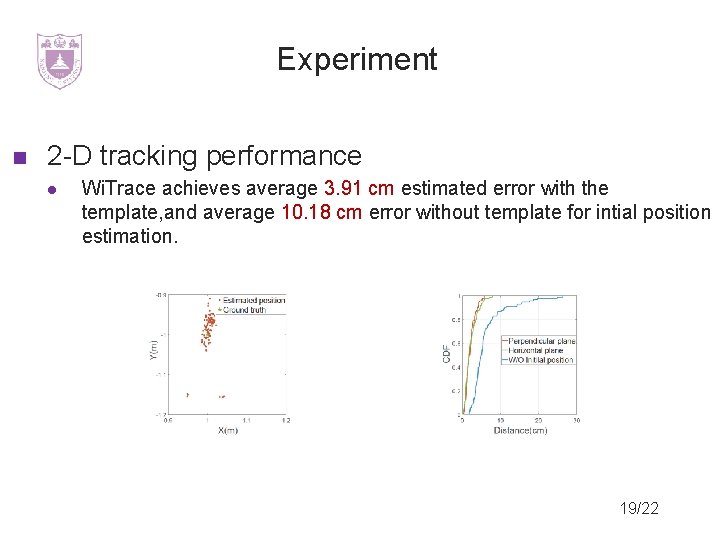
Experiment 2 -D tracking performance Wi. Trace achieves average 3. 91 cm estimated error with the template, and average 10. 18 cm error without template for intial position estimation. 19/22
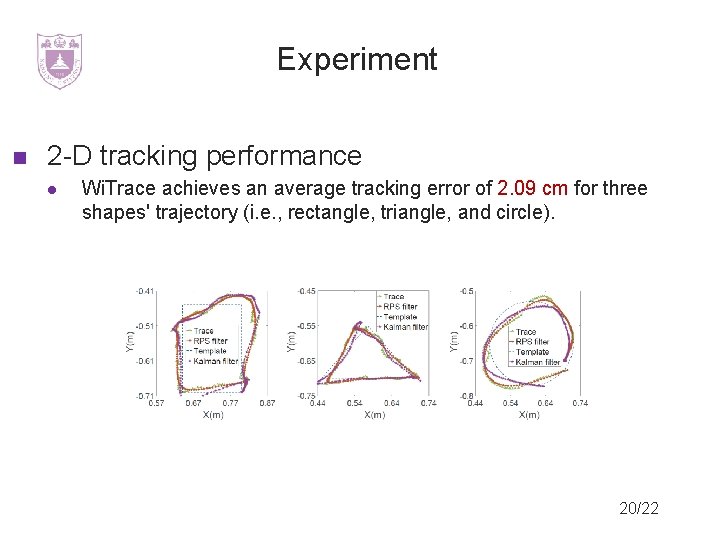
Experiment 2 -D tracking performance Wi. Trace achieves an average tracking error of 2. 09 cm for three shapes' trajectory (i. e. , rectangle, triangle, and circle). 20/22
Conclusions Wi. Trace achieves high accuracy gesture tracking using Wi. Fi signals. We propose a novel scheme based on two preamble gestures to measure the initial position of hand. We implement Wi. Trace on USRP. 21/22
Q&A 22/22