
Why would constitutively active Ras lead to cancer

- Slides: 78
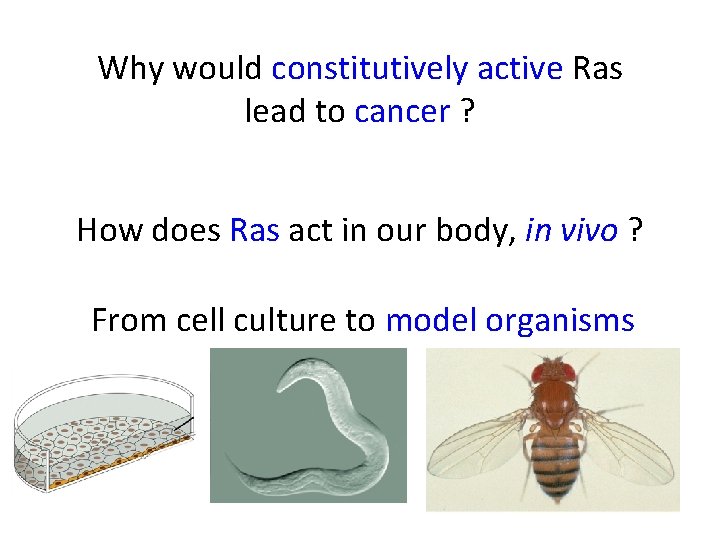
Why would constitutively active Ras lead to cancer ? How does Ras act in our body, in vivo ? From cell culture to model organisms
Model organisms teach us about ourselves Mus musculus Xenopus laevis Caenorhabditis elegans Drosophila melanogaster
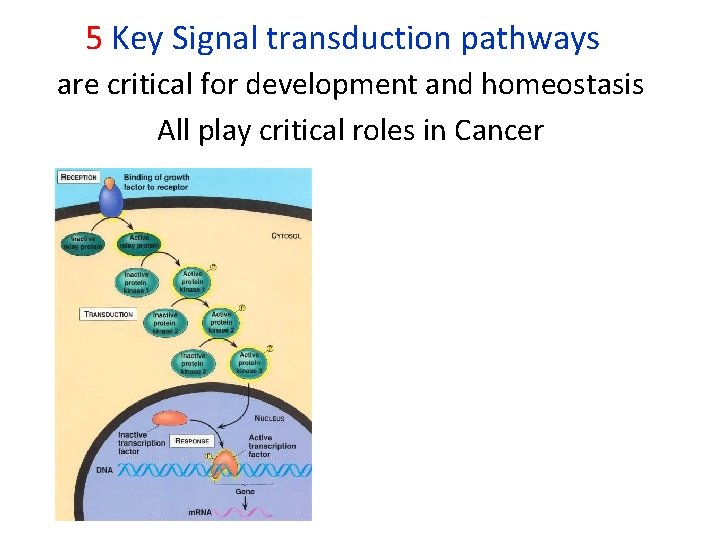
5 Key Signal transduction pathways are critical for development and homeostasis All play critical roles in Cancer
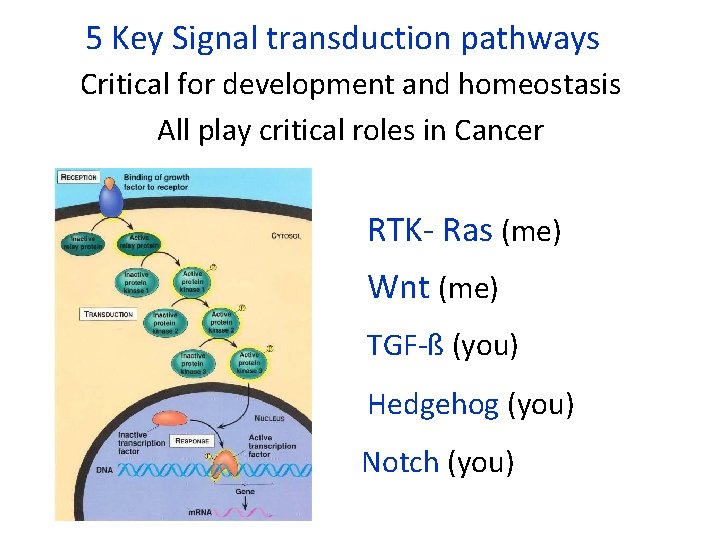
5 Key Signal transduction pathways Critical for development and homeostasis All play critical roles in Cancer RTK- Ras (me) Wnt (me) TGF-ß (you) Hedgehog (you) Notch (you)
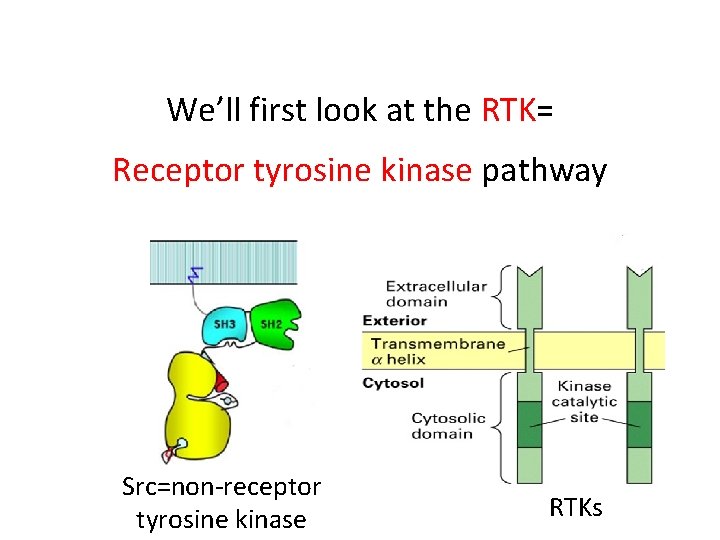
We’ll first look at the RTK= Receptor tyrosine kinase pathway Src=non-receptor tyrosine kinase RTKs
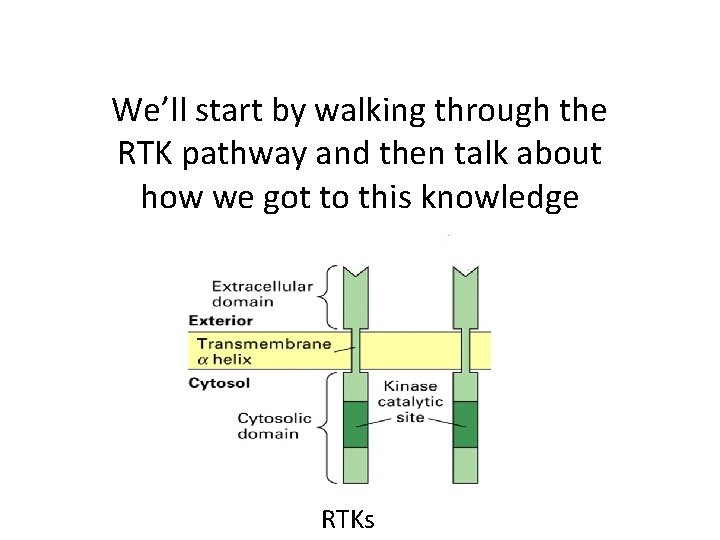
We’ll start by walking through the RTK pathway and then talk about how we got to this knowledge RTKs
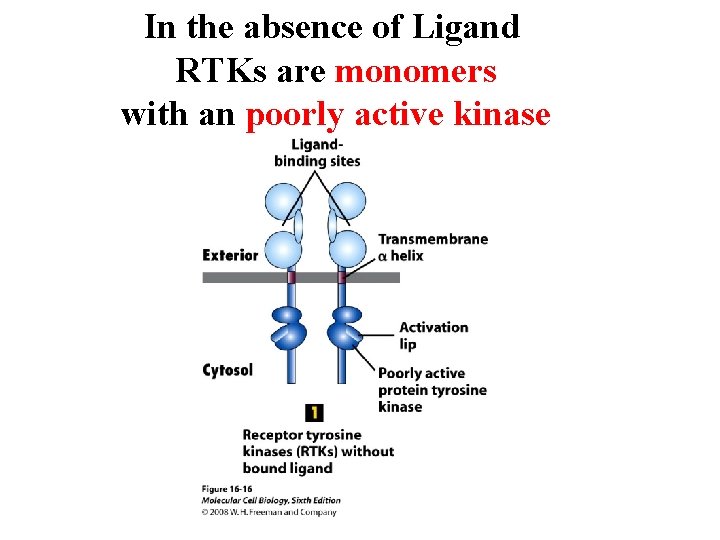
In the absence of Ligand RTKs are monomers with an poorly active kinase
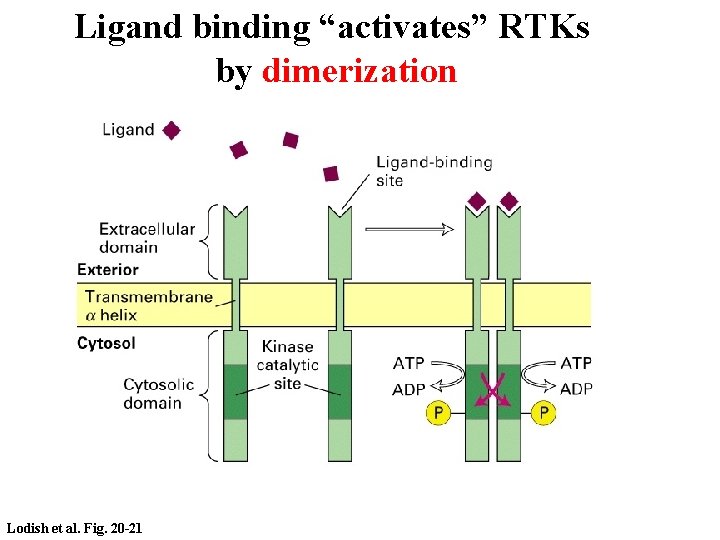
Ligand binding “activates” RTKs by dimerization Lodish et al. Fig. 20 -21
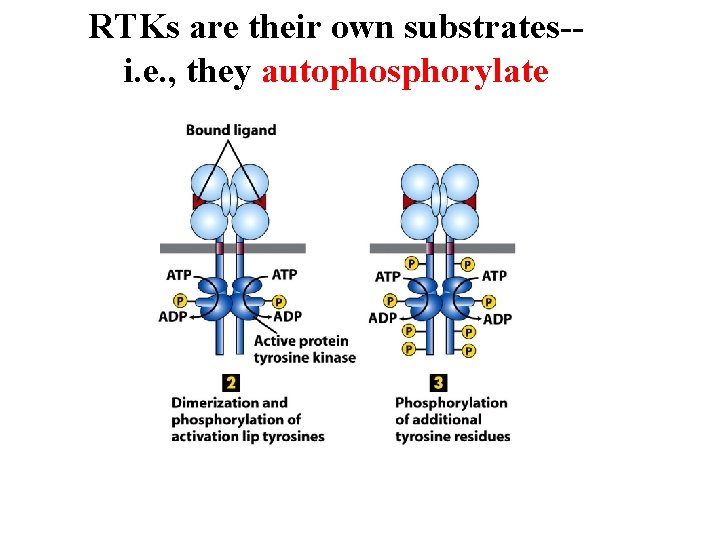
RTKs are their own substrates-i. e. , they autophosphorylate
Remember SH 2 domains? What did they bind? ?
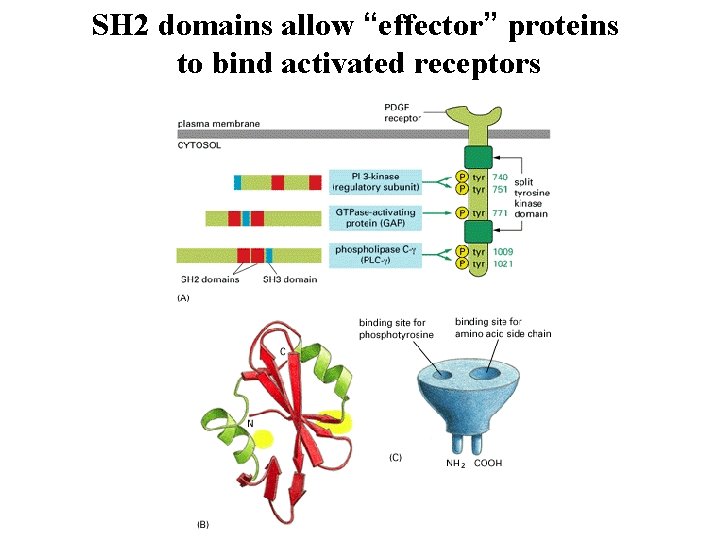
SH 2 domains allow “effector” proteins to bind activated receptors
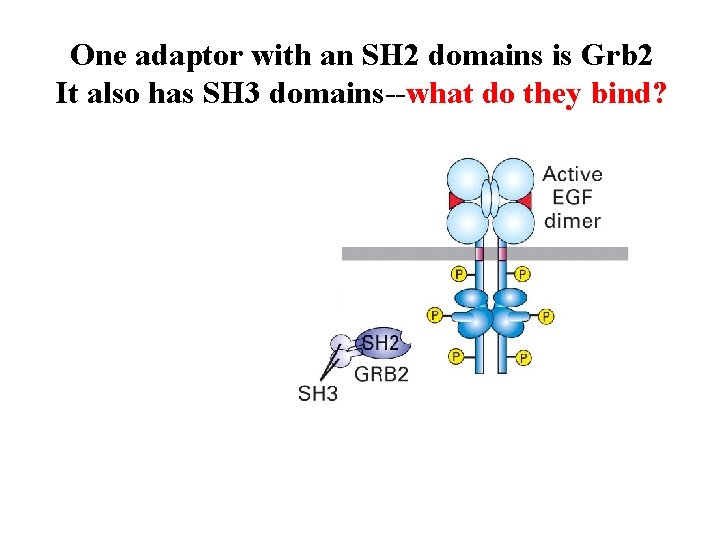
One adaptor with an SH 2 domains is Grb 2 It also has SH 3 domains--what do they bind?
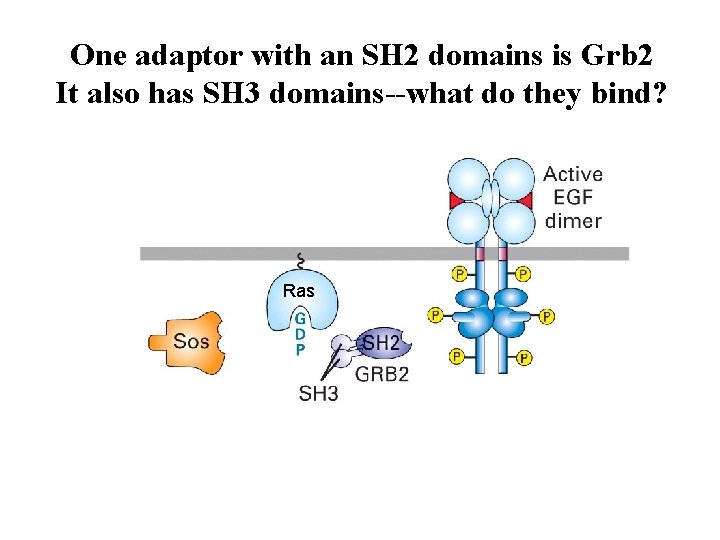
One adaptor with an SH 2 domains is Grb 2 It also has SH 3 domains--what do they bind? Ras
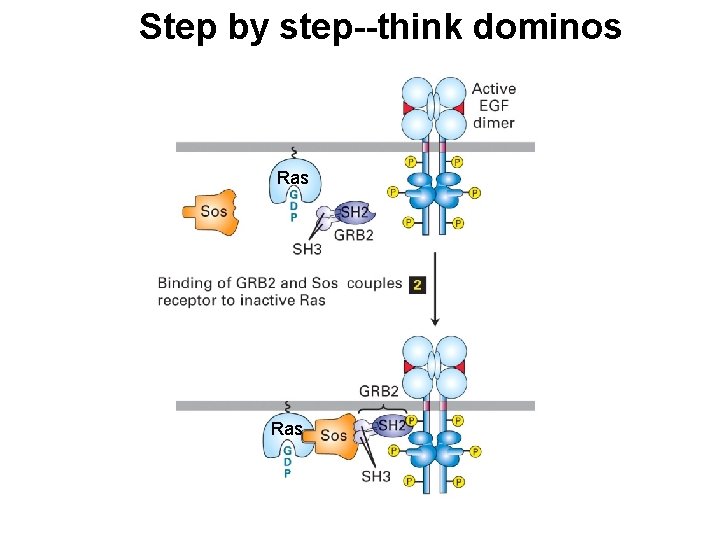
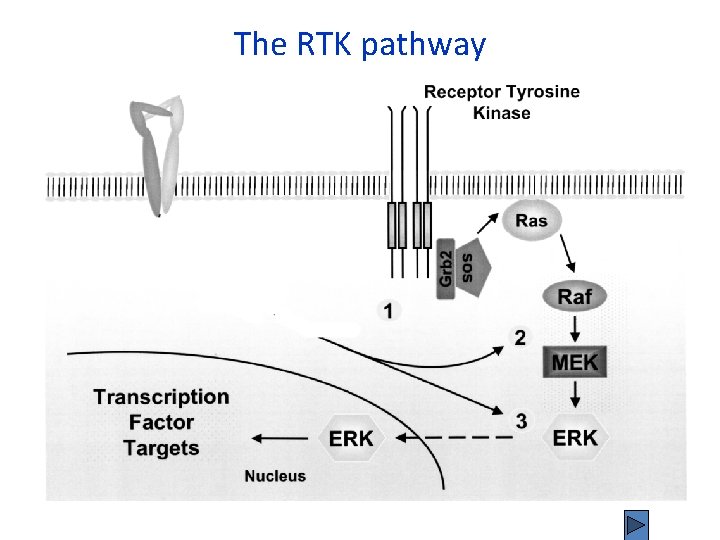
Step by step--think dominos Ras
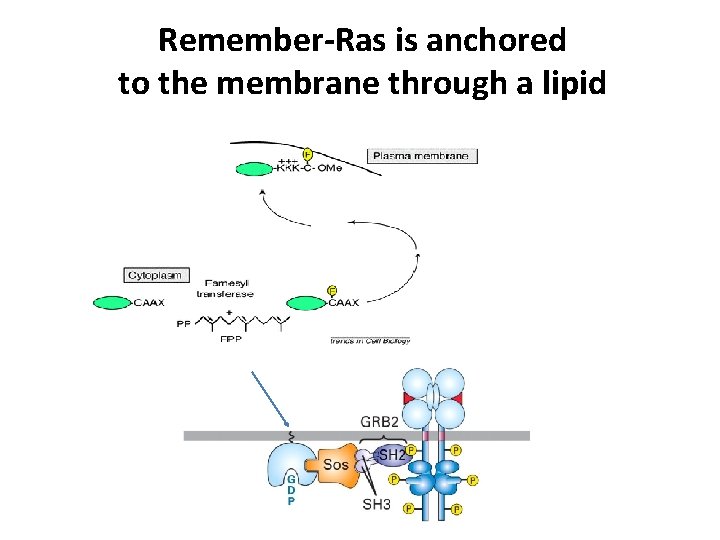
Remember-Ras is anchored to the membrane through a lipid
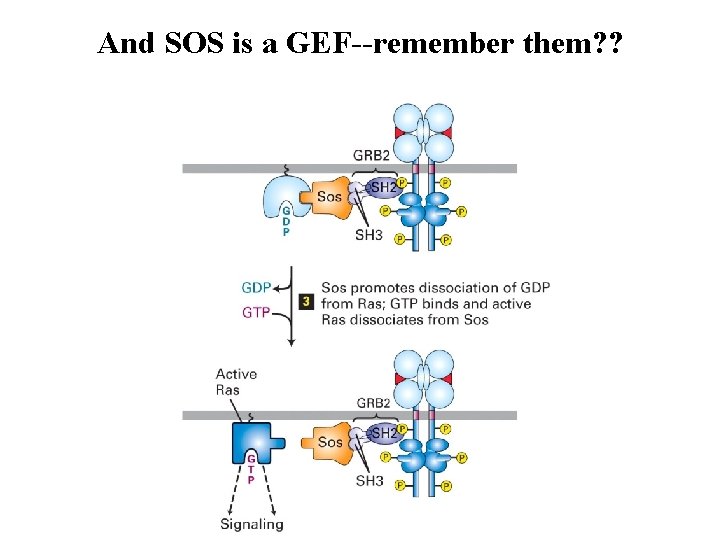
And SOS is a GEF--remember them? ?
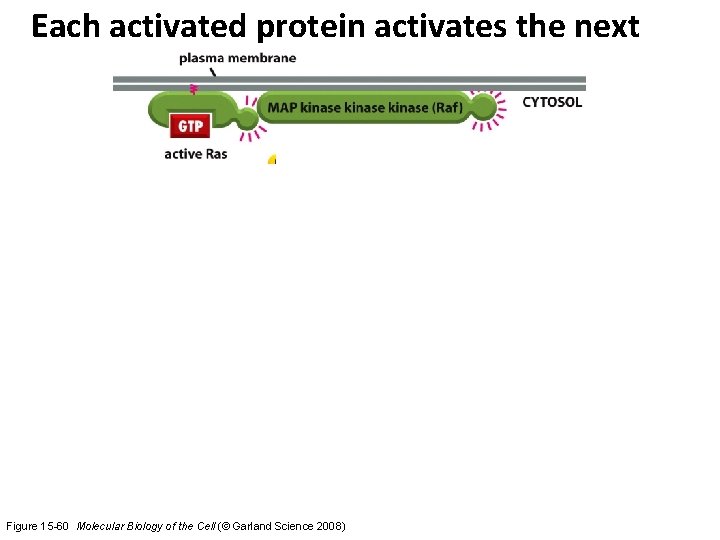
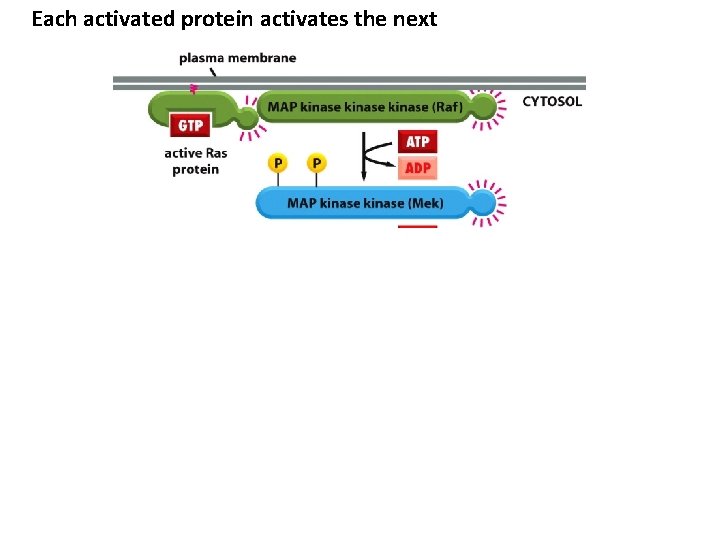
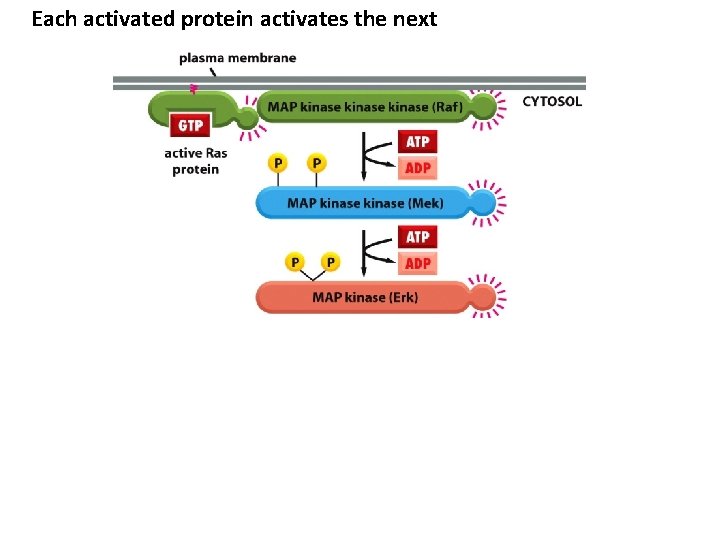
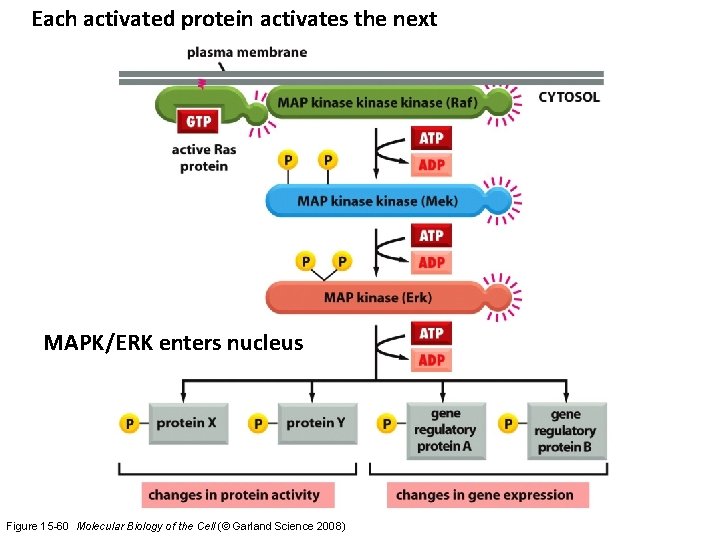
Each activated protein activates the next Figure 15 -60 Molecular Biology of the Cell (© Garland Science 2008)
Each activated protein activates the next MAPK/ERK enters nucleus Figure 15 -60 Molecular Biology of the Cell (© Garland Science 2008)
Each activated protein activates the next MAPK/ERK enters nucleus Figure 15 -60 Molecular Biology of the Cell (© Garland Science 2008)
Each activated protein activates the next MAPK/ERK enters nucleus Figure 15 -60 Molecular Biology of the Cell (© Garland Science 2008)
The RTK pathway
We made it to the 90 s 10 years-old Britney Spears Travolta is still dancing A new graduate from Harvard Kurt Cobain
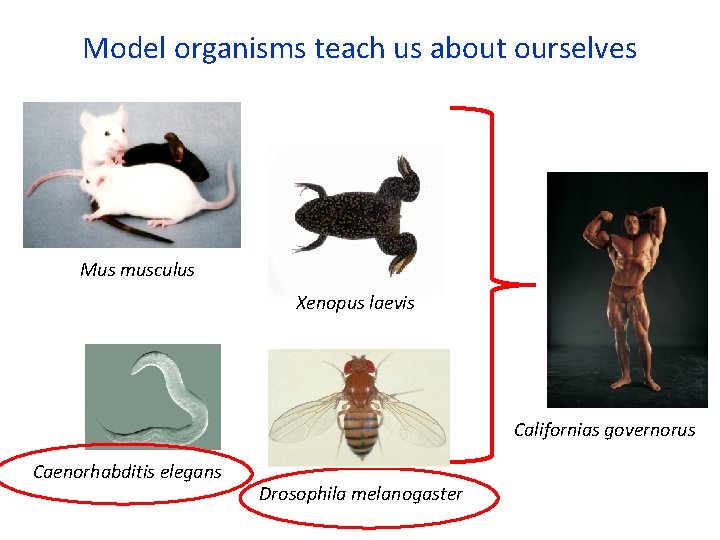
Model organisms teach us about ourselves Mus musculus Xenopus laevis Californias governorus Caenorhabditis elegans Drosophila melanogaster
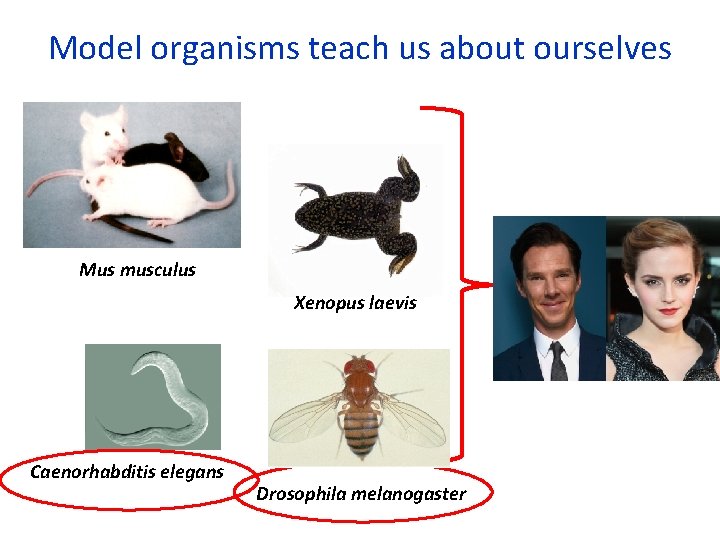
Model organisms teach us about ourselves Mus musculus Xenopus laevis Caenorhabditis elegans Drosophila melanogaster
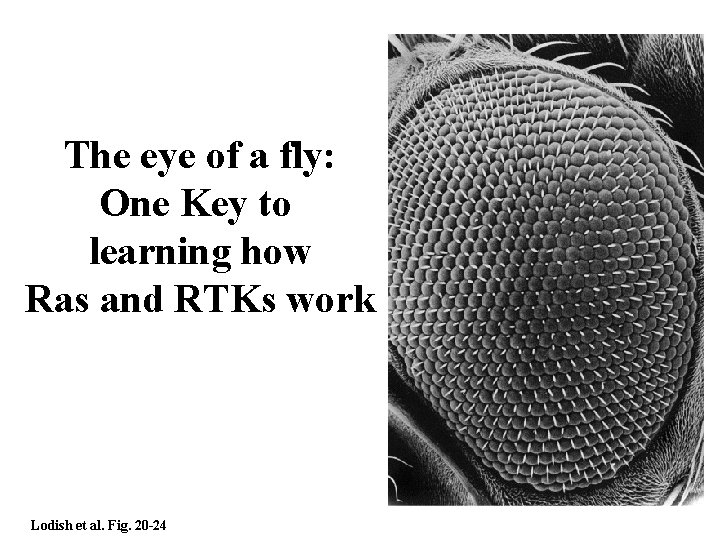
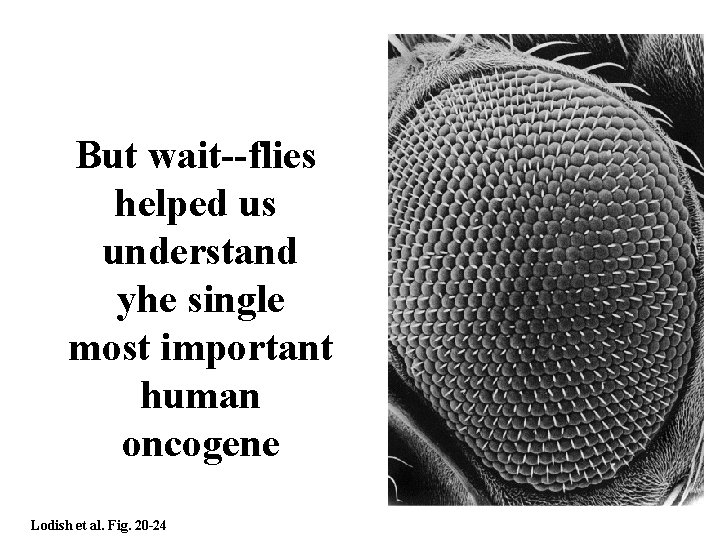
The eye of a fly: One Key to learning how Ras and RTKs work Lodish et al. Fig. 20 -24
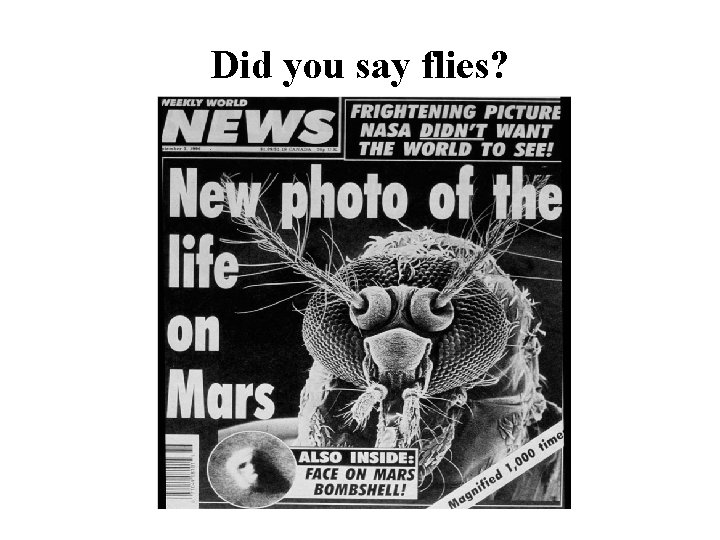
Did you say flies?
Did you say flies?
This is all I need to know
But wait--flies helped us understand yhe single most important human oncogene Lodish et al. Fig. 20 -24
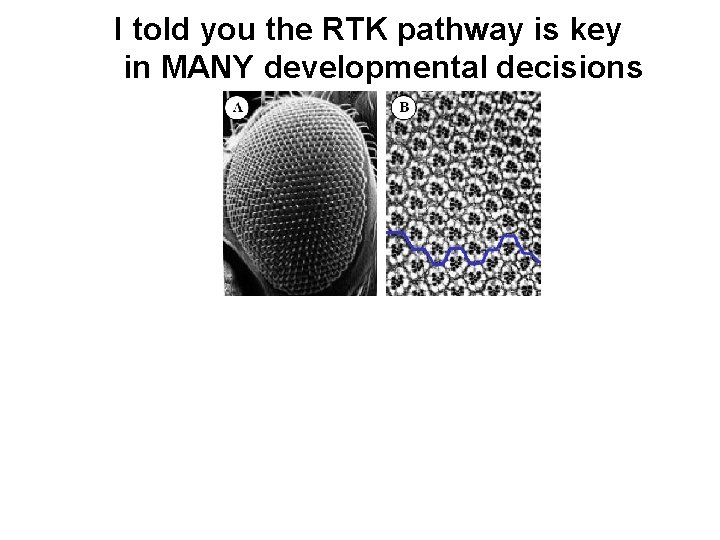
I told you the RTK pathway is key in MANY developmental decisions
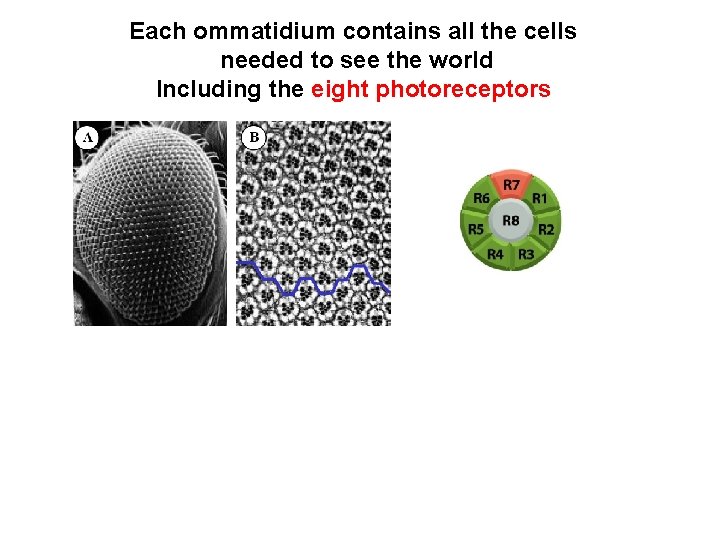
Each ommatidium contains all the cells needed to see the world Including the eight photoreceptors
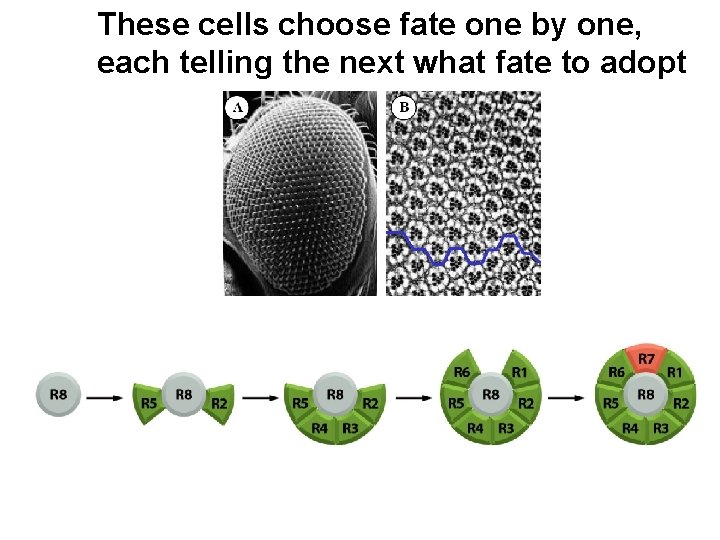
These cells choose fate one by one, each telling the next what fate to adopt
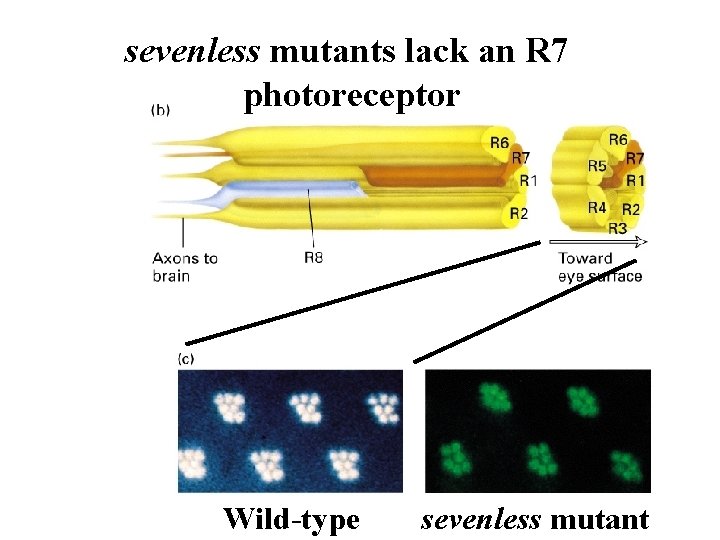
sevenless mutants lack an R 7 photoreceptor Wild-type sevenless mutant
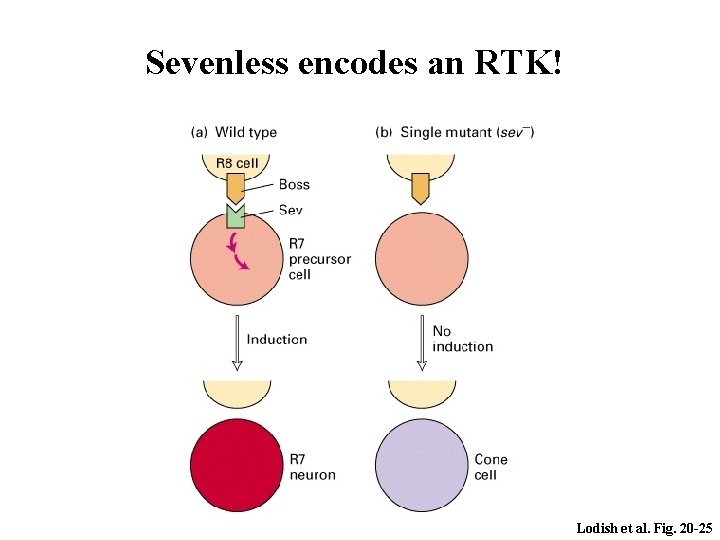
Sevenless encodes an RTK! Lodish et al. Fig. 20 -25
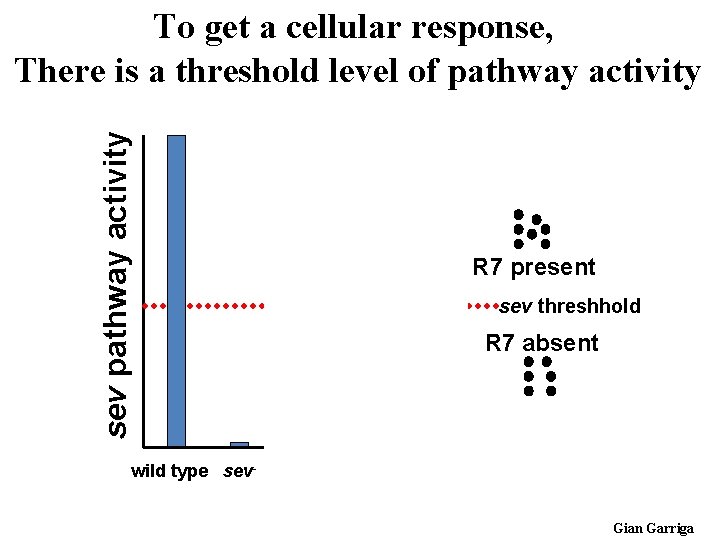
sev pathway activity To get a cellular response, There is a threshold level of pathway activity wild type sev- R 7 present sev threshhold R 7 absent sevts 22. 7 o C 24. 3 o C sevts; enh*/+ 22. 7 o C Gian Garriga
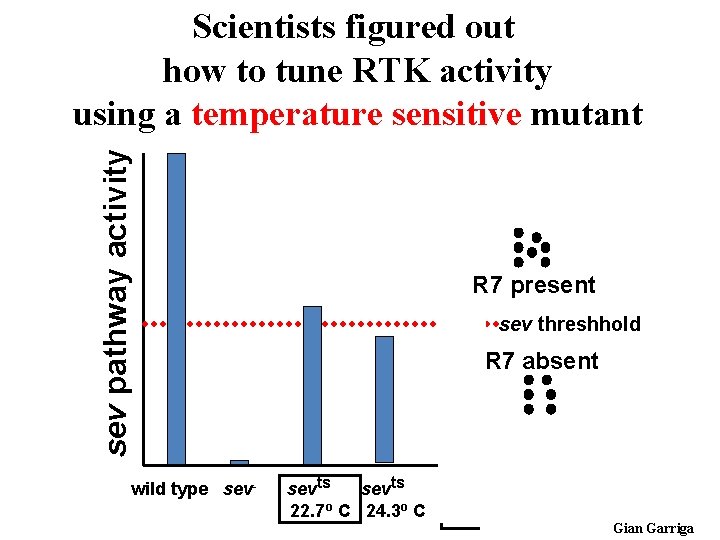
sev pathway activity Scientists figured out how to tune RTK activity using a temperature sensitive mutant wild type sev- R 7 present sev threshhold R 7 absent sevts 22. 7 o C 24. 3 o C sevts; enh*/+ 22. 7 o C Gian Garriga
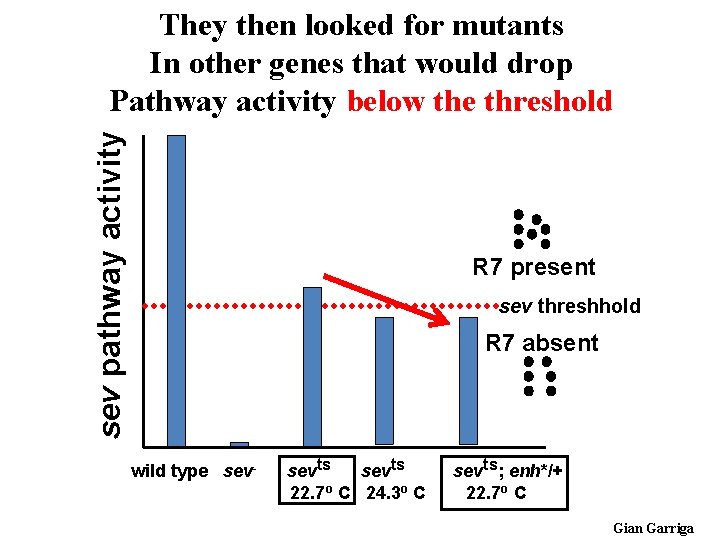
sev pathway activity They then looked for mutants In other genes that would drop Pathway activity below the threshold R 7 present sev threshhold R 7 absent wild type sev- sevts 22. 7 o C 24. 3 o C sevts; enh*/+ 22. 7 o C Gian Garriga
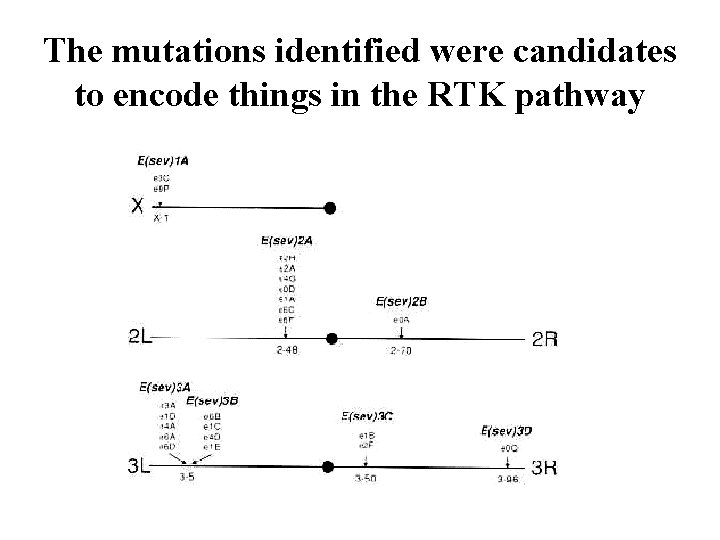
The mutations identified were candidates to encode things in the RTK pathway
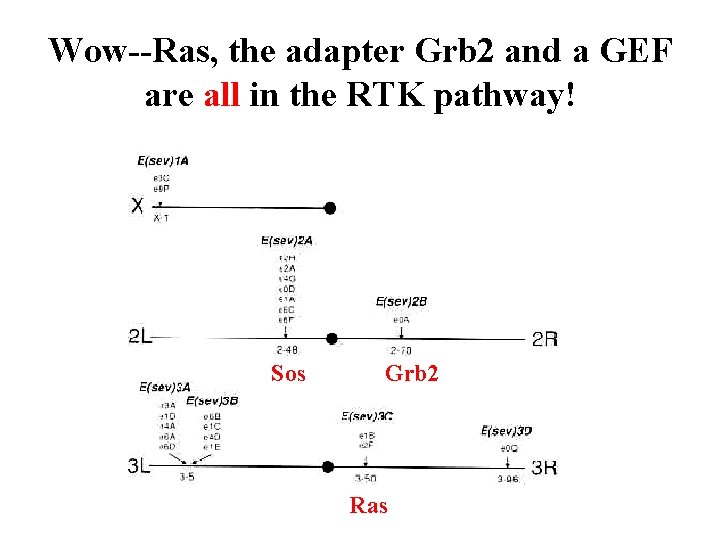
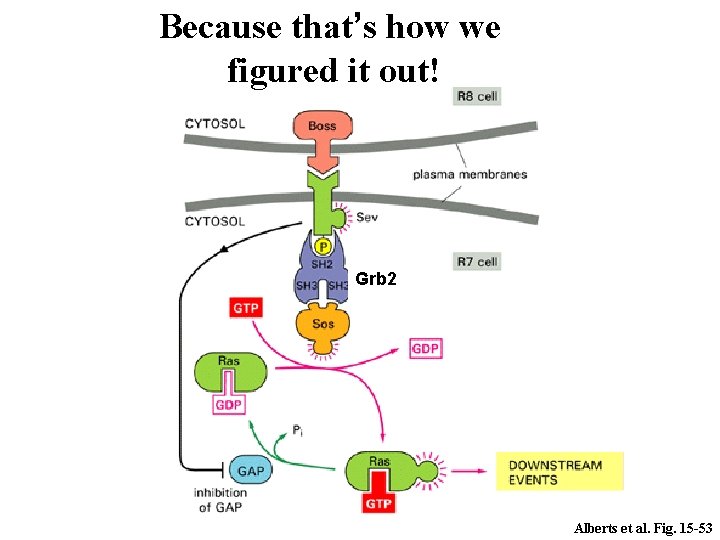
Wow--Ras, the adapter Grb 2 and a GEF are all in the RTK pathway! Sos Grb 2 Ras
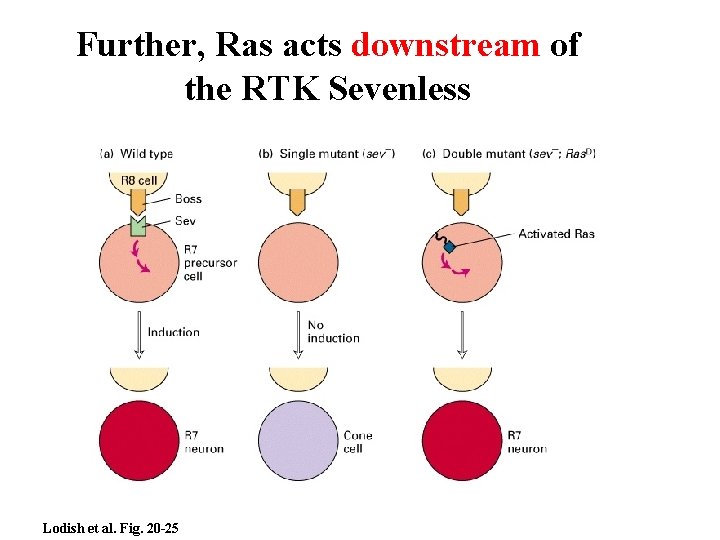
Further, Ras acts downstream of the RTK Sevenless Lodish et al. Fig. 20 -25
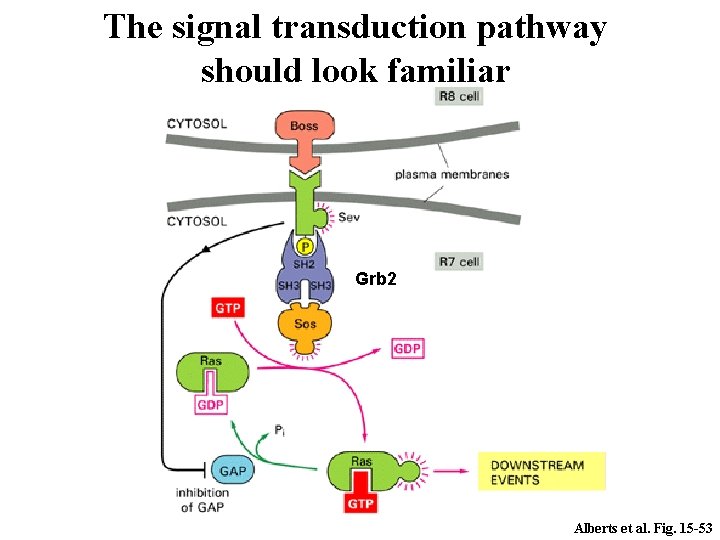
The signal transduction pathway should look familiar Grb 2 Alberts et al. Fig. 15 -53
Because that’s how we figured it out! Grb 2 Alberts et al. Fig. 15 -53
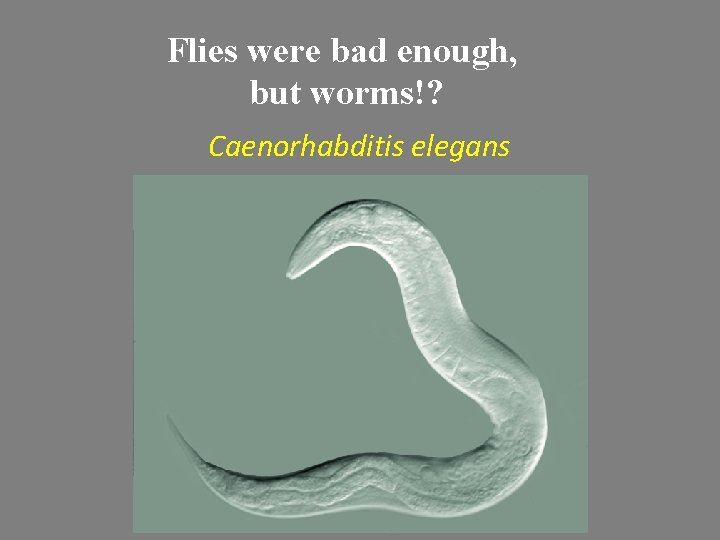
Flies were bad enough, but worms!? Caenorhabditis elegans
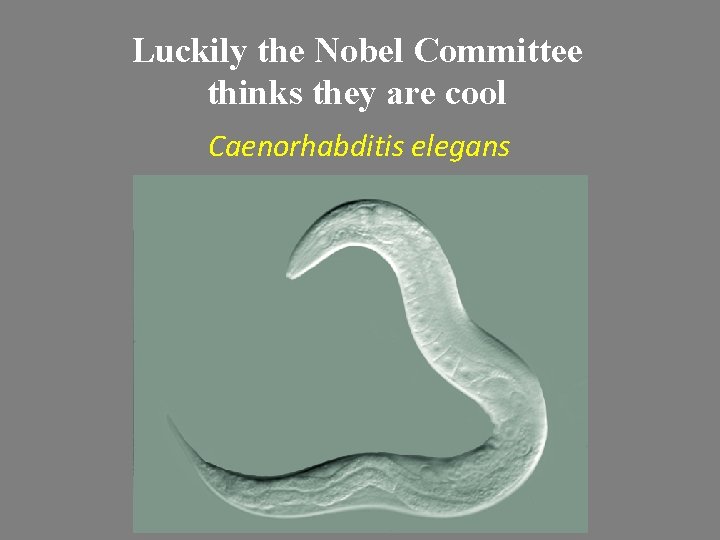
Luckily the Nobel Committee thinks they are cool Caenorhabditis elegans
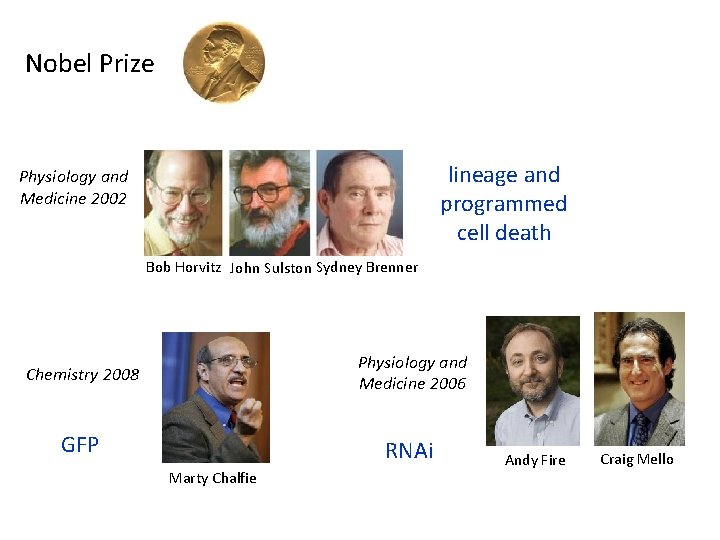
Nobel Prize lineage and programmed cell death Physiology and Medicine 2002 Bob Horvitz John Sulston Sydney Brenner Chemistry 2008 Physiology and Medicine 2006 GFP RNAi Marty Chalfie Andy Fire Craig Mello
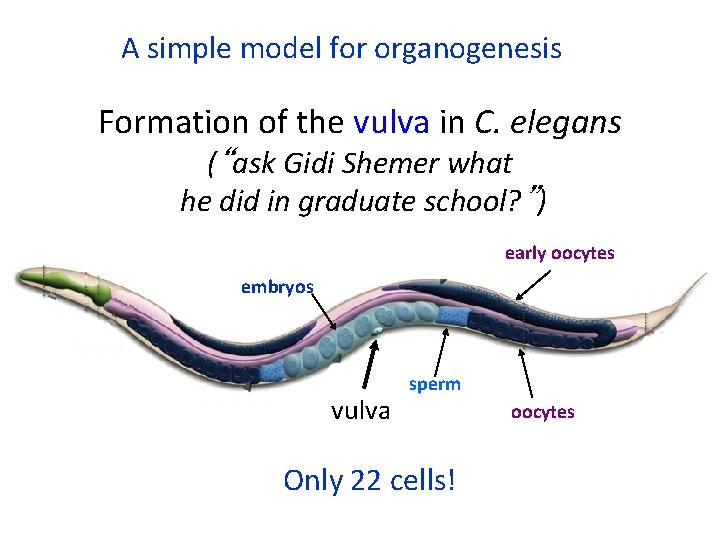
A simple model for organogenesis Formation of the vulva in C. elegans (“ask Gidi Shemer what he did in graduate school? ”) early oocytes embryos vulva sperm Only 22 cells! oocytes
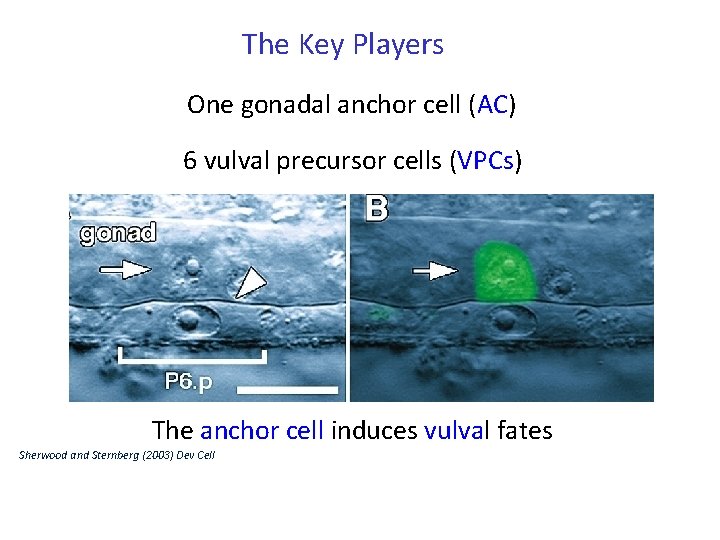
The Key Players One gonadal anchor cell (AC) 6 vulval precursor cells (VPCs) The anchor cell induces vulval fates Sherwood and Sternberg (2003) Dev Cell
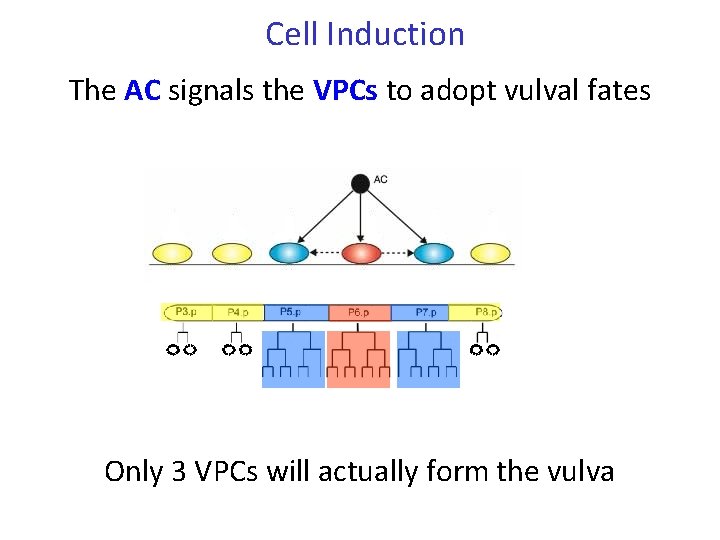
Cell Induction The AC signals the VPCs to adopt vulval fates Only 3 VPCs will actually form the vulva
How can we figure out what proteins are required to build a vulva?
GENETICS!
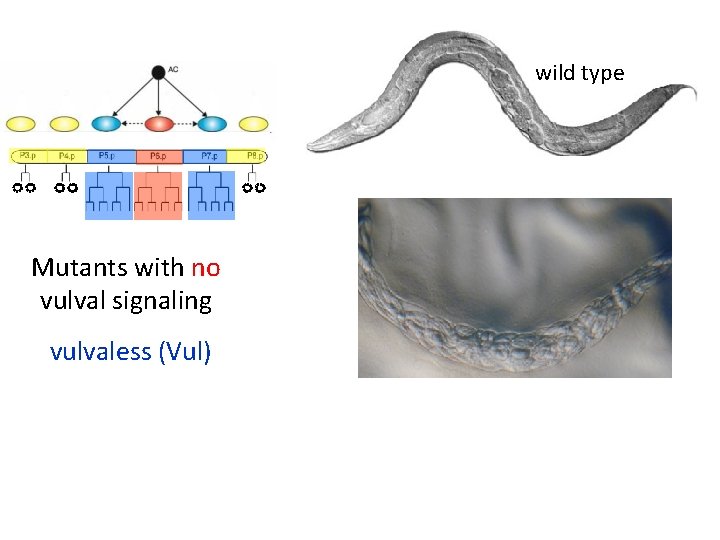
wild type No vulva induction Mutants with no vulval signaling vulvaless (Vul)
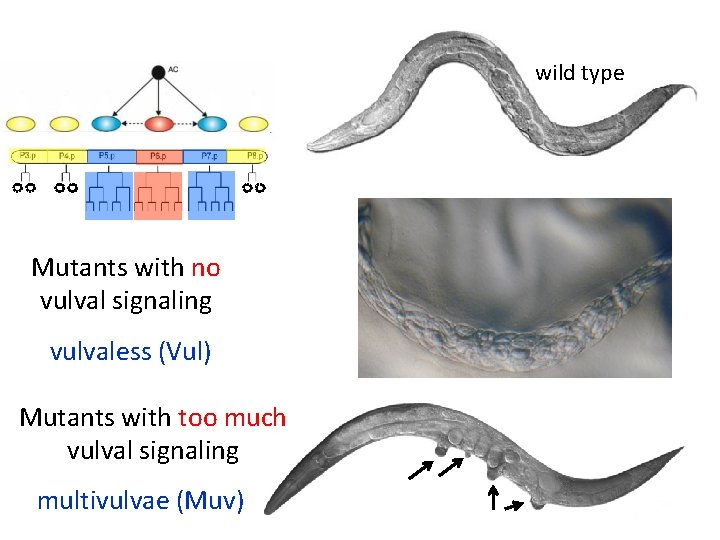
wild type No vulva induction Mutants with no vulval signaling vulvaless (Vul) Mutants with too much vulval signaling multivulvae (Muv)
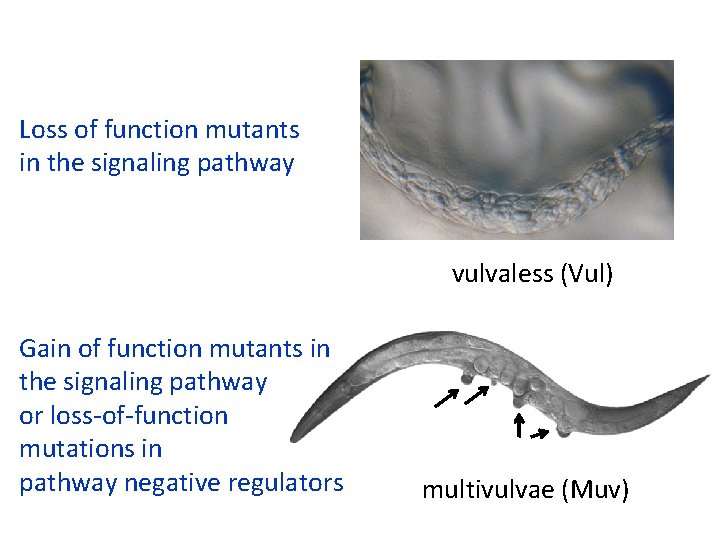
Loss of function mutants in the signaling pathway vulvaless (Vul) Gain of function mutants in the signaling pathway or loss-of-function mutations in pathway negative regulators multivulvae (Muv)
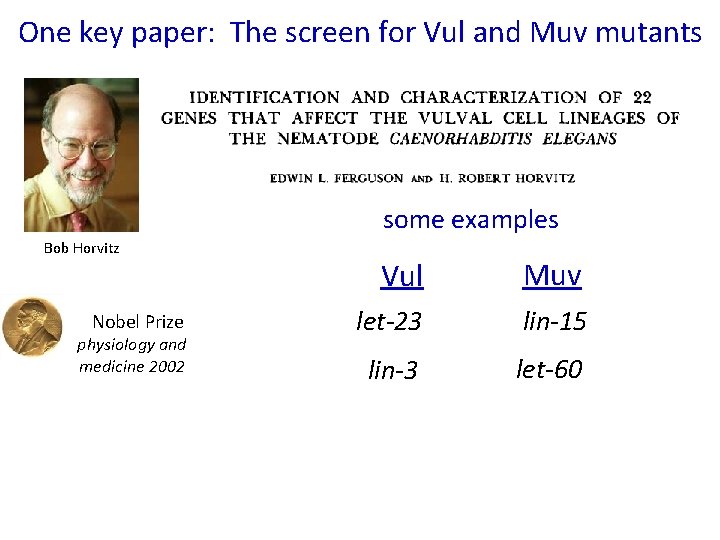
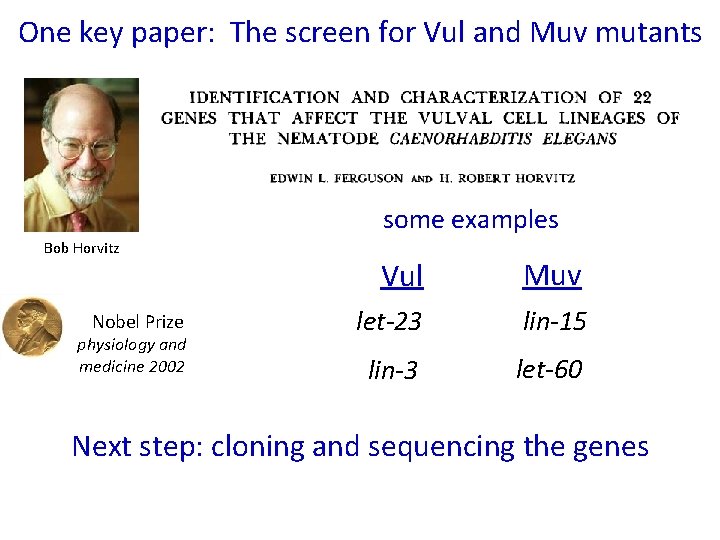
One key paper: The screen for Vul and Muv mutants some examples Bob Horvitz Nobel Prize physiology and medicine 2002 Vul Muv let-23 lin-15 lin-3 let-60
One key paper: The screen for Vul and Muv mutants some examples Bob Horvitz Nobel Prize physiology and medicine 2002 Vul Muv let-23 lin-15 lin-3 let-60 Next step: cloning and sequencing the genes
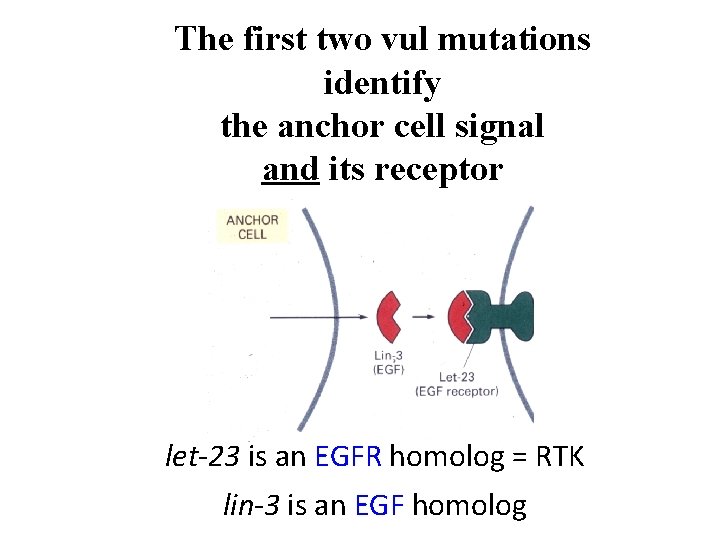
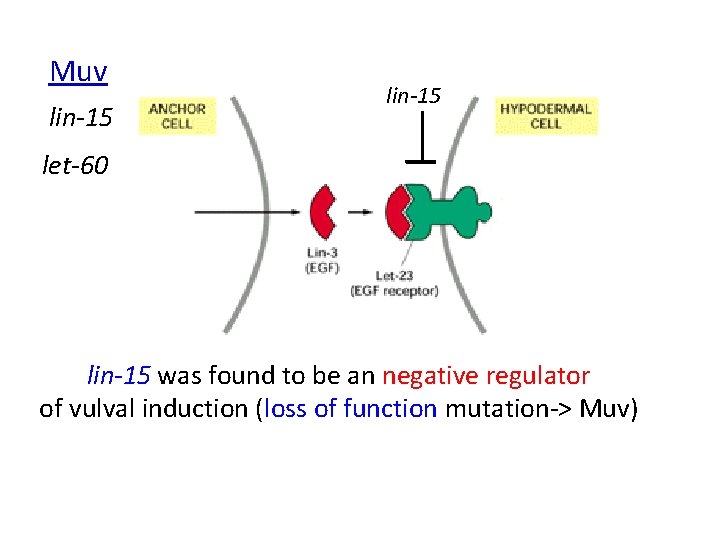
The first two vul mutations identify the anchor cell signal and its receptor let-23 is an EGFR homolog = RTK lin-3 is an EGF homolog
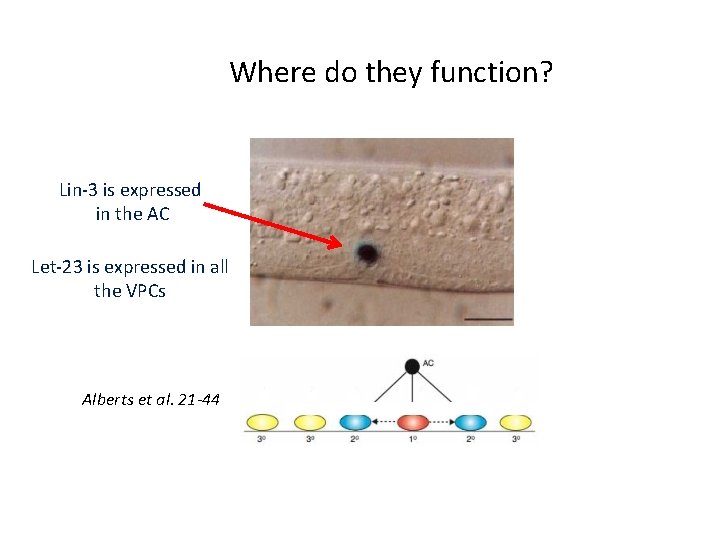
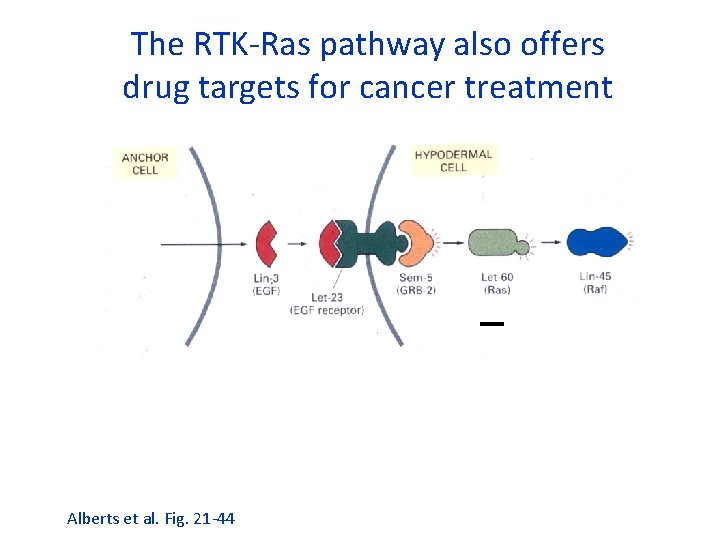
Where do they function? Lin-3 is expressed in the AC Let-23 is expressed in all the VPCs Alberts et al. 21 -44
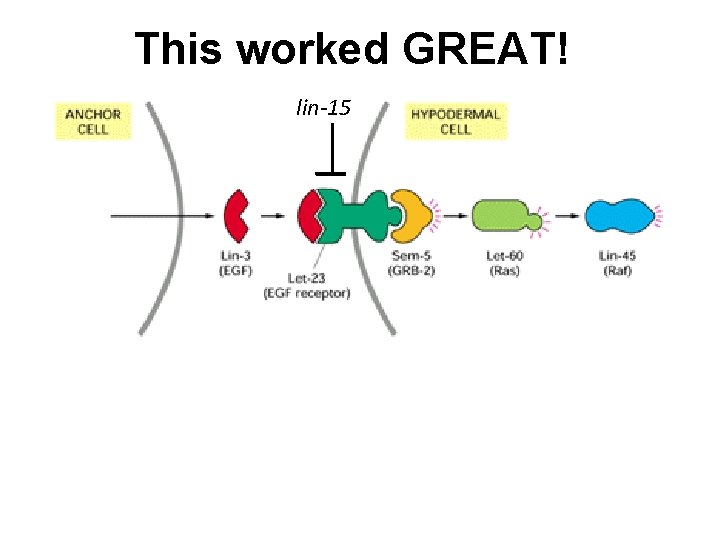
Muv lin-15 let-60 lin-15 was found to be an negative regulator of vulval induction (loss of function mutation-> Muv)
let-60 was found to be a gain of function mutation that promoted vulval induction Next step: clone the let-60 gene
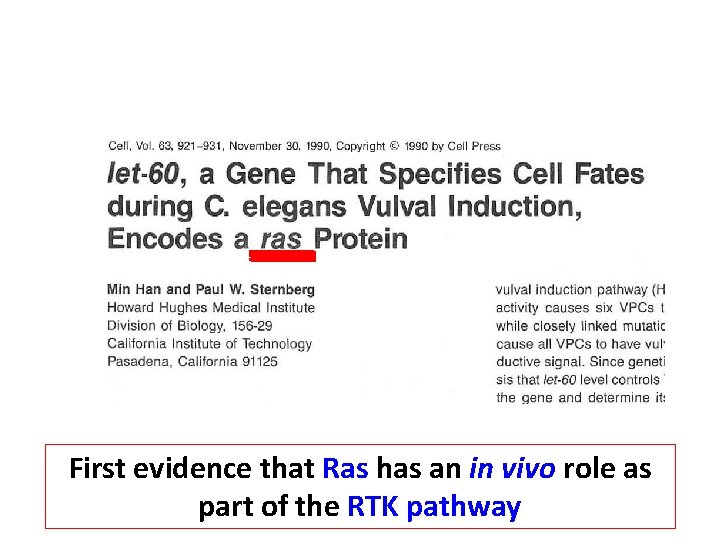
First evidence that Ras has an in vivo role as part of the RTK pathway
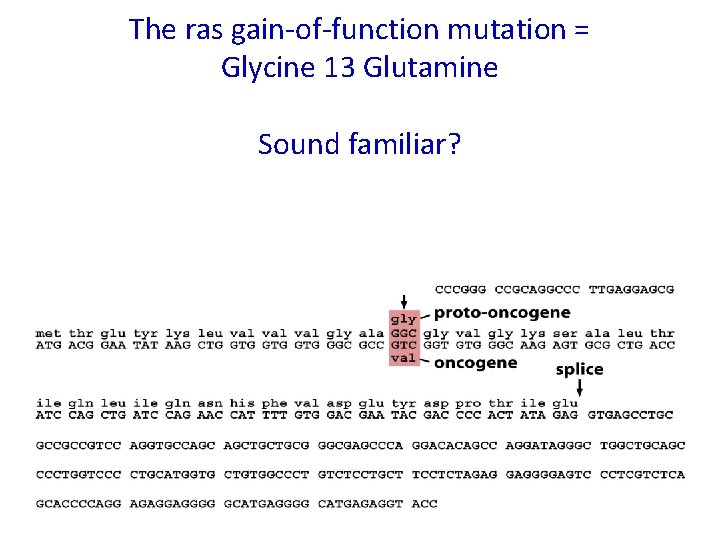
The Ras gain-of-function mutation = Glycine 13 Glutamine
The ras gain-of-function mutation = Glycine 13 Glutamine Sound familiar?
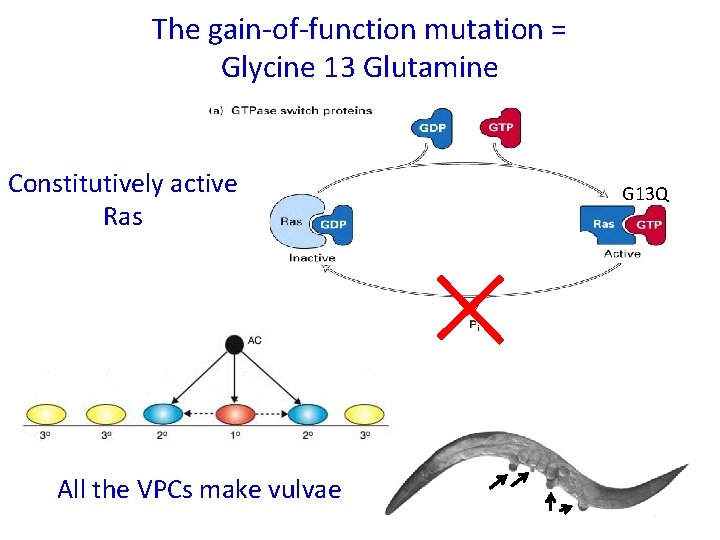
The gain-of-function mutation = Glycine 13 Glutamine Constitutively active Ras All the VPCs make vulvae G 13 Q
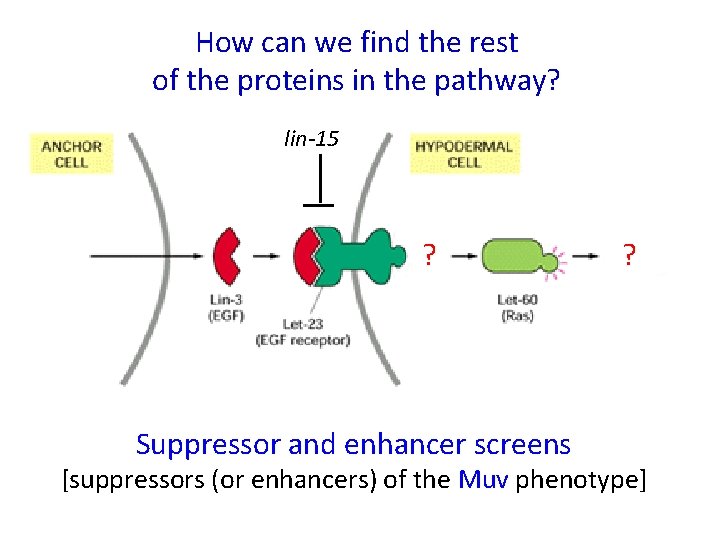
How can we find the rest of the proteins in the pathway? lin-15 Other mutations? of ras Suppressor and enhancer screens ? [suppressors (or enhancers) of the Muv phenotype]
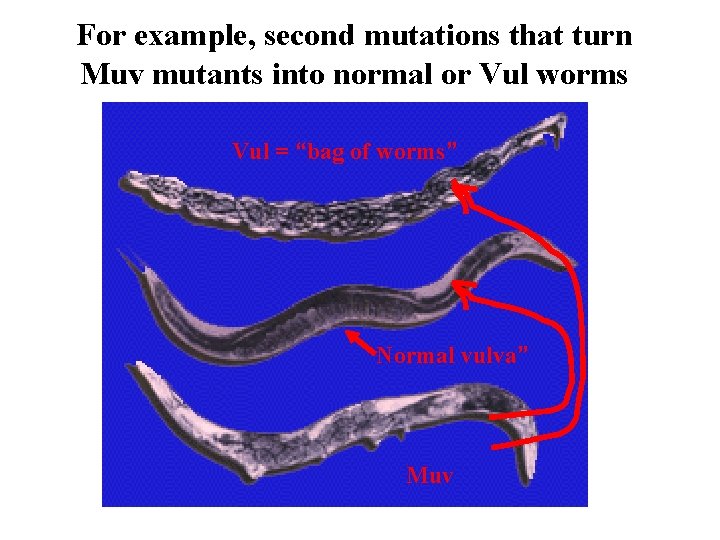
For example, second mutations that turn Muv mutants into normal or Vul worms Vul = “bag of worms” Normal vulva” Muv
This worked GREAT! lin-15
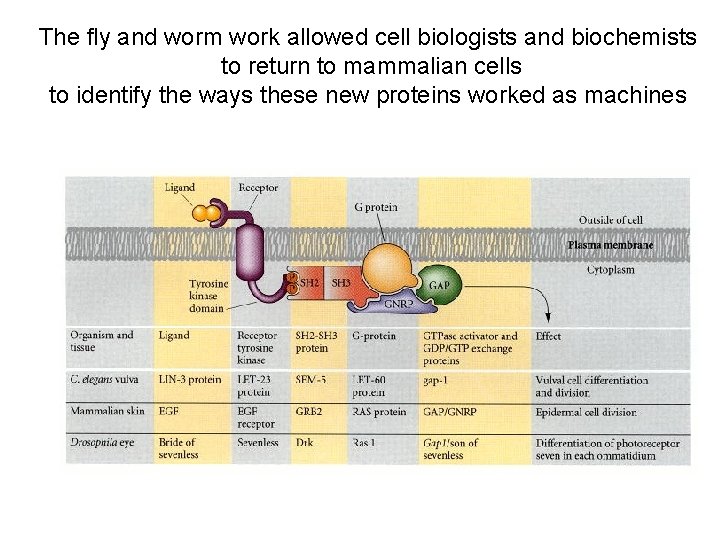
The fly and worm work allowed cell biologists and biochemists to return to mammalian cells to identify the ways these new proteins worked as machines
The RTK-Ras pathway also offers drug targets for cancer treatment Alberts et al. Fig. 21 -44
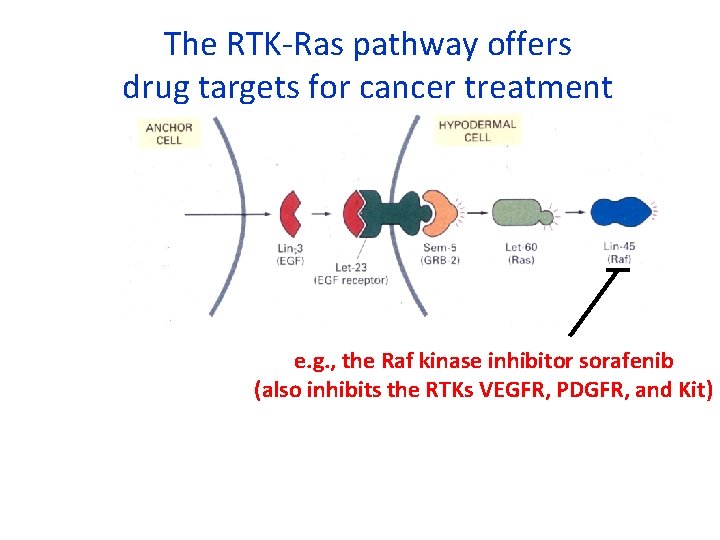
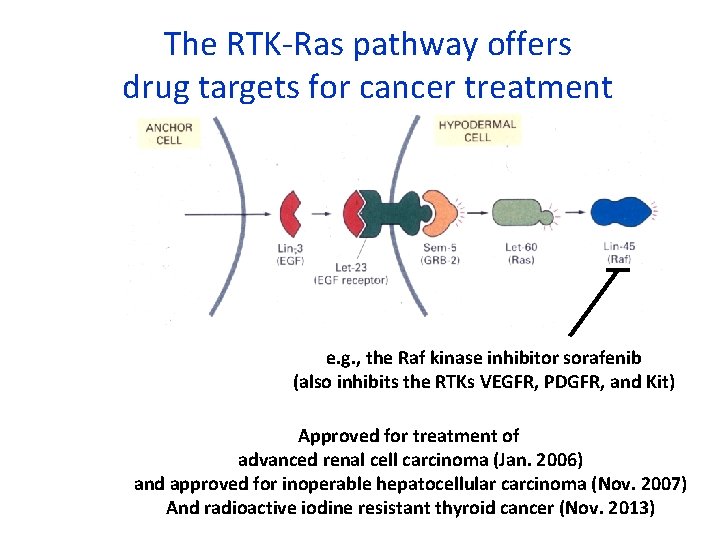
The RTK-Ras pathway offers drug targets for cancer treatment e. g. , the Raf kinase inhibitor sorafenib (also inhibits the RTKs VEGFR, PDGFR, and Kit)
The RTK-Ras pathway offers drug targets for cancer treatment e. g. , the Raf kinase inhibitor sorafenib (also inhibits the RTKs VEGFR, PDGFR, and Kit) Approved for treatment of advanced renal cell carcinoma (Jan. 2006) and approved for inoperable hepatocellular carcinoma (Nov. 2007) And radioactive iodine resistant thyroid cancer (Nov. 2013)
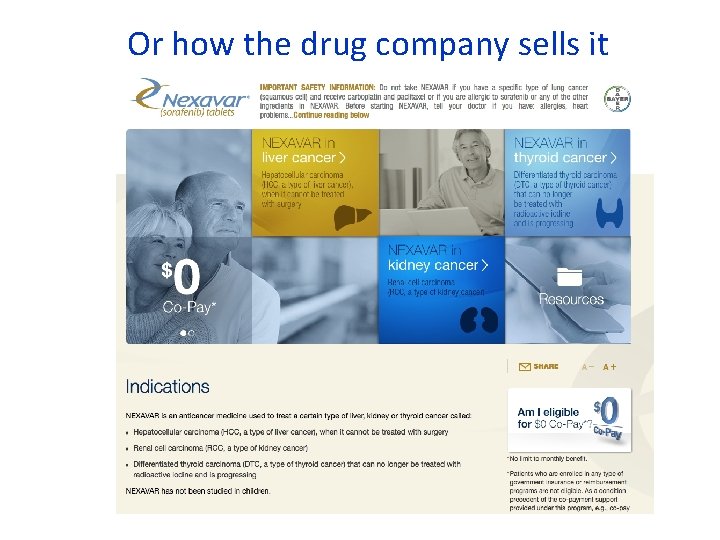
Or how the drug company sells it
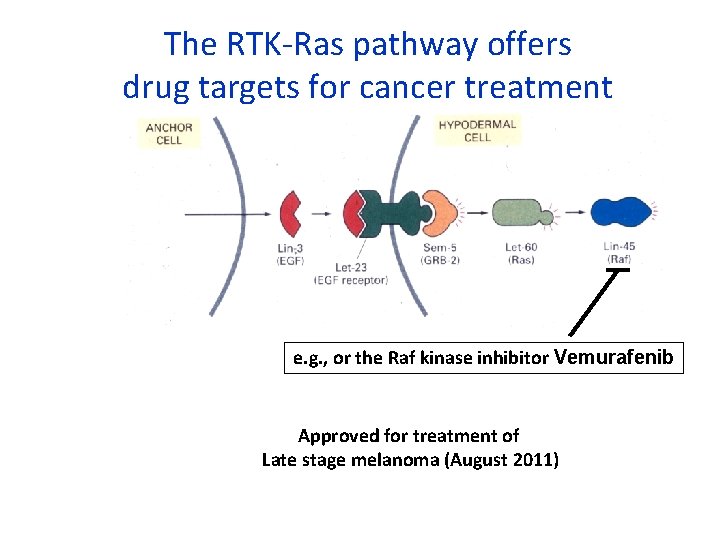
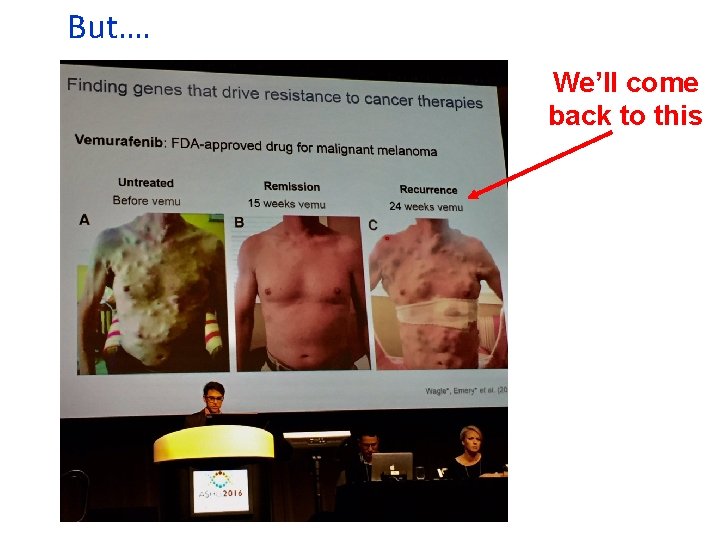
The RTK-Ras pathway offers drug targets for cancer treatment e. g. , or the Raf kinase inhibitor Vemurafenib Approved for treatment of Late stage melanoma (August 2011)
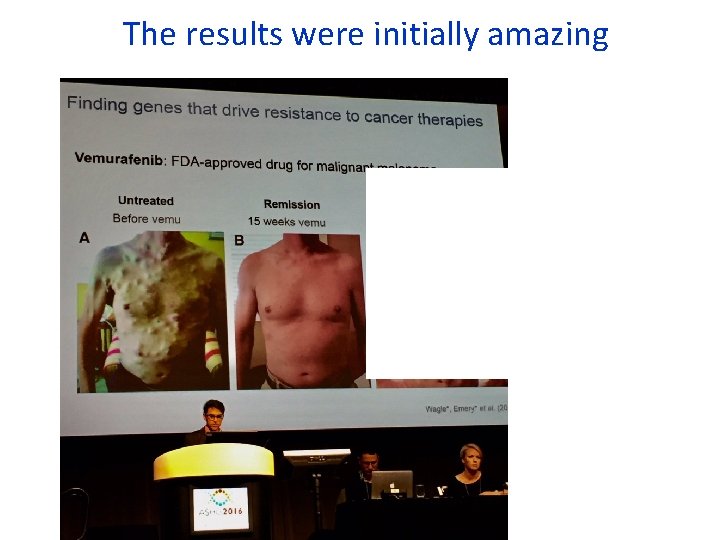
The results were initially amazing
But…. We’ll come back to this
Summary - Cellular oncogenes = viral oncogenes
Summary - Cellular oncogenes = viral oncogenes - Ras, as one of these genes, encodes a small GTPase, acting as a molecular switch
Summary - Cellular oncogenes = viral oncogenes - Ras, as one of these genes, encodes a small GTPase, acting as a molecular switch - Ras is a major component of the RTK pathway
Summary - Cellular oncogenes = viral oncogenes - Ras, as one of these genes, encodes a small GTPase, acting as a molecular switch - Ras is a major component of the RTK pathway - Basic and Clinical Science provide a VERY powerful partnership