
WHY WHERE WHAT UNDERSTANDING UCC Presented by Mariana
WHY? WHERE? WHAT? UNDERSTANDING UCC Presented by Mariana Fradman, Senior Legal Assistant Chadbourne & Parke LLP
WHY? • The term UCC is short for Uniform Commercial Code. • Under the provisions of state Universal Commercial Code statutes, when personal property (equipment, inventory, and other tangible assets of a business) are used as collateral for borrowing, a UCC 1 statement is prepared, signed, and filed. This process is also called "perfecting the security interest" in the property, and this type of loan is a secured loan. • The filing creates a lien against the property, so the borrower may not dispose of the property without paying off the debt. 3/12/2013 2
WHY? (cont’d) • In the U. S. the term "security interest" is often used interchangeably with "lien". However, the term "lien" is more often associated with the collateral of real property than with of personal property. • A security interest is typically granted by a "security agreement". The security interest is established with respect to the property, if the debtor has an ownership interest in the property and the holder of the security interest conferred value to the debtor, such as giving a loan. 3/12/2013 3
WHY? (cont’d) • The holder may "perfect" the security interest to put third parties on notice thereof. Perfection is typically achieved by filing a financing statement with government, often the secretary of state located at a jurisdiction where a corporate debtor is incorporated. Perfection can also be obtained by possession of the collateral, if the collateral is tangible property. • Absent perfection, the holder of the security interest may have difficulty enforcing his rights in the collateral vis-á-vis third parties, including a trustee in bankruptcy and other creditors who claim a security interest in the same collateral. 3/12/2013 4

WHERE? • UCC documents filed with the Department of State are public records that are subject to disclosure under the Uniform Commercial Code. The Department also provides copies of UCC documents upon request and payment of the applicable fee. • UCC documents filed in the state of incorporation of the company; AND • UCC documents filed on the county level where the property is located. 3/12/2013 5
WHERE? (cont’d) • Why records on financial obligations (including IRS liens) incurred by individuals , in business as a sole proprietor, business entities and corporations are important? – This information is important to any business or financial institution contemplating entering into a lien transaction as the secured party (the party providing funds or financing collateral). – Knowing the current financial status of the debtor party (the potential borrower) before extending credit is crucial, and it is the number of active, existing liens already in effect for that particular debtor party that most interests the potential secured party. – As a prerequisite for entering into a lien relationship, many secured parties first research a debtor name to ascertain their credit worthiness and then demand a lien filing in regard to the actual, current transaction. Secured parties routinely include banks, commercial businesses (appliances, autos, boats), and sole proprietors. 3/12/2013 6
WHAT? • Original Financing Statement (UCC 1) – the collateral is as-extracted collateral or timber to be cut; or – the financing statement is filed as a fixture filing and the collateral is goods that are or are to become fixtures; or – the collateral is a cooperative interest. 3/12/2013 7
WHAT? (cont’d) • Amendment, Assignment, Continuation, & Termination (UCC 3) 3/12/2013 8
Uniform Commercial Code Filing Requirements • Legislation revising Article 9 of the Uniform Commercial Code was signed into law as Chapter 84 of the Laws of 2001 and became effective July 1, 2001. That was the first major change since 1972. • It brought greater certainty to financing transactions. • Reduced transaction costs – By reducing number of filings – By reducing number of searches • Expanded scope. 3/12/2013 9
Uniform Commercial Code Filing Requirements (cont’d) • Redefined correct name of debtor financing statements, including – Registered Organization – "Unregistered" Organization – Individual 3/12/2013 10
Uniform Commercial Code Filing Requirements (cont’d) • "Seriously Misleading” – Use the correct legal name of the debtor and the mailing address of the debtor; – The filing must indicate whether the debtor is an individual or an organization; – If the debtor is an individual, the filing must identify the debtor's last name; and – If the debtor is an organization, the filing must provide both the debtor's type of organization and jurisdiction of organization. 3/12/2013 11
Uniform Commercial Code Filing Requirements (cont’d) • Retention of Priority - this transition took place through July 1, 2006 – From collateral based location to location of debtor 3/12/2013 12
Uniform Commercial Code Filing Requirements (cont’d) The fact that a record is accepted for filing does not necessarily mean that the filing is effective for the purpose intended by the filer. The filer is solely responsible for determining the proper office in which to file and for determining that the record to be filed contains the information necessary to make the record effective to accomplish the filer's purpose. 3/12/2013 13
Uniform Commercial Code Filing Requirements (cont’d) • Electronic transactions – Elimination of signatures • Co-op filing • New Uniform Forms – Additional data requirements 3/12/2013 14
2013 AMENDED Article 9 Overview • Proposed Effective Dated of July 1, 2013 • Some terminology clarified along with some additions • New forms removing data requirements introduced in 2001 – Relocation of fields • Transition end date: July 1, 2018 3/12/2013 15
2013 AMENDED Article 9 Overview (cont’d) • Amended A 9 Definition Changes/Clarifications – § 9 -102 Public Organic Record (new) • (68) A record that is available to the public for inspection that is: – A) a record consisting of the record initially filed with or issued by a State or the U. S. to form or organize an organization and any record filed with or issued by the State of the U. S. which amends or restates the initial record. – B) an organic record of a business trust consisting of the record initially field with a state and any record filed with the State which amends or restates the initial record, if a statute of the State governing business trusts requires that the record be filed with the State. 3/12/2013 16
2013 AMENDED Article 9 Overview (cont’d) • Amended A 9 Definition Changes/Clarifications (cont’d) – (71) definition of "Registered Organization" expanded to include Business Trusts…"Registered Organization"…organization formed or organized under the law of a single state or the U. S. by the filing of a public organic record with, the issuance of a public organic record by, or the enactment of legislation by the State or U. S. The term includes a business trust that is formed or organized under the law of a single State… 3/12/2013 17

2013 AMENDED Article 9 Overview (cont’d) • Amended A 9 Definition Changes/Clarifications (cont’d) – Clarifies registered organization name issue 3/12/2013 18

2013 AMENDED Article 9 Overview (cont’d) – § 9 -503 Clarifies Individual Name issues • Individual Name – Alternative A (only if) » Name as it appears on unexpired driver's license » If no driver's license, unexpired state-issued ID card from primary state of residence • What about passports? – Alternative B (Safe Harbor) » Individual's name (current law) » Individual debtor's name and first personal name or » Name as it appears on unexpired driver's license or state issued ID 3/12/2013 19
2013 AMENDED Article 9 Overview (cont’d) – Case Law & the Legal Name of the Debtor • Examples: Dr. John Doe, MD, John Doe, or Doe, John (correct name)… • Examples: First Company Holdings, Inc. (on Articles of Incorporation) vs. First Company Holdings (listed on UCC Statement) • Words vs. Symbols: Alvin & Chipmunks vs. Alvin and Chipmunks 3/12/2013 20
2013 AMENDED Article 9 Overview (cont’d) • In the case of an individual, some examples of common errors include providing the following in the "Debtor's Name" section of the financing statement: – – – – 3/12/2013 Mr. John J. Smith, Esq. John J. Smith, M. D. John J. Smith, C. P. A. John J. Smith (debtor in possession) John J. Smith d/b/a ABC Manufacturing Corp. John J. Smith a/k/a Jon J. Smith 21
2013 AMENDED Article 9 Overview (cont’d) • In the case of a business, some examples of common errors include providing the following in the "Debtor's Name" section of the financing statement: – – – – 3/12/2013 ABC Manufacturing Corp. d/b/a Albany Tools ABC Manufacturing Corp. (a New York Corporation) ABC Manufacturing ABC Mfg. Corp. ABC Manufacturing Corp. a division of XYZ Enterprises, Inc. ABC Manufacturing Corp. a/k/a John J. Smith d/b/a ABC Manufacturing Corp. 22

2013 AMENDED Article 9 Overview (cont’d) • Old National Forms vs. New National Forms 3/12/2013 23
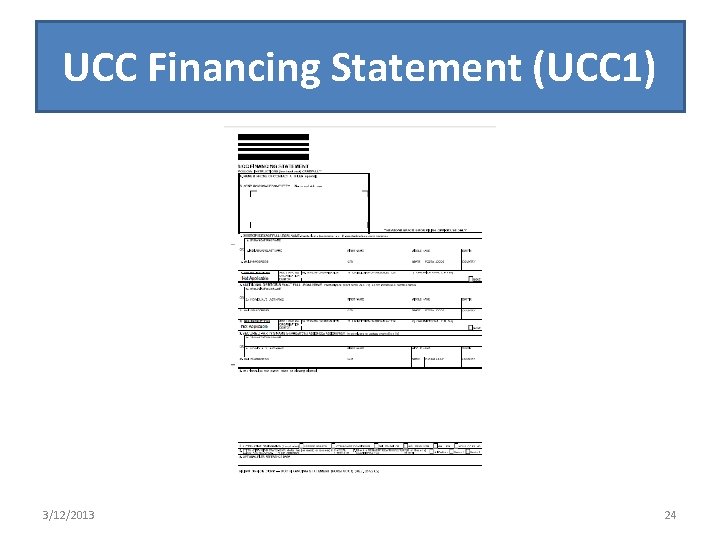
UCC Financing Statement (UCC 1) 3/12/2013 24
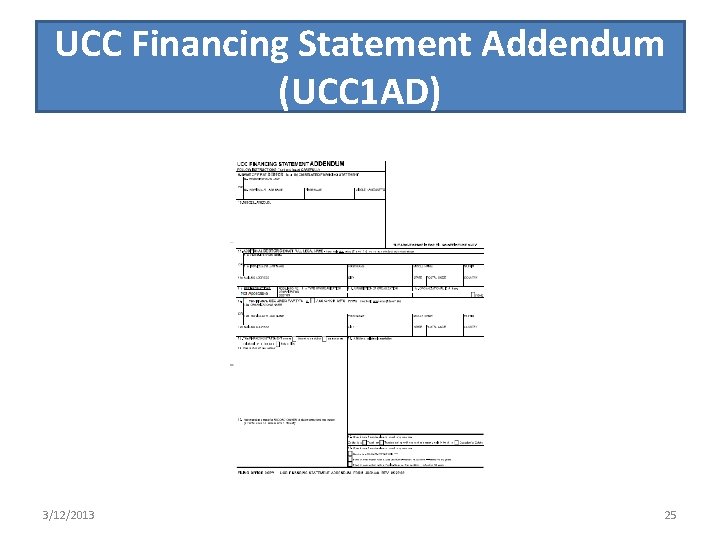
UCC Financing Statement Addendum (UCC 1 AD) 3/12/2013 25
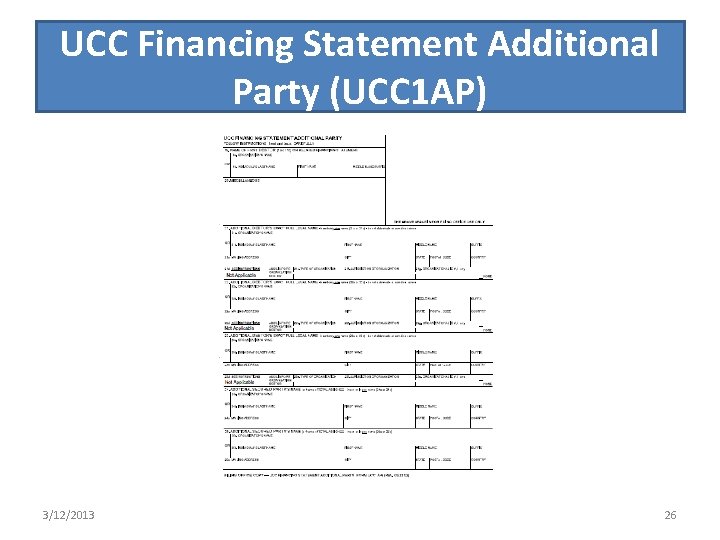
UCC Financing Statement Additional Party (UCC 1 AP) 3/12/2013 26
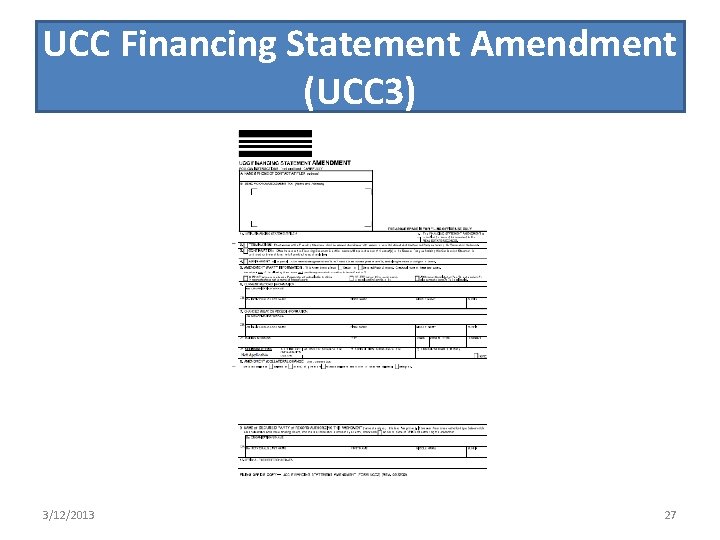
UCC Financing Statement Amendment (UCC 3) 3/12/2013 27
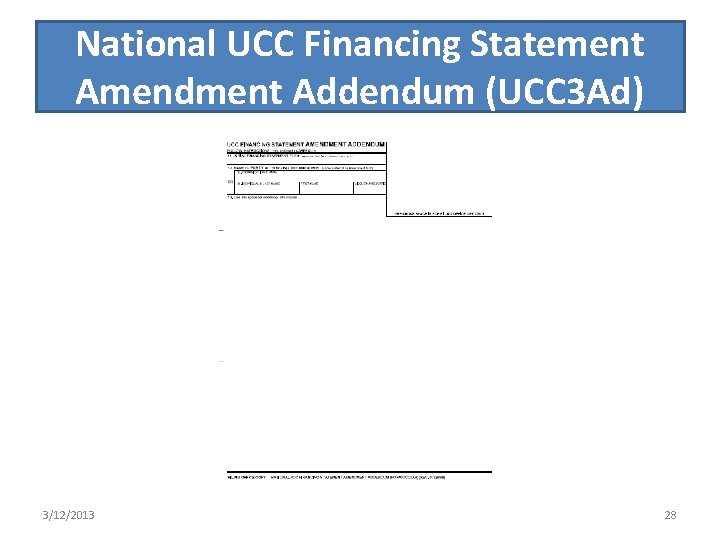
National UCC Financing Statement Amendment Addendum (UCC 3 Ad) 3/12/2013 28
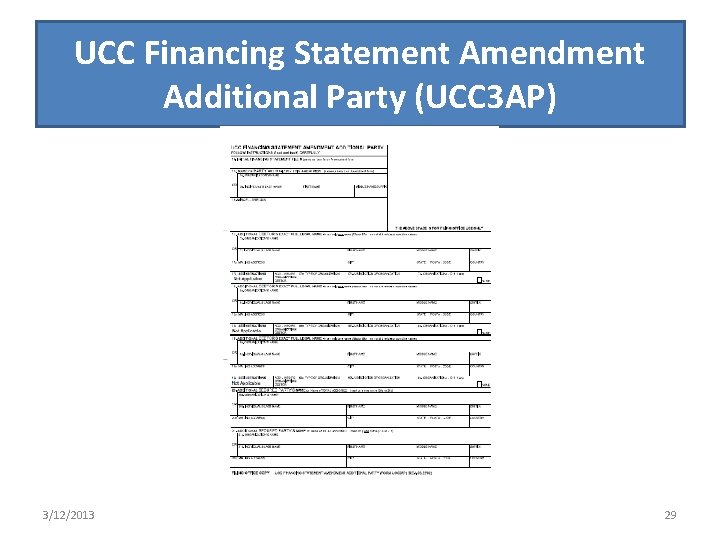
UCC Financing Statement Amendment Additional Party (UCC 3 AP) 3/12/2013 29
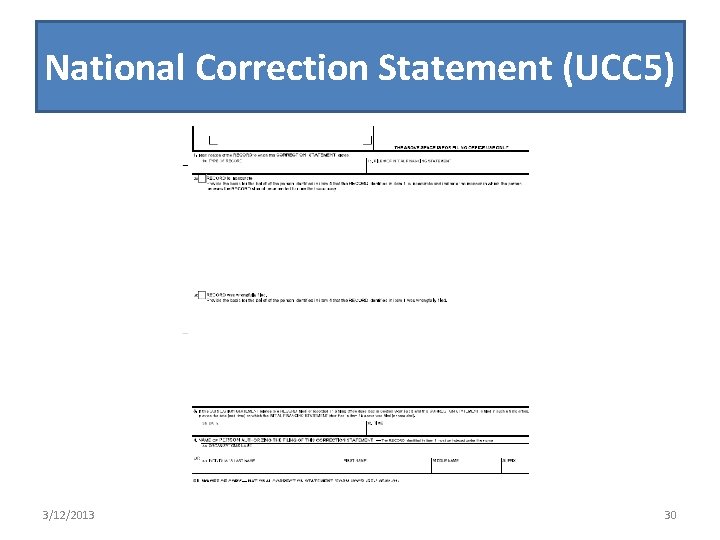
National Correction Statement (UCC 5) 3/12/2013 30

National Information Request (UCC 11) 3/12/2013 31
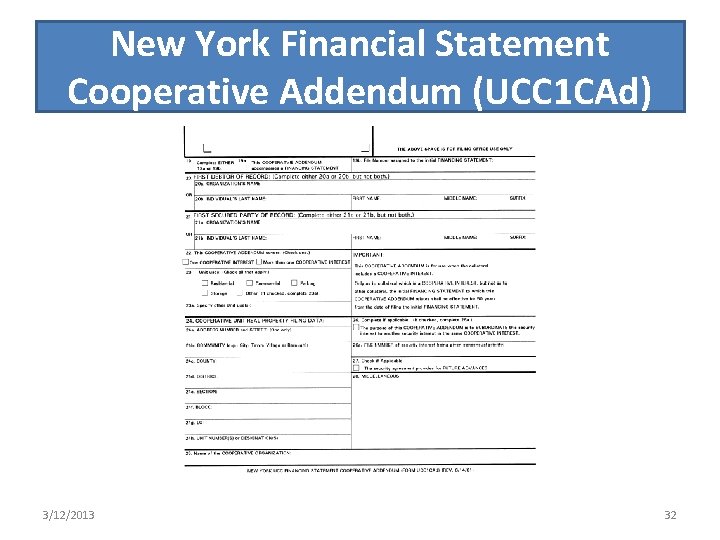
New York Financial Statement Cooperative Addendum (UCC 1 CAd) 3/12/2013 32
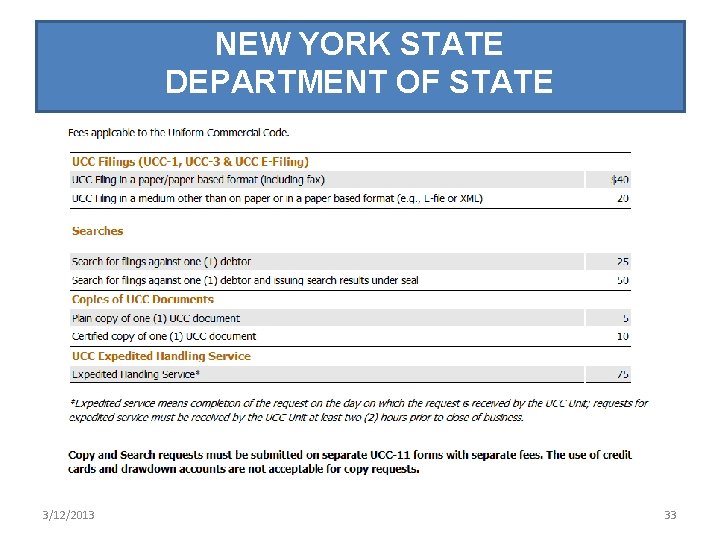
NEW YORK STATE DEPARTMENT OF STATE 3/12/2013 33
REFERENCES: • Article 9 of the Uniform Commercial Code can be accessed through the New York State Department of State Website at (http: //www. dos. ny. gov/corps/uccforms. html) • International Association of Commercial Administrators (IACA) • http: //www. nationalcorp. com/ncr/resources/UCCResources/Article-9 -Forms • Article 9 Amendments: Non-Uniform Provisions and Effective Dates by Despina Shields, National Corporate Research, Ltd. http: //info. nationalcorp. com/blog/bid/271618/Article-9 Amendments-Non-Uniform-Provisions-and-Effective-Dates • http: //www. law. cornell. edu/ucc/9/overview. html • http: //www. dos. ny. gov/corps/uccfilingguide. html • http: //apps. americanbar. org/dch/committee. cfm? com=CL 710043 3/12/2013 34
Q&A 3/12/2013 35
- Slides: 35