
Why We Shouldnt Go to Mars by Gregg
Why We Shouldn’t Go to Mars by Gregg Easterbrook By Prof. Jim Rush
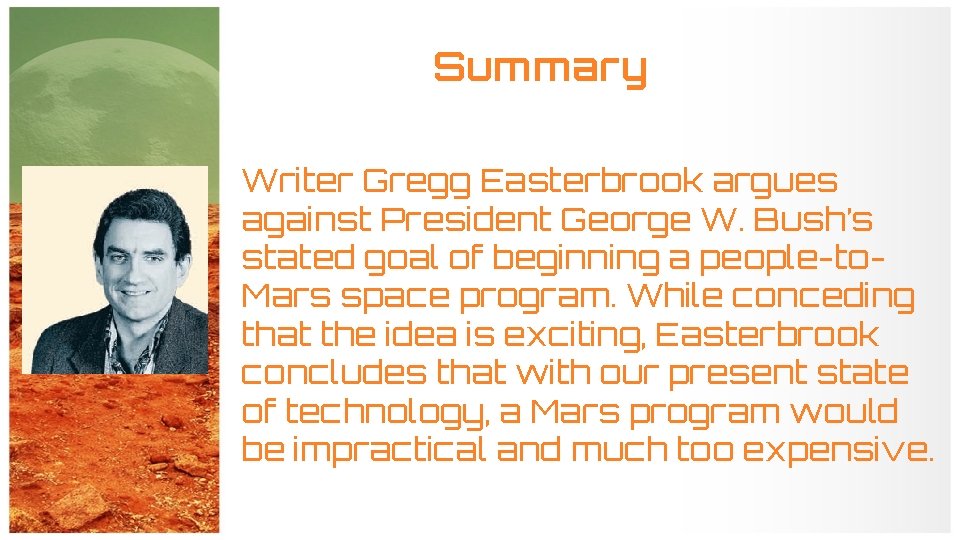
Summary Writer Gregg Easterbrook argues against President George W. Bush’s stated goal of beginning a people-to. Mars space program. While conceding that the idea is exciting, Easterbrook concludes that with our present state of technology, a Mars program would be impractical and much too expensive.
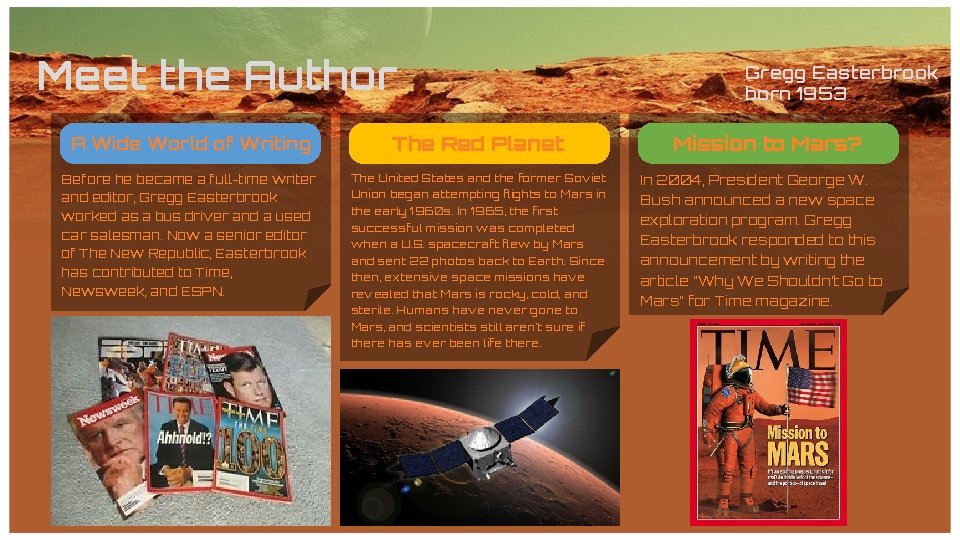
Meet the Author A Wide World of Writing The Red Planet Before he became a full-time writer and editor, Gregg Easterbrook worked as a bus driver and a used car salesman. Now a senior editor of The New Republic, Easterbrook has contributed to Time, Newsweek, and ESPN. The United States and the former Soviet Union began attempting flights to Mars in the early 1960 s. In 1965, the first successful mission was completed when a U. S. spacecraft flew by Mars and sent 22 photos back to Earth. Since then, extensive space missions have revealed that Mars is rocky, cold, and sterile. Humans have never gone to Mars, and scientists still aren’t sure if there has ever been life there. Gregg Easterbrook born 1953 Mission to Mars? In 2004, President George W. Bush announced a new space exploration program. Gregg Easterbrook responded to this announcement by writing the article “Why We Shouldn’t Go to Mars” for Time magazine.
Text Analysis: Counterargument A strong counterargument is an important part of any argument. A counterargument anticipates what “the other side” might say and answers possible objections with reasons and evidence. • As this article’s title suggests, author Gregg Easterbrook believes that sending astronauts to Mars is a mistake. Rather than ignoring those who disagree with him, Easterbrook states his opponents’ views and then tells why he disagrees. As you read, search for examples of this technique.
Text Analysis: Counterargument To examine counterarguments, read this example: “Mom, this computer will help me with my schoolwork, and I’ve found a part-time job to help pay for. ” it • What arguments from the mother is the speaker anticipating? ü �he speaker anticipates the arguments that buying T the computer isn’t necessary and that it is too expensive. Name a school rule and then think of reasons both for and against changing it.
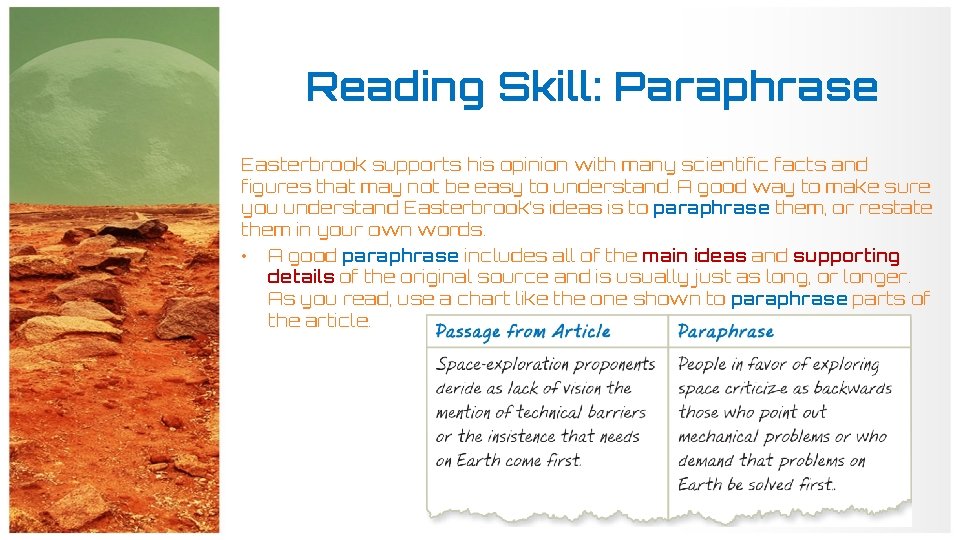
Reading Skill: Paraphrase Easterbrook supports his opinion with many scientific facts and figures that may not be easy to understand. A good way to make sure you understand Easterbrook’s ideas is to paraphrase them, or restate them in your own words. • A good paraphrase includes all of the main ideas and supporting details of the original source and is usually just as long, or longer. As you read, use a chart like the one shown to paraphrase parts of the article.
Reading Skill: Paraphrase Read this example and paraphrase it: “I object to cleaning up this sink full of dishes and not receiving a monetary reward. ” ü I�think I should get paid for washing the dishes. Think of a common proverb, such as “Waste not, want not, ” and paraphrase it.

Read With a Purpose As you read “Why We Shouldn’t Go to Mars, ” consider the pros and cons of going to Mars.
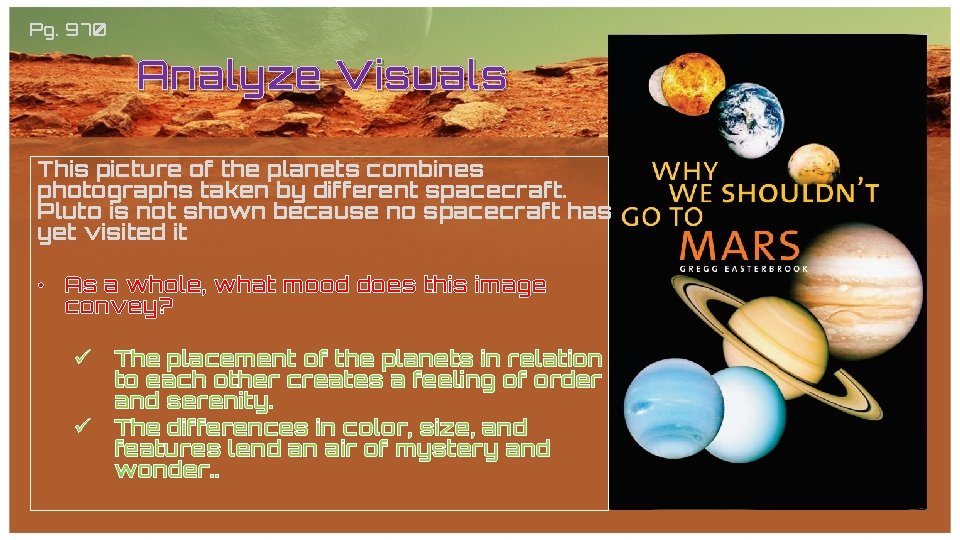
Pg. 970 Analyze Visuals This picture of the planets combines photographs taken by different spacecraft. Pluto is not shown because no spacecraft has yet visited it. • As a whole, what mood does this image convey? ü ü The placement of the planets in relation to each other creates a feeling of order and serenity. The differences in color, size, and features lend an air of mystery and wonder. .
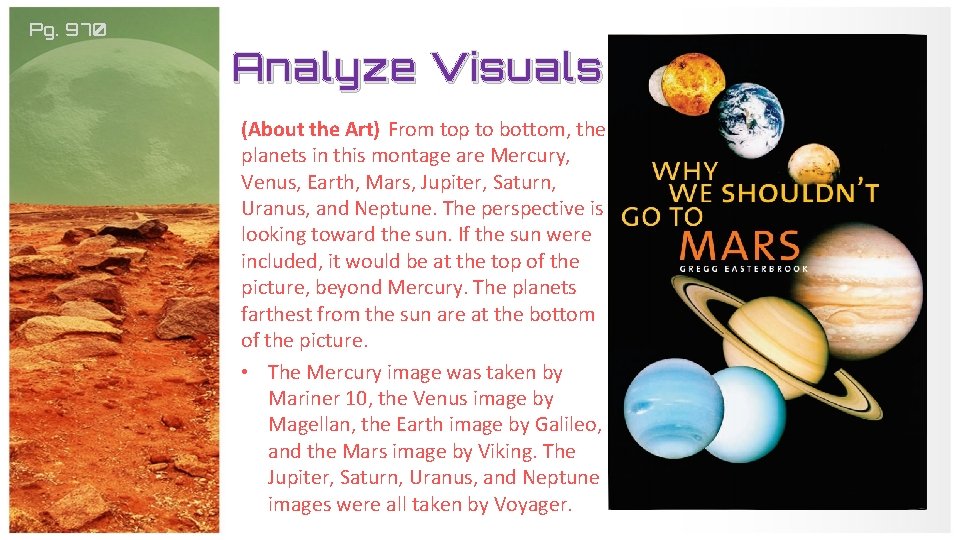
Pg. 970 Analyze Visuals (About the Art) From top to bottom, the planets in this montage are Mercury, Venus, Earth, Mars, Jupiter, Saturn, Uranus, and Neptune. The perspective is looking toward the sun. If the sun were included, it would be at the top of the picture, beyond Mercury. The planets farthest from the sun are at the bottom of the picture. • The Mercury image was taken by Mariner 10, the Venus image by Magellan, the Earth image by Galileo, and the Mars image by Viking. The Jupiter, Saturn, Uranus, and Neptune images were all taken by Voyager.
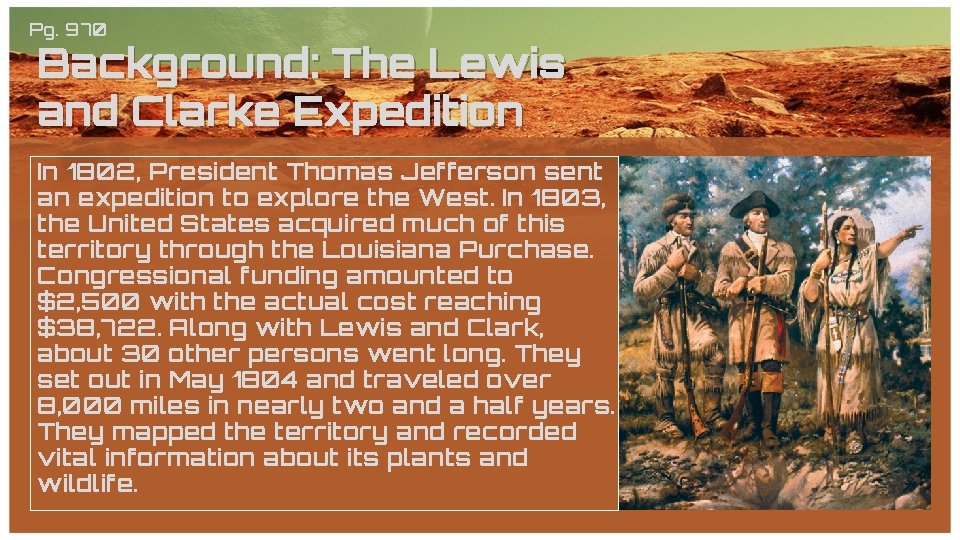
Pg. 970 Background: The Lewis and Clarke Expedition In 1802, President Thomas Jefferson sent an expedition to explore the West. In 1803, the United States acquired much of this territory through the Louisiana Purchase. Congressional funding amounted to $2, 500 with the actual cost reaching $38, 722. Along with Lewis and Clark, about 30 other persons went long. They set out in May 1804 and traveled over 8, 000 miles in nearly two and a half years. They mapped the territory and recorded vital information about its plants and wildlife.
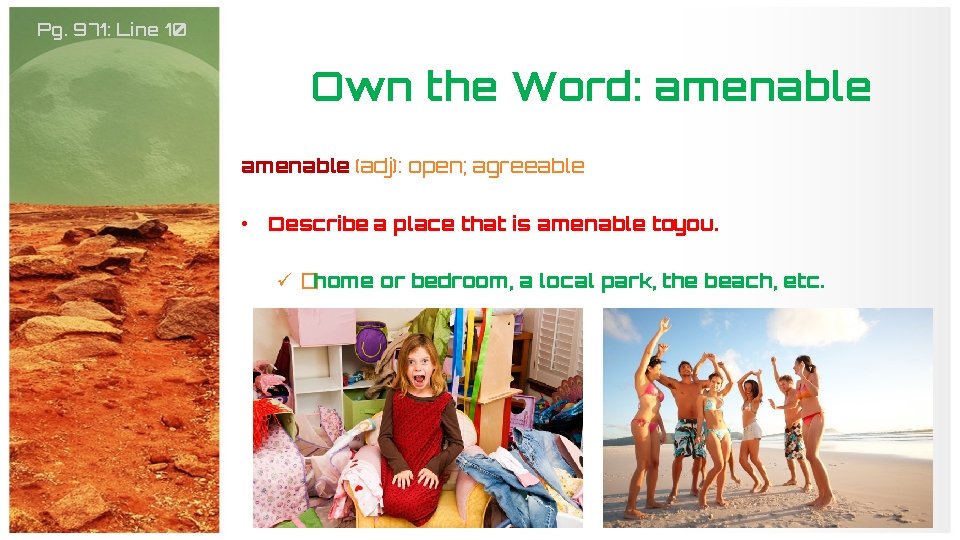
Pg. 971: Line 10 Own the Word: amenable (adj): open; agreeable • Describe a place that is amenable toyou. ü �home or bedroom, a local park, the beach, etc.
Pg. 971: Lines 1 -16 1. Targetted Passage • This passage introduces the idea of sending people to Mars and sets out three reasons why the argument is faulty. What is the idea or argument with which Easterbrook disagrees? (lines 8– 9) ü The Lewis and Clark Expedition should not be compared to a manned expedition to Mars. There are some important differences. Why does he point out that many people already lived in the area that Lewis and Clark explored? (lines 9– 11) ü �� Because if there are people, the target area already supports life, whereas Mars cannot support life. • • What does Easterbrook imply about the places and things that might be found by sending people to Mars? (lines 11– 13) ü Lewis and Clarke knew that they would find new places � and things of value, but Easterbrook issceptical that a trip to Mars will result in finding any new places or things of value that automated probes have not already found. • What fact does he provide about the cost of sending people to Mars? (lines 14– 16) ü ��� The cost of an expedition to Mars would be $600 billion, which would be equivalent to building 800 Hoover Dams.
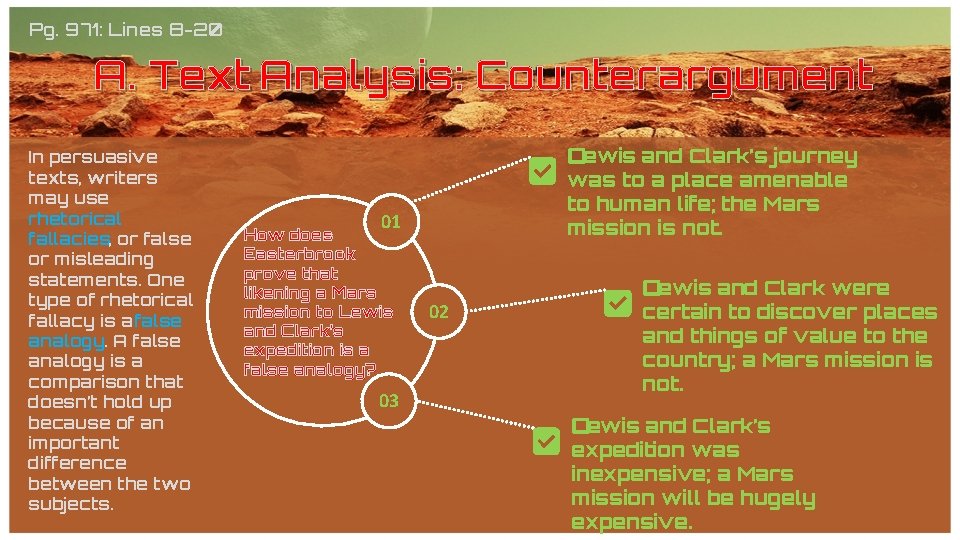
Pg. 971: Lines 8 -20 A. Text Analysis: Counterargument In persuasive texts, writers may use rhetorical fallacies, or false or misleading statements. One type of rhetorical fallacy is a false analogy. A false analogy is a comparison that doesn’t hold up because of an important difference between the two subjects. �ewis and Clark’s journey L was to a place amenable to human life; the Mars mission is not. 01 How does Easterbrook prove that likening a Mars mission to Lewis and Clark’s expedition is a false analogy? 03 02 �ewis and Clark were L certain to discover places and things of value to the country; a Mars mission is not. �ewis and Clark’s L expedition was inexpensive; a Mars mission will be hugely expensive.
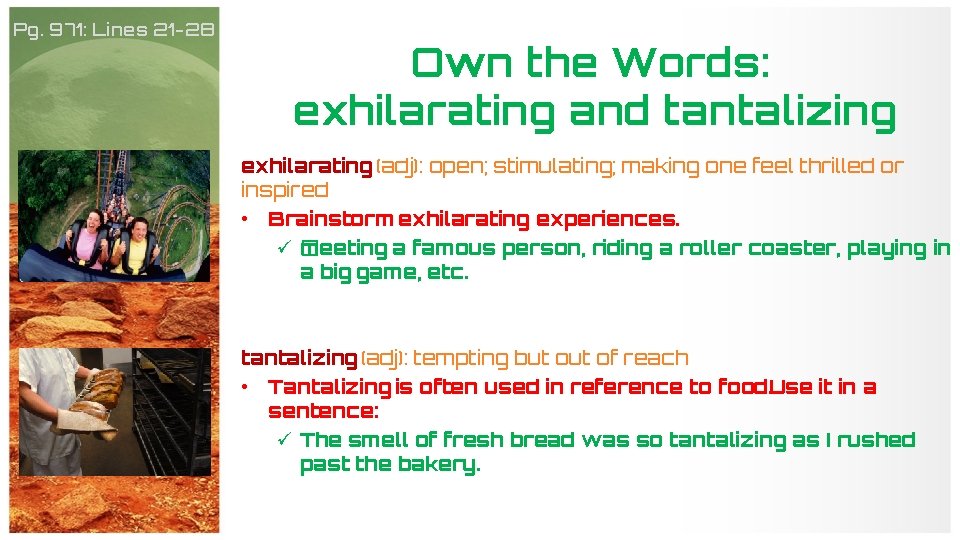
Pg. 971: Lines 21 -28 Own the Words: exhilarating and tantalizing exhilarating (adj): open; stimulating; making one feel thrilled or inspired • Brainstorm exhilarating experiences. ü� meeting a famous person, riding a roller coaster, playing in a big game, etc. tantalizing (adj): tempting but of reach • Tantalizing is often used in reference to food. Use it in a sentence: ü The smell of fresh bread was so tantalizing as I rushed past the bakery.
Pg. 971: Lines 21 -31 Analyze Easterbrook describes his own fascination with Mars in lines 21 – 27. • How does his tone change in lines 28– 31 and what effect does this have on his argument?
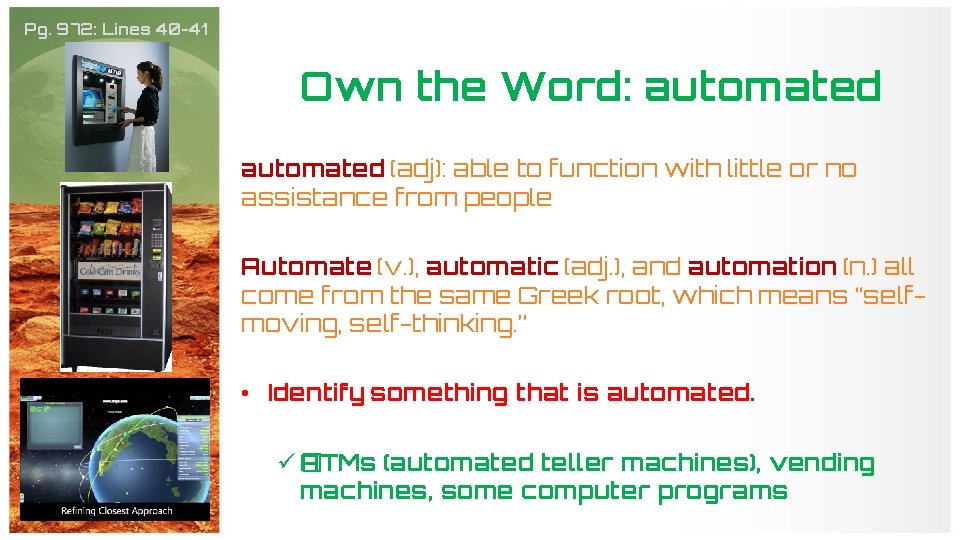
Pg. 972: Lines 40 -41 Own the Word: automated (adj): able to function with little or no assistance from people Automate (v. ), automatic (adj. ), and automation (n. ) all come from the same Greek root, which means “selfmoving, self-thinking. ” • Identify something that is automated. ü� ATMs (automated teller machines), vending machines, some computer programs
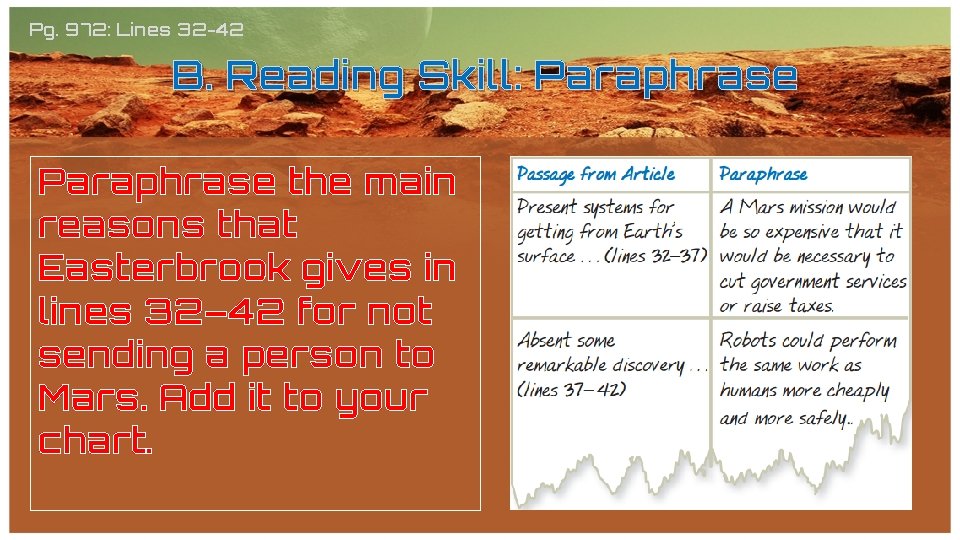
Pg. 972: Lines 32 -42 B. Reading Skill: Paraphrase the main reasons that Easterbrook gives in lines 32– 42 for not sending a person to Mars. Add it to your chart.
Pg. 972: Lines 43 -53 1. Targetted Passage In lines 30– 53, use these prompts to help understand Easterbrook’s objections to a Mars mission: • (Recall) What does Easterbrook say about traveling to Mars with our current technology? ü He says that sending people to Mars makes no sense with our current technology. (lines 30– 31) • (Analyze) What scientific activities could humans do on Mars that automated devices cannot do? ü � Easterbrook thinks that humans could do nothing beyond what automated devices are already doing.
Pg. 973: Lines 63 -65 Own the Words: proponent and rationality proponent (n): a person who supports something • Identify an idea for which you are a proponent. ü� changes in a Panamanian law ü more school days off ü watching movies in class rationality (n): ) reasonableness • Who or what would you say is rational?
Pg. 973: Lines 63 -75 C. Text Analysis: Counterargument Easterbrook’s opponents could claim that he has a “lack of vision” because he is against a Mars mission. Reread lines 63– 75. What is his counterargument to this possible criticism? ü He emphasizes “rationality” and “the setting of priorities. ” ü He uses words such as “former” and “latter”.
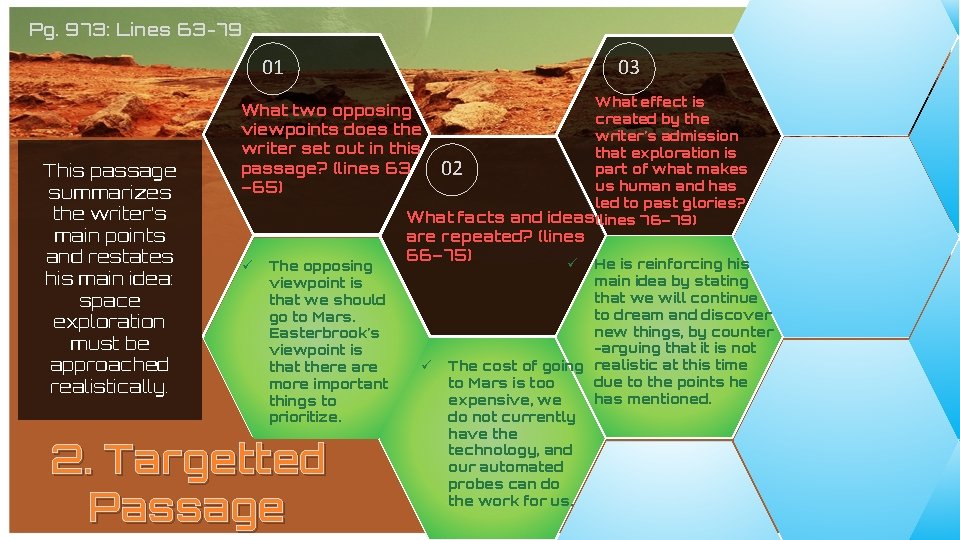
Pg. 973: Lines 63 -79 01 This passage summarizes the writer’s main points and restates his main idea: space exploration must be approached realistically. 03 What effect is created by the writer’s admission that exploration is part of what makes 02 us human and has led to past glories? What facts and ideas(lines 76– 79) What two opposing viewpoints does the writer set out in this passage? (lines 63 – 65) ü The opposing viewpoint is that we should go to Mars. Easterbrook’s viewpoint is that there are more important things to prioritize. 2. Targetted Passage are repeated? (lines 66– 75) ü He is reinforcing his ü main idea by stating that we will continue to dream and discover new things, by counter -arguing that it is not The cost of going realistic at this time due to the points he to Mars is too has mentioned. expensive, we do not currently have the technology, and our automated probes can do the work for us.
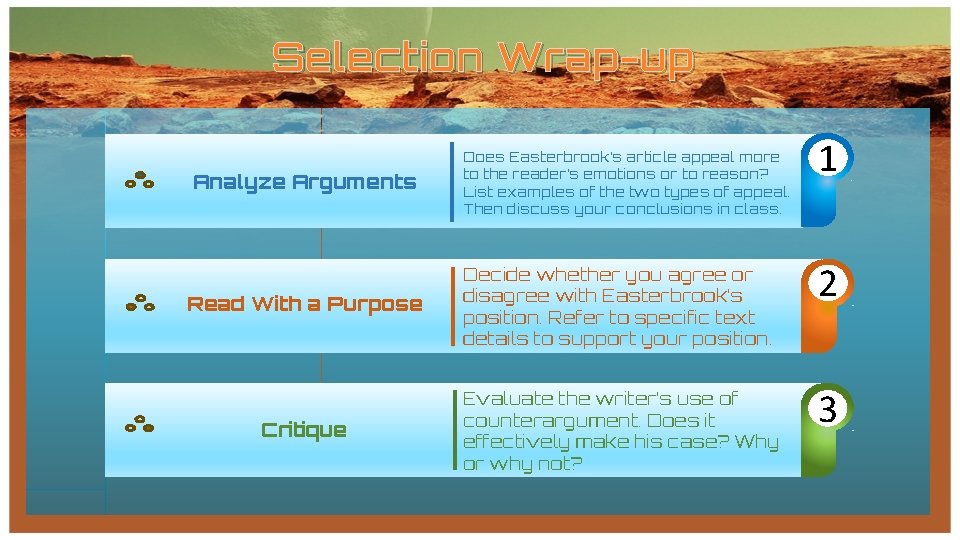
Selection Wrap-up Analyze Arguments Does Easterbrook’s article appeal more to the reader’s emotions or to reason? List examples of the two types of appeal. Then discuss your conclusions in class. 1 Read With a Purpose Decide whether you agree or disagree with Easterbrook’s position. Refer to specific text details to support your position. 2 Critique Evaluate the writer’s use of counterargument. Does it effectively make his case? Why or why not? 3
- Slides: 23