
Why we need both external incentives and internal

Why we need both: external incentives and internal business case in OSH Dr. Dietmar Elsler Project Manager Working Environment Information Unit
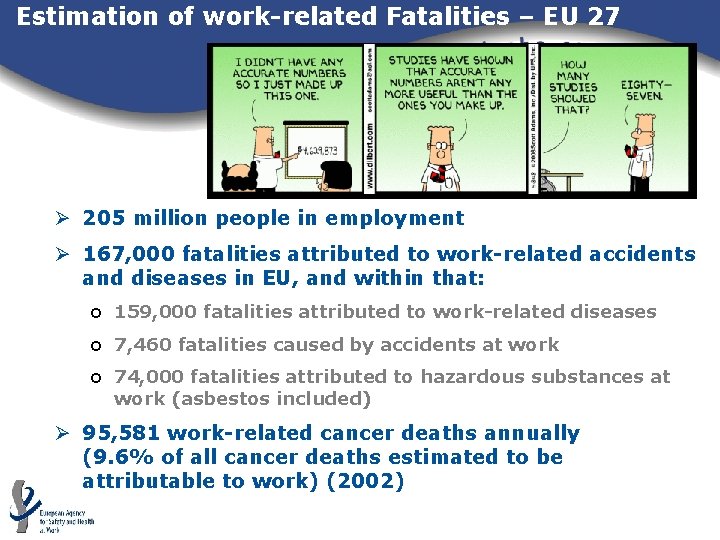
Estimation of work-related Fatalities – EU 27 Ø 205 million people in employment Ø 167, 000 fatalities attributed to work-related accidents and diseases in EU, and within that: o 159, 000 fatalities attributed to work-related diseases o 7, 460 fatalities caused by accidents at work o 74, 000 fatalities attributed to hazardous substances at work (asbestos included) Ø 95, 581 work-related cancer deaths annually (9. 6% of all cancer deaths estimated to be attributable to work) (2002)
Ø Cost of accidents at work and of occupational diseases in EU-15 ranges from 2. 6% to 3. 8% of GDP Ø According to a study (CIOP, Poland) average cost of an accident is incurred by o 76% of society o 13% of the victim and his or her family o 11% of the employer
How to motivate employers? How to reach the workplace? Ø Regulation: Command control o Only guarantees a minimum level o Problem of enforcement, not enough inspectors o Costly to take companies to court Ø Information about good practice o Preaching to the converted o Does the SME around the corner look on our website every day?
Problems of the business case Ø Safety and health may not always pay on company level, but in most cases it pays on society level Ø Solution: external incentives o Best allocation of economic resources: Safety and health are improved there, where it is most efficient (like in environment) Ø Problem of awareness: costs are obvious, benefits long-term and uncertain Ø The better companies are, the less strong is the business case (marginal costs problem)
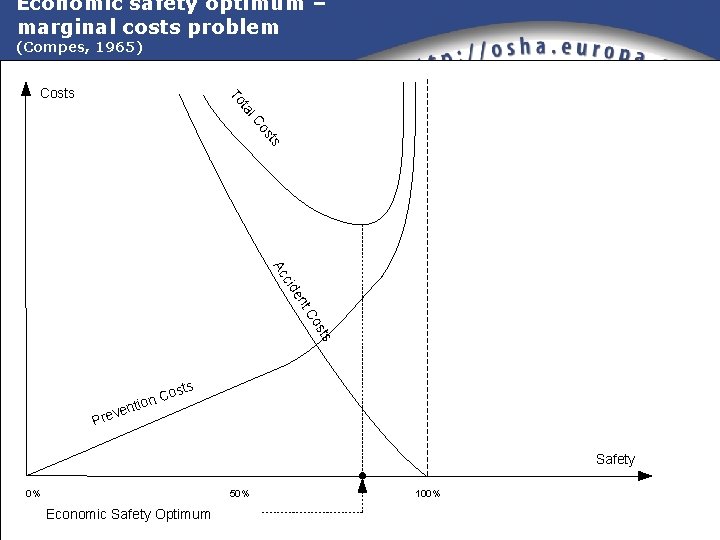
Economic safety optimum – marginal costs problem (Compes, 1965) l ta To Costs Co t en cid Ac sts Co osts C on nti ve Pre Safety 0% 50% Economic Safety Optimum 100%
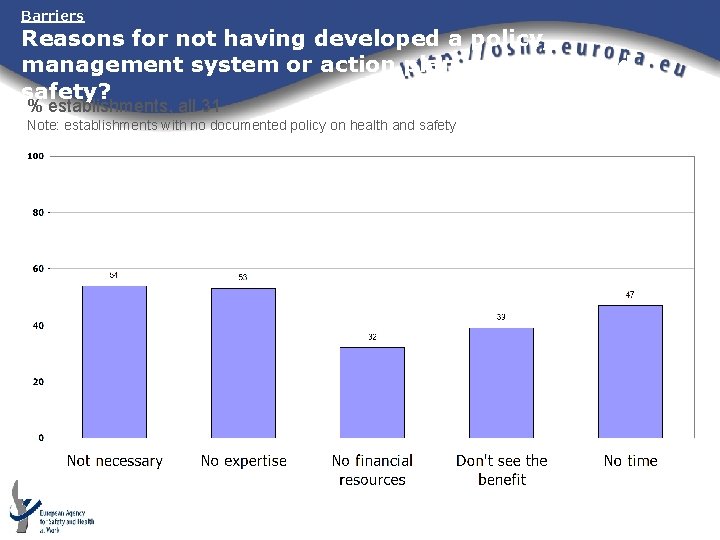
Barriers Reasons for not having developed a policy, management system or action plan on health and safety? % establishments, all 31 Note: establishments with no documented policy on health and safety
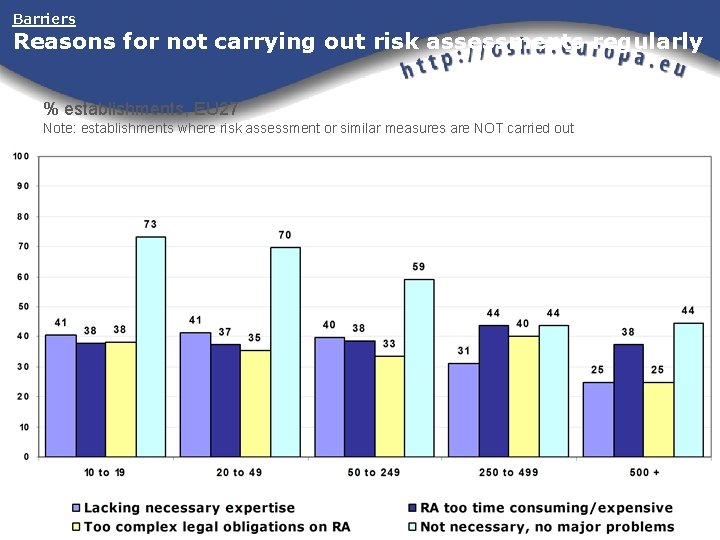
Barriers Reasons for not carrying out risk assessments regularly % establishments, EU 27 Note: establishments where risk assessment or similar measures are NOT carried out

Why external economic incentives? Ø Strong case for Economic Incentives (EI) by European Foundation and ILO (P. Dorman (2000)): o EI are directly linked with business performance (impact on productivity easily visible to managers) o EI can stimulate continuous improvement (vs. regulation specifying minimum performance level) o EI encourage problem-solving and innovation (vs. method-focus) Ø First step to increase companies attention: Foot in the door for OSH!

What could act as an incentive? Ø Insurance premium variations, e. g. dependent on o Occupational accidents and diseases o Specific risk of sector o Prevention activities such as training, investments, personal protection measures Ø Tax incentives, e. g. better write-off conditions Ø Better banking conditions, e. g. lower interest rates Ø State subsidies, e. g. for innovative investments or reorganisation Ø Certification of OSH managment systems (e. g. reimbursement of certification fees)

Why a project on economic incentives? Ø More economic incentives is called for in in the new community strategy Ø Need to develop better models for SMEs Ø Need for models which reward rather OSH effort than only OSH results Ø Institutions that can provide incentives need good practice information
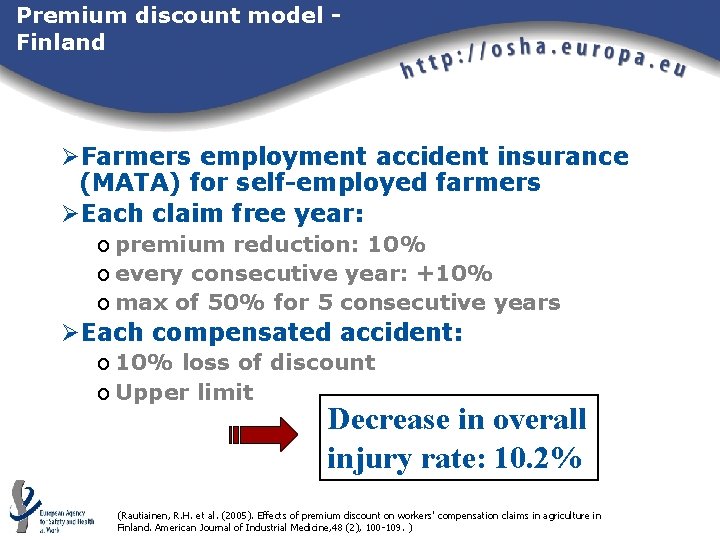
Premium discount model Finland ØFarmers employment accident insurance (MATA) for self-employed farmers ØEach claim free year: o premium reduction: 10% o every consecutive year: +10% o max of 50% for 5 consecutive years ØEach compensated accident: o 10% loss of discount o Upper limit Decrease in overall injury rate: 10. 2% (Rautiainen, R. H. et al. (2005). Effects of premium discount on workers' compensation claims in agriculture in Finland. American Journal of Industrial Medicine, 48 (2), 100 -109. )
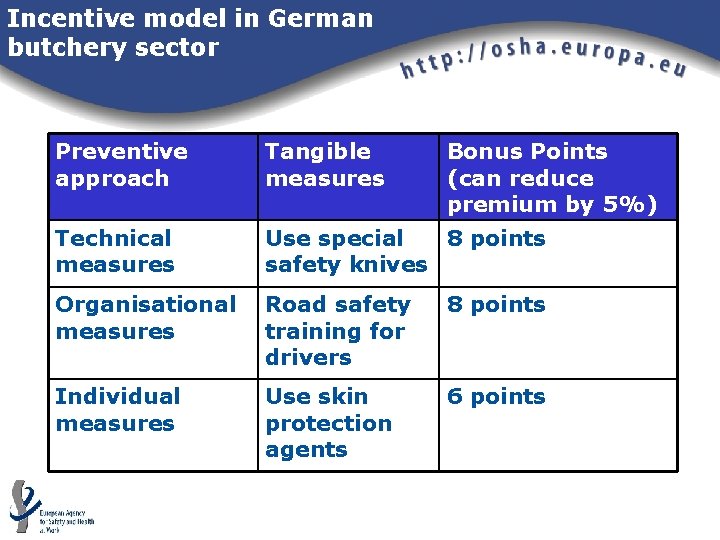
Incentive model in German butchery sector Preventive approach Tangible measures Bonus Points (can reduce premium by 5%) Technical measures Use special 8 points safety knives Organisational measures Road safety training for drivers 8 points Individual measures Use skin protection agents 6 points
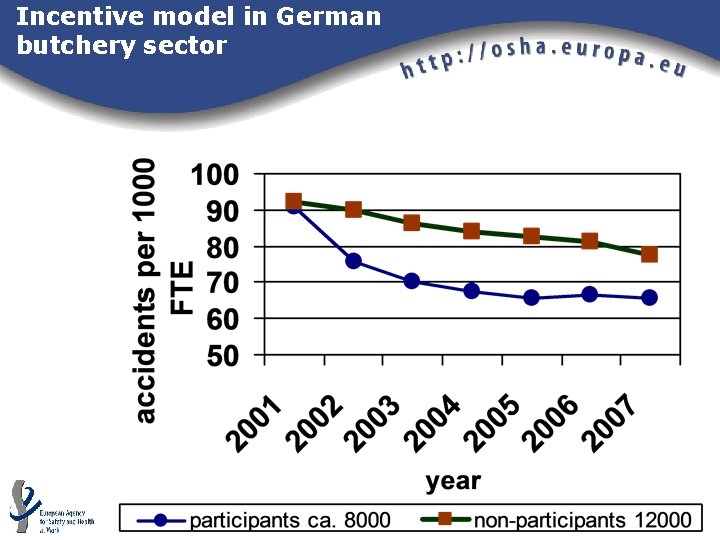
Incentive model in German butchery sector

A review of case studies evaluating economic incentives Ø Butchery sector incentive scheme leads to ca. 1000 accidents less/year Ø Costs for incentives € 8. 32 Mio Euro (6 years, 2002 -2007) Ø HSE estimates 6670 € costs for each reportable accident Ø Business case o 6000 accidents X 6. 670 € = 40. 02 Mio € 4. 81 € savings for every 1 € invested Elsler D, Treutlein D, Rydlewska I, Frusteri L, Krüger H, Van Den Broek K, Veerman T, Eeckelaert L, Roskams N, Taylor TN (2010). Scandinavian Journal of Work, Environment & Health
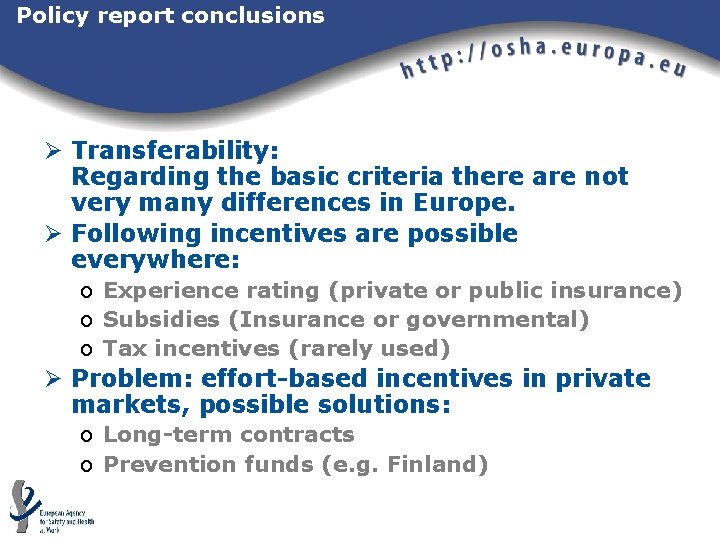
Policy report conclusions Ø Transferability: Regarding the basic criteria there are not very many differences in Europe. Ø Following incentives are possible everywhere: o Experience rating (private or public insurance) o Subsidies (Insurance or governmental) o Tax incentives (rarely used) Ø Problem: effort-based incentives in private markets, possible solutions: o Long-term contracts o Prevention funds (e. g. Finland)
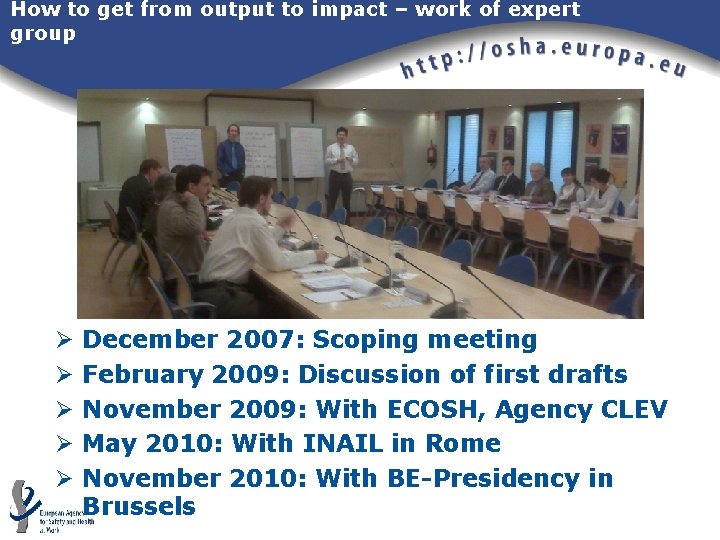
How to get from output to impact – work of expert group Ø Ø Ø December 2007: Scoping meeting February 2009: Discussion of first drafts November 2009: With ECOSH, Agency CLEV May 2010: With INAIL in Rome November 2010: With BE-Presidency in Brussels
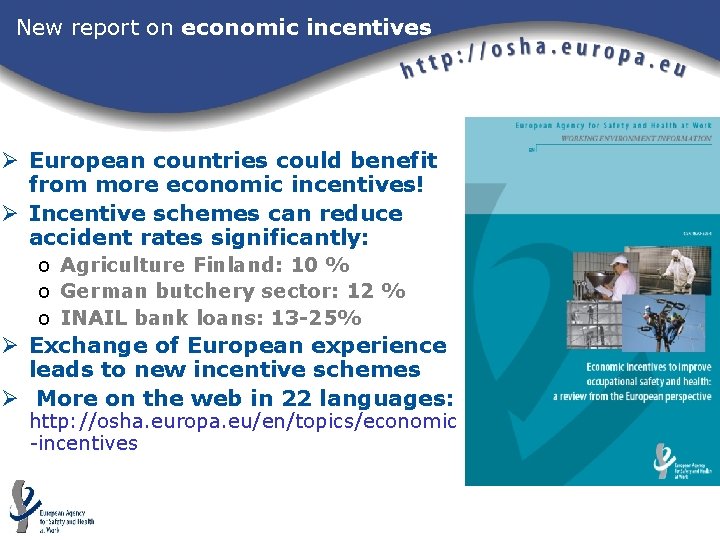
New report on economic incentives Ø European countries could benefit from more economic incentives! Ø Incentive schemes can reduce accident rates significantly: o Agriculture Finland: 10 % o German butchery sector: 12 % o INAIL bank loans: 13 -25% Ø Exchange of European experience leads to new incentive schemes Ø More on the web in 22 languages: http: //osha. europa. eu/en/topics/economic -incentives
Exchange of good practice Example Italy Ø INAIL is the Italian national worker’s compensation body for 3. 8 Mio enterprises and 17. 8 Mio workers Ø Based on the discussion of the Agency’s expert group INAIL will implement an incentive scheme focussed on SMEs with € 60 Mio budget Ø Estimation of potential benefit on society level based on evaluations of other economic incentives schemes: o Financial benefit assuming a pay-back ratio of 1 to 3: € 180 Mio o Accidents prevented assuming a cost of € 6670 per reportable accident (HSE): ca. 27000
Conclusions Ø We need both: promotion of the business case and external economic incentives Ø External economic incentives can o Be effective in all EU countries o Be attractive for SMEs o Promote also health, not only safety Ø The EU-OSHA project has stimulated a mutual learning process between economic incentives organisations, e. g. Italy, France, Finland, Switzerland, Cyprus
Thank you very much for your attention! Dr. Dietmar Elsler Project Manager European Agency for Safety and Health at Work Gran Vía, 33 - 48009 Bilbao - Spain Tel. +34 94 479 57 44 Fax. +34 94 479 43 83 http: //osha. europa. eu/ E-mail: elsler@osha. europa. eu
- Slides: 21