
Why was the 19 th century considered Europes


- Slides: 26
Why was the 19 th century considered Europe’s greatest age of global expansion?
Europe’s age of global expansion a) b) c) d) Europe-center of the world Europeans moved to dif. other regions Explorers & missionaries reached everywhere Most of the world became Europe’s colonies
What were the causes of Europ. Imperialism?
Econ. causes of Europ. imperialism 1) Need for raw materials & agric. prod. 2) Need for more markets to sell the manufactured goods 3) Europ. capitalists invested money abroad 4) Foreign markets to unload the surpluses of manufactured goods.
Political causes • Military might & polit. ambitions • Italy & Germany unified by 1871 • Nationalism (German, Filipino, Liberian) that swept up many Europeans. • Colonies=symbol that a country was a big power
What made possible the expression of European imperialism?
Tools of Europ. imperialism • Industrial Revolution gave Europ. a military advantage a) Steamships b) Underwater telegraph c) Quinine d) Machine-guns & breech-loading rifles
What was the Europ. Perception of “the other”? Why? What was social Darwinism? What was Europ. duty toward other races?
Perception of “the other” • Before 19 th century • Africans & Asians were considered “ heathen” b/c they were not Christians. • Defined others in relig. terms & considered them “ noble savages” • Europ. mingled with African & Asian elites • 19 th century • Secular arrogance • Despise for other cultures • Europ. Considered themselves “superior” b/c of their superior technology ( African societies lost status)
Perception of “the other” • Europ. created a hierarchy of races • they have a sense of responsibility to the “weaker races” 1) To civilize them 2) To bring educ. , health care, Christianity, good government. Social Darwinism • Effort to apply Darwin’s evol. theory to human history • The “unfit” races should be displaced/destroyed
What was China’s century crisis? What were the internal causes of the crisis?
China’s crisis a)Growth of popul. from 100 million (1685) to 430 million ( 1853) b)More popul. -pressure on the land, starvation, impoverishment c) out-dated bureaucracy: by 1800 the same no. of bureaucrats, but the popul. was 4 times more d) Central governm. lost control of prov. officials & gentry; corruption e) China didn’t have an Industr. Rev. f) Harsh treatment of peasants-rebellions
What were the causes & the effects of the Taiping rebellion?
Taiping Rebellion Yrs. 1850 -1864 • Rebellion infl. by religious ideas( leader=younger brother of Jesus) • Leader: Hong Xiuquan • Goals: 1)equality of men & women; redistribution of land 2)China’s industr. • 1853: the Taiping forces established their capital at Nanjing • 1864: rebellion was crushed by landowners( gentry) with their armies, not the emperor. • Effects: • A) largest life loss in 19 th C • B) civil war weakened China • C) gentry (Chinese nobles) became more powerful than the emperor.
What changes did the Opium trade experience in the 19 th century?
Opium trade in 19 th C British had to pay for all Chinese prod. in silver Started to sell large quantities of Indian opium China paid silver for opium 1836: the emperor decided to suppress the opium trade • Lin Zexu-seized & destroyed more than 3 million pounds of opium from W traders • British answer: 1 st Opium War ( 1839 -1842) • •
1 st Opium War (1839 -1842) • Forced Chinese to accept free trade & “proper relations” among countries • (before 1 st Opium War foreigners were allowed to trade only in one place in China, at Canton- “ Canton system”) • 1842 “ Treaty of Nanjing” • 1)China paid 21 million indemnity • 2)China had to open 5 ports foreigners( all 5 ports were located in the spheres of influence of foreign powers) • 3)Ceded Hong Kong • 4)Tariffs fixed at a low rate • 5)Foreigners: right to live in China under their own laws
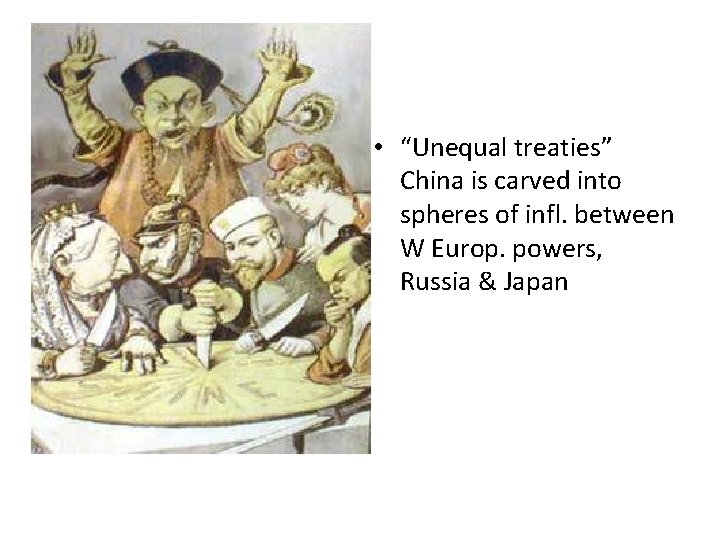
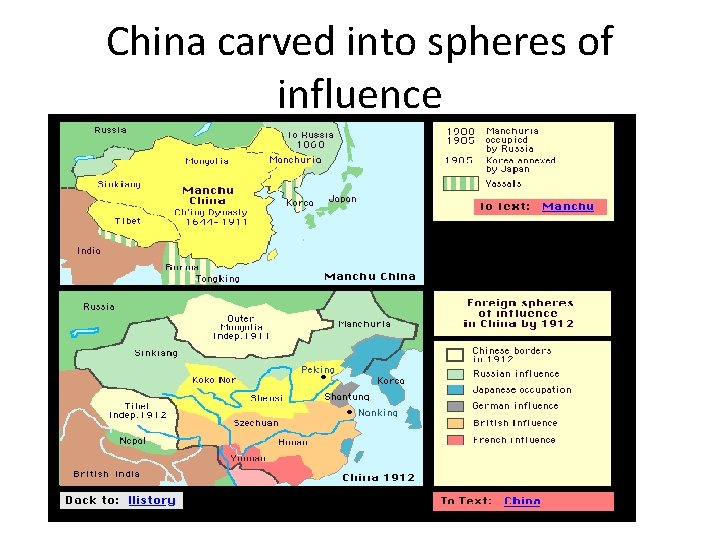
2 nd Opium War (1856 -1858) • Europ. vandalized the Summer Palace • More treaty ports were opened to foreigners • China was opened to foreign missionaries • China was defeated by French(1885)& Japan ( 1895) • Qing dynasty-weakened • “unequal treaties” –inhibited China’s industr. • China was carved into spheres of infl. Between : Western Europ. powers + Russia & Japan.
“ • “Unequal treaties” China is carved into spheres of infl. between W Europ. powers, Russia & Japan
Conservative moderniz. • China made an attempt of industrialization during 1860 -1870: reforms as response to rebellions; it was a policy of “self-strengthening movement” • China took mild measures to adopt some Western innovations • Foundation of few ind. factories • China didn’t became an industrial power b/c the reforms were done too late, too little; the gentry class & the Empress were against the reforms b/c they feared they would lose power.
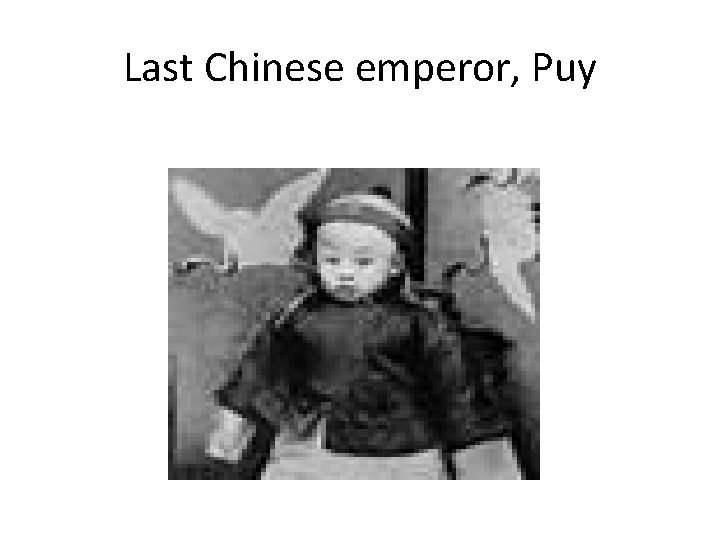
Last Chinese emperor, Puy
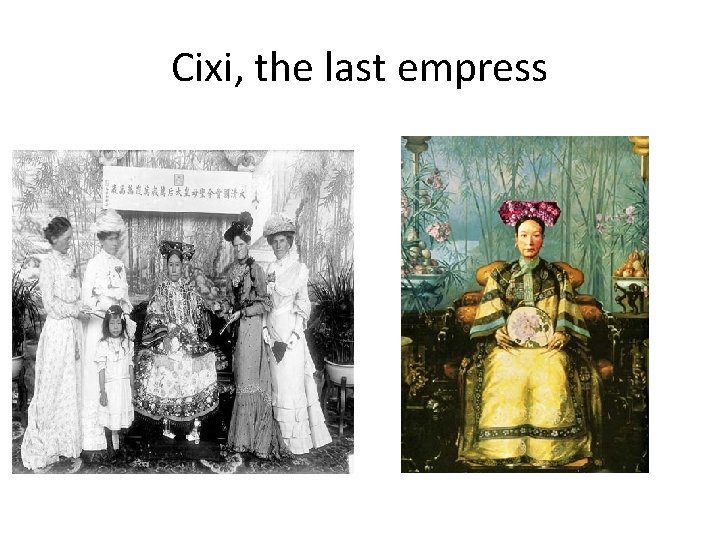
Cixi, the last empress
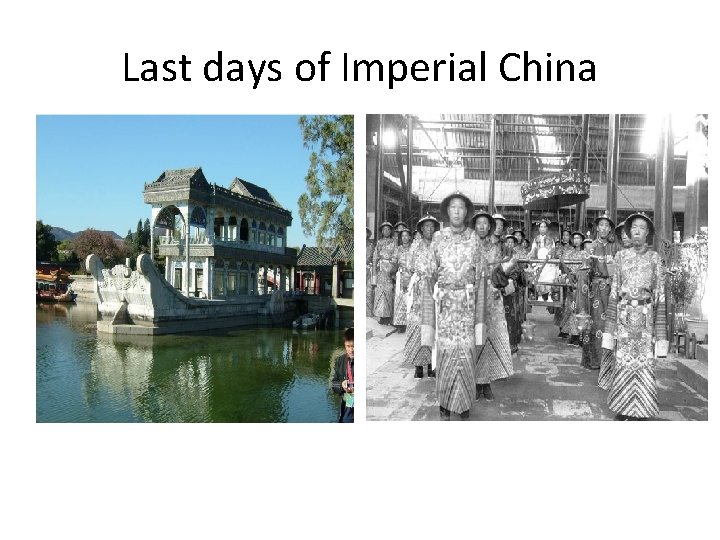
Last days of Imperial China
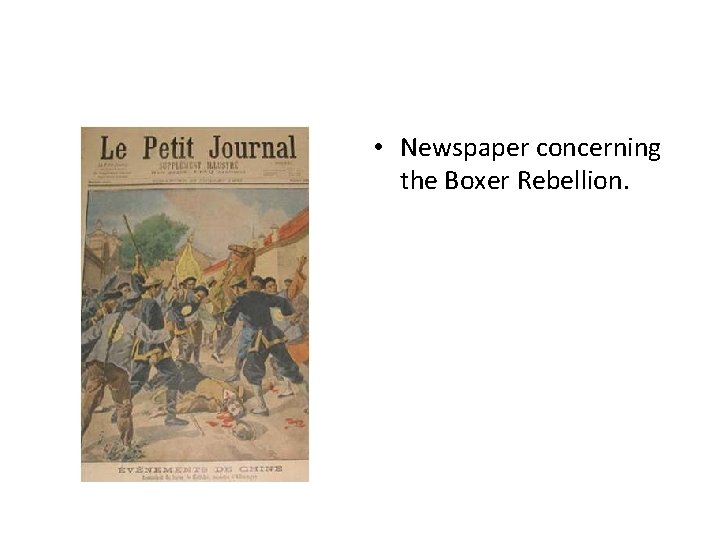
• Newspaper concerning the Boxer Rebellion.
The Boxer rebellion, 1900 E. G. of anticolonial movement • Goal • Boxer Rebellion ( 1900) was against foreign imperialism & against Qing dynasty • Militia org. killed Europ. & Chinese Christ. • Outcome: • Western powers & Japan defeated the rebellion & demand massive reparation payments from China • Govern. Accepted to make some reforms • Led in 1911/1912 to the abolition of monarchy
China carved into spheres of influence