
Why Use an Alternative Engine By Stuart Davis
Why Use an Alternative Engine? By Stuart Davis of
7 Old Arguments That Don’t Fly There are several old arguments against automotive conversions that just don’t fly anymore. 1) An aircraft engine is a purpose built engine that is better than any automotive engine could be. – That was very true of most automotive engines up through the late 70’s and early 80’s. After that advances in fuel and ignition systems along with lighter all aluminum engines eclipsed the technology of aircraft engines. There automotive engines that are not good candidates for aircraft use. Those automotive engines that are good candidates can be superior to aircraft engines in many ways.
Old Arguments That Don’t Fly (continued) 2) Automotive engines won’t last as long. – Again, prior to the late 70’s and early 80’s that was mostly true. Modern engines had to change that just to meet stricter government and EPA standards. As an example, the first LS 1’s had to pass 3000 continuous hours of rigorous engine cell testing before going on to road testing and production. 3) There are no proper support bearings for the propeller. – This is very true of bolting the propeller directly to the crankshaft of an automotive engine. But an automotive engine needs a propeller speed reduction unit (PSRU) to resolve the different RPM requirements between the propeller and the engine. The proper thrust bearings are part of the PSRU, which also takes care of all the flight loads. With a well designed PSRU the engine will think it is still in a car.
Old Arguments That Don’t Fly (continued) 4) Automotive conversion have bad harmonics. – This was mostly in early designs but continues to creep into new designs if the designer doesn’t learn from earlier mistakes or doesn’t understand the phenomenon. Reduction ratios that are even or too close to even, like 2: 1, will match the primary harmonics generated by the engine power pulses. So picking a reduction ratio that works for the engine and avoids the primary harmonics is crucial. Second order and third order harmonics must also be addressed through proper sizing of bearings, shafts, the case, and how the PSRU is connected to the crankshaft. A well designed PSRU will take care of all of these sources of bad harmonics with out any RPM limitations.
Old Arguments That Don’t Fly (continued) 5) PSRU’s don’t last. – Early designs definitely went through growing pains, and some designers made unwilling test pilots of their customers. Most of the early problems were due to improper lubrication of the bearings and/or gears, or they were not properly sized for the loads. Some early designs tried to use engine oil to lubricate the gears. Only a good quality gear lubricant can do that. Using engine oil to lubricant the gears would fail contaminating the oil that circulated back to the engine causing the engine to fail too. The “bath” method of lubricating bearings doesn’t work. Above about 1000 RPM’s all the lubricant is slung out and the bearings are in a bubble of air. Bearings need to be pressure lubricated for long life. Good PSRU designs are thoroughly tested and corrected first, then sold to customers.
Old Arguments That Don’t Fly (continued) 6) Auto engines shake after shut down. – This is called Propeller Kickback which can be bad for every part of the airplane. It is caused by the high inertia of the propeller trying to turn a high compression engine over after it is turned off. It’s like an engine that diesels due to carbon hot spots in the combustion chamber. While that is rough in a car it is even worse in an airplane. The Propeller Kickback can be bad enough that the airplane will start bouncing on the main gear and start to move it sideways. This is not a good way to impress your passengers either. Auto PSRU’s is the only manufacturer to solve Propeller Kickback. We use a centrifugal clutch that engages at 800 -900 RPM immediately after start up and disengages immediately after the engine is shut down. This also eliminates the extra load on the starter.
Old Arguments That Don’t Fly (continued) 7) Auto engines can’t handle high power loads. – The common misconception is that automotive engines are not designed to run at 90 -100% power for extended periods of time. The fact is automotive engines are never operated near 100% power in an aircraft application. The operation of automotive engines in an aircraft is similar to that in a car, as seen with how the LS 3 is operated. The LS 3 Chevrolet engine has 430 HP at 5900 RPM. When used in an experimental aircraft the most horse power we recommend is 367 HP at 4500 rpm for takeoff. Throttling back to a high cruise setting RPM of 3400 is about 270 HP of the available 430. A low cruise setting of 2800 RPM is only 187 HP. This constitutes conservative use of the engine, extending engine life and offering exceptional fuel economy.
Why Use an Alternative Engine? Top Seven Reasons to Consider an Auto Conversion (from May 2013 Kit. Planes Buyers Guide) 1. Cost to Install – can cost 35% to 65% less than a certified engine. 2. Cost to Rebuild – can be brought back to zero time condition for less than a 3. 4. 5. 6. 7. yellow-tagged aircraft crankshaft. Cost to Operate – Can use auto fuel instead of 100 LL, burns less fuel per hour, uses less oil, etc. Cost to Maintain – Spark plugs, filters, and oil all cost less , often use fewer parts, and maintenance intervals are longer. Convenience – Parts are available 24/7 locally or a short drive from the airport you might be stuck at. Smoothness – Most auto conversions run smoother due to configuration or better balancing which reduces fatigue on components and occupants. Because you can – Most of us build because we want to, and we get great satisfaction from it. In some cases you can get more horse power for less weight and get better performance too.
Comparison Back Ground 1. At Auto PSRUS’s most of our experience is with the LS series of V 8 engines. 2. The current LS engine used is the LS 3. 3. Other engines, like the Subaru that we also have experience with, may not be available from a automotive dealer as a new crate engine. So to keep the comparisons as equal as possible this presentation uses a new LS 3 crate engine to compare to new Lycoming and Continental engines. 4. We have seen similar cost savings at the rebuilt to rebuilt level, but this area has too many variables to take into account.
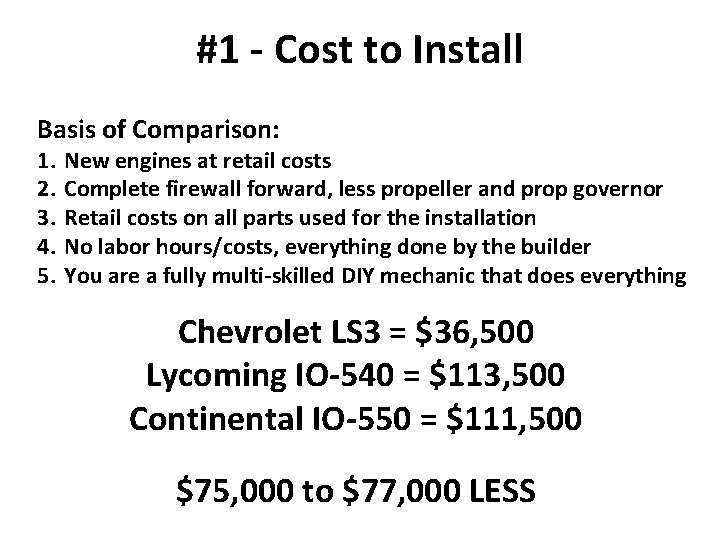
#1 - Cost to Install Basis of Comparison: 1. 2. 3. 4. 5. New engines at retail costs Complete firewall forward, less propeller and prop governor Retail costs on all parts used for the installation No labor hours/costs, everything done by the builder You are a fully multi-skilled DIY mechanic that does everything Chevrolet LS 3 = $36, 500 Lycoming IO-540 = $113, 500 Continental IO-550 = $111, 500 $75, 000 to $77, 000 LESS
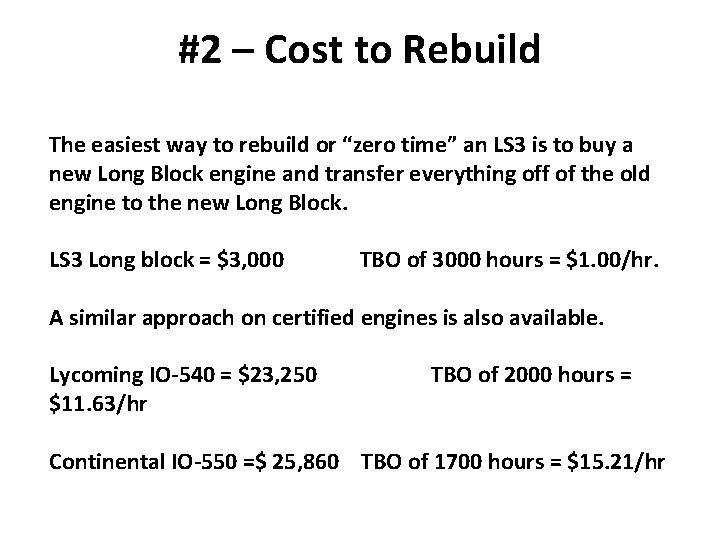
#2 – Cost to Rebuild The easiest way to rebuild or “zero time” an LS 3 is to buy a new Long Block engine and transfer everything off of the old engine to the new Long Block. LS 3 Long block = $3, 000 TBO of 3000 hours = $1. 00/hr. A similar approach on certified engines is also available. Lycoming IO-540 = $23, 250 $11. 63/hr TBO of 2000 hours = Continental IO-550 =$ 25, 860 TBO of 1700 hours = $15. 21/hr
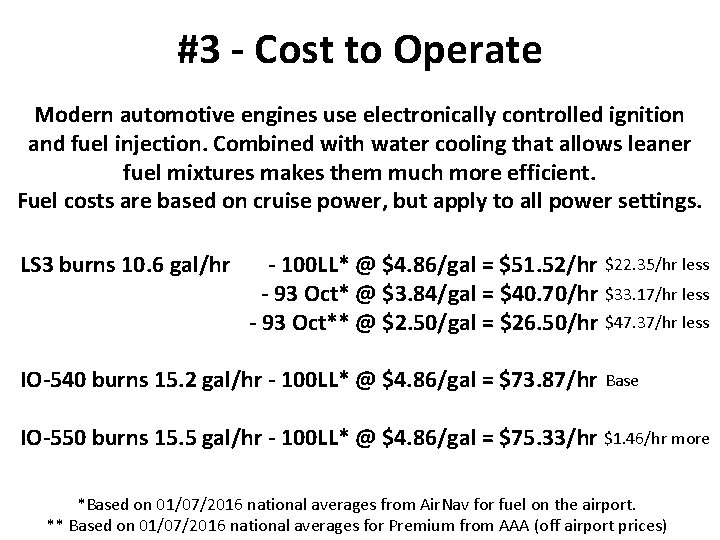
#3 - Cost to Operate Modern automotive engines use electronically controlled ignition and fuel injection. Combined with water cooling that allows leaner fuel mixtures makes them much more efficient. Fuel costs are based on cruise power, but apply to all power settings. LS 3 burns 10. 6 gal/hr - 100 LL* @ $4. 86/gal = $51. 52/hr $22. 35/hr less - 93 Oct* @ $3. 84/gal = $40. 70/hr $33. 17/hr less - 93 Oct** @ $2. 50/gal = $26. 50/hr $47. 37/hr less IO-540 burns 15. 2 gal/hr - 100 LL* @ $4. 86/gal = $73. 87/hr Base IO-550 burns 15. 5 gal/hr - 100 LL* @ $4. 86/gal = $75. 33/hr $1. 46/hr more *Based on 01/07/2016 national averages from Air. Nav for fuel on the airport. ** Based on 01/07/2016 national averages for Premium from AAA (off airport prices)
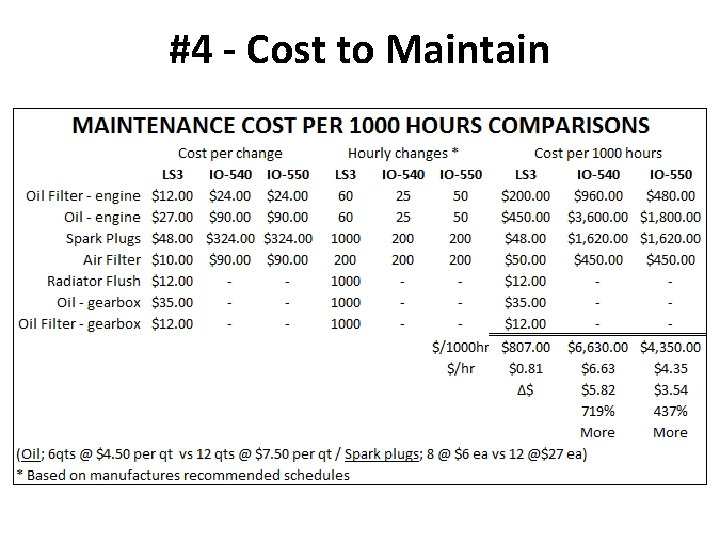
#4 - Cost to Maintain
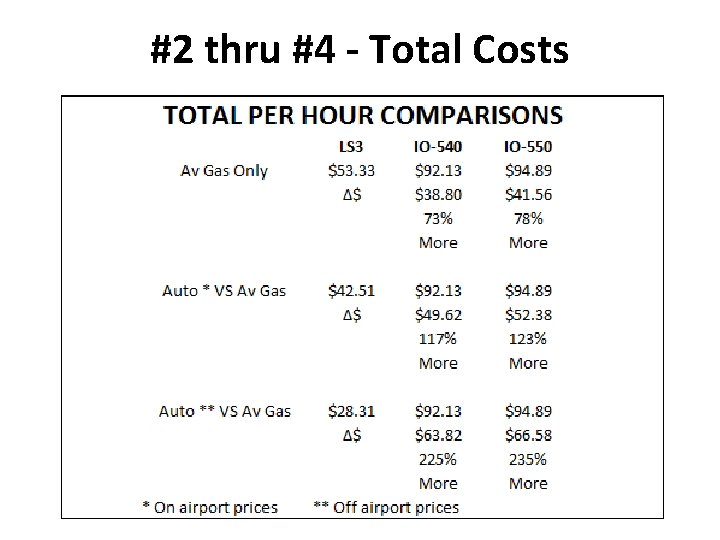
#2 thru #4 - Total Costs
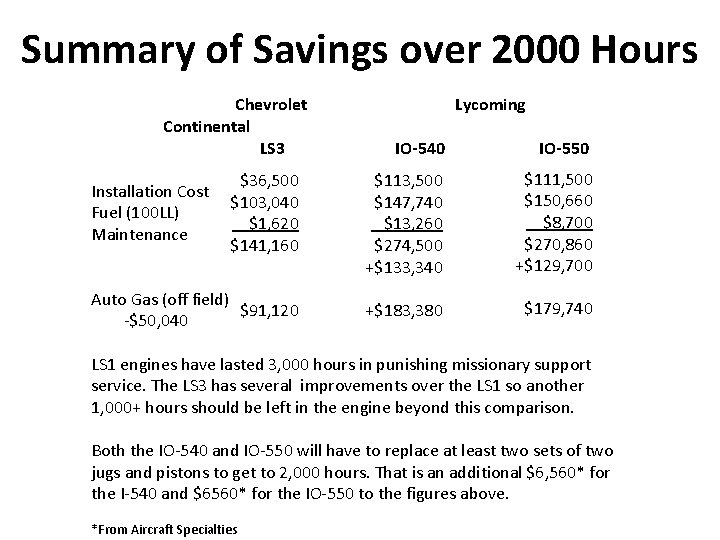
Summary of Savings over 2000 Hours Chevrolet Continental LS 3 Installation Cost Fuel (100 LL) Maintenance $36, 500 $103, 040 $1, 620 $141, 160 Auto Gas (off field) $91, 120 -$50, 040 Lycoming IO-540 IO-550 $113, 500 $147, 740 $13, 260 $274, 500 +$133, 340 $111, 500 $150, 660 $8, 700 $270, 860 +$129, 700 +$183, 380 $179, 740 LS 1 engines have lasted 3, 000 hours in punishing missionary support service. The LS 3 has several improvements over the LS 1 so another 1, 000+ hours should be left in the engine beyond this comparison. Both the IO-540 and IO-550 will have to replace at least two sets of two jugs and pistons to get to 2, 000 hours. That is an additional $6, 560* for the I-540 and $6560* for the IO-550 to the figures above. *From Aircraft Specialties
#5 - Convenience The major convenience is that all of your maintenance parts are available at local automotive parts stores 14 hours a day Monday through Saturday and 10 hours on Sunday. Some parts are available 24/7 at Wal-Mart. All of this convenience is usually within a short drive of home, or any airport if needed. If you are lucky enough to have an aircraft parts supplier in your area they usually are open 8 am to 5 pm Monday through Friday. You better call first to make sure they have what you need, if not be ready to wait several days, and be ready to pay top price. Or you could get better prices by ordering the parts you need online and then wait several days for it to be delivered directly to you. If you are stuck away from home both the inconveniences and costs go way up.
#6 - Smoothness Most modern car engines are internally balanced to operate as smooth as possible in the family car. The Generation IV and V series of LS engines updated the cylinder firing order as well. Modern automotive fuel injection intake manifolds have equal length runners along with individual injectors at each intake valve guaranteeing a consistent fuel/air mixture to each cylinder for a smoother running engine. This also makes for a quieter engine. All this smoothness and less noise reduces fatigue on the airframe, components, and the occupants. Car manufacturers know that Momma doesn’t like anything less than smooth and quiet, or their sales figures will drop.
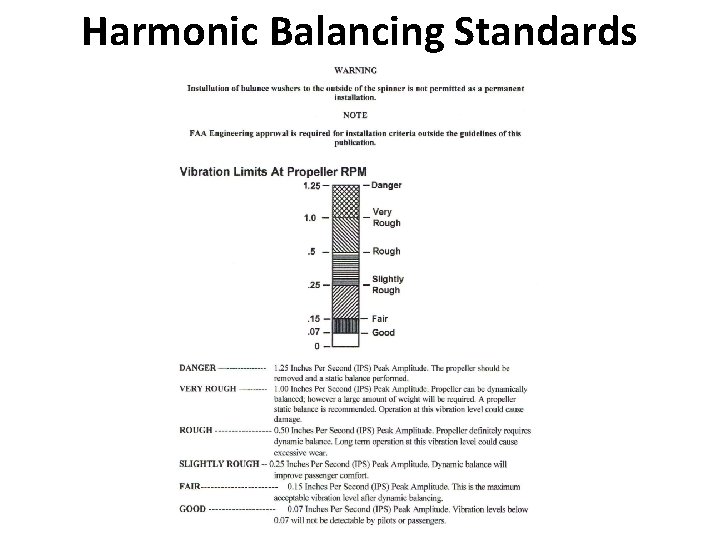
Harmonic Balancing Standards
Harmonic Survey Unique Issues of Balancing a V 8 with an Automatic Clutch 1. Currently all dynamic balancing systems are based on horizontally opposed engines. They ignore out all horizontal vibrations and balance based on vibrations in the vertical plane. 2. A V 8 engine configuration creates vibrations in between both planes making difficult to isolate the engine from the propeller. 3. The propeller is always reconnecting to the crankshaft at a different angle rather than being bolted in a fixed clocked position. SOLUTION 1. Dynamically balancing the flywheel and pressure plate assembly prior to balancing the propeller removed all “wandering” inputs to the propeller balancing sensor. 2. The ACES 2020 balancing system was then able to “learn” and adjusted it’s calculations over 6 balancing runs resulting in a 0. 03 IPS balance with temporary weights, and 0. 06 IPS with permanent weights. Anything less than 0. 07 IPS is considered good and the ACES system stops calculating corrections.
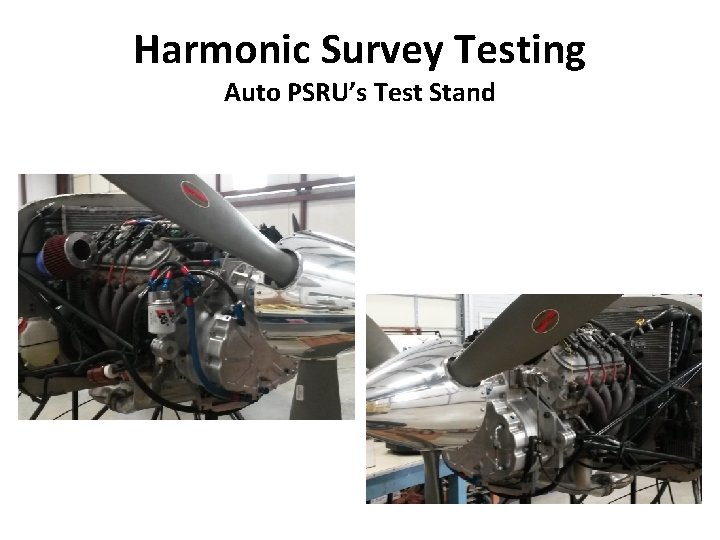
Harmonic Survey Testing Auto PSRU’s Test Stand
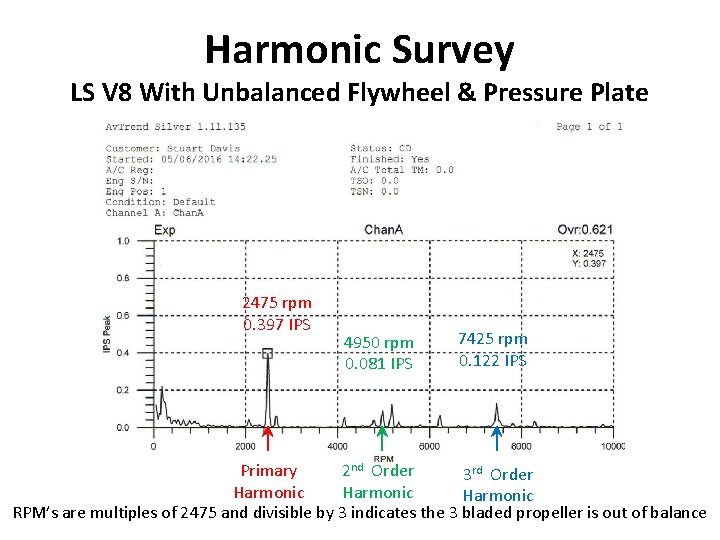
Harmonic Survey LS V 8 With Unbalanced Flywheel & Pressure Plate 2475 rpm 0. 397 IPS 4950 rpm 0. 081 IPS 7425 rpm 0. 122 IPS Primary 2 nd Order 3 rd Order Harmonic RPM’s are multiples of 2475 and divisible by 3 indicates the 3 bladed propeller is out of balance
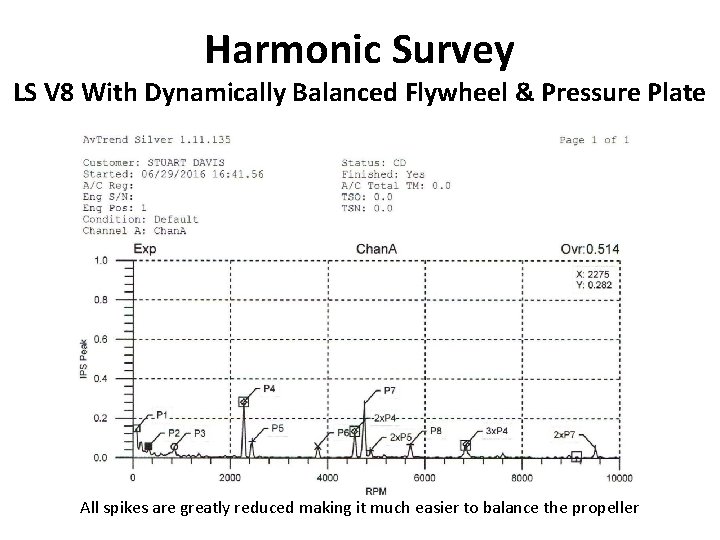
Harmonic Survey LS V 8 With Dynamically Balanced Flywheel & Pressure Plate All spikes are greatly reduced making it much easier to balance the propeller
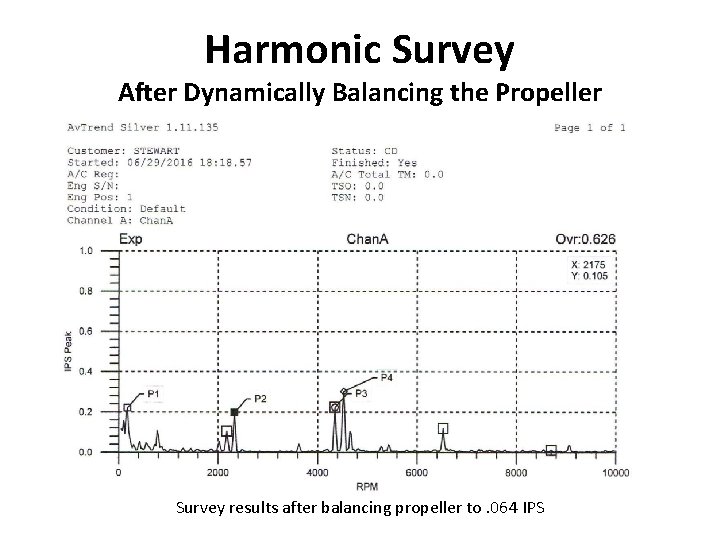
Harmonic Survey After Dynamically Balancing the Propeller Survey results after balancing propeller to. 064 IPS
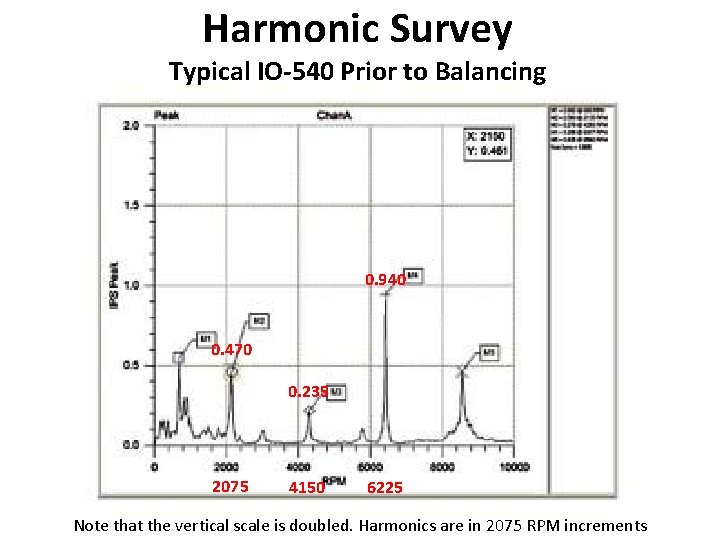
Harmonic Survey Typical IO-540 Prior to Balancing 0. 940 0. 470 0. 235 2075 4150 6225 Note that the vertical scale is doubled. Harmonics are in 2075 RPM increments
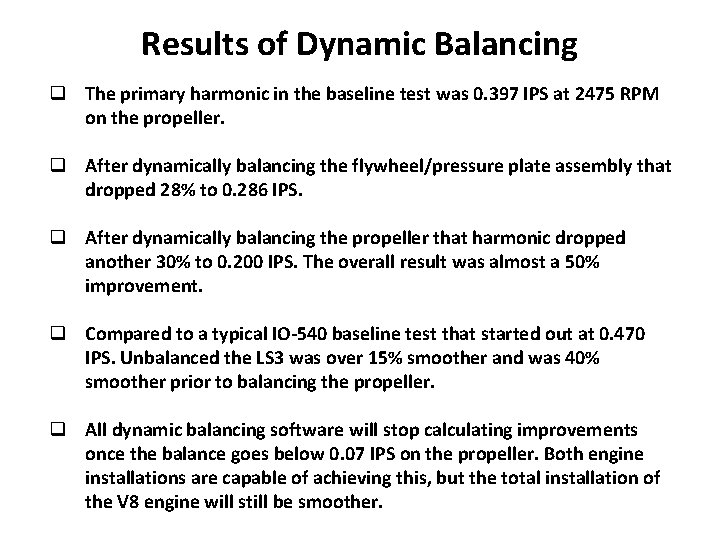
Results of Dynamic Balancing q The primary harmonic in the baseline test was 0. 397 IPS at 2475 RPM on the propeller. q After dynamically balancing the flywheel/pressure plate assembly that dropped 28% to 0. 286 IPS. q After dynamically balancing the propeller that harmonic dropped another 30% to 0. 200 IPS. The overall result was almost a 50% improvement. q Compared to a typical IO-540 baseline test that started out at 0. 470 IPS. Unbalanced the LS 3 was over 15% smoother and was 40% smoother prior to balancing the propeller. q All dynamic balancing software will stop calculating improvements once the balance goes below 0. 07 IPS on the propeller. Both engine installations are capable of achieving this, but the total installation of the V 8 engine will still be smoother.
#7 - Because you can Most of us build because we want to. We like it for several reasons. There is a lot of satisfaction from it when you can say “I built that”. When you can also say “It costs less, burns less fuel, and performs better” then that satisfaction grows exponentially. Referring back to the LS 3 conversions that we do lets look at the performance differences. At the propeller flange the LS 3/BW 350 delivers 67 more horse power and 125 more lb-ft torque at takeoff. That is a 22% increase over an IO-540, with similar increases at all power settings. The Firewall Forward installation of an LS 3 weighs an average of 24 pounds less. That equals better take-off, climb, cruise, and max air speed performance. Over all fuel burn is 30% less which saves money and increases range.
Determining a Good Engine 7 Things to look for in an Automotive engine conversion 1. Power to weight ration of 2. 0, or better. It is better if max HP is made at 6000 RPM or less. (LS 3 weighs 580#, stock is 430 hp @ 5800 rpm = 1. 348#/hp, for aircraft application is 367 hp @ 4500 rpm, 580# = 1. 580#/hp) 2. Has a good reputation for being a fuel efficient and as a reliable car engine. 3. Makes the same, or a little more, horsepower than the certified engine recommended for your aircraft. 4. Does not weigh 15 to 30 lbs more than the certified engine recommended for your aircraft. (This is a reasonable limit for ballasting with the battery, etc. ) (The LS 3 installation averages 24# less than the IO-540) 5. Has an electronic ignition, or can be upgraded to something better than points in a distributor. 6. Will fit within the cowling with no or little modifications. 7. Replica/Scale aircraft requirements will change many of the above items. (The #/hp, fuel efficiency, and ignition may not matter, etc. )
Crate Engines Not Available? What are your best options Buy a Firewall Forward package. This is probably the easiest and fastest way to get a trouble free automotive conversion. The company has already done all the research and development for the best parts and configuration of those parts to fit under your cowling. Buy a new engine from a dealer. This is almost like buying a crate engine but may pose some problems. Many foreign manufactures require that you provide the VIN of the car you intend to replace an old engine with the new engine. They may also cross reference your VIN with registration records to verify it is not a totaled/salvaged vehicle.
Crate Engines Not Available? What are your best options (continued) Get a used engine out of a donor car or salvage yard. This will avoid any issues with a VIN but has other considerations. Even if the history of the engine is known or guaranteed (low mileage, doesn’t burn oil, etc. ) it probably isn’t in good enough condition to last very long in an aircraft application. A complete overhaul is the best approach. Using upgraded parts will also address any standard production part short comings. Build a new engine based 100% on aftermarket parts. This is one way to get a collection of hell for stout engine parts. It isn’t easy to do this correctly and end up with the desired results, unless you are duplicating what someone else has already developed. Blazing a new trail successfully requires a lot of technical knowledge, or an engine shop that is willing to work with you.
Crate Engines Not Available? What are your best options (continued) Draw backs of building your own engine. Weather it is a certified engine or an automotive engine conversion that you overhaul yourself most insurance companies will not cover your aircraft during the Phase 1 flight tests. This the a major appeal of an automotive crate engine or a new engine purchased from a dealer. The same goes or a factory long block for a rebuild. If you are starting with a used engine, or build a custom engine from 100% aftermarket parts, the insurance company might cover Phase 1 flight testing if the engine is assembled and tested by a reputable shop.
What Auto PSRU’s can provide Auto PSRU’s provides several products and services for automotive engine conversions. 1. The BW 350 b – for 300 to 400 hp engines 2. The 200 Za – for 150 to 300 hp engines 3. Firewall Forward packages for the BW 350 b 4. Special projects support
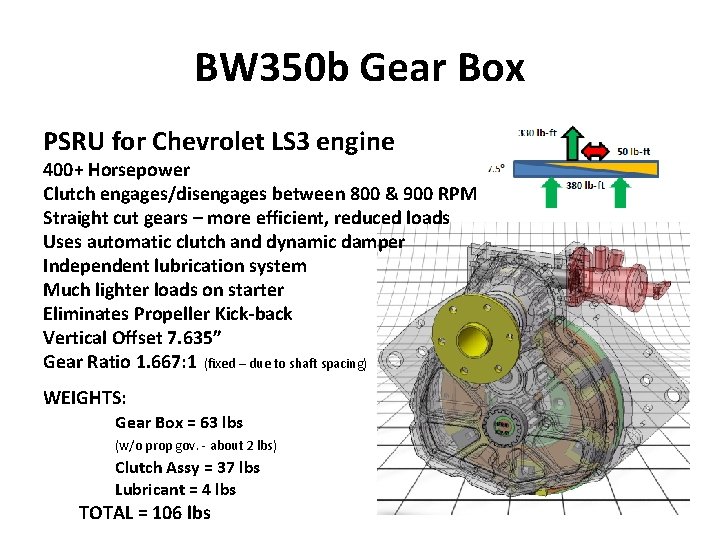
BW 350 b Gear Box PSRU for Chevrolet LS 3 engine 400+ Horsepower Clutch engages/disengages between 800 & 900 RPM Straight cut gears – more efficient, reduced loads Uses automatic clutch and dynamic damper Independent lubrication system Much lighter loads on starter Eliminates Propeller Kick-back Vertical Offset 7. 635” Gear Ratio 1. 667: 1 (fixed – due to shaft spacing) WEIGHTS: Gear Box = 63 lbs (w/o prop gov. - about 2 lbs) Clutch Assy = 37 lbs Lubricant = 4 lbs TOTAL = 106 lbs
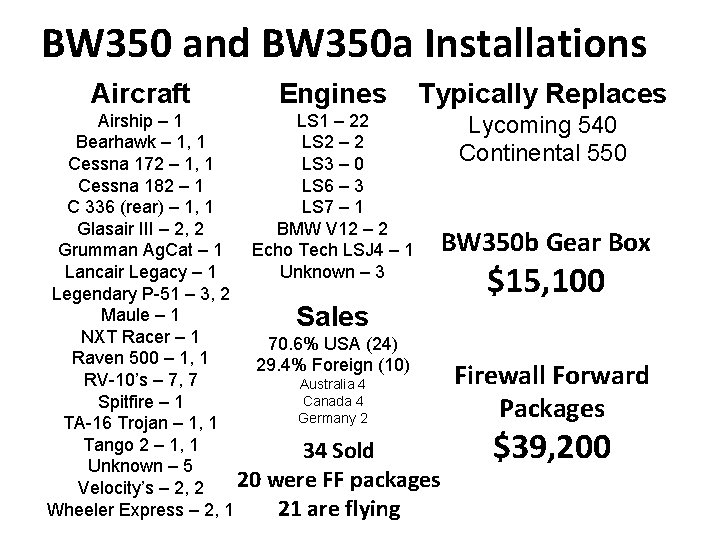
BW 350 and BW 350 a Installations Aircraft Engines Typically Replaces Airship – 1 LS 1 – 22 Lycoming 540 Bearhawk – 1, 1 LS 2 – 2 Continental 550 Cessna 172 – 1, 1 LS 3 – 0 Cessna 182 – 1 LS 6 – 3 C 336 (rear) – 1, 1 LS 7 – 1 Glasair III – 2, 2 BMW V 12 – 2 Grumman Ag. Cat – 1 Echo Tech LSJ 4 – 1 BW 350 b Gear Box Lancair Legacy – 1 Unknown – 3 Legendary P-51 – 3, 2 Maule – 1 Sales NXT Racer – 1 70. 6% USA (24) Raven 500 – 1, 1 29. 4% Foreign (10) Firewall Forward RV-10’s – 7, 7 Australia 4 Canada 4 Spitfire – 1 Packages Germany 2 TA-16 Trojan – 1, 1 Tango 2 – 1, 1 34 Sold Unknown – 5 20 were FF packages Velocity’s – 2, 2 Wheeler Express – 2, 1 21 are flying $15, 100 $39, 200
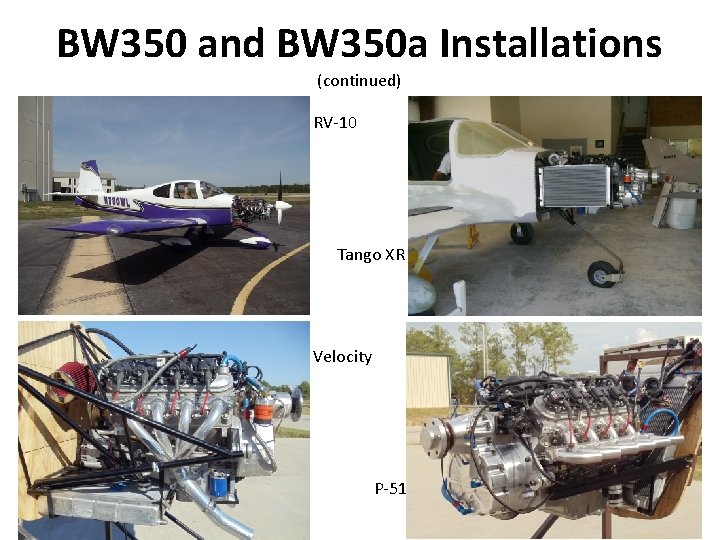
BW 350 and BW 350 a Installations (continued) RV-10 Tango XR Velocity P-51
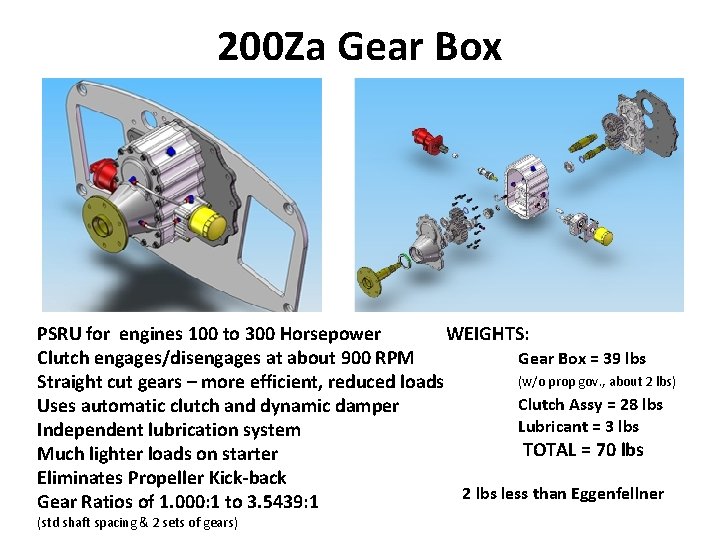
200 Za Gear Box PSRU for engines 100 to 300 Horsepower WEIGHTS: Clutch engages/disengages at about 900 RPM Gear Box = 39 lbs (w/o prop gov. , about 2 lbs) Straight cut gears – more efficient, reduced loads Clutch Assy = 28 lbs Uses automatic clutch and dynamic damper Lubricant = 3 lbs Independent lubrication system TOTAL = 70 lbs Much lighter loads on starter Eliminates Propeller Kick-back 2 lbs less than Eggenfellner Gear Ratios of 1. 000: 1 to 3. 5439: 1 (std shaft spacing & 2 sets of gears)
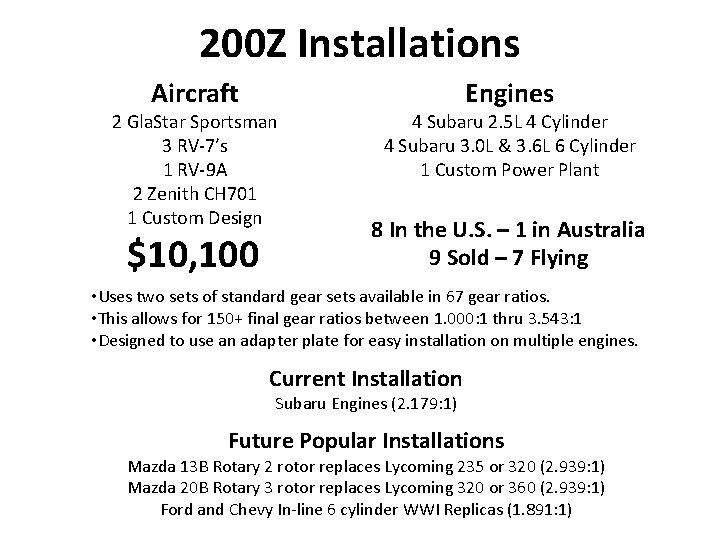
200 Z Installations Aircraft 2 Gla. Star Sportsman 3 RV-7’s 1 RV-9 A 2 Zenith CH 701 1 Custom Design $10, 100 Engines 4 Subaru 2. 5 L 4 Cylinder 4 Subaru 3. 0 L & 3. 6 L 6 Cylinder 1 Custom Power Plant 8 In the U. S. – 1 in Australia 9 Sold – 7 Flying • Uses two sets of standard gear sets available in 67 gear ratios. • This allows for 150+ final gear ratios between 1. 000: 1 thru 3. 543: 1 • Designed to use an adapter plate for easy installation on multiple engines. Current Installation Subaru Engines (2. 179: 1) Future Popular Installations Mazda 13 B Rotary 2 rotor replaces Lycoming 235 or 320 (2. 939: 1) Mazda 20 B Rotary 3 rotor replaces Lycoming 320 or 360 (2. 939: 1) Ford and Chevy In-line 6 cylinder WWI Replicas (1. 891: 1)
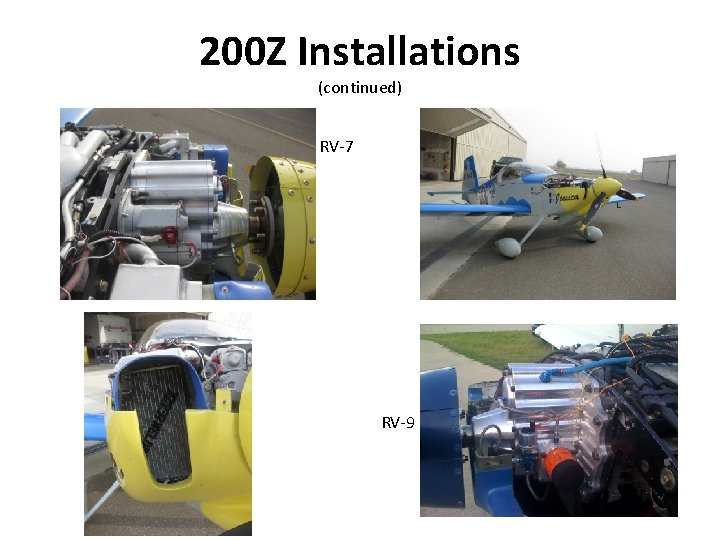
200 Z Installations (continued) RV-7 RV-9
New PSRU Model Designations Due to all the new features developed incorporated into both PSRU’s over the last 3 years as of January 01, 2016 new model designations were rolled over. The BW 350 becomes the BW 350 b (technically the BW 350 a was going from the old cast aluminum case to a the current CNC machined billet aluminum case) The 200 Z becomes the 200 Za.
BW 350 b Upgrades Relocated case vent New seal retainers Flywheel, pressure plate, and weight upgrades • New retainer ring (increase RPM limitation from about 4800 to 6000+) • Cerakote coating on Flywheel Fingers (eliminates rust & sticking weights) • Centrifugal weights changed from 1080 steal to 17 -4 Stainless New oil filter and mount Magnetic drain plug and filler plug New oil level sight tube
200 Za Upgrades New seal retainers Flywheel, pressure plate, and weight upgrades • Cerakote coating on Flywheel Fingers (eliminates rust and sticky weights) • Centrifugal weights changed from 1080 steal to 17 -4 Stainless Magnetic drain plug and filler plug New oil level sight tube
Production Time Lines The 200 Z went into production again in July 2013. The BW 350 a testing of upgrades to the flywheel/clutch system completed October 2013 and went back into production in November 2013. The delivery of a BW 350 b or a 200 Za PSRU started in January 2016. It typically takes 90 to 120 days from the time an order deposit clears until delivery. Development for new engine and/or installations into a new airframe could take longer.
Old Stock Discounts Currently there are two 200 Z cases already machined for the removable dipstick, and one BW 350 a case that is not machined for a dipstick. All three cases will be equipped with the new oil level sight tube. Due to the overlap with the newer models I will be discounting the price of PSRU’s ordered with these three older cases by 10%. That is $1, 510 off for the BW 350 a case and $1, 010 off for both 200 Z cases. All the other upgrades are included. The online ordering system is not set up to process this special offer so call or email if you are interested.
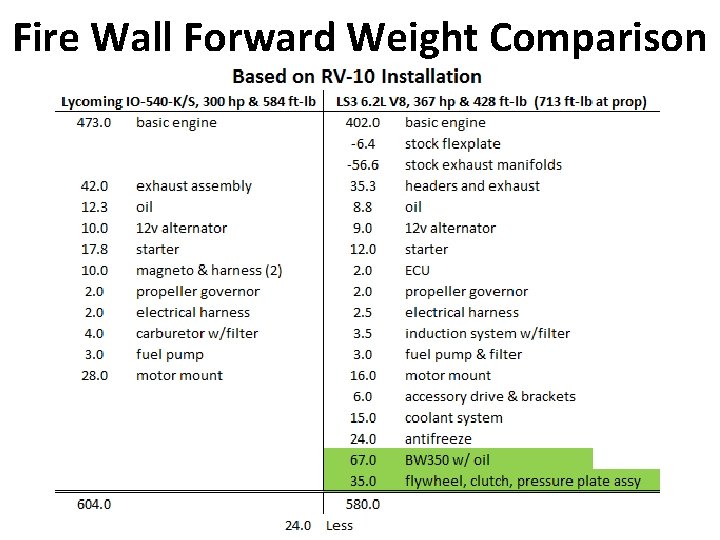
Fire Wall Forward Weight Comparison

QUESTIONS & ANSWERS EXCLUDED TOPICS: Politics Taxes Weather Religion
- Slides: 44