
Why Trauma Matters A TraumaInformed Answer Presented by
“Why Trauma Matters” A Trauma-Informed Answer Presented by: Arabella Perez, LCSW Director THRIVE Initiative
What is Trauma and Why Does it Matter? • The personal experience of interpersonal violence including sexual abuse, physical abuse, severe neglect, loss, and/or the witnessing of violence, terrorism and/or disasters. NASMHPD, 2004 • We all care clinically but why should you care as a leader about systems change? • Evidence – Adverse Childhood Experiences and local research • Preventable health and human event with enormous societal cost working together for a brighter tomorrow
What is Trauma and Why Does it Matter? ØTrauma is pervasive ØTrauma’s impact is broad and diverse ØTrauma’s impact is deep and life-shaping ØTrauma is often self-perpetuating and differentially affects the more vulnerable ØTrauma affects how people approach services ØThe service system has often been traumatizing and/or re-traumatizing working together for a brighter tomorrow
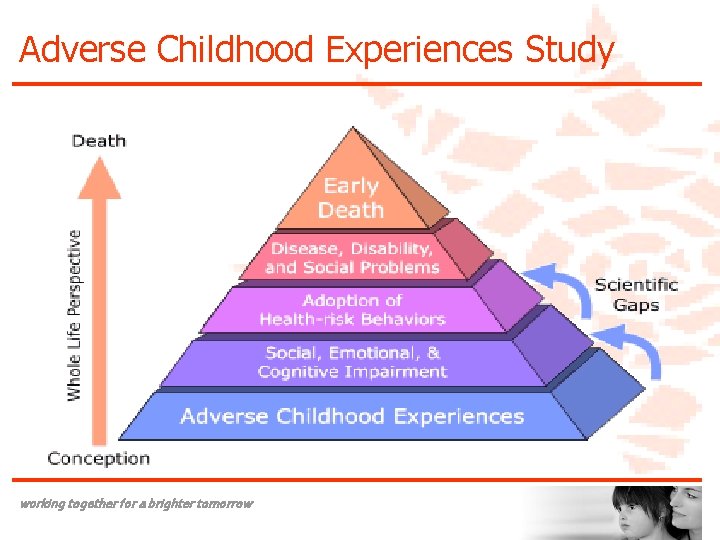
Adverse Childhood Experiences Study working together for a brighter tomorrow
National Data Gordon Hodas, Responding to Childhood Trauma: the Promise and Practice of Trauma Informed Care, February 2006, Pennsylvania Office of Mental Health and Substance Abuse. Some excerpts: • • • 81% patients in psychiatric hospital experienced physical and or sexual abuse, 67% as children Massachusetts adolescent inpatient record review showed 93% reported trauma 93. 2 % males and 84% female of juvenile detainees reported a traumatic experience Ø Males likely to witness violence, females likely to be victimized by violence Ø Childhood abuse and neglect increases likelihood of arrest as a juvenile by 53% working together for a brighter tomorrow
Maine Data Children and youth trauma survivors: • • • Were significantly younger; Were 1. 62 times more likely to be rated at moderate to serious risk of harm (as measured by the CALOCUS); Were 1. 76 times more likely to experience higher-levels of environmental stress and 1. 65 times more likely to have moderate to severe challenges in the area of supports; Were ½ as likely to experience serious challenges with substance use (as measured by CAFAS) Had significantly greater challenges in the areas of child/youth and parent/caregiver acceptance & engagement with service providers; Than children and youth without a trauma history working together for a brighter tomorrow
Maine Data Child and youth trauma survivors: • • Were more likely to use high-end mental health services, including: inpatient psychiatric hospitalization, residential/group treatment, and crisis intervention services at higher cost; Were 1. 92 times more likely to use out-of-home treatment (Psych. Inpatient, Resid. Tx. Crisis Residential); Were 1. 55 times more likely to use Outpatient Mental Health treatment services Were 1. 75 times more likely to use Medication Management Services Used more Targeted Case Management services at significant higher expense; Used outpatient-clinical and medication management services at significantly higher cost; Had 73% higher mental health service expenditures & 51% higher overall treatment expenditures; Were significantly less likely to exhibit behavioral/functional stability or improvement over study period. Than children and youth without a trauma history working together for a brighter tomorrow
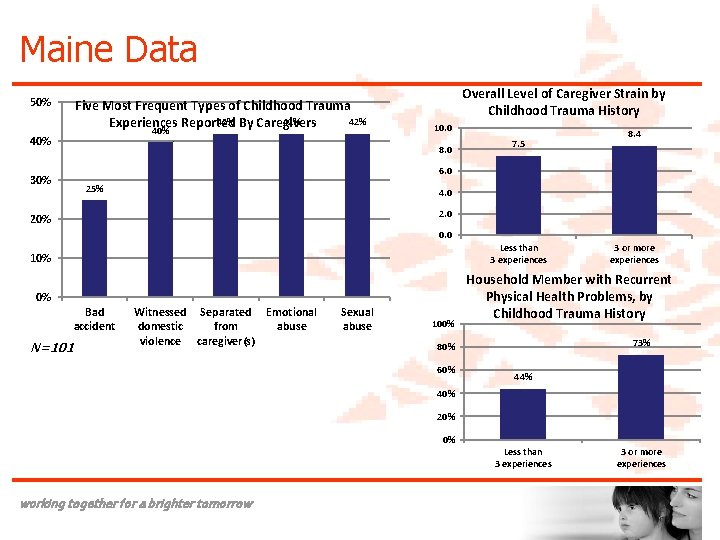
Maine Data 50% 40% 30% Five Most Frequent Types of Childhood Trauma 42% By Caregivers 42% Experiences Reported 40% Overall Level of Caregiver Strain by Childhood Trauma History 10. 0 8. 0 7. 5 8. 4 6. 0 25% 4. 0 20% 0. 0 Less than 3 experiences 10% 0% Bad accident N=101 Witnessed Separated Emotional domestic from abuse violence caregiver(s) Sexual abuse 100% Household Member with Recurrent Physical Health Problems, by Childhood Trauma History 73% 80% 60% 3 or more experiences 44% 40% 20% 0% Less than 3 experiences working together for a brighter tomorrow 3 or more experiences
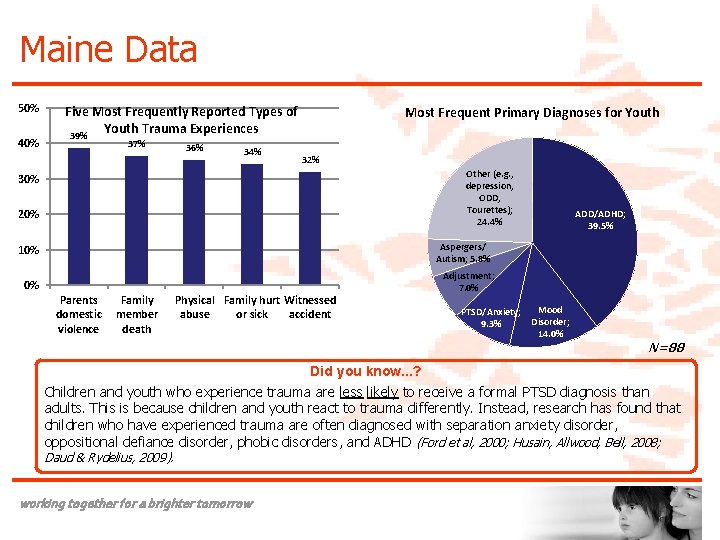
Maine Data 50% 40% Five Most Frequently Reported Types of Youth Trauma Experiences 39% 37% 36% 34% Most Frequent Primary Diagnoses for Youth 32% Other (e. g. , depression, ODD, Tourettes); 24. 4% 30% 20% ADD/ADHD; 39. 5% Aspergers/ Autism; 5. 8% 10% 0% Parents domestic violence Family member death Physical Family hurt Witnessed abuse or sick accident Adjustment; 7. 0% PTSD/Anxiety; 9. 3% Mood Disorder; 14. 0% N=88 Did you know. . . ? Children and youth who experience trauma are less likely to receive a formal PTSD diagnosis than adults. This is because children and youth react to trauma differently. Instead, research has found that children who have experienced trauma are often diagnosed with separation anxiety disorder, oppositional defiance disorder, phobic disorders, and ADHD (Ford et al, 2000; Husain, Allwood, Bell, 2008; Daud & Rydelius, 2009). working together for a brighter tomorrow
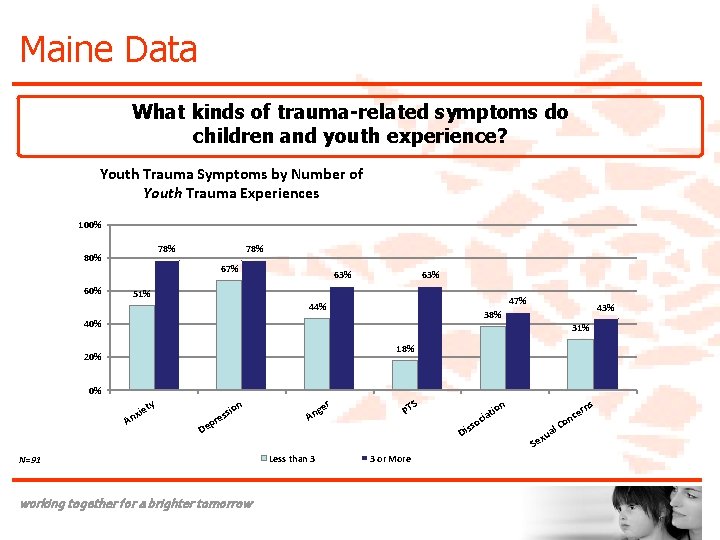
Maine Data What kinds of trauma-related symptoms do children and youth experience? Youth Trauma Symptoms by Number of Youth Trauma Experiences 100% 78% 80% 78% 67% 60% 63% 51% 47% 44% 43% 38% 40% 31% 18% 20% 0% ty ie nx A on si res p De N=91 working together for a brighter tomorrow er g An Less than 3 S on PT Di sso 3 or More ti cia Se o l. C a xu s rn e nc
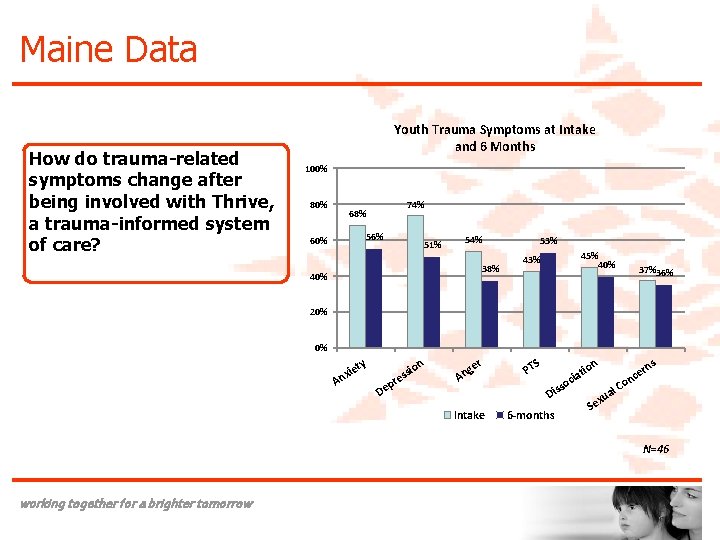
Maine Data How do trauma-related symptoms change after being involved with Thrive, a trauma-informed system of care? Youth Trauma Symptoms at Intake and 6 Months 100% 80% 74% 68% 56% 60% 51% 54% 38% 40% 53% 45% 40% 43% 37%36% 20% 0% ty ie nx A on p De si res g An er Intake S on PT sso Di 6 -months ti cia x Se l ua Co s rn e nc N=46 working together for a brighter tomorrow
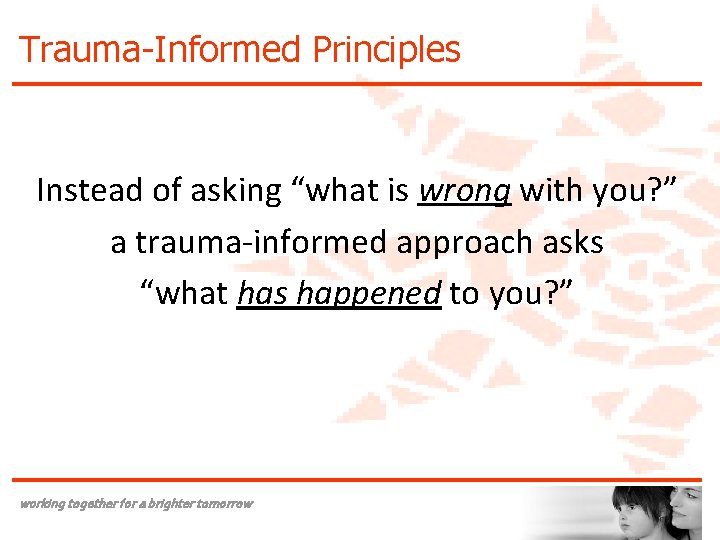
Trauma-Informed Principles Instead of asking “what is wrong with you? ” a trauma-informed approach asks “what has happened to you? ” working together for a brighter tomorrow
The Trauma-Informed Principles 1. 2. 3. 4. 5. 6. Safety Trustworthiness Choice Collaboration Empowerment Language Access and Cultural Competency working together for a brighter tomorrow
The Trauma-Informed Domains 1. Physical and Emotional Safety 2. Youth & Family Empowerment, Choice and Collaboration 3. Trauma Competence 4. Trustworthiness 5. Commitment to Trauma-Informed Philosophy 6. Language Access and Cultural Competency working together for a brighter tomorrow
Traditional vs. Trauma Informed vs. Trauma Specific How are these different? • Traditional: Business as Usual • Trauma Informed: First Floor • Trauma Specific: Second Floor working together for a brighter tomorrow
Traditional versus Trauma-Informed • Understanding of Trauma • Understanding of the child/youth survivor • Understanding of services • Understanding of the service relationship working together for a brighter tomorrow
National Recommendations Strengthening Policies to Support Children, Youth, and Families Who Experience Trauma, July 2007 National Center for Children in Poverty Columbia University Policies should support: • Delivery systems that identify and implement strategies to prevent, identify and intervene • Prevent and eliminate treatment practices that cause trauma/retraumatization • Reinforce best practices that embodies system of care principles • Resiliency, family youth strengths and engagement strategies • Ensure that funding is supportive of trauma-informed care working together for a brighter tomorrow
Essential Elements in a Trauma Informed System • • Trauma Training for ALL Staff Engagement of Family, Youth, Adults Trauma Screening Trauma Assessments Trauma Specific Treatments Policies Community Education and Stigma Reduction Continuous Quality Improvement working together for a brighter tomorrow
The Contract Language System of Care Principles: 17. The goal of DHHS is that Providers of Children’s Behavioral Health Services are integrated in a Trauma Informed System of Care. Providers will promote the Federal Substance Abuse and Mental Health Services Administration’s (SAMHSA) System of Care Principles of 1) Family Driven, 2) Youth Guided, and 3) Culturally and Linguistically Competent care. These three System of Care Principles are described at http: //systemsofcare. samhsa. gov/. 18. An additional principle for a Maine’s Children’s Behavioral Health System of Care is that it is Trauma Informed. 19. By January 1, 2010, the Provider shall administer a system of care self Assessment Tool approved by the Department that addresses the principles referenced in paragraphs 18 and 19 herein. 20. By January 1, 2011, Provider, in collaboration with Children’s Behavioral Health Services, will include in its Quality Improvement Plan developed under Rider “A” areas of need identified by the Assessment Tool and plans to meet those needs www. maine. gov/dhhs/purchased-services/contract-2010/rider-e/RIDER-E-CS. pdf working together for a brighter tomorrow
Conclusion, Resources and Contact Information www. thriveinitiative. org www. nctsn. org (national child traumatic stress) www. chadwickcenter. org www. acestudy. org www. nccp. org (national center for children in poverty) http: //mentalhealth. samhsa. gov/nctic/ For more information please contact aperez@tcmhs. org working together for a brighter tomorrow
- Slides: 20