
why to know syllable suprasegmental also called Prosodic
why to know syllable… • suprasegmental, also called Prosodic Feature, in phonetics, a speech feature such as stress, tone, or word juncture that accompanies or is added over consonants and vowels; these features are not limited to single sounds but often extend over syllables, words, and phrases. • Understanding syallable will help us understand stress patterns and thus pronunciation of a language
syllables • The syllable is a sound segment studied on both the phonetic and phonological levels of analysis. • No matter how easy it can be for people and even for children to • count the number of syllables in a sequence • in their native language, still there are no universally agreed upon phonetic definitions of what a syllable is.
Phonetic definition • Phonetically syllables “are usually described as consisting of a centre which has little or no obstruction to airflow and which sounds comparatively loud; before and after that centre (…) there will be greater obstruction to airflow and/or less loud sound” (Roach, 2000: 70). In the monosyllable (one-syllable word) cat /kæt/, the vowel /æ/ is the “centre” at which little obstruction takes place, whereas we have complete obstruction to the airflow for the surrounding plosives /k/ and /t/.
Phonological definition • Laver (1994: 114) defines the phonological syllable as “a complex unit made up of nuclear and marginal elements”. Nuclear elements are the vowels or syllabic segments; marginal elements are the consonants or nonsyllabic segments. In the syllable paint /peɪnt/, the diphthong /eɪ/ is the nuclear element, while initial consonant /p/ and the final cluster /nt/ are marginal elements.
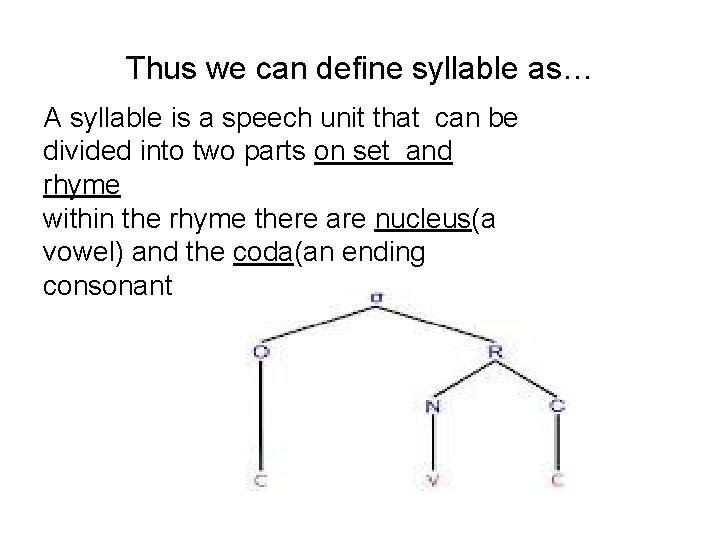
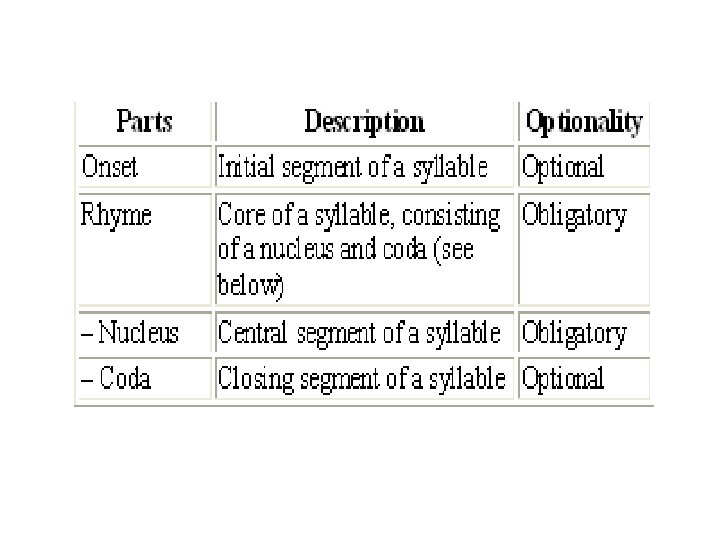
Thus we can define syllable as… A syllable is a speech unit that can be divided into two parts on set and rhyme within the rhyme there are nucleus(a vowel) and the coda(an ending consonant
Syllable theories Sonority theory Prominence theory ( prosodic theory) Chest pulse theory
Sonoroty theory • The term sonority; • The sonority of a speech sound is discussed as “its relative loudness compared to other sounds” (Giegerich, 1992: 132).
Sonority theory • An approach towards understanding syllable is presented by sonority theory. • According to this theory the pulses of pulmonic air stream (the flow of air from the lungs under comparatively constant pressure, used in forming speech sounds) in speech “correspond to peaks in sonority” » (Giegerich, 1992: 132)
Thus according to this theory… each syllable corresponds to a peak in the flow rate of pulmonic air. Thus nuclear elements, or syllabic segments can be described as intrinsically more sonorous than marginal, or non-syllabic elements.
Sonority hierarchy • Speech sounds can be ranked in terms of their intrinsic sonority according to a sonority scale( the degree of sonority of different classes of sounds affect their possible positions in the syllable)
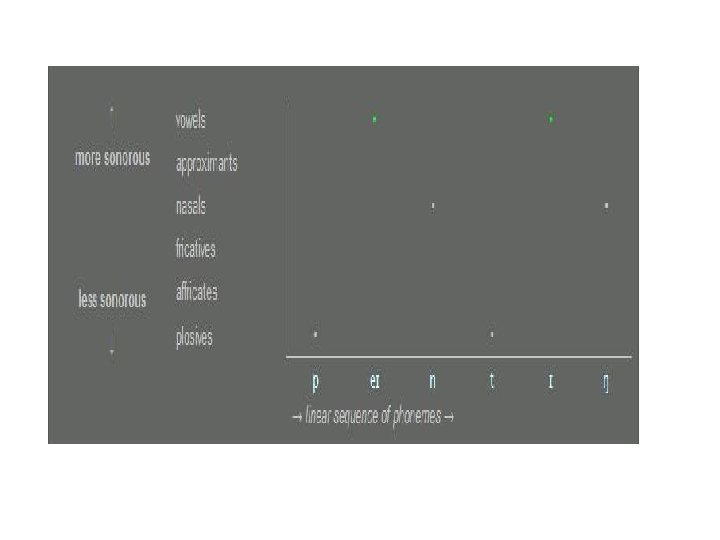
Sonority hierarchy • The sonority scale for English is given below (although in principle it is also valid for other languages). • Voiced segments are more sonorous than voiceless ones and sonorants are more sonorous than obstruents; • vowels are more sonorous than consonants, • open vowels being more sonorous than close ones. • The disyllabic word painting /ˈpeɪntɪŋ/ has been plotted onto the sonority scale as an example.
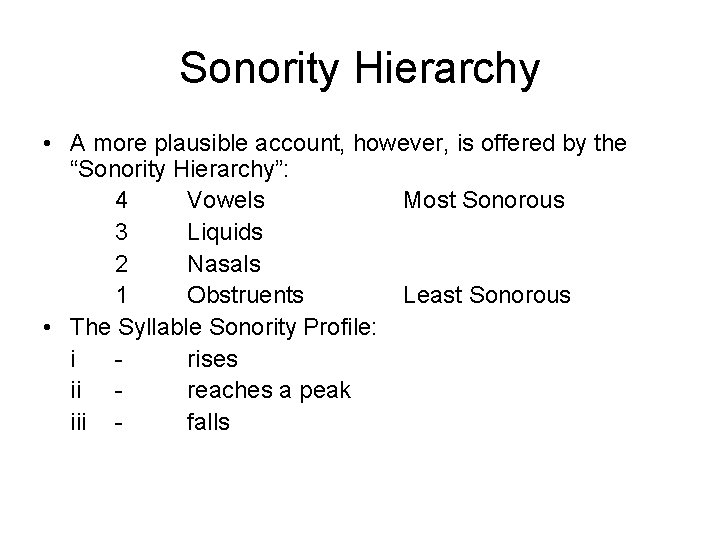
Sonority Hierarchy • A more plausible account, however, is offered by the “Sonority Hierarchy”: 4 Vowels Most Sonorous 3 Liquids 2 Nasals 1 Obstruents Least Sonorous • The Syllable Sonority Profile: i rises ii reaches a peak iii falls
![Sonority Hierarchy [sli: p]](http://slidetodoc.com/presentation_image_h2/369f0f2d3bb20c8299080a0aba96624b/image-14.jpg "Sonority Hierarchy [sli: p]")
Sonority Hierarchy [sli: p]
![Sonority Hierarchy *[lsi: p]](http://slidetodoc.com/presentation_image_h2/369f0f2d3bb20c8299080a0aba96624b/image-15.jpg "Sonority Hierarchy *[lsi: p]")
Sonority Hierarchy *[lsi: p]
Sonority Sequencing • The sonority profile of the syllable is regulated by a universal principle: The Sonority Sequencing The sonority profile of the syllable must rise until it peaks, and then fall. • So, an onset such as ls, the converse of existing sl, would violate the Sonority Sequencing Principle.
Prominence theory • Attempts have been made to provide physiological, acoustic or auditory explanations and definitions of the syllable. • According to the prominence theory, for example, which is based mainly on auditory judgements, the number of syllables in a word is determined by the number of peaks of prominence. • In the word entertaining /ˌentəˈteɪnɪŋ/ the peaks of prominence are represented by the vowels /e ə eɪ ɪ/. However, this theory does not help much in discussions of syllable division.
Rhythm create peaks of prominence in a language • Possible definition of rhythm: • Rhythm is the systematic organization of prominent and less prominent speech units in time. • Speech units: e. g. syllables • Prominence: – higher fundamental frequency – higher duration – Higher intensity • Thus syllables according to this theory are the prominent speech units that are time bound.
Chest pulse theory • The chest pulse theory discusses syllable in the context of muscular activities and lung movements in the process of speech. • Experiments have shown that the number of chest pulses, accompanied by increase of air pressure can determine the number of syllables produced (Gimson, 1980: 56), • thus allowing to associate the number of syllables with the number of chest pulses.
• This approach, however, cannot account for cases when 2 vowels occur one after the other – • for example in words like being /ˈbi: ɪŋ/ or playing /ˈpleɪɪŋ/ the second chest pulse might be almost irrelevant • and thus lead erroneously to the conclusion that such English words consist of one syllable only.
Structure of Syllable
Syllable • The syllable is a basic unit of speech studied on both the phonetic and phonological levels of analysis. • we refer to syllables (Greek letter sigma s) • Words can be cut up into units called syllables. • Humans seem to need syllables as a way of segmenting the stream of speech and giving it a rhythm of strong and weak beats, as we hear in music. • Syllables don't serve any meaning-signalling function in language; they exist only to make speech easier for the brain to process. A word contains at least one syllable.
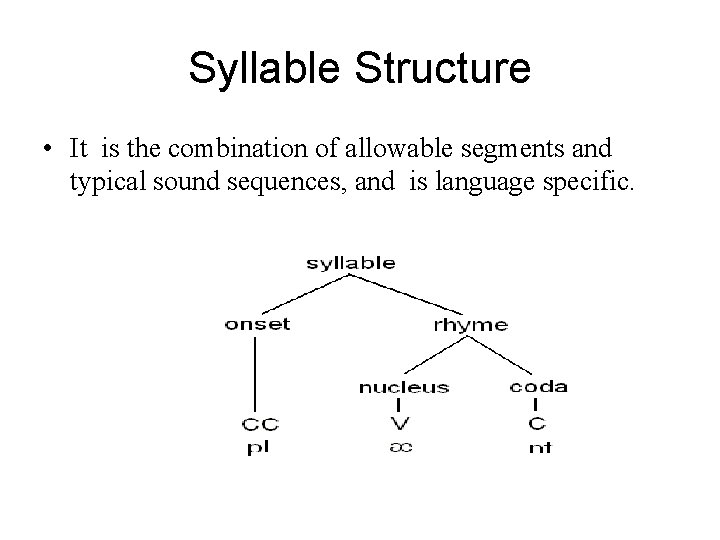
Syllable Structure • It is the combination of allowable segments and typical sound sequences, and is language specific.
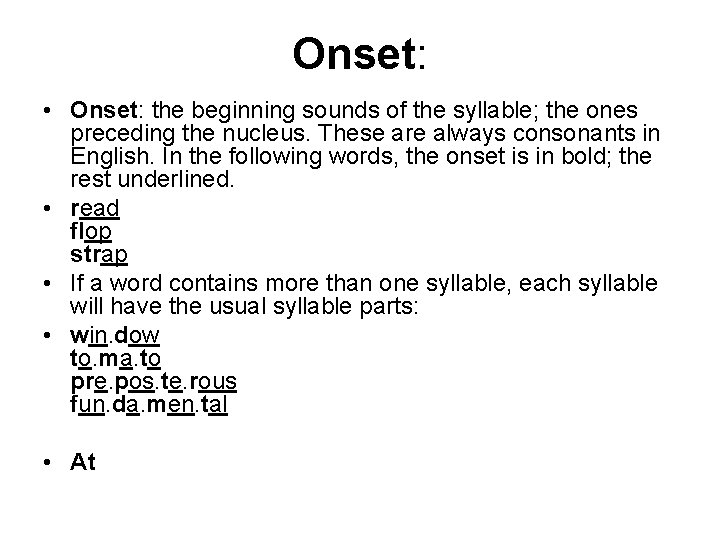
Onset: • Onset: the beginning sounds of the syllable; the ones preceding the nucleus. These are always consonants in English. In the following words, the onset is in bold; the rest underlined. • read flop strap • If a word contains more than one syllable, each syllable will have the usual syllable parts: • win. dow to. ma. to pre. pos. te. rous fun. da. men. tal • At
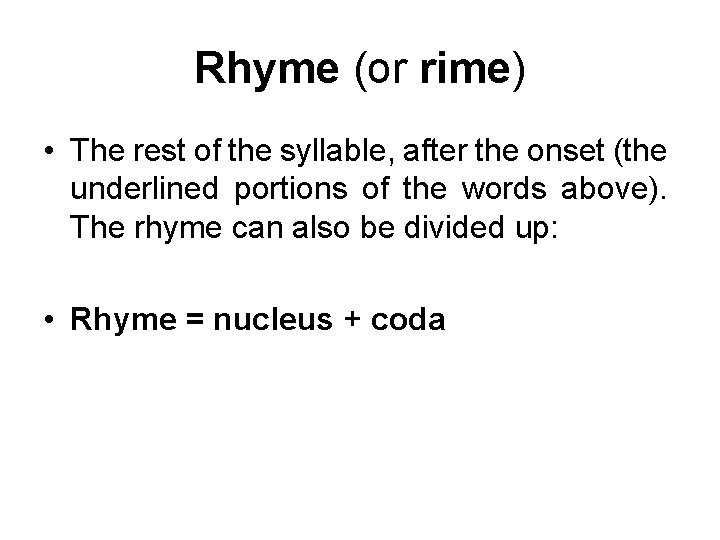
Rhyme (or rime) • The rest of the syllable, after the onset (the underlined portions of the words above). The rhyme can also be divided up: • Rhyme = nucleus + coda
Nucleus • The nucleus, as the term suggests, is the core or essential part of a syllable. • A nucleus must be present in order for a syllable to be present. • Syllable nuclei are most often highly 'sonorant' or resonant sounds, that can be relatively loud and carry a clear pitch level. • In English and most other languages, most syllable nuclei are vowels.
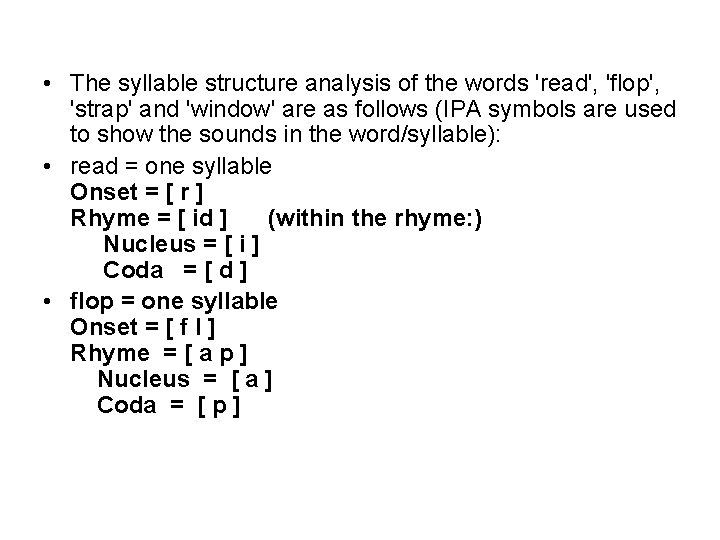
• The syllable structure analysis of the words 'read', 'flop', 'strap' and 'window' are as follows (IPA symbols are used to show the sounds in the word/syllable): • read = one syllable Onset = [ r ] Rhyme = [ id ] (within the rhyme: ) Nucleus = [ i ] Coda = [ d ] • flop = one syllable Onset = [ f l ] Rhyme = [ a p ] Nucleus = [ a ] Coda = [ p ]
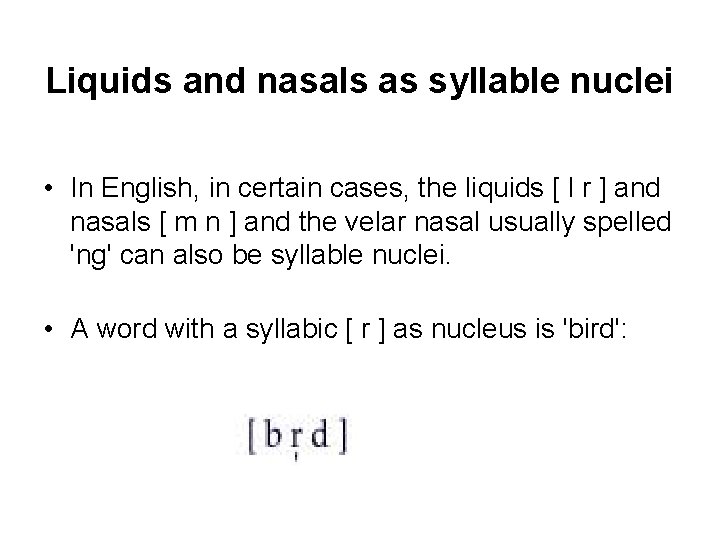
Liquids and nasals as syllable nuclei • In English, in certain cases, the liquids [ l r ] and nasals [ m n ] and the velar nasal usually spelled 'ng' can also be syllable nuclei. • A word with a syllabic [ r ] as nucleus is 'bird':
Coda • The Coda includes all consonants that follow the Peak in a syllable. • Some syllables consist only of a nucleus with no coda. • The following single-syllable words end in a nucleus and do not have a coda (phonologically): Glue Pie Through
Open and Closed Syllable • Syllables ending in a consonant, e. g. cat /kæt/, it /ɪt/, eat /i: t/, are traditionally known as closed syllables, • syllable that has a coda (VC, CVCC, etc. • whereas those ending in a vowel, as in sea /si: / or eye /aɪ/, are called open. • A coda-less syllable of the form V, CCV. • In terms of syllable structure, in closed syllables the Coda is present, while in open it is not.
Monosyllable • A word that consists of a single syllable (like dog) is called a monosyllable (and is said to be monosyllabic). • bear • can • dish • deal • ball • bat
Disyllable • It is for a word of two syllables; • arrow bellow billow borough borrow
Trisyllable • • • It is for a word of three syllables; Beautiful Terrible Horrible carefully
Polysyllable • which may refer either to a word of more than three syllables or to any word of more than one syllable. • Polysyllable • Trisyllable
Phonology of syllable
Constitution of the syllable • Syllable structure • Syllabic consonant • Phonotactic Constraint • The sonority sequencing generalization • Aspiration • Dark and clear /l/ • Onset Maximalism • Realization of /r/ • Ambisyllable • Alliteration • Syllable weight
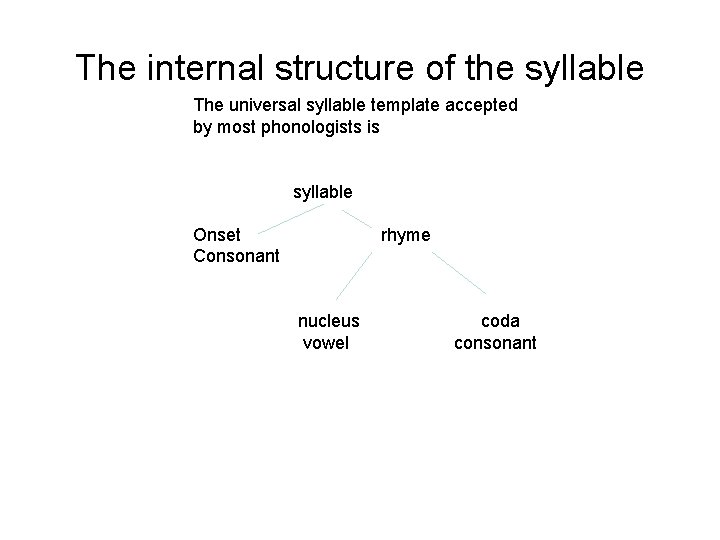
The internal structure of the syllable The universal syllable template accepted by most phonologists is syllable Onset Consonant rhyme nucleus vowel coda consonant
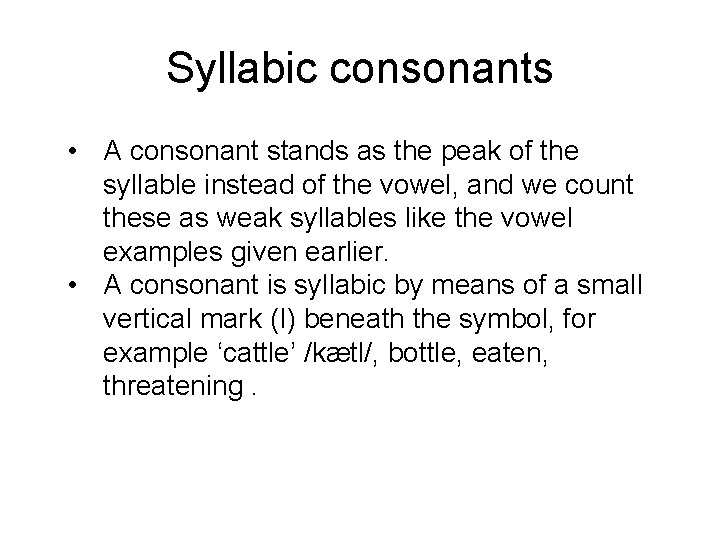
Syllabic consonants • A consonant stands as the peak of the syllable instead of the vowel, and we count these as weak syllables like the vowel examples given earlier. • A consonant is syllabic by means of a small vertical mark (I) beneath the symbol, for example ‘cattle’ /kætl/, bottle, eaten, threatening.
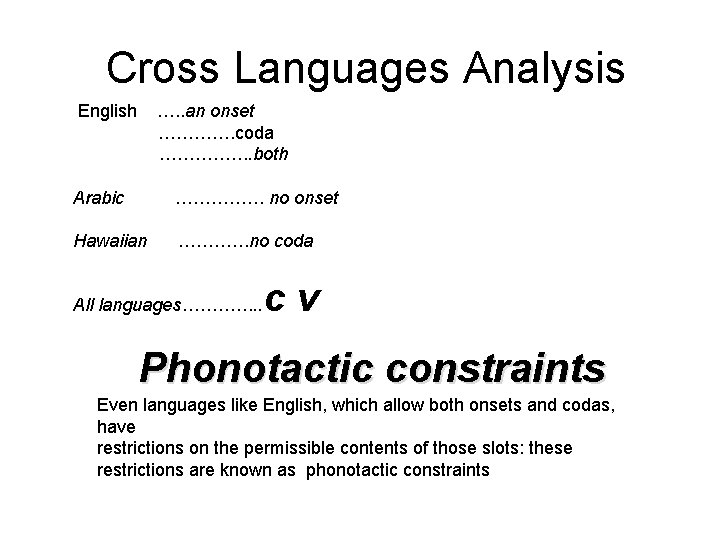
Cross Languages Analysis English …. . an onset …………. coda ……………. both Arabic …………… no onset Hawaiian …………no coda All languages…………. . cv Phonotactic constraints Even languages like English, which allow both onsets and codas, have restrictions on the permissible contents of those slots: these restrictions are known as phonotactic constraints
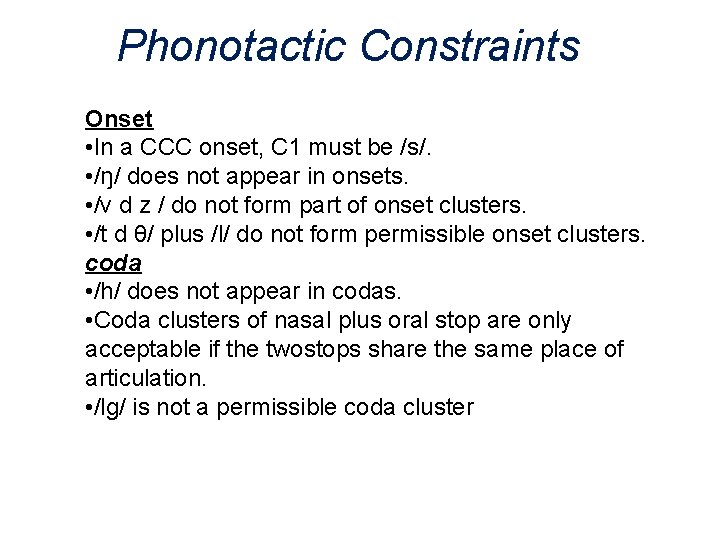
Phonotactic Constraints Onset • In a CCC onset, C 1 must be /s/. • /ŋ/ does not appear in onsets. • /v d z / do not form part of onset clusters. • /t d θ/ plus /l/ do not form permissible onset clusters. coda • /h/ does not appear in codas. • Coda clusters of nasal plus oral stop are only acceptable if the twostops share the same place of articulation. • /lg/ is not a permissible coda cluster
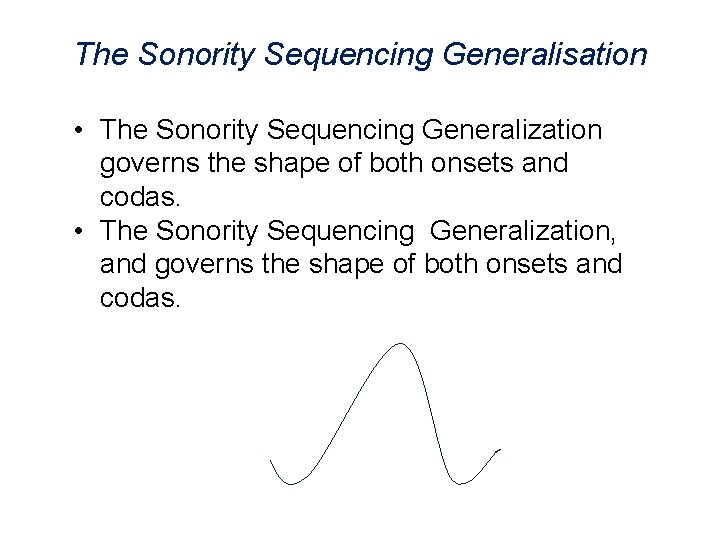
The Sonority Sequencing Generalisation • The Sonority Sequencing Generalization governs the shape of both onsets and codas. • The Sonority Sequencing Generalization, and governs the shape of both onsets and codas.
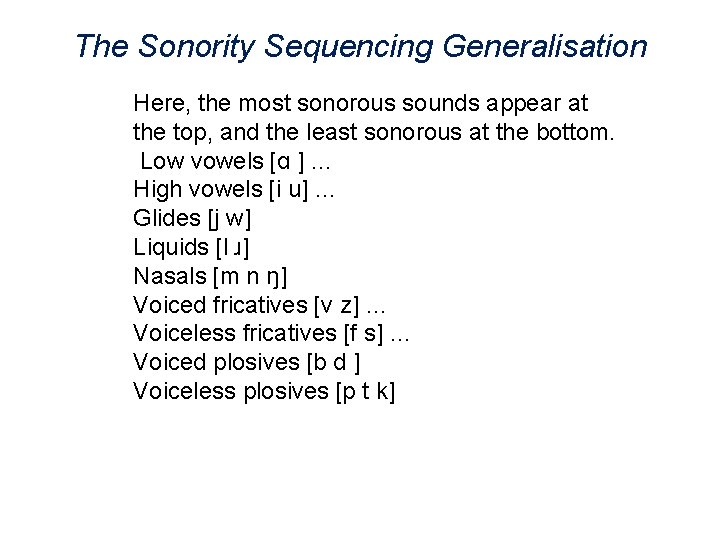
The Sonority Sequencing Generalisation Here, the most sonorous sounds appear at the top, and the least sonorous at the bottom. Low vowels [ɑ ] … High vowels [i u] … Glides [j w] Liquids [l ɹ] Nasals [m n ŋ] Voiced fricatives [v z] … Voiceless fricatives [f s] … Voiced plosives [b d ] Voiceless plosives [p t k]
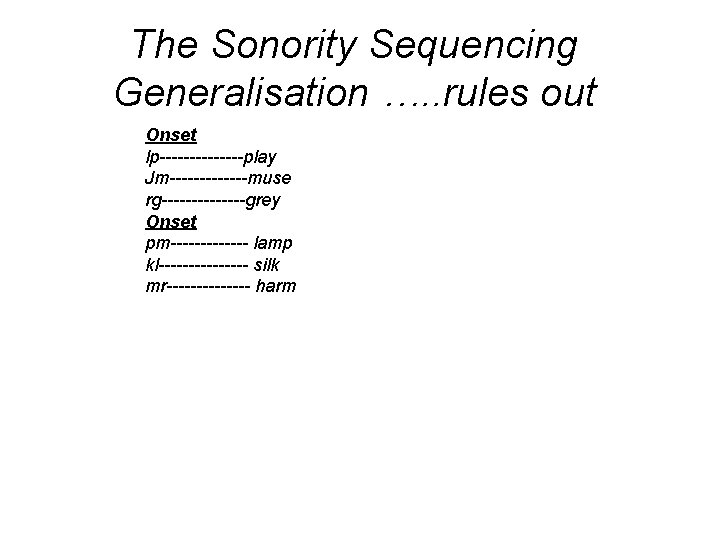
The Sonority Sequencing Generalisation …. . rules out Onset lp-------play Jm-------muse rg-------grey Onset pm------- lamp kl-------- silk mr------- harm
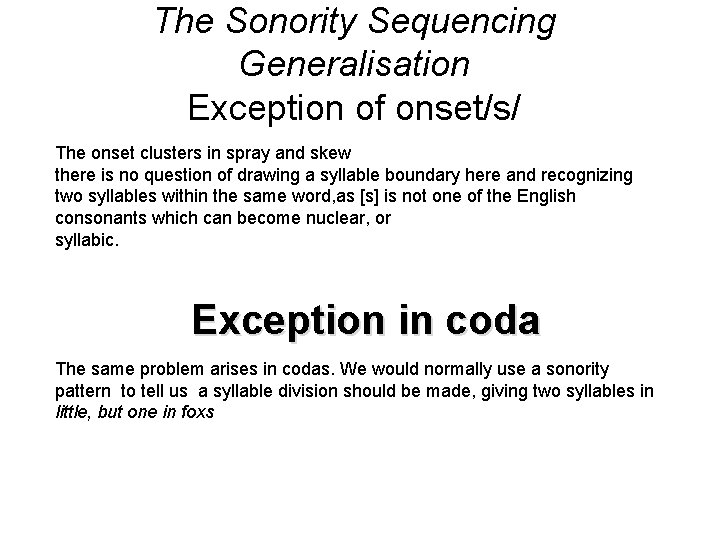
The Sonority Sequencing Generalisation Exception of onset/s/ The onset clusters in spray and skew there is no question of drawing a syllable boundary here and recognizing two syllables within the same word, as [s] is not one of the English consonants which can become nuclear, or syllabic. Exception in coda The same problem arises in codas. We would normally use a sonority pattern to tell us a syllable division should be made, giving two syllables in little, but one in foxs
Aspiration of voiceless stops…. /p/ /t/ /k/ Word initial position Aspiration : pill, till, kill No aspiration : skill, still , spill Aspiration : repair, return record No aspiration preceded by /s/ medial onset position respond, disturb, discord In short, aspiration of voiceless stops takes place, not at the beginning of the word, but at the beginning of the onset.
Support by the rhyme clear and dark /l/ English have two main allophones of /l/ clear or alveolar [l] and dark, velarised [l], in complementary distribution. clear [l] appears in onset position, and dark [l] in the coda. In fact, this process does not only provide evidence for the contrast between onset and coda position, but for the superordinate rhyme constituents which consists of the nucleus plus the optional coda. In cases of consonant syllabification, where /l/ (or another sonorant consonant)comes to play the role of a vowel and therefore occupies the nuclear position, as in bottle, little, Examples : lip , holly ,
Onset Maximalism tells us that, in a word like leader, the medial /d/ belong to the second syllable, where it can be located in the onset as in /l/ second syllable onset clear Onset Maximalism Realization of /r/ Two realization of /r/ red, bread, very------onset realization Car, park, farm-----coda………. no realization
Onset Maximalism Morphemes Star -y Syllable Sta. rry It also follows that syllable boundaries will not always coincide with morpheme boundaries Onset Maximalism Alternation in word Boundaries in connected speech Car keys / Car engine consonant………No /r/ vowel…………… /r/ Delete the /r/ before a consonant or pause. [ɹ] is being inserted before vowels in mental lexicon.
Onset Maximalism Ambisyllabic Bottle A single short vowel cannot make up the rhyme of a stressed syllable. the first syllable clearly need coda. The /t/ of bottle as ambisyllabic: that is, as belonging simultaneously in both the coda of the first syllable, and the onset of the second. Poetry Rhyme In alliterative poetry, the important constituent is the onset, which must be identical in several words in a single line On the bald street breaks the blank day Alliterative sound appears in word intial on set
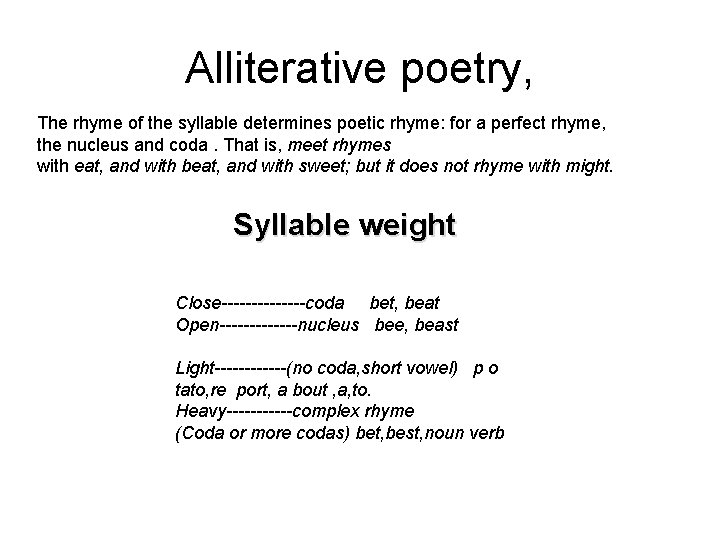
Alliterative poetry, The rhyme of the syllable determines poetic rhyme: for a perfect rhyme, the nucleus and coda. That is, meet rhymes with eat, and with beat, and with sweet; but it does not rhyme with might. Syllable weight Close-------coda bet, beat Open-------nucleus bee, beast Light------(no coda, short vowel) p o tato, re port, a bout , a, to. Heavy------complex rhyme (Coda or more codas) bet, best, noun verb
- Slides: 51