
Why the use of 3 D Printing Improves
- Slides: 15
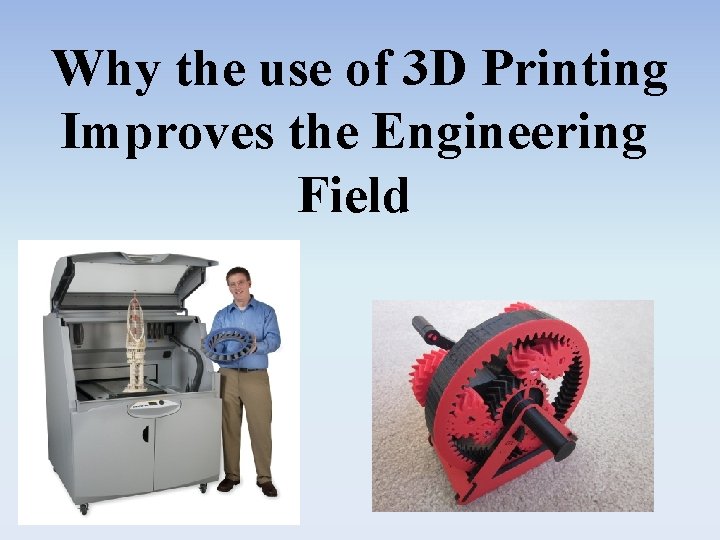
Why the use of 3 D Printing Improves the Engineering Field
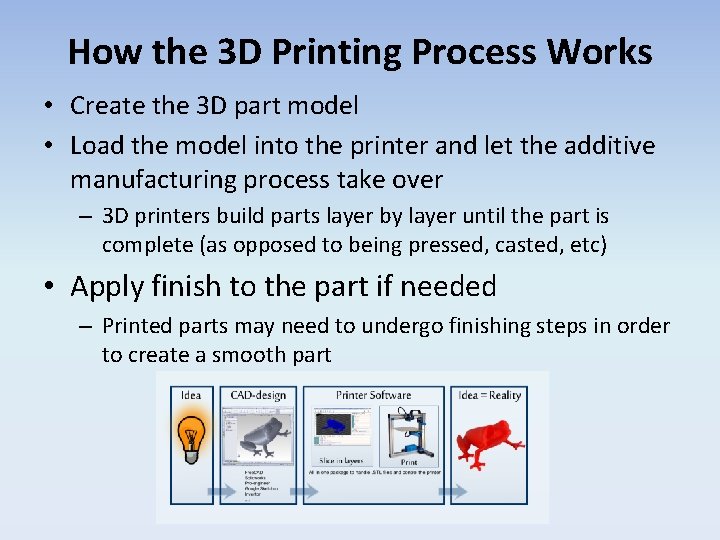
How the 3 D Printing Process Works • Create the 3 D part model • Load the model into the printer and let the additive manufacturing process take over – 3 D printers build parts layer by layer until the part is complete (as opposed to being pressed, casted, etc) • Apply finish to the part if needed – Printed parts may need to undergo finishing steps in order to create a smooth part
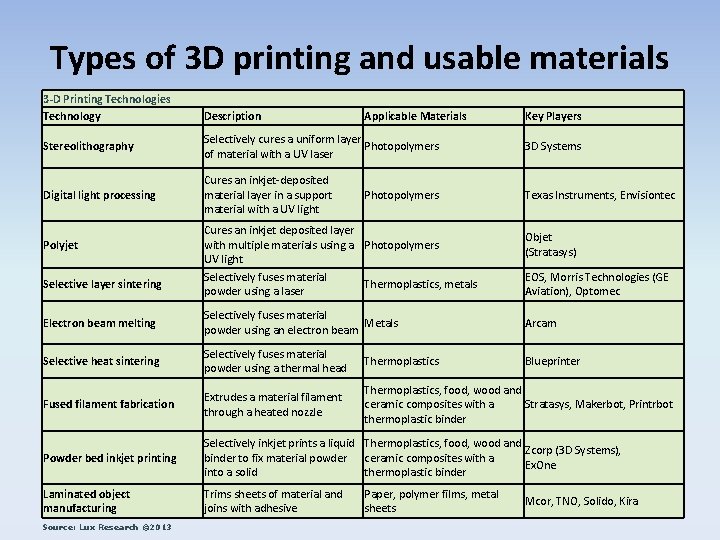
Types of 3 D printing and usable materials 3 -D Printing Technologies Technology Description Applicable Materials Key Players Stereolithography Selectively cures a uniform layer Photopolymers of material with a UV laser 3 D Systems Digital light processing Cures an inkjet-deposited material layer in a support material with a UV light Texas Instruments, Envisiontec Polyjet Cures an inkjet deposited layer with multiple materials using a Photopolymers UV light Objet (Stratasys) Selective layer sintering Selectively fuses material powder using a laser EOS, Morris Technologies (GE Aviation), Optomec Electron beam melting Selectively fuses material Metals powder using an electron beam Arcam Selective heat sintering Selectively fuses material powder using a thermal head Thermoplastics Blueprinter Fused filament fabrication Extrudes a material filament through a heated nozzle Thermoplastics, food, wood and Stratasys, Makerbot, Printrbot ceramic composites with a thermoplastic binder Powder bed inkjet printing Selectively inkjet prints a liquid Thermoplastics, food, wood and Zcorp (3 D Systems), binder to fix material powder ceramic composites with a Ex. One into a solid thermoplastic binder Laminated object manufacturing Trims sheets of material and joins with adhesive Source: Lux Research © 2013 Photopolymers Thermoplastics, metals Paper, polymer films, metal sheets Mcor, TNO, Solido, Kira
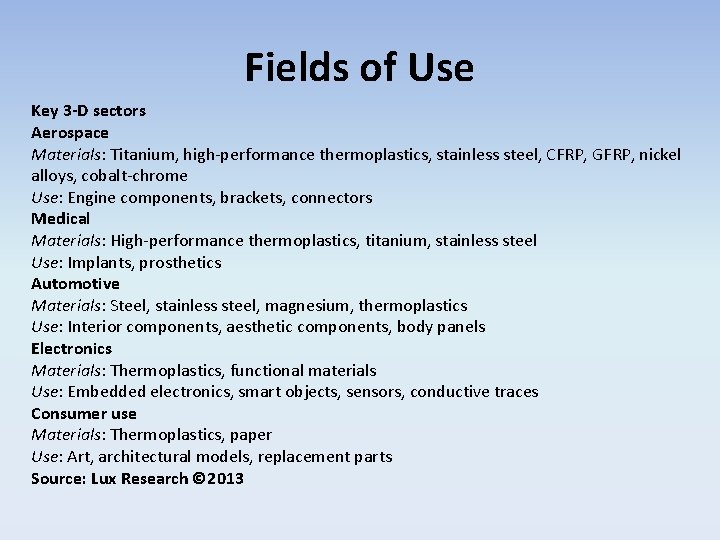
Fields of Use Key 3 -D sectors Aerospace Materials: Titanium, high-performance thermoplastics, stainless steel, CFRP, GFRP, nickel alloys, cobalt-chrome Use: Engine components, brackets, connectors Medical Materials: High-performance thermoplastics, titanium, stainless steel Use: Implants, prosthetics Automotive Materials: Steel, stainless steel, magnesium, thermoplastics Use: Interior components, aesthetic components, body panels Electronics Materials: Thermoplastics, functional materials Use: Embedded electronics, smart objects, sensors, conductive traces Consumer use Materials: Thermoplastics, paper Use: Art, architectural models, replacement parts Source: Lux Research © 2013
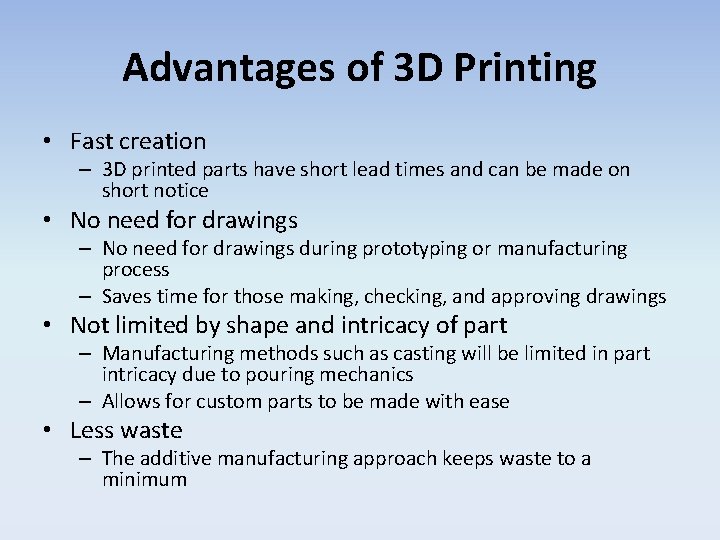
Advantages of 3 D Printing • Fast creation – 3 D printed parts have short lead times and can be made on short notice • No need for drawings – No need for drawings during prototyping or manufacturing process – Saves time for those making, checking, and approving drawings • Not limited by shape and intricacy of part – Manufacturing methods such as casting will be limited in part intricacy due to pouring mechanics – Allows for custom parts to be made with ease • Less waste – The additive manufacturing approach keeps waste to a minimum
3 Major Engineering Processes • Prototyping • Manufacturing • Post-Manufacture
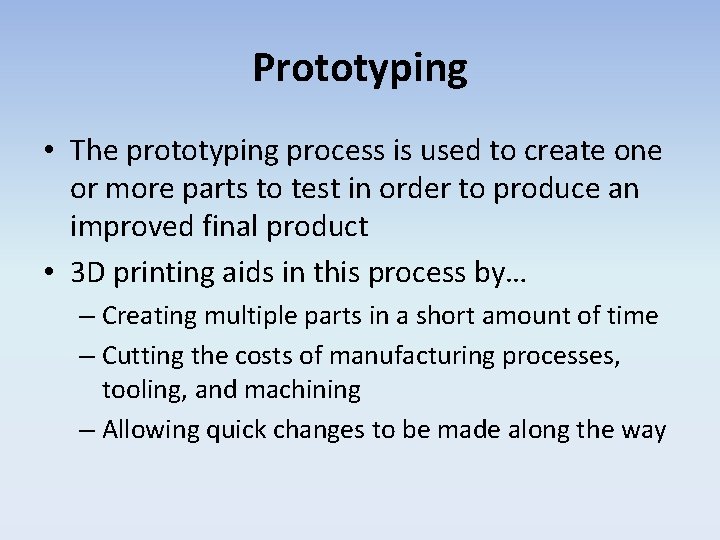
Prototyping • The prototyping process is used to create one or more parts to test in order to produce an improved final product • 3 D printing aids in this process by… – Creating multiple parts in a short amount of time – Cutting the costs of manufacturing processes, tooling, and machining – Allowing quick changes to be made along the way
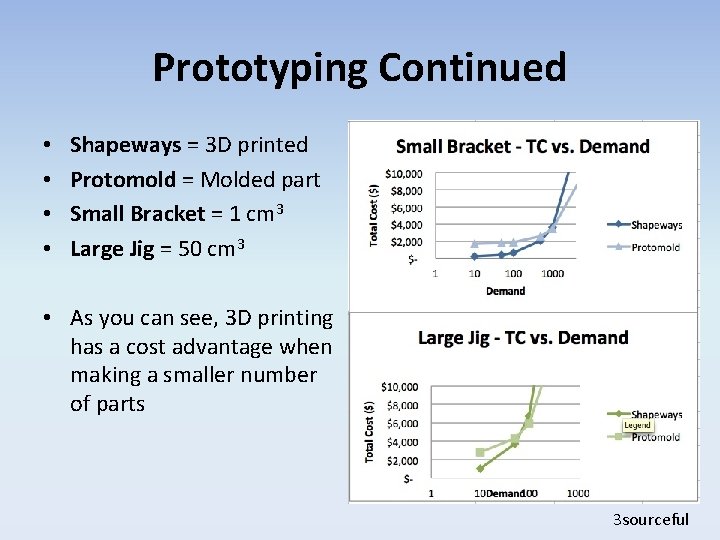
Prototyping Continued • • Shapeways = 3 D printed Protomold = Molded part Small Bracket = 1 cm 3 Large Jig = 50 cm 3 • As you can see, 3 D printing has a cost advantage when making a smaller number of parts 3 sourceful
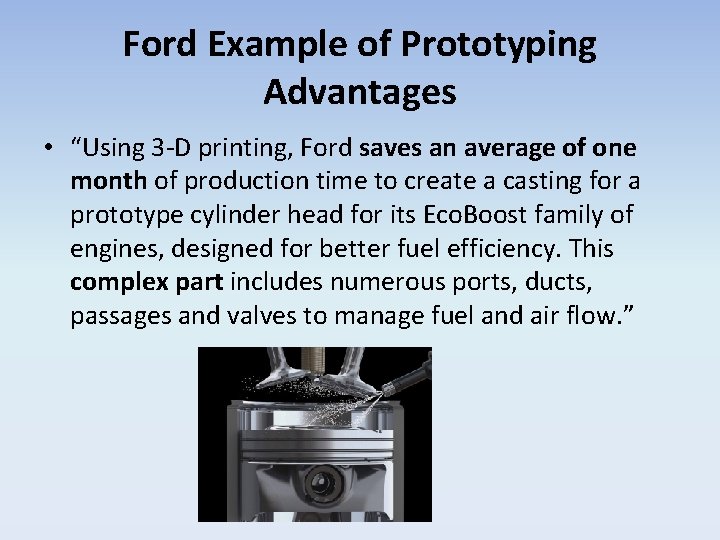
Ford Example of Prototyping Advantages • “Using 3 -D printing, Ford saves an average of one month of production time to create a casting for a prototype cylinder head for its Eco. Boost family of engines, designed for better fuel efficiency. This complex part includes numerous ports, ducts, passages and valves to manage fuel and air flow. ”
Manufacturing 3 D printers have seen little use in large scale manufacturing due to material costs, but 3 D printers are still a viable option because… • Cuts cost of tooling and machining (which can be very expensive depending on the process) • Tweaking the product is as easy as tweaking the 3 D model • Can decrease the lead time for customers
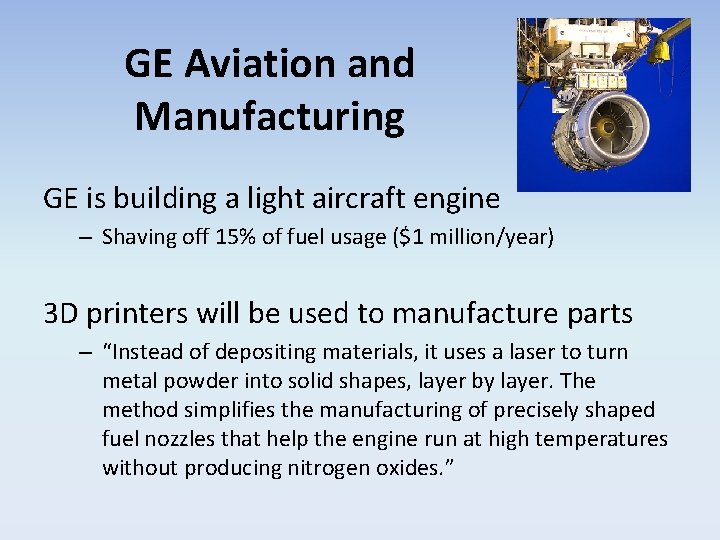
GE Aviation and Manufacturing GE is building a light aircraft engine – Shaving off 15% of fuel usage ($1 million/year) 3 D printers will be used to manufacture parts – “Instead of depositing materials, it uses a laser to turn metal powder into solid shapes, layer by layer. The method simplifies the manufacturing of precisely shaped fuel nozzles that help the engine run at high temperatures without producing nitrogen oxides. ”
Post-Manufacturing (part of the 3 D printing future) No matter the material, a finished product will not last forever. Replacement parts can be hard to come by and expensive. • 3 D printers allow the manufacturer or customer to replace a broken part with ease and in without having to wait weeks for procurement and shipment – Military example: Build a new part oversees instead of waiting for a new one to arrive. The part file is all that’s needed.
Conclusion • 3 D printers can create parts from thermoplastics, metals, and polymers • 3 D printers are currently used in many fields and are growing in popularity – Due to its advantages over other manufacturing processes in prototyping, manufacturing, and post -manufacturing
Sources • • Hayes, T. (2013, July). The future of 3 -d printing. Retrieved from http: //www. osaopn. org/home/articles/volume_24/july_august_2013/features/the_fut ure_of_3 -d_printing/ Bullis, K. (2013, May 14). A More Efficient Jet Engine Is Made from Lighter Parts, Some 3 -D Printed. Retrieved from http: //www. technologyreview. com/news/514656/a-moreefficient-jet-engine-is-made-from-lighter-parts-some-3 -d-printed/ Sujay (2013, February 20). Cost = f(size, quantity, technology) + a whole lot more. Retrieved from http: //blog. 3 sourceful. com/post/43619184865/ cost-f-size-quantitytechnology-a-whole-lot-more Ford Motor Company’s Eco. Boost V-6 cylinder head with DI. (2009). Retrieved August 2, 2013, from: http: //www. thecarconnection. com /news/1020747_fords-ecoboost-almost -ready-for-liftoff [Untitled Photograph of Composite fan blade test]. Retrieved August 2, 2013, from: http: //www. technologyreview. com/news/514656/a-more-efficient-jet-engine-is-madefrom-lighter-parts-some-3 -d-printed/ [Untitled Photograph of 3 D printing process]. Retrieved August 2, 2013, from: http: //shop. felixprinters. com/learn The New Z Printer 850 by 3 D Systems. Retrieved August 1, 2013, from: http: //i. materialise. com/blog/entry/the-month-of-april-in-3 d-printing [Untitled photograph of 3 D printed gears]. Retrieved August 1, 2013, from: http: //www. 3 dprintingera. com/how-to-3 d-print-gears/
Reflective Note My audience here would be those who work with me and are in my field. I felt that they should understand why it is that 3 D printing is a manufacturing process that should be used in engineering. This type of document would be presented to my group or sent around to those it pertains to.