
Why study Computer Vision Images and movies are


- Slides: 45
Why study Computer Vision? • Images and movies are everywhere • Fast-growing collection of useful applications – – building representations of the 3 D world from pictures automated surveillance (who’s doing what) movie post-processing face finding • Various deep and attractive scientific mysteries – how does object recognition work? • Greater understanding of human vision Computer Vision - A Modern Approach Set: Introduction to Vision Slides by D. A. Forsyth
Properties of Vision • One can “see the future” – Cricketers avoid being hit in the head • There’s a reflex --- when the right eye sees something going left, and the left eye sees something going right, move your head fast. – Gannets pull their wings back at the last moment • Gannets are diving birds; they must steer with their wings, but wings break unless pulled back at the moment of contact. • Area of target over rate of change of area gives time to contact. Computer Vision - A Modern Approach Set: Introduction to Vision Slides by D. A. Forsyth
Properties of Vision • 3 D representations are easily constructed – There are many different cues. – Useful • to humans (avoid bumping into things; planning a grasp; etc. ) • in computer vision (build models for movies). – Cues include • multiple views (motion, stereopsis) • texture • shading Computer Vision - A Modern Approach Set: Introduction to Vision Slides by D. A. Forsyth
Properties of Vision • People draw distinctions between what is seen – – – – “Object recognition” This could mean “is this a fish or a bicycle? ” It could mean “is this George Washington? ” It could mean “is this poisonous or not? ” It could mean “is this slippery or not? ” It could mean “will this support my weight? ” Great mystery • How to build programs that can draw useful distinctions based on image properties. Computer Vision - A Modern Approach Set: Introduction to Vision Slides by D. A. Forsyth
Part I: The Physics of Imaging • How images are formed – Cameras • What a camera does • How to tell where the camera was – Light • How to measure light • What light does at surfaces • How the brightness values we see in cameras are determined – Color • The underlying mechanisms of color • How to describe it and measure it Computer Vision - A Modern Approach Set: Introduction to Vision Slides by D. A. Forsyth
Part II: Early Vision in One Image • Representing small patches of image – For three reasons • We wish to establish correspondence between (say) points in different images, so we need to describe the neighborhood of the points • Sharp changes are important in practice --- known as “edges” • Representing texture by giving some statistics of the different kinds of small patch present in the texture. – Tigers have lots of bars, few spots – Leopards are the other way Computer Vision - A Modern Approach Set: Introduction to Vision Slides by D. A. Forsyth
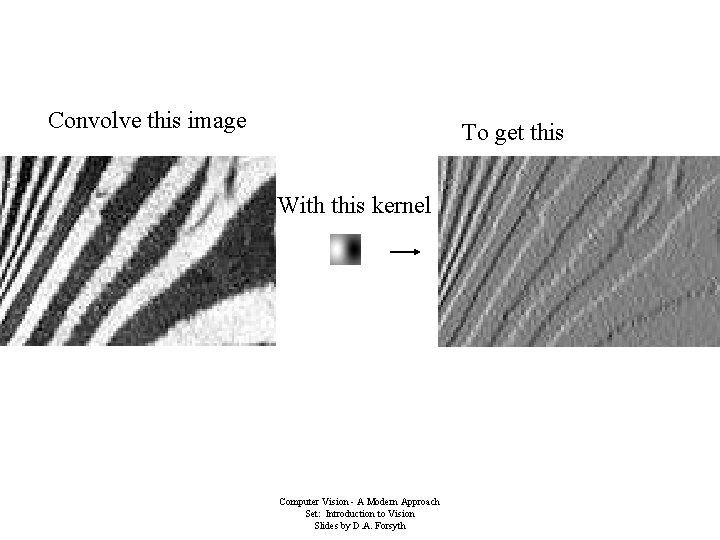
Representing an image patch • Filter outputs – essentially form a dot-product between a pattern and an image, while shifting the pattern across the image – strong response -> image locally looks like the pattern – e. g. derivatives measured by filtering with a kernel that looks like a big derivative (bright bar next to dark bar) Computer Vision - A Modern Approach Set: Introduction to Vision Slides by D. A. Forsyth
Convolve this image To get this With this kernel Computer Vision - A Modern Approach Set: Introduction to Vision Slides by D. A. Forsyth
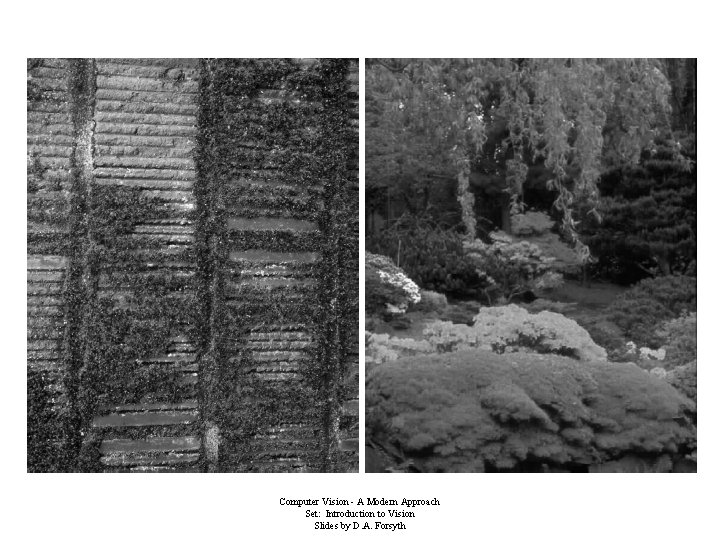
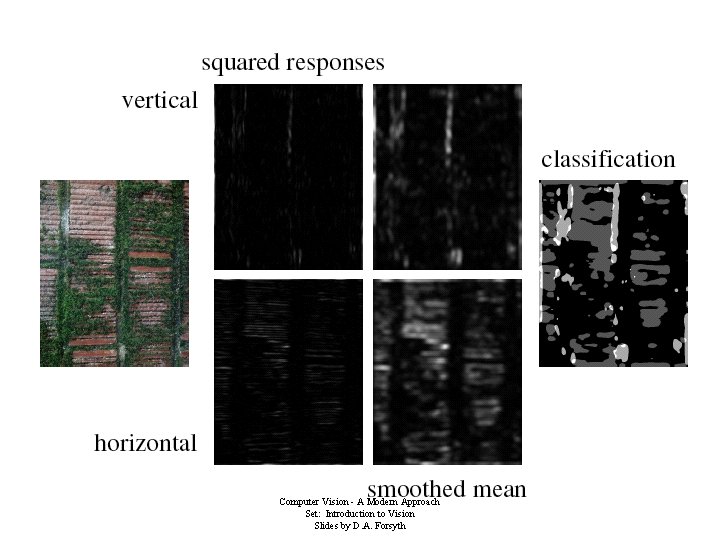
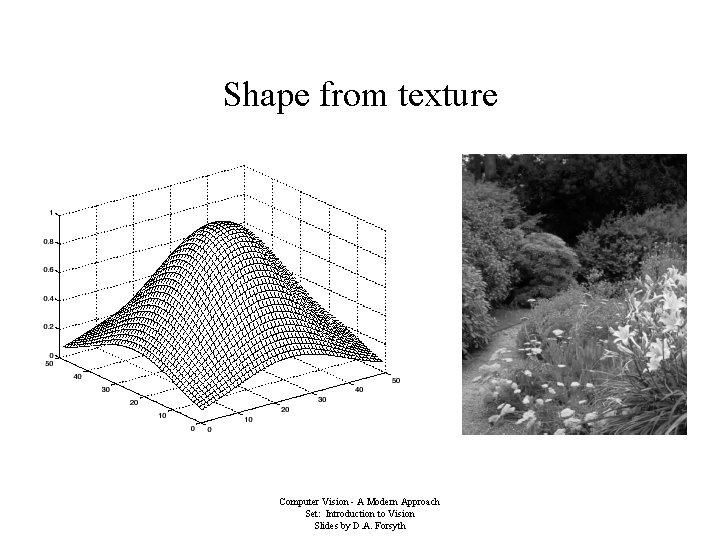
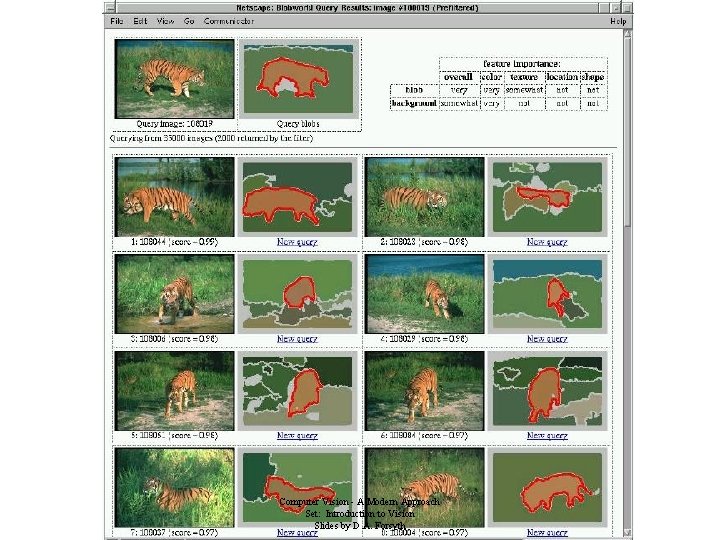
Texture • Many objects are distinguished by their texture – Tigers, cheetahs, grass, trees • We represent texture with statistics of filter outputs – – For tigers, bar filters at a coarse scale respond strongly For cheetahs, spots at the same scale For grass, long narrow bars For the leaves of trees, extended spots • Objects with different textures can be segmented • The variation in textures is a cue to shape Computer Vision - A Modern Approach Set: Introduction to Vision Slides by D. A. Forsyth
Computer Vision - A Modern Approach Set: Introduction to Vision Slides by D. A. Forsyth
Computer Vision - A Modern Approach Set: Introduction to Vision Slides by D. A. Forsyth
Shape from texture Computer Vision - A Modern Approach Set: Introduction to Vision Slides by D. A. Forsyth
Part III: Early Vision in Multiple Images • The geometry of multiple views – Where could it appear in camera 2 (3, etc. ) given it was here in 1 (1 and 2, etc. )? • Stereopsis – What we know about the world from having 2 eyes • Structure from motion – What we know about the world from having many eyes • or, more commonly, our eyes moving. Computer Vision - A Modern Approach Set: Introduction to Vision Slides by D. A. Forsyth
Part IV: Mid-Level Vision • Finding coherent structure so as to break the image or movie into big units – Segmentation: • Breaking images and videos into useful pieces • E. g. finding video sequences that correspond to one shot • E. g. finding image components that are coherent in internal appearance – Tracking: • Keeping track of a moving object through a long sequence of views Computer Vision - A Modern Approach Set: Introduction to Vision Slides by D. A. Forsyth
Part V: High Level Vision (Geometry) • The relations between object geometry and image geometry – Model based vision • find the position and orientation of known objects – Smooth surfaces and outlines • how the outline of a curved object is formed, and what it looks like – Aspect graphs • how the outline of a curved object moves around as you view it from different directions – Range data Computer Vision - A Modern Approach Set: Introduction to Vision Slides by D. A. Forsyth
Part VI: High Level Vision (Probabilistic) • Using classifiers and probability to recognize objects – Templates and classifiers • how to find objects that look the same from view to view with a classifier – Relations • break up objects into big, simple parts, find the parts with a classifier, and then reason about the relationships between the parts to find the object. – Geometric templates from spatial relations • extend this trick so that templates are formed from relations between much smaller parts Computer Vision - A Modern Approach Set: Introduction to Vision Slides by D. A. Forsyth
3 D Reconstruction from multiple views • Multiple views arise from – stereo – motion • Strategy – “triangulate” from distinct measurements of the same thing • Issues – Correspondence: which points in the images are projections of the same 3 D point? – The representation: what do we report? – Noise: how do we get stable, accurate reports Computer Vision - A Modern Approach Set: Introduction to Vision Slides by D. A. Forsyth
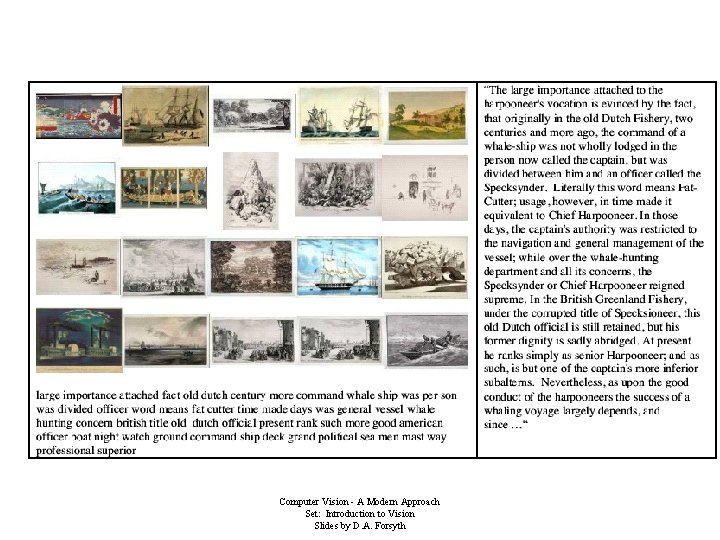
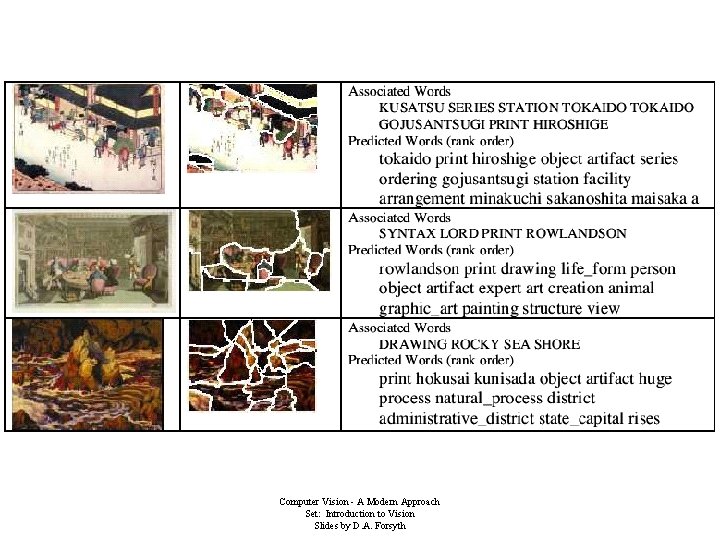
Part VII: Some Applications in Detail • Finding images in large collections – searching for pictures – browsing collections of pictures • Image based rendering – often very difficult to produce models that look like real objects • surface weathering, etc. , create details that are hard to model • Solution: make new pictures from old Computer Vision - A Modern Approach Set: Introduction to Vision Slides by D. A. Forsyth
Some applications of recognition • Digital libraries – Find me the pic of JFK and Marilyn Monroe embracing – NCMEC • Surveillance – Warn me if there is a mugging in the grove • HCI – Do what I show you • Military – Shoot this, not that Computer Vision - A Modern Approach Set: Introduction to Vision Slides by D. A. Forsyth
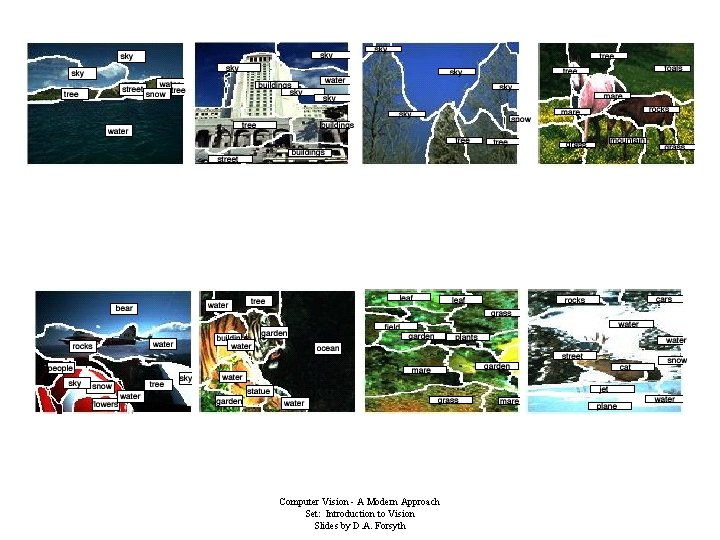
What are the problems in recognition? • Which bits of image should be recognised together? – Segmentation. • How can objects be recognised without focusing on detail? – Abstraction. • How can objects with many free parameters be recognised? – No popular name, but it’s a crucial problem anyhow. • How do we structure very large modelbases? – again, no popular name; abstraction and learning come into this Computer Vision - A Modern Approach Set: Introduction to Vision Slides by D. A. Forsyth
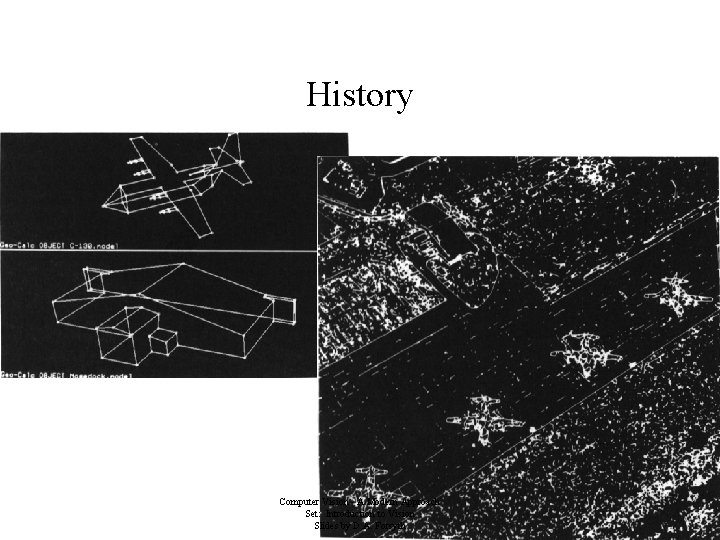
History Computer Vision - A Modern Approach Set: Introduction to Vision Slides by D. A. Forsyth
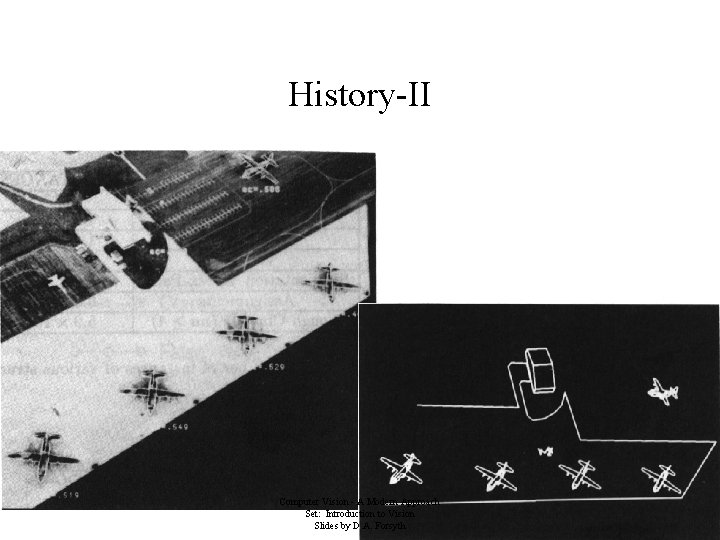
History-II Computer Vision - A Modern Approach Set: Introduction to Vision Slides by D. A. Forsyth
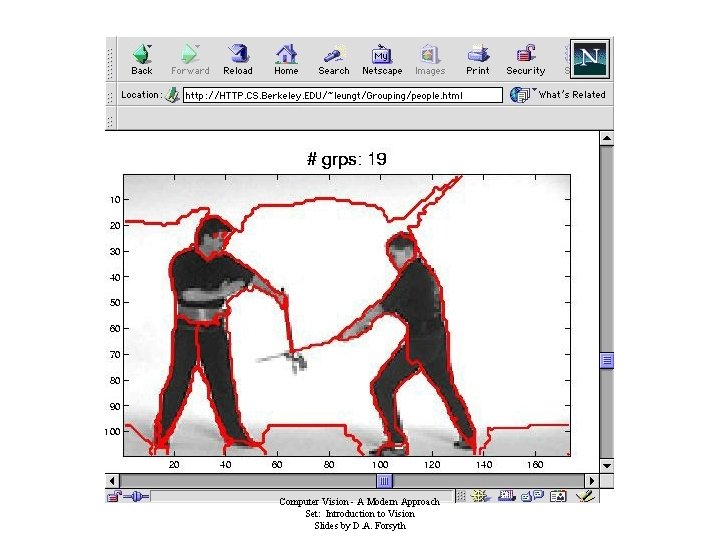
Segmentation • Which image components “belong together”? • Belong together=lie on the same object • Cues – – similar colour similar texture not separated by contour form a suggestive shape when assembled Computer Vision - A Modern Approach Set: Introduction to Vision Slides by D. A. Forsyth
Computer Vision - A Modern Approach Set: Introduction to Vision Slides by D. A. Forsyth
Computer Vision - A Modern Approach Set: Introduction to Vision Slides by D. A. Forsyth
Computer Vision - A Modern Approach Set: Introduction to Vision Slides by D. A. Forsyth
Computer Vision - A Modern Approach Set: Introduction to Vision Slides by D. A. Forsyth
Computer Vision - A Modern Approach Set: Introduction to Vision Slides by D. A. Forsyth
Computer Vision - A Modern Approach Set: Introduction to Vision Slides by D. A. Forsyth
Computer Vision - A Modern Approach Set: Introduction to Vision Slides by D. A. Forsyth
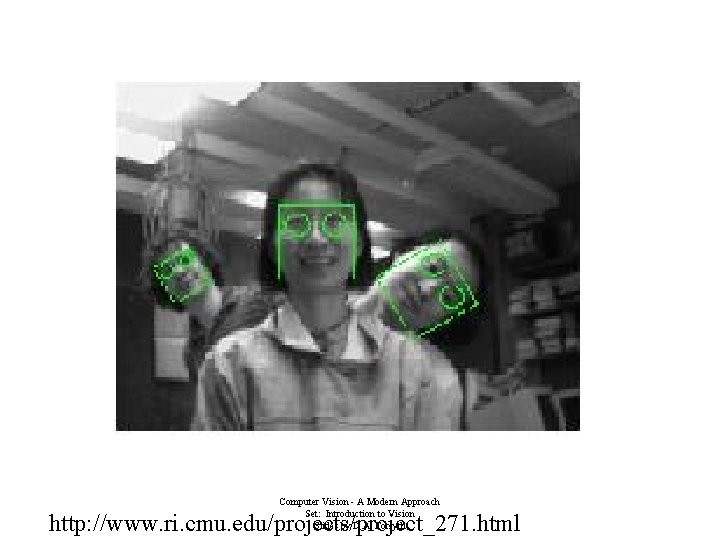
Matching templates • Some objects are 2 D patterns – e. g. faces • Build an explicit pattern matcher – discount changes in illumination by using a parametric model – changes in background are hard – changes in pose are hard Computer Vision - A Modern Approach Set: Introduction to Vision Slides by D. A. Forsyth
Computer Vision - A Modern Approach Set: Introduction to Vision Slides by D. A. Forsyth http: //www. ri. cmu. edu/projects/project_271. html
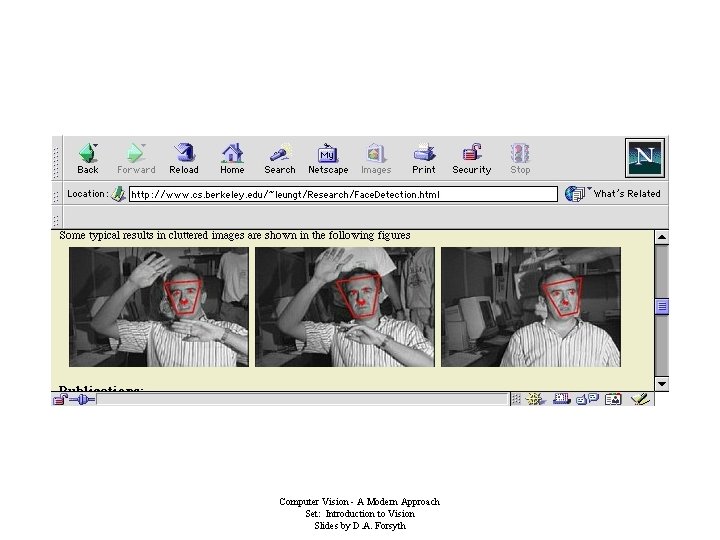
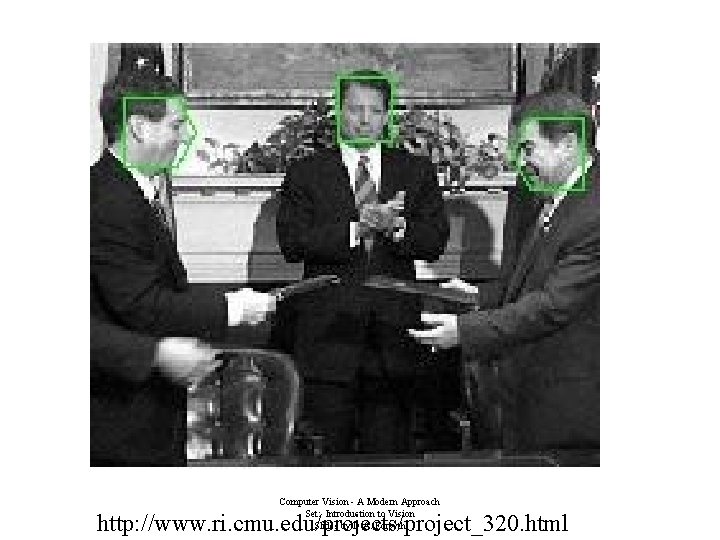
Relations between templates • e. g. find faces by – finding eyes, nose, mouth – finding assembly of the three that has the “right” relations Computer Vision - A Modern Approach Set: Introduction to Vision Slides by D. A. Forsyth
Computer Vision - A Modern Approach Set: Introduction to Vision Slides by D. A. Forsyth
Computer Vision - A Modern Approach Set: Introduction to Vision Slides by D. A. Forsyth http: //www. ri. cmu. edu/projects/project_320. html
Computer Vision - A Modern Approach Set: Introduction to Vision Slides by D. A. Forsyth
Representing the 3 D world • Assemblies of primitives – fit parametric forms – Issues • what primitives? • uniqueness of representation • few objects are actual primitives • Indexed collection of images – use interpolation to predict appearance between images – Issues • occlusion is a mild nuisance • structuring the collection can be tricky Computer Vision - A Modern Approach Set: Introduction to Vision Slides by D. A. Forsyth
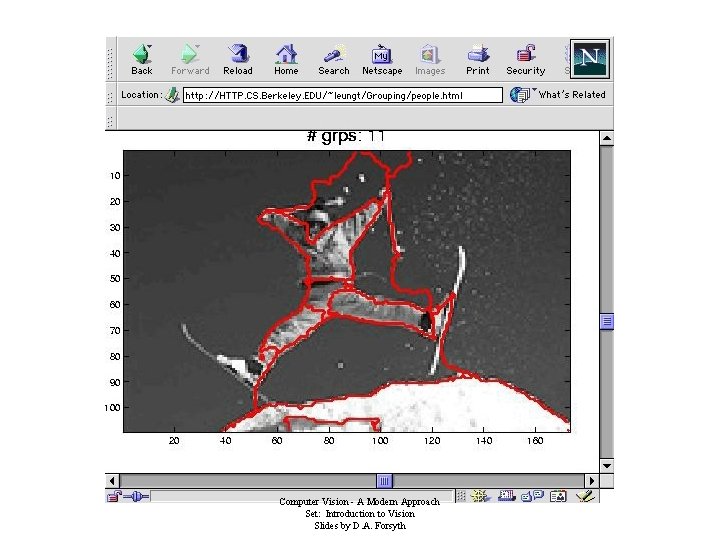
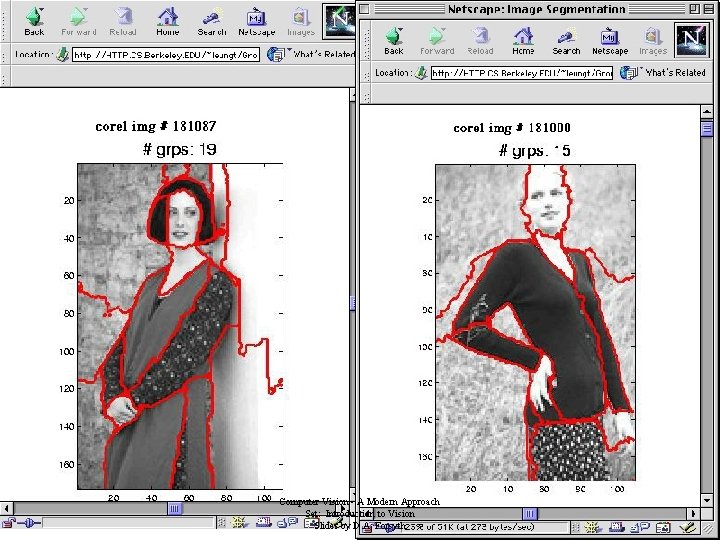
People • Skin is characteristic; clothing hard to segment – hence, people wearing little clothing • Finding body segments: – finding skin-like (color, texture) regions that have nearly straight, nearly parallel boundaries • Grouping process constructed by hand, tuned by hand using small dataset. • When a sufficiently large group is found, assert a person is present Computer Vision - A Modern Approach Set: Introduction to Vision Slides by D. A. Forsyth
Horse grouper Computer Vision - A Modern Approach Set: Introduction to Vision Slides by D. A. Forsyth
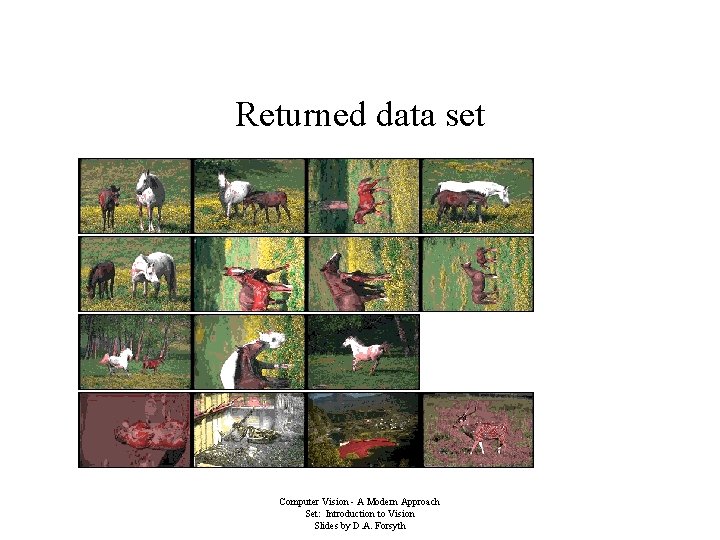
Returned data set Computer Vision - A Modern Approach Set: Introduction to Vision Slides by D. A. Forsyth
Tracking • Use a model to predict next position and refine using next image • Model: – simple dynamic models (second order dynamics) – kinematic models – etc. • Face tracking and eye tracking now work rather well Computer Vision - A Modern Approach Set: Introduction to Vision Slides by D. A. Forsyth
The nasty likelihood Computer Vision - A Modern Approach Set: Introduction to Vision Slides by D. A. Forsyth
Computer Vision - A Modern Approach Set: Introduction to Vision Slides by D. A. Forsyth
Computer Vision - A Modern Approach Set: Introduction to Vision Slides by D. A. Forsyth
Computer Vision - A Modern Approach Set: Introduction to Vision Slides by D. A. Forsyth