
Why Study Chemistry Why Study Chemistry Everywhere Why



- Slides: 60
Why Study Chemistry?
Why Study Chemistry? • Everywhere
Why Study Chemistry? • To see the glory of God v Where did I come from? v Why am I here? v Where am I going?
Why Study Chemistry? • To connect Genesis and chemistry § Man is created in the image of God. § Creation Mandate
Creation Mandate Man is to exercise good and wise dominion.
Why Study Chemistry? • To connect Genesis and chemistry § Man is created in the image of God. § Creation Mandate § Dominion science
dominion science scientific activity that seeks to bring glory to God and benefit other humans by controlling aspects of creation
Why Study Chemistry? • To understand the purpose of science § Science does not establish truth. § Science makes models (simplified representations).
Why Study Chemistry? • To understand the purpose of science § The goal of science is workability. § Science always has uncertainty. v. It is a matter of faith.
Why Study Chemistry? • To distinguish truth from error in worldviews
presupposition an idea assumed to be true without proof
Why Study Chemistry? • To distinguish truth from error in worldviews § Naturalistic worldview • Matter is all that exists. • Human reason informed by science is the only reliable path to truth.
Why Study Chemistry? • To distinguish truth from error in worldviews § Naturalistic worldview • Evolution − the Creator = no accountability. • Chemistry exists for humanity’s survival.
Why Study Chemistry? • To distinguish truth from error in worldviews § Christian worldview • The Bible is the ultimate authority. v Seeing the world through the lens of the Bible
Why Study Chemistry? • To distinguish truth from error in worldviews § Christian worldview • God created us as His image bearers. • Man rebelled. • God is implementing His plan to redeem fallen man.
Why Study Chemistry? • To help make life choices § Careers § Life • Logical thinking • Issues • See naturalistic biases
What Is Chemistry?
Chemistry is…. • A Natural Science • A language with its own vocabulary • A way of thinking
Chemistry • structure and composition • changes in structure and composition • interactions with energy • properties § takes up space and has mass
Influences on Chemistry • Old Testament Times— The Age of Practical Skill § Focused on practicality § Metallurgy— the process of extracting metal from ore
Influences on Chemistry • Old Testament Times— The Age of Practical Skill § Apothecaries— pharmacists
Influences on Chemistry • Ancient Greece— The Age of Critical Thought § Focused on philosophy and knowledge § Developed critical thinking, but no experimentation
Influences on Chemistry • Ancient Greece— The Age of Critical Thought § Stagnated science for centuries § Four elements—earth, wind, fire, water
Influences on Chemistry • The Alchemists—The Age of Applied Experimentation § Focused on experimentation § Developed sublimation, precipitation, distillation, and crystallization
Influences on Chemistry • The Alchemists—The Age of Applied Experimentation § “transmutation”— tried to change elements (lead into gold) § Paracelsus—started pharmacology
Influences on Chemistry • The Transition— The Rise of Modern Chemistry § Questioned Greek “truths” following the Reformation § Boyle—shattered tradition by proposing a new definition of elements
Influences on Chemistry • The Transition— The Rise of Modern Chemistry § Priestley—discovered oxygen by experimentation
Influences on Chemistry • The Transition— The Rise of Modern Chemistry § Lavoisier— • engaged in careful experimenting and recording • overthrew the phlogiston theory
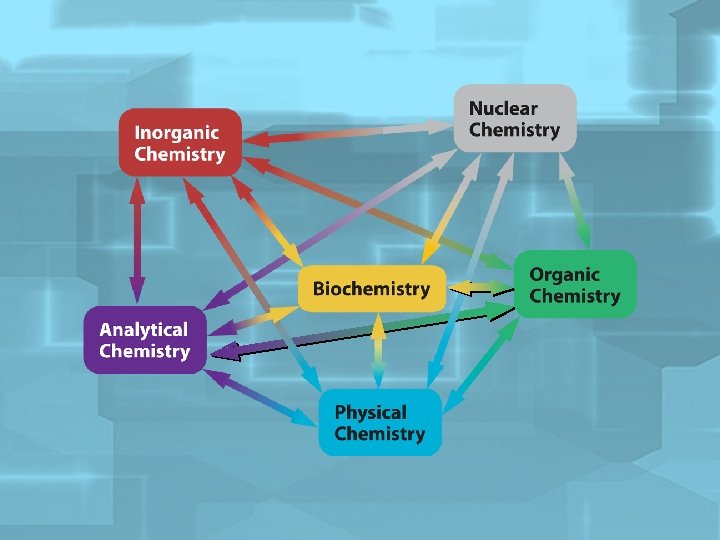
Chemistry • An academic field since the 1800’s • Different branches developed
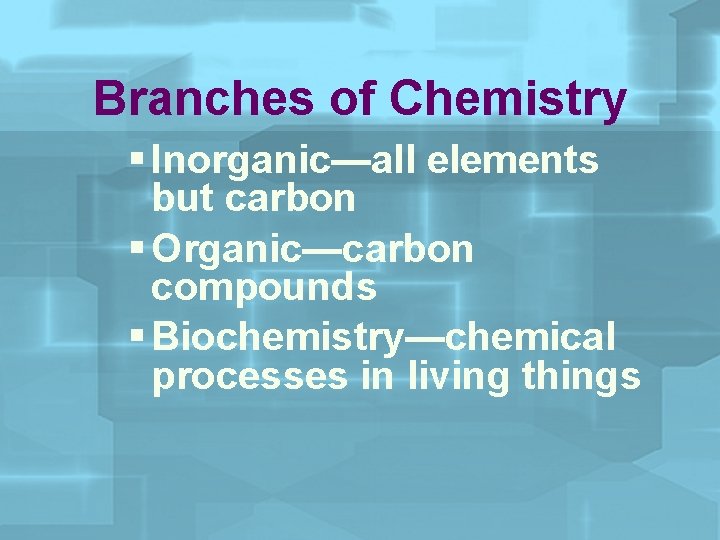
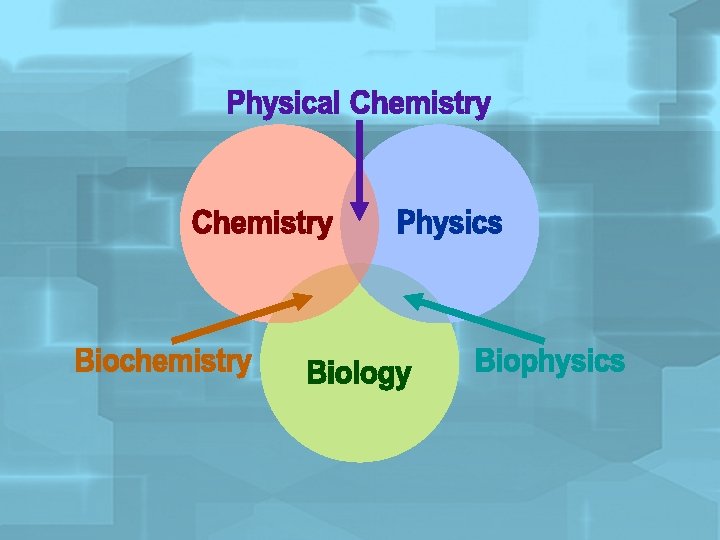
Branches of Chemistry § Inorganic—all elements but carbon § Organic—carbon compounds § Biochemistry—chemical processes in living things
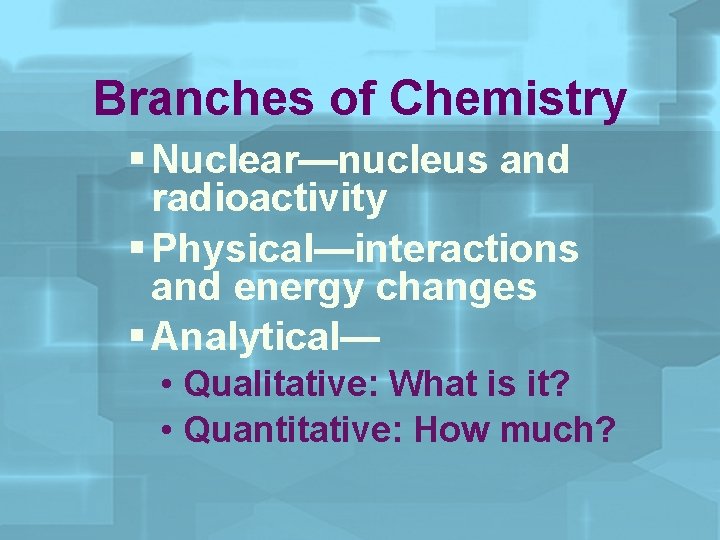
Branches of Chemistry § Nuclear—nucleus and radioactivity § Physical—interactions and energy changes § Analytical— • Qualitative: What is it? • Quantitative: How much?
What Do Chemists Do?
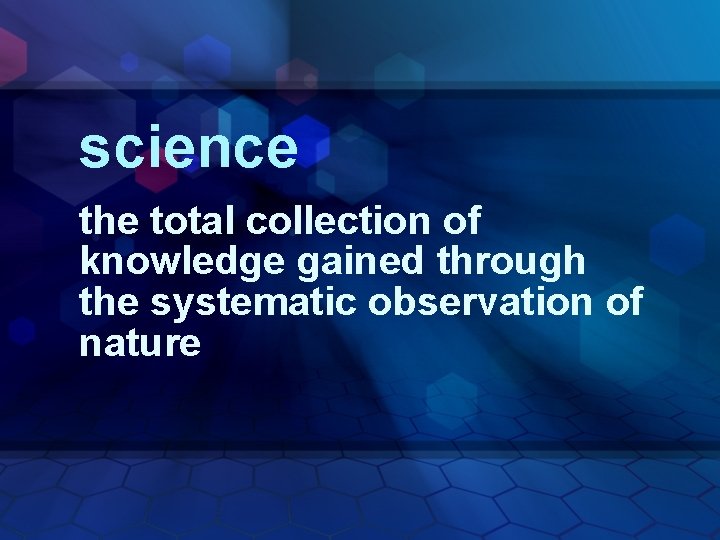
science the total collection of knowledge gained through the systematic observation of nature
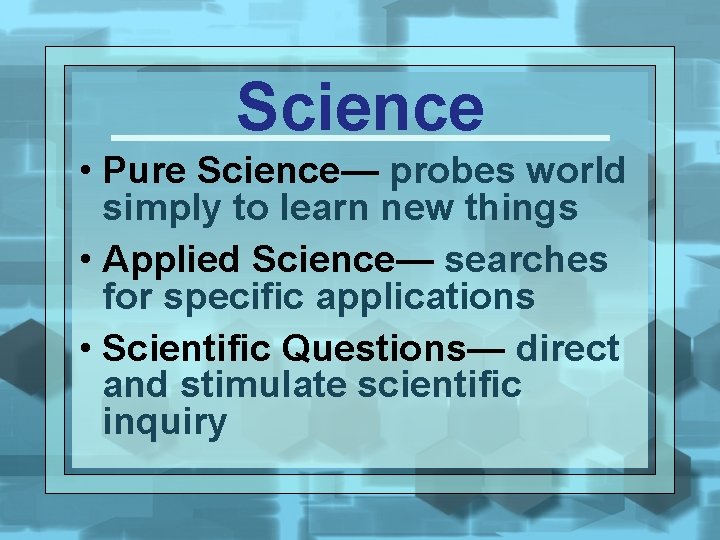
Science • Pure Science— probes world simply to learn new things • Applied Science— searches for specific applications • Scientific Questions— direct and stimulate scientific inquiry
How Do Chemists DO Science?
Scientists … • Notice something which elicits a question • Gather information § Objective information – Unaffected by observer’s personal inclinations and presuppositions
Scientists … • Notice something which elicits a question • Gather information § Objective information § Subjective information – Affected by observer’s personal inclinations and presuppositions
Scientists … • Collect data § Quantitative—numerical § Qualitative—nonnumerical • Use reasoning processes § Deductive reasoning – Applying a premise to many different situations
Scientists … • Collect data § Quantitative—numerical § Qualitative—nonnumerical • Use reasoning processes § Deductive reasoning § Inductive reasoning – Using facts to lead into a conclusion
Scientists … • Make models § To make sense of data § To identify causes and effects § To suggest practical application § To establish connections § To direct predictions
Scientists … • Perform experiments
experiment a repeatable method that involves observing a natural process, sometimes under controlled conditions, for the purpose of analysis
Scientists … • Perform experiments • Record data from experimentation § Empirical data—gathered experimentally
Scientists … • Form hypotheses
hypothesis a simple, reasonable, testable statement that tries to predict the results of an experiment If……, then….
Scientists … • Form hypotheses • Perform experiments
natural experiment an experiment in which the conditions cannot be controlled
controlled experiment only one condition is varied at a time
Scientists … • Form hypotheses • Perform experiments or • Perform scientific surveys— randomly selecting representative samples
Scientists … • Formulate results § Classify § Simplify § Enter in charts and graphs • Communicate findings § Peer-reviewed scientific journals § Internet forums
Scientists … • Formulate theories § Must consistently explain a phenomenon § Can be thought of as scientific models § Can be modified § Must be supported by evidence § Are not “provably” true
Scientists … • Frame scientific laws
law statement of a recognizable, repeating pattern in the universe
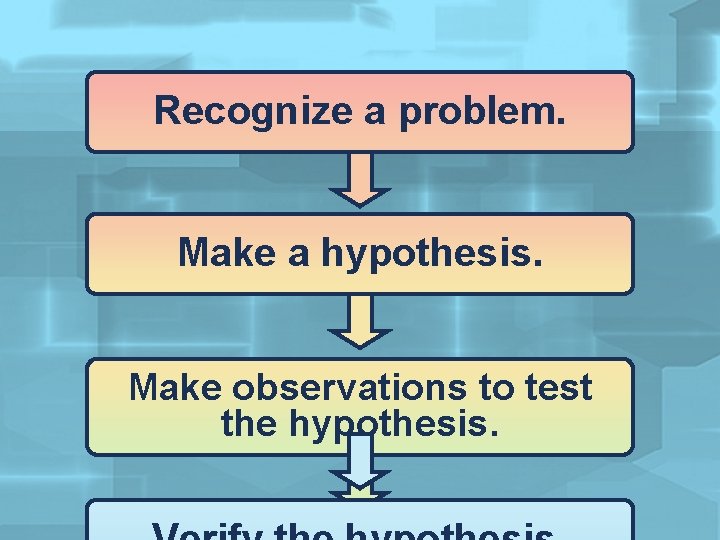
Scientists … • Frame scientific laws • Use the Scientific Method
scientific method an inductive approach to discover information about the universe
Scientists … • Frame scientific laws • Use the Scientific Method § Many versions § No standardized form
Recognize a problem. Make a hypothesis. Make observations to test the hypothesis.