
Why should you engage with the CQC Tom
- Slides: 21
Why should you engage with the CQC? Tom Stocker July 2019
Agenda • Who are the CQC? • What is regulated by the CQC? • How do the CQC regulate? • What is the CQC doing around innovation and tech? 2
Who are the CQC?
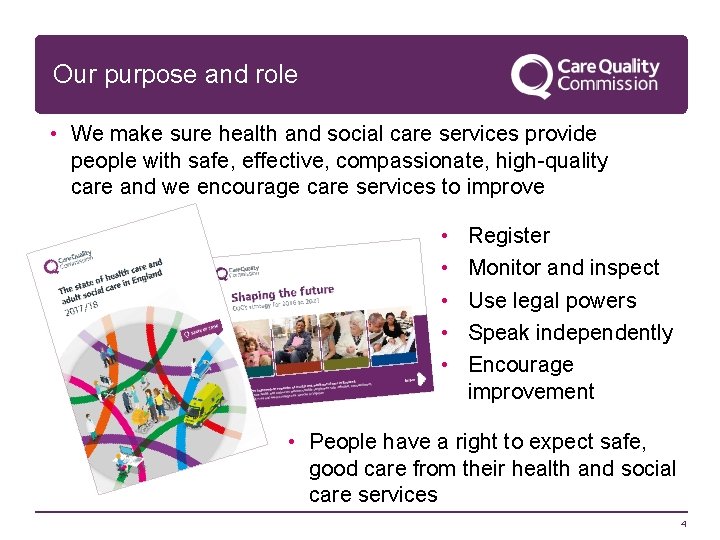
Our purpose and role • We make sure health and social care services provide people with safe, effective, compassionate, high-quality care and we encourage care services to improve • • • Register Monitor and inspect Use legal powers Speak independently Encourage improvement • People have a right to expect safe, good care from their health and social care services 4
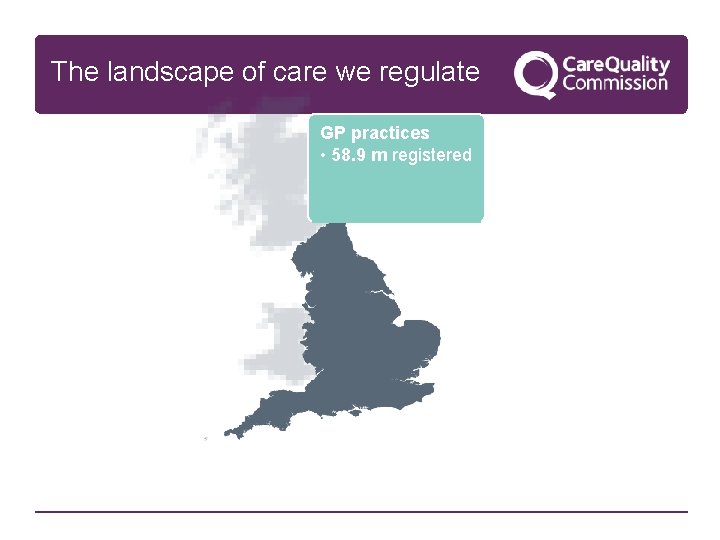
The landscape of care we regulate GP practices • 58. 9 m registered
When do you need to register?
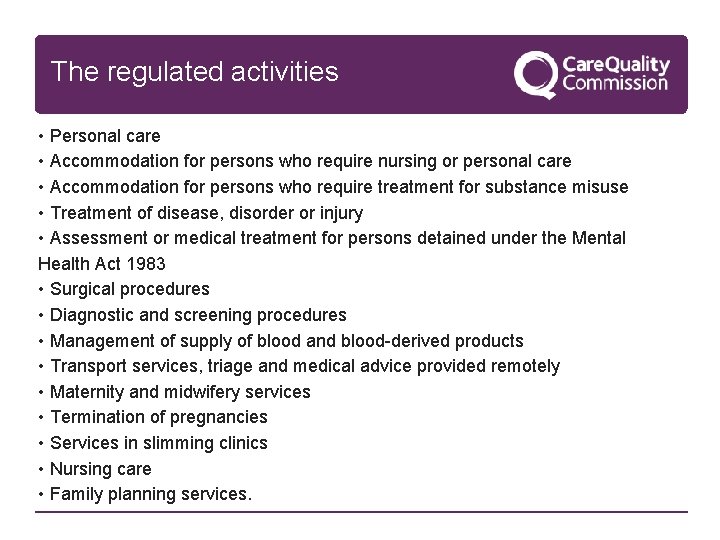
The regulated activities • Personal care • Accommodation for persons who require nursing or personal care • Accommodation for persons who require treatment for substance misuse • Treatment of disease, disorder or injury • Assessment or medical treatment for persons detained under the Mental Health Act 1983 • Surgical procedures • Diagnostic and screening procedures • Management of supply of blood and blood-derived products • Transport services, triage and medical advice provided remotely • Maternity and midwifery services • Termination of pregnancies • Services in slimming clinics • Nursing care • Family planning services.
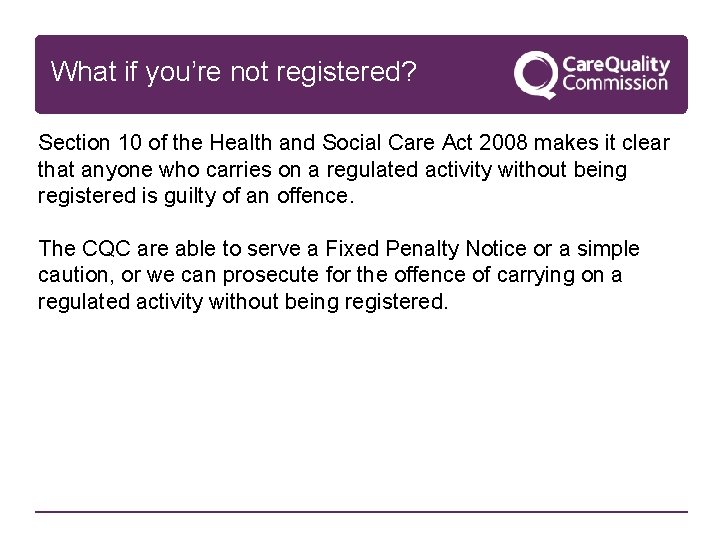
What if you’re not registered? Section 10 of the Health and Social Care Act 2008 makes it clear that anyone who carries on a regulated activity without being registered is guilty of an offence. The CQC are able to serve a Fixed Penalty Notice or a simple caution, or we can prosecute for the offence of carrying on a regulated activity without being registered.
Where do I go, when I need to understand whether I need to register? CQC’s website: www. cqc. org. uk/content/guidance-providers Scope of registration guidance Statute: Health and Social Care Act 2008: www. legislation. gov. uk/ukpga/2008/14/contents Care Quality Commission (Registration) Regulations 2009: www. legislation. gov. uk/uksi/2009/3112/contents/made Health and Social Care Act 2008 (Regulated Activities) Regulations 2014: www. legislation. gov. uk/uksi/2014/2936/contents/made Make early contact with us at enquiries-newmodelsofcare@cqc. org. uk about issues concerning organisational forms and registration.
How do the CQC regulate?
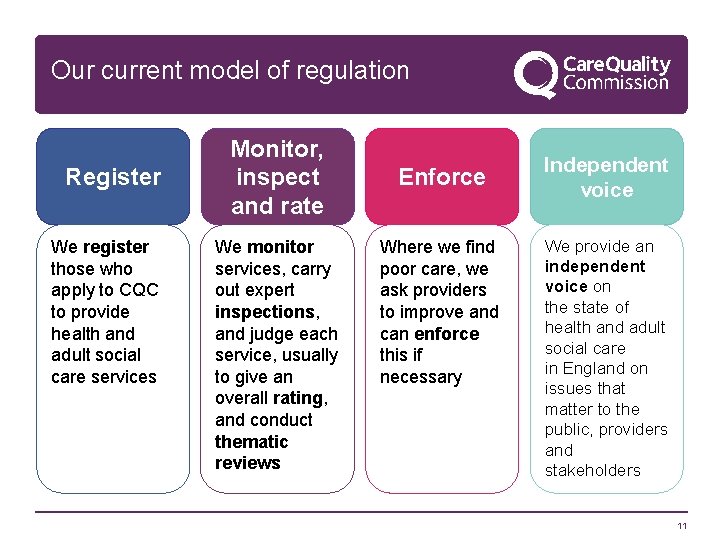
Our current model of regulation Register We register those who apply to CQC to provide health and adult social care services Monitor, inspect and rate We monitor services, carry out expert inspections, and judge each service, usually to give an overall rating, and conduct thematic reviews Enforce Where we find poor care, we ask providers to improve and can enforce this if necessary Independent voice We provide an independent voice on the state of health and adult social care in England on issues that matter to the public, providers and stakeholders 11
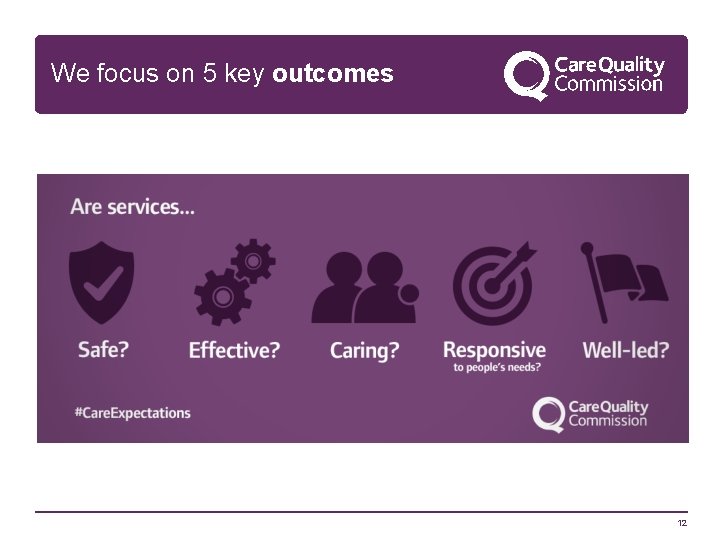
We focus on 5 key outcomes 12
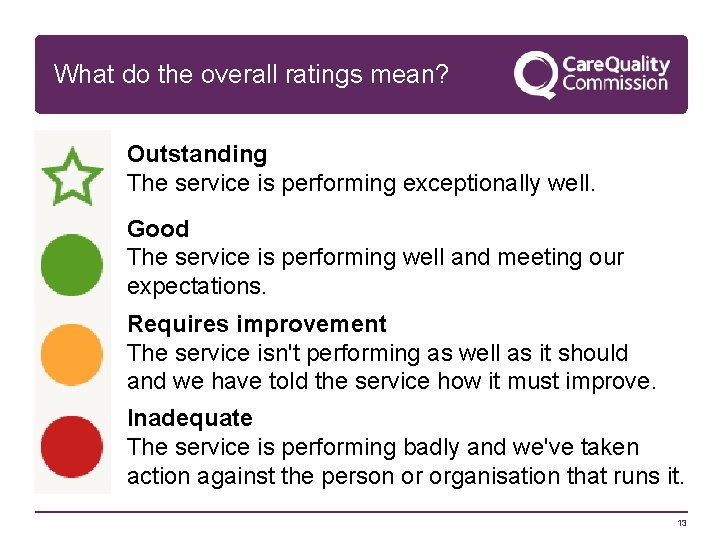
What do the overall ratings mean? Outstanding The service is performing exceptionally well. Good The service is performing well and meeting our expectations. Requires improvement The service isn't performing as well as it should and we have told the service how it must improve. Inadequate The service is performing badly and we've taken action against the person or organisation that runs it. 13
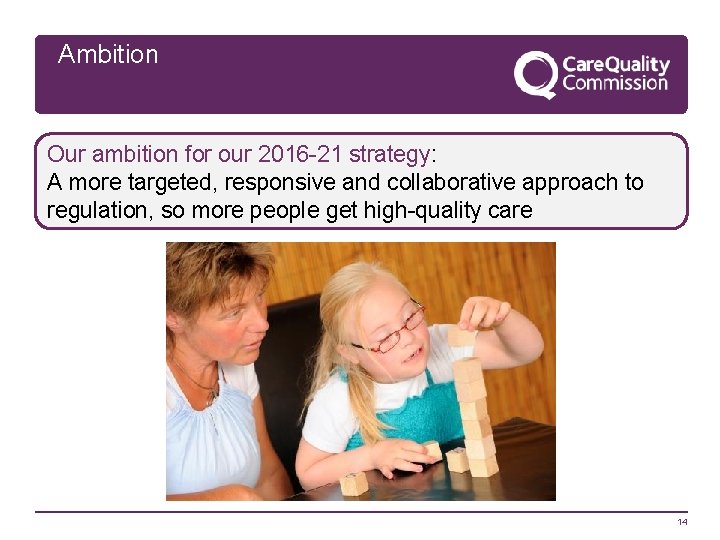
Ambition Our ambition for our 2016 -21 strategy: A more targeted, responsive and collaborative approach to regulation, so more people get high-quality care 14 14
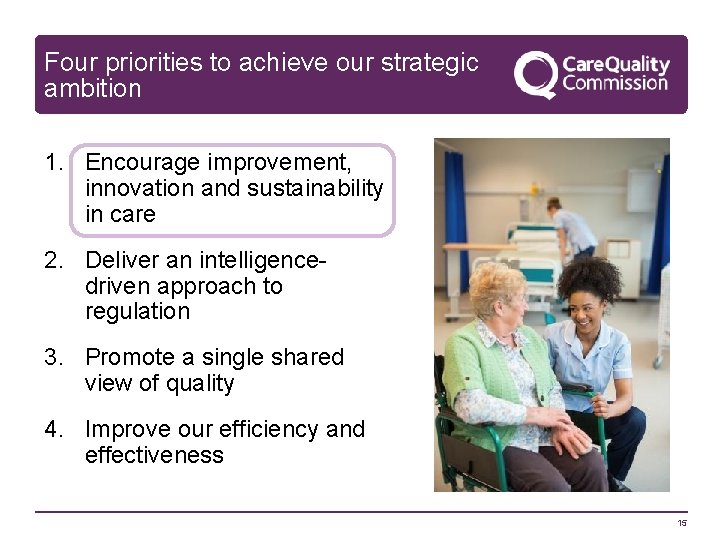
Four priorities to achieve our strategic ambition 1. Encourage improvement, innovation and sustainability in care 2. Deliver an intelligencedriven approach to regulation 3. Promote a single shared view of quality 4. Improve our efficiency and effectiveness 15
What are we doing at the CQC to improve our approach to innovation & tech?
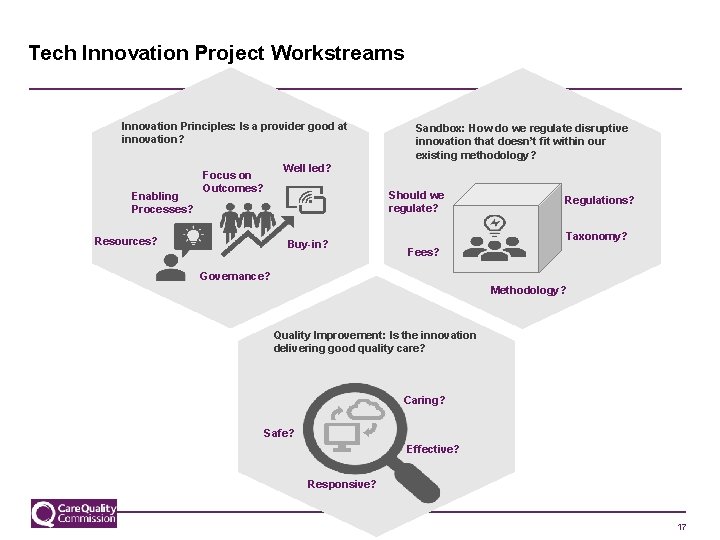
Tech Innovation Project Workstreams Innovation Principles: Is a provider good at innovation? Enabling Processes? Sandbox: How do we regulate disruptive innovation that doesn’t fit within our existing methodology? Well led? Focus on Outcomes? Should we regulate? Resources? Buy-in? Regulations? Taxonomy? Fees? Governance? Methodology? Quality Improvement: Is the innovation delivering good quality care? Caring? Safe? Effective? Responsive? 17
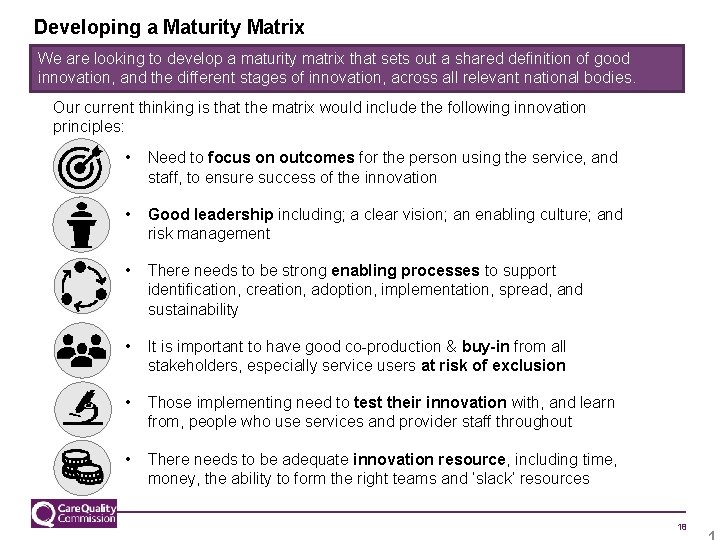
Developing a Maturity Matrix We are looking to develop a maturity matrix that sets out a shared definition of good innovation, and the different stages of innovation, across all relevant national bodies. Our current thinking is that the matrix would include the following innovation principles: • Need to focus on outcomes for the person using the service, and staff, to ensure success of the innovation • Good leadership including; a clear vision; an enabling culture; and risk management • There needs to be strong enabling processes to support identification, creation, adoption, implementation, spread, and sustainability • It is important to have good co-production & buy-in from all stakeholders, especially service users at risk of exclusion • Those implementing need to test their innovation with, and learn from, people who use services and provider staff throughout • There needs to be adequate innovation resource, including time, money, the ability to form the right teams and ‘slack’ resources 18
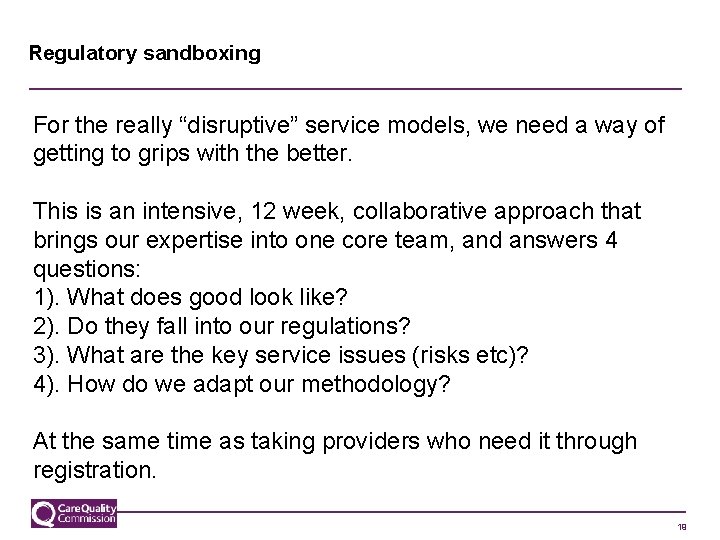
Regulatory sandboxing For the really “disruptive” service models, we need a way of getting to grips with the better. This is an intensive, 12 week, collaborative approach that brings our expertise into one core team, and answers 4 questions: 1). What does good look like? 2). Do they fall into our regulations? 3). What are the key service issues (risks etc)? 4). How do we adapt our methodology? At the same time as taking providers who need it through registration. 19
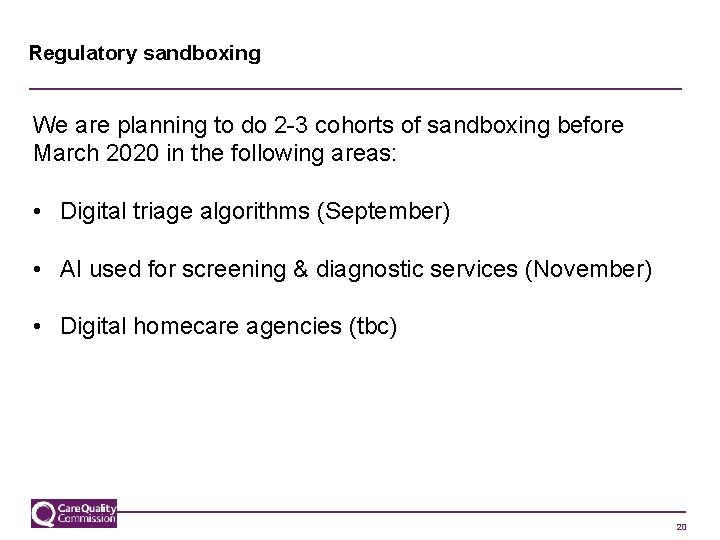
Regulatory sandboxing We are planning to do 2 -3 cohorts of sandboxing before March 2020 in the following areas: • Digital triage algorithms (September) • AI used for screening & diagnostic services (November) • Digital homecare agencies (tbc) 20
Questions www. cqc. org. uk Tom. stocker@cqc. org. uk enquiries@cqc. org. uk @Care. Quality. Comm Tom Stocker: Policy Manager – Innovation 21