
Why should we change how we teach physics

- Slides: 31
Why should we change how we teach physics? Derek Muller & Manju Sharma Sydney University Physics Education Research (SUPER)
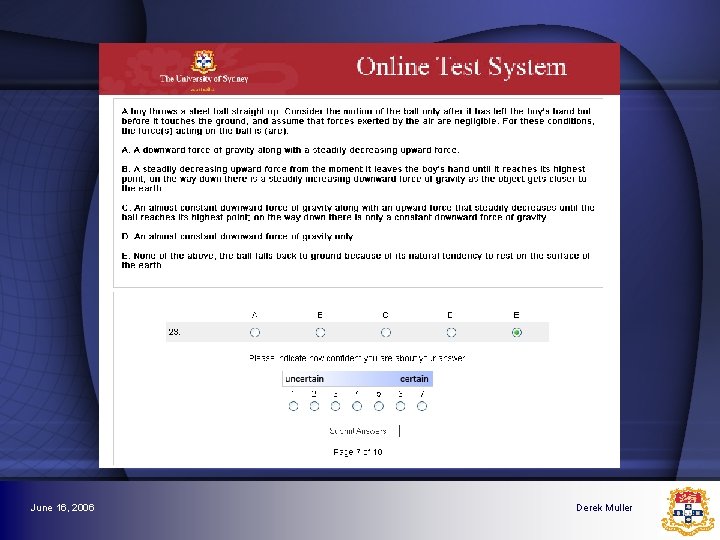
Conceptual Inventories • Tests to evaluate conceptual physics understandings – Force Concept Inventory – Force and Motion Conceptual Evaluation – Mechanics Baseline • Developed based on interviews/surveys • Used before and after courses to assess effectiveness June 16, 2006 Derek Muller
Force Concept Inventory • Do the questions ask about important conceptual topics? • Is the wording appropriate? • Is the test easier/more difficult than a standard mechanics test or the HSC? • Do you think a student could understand Newton’s laws well and score poorly? • Do you think a student without a good conceptual understanding could score well? June 16, 2006 Derek Muller
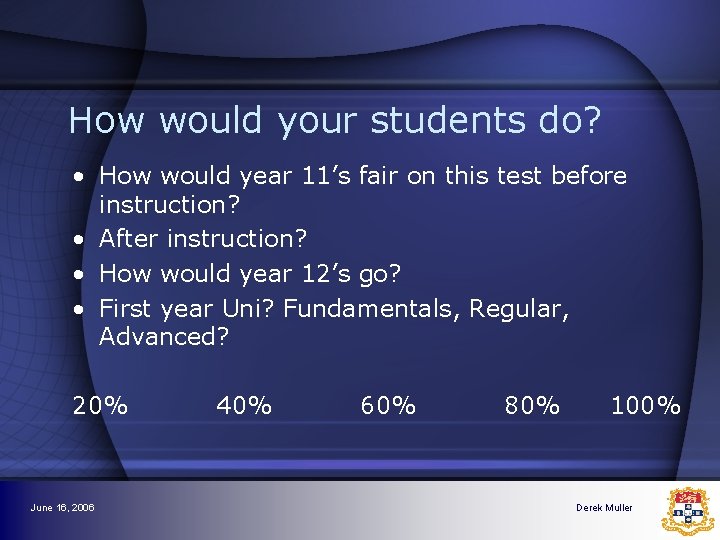
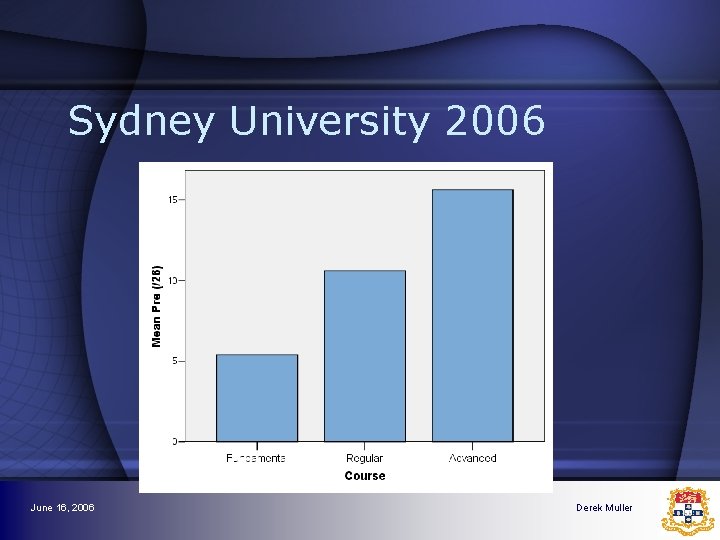
How would your students do? • How would year 11’s fair on this test before instruction? • After instruction? • How would year 12’s go? • First year Uni? Fundamentals, Regular, Advanced? 20% June 16, 2006 40% 60% 80% 100% Derek Muller
The facts • Before instruction, students average 20 -30% • After traditional lecturing or instruction, most students gain 10 -20% with a max of 30% June 16, 2006 Derek Muller
June 16, 2006 Derek Muller
Sydney University 2006 June 16, 2006 Derek Muller
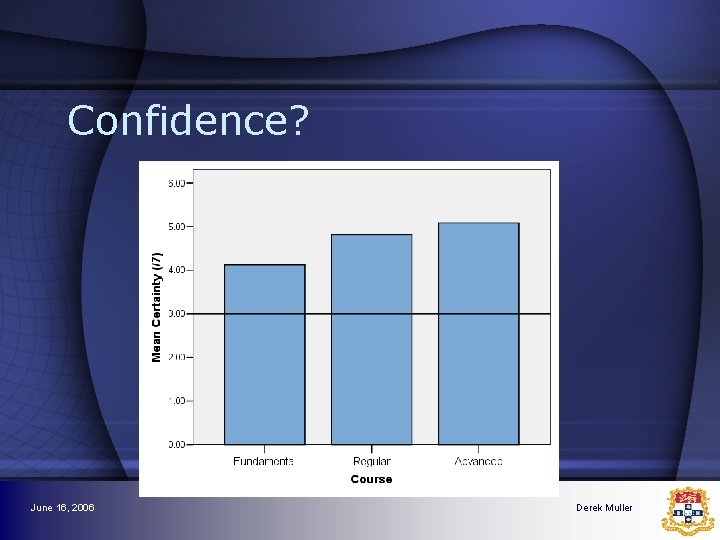
Confidence? June 16, 2006 Derek Muller
Questions • Why do students do so poorly? • Why do they think that they’re going well? June 16, 2006 Derek Muller
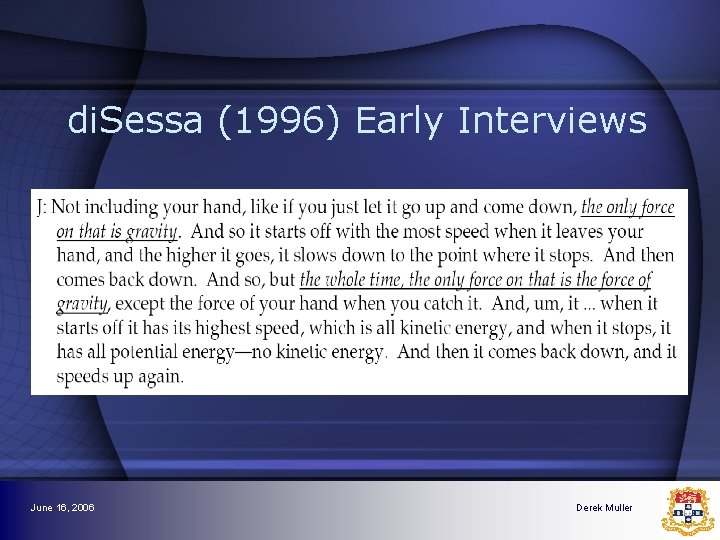
di. Sessa (1996) Early Interviews June 16, 2006 Derek Muller
di. Sessa (1996) cont. June 16, 2006 Derek Muller
di. Sessa (1996) Final interviews June 16, 2006 Derek Muller
June 16, 2006 Derek Muller
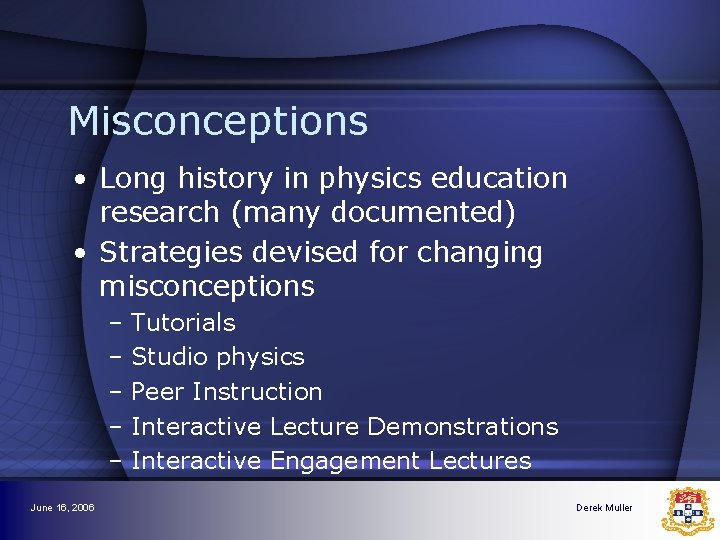
Misconceptions • Long history in physics education research (many documented) • Strategies devised for changing misconceptions – Tutorials – Studio physics – Peer Instruction – Interactive Lecture Demonstrations – Interactive Engagement Lectures June 16, 2006 Derek Muller
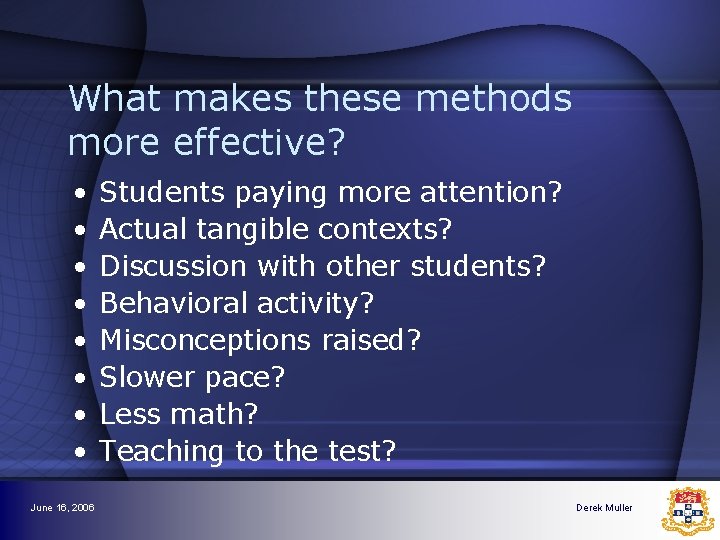
What makes these methods more effective? • • June 16, 2006 Students paying more attention? Actual tangible contexts? Discussion with other students? Behavioral activity? Misconceptions raised? Slower pace? Less math? Teaching to the test? Derek Muller
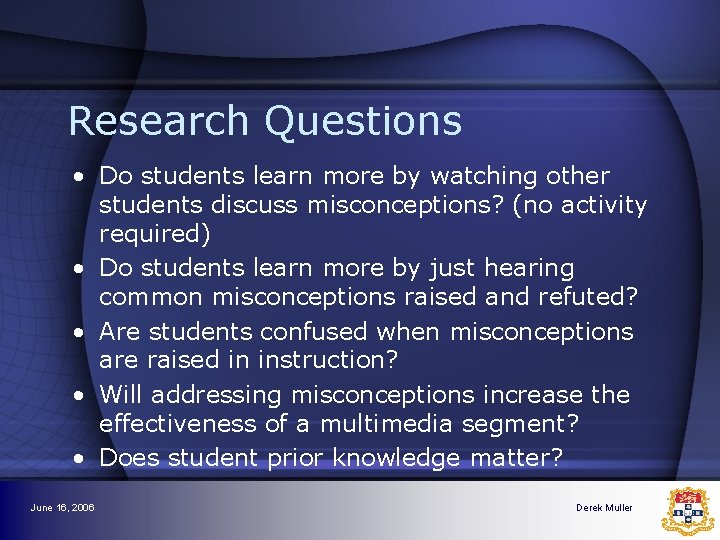
Research Questions • Do students learn more by watching other students discuss misconceptions? (no activity required) • Do students learn more by just hearing common misconceptions raised and refuted? • Are students confused when misconceptions are raised in instruction? • Will addressing misconceptions increase the effectiveness of a multimedia segment? • Does student prior knowledge matter? June 16, 2006 Derek Muller
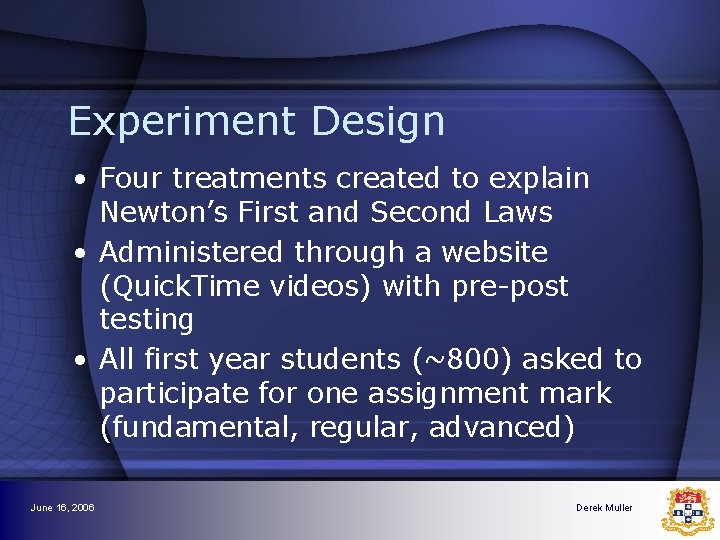
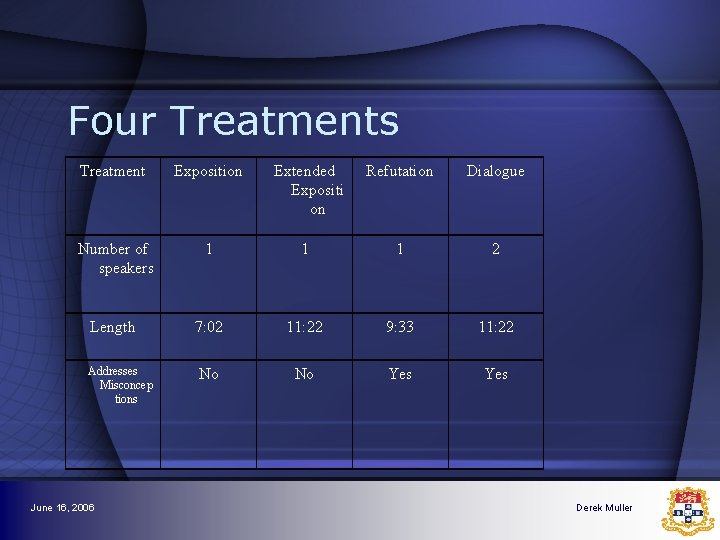
Experiment Design • Four treatments created to explain Newton’s First and Second Laws • Administered through a website (Quick. Time videos) with pre-post testing • All first year students (~800) asked to participate for one assignment mark (fundamental, regular, advanced) June 16, 2006 Derek Muller
Four Treatments Treatment Exposition Number of speakers 1 Length Addresses Misconcep tions June 16, 2006 Extended Expositi on Refutation Dialogue 1 1 2 7: 02 11: 22 9: 33 11: 22 No No Yes Derek Muller
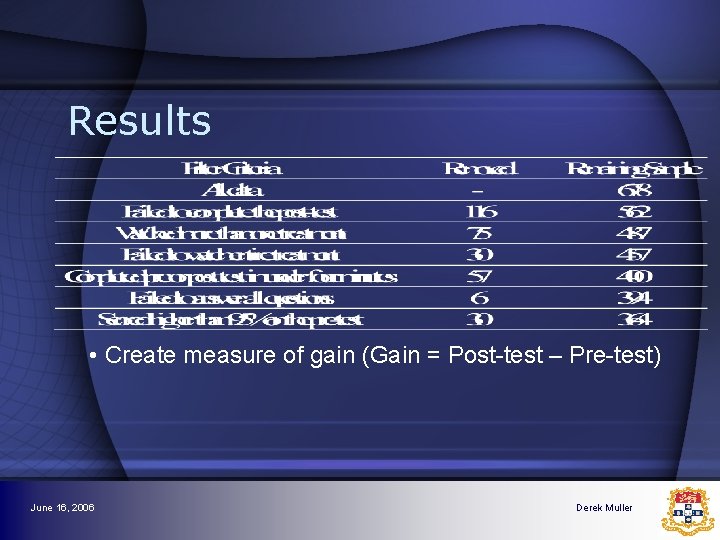
Results • Create measure of gain (Gain = Post-test – Pre-test) June 16, 2006 Derek Muller
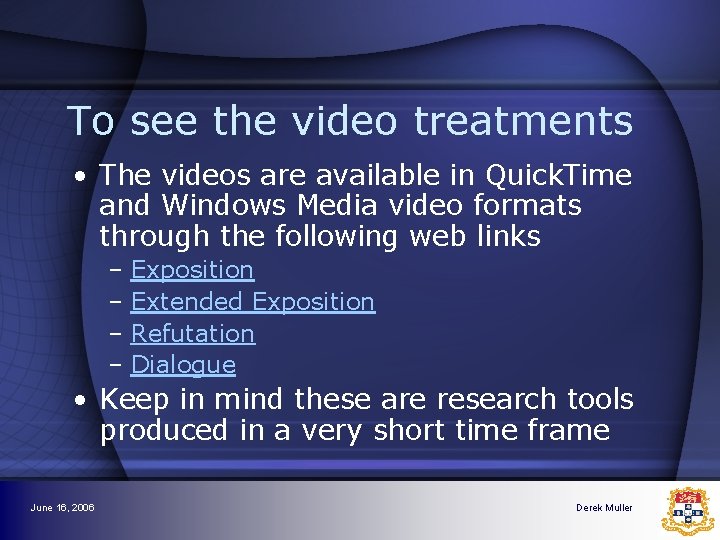
To see the video treatments • The videos are available in Quick. Time and Windows Media video formats through the following web links – Exposition – Extended Exposition – Refutation – Dialogue • Keep in mind these are research tools produced in a very short time frame June 16, 2006 Derek Muller
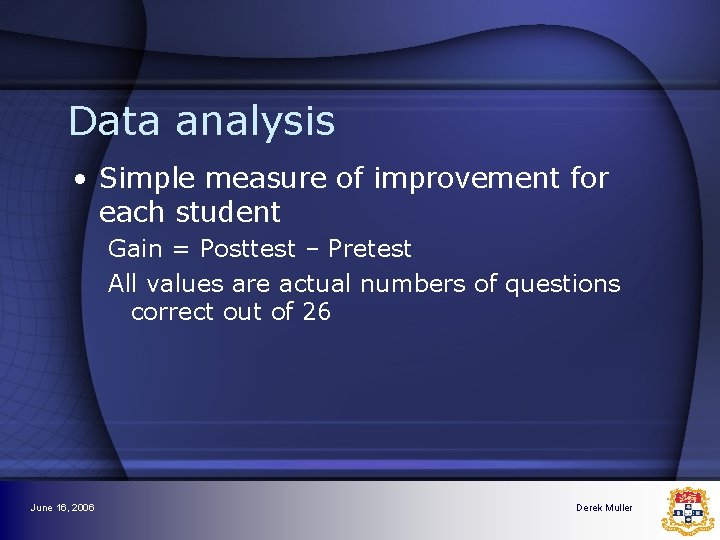
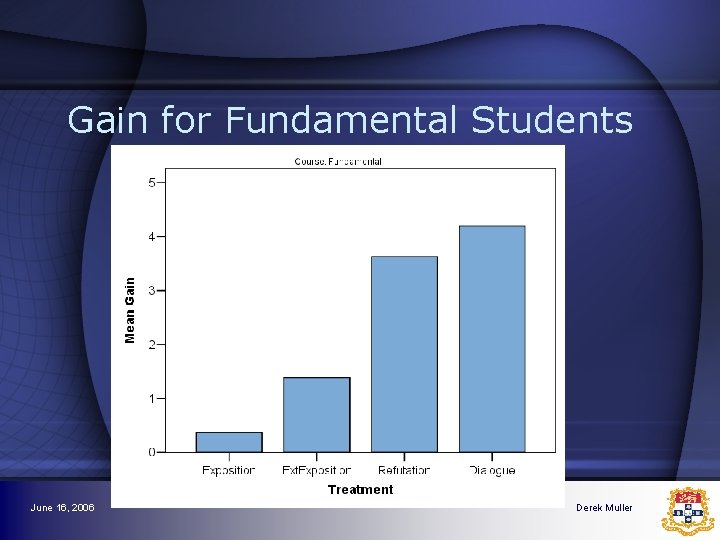
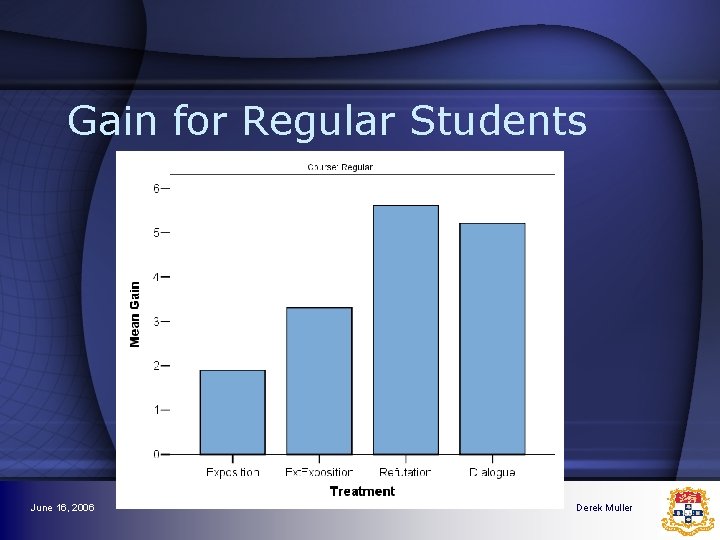
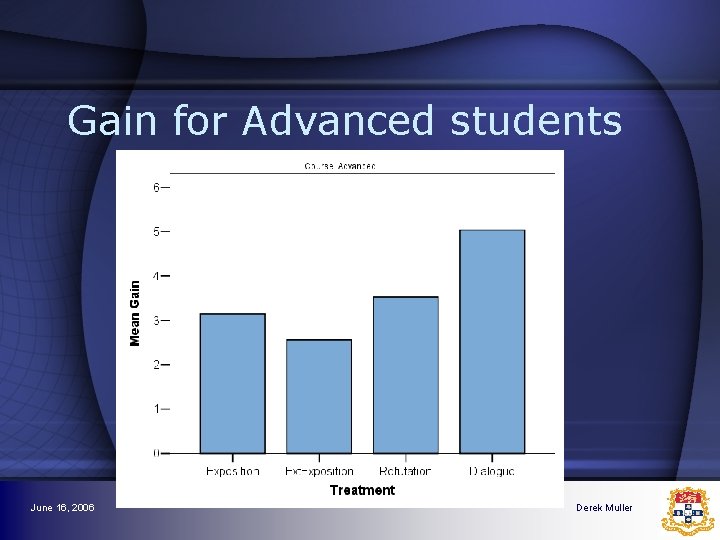
Data analysis • Simple measure of improvement for each student Gain = Posttest – Pretest All values are actual numbers of questions correct out of 26 June 16, 2006 Derek Muller
Gain for Fundamental Students June 16, 2006 Derek Muller
Gain for Regular Students June 16, 2006 Derek Muller
Gain for Advanced students June 16, 2006 Derek Muller
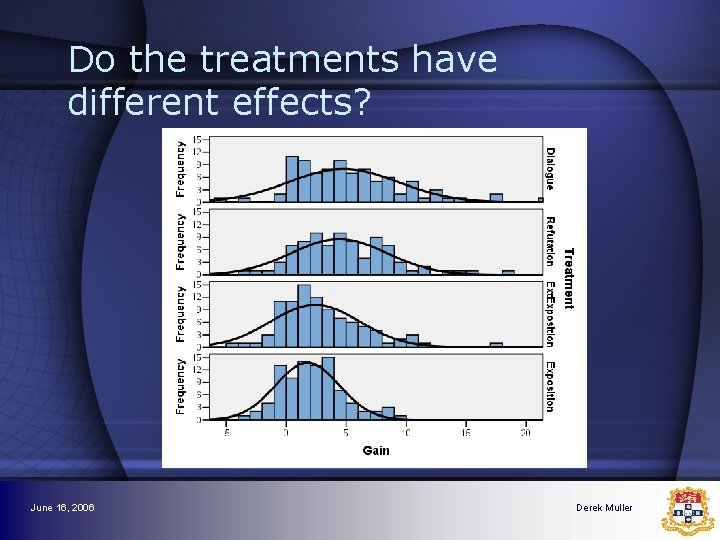
Do the treatments have different effects? June 16, 2006 Derek Muller
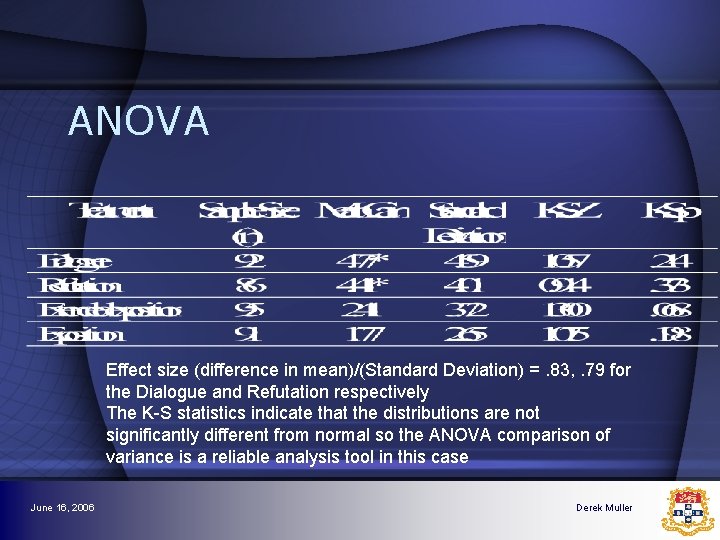
ANOVA Effect size (difference in mean)/(Standard Deviation) =. 83, . 79 for the Dialogue and Refutation respectively The K-S statistics indicate that the distributions are not significantly different from normal so the ANOVA comparison of variance is a reliable analysis tool in this case June 16, 2006 Derek Muller
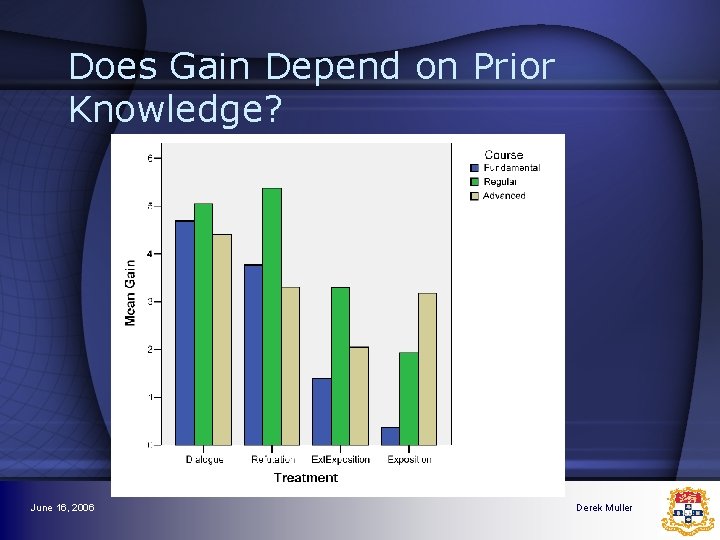
Does Gain Depend on Prior Knowledge? June 16, 2006 Derek Muller
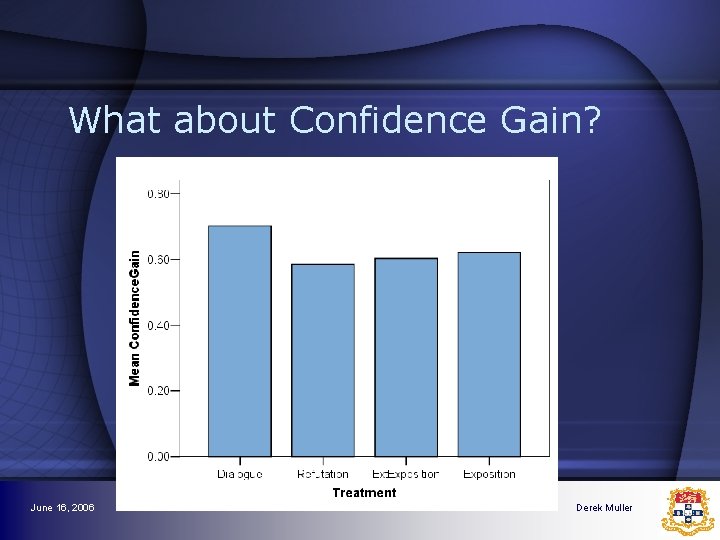
What about Confidence Gain? June 16, 2006 Derek Muller
Future Investigation • Is there a difference between Dialogue and Refutation methods? • Interviews to gauge student perceptions of videos • Applications of ‘vicarious learning’ in classrooms • Comparison with other online methods, collaborative learning June 16, 2006 Derek Muller
If you want to try the FCI • Use a different name (Mechanics Concepts etc. ) • Make sure copies don’t get passed out among students • Find data and research papers on its use with thousands of students • Normalized gain Gain/(Max Gain) is usually ~. 23 for typical courses and. 48 for ‘reform method’ teaching practices June 16, 2006 Derek Muller
Should we change how we teach physics? • Many researchers believe physics lectures/classes need to be significantly altered • Teaching physics at a slower pace with more hands-on activities and more discussion • Implemented in schools and universities internationally (Curtain University in Australia) • But is it sustainable? • At the very least, students seem to need explicit exposure to misconceptions June 16, 2006 Derek Muller