
Why Read if You Can Scan Trigger Scoping
- Slides: 1
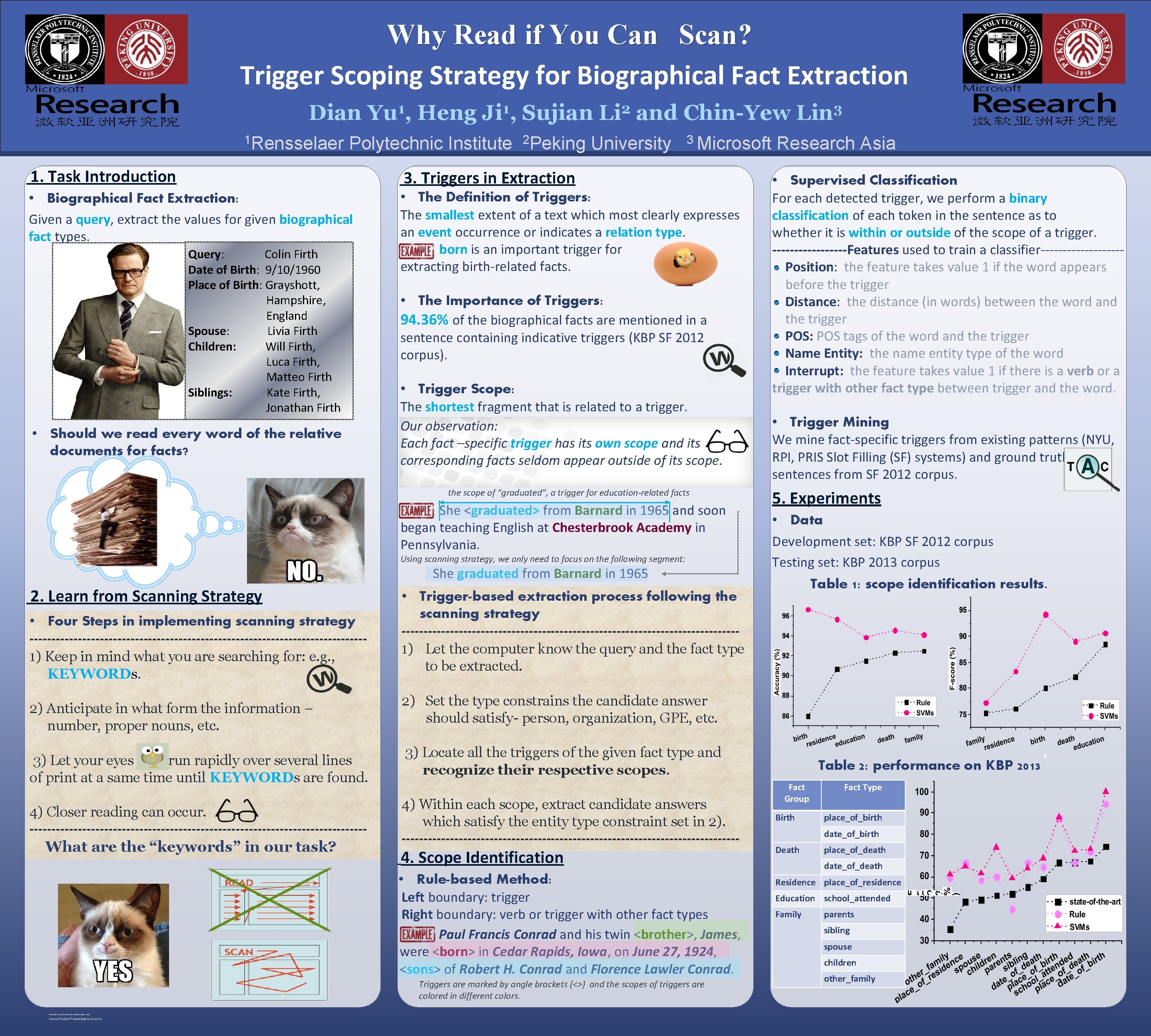
Why Read if You Can Scan? Trigger Scoping Strategy for Biographical Fact Extraction Dian 1 Rensselaer 1 Yu , Heng 1 Ji , Sujian 2 Li and Chin-Yew Polytechnic Institute 2 Peking University 3 Microsoft 1. Task Introduction 3. Triggers in Extraction • Biographical Fact Extraction: Given a query, extract the values for given biographical fact types. • The Definition of Triggers: The smallest extent of a text which most clearly expresses an event occurrence or indicates a relation type. born is an important trigger for extracting birth-related facts. Query: Colin Firth Date of Birth: 9/10/1960 Place of Birth: Grayshott, Hampshire, England Spouse: Livia Firth Children: Will Firth, Luca Firth, Matteo Firth Siblings: Kate Firth, Jonathan Firth • Should we read every word of the relative documents for facts? • The Importance of Triggers: 94. 36% of the biographical facts are mentioned in a sentence containing indicative triggers (KBP SF 2012 corpus). • Trigger Scope: The shortest fragment that is related to a trigger. Our observation: Each fact –specific trigger has its own scope and its corresponding facts seldom appear outside of its scope. the scope of “graduated”, a trigger for education-related facts She <graduated> from Barnard in 1965 and soon began teaching English at Chesterbrook Academy in Pennsylvania. Using scanning strategy, we only need to focus on the following segment: She graduated from Barnard in 1965 2. Learn from Scanning Strategy • Four Steps in implementing scanning strategy --------------------------------------1) Keep in mind what you are searching for: e. g. , KEYWORDs. 2) Anticipate in what form the information – number, proper nouns, etc. 3) Let your eyes run rapidly over several lines of print at a same time until KEYWORDs are found. 4) Closer reading can occur. --------------------------------------- What are the “keywords” in our task? • Trigger-based extraction process following the scanning strategy --------------------------------------1) Let the computer know the query and the fact type to be extracted. • Supervised Classification For each detected trigger, we perform a binary classification of each token in the sentence as to whether it is within or outside of the scope of a trigger. ---------Features used to train a classifier---------Position: the feature takes value 1 if the word appears before the trigger Distance: the distance (in words) between the word and the trigger POS: POS tags of the word and the trigger Name Entity: the name entity type of the word Interrupt: the feature takes value 1 if there is a verb or a trigger with other fact type between trigger and the word. • Trigger Mining We mine fact-specific triggers from existing patterns (NYU, RPI, PRIS Slot Filling (SF) systems) and ground truth sentences from SF 2012 corpus. 5. Experiments • Data Development set: KBP SF 2012 corpus Testing set: KBP 2013 corpus Table 1: scope identification results. 3) Locate all the triggers of the given fact type and recognize their respective scopes. 4) Within each scope, extract candidate answers which satisfy the entity type constraint set in 2). --------------------------------------- 4. Scope Identification Triggers are marked by angle brackets (<>) and the scopes of triggers are colored in different colors. www. Poster. Presentations. com Research Asia 2) Set the type constrains the candidate answer should satisfy- person, organization, GPE, etc. • Rule-based Method: Left boundary: trigger Right boundary: verb or trigger with other fact types Paul Francis Conrad and his twin <brother>, James, were <born> in Cedar Rapids, Iowa, on June 27, 1924, <sons> of Robert H. Conrad and Florence Lawler Conrad. RESEARCH POSTER PRESENTATION DESIGN © 2012 3 Lin Table 2: performance on KBP 2013 Fact Group Birth Fact Type place_of_birth date_of_birth Death place_of_death date_of_death Residence place_of_residence Education school_attended Family parents sibling spouse children other_family