
Why Public Health Matters Disease Surveillance and Investigation
Why Public Health Matters: Disease Surveillance and Investigation
Today’s Purpose To discuss governmental public health Public health in general The Kansas system and governance structure Statutes Programs Specifically, Disease Surveillance
What is Public Health? Public Health Focuses on prevention Includes environmental health Administers programs and services to reduce chronic disease Improves Engages health outcomes community partners to monitor and assess the health of the community
The Work of Your Health Department The responsibilities and work of the health department require specific expertise. Local public health departments focus on improving health outcomes by providing services such as immunizations, nutrition assistance for pregnant and nursing mothers and their young children, disease investigation and surveillance, emergency preparedness, home health, and enforcement of public health laws. Some health departments also conduct daycare and school inspections to ensure compliance with state regulations and licensure requirements.
The Work of Your Health Department Beyond program administration, the department • Is the link between the local and state department of health • Manages communications (state partners, media, community members) • Links people to other resources and health services/providers • Ensures compliance with federal and state privacy laws • Proactively looks for opportunities to bring additional funding/grants/opportunities to the community
The Governmental Public Health System 100 local health departments, serving all 105 counties Governed by local Boards of Health In most counties, this is the County Commission Kansas Department of Health and Environment (KDHE): The state health department Kansas Association of Local Health Departments: The statewide membership organization that represents 97 of the 100 local health departments
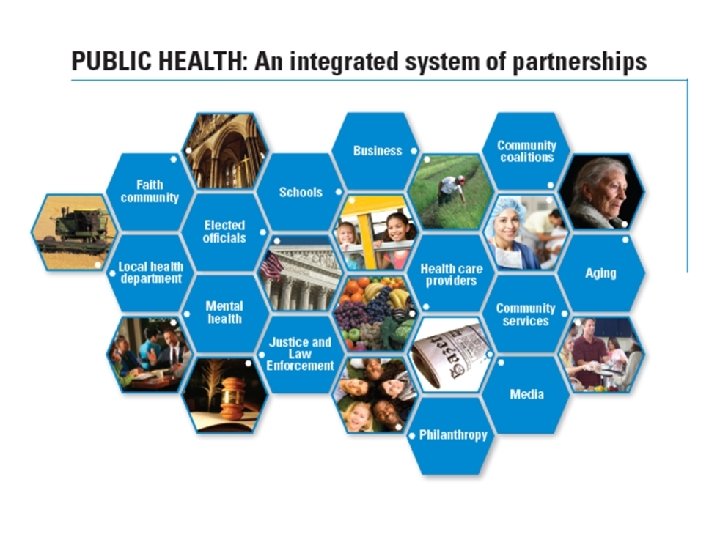
This Is Public Health
Governance of Public Health: Kansas Statutes A look at the statutes…
Governance 65 -201: The county commissioners of the several counties of this state shall act as county boards of health for their respective counties. Each county board thus created shall appoint a person. . . who shall serve in an advisory capacity to the county board of health and as the local health officer 65 -204: County health funds; . . . allows the county to levy taxes to establish a county health fund to defray costs of carrying out the health laws, rules, and regulations of the state, salary of the health officer, and other personnel. . .
Environmental 65 -159: Abatement of nuisances. . . the county or joint boards of health shall have the power and authority to examine into all nuisances, sources of filth and causes of sickness that in their opinion may be injurious to the health of inhabitants within any county or municipality in this state 19 -3703: Sanitary codes, administration of K. S. A. 48 -929: regarding county responsibilities for emergency response and management (Local health departments are responsible for Emergency Support Function #8: Public Health and Medical Services)
Disease Surveillance and Containment 65 -202: Local health officer responsible for communicable disease investigations and control measures (also in 65 -119) 65 -118: Authority for KDHE to designate reportable diseases 65 -301: Control of contagious diseases in cities of the second and third class 65 -101: Secretary of KDHE responsible for health supervision; investigation of causes of diseases, sickness, and death; sanitation inspections; prevention of spread of disease, outreach services; rules and regulations 75 -5210 Health tests and inoculations (purchase and provision of vaccines; 75 -5209 requirement for vaccinations for entry to daycare and public school)
Isolation and Quarantine 65 -128 & K. A. R. 28 -1 -6: Isolation and quarantine for specific diseases Also 65 -126 & K. A. R. 28 -1 -5 for broader isolation and quarantine authority 65 -119(a): Duties and powers of local health officers; Any county or joint board of health or local health officer having knowledge of any infectious or contagious disease. . . Within their jurisdiction, shall immediately exercise and maintain a supervision over such case or cases. . . Seeing that all cases are properly cared for and that provisions of this act as to isolation, restriction of communication, quarantine, and disinfection are duly enforced
Reporting Health care providers and laboratories are required to notify KDHE regarding patients with suspected or confirmed reportable diseases. The list of reportable diseases is defined by Kansas statute (K. S. A. 65 -118, 65128 and 65 -6001 through 65 -6007; and by K. A. R. 28 -1 -2 and 28 -1 -18). Infectious diseases designated in statute must be reported to the state health department (KDHE) within the statutorily defined time frame. Local health care providers must also notify the local health department of confirmed cases reportable diseases.
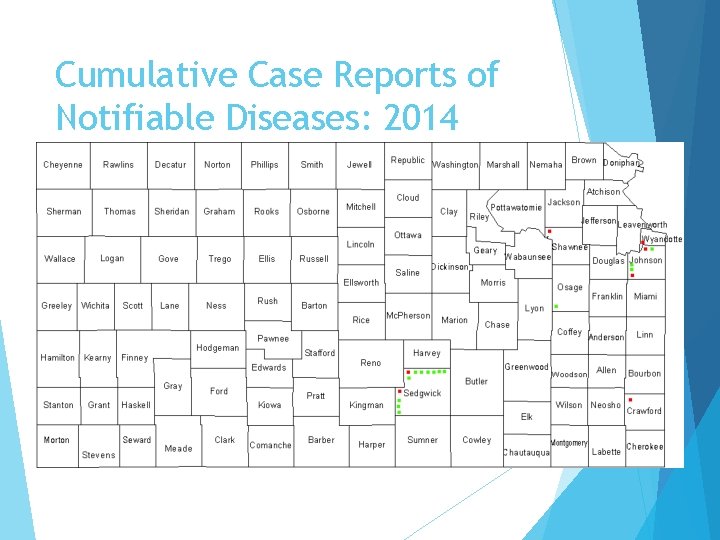
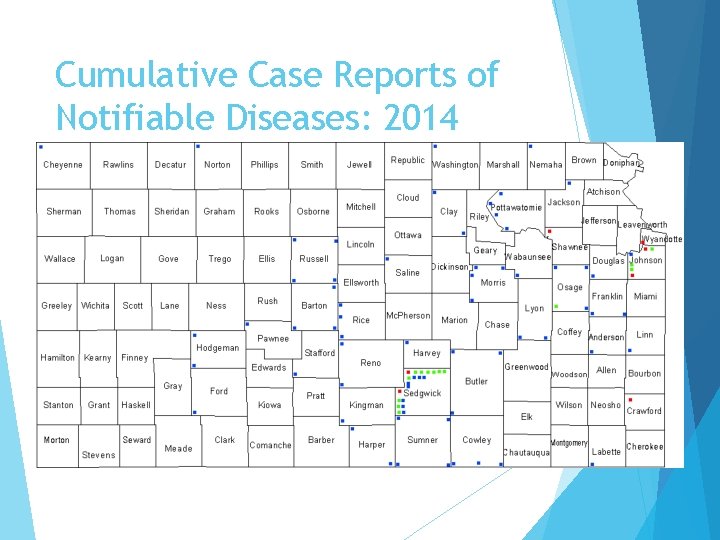
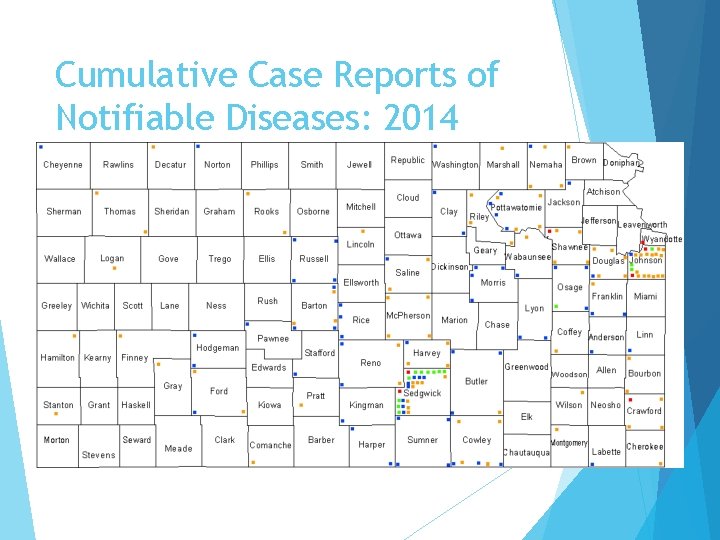
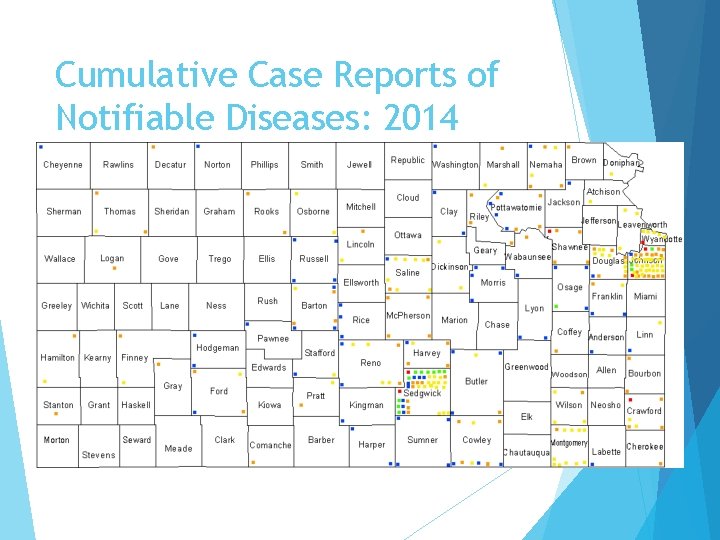
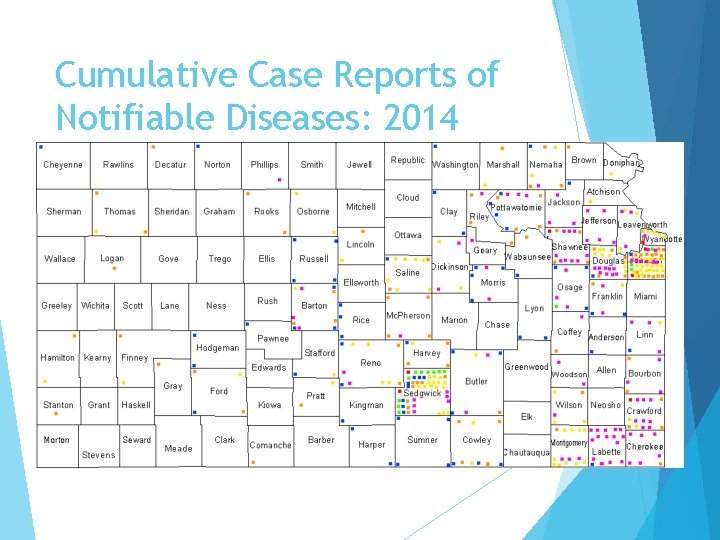
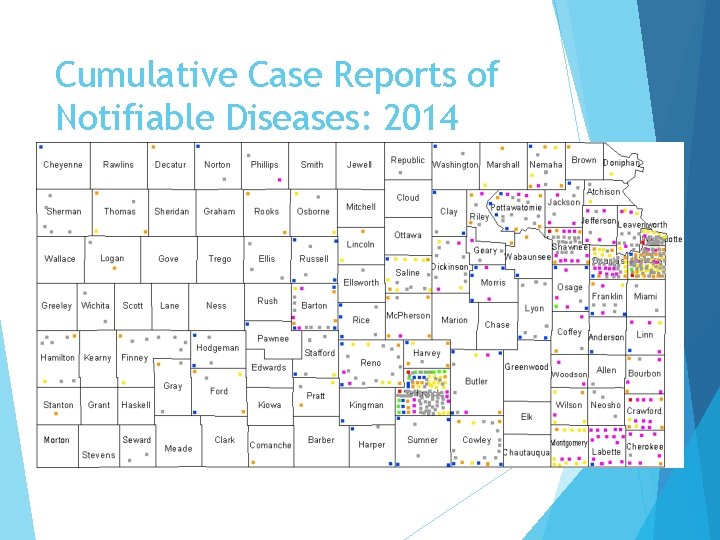
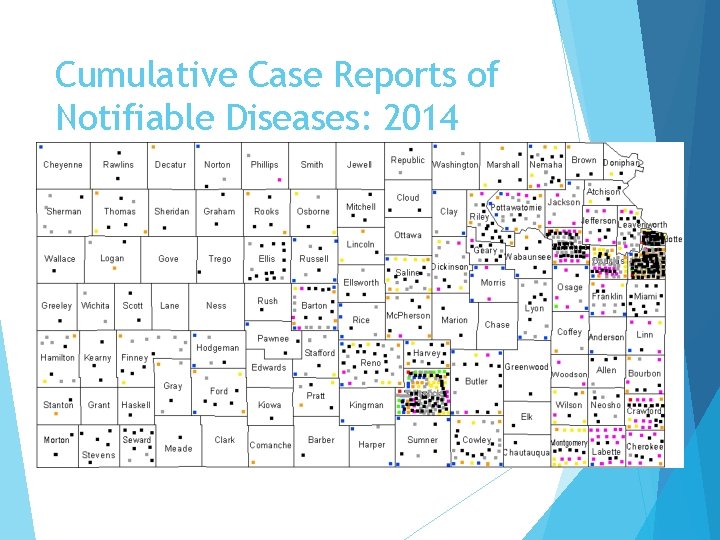
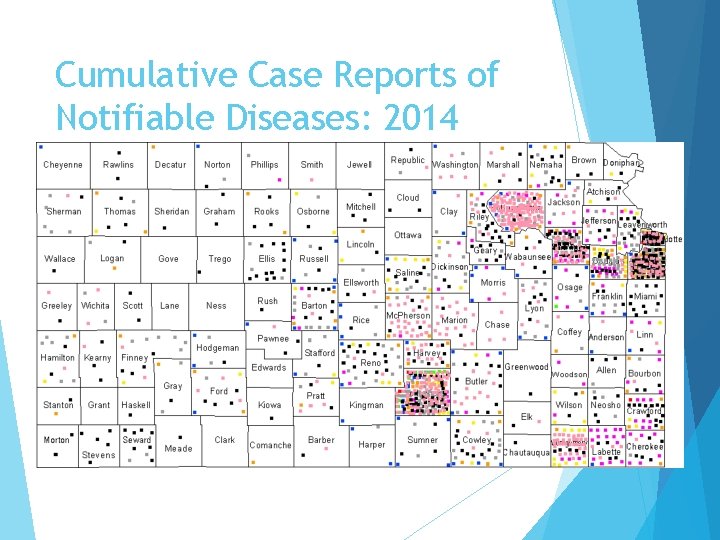
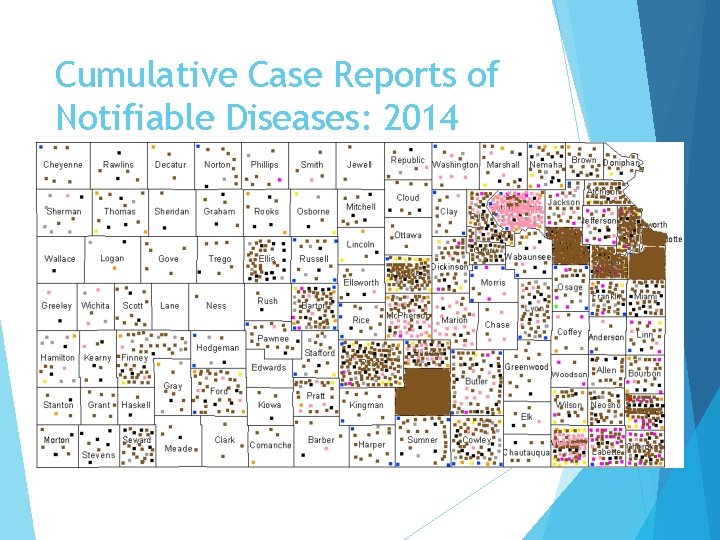
Why disease surveillance? Impact is LOCAL Local health departments are responsible for disease surveillance, containment, risk and communication.
Some Broad Disease Categories Foodborne n n n Hepatitis A E. coli Giardiasis Salmonellosis Bites n Rabies n Spotted fever rickettsiosis n West Nile Environmental Lead poisoning Asbestosis Black lung disease Human-to-Human n Measles n Varicella n Pertussis
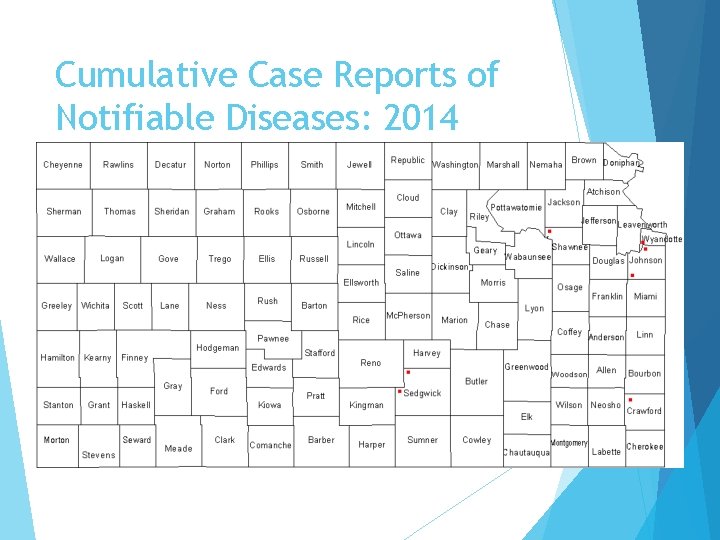
Cumulative Case Reports of Notifiable Diseases: 2014
Cumulative Case Reports of Notifiable Diseases: 2014
Cumulative Case Reports of Notifiable Diseases: 2014
Cumulative Case Reports of Notifiable Diseases: 2014
Cumulative Case Reports of Notifiable Diseases: 2014
Cumulative Case Reports of Notifiable Diseases: 2014
Cumulative Case Reports of Notifiable Diseases: 2014
Cumulative Case Reports of Notifiable Diseases: 2014
Cumulative Case Reports of Notifiable Diseases: 2014
Cumulative Case Reports of Notifiable Diseases: 2014
What Is Your Role? The Board of Health has specific statutory responsibilities, is responsible for management and oversight of the local health department, has a duty to serve its constituents, including ensuring the health and safety of the community. What do you need to be successful?

Partnering With Your LHD Director In 2013, KALHD partnered with KAC on a project designed to engage county commissioners and provide information to them about the important role they play in management of public health To that end, we hosted a series of regional meetings with commissioners and health department directors and asked for their feedback on what is needed to successfully manage public health Some common themes emerged…
Successful Partnerships What do commissioners want from their health department directors? Frequent, timely, succinct communication in context of community needs and resources; no acronyms; explain the “why” as well as the “what”; updates on current events at the department and service utilization Prioritization of goals/requests Accountability (i. e. help explaining to taxpayers the what and why of how resources are invested) Provide choices and solutions Vision
Successful Partnerships What do health department directors want from their commissioners? Communication Investment, not just funding but also time, involvement, increased knowledge, participation, and support Clear expectations Budget that aligns with expectations Leadership Help with enforcement Vision
Role of Commissioners Embrace your role as the Board of Health. Comply with statutory requirements for public health services. Rely on your health department staff for their expertise. Partner with your health department to make informed decisions to improve the health of your community.
Michelle Ponce KALHD Executive Director michelle. ponce@kalhd. org www. kalhd. org 785 -271 -8391
- Slides: 31