
Why People Work Your Career Doing What Matters
- Slides: 24
Why People Work Your Career: Doing What Matters Most
Job vs. Career �Job – provides you with the basics �Career – chosen occupation � Example: Currently your career is being a student �Career Choice: � Determines your life style � Your values determine earning potential � Personal Satisfaction
Making a Career Plan �Most people spend about one-third of their waking hours at work �The work you choose will affect your earning power, job opportunities, job satisfaction, and financial security
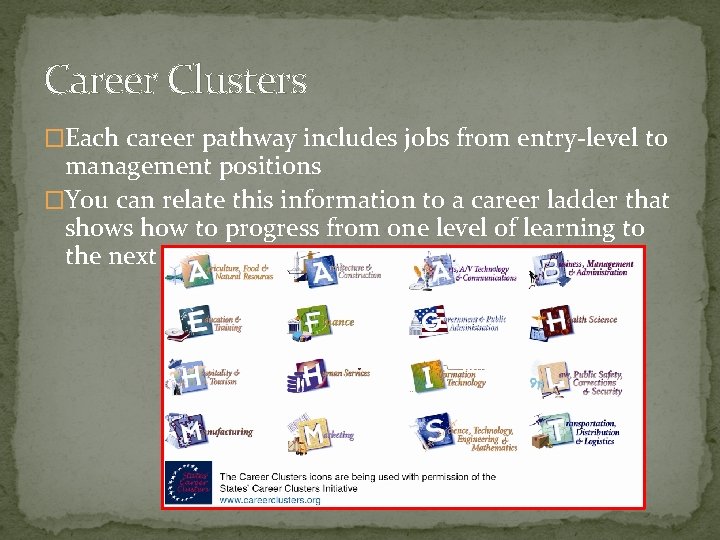
Career Clusters �The 16 career clusters link material learned in school to specific career paths and their programs of study �Within each cluster are subgroups called career pathways �Pathways reflect associations among occupations that require similar knowledge and skills �You will be drawn to one or more clusters based on your interests, aptitudes, and abilities �By focusing on one career cluster and pathway, you can easily explore different occupations within your areas of interest
Career Clusters �Each career pathway includes jobs from entry-level to management positions �You can relate this information to a career ladder that shows how to progress from one level of learning to the next
Making a Career Plan �After deciding on a field of interest, begin making a career plan.
Making a Career Plan �A career plan includes � required courses and training � job-related experiences � extracurricular activities and projects �Career plans can be started as early as junior high school � Career Plan: An outline of steps or action you can take to reach a career goal, including required courses and training, job-related experiences, and extracurricular activities or projects.
Identify Your Interests �The type of work you’ll enjoy can be determined by your interest: � Favorite hobbies, subjects, and extracurricular activities � School subjects you’ve enjoyed � Part-time jobs you liked
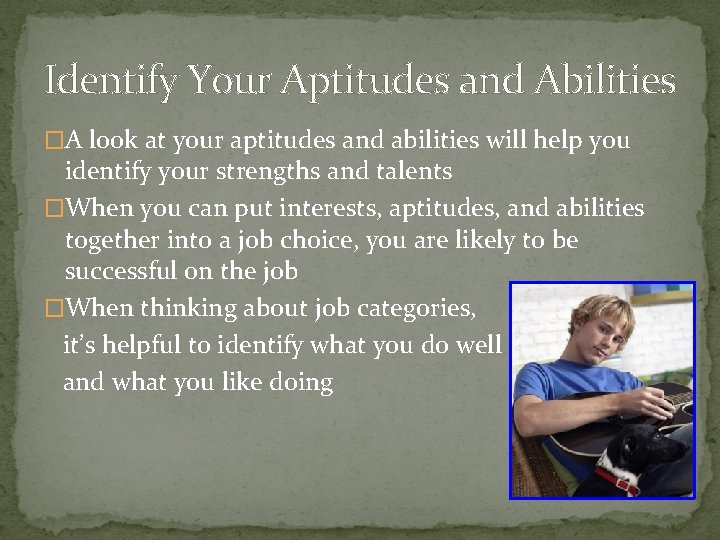
Identify Your Aptitudes and Abilities �A look at your aptitudes and abilities will help you identify your strengths and talents �When you can put interests, aptitudes, and abilities together into a job choice, you are likely to be successful on the job �When thinking about job categories, it’s helpful to identify what you do well and what you like doing
Examples of Aptitudes and Abilitites �Aptitudes - Natural Physical and Mental Talents � Born with Skills � High Verbal Skills (high test scores) �Written or oral communication � High Math Skills (high test scores) �Work with numbers �Abilities – Physical and mental talents you DEVELOP through learning, training, and practice � Play a sport through well trough lots of practice
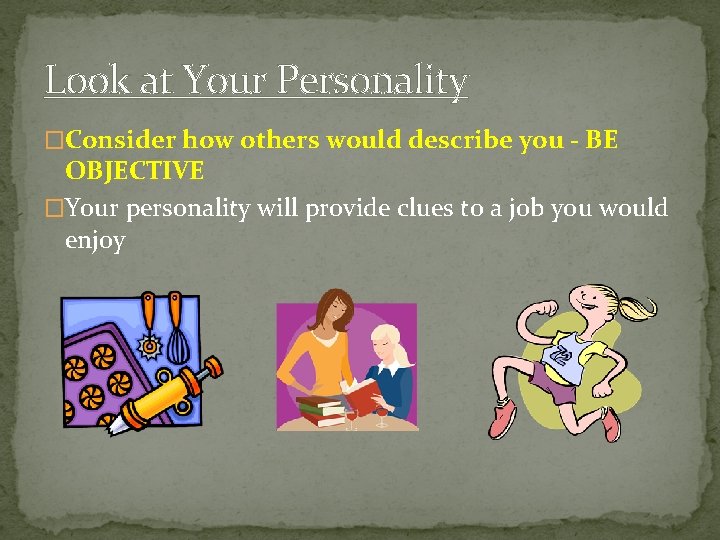
Look at Your Personality �Consider how others would describe you - BE OBJECTIVE �Your personality will provide clues to a job you would enjoy
Assess Your Values and Goals �Analyzing personal values and goals can help you make good career and job choices � What is really important to you? � What contribution do you want to make? � What job or career will make you feel you are making a difference?
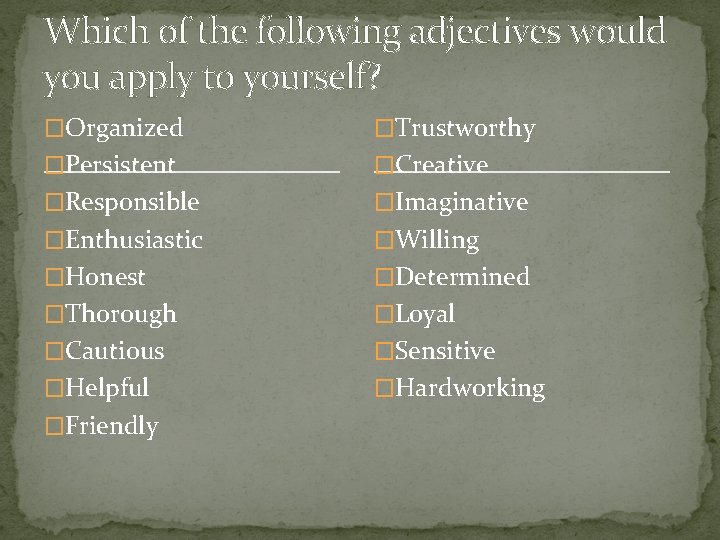
Which of the following adjectives would you apply to yourself? �Organized �Trustworthy �Persistent �Creative �Responsible �Imaginative �Enthusiastic �Willing �Honest �Determined �Thorough �Loyal �Cautious �Sensitive �Helpful �Hardworking �Friendly
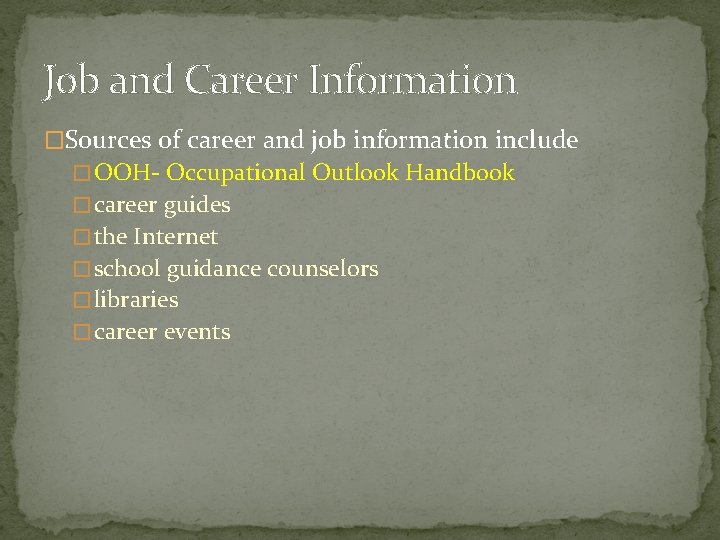
Job and Career Information �Sources of career and job information include � OOH- Occupational Outlook Handbook � career guides � the Internet � school guidance counselors � libraries � career events
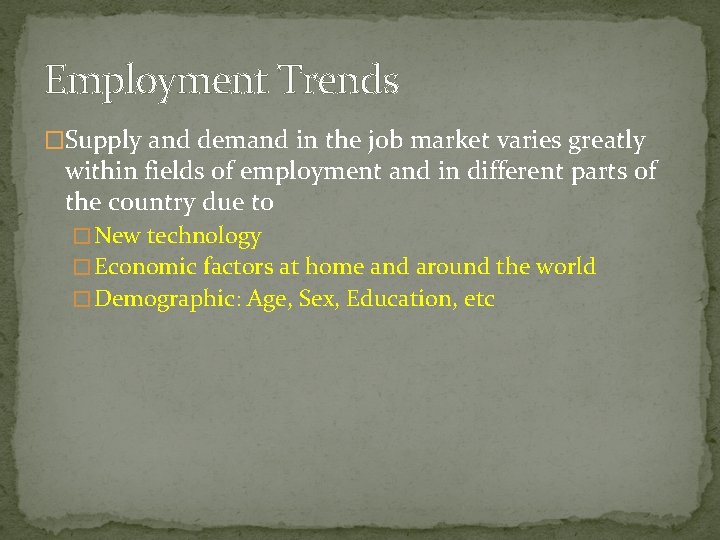
Employment Trends �Supply and demand in the job market varies greatly within fields of employment and in different parts of the country due to � New technology � Economic factors at home and around the world � Demographic: Age, Sex, Education, etc
Education and Training for your job
Plan the Training and Education You Need �In a variety of fields, jobs using new technology require highly trained and skilled workers �A college education or occupational training will be required for many jobs �Untrained and unskilled workers will either be unemployed or remain at bottom-level, low-paying jobs �You need to learn and relearn work skills over a lifetime
College or University Education �Higher education can be a costly investment, with returns of higher earnings, better job opportunities, and a fuller life �Factors to consider include � personal goals � personal preferences � your record and performance
College Choices Open to You �Check out and compare � programs of study � faculty � facilities � environment � geographic location and campus setting � cost � financial aid
College Choices Open to You �Decide if you prefer a campus that is � coed or single-sex � religious or non-denominational � small or large �Sources of college information include � the college’s Web site and printed materials, including catalogs � college and career orientation programs � visiting the college or its representatives � current students and alumni
College and Job Training Online � Internet education and training programs are called e- learning, which is a form of distance learning � Do some research before enrolling for any form of distance learning � The U. S. Distance Learning Association is a good source of information � Research an online school’s � prerequisites � necessary equipment and supplies � expectation of student computer skills � reputation and reliability � faculty qualifications � cost
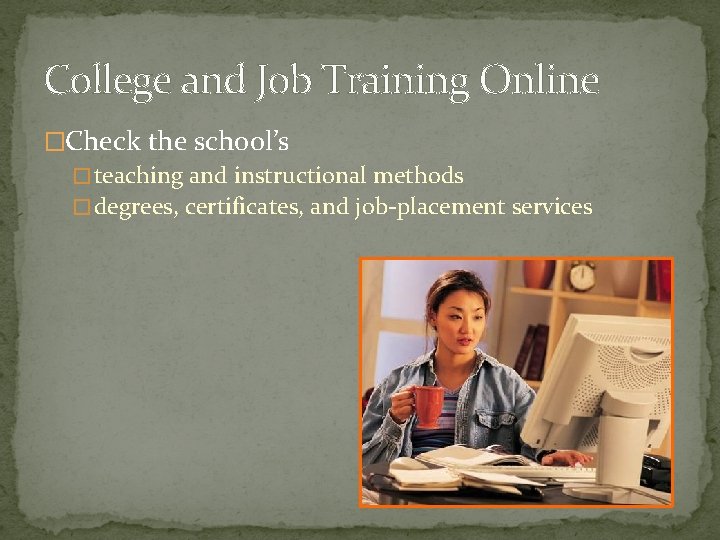
College and Job Training Online �Check the school’s � teaching and instructional methods � degrees, certificates, and job-placement services
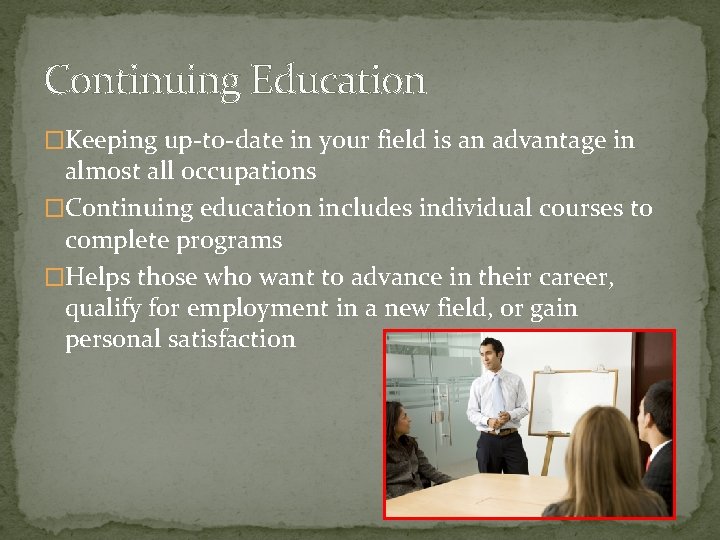
Continuing Education �Keeping up-to-date in your field is an advantage in almost all occupations �Continuing education includes individual courses to complete programs �Helps those who want to advance in their career, qualify for employment in a new field, or gain personal satisfaction
Paying for Training and Education �Education is an investment in yourself �Deciding how much you can afford to invest and how you will pay for it requires careful thought �Financial aid comes in many forms and from many sources; search for options