
Why People Buy The Psychology of Selling Psychological
Why People Buy: The Psychology of Selling
Psychological Influences on Buying • Motivation to buy should exist: • Needs result from a lack of something desirable • Economic needs (Best value for money): • Best value or most satisfying product for the money 4 -1
Selling Implications • Sell what customer needs… • But anticipate competition comparisons 4 -2
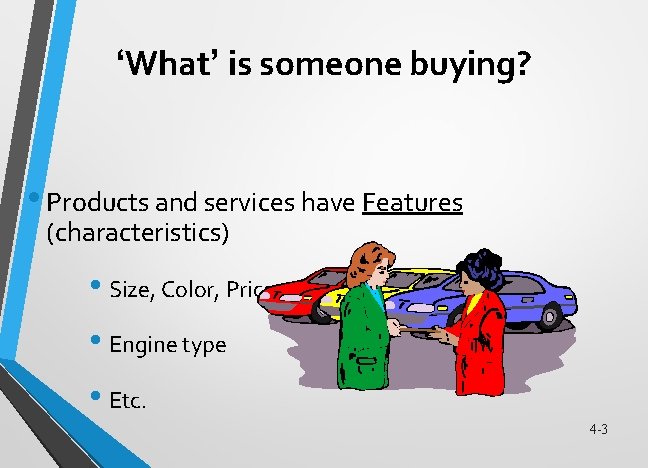
‘What’ is someone buying? • Products and services have Features (characteristics) • Size, Color, Price • Engine type • Etc. 4 -3
Features give a product Advantage • Advantage • A performance characteristic • What it can do for you • How it compares with other products • “More” something – performance, savings, time 4 -4
Advantages will result in Benefits • We are interested in what product will do for us • Benefits can be both practical & psychological • Emphasizing benefits increases sales 4 -5
A FABulous Approach to Buyer Need Satisfaction • ùStressing benefits is a very powerful selling technique Feature • ùFAB selling technique helps emphasize benefit Advantage ù Benefit 4 -6
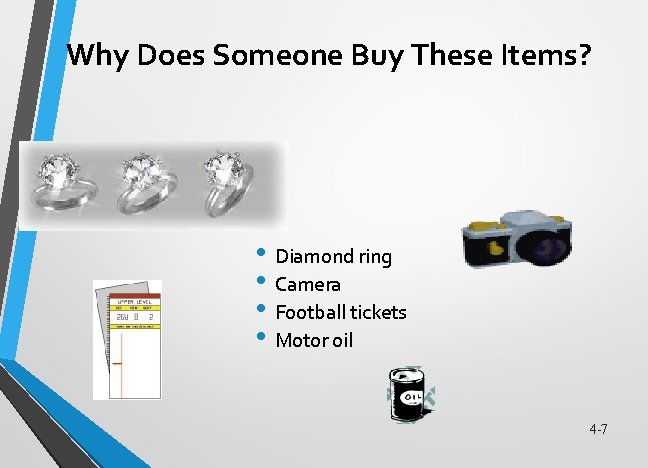
Why Does Someone Buy These Items? • Diamond ring • Camera • Football tickets • Motor oil 4 -7
People Buy the Product Benefits • Diamond benefit? • Camera benefit? • Motor oil benefit? • Football tickets benefit? 4 -8
Selling Implications • Buyers are most interested in benefits • That is, “What’s in it for me? ” • But the Features & Advantages will prove it. 4 -9
People Buy Benefit(s) • Not a product’s feature(s) • Not a product’s advantage(s) 4 -10
People Buy Benefit(s) • But Features and Advantages support Benefits • They explain why & how benefits are delivered 4 -11
People Buy Benefit(s) • Think about advertising messages: • They focus on benefits • Advertisers know this helps sell the product 4 -12
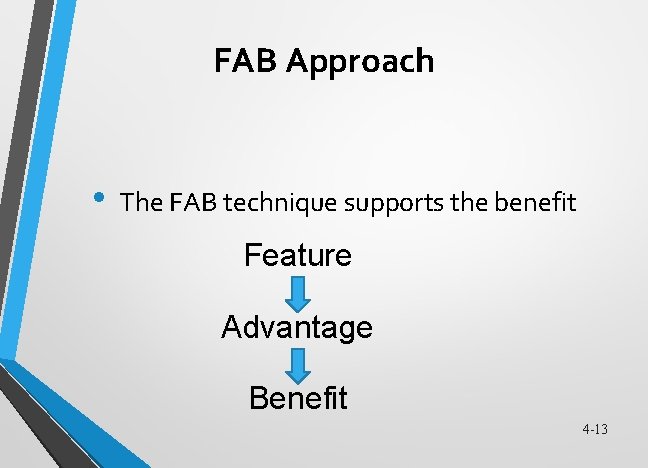
FAB Approach • The FAB technique supports the benefit Feature Advantage Benefit 4 -13
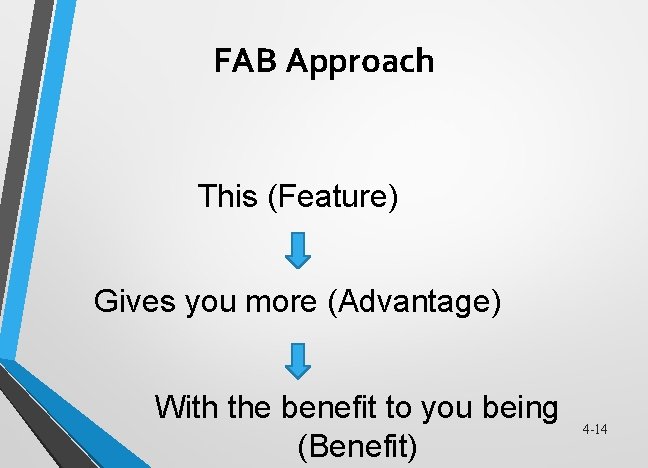
FAB Approach This (Feature) Gives you more (Advantage) With the benefit to you being (Benefit) 4 -14
FABs Can Be Awkward at First • New salespeople are frequently not accustomed to using feature, advantage, and benefit phrases • It may seem awkward at first 4 -15
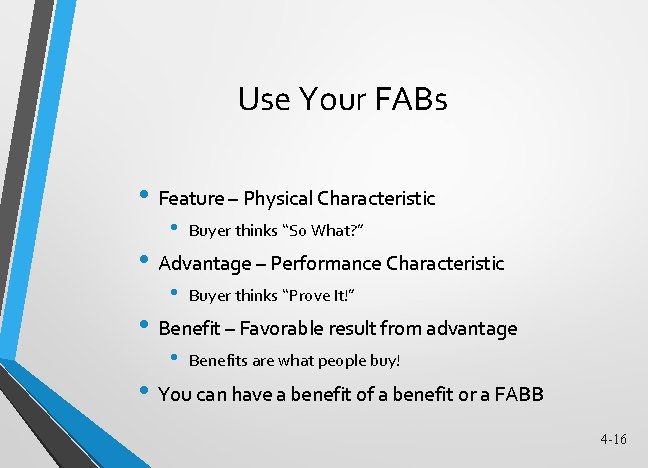
Use Your FABs • Feature – Physical Characteristic • Buyer thinks “So What? ” • Advantage – Performance Characteristic • Buyer thinks “Prove It!” • Benefit – Favorable result from advantage • Benefits are what people buy! • You can have a benefit of a benefit or a FABB 4 -16
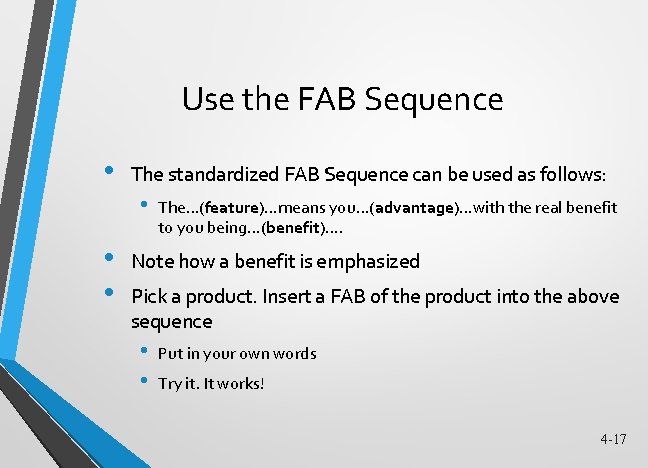
Use the FAB Sequence • The standardized FAB Sequence can be used as follows: • • • The…(feature)…means you…(advantage)…with the real benefit to you being…(benefit)…. Note how a benefit is emphasized Pick a product. Insert a FAB of the product into the above sequence • • Put in your own words Try it. It works! 4 -17
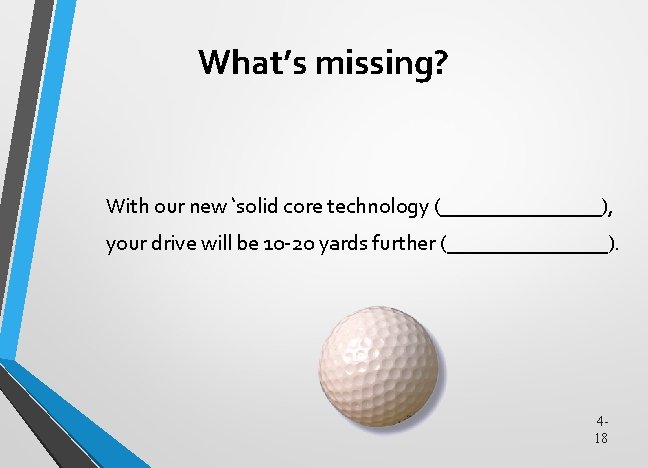
What’s missing? With our new ‘solid core technology (________), your drive will be 10 -20 yards further (________). 418
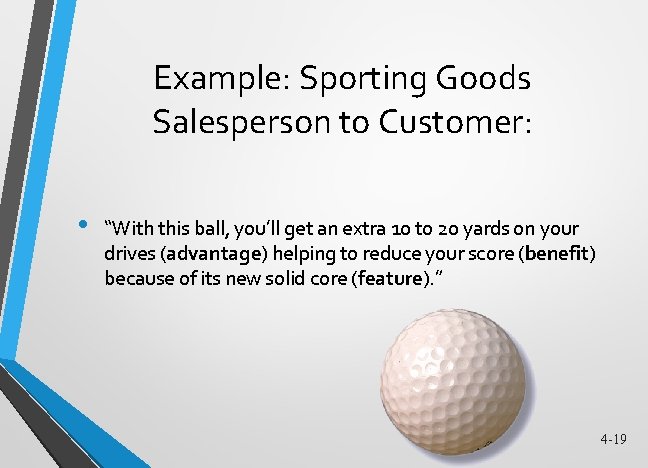
Example: Sporting Goods Salesperson to Customer: • “With this ball, you’ll get an extra 10 to 20 yards on your drives (advantage) helping to reduce your score (benefit) because of its new solid core (feature). ” 4 -19
Fill in the FAB blanks For longer wear (___) & saving money(___), you can’t beat these slacks. All the seams are double stitched (___) and the material is 100% Dacron (___) 420
Let’s Review FABs • “For long wear (advantage) and savings on your clothing costs (benefit), you can’t beat these slacks. All the seams are double stitched (feature) and the material is 100% Dacron (feature)” 4 -21
People Buy Benefit(s) • High performing salespeople stress benefits • Increases chances of ‘making the sale’ 4 -22
FAB Review (Name: ______) Made of 100% silk (___) Engine gets 20% better fuel consumption (___) Newer (___) Lasts twice as long (___) Saves time (___) 423
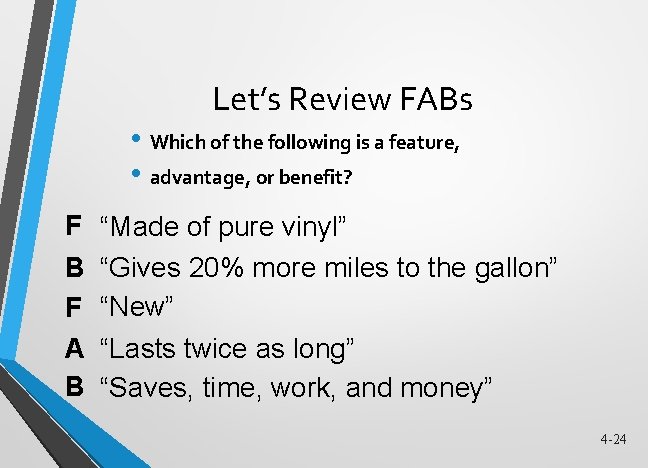
Let’s Review FABs • Which of the following is a feature, • advantage, or benefit? F “Made of pure vinyl” B “Gives 20% more miles to the gallon” F “New” A “Lasts twice as long” B “Saves, time, work, and money” 4 -24
Use the FAB Sequence • Names: _________ • • Product or Service: ________ Feature: ________ Advantage: ________ Benefit: ________ 4 -25
Salesperson needs to be a Detective • Every product has several benefits • Should you spend time on unimportant ones? • How can you find out which benefit is more important to Buyer? 4 -26

How to Determine Important Needs ù Listen ù Observe ù Combine • L-O-C-A-T-E technique ù Ask questions ù T alk to others ù Empathize 4 -27
Uncovering Hidden Needs? ? • The Trial Close • Asking for an opinion, not a decision to buy • One of the best selling techniques 4 -28
Trial Closes do not ask someone to Buy • • “How does that sound to you? ” “Is this important to you? ” “Does that answer your concern? ” “What do you think about…? ” 4 -29
Trial Close Helps You to Determine: • Prospect reactions to FABs (and importance) • If you have successfully answered objection • Whether any objections remain • Whether the prospect is ready for ‘close’ 4 -30
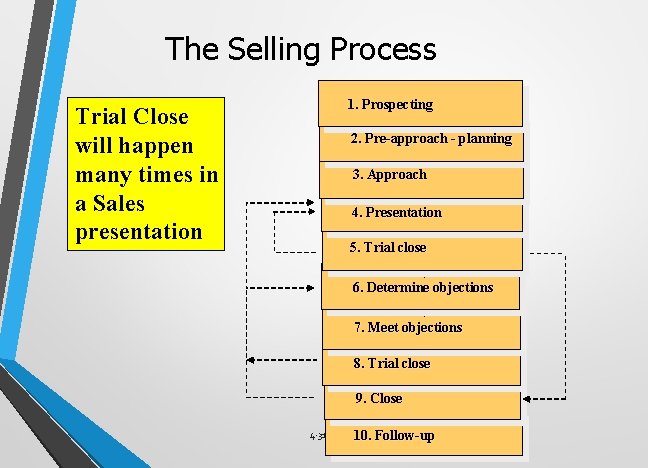
The Selling Process 1. Prospecting Trial Close will happen many times in a Sales presentation 2. Pre-approach - planning 3. Approach 4. Presentation 5. Trial close 6. Determine objections 7. Meet objections 8. Trial close 9. Close 4 -31 10. Follow-up
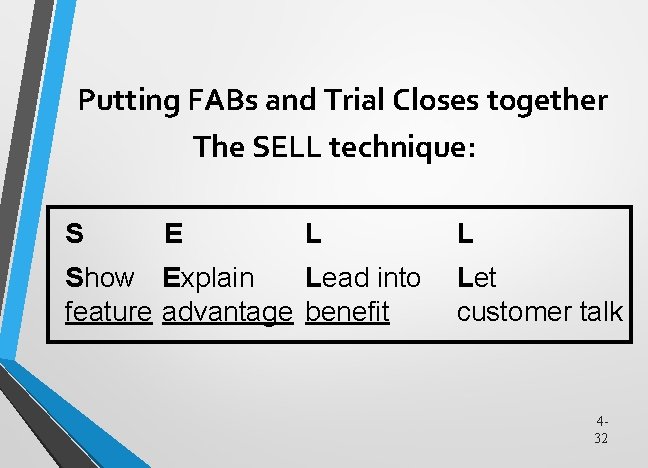
Putting FABs and Trial Closes together The SELL technique: S E L Show Explain Lead into feature advantage benefit L Let customer talk 432

SELL Sequence ù S - Show Feature - physical characteristic ù E - Explain advantage - performance characteristic ù L - Lead into benefit - result of advantage ù L - Lead customer to talk: - By asking ‘opinion’ question - (trial close) 4 -33
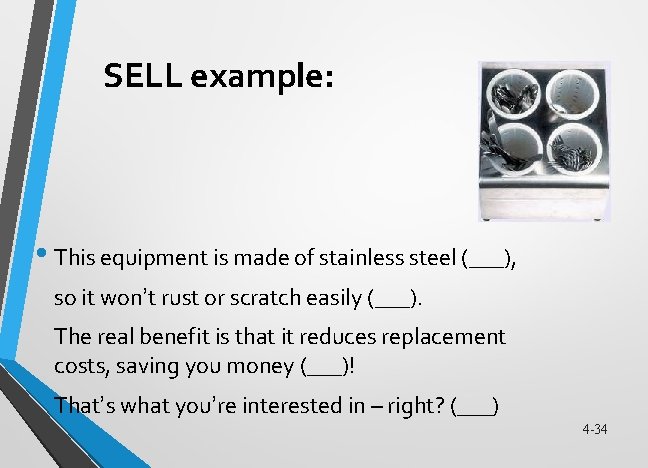
SELL example: • This equipment is made of stainless steel (___), so it won’t rust or scratch easily (___). The real benefit is that it reduces replacement costs, saving you money (___)! That’s what you’re interested in – right? (___) 4 -34
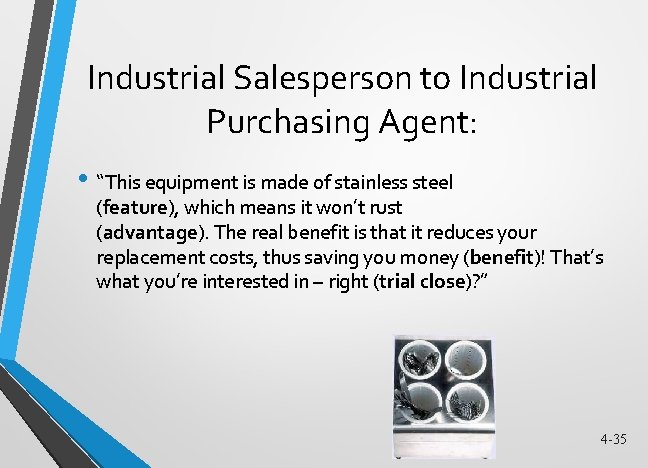
Industrial Salesperson to Industrial Purchasing Agent: • “This equipment is made of stainless steel (feature), which means it won’t rust (advantage). The real benefit is that it reduces your replacement costs, thus saving you money (benefit)! That’s what you’re interested in – right (trial close)? ” 4 -35
Trial Close Helps You to Determine: • Prospect reaction to FAB (and importance) • If you have successfully answered objection • Whether any objections remain • Whether the prospect is ready for the ‘close’ 4 -36
A Challenge! Use the Trial Close in Your Normal Conversation To: * • See if it helps your communication • See if it gets the other person to participate in the conversation • All you do is occasionally ask the person an opinion type question such as: • • • “Is that a good place to eat? ” “What did you think about the movie? ” “How does that sound to you? ” 4 -37
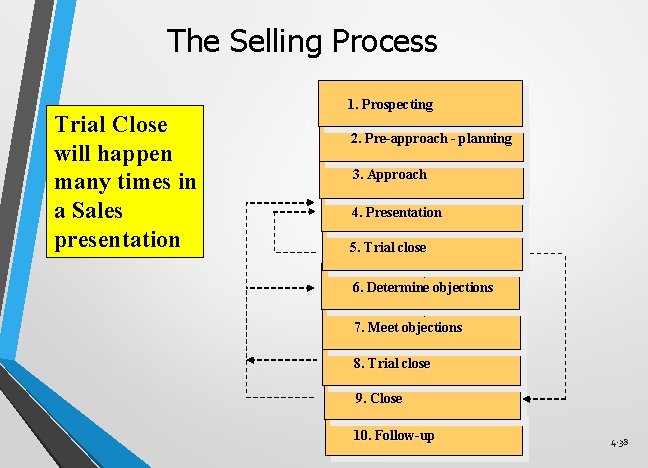
The Selling Process Trial Close will happen many times in a Sales presentation 1. Prospecting 2. Pre-approach - planning 3. Approach 4. Presentation 5. Trial close 6. Determine objections 7. Meet objections 8. Trial close 9. Close 10. Follow-up 4 -38
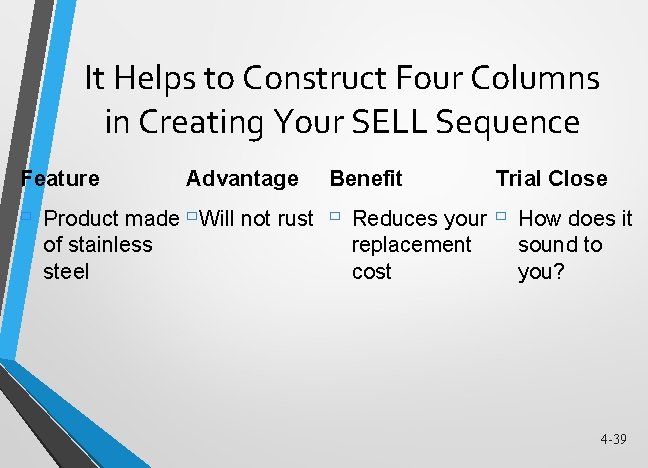
It Helps to Construct Four Columns in Creating Your SELL Sequence Feature Advantage Benefit Trial Close ù Product made ùWill not rust ù Reduces your ù How does it of stainless steel replacement cost sound to you? 4 -39
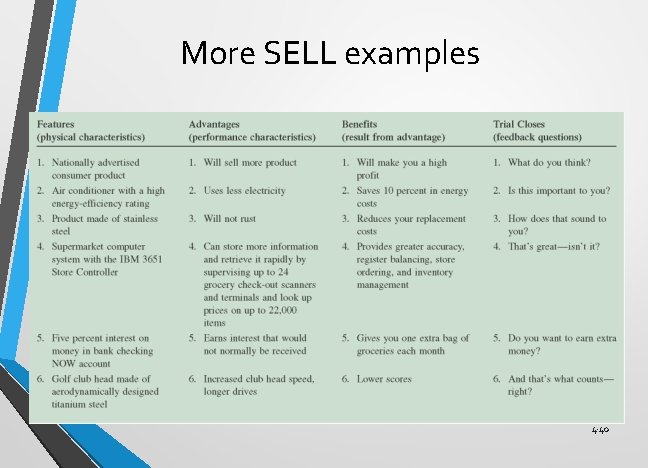
More SELL examples 4 -40
- Slides: 41