
Why nest boxes From a birds perspective Nest
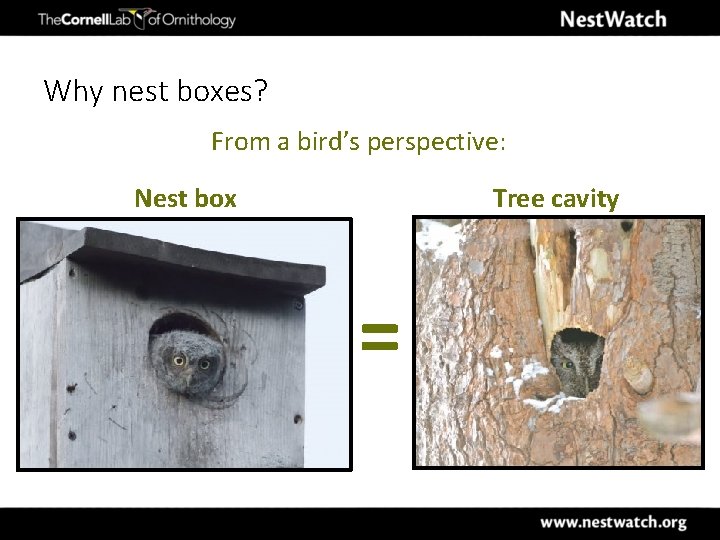
Why nest boxes? From a bird’s perspective: Nest box Tree cavity =
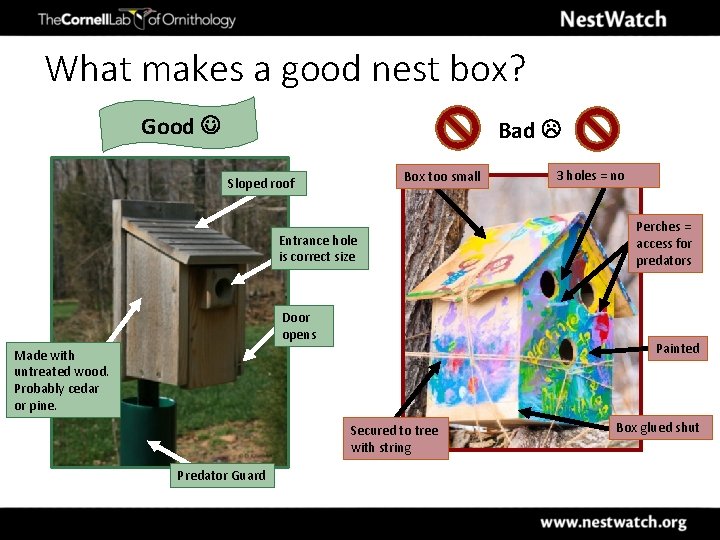
What makes a good nest box? Good Bad Box too small Sloped roof Entrance hole is correct size Door opens Perches = access for predators Painted Made with untreated wood. Probably cedar or pine. Secured to tree with string Predator Guard 3 holes = no Box glued shut
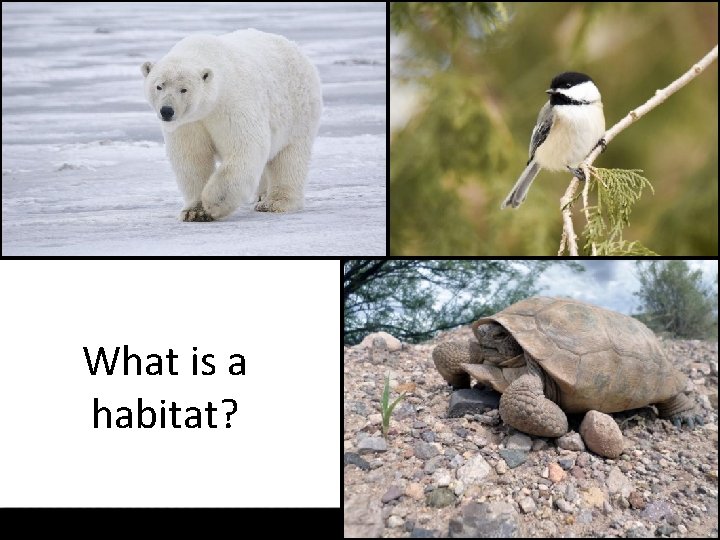
What is a habitat?
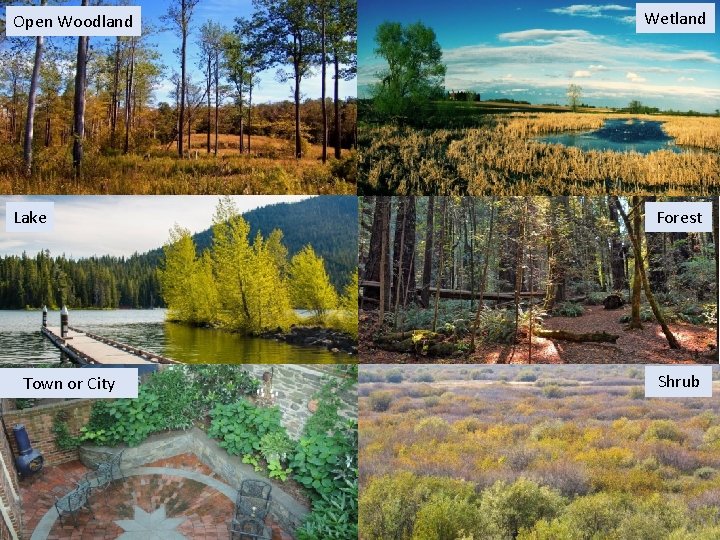
Open Woodland Lake Town or City Wetland Forest Shrub
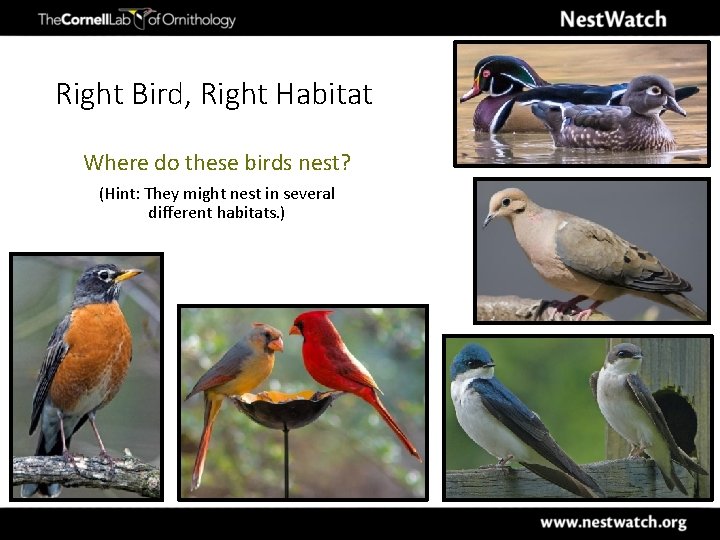
Right Bird, Right Habitat Where do these birds nest? (Hint: They might nest in several different habitats. )
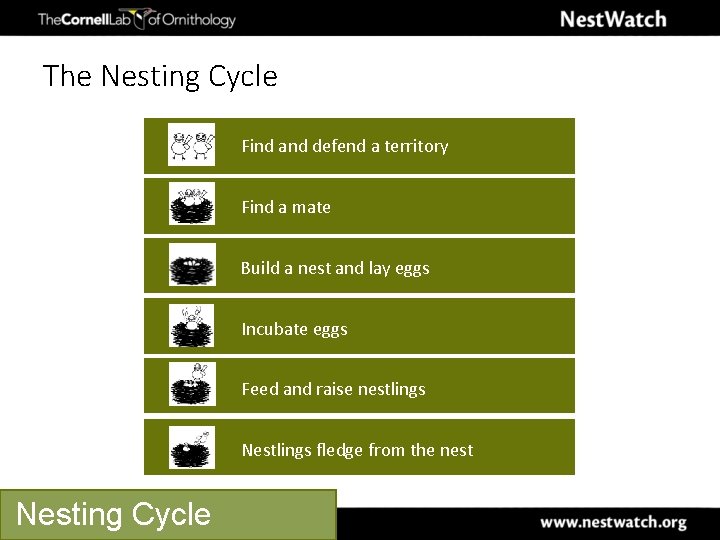
The Nesting Cycle Find and defend a territory Find a mate Build a nest and lay eggs Incubate eggs Feed and raise nestlings Nestlings fledge from the nest Nesting Cycle
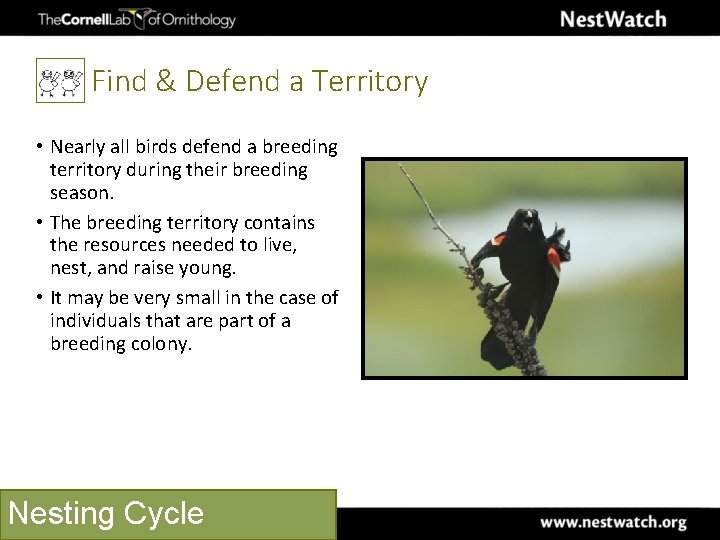
Find & Defend a Territory • Nearly all birds defend a breeding territory during their breeding season. • The breeding territory contains the resources needed to live, nest, and raise young. • It may be very small in the case of individuals that are part of a breeding colony. Nesting Cycle
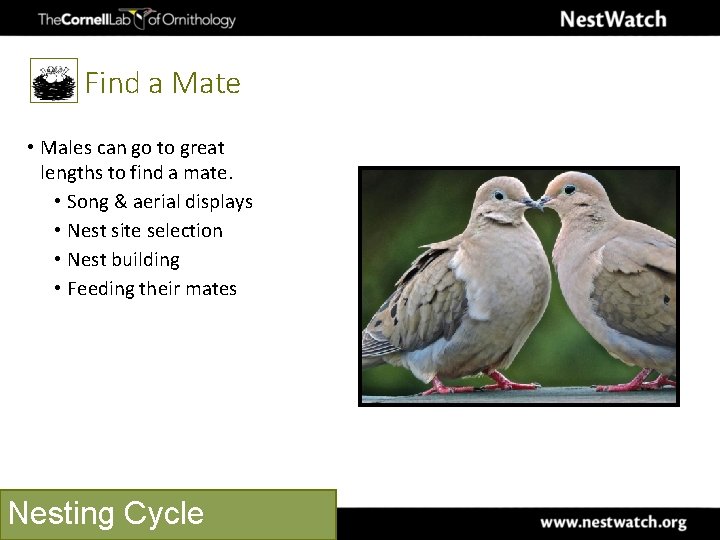
Find a Mate • Males can go to great lengths to find a mate. • Song & aerial displays • Nest site selection • Nest building • Feeding their mates Nesting Cycle
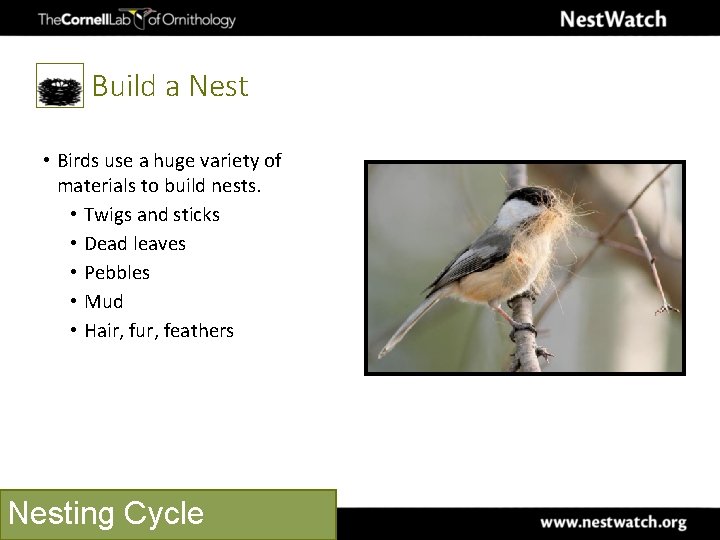
Build a Nest • Birds use a huge variety of materials to build nests. • Twigs and sticks • Dead leaves • Pebbles • Mud • Hair, fur, feathers Nesting Cycle

Types of Nests Scrape Pendant Nesting Cycle Platform Cup Dome Cavity
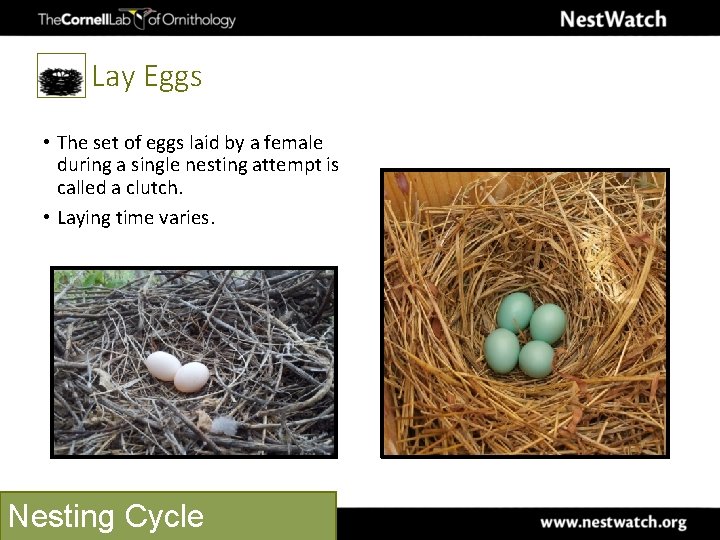
Lay Eggs • The set of eggs laid by a female during a single nesting attempt is called a clutch. • Laying time varies. Nesting Cycle
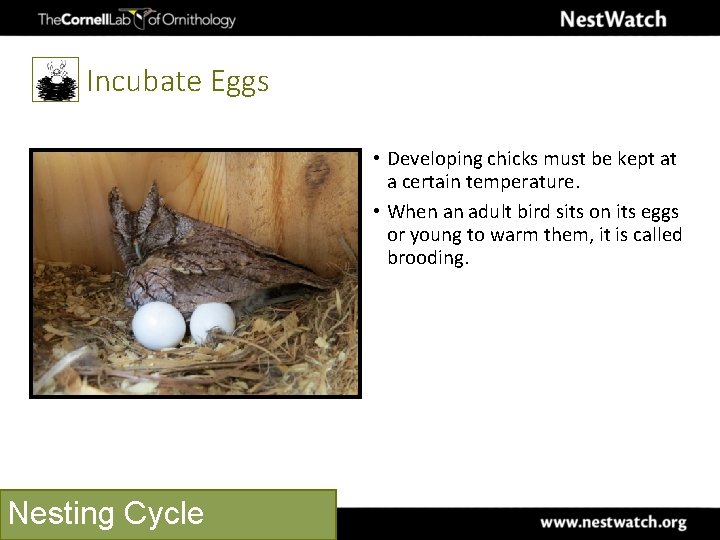
Incubate Eggs • Developing chicks must be kept at a certain temperature. • When an adult bird sits on its eggs or young to warm them, it is called brooding. Nesting Cycle
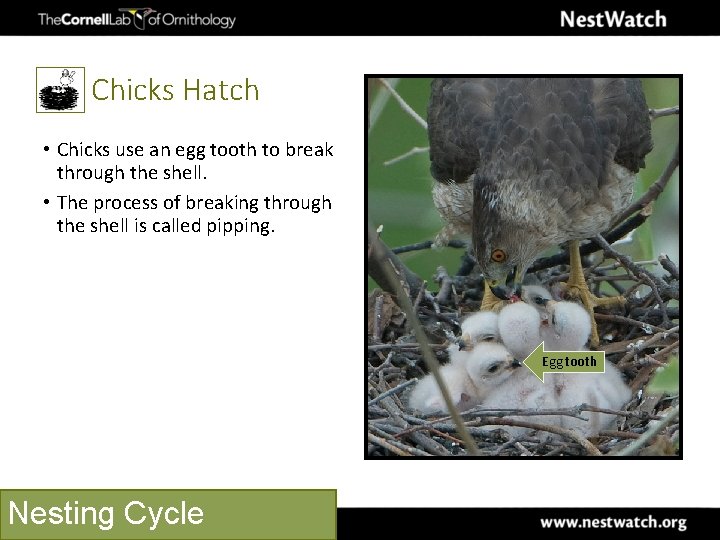
Chicks Hatch • Chicks use an egg tooth to break through the shell. • The process of breaking through the shell is called pipping. Egg tooth Nesting Cycle
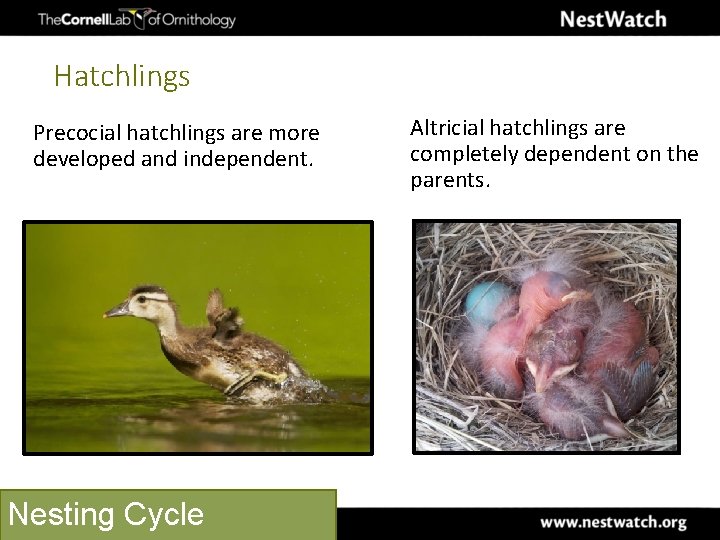
Hatchlings Precocial hatchlings are more developed and independent. Nesting Cycle Altricial hatchlings are completely dependent on the parents.
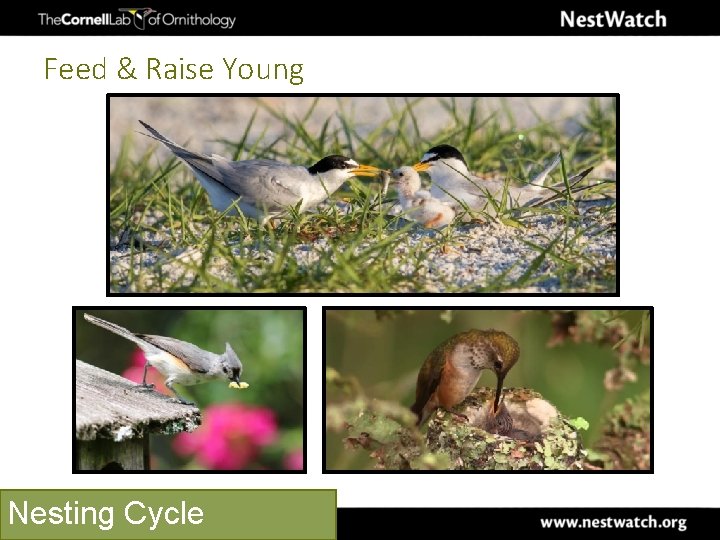
Feed & Raise Young Nesting Cycle

Fledging from the Nest • Fledging is when a nestling: • is able to leave the nest, but is not necessarily fully capable of flight; • has acquired its first complete set of flight feathers. • This term is usually used for altricial nestlings. Nesting Cycle
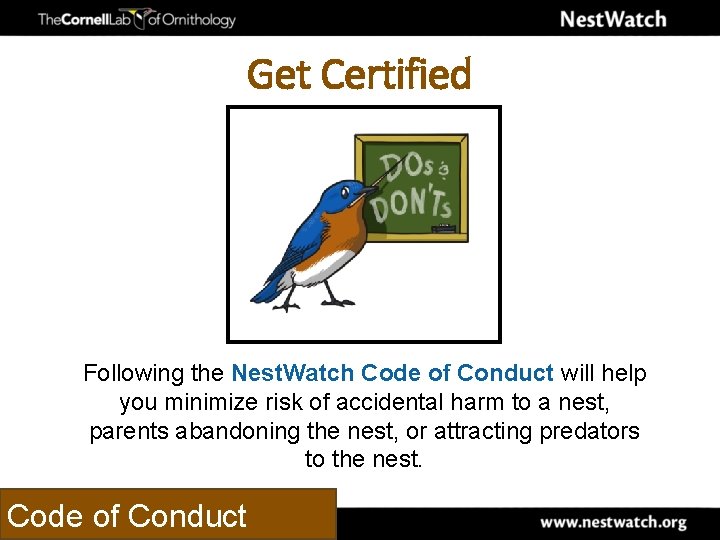
Get Certified Following the Nest. Watch Code of Conduct will help you minimize risk of accidental harm to a nest, parents abandoning the nest, or attracting predators to the nest. Code of Conduct
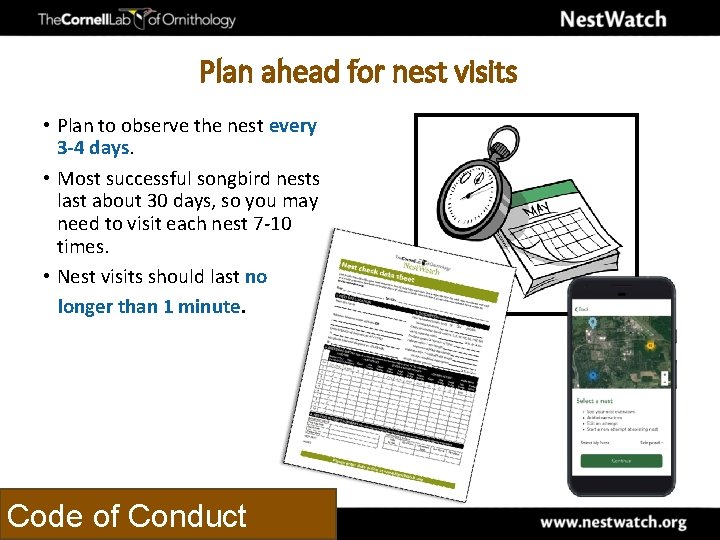
Plan ahead for nest visits • Plan to observe the nest every 3 -4 days. • Most successful songbird nests last about 30 days, so you may need to visit each nest 7 -10 times. • Nest visits should last no longer than 1 minute. Code of Conduct
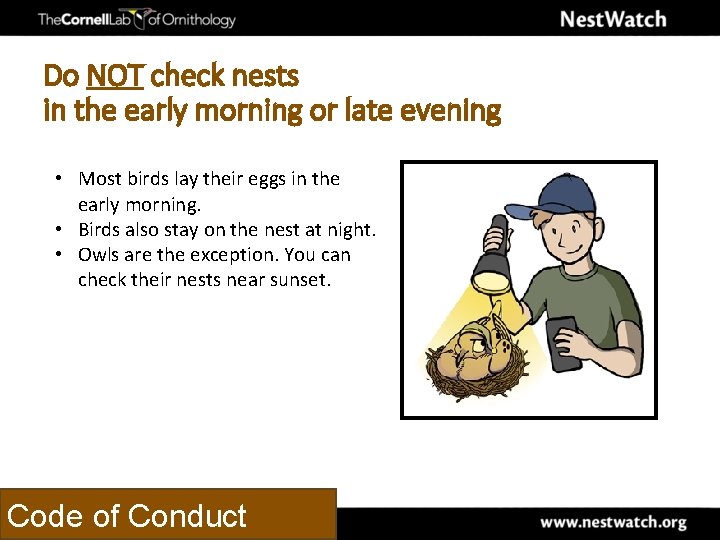
Do NOT check nests in the early morning or late evening • Most birds lay their eggs in the early morning. • Birds also stay on the nest at night. • Owls are the exception. You can check their nests near sunset. Code of Conduct
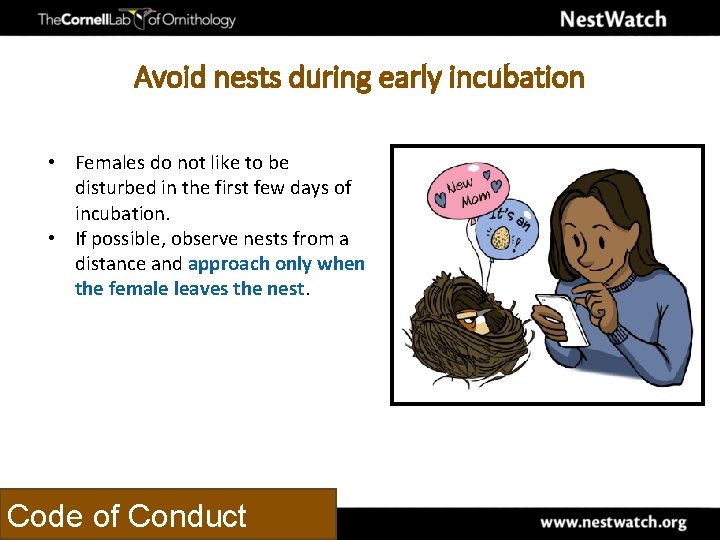
Avoid nests during early incubation • Females do not like to be disturbed in the first few days of incubation. • If possible, observe nests from a distance and approach only when the female leaves the nest. Code of Conduct
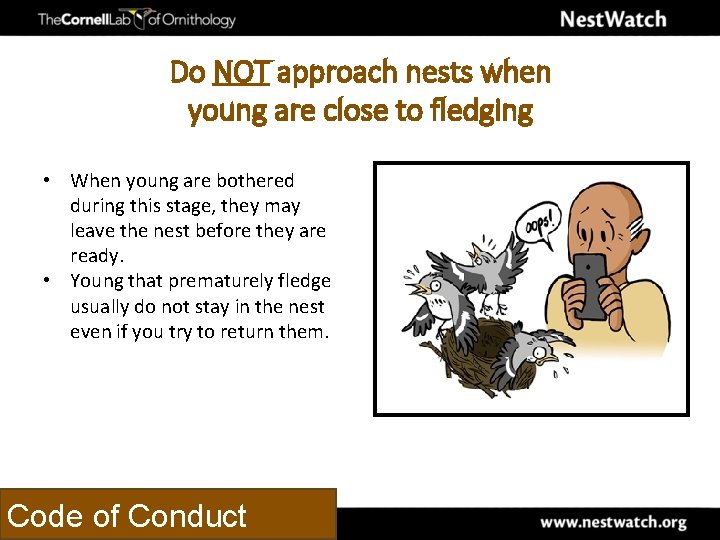
Do NOT approach nests when young are close to fledging • When young are bothered during this stage, they may leave the nest before they are ready. • Young that prematurely fledge usually do not stay in the nest even if you try to return them. Code of Conduct
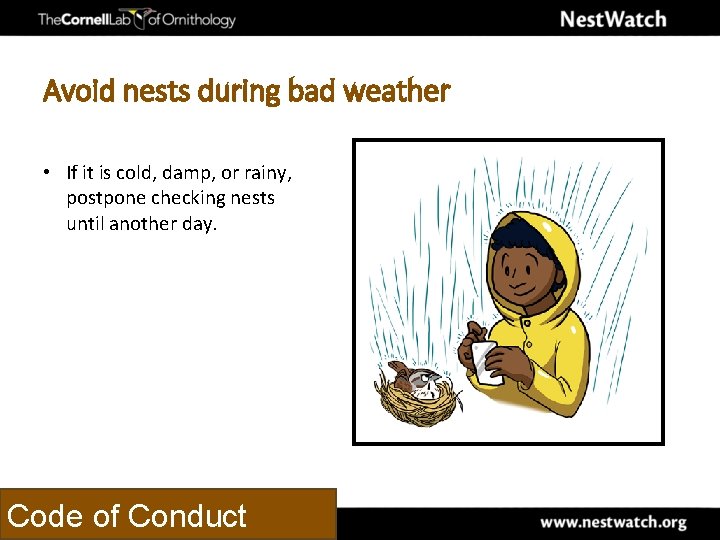
Avoid nests during bad weather • If it is cold, damp, or rainy, postpone checking nests until another day. Code of Conduct
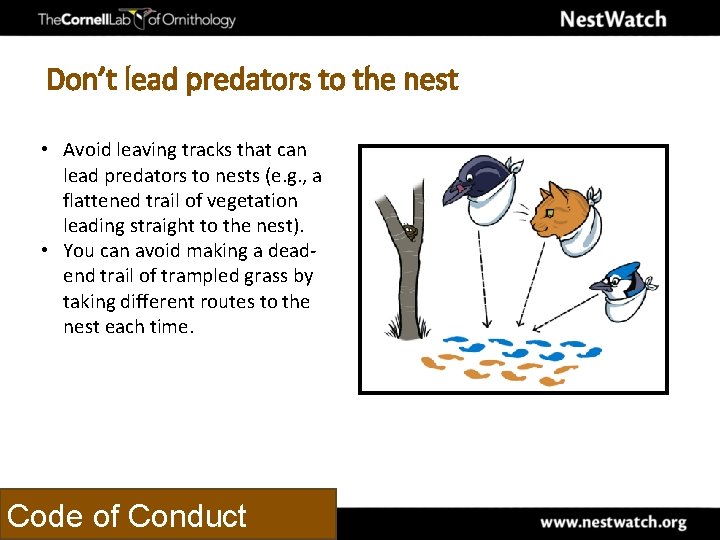
Don’t lead predators to the nest • Avoid leaving tracks that can lead predators to nests (e. g. , a flattened trail of vegetation leading straight to the nest). • You can avoid making a deadend trail of trampled grass by taking different routes to the nest each time. Code of Conduct
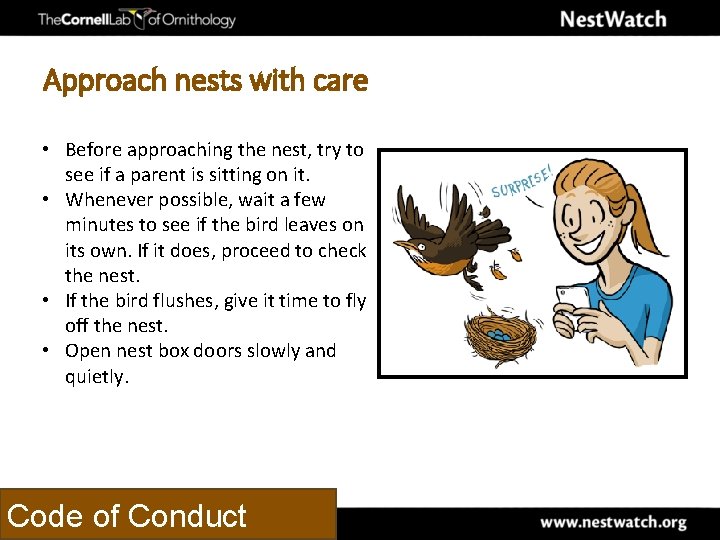
Approach nests with care • Before approaching the nest, try to see if a parent is sitting on it. • Whenever possible, wait a few minutes to see if the bird leaves on its own. If it does, proceed to check the nest. • If the bird flushes, give it time to fly off the nest. • Open nest box doors slowly and quietly. Code of Conduct
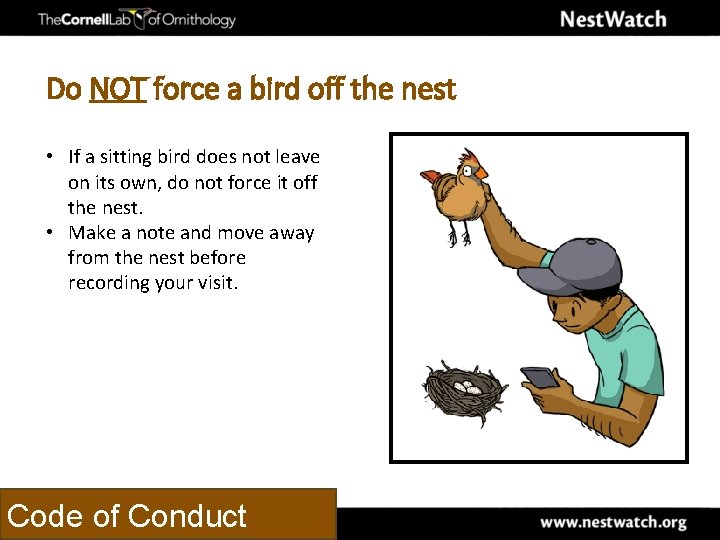
Do NOT force a bird off the nest • If a sitting bird does not leave on its own, do not force it off the nest. • Make a note and move away from the nest before recording your visit. Code of Conduct
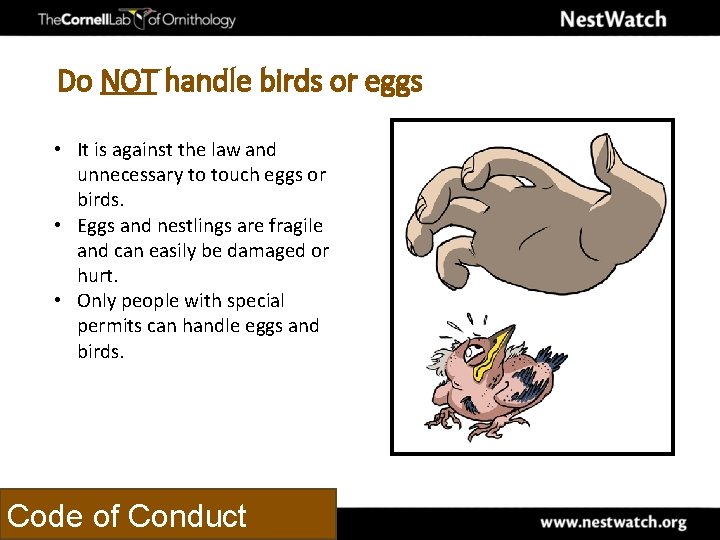
Do NOT handle birds or eggs • It is against the law and unnecessary to touch eggs or birds. • Eggs and nestlings are fragile and can easily be damaged or hurt. • Only people with special permits can handle eggs and birds. Code of Conduct
Time to play BINGO!
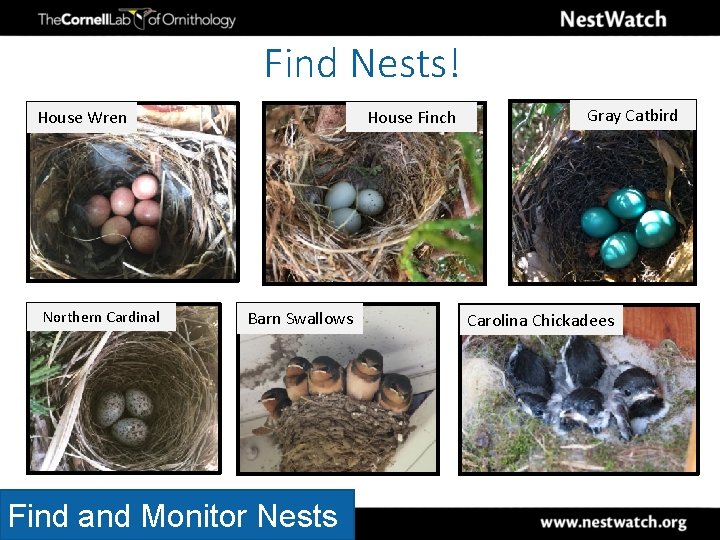
Find Nests! House Finch House Wren Northern Cardinal Barn Swallows Find and Monitor Nests Gray Catbird Carolina Chickadees
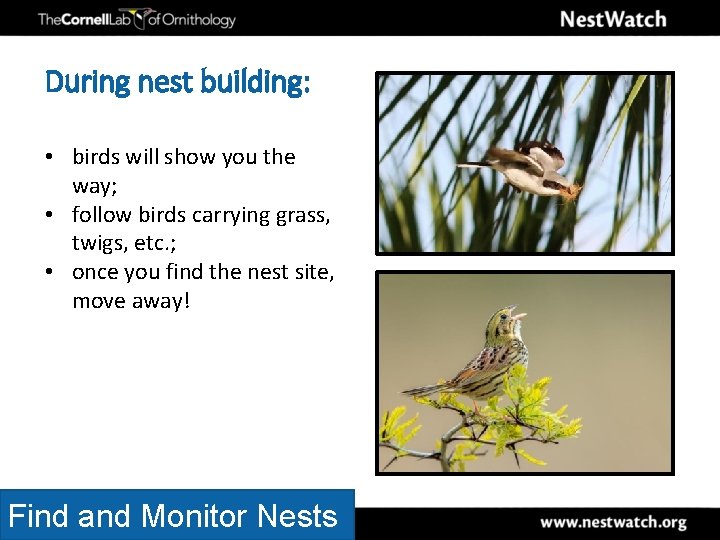
During nest building: • birds will show you the way; • follow birds carrying grass, twigs, etc. ; • once you find the nest site, move away! Find and Monitor Nests
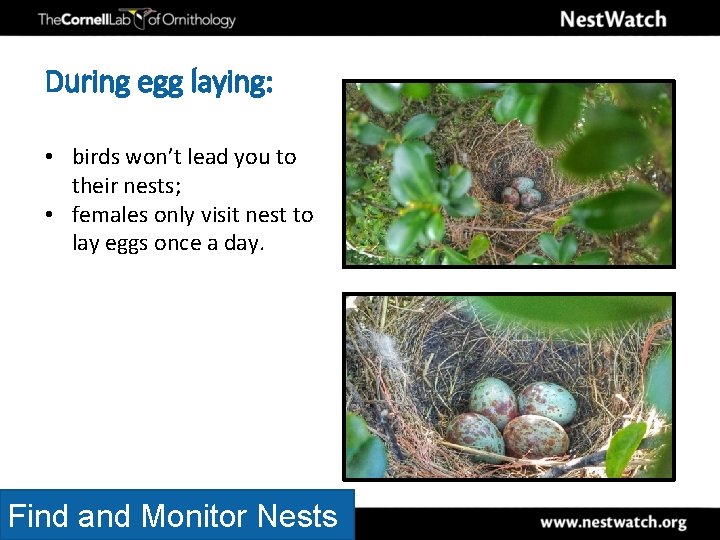
During egg laying: • birds won’t lead you to their nests; • females only visit nest to lay eggs once a day. Find and Monitor Nests
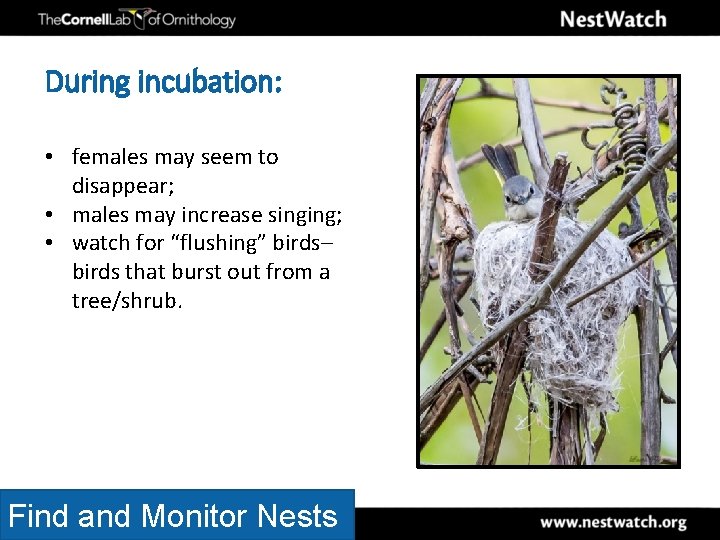
During incubation: • females may seem to disappear; • males may increase singing; • watch for “flushing” birds– birds that burst out from a tree/shrub. Find and Monitor Nests
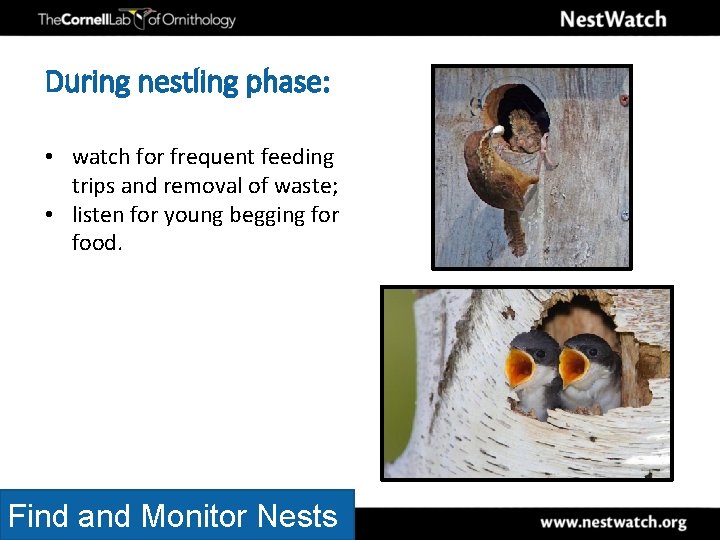
During nestling phase: • watch for frequent feeding trips and removal of waste; • listen for young begging for food. Find and Monitor Nests
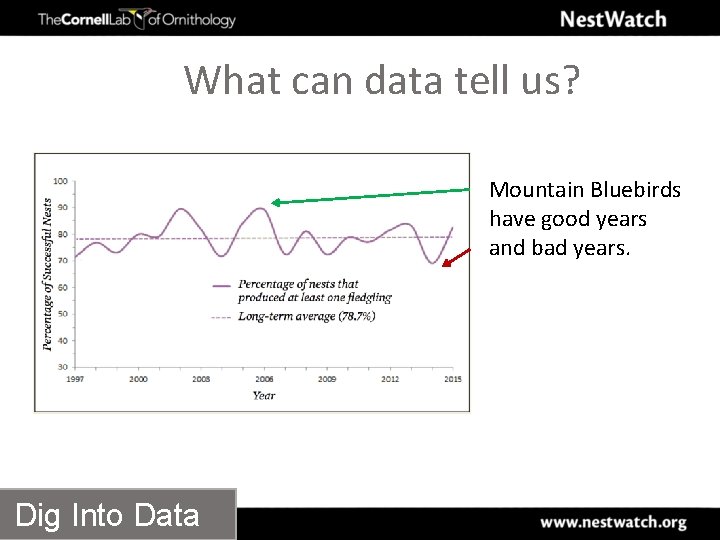
What can data tell us? Mountain Bluebirds have good years and bad years. Dig Into Data
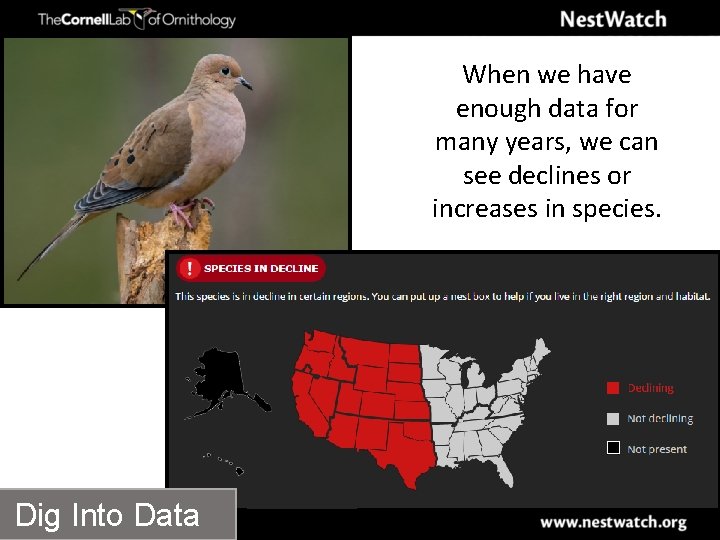
When we have enough data for many years, we can see declines or increases in species. Dig Into Data
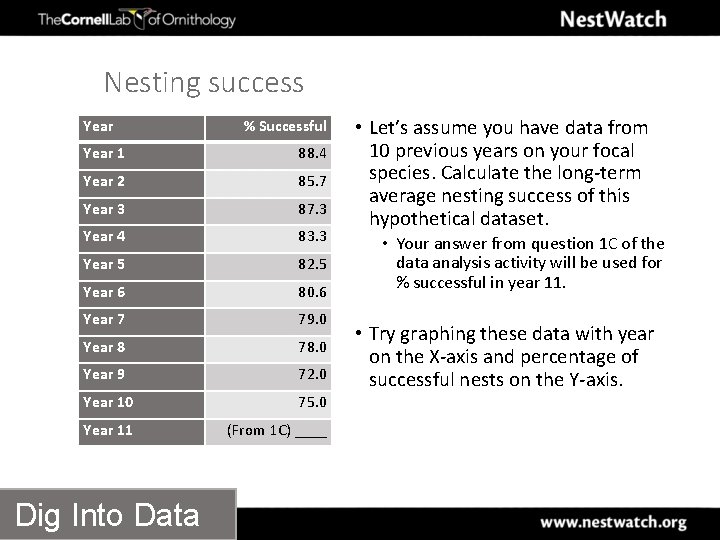
Nesting success Year % Successful Year 1 88. 4 Year 2 85. 7 Year 3 87. 3 Year 4 83. 3 Year 5 82. 5 Year 6 80. 6 Year 7 79. 0 Year 8 78. 0 Year 9 72. 0 Year 10 75. 0 Year 11 (From 1 C) ____ Dig Into Data • Let’s assume you have data from 10 previous years on your focal species. Calculate the long-term average nesting success of this hypothetical dataset. • Your answer from question 1 C of the data analysis activity will be used for % successful in year 11. • Try graphing these data with year on the X-axis and percentage of successful nests on the Y-axis.
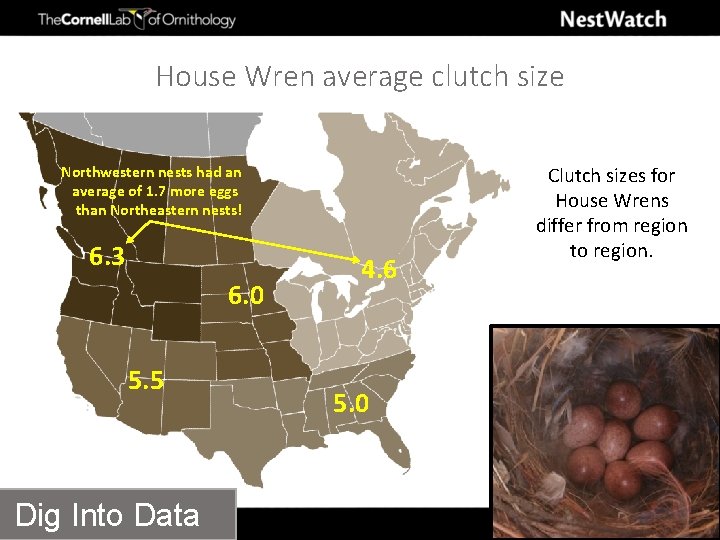
House Wren average clutch size Northwestern nests had an average of 1. 7 more eggs than Northeastern nests! 6. 3 6. 0 5. 5 Dig Into Data 4. 6 5. 0 Clutch sizes for House Wrens differ from region to region.
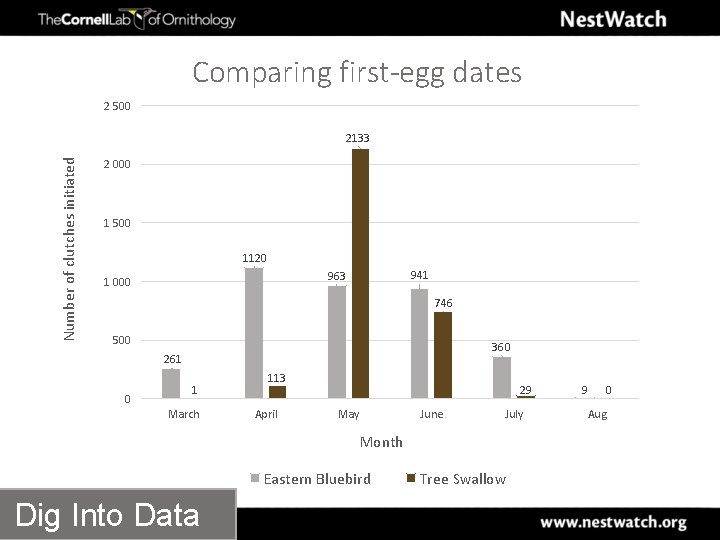
Comparing first-egg dates 2 500 Number of clutches initiated 2133 2 000 1 500 1120 941 963 1 000 746 500 360 261 0 1 March 113 April 29 May June July Month Eastern Bluebird Dig Into Data Tree Swallow 9 0 Aug

That’s why we need your data!
Photo Credits Slide 1: Eastern Bluebird by Craig Moody Slide 2: Polar bear by Alan Wilson – Wikimedia Commons; Desert tortoise by Laura Patterson – Wikimedia Commons; Black-capped Chickadee by Betsy Bass Slide 3: Open woodland - Nicholas A. Tonelli/Flickr/CC BY 2. 0; Lake - Lessa Clayton/Flickr/CC 0; Town or city - Serge Melki/Flickr/CC BY 2. 0; Wetland - Varanos/Flickr/CC BY 2. 0; Forest - Kirt Edblom/Flickr/CC BY-SA – cropped; Shrub - Tony Hisgett/Flickr/CC BY 2. 0 Slide 4: American Robin by Gary Mueller; Northern Cardinals by Susan Bebee; Wood Ducks by Susan Jensen; Tree Swallows by Bob Vuxinic; Mourning Dove by Andrew Warren Slide 5: Eastern Screech-Owl in nest box by Robert Strickland, Eastern Screech-Owl in tree by George Brehm Slide 6: “Good” nest box by D. Glankler, “Bad” nest box by rcfalcon/Flickr/CC BY 2. 0 – cropped Slide 7: Illustrations by Holly Faulkner Slide 8: Illustration by Holly Faulkner; Red-winged Blackbird by Mary Ann Jacobs Slide 9: Illustration by Holly Faulkner; Mourning Doves by Judi Hamilton Slide 10: Illustration by Holly Faulkner; Black-capped Chickadee by Kevin Mc. Gowan Slide 11: Scrape - Killdeer nest by Marianne Kutat; Platform Osprey nest by Eric Smith; Domed - Eastern Meadowlark nest by Mike Allen/Flickr/CC BY-NC-SA 2. 0; Cavity - Red-headed Woodpecker nest by Larry Keller; Cup - American Robin nest by Shirin Kazimov; Pendant - Baltimore Oriole nest by Barry Kant Slide 12: Illustration by Holly Faulkner; Mourning Dove eggs (left) by Searra Baguley; Eastern Bluebird eggs (right) by Martha Johnston Slide 13: Illustration by Holly Faulkner; Eastern Screech-Owl by Julia Schreuder Slide 14: Illustration by Holly Faulkner; Cooper’s Hawk by Tom Muir/Arkive. org Slide 15: Wood Duck by Alan Peterson; American Robins by Searra Baguley Slide 16: Least Tern by Jeff Timmons; Rufous Hummingbird by Eric Pittman Slide 17: Illustration by Holly Faulkner; Red-winged Blackbird by Cheri Hillis Slides 18 -27: Illustrations by Virginia Greene, Cornell Lab of Ornithology Bartels Science Illustration Program Slide 28: American Robins by Angela Wilkins Slide 29: House Wren by Sheri Tindle; House Finch nest by Irina Vasilchenkov; Gray Catbird eggs by Natalie Lynn; Carolina Chickadees by Tony-Cara Woods; Barn Swallows by Brynn Artley; Northern Cardinal by Crystal Hill Slide 30: Loggerhead Shrike by Philip Rathner; Henslow’s Sparrow by Jeff Timmons Slide 31: Northern Mockingbird nests by Laura Frazier Slide 32: American Redstart by Laura Frazier Slide 33: Carolina Wren with fecal sac by Paul Katinas; Tree Swallows by Kim Caruso Slide 35: Mourning Dove by Daniel Dunn; map by Nest. Watch. org Slide 37: House Wren eggs by Andrew Staufer Slide 39: Illustration by Anna Rettberg
- Slides: 40