
Why Mutual Fund AMFI IAP Association of Mutual




- Slides: 30
Why Mutual Fund? AMFI IAP (Association of Mutual Funds India Investor Awareness Program)
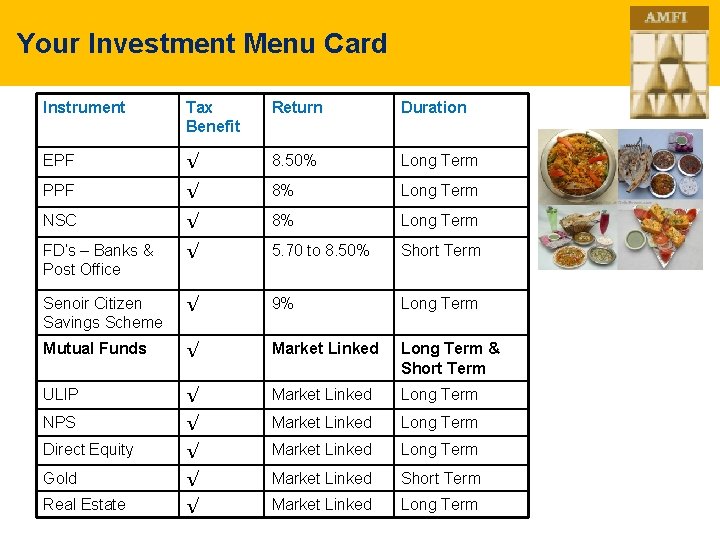
Your Investment Menu Card Instrument Tax Benefit Return Duration EPF √ 8. 50% Long Term PPF √ 8% Long Term NSC √ 8% Long Term FD’s – Banks & Post Office √ 5. 70 to 8. 50% Short Term Senoir Citizen Savings Scheme √ 9% Long Term Mutual Funds √ Market Linked Long Term & Short Term ULIP √ Market Linked Long Term NPS √ Market Linked Long Term Direct Equity √ Market Linked Long Term Gold √ Market Linked Short Term Real Estate √ Market Linked Long Term
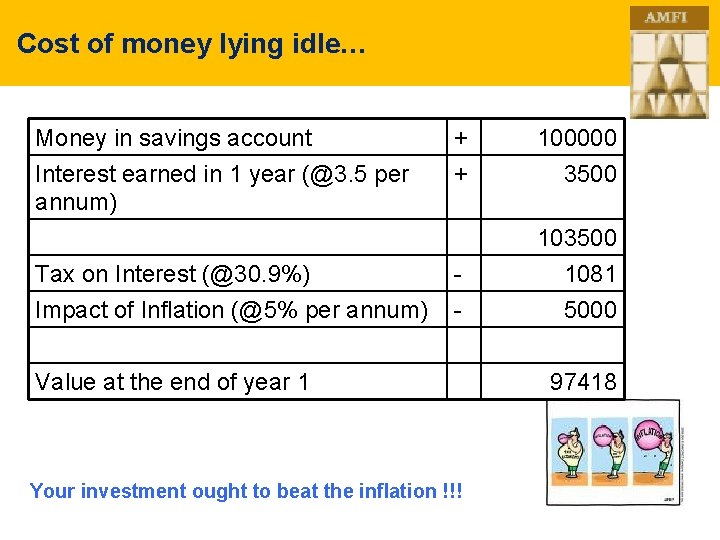
Cost of money lying idle… Money in savings account Interest earned in 1 year (@3. 5 per annum) Tax on Interest (@30. 9%) Impact of Inflation (@5% per annum) + + 100000 3500 - 103500 1081 5000 Value at the end of year 1 Your investment ought to beat the inflation !!! 97418
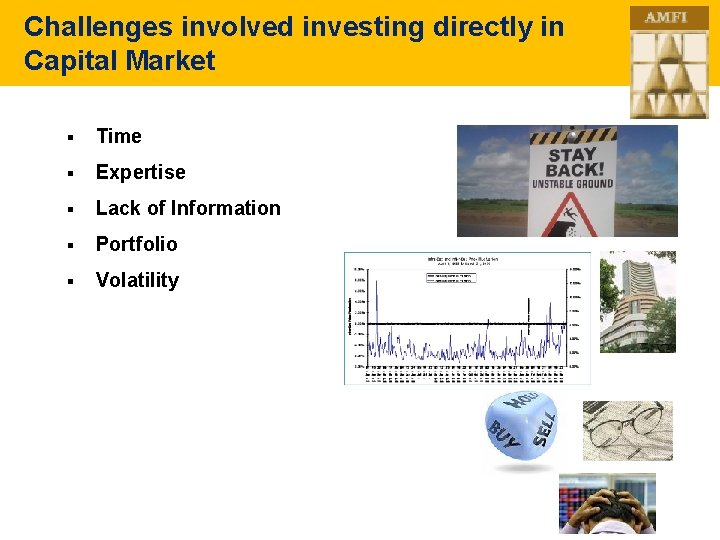
Challenges involved investing directly in Capital Market § Time § Expertise § Lack of Information § Portfolio § Volatility
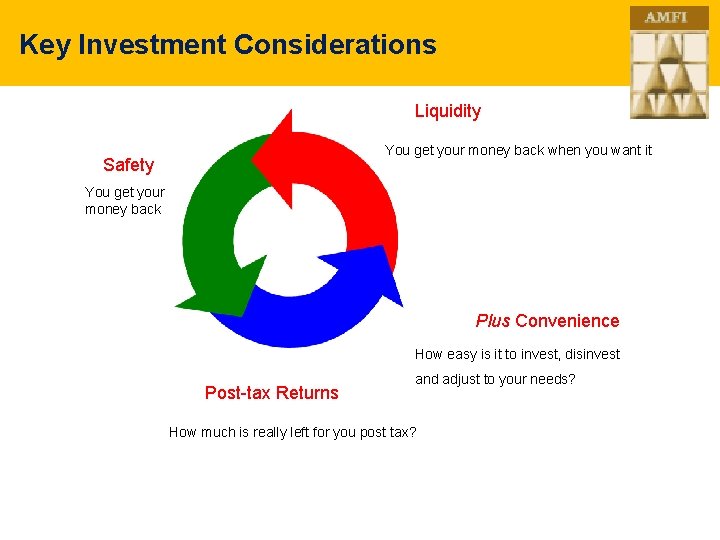
Key Investment Considerations Liquidity You get your money back when you want it Safety You get your money back Plus Convenience How easy is it to invest, disinvest Post-tax Returns and adjust to your needs? How much is really left for you post tax?
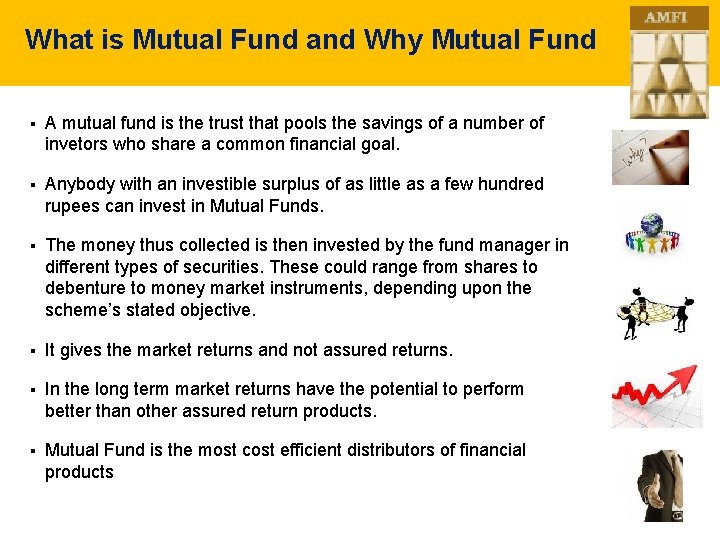
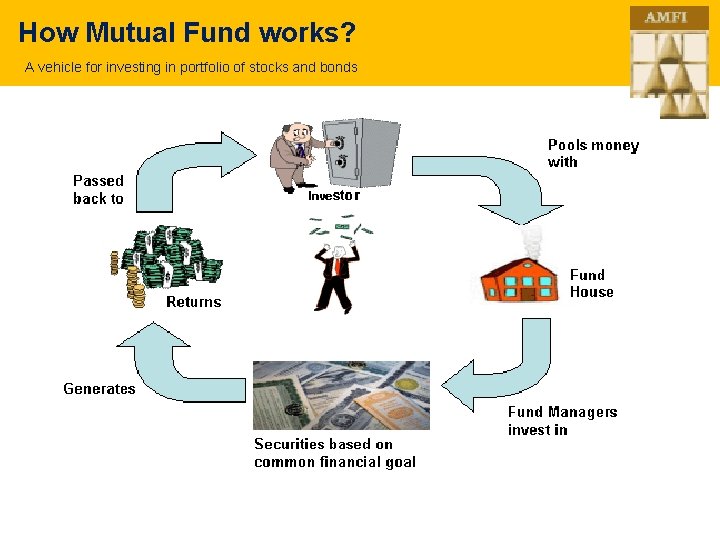
What is Mutual Fund and Why Mutual Fund § A mutual fund is the trust that pools the savings of a number of invetors who share a common financial goal. § Anybody with an investible surplus of as little as a few hundred rupees can invest in Mutual Funds. § The money thus collected is then invested by the fund manager in different types of securities. These could range from shares to debenture to money market instruments, depending upon the scheme’s stated objective. § It gives the market returns and not assured returns. § In the long term market returns have the potential to perform better than other assured return products. § Mutual Fund is the most cost efficient distributors of financial products
How Mutual Fund works? A vehicle for investing in portfolio of stocks and bonds
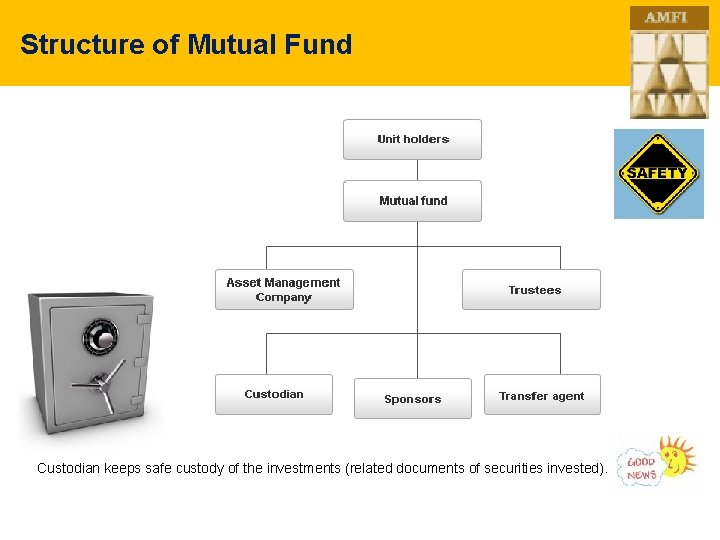
Structure of Mutual Fund Custodian keeps safe custody of the investments (related documents of securities invested).
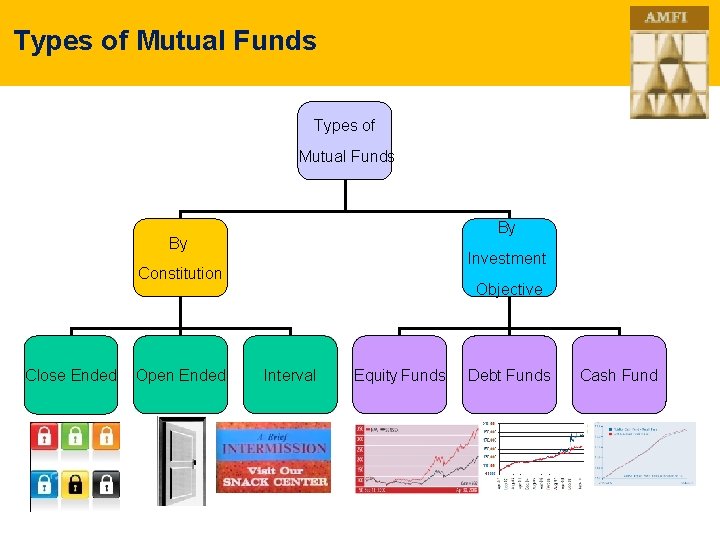
Types of Mutual Funds By Investment Constitution Close Ended Open Ended Objective Interval Equity Funds Debt Funds Cash Fund
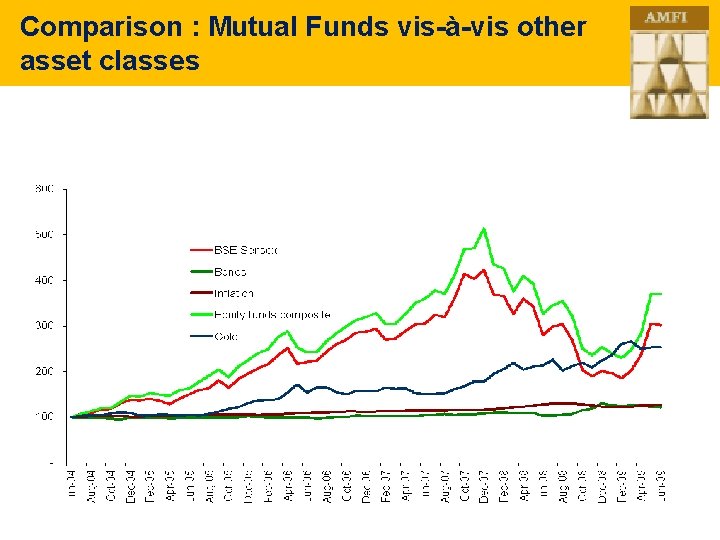
Comparison : Mutual Funds vis-à-vis other asset classes
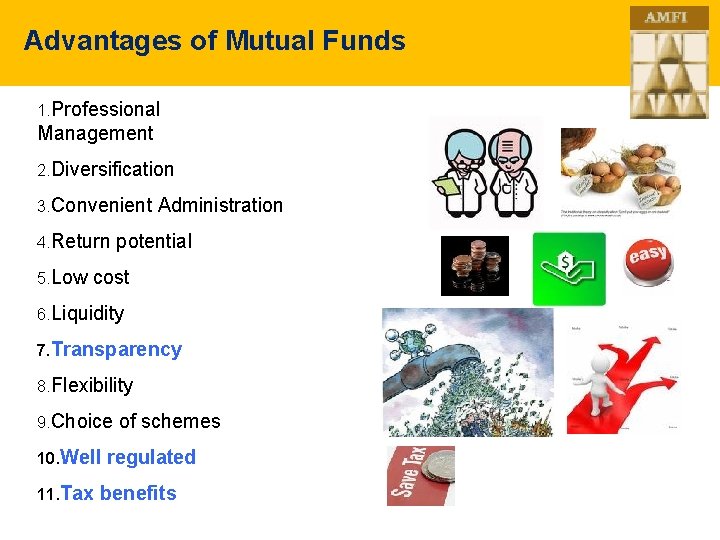
Advantages of Mutual Funds 1. Professional Management 2. Diversification 3. Convenient Administration 4. Return potential 5. Low cost 6. Liquidity 7. Transparency 8. Flexibility 9. Choice of schemes 10. Well regulated 11. Tax benefits
How do I make money from a mutual fund? 1. Capital appreciation: As the value of securities in the fund increases, the fund's unit price will also increase. You can make a profit by selling the units at a price higher than at which you bought 2. Coupon / Dividend Income: Fund will earn interest income from the bonds it holds or will have dividend income from the shares 3. Income Distribution: The fund passes on the profits it has earned in the form of dividends Disclaimer As the value of securities in the fund increases, the fund's unit price will also increase. You can make a profit by selling the units at a price higher than at which you bought. Although Mutual Fund does not guarantee the same.
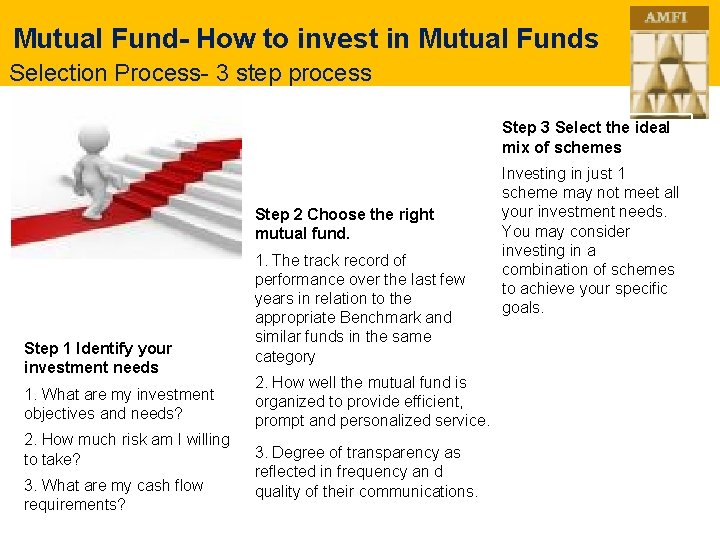
Mutual Fund- How to invest in Mutual Funds Selection Process- 3 step process Step 3 Select the ideal mix of schemes Step 2 Choose the right mutual fund. Step 1 Identify your investment needs 1. What are my investment objectives and needs? 2. How much risk am I willing to take? 3. What are my cash flow requirements? 1. The track record of performance over the last few years in relation to the appropriate Benchmark and similar funds in the same category 2. How well the mutual fund is organized to provide efficient, prompt and personalized service. 3. Degree of transparency as reflected in frequency an d quality of their communications. Investing in just 1 scheme may not meet all your investment needs. You may consider investing in a combination of schemes to achieve your specific goals.
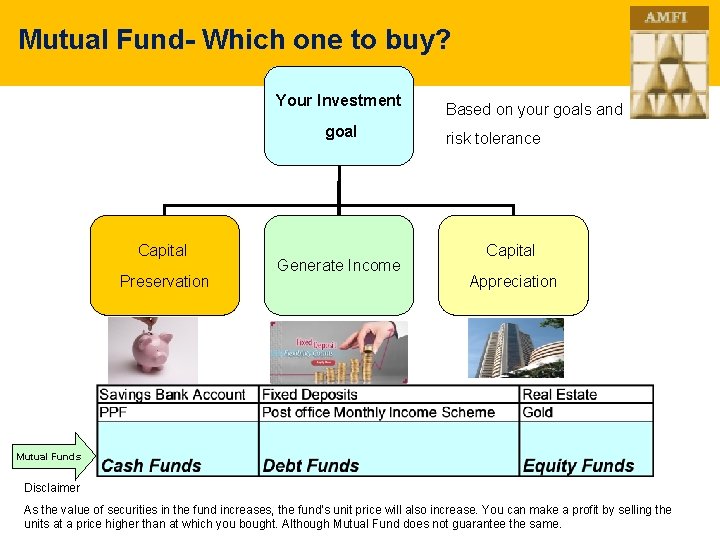
Mutual Fund- Which one to buy? Your Investment goal Capital Preservation Generate Income Based on your goals and risk tolerance Capital Appreciation Mutual Funds Disclaimer As the value of securities in the fund increases, the fund's unit price will also increase. You can make a profit by selling the units at a price higher than at which you bought. Although Mutual Fund does not guarantee the same.
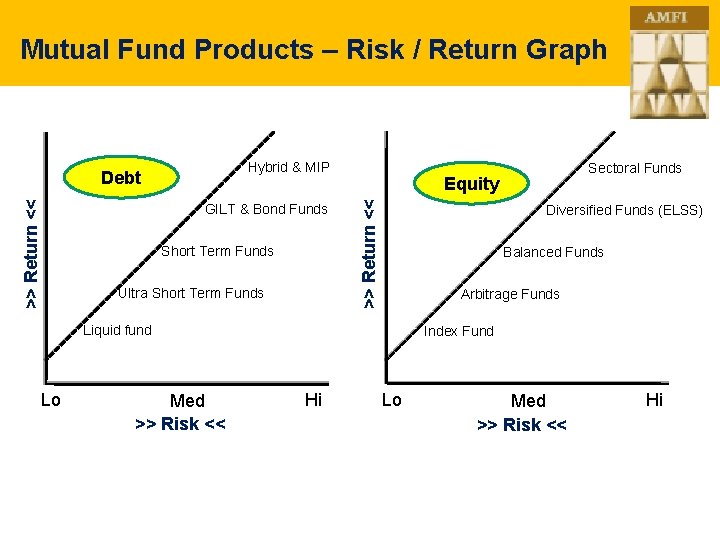
Mutual Fund Products – Risk / Return Graph Hybrid & MIP GILT & Bond Funds Short Term Funds Ultra Short Term Funds Diversified Funds (ELSS) Balanced Funds Arbitrage Funds Liquid fund Lo Med >> Risk << Sectoral Funds Equity >> Return << Debt Index Fund Hi Lo Med >> Risk << Hi
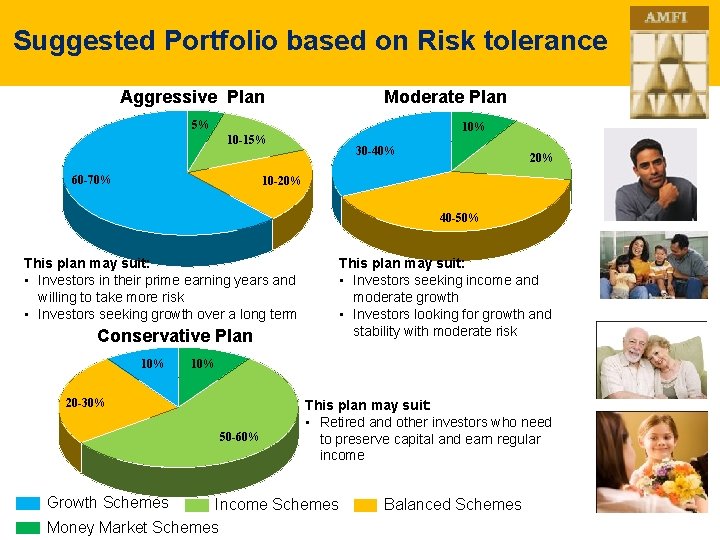
Suggested Portfolio based on Risk tolerance Aggressive Plan Moderate Plan 5% 10 -15% 60 -70% 30 -40% 20% 10 -20% 40 -50% This plan may suit: • Investors in their prime earning years and willing to take more risk • Investors seeking growth over a long term This plan may suit: • Investors seeking income and moderate growth • Investors looking for growth and stability with moderate risk Conservative Plan 10% 20 -30% 50 -60% Growth Schemes This plan may suit: • Retired and other investors who need to preserve capital and earn regular income Income Schemes Money Market Schemes Balanced Schemes
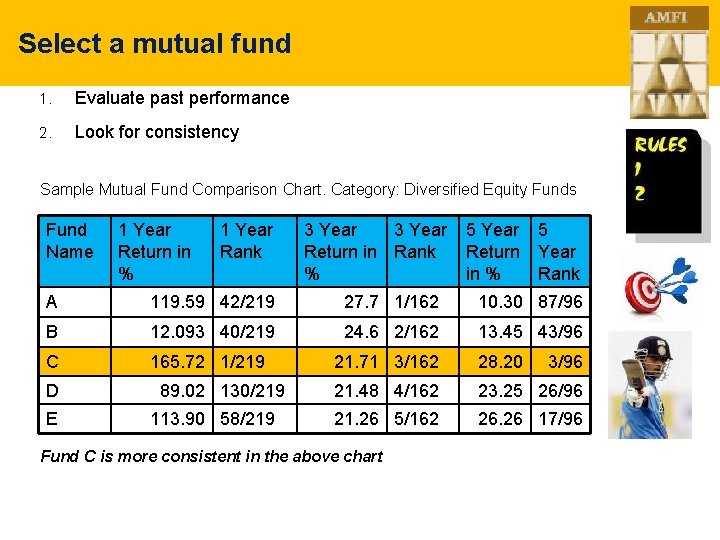
Select a mutual fund 1. Evaluate past performance 2. Look for consistency Sample Mutual Fund Comparison Chart. Category: Diversified Equity Funds Fund Name 1 Year Return in % 1 Year Rank 3 Year 5 Return in Rank Return Year % in % Rank A 119. 59 42/219 27. 7 1/162 10. 30 87/96 B 12. 093 40/219 24. 6 2/162 13. 45 43/96 C 165. 72 1/219 21. 71 3/162 28. 20 21. 48 4/162 23. 25 26/96 21. 26 5/162 26. 26 17/96 D E 89. 02 130/219 113. 90 58/219 Fund C is more consistent in the above chart 3/96
Rating Agencies Role of Rating Agencies 1. Facilitate informed investment decision making 2. Provide independent and reliable opinion of schemes 3. The quality of the Fund’s management and operations 4. Help meet specific investment objective v CRISIL~CPR Rankings and Value Research Star Rating are prominent ones
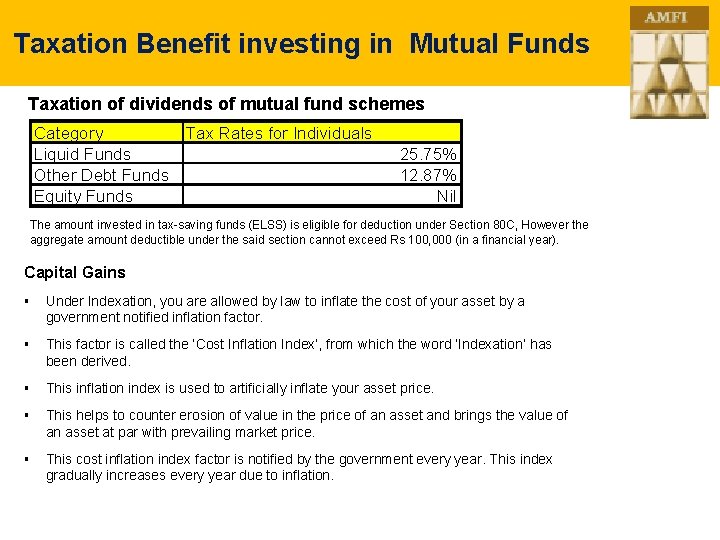
Taxation Benefit investing in Mutual Funds Taxation of dividends of mutual fund schemes Category Tax Rates for Individuals Liquid Funds Other Debt Funds Equity Funds 25. 75% 12. 87% Nil The amount invested in tax-saving funds (ELSS) is eligible for deduction under Section 80 C, However the aggregate amount deductible under the said section cannot exceed Rs 100, 000 (in a financial year). Capital Gains § Under Indexation, you are allowed by law to inflate the cost of your asset by a government notified inflation factor. § This factor is called the ‘Cost Inflation Index’, from which the word ‘Indexation’ has been derived. § This inflation index is used to artificially inflate your asset price. § This helps to counter erosion of value in the price of an asset and brings the value of an asset at par with prevailing market price. § This cost inflation index factor is notified by the government every year. This index gradually increases every year due to inflation.
Equity Linked Saving Schemes (ELSS) advantage: all about 80 C investments Instrument Returns EPF Lock In Period (in Years) 8. 50% Until Retirement PPF 8% 15 NSC 8% 6 FD’s – Banks & Post office 5. 70 to 8. 50% Senior Citizen Savings Scheme 5 9% 5 Life Insurance Policies 5 to 6% 3 ELSS Market Linked 3 ULIP Market Linked 5 NPS Market Linked ELSS Advantage over other tax saving instruments 1. Low Lock in period 2. Earn market linked return 3. Tax free returns till age 60
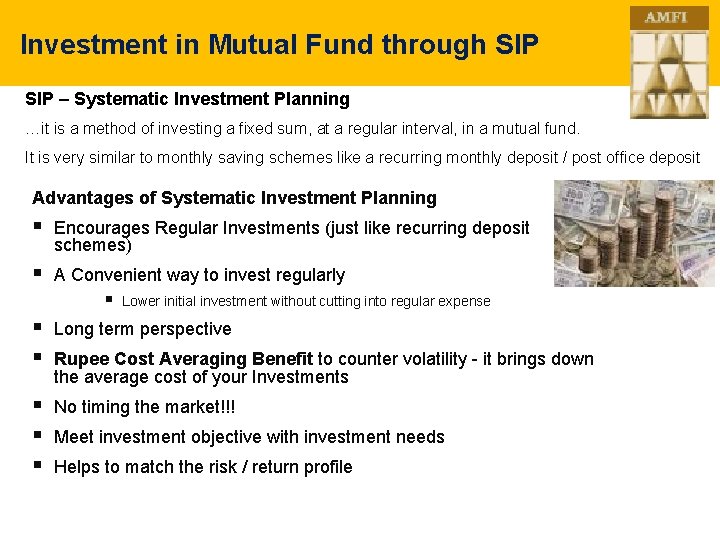
Investment in Mutual Fund through SIP – Systematic Investment Planning …it is a method of investing a fixed sum, at a regular interval, in a mutual fund. It is very similar to monthly saving schemes like a recurring monthly deposit / post office deposit Advantages of Systematic Investment Planning § Encourages Regular Investments (just like recurring deposit schemes) § A Convenient way to invest regularly § Lower initial investment without cutting into regular expense § § Long term perspective § § § No timing the market!!! Rupee Cost Averaging Benefit to counter volatility - it brings down the average cost of your Investments Meet investment objective with investment needs Helps to match the risk / return profile
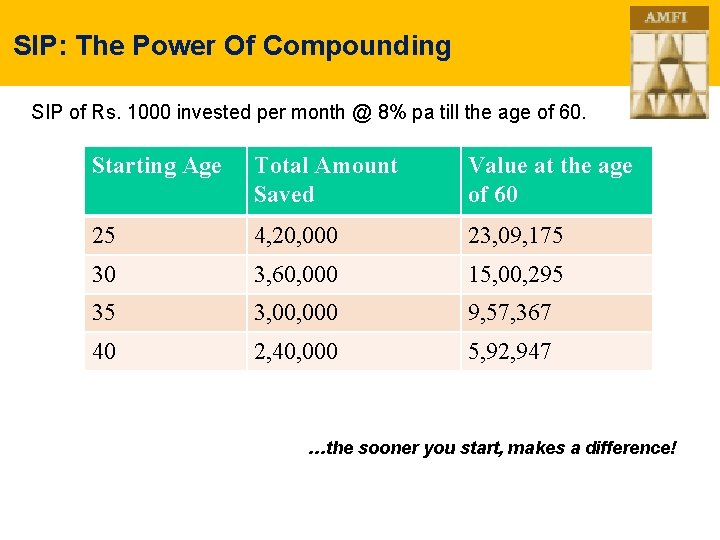
SIP: The Power Of Compounding SIP of Rs. 1000 invested per month @ 8% pa till the age of 60. Starting Age Total Amount Saved Value at the age of 60 25 4, 20, 000 23, 09, 175 30 3, 60, 000 15, 00, 295 35 3, 000 9, 57, 367 40 2, 40, 000 5, 92, 947 …the sooner you start, makes a difference!
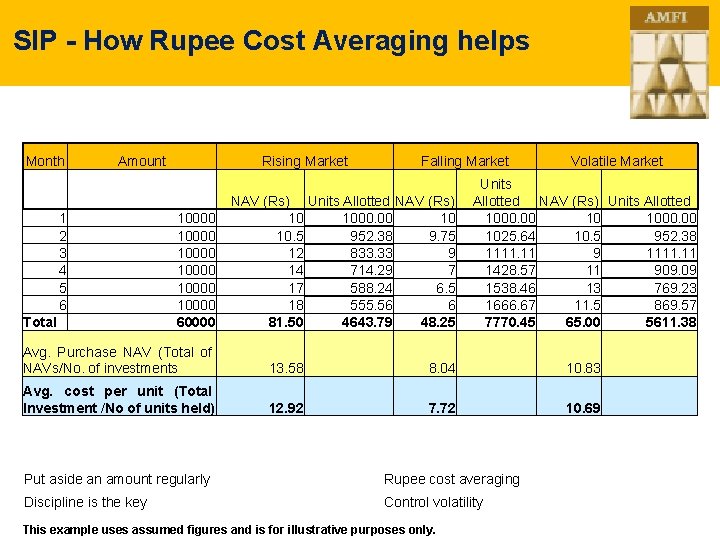
SIP - How Rupee Cost Averaging helps Month Amount Rising Market 1 2 3 4 5 6 Total 10000 10000 60000 Falling Market NAV (Rs) Units Allotted NAV (Rs) 10 1000. 00 10 10. 5 952. 38 9. 75 12 833. 33 9 14 714. 29 7 17 588. 24 6. 5 18 555. 56 6 81. 50 4643. 79 48. 25 Volatile Market Units Allotted NAV (Rs) Units Allotted 1000. 00 1025. 64 10. 5 952. 38 1111. 11 9 1111. 11 1428. 57 11 909. 09 1538. 46 13 769. 23 1666. 67 11. 5 869. 57 7770. 45 65. 00 5611. 38 Avg. Purchase NAV (Total of NAVs/No. of investments 13. 58 8. 04 10. 83 Avg. cost per unit (Total Investment /No of units held) 12. 92 7. 72 10. 69 Put aside an amount regularly Rupee cost averaging Discipline is the key Control volatility This example uses assumed figures and is for illustrative purposes only.
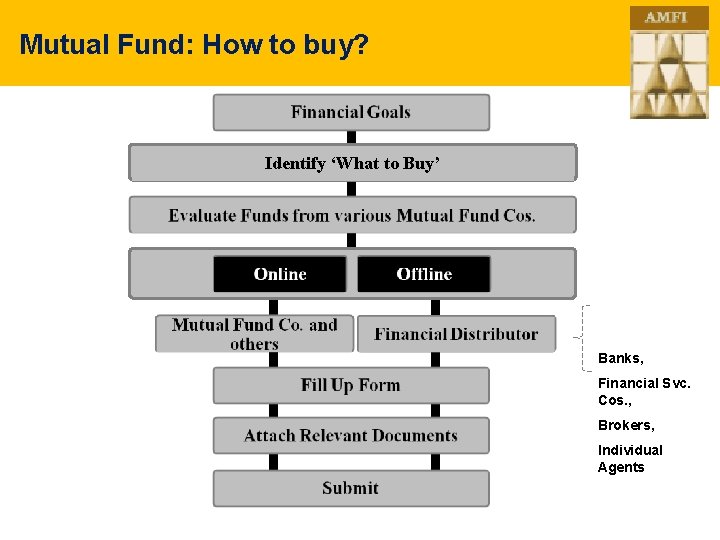
Mutual Fund: How to buy? Identify ‘What to Buy’ Banks, Financial Svc. Cos. , Brokers, Individual Agents
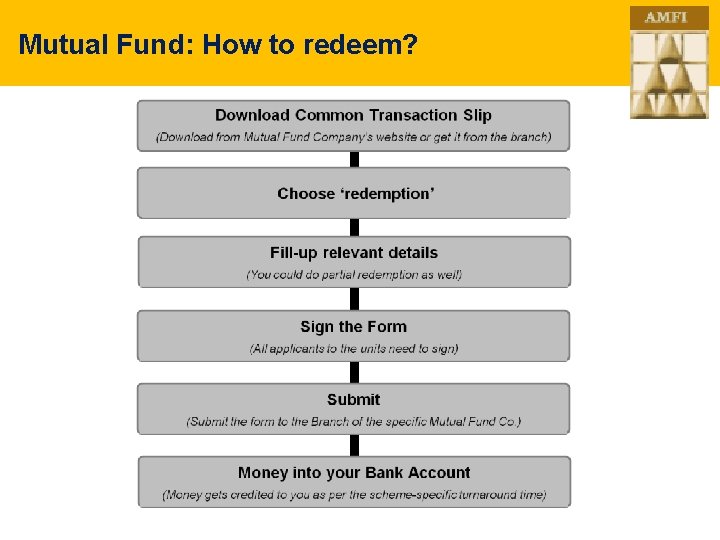
Mutual Fund: How to redeem?
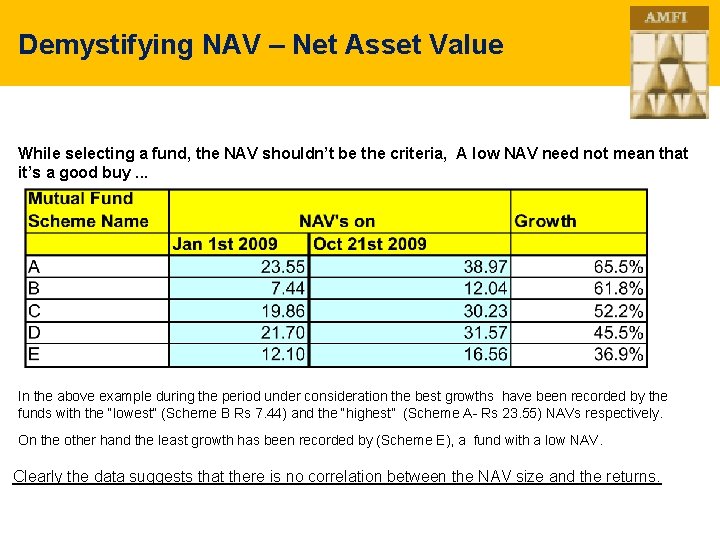
Demystifying NAV – Net Asset Value While selecting a fund, the NAV shouldn’t be the criteria, A low NAV need not mean that it’s a good buy. . . In the above example during the period under consideration the best growths have been recorded by the funds with the “lowest” (Scheme B Rs 7. 44) and the “highest” (Scheme A- Rs 23. 55) NAVs respectively. On the other hand the least growth has been recorded by (Scheme E), a fund with a low NAV. Clearly the data suggests that there is no correlation between the NAV size and the returns.
Types of risks associated with Mutual Fund Investment Risk is an inherent aspect of every form of investment. For Mutual Fund investments, risks would include variability, or period-by-period fluctuations in total return. Market risk: At times the prices or yields of all the securities in a particular market rise or fall due to broad outside influences. This change in price is due to 'market risk'. Inflation risk: Sometimes referred to as 'loss of purchasing power'. Whenever the rate of inflation exceeds the earnings on your investment, you run the risk that you'll actually be able to buy less, not more. Credit risk: In short, how stable is the company or entity to which you lend your money when you invest? How certain are you that it will be able to pay the interest you are promised, or repay your principal when the investment matures? Interest rate risk: Interest rate movements in the Indian debt markets can be volatile leading to the possibility of large price movements up or down in debt and money market securities and thereby to possibly large movements in the NAV. Other risks associated are: Investment risks Liquidity risk Changes in the government policy
THANK YOU
Important Information The market information, wherever stated has been sourced from the entities referred in the document. This information is purely for informational purposes and should not be construed as reflecting or indicating the views of (Name of the AMC). The value of investments and income from them may go down as well as up and an investor may not get back the amount invested. Please consult your tax advisor before investing. Risk Factors: ▪Mutual funds, like securities investments, are subject to market risks and there is no guarantee against loss in the schemes or that the schemes objectives will be achieved. ▪As with any investment in securities, the NAV of the units issued under the schemes can go up or down depending on various factors and forces affecting capital markets. ▪Past performance of the Sponsor /the AMC/the Mutual Fund does not indicate the future performance of the schemes. ▪ Please read the scheme information documents of the scheme and the statement of additional information before investing. Statutory: Kindly incorporate the statutory details related to the constitution of the AMC and the names of the Trustee and AMC.