
Why Low Power Testing 1 Test is HOT


- Slides: 18
Why Low Power Testing? 台大電子所 李建模 1
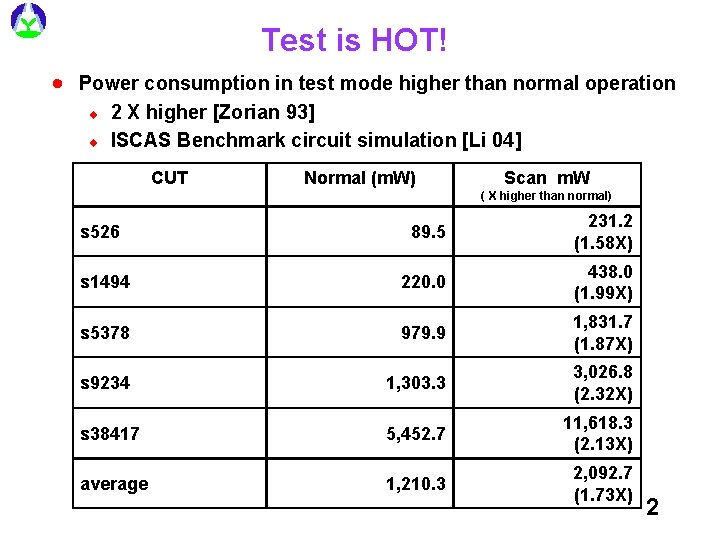
Test is HOT! · Power consumption in test mode higher than normal operation ¨ ¨ 2 X higher [Zorian 93] ISCAS Benchmark circuit simulation [Li 04] CUT Normal (m. W) Scan m. W ( X higher than normal) s 526 89. 5 231. 2 (1. 58 X) s 1494 220. 0 438. 0 (1. 99 X) s 5378 979. 9 1, 831. 7 (1. 87 X) s 9234 1, 303. 3 3, 026. 8 (2. 32 X) s 38417 5, 452. 7 11, 618. 3 (2. 13 X) average 1, 210. 3 2, 092. 7 (1. 73 X) 2
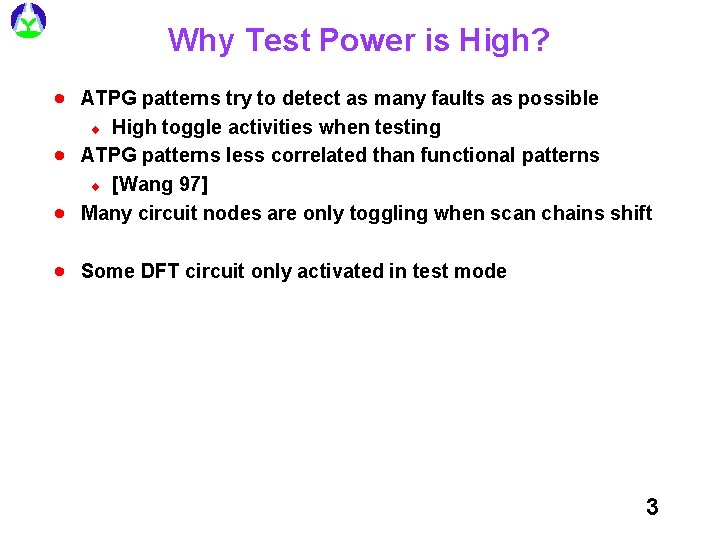
Why Test Power is High? · ATPG patterns try to detect as many faults as possible High toggle activities when testing ATPG patterns less correlated than functional patterns ¨ [Wang 97] Many circuit nodes are only toggling when scan chains shift ¨ · · · Some DFT circuit only activated in test mode 3
Why Low Power Testing? · Avoid power problems (e. g. IR drop) in test mode Ensure correct operation in test mode Protect CUT from overheating in test mode ¨ No expensive package for testing Enable parallel testing of multiple cores in SOC ¨ Save test time Avoid reliability problems ¨ Overheating can shorten CUT lifetime ¨ · · · 4
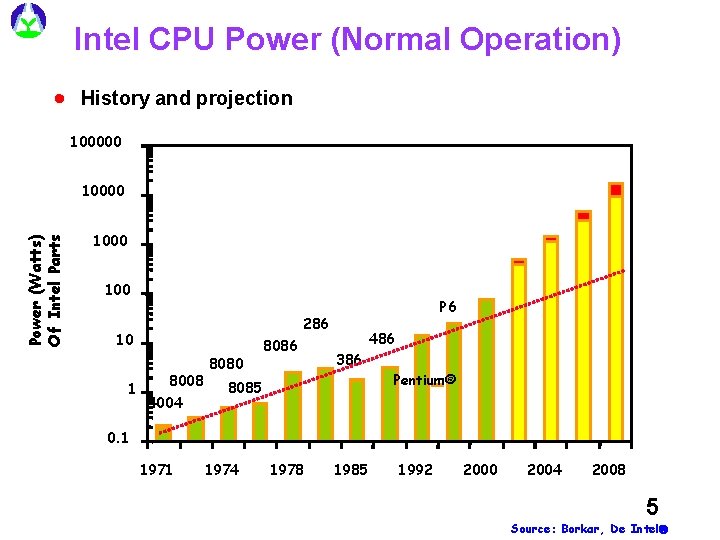
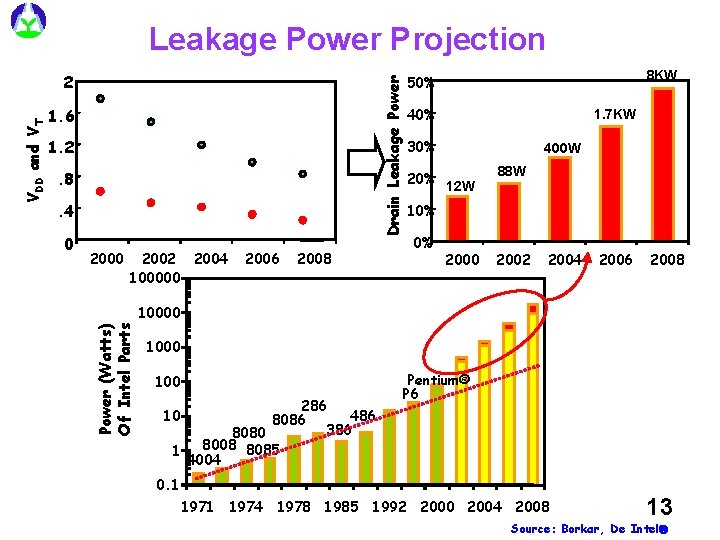
Intel CPU Power (Normal Operation) · History and projection 100000 Power (Watts) Of Intel Parts 10000 100 286 10 1 P 6 8008 4004 8080 8086 486 386 Pentium® 8085 0. 1 1974 1978 1985 1992 2000 2004 2008 5 Source: Borkar, De Intel
Types of Power Dissipation · Classified by Circuit Operation · Classified by Circuit Type · Classified by Time 6
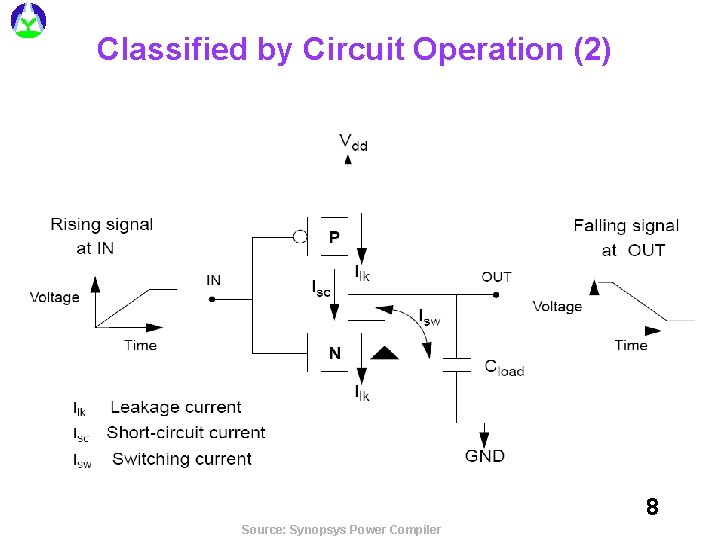
Classified by Circuit Operation · Static power dissipation (circuit activity independent) Leakage power Dynamic power dissipation (circuit activity dependent) ¨ Short circuit power ¨ Switch power ¨ · 7
Classified by Circuit Operation (2) 8 Source: Synopsys Power Compiler
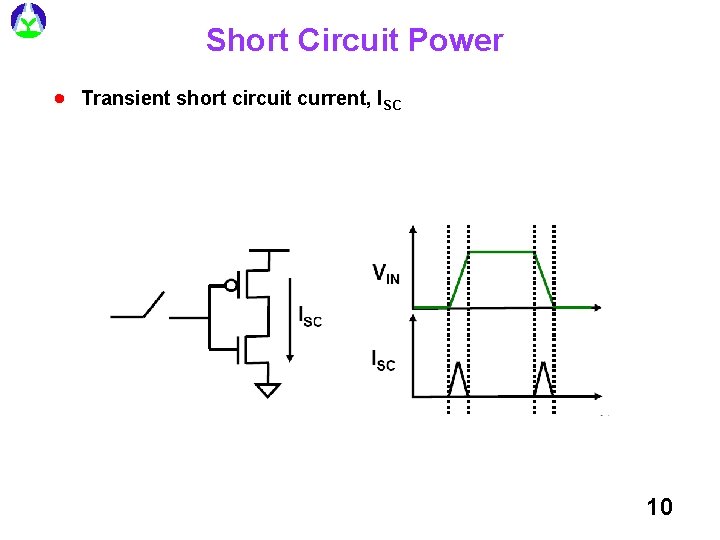
Short Circuit Power · Short Circuit Power ¨ ¨ ¨ Caused by momentary short circuit current * When NMOS PMOS both on Occurs only when circuit switching Can be estimated by the equation * Ei = energy consumed per transition of gate i. - usually provided by the ASIC vendor * TRi = toggle rate of output of gate i. - TRi is usually obtained by simulation 9
Short Circuit Power · Transient short circuit current, ISC 10
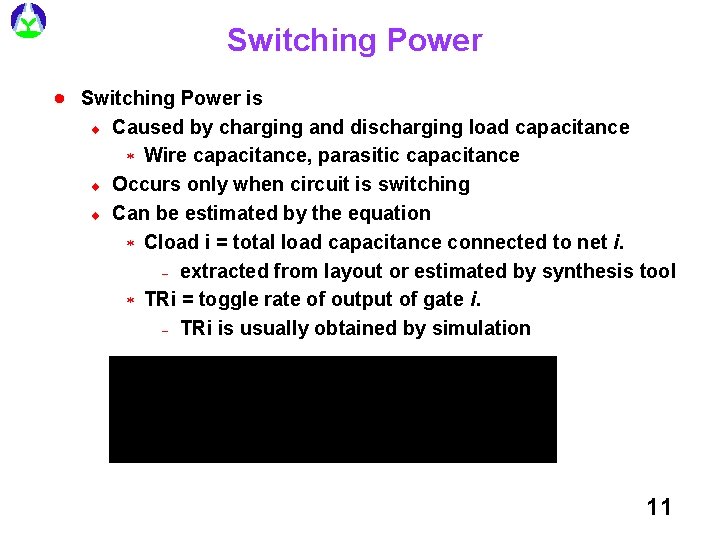
Switching Power · Switching Power is ¨ ¨ ¨ Caused by charging and discharging load capacitance * Wire capacitance, parasitic capacitance Occurs only when circuit is switching Can be estimated by the equation * Cload i = total load capacitance connected to net i. - extracted from layout or estimated by synthesis tool * TRi = toggle rate of output of gate i. - TRi is usually obtained by simulation 11
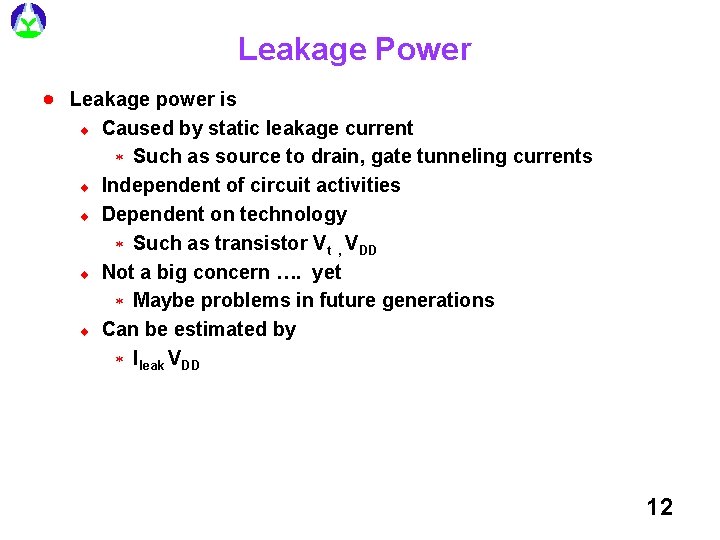
Leakage Power · Leakage power is ¨ ¨ ¨ Caused by static leakage current * Such as source to drain, gate tunneling currents Independent of circuit activities Dependent on technology * Such as transistor Vt , VDD Not a big concern …. yet * Maybe problems in future generations Can be estimated by * Ileak VDD 12
Leakage Power Projection Drain Leakage Power 1. 6 1. 2. 8. 4 0 2002 2004 100000 2006 2008 8 KW 50% 40% 1. 7 KW 30% 400 W 20% 12 W 88 W 10% 0% 2000 2002 2004 2006 2008 10000 Power (Watts) Of Intel Parts VDD and VT 2 1000 100 286 486 8086 386 8080 8008 8085 1 4004 Pentium® P 6 10 0. 1 1974 1978 1985 1992 2000 2004 2008 13 Source: Borkar, De Intel
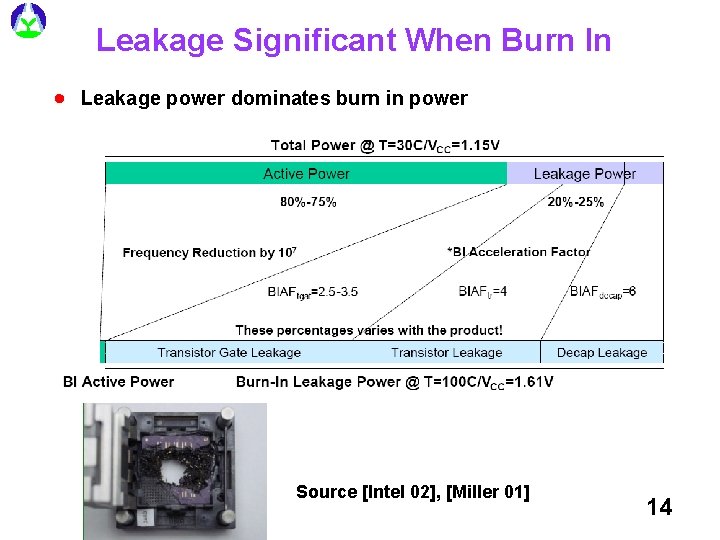
Leakage Significant When Burn In · Leakage power dominates burn in power Source [Intel 02], [Miller 01] 14
Classified by Circuit Types · Logic power Power dissipation in combinational logic Sequential power ¨ Power dissipation in the sequential elements * Such as scan chain, or latches Clock power ¨ Power dissipation in clock tree ¨ · · · Other types of circuits (not covered in this lecture) ¨ ¨ Memory power * SRAM, DRAM Analog, Mixed Signal Power 15
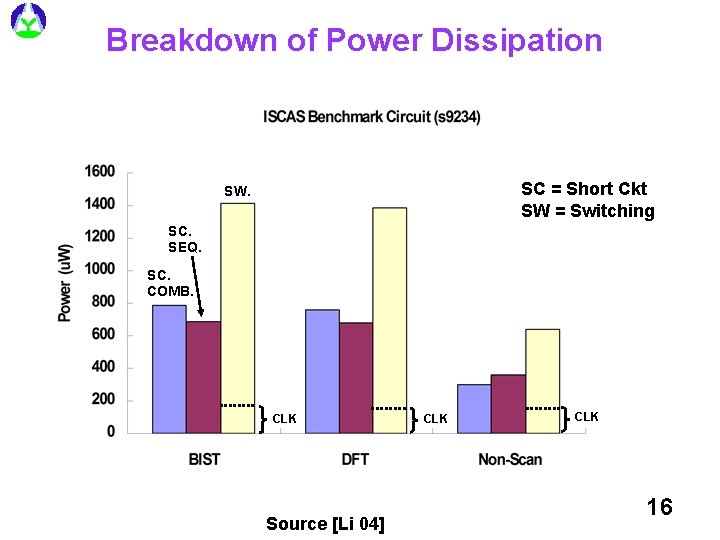
Breakdown of Power Dissipation SC = Short Ckt SW = Switching SW. SC. SEQ. SC. COMB. CLK Source [Li 04] CLK 16
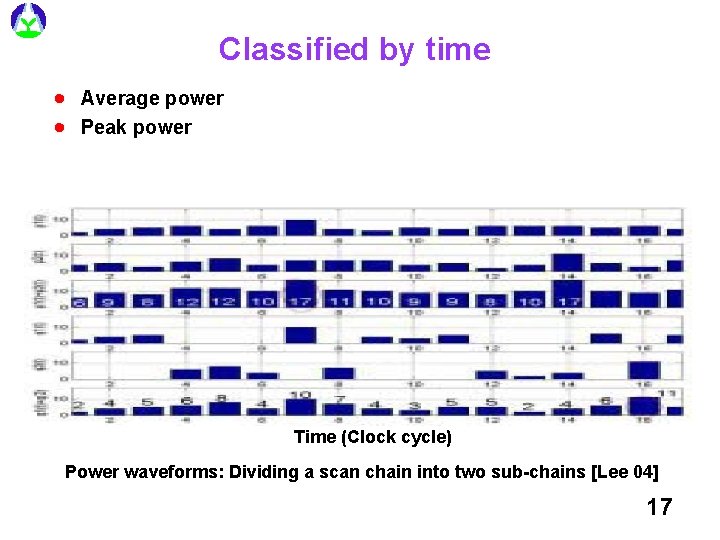
Classified by time · Average power · Peak power Time (Clock cycle) Power waveforms: Dividing a scan chain into two sub-chains [Lee 04] 17
My opinion · Low power testing not really needed now ¨ ¨ But will be needed in future Especially for burn in · Area needs more research ¨ ¨ Peak power reduction still needs more research Static power is difficult to control 18