
Why KM is Important KM enhances mission command
- Slides: 6
Why KM is Important KM enhances mission command, facilitates the exchange of knowledge, supports doctrine development, fosters leaders’ development, supports lessons learned, supports training and enhances professional education. Ultimately, KM enables the Army to become an adaptable organization that is able to learn and change. The Army’s strategy focuses on advancement in a culture of innovation rather than survival in a culture of compliance. • “Military operations are human endeavors characterized by the continuous, mutual adaptation of give and take, moves and countermoves among all participants (FM 6 -0 2011). ” The participants that are able to adapt and learn more efficiently will create advantages that can be exploited. The Army has moved towards mission command as the means to be more adaptable and able to execute in a decentralized manner. One of the key enables for an organization to learn and adapt is through the use of knowledge management. • Effective knowledge management enhances the shared understanding of an organization. The command staff possess a shared understanding of the OE and mission that allows for a synergy of effort between commanders, staffs, and subordinate commands. • Knowledge management enhances mission command’s ability to use mission type orders to promote initiative within the commander’s intent. If done properly trust is built within the organization, shared understanding is generated, and the people and organization will learn.
AOKM Mission Statement Army Operational Knowledge Management Proponent continually develops and integrates knowledge management DOTMLPF capabilities to support the Army generating and operating forces for the leaders and Soldiers in order to enable shared understanding and learning organizations.
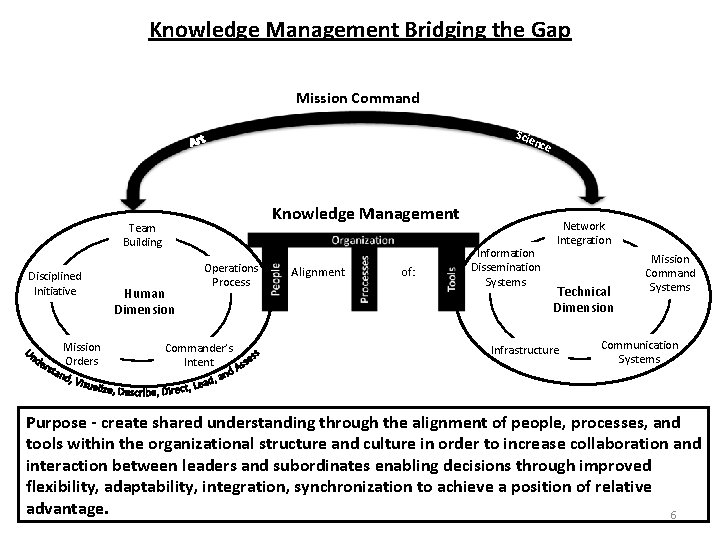
Purpose of AOKM Role: Army Operational Knowledge Management Proponent supports the generation of doctrine, education, and training of knowledge management throughout the United States Army in order to bridge the art and science of mission command; ultimately, foster an environment of persistent learning by facilitating knowledge flow between Army units in the field and Army schoolhouses and centers. Vision: Army lead for integration of requirements determination and capability development of Knowledge Management (KM) as an enabler of mission command. The land forces focal point for developing, sharing, and integrating knowledge management DOTMLPF, lessons learned, and expertise. Supporting the joint force, our international partners, and the United States government with research and analysis to: (1)Identify best practices for knowledge management in the Army (2)Provide KM subject matter expertise, advice, and support (3)Lead the integration of KM DOTMLPF initiatives across the force
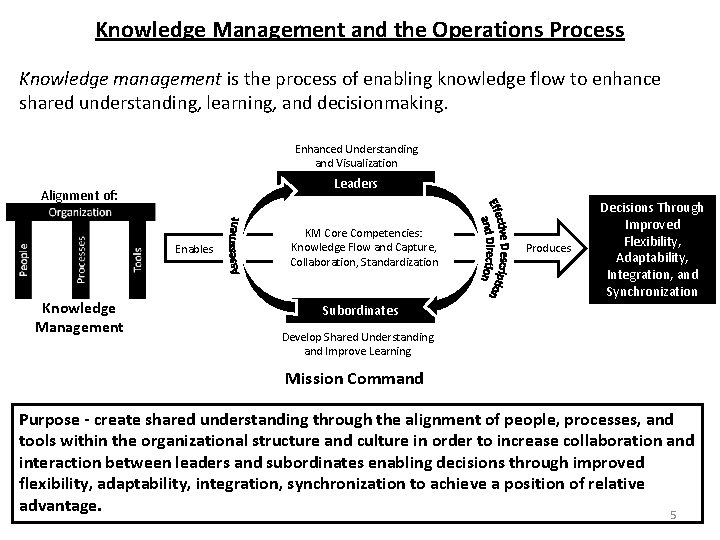
Knowledge Management Definition The process of enabling knowledge flow to enhance shared understanding, learning, and decisionmaking. (What) - through creation, organization, integration, and sharing of knowledge(How) - between leaders and subordinates (Who) - in order to improve adaptability, integration, and synchronization enabling effective decisionmaking (Why) 4
Knowledge Management and the Operations Process Knowledge management is the process of enabling knowledge flow to enhance shared understanding, learning, and decisionmaking. Enhanced Understanding and Visualization Leaders Alignment of: Enables Knowledge Management KM Core Competencies: Knowledge Flow and Capture, Collaboration, Standardization Produces Decisions Through Improved Flexibility, Adaptability, Integration, and Synchronization Subordinates Develop Shared Understanding and Improve Learning Mission Command Purpose - create shared understanding through the alignment of people, processes, and tools within the organizational structure and culture in order to increase collaboration and interaction between leaders and subordinates enabling decisions through improved flexibility, adaptability, integration, synchronization to achieve a position of relative advantage. 5
Knowledge Management Bridging the Gap Mission Command Scie nce Knowledge Management Team Building Disciplined Initiative Mission Orders Human Dimension Operations Process Commander’s Intent Alignment of: Information Dissemination Systems Network Integration Technical Dimension Infrastructure Mission Command Systems Communication Systems Purpose - create shared understanding through the alignment of people, processes, and tools within the organizational structure and culture in order to increase collaboration and interaction between leaders and subordinates enabling decisions through improved flexibility, adaptability, integration, synchronization to achieve a position of relative advantage. 6