
Why is Water Important Humans are made up
- Slides: 21
Why is Water Important • Humans are made up of 2/3 water • We can survive weeks without food but most people would be dead in 4 days without water • We lose approximately 1. 5 L of water per day – Therefore, we should drink 1. 5 -2 L of water each day • Role: helps us get rid of toxic substances, regulates our temperature, used as a delivery system (throughout our body) and is a lubricant for our body
7 Easy Tricks to Drink More Water 1. 2. 3. 4. 5. 6. 7. Put a glass of water by your bed & drink it when you wake up Carry a 500 ml bottle with you throughout the day Dilute juice 50/50 with water Flavor it (fresh lemon, lime, ginger or mint, or herbal or fruit teas) Fruits & veggies (2 pieces of fruit & 2 servings of veggies can provide 500 ml of water) When you are hungry, drink a glass of water; we often mistake thirst for hunger Always have 1 glass of water with coffee & 2 glasses with alcoholic drinks
Why is Protein Important? • Known as the body’s building blocks • Role: – Vital for growth & repair of body tissue – Used to make hormones, enzymes, antibodies & neurotransmitters – Help transport substances around the body • Protein should make up 15 -25% of your total calorie intake (the higher end if you are trying to lose weight)
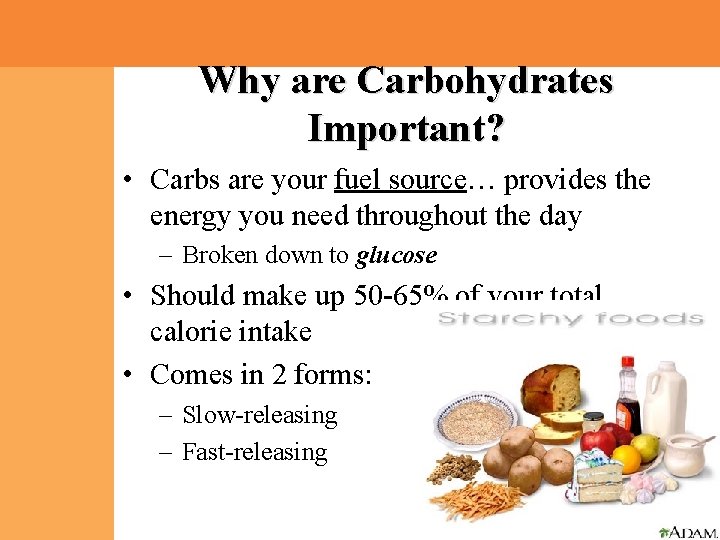
Why are Carbohydrates Important? • Carbs are your fuel source… provides the energy you need throughout the day – Broken down to glucose • Should make up 50 -65% of your total calorie intake • Comes in 2 forms: – Slow-releasing – Fast-releasing
Why is Fat Important? • Fat is good & necessary in small quantities (and the good kind!!) • Reduces the risk of cancer, heart disease, allergies, Alzheimer’s disease, arthritis, eczema, depression, fatigue & PMS • The human brain is 60% fat – 1/3 should come from essential fats to achieve your full potential for health & happiness • Most Westerners eat too much saturated & trans fats & not enough unsaturated • Fat should make up 20 -25% of total calorie intake – It comes out to approx. 1/8 of what you eat because there are more calories in 1 g of fat than 1 g of protein or carbohydrates
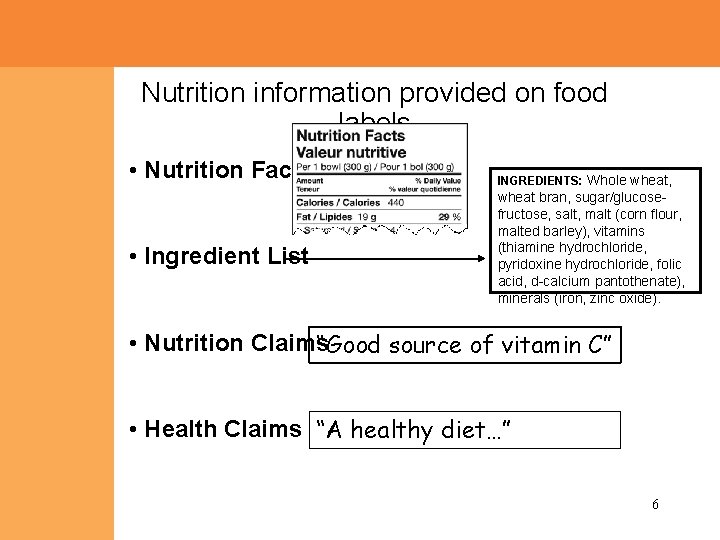
Nutrition information provided on food labels • Nutrition Facts • Ingredient List INGREDIENTS: Whole wheat, wheat bran, sugar/glucosefructose, salt, malt (corn flour, malted barley), vitamins (thiamine hydrochloride, pyridoxine hydrochloride, folic acid, d-calcium pantothenate), minerals (iron, zinc oxide). • Nutrition Claims “Good source of vitamin C” • Health Claims “A healthy diet…” 6
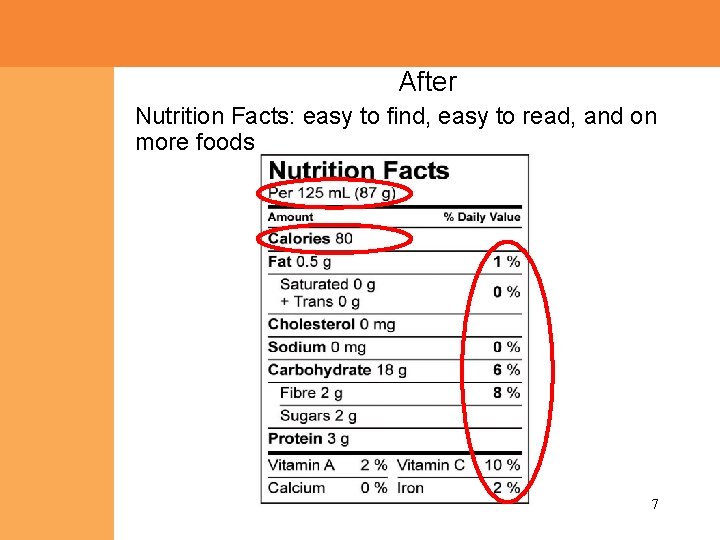
After Nutrition Facts: easy to find, easy to read, and on more foods 7
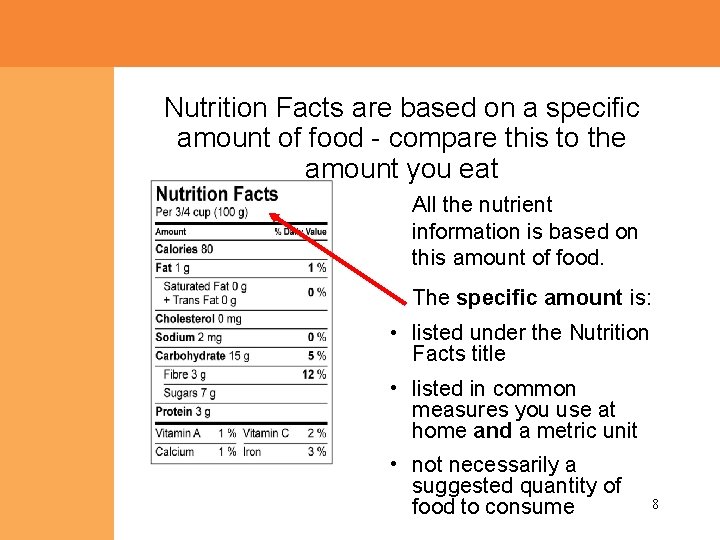
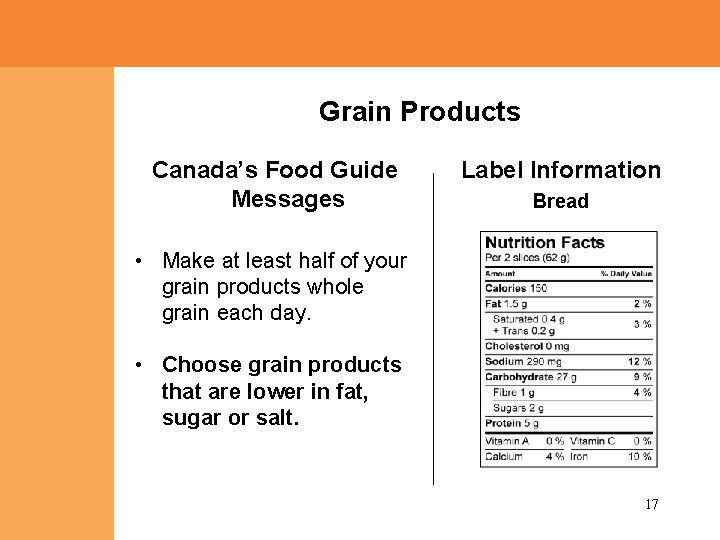
Nutrition Facts are based on a specific amount of food - compare this to the amount you eat All the nutrient information is based on this amount of food. The specific amount is: • listed under the Nutrition Facts title • listed in common measures you use at home and a metric unit • not necessarily a suggested quantity of food to consume 8
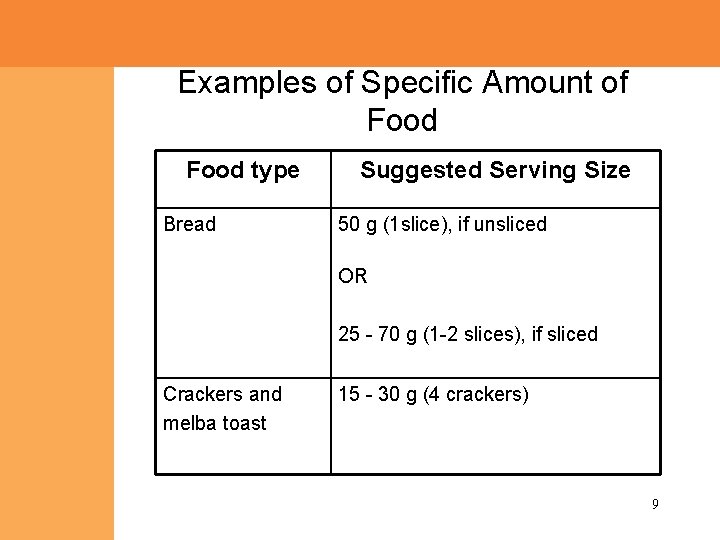
Examples of Specific Amount of Food type Bread Suggested Serving Size 50 g (1 slice), if unsliced OR 25 - 70 g (1 -2 slices), if sliced Crackers and melba toast 15 - 30 g (4 crackers) 9
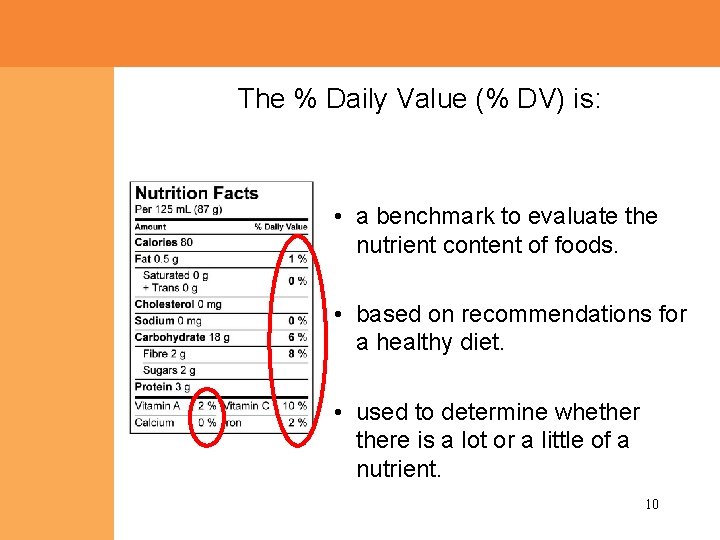
The % Daily Value (% DV) is: • a benchmark to evaluate the nutrient content of foods. • based on recommendations for a healthy diet. • used to determine whethere is a lot or a little of a nutrient. 10
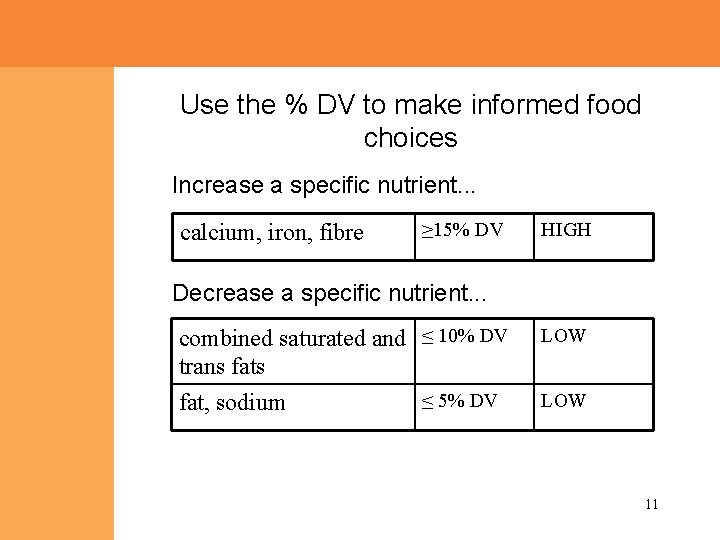
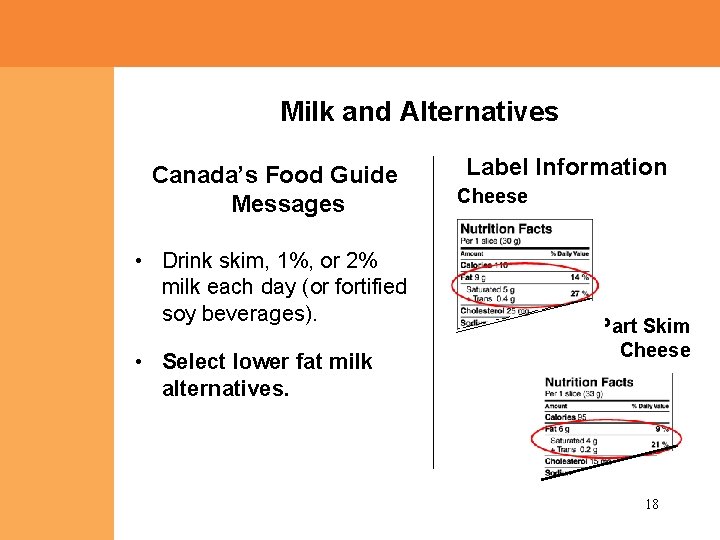
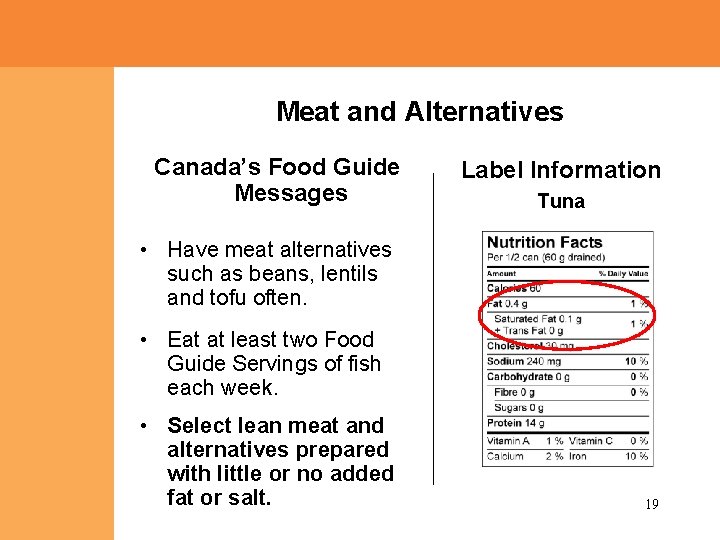
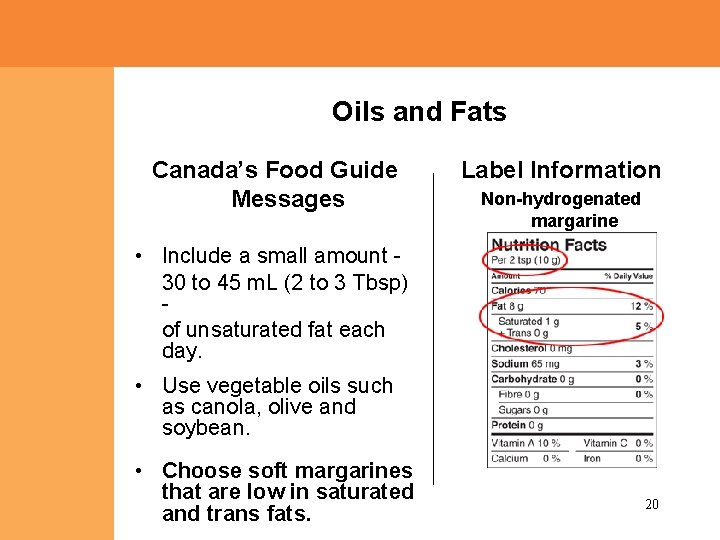
Use the % DV to make informed food choices Increase a specific nutrient. . . calcium, iron, fibre ≥ 15% DV HIGH Decrease a specific nutrient. . . combined saturated and ≤ 10% DV trans fat, sodium ≤ 5% DV LOW 11
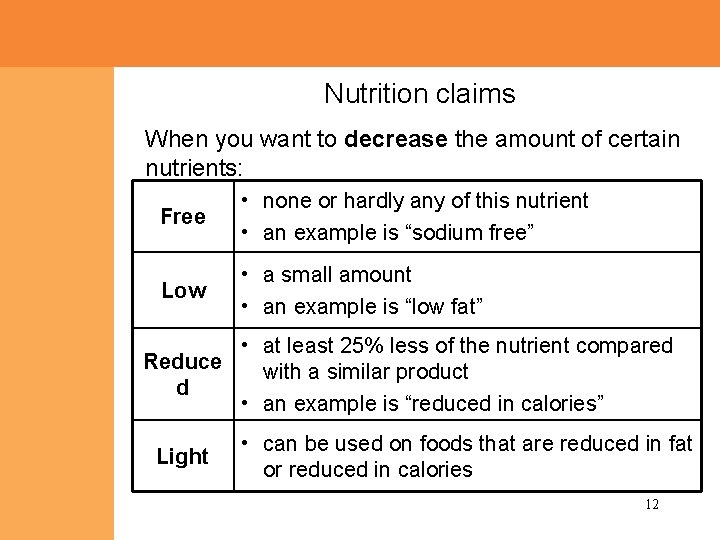
Nutrition claims When you want to decrease the amount of certain nutrients: Free • none or hardly any of this nutrient • an example is “sodium free” Low • a small amount • an example is “low fat” • at least 25% less of the nutrient compared Reduce with a similar product d • an example is “reduced in calories” Light • can be used on foods that are reduced in fat or reduced in calories 12
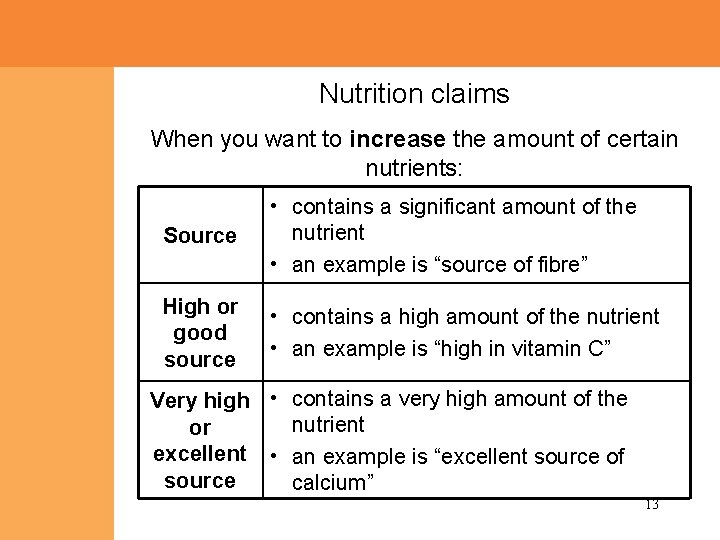
Nutrition claims When you want to increase the amount of certain nutrients: Source • contains a significant amount of the nutrient • an example is “source of fibre” High or good source • contains a high amount of the nutrient • an example is “high in vitamin C” Very high • contains a very high amount of the nutrient or excellent • an example is “excellent source of source calcium” 13
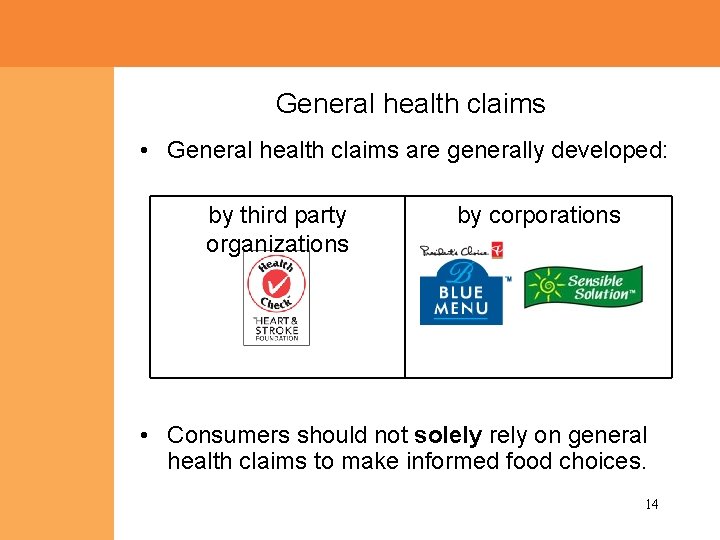
General health claims • General health claims are generally developed: by third party organizations by corporations • Consumers should not solely rely on general health claims to make informed food choices. 14
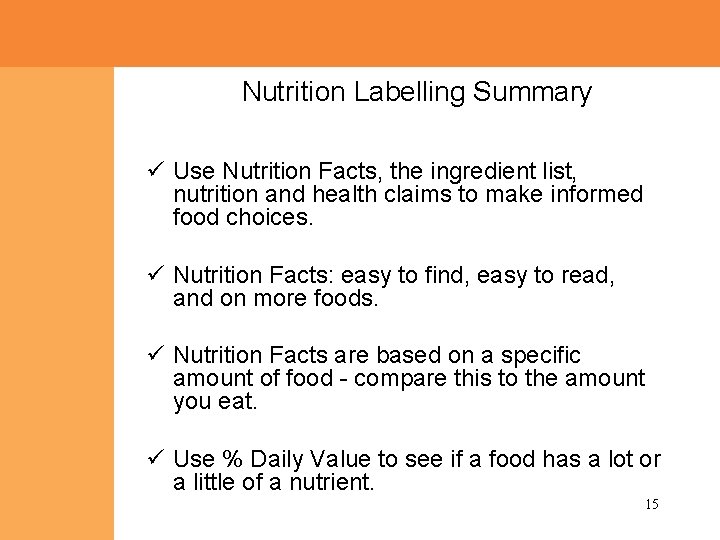
Nutrition Labelling Summary ü Use Nutrition Facts, the ingredient list, nutrition and health claims to make informed food choices. ü Nutrition Facts: easy to find, easy to read, and on more foods. ü Nutrition Facts are based on a specific amount of food - compare this to the amount you eat. ü Use % Daily Value to see if a food has a lot or a little of a nutrient. 15
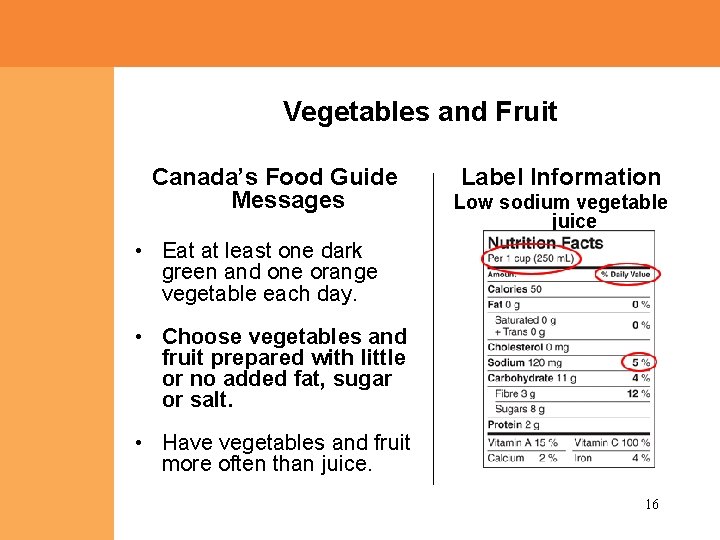
Vegetables and Fruit Canada’s Food Guide Messages Label Information Low sodium vegetable juice • Eat at least one dark green and one orange vegetable each day. • Choose vegetables and fruit prepared with little or no added fat, sugar or salt. • Have vegetables and fruit more often than juice. 16
Grain Products Canada’s Food Guide Messages Label Information Bread • Make at least half of your grain products whole grain each day. • Choose grain products that are lower in fat, sugar or salt. 17
Milk and Alternatives Canada’s Food Guide Messages • Drink skim, 1%, or 2% milk each day (or fortified soy beverages). • Select lower fat milk alternatives. Label Information Cheese Part Skim Cheese 18
Meat and Alternatives Canada’s Food Guide Messages Label Information Tuna • Have meat alternatives such as beans, lentils and tofu often. • Eat at least two Food Guide Servings of fish each week. • Select lean meat and alternatives prepared with little or no added fat or salt. 19
Oils and Fats Canada’s Food Guide Messages Label Information Non-hydrogenated margarine • Include a small amount 30 to 45 m. L (2 to 3 Tbsp) of unsaturated fat each day. • Use vegetable oils such as canola, olive and soybean. • Choose soft margarines that are low in saturated and trans fats. 20
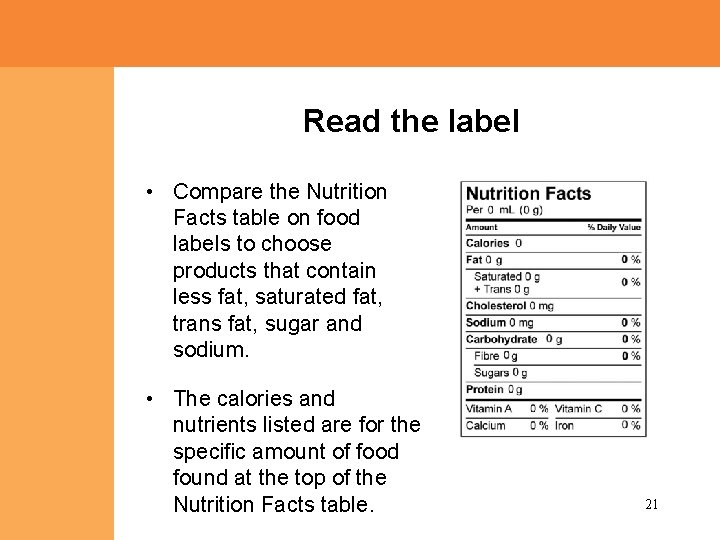
Read the label • Compare the Nutrition Facts table on food labels to choose products that contain less fat, saturated fat, trans fat, sugar and sodium. • The calories and nutrients listed are for the specific amount of food found at the top of the Nutrition Facts table. 21