
Why is the Scientific Method Important The Scientific


- Slides: 14
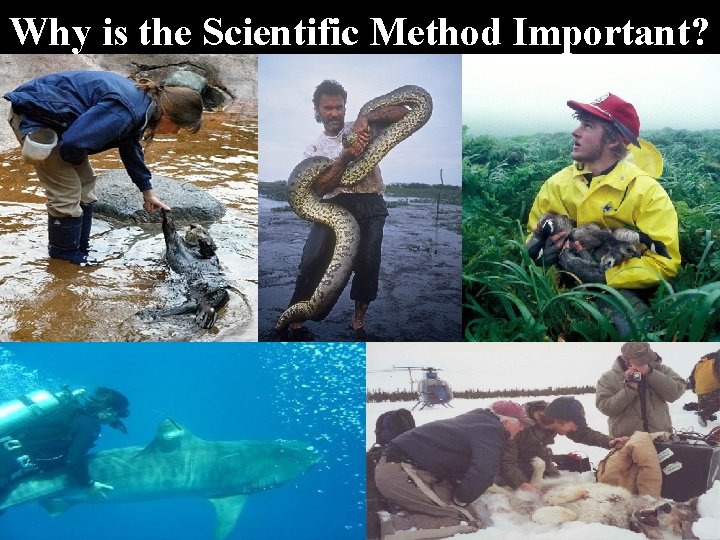
Why is the Scientific Method Important?
The Scientific Method • To answer questions, biologists may use many different approaches, yet there are some steps that are common to all approaches. • The common steps that biologists and other scientists use to gather information and answer questions are known as scientific methods. • There are no fixed steps to follow, but scientific investigations generally involve: 1. Making observations/State problem 2. Making a hypothesis 3. Collecting information 4. Forming a theory by proving/disproving hypothesis
• A hypothesis is an explanation for a question or a problem that can be formally tested. The hypothesis must be tested in some way. • A hypothesis is not a random guess. It comes about through observations, extensive reading, or previous investigations. • Eventually, the hypothesis will be tested through an experiment.
• An experiment is an investigation that tests a hypothesis by the process of collecting information under controlled conditions. • Some experiments involve two groups: 1. Control group 2. Experimental group • A control is the standard against which results are compared. The control receives no experimental treatment. • The experimental group is the test group
CONTROL GROUP No fertilizer Same sunlight Same amt. water EXPERIMENTAL GROUP Add fertilizer Same sunlight Same amt. water
Designing an Experiment • In a controlled experiment, only one condition is changed at a time. • Independent variable=what is tested because it is the only factor that affects the outcome of the experiment. • Dependent variable=resulting condition • Biologists use a variety of tools to carry out an investigation. Ex: beakers, test tubes, petri dishes, thermometers, balances, etc.
What is the independent variable? What is the dependent variable?
• The information gained from experiments is called data, which can be in numerical form or verbal form. • Data from an investigation may be considered confirmed only if repeating that investigation several times yields similar results. • Results and conclusions are reported in scientific journals, where they are available for examination by other scientists. • A hypothesis that is supported by many separate observations and investigations, usually over a long period of time, becomes a
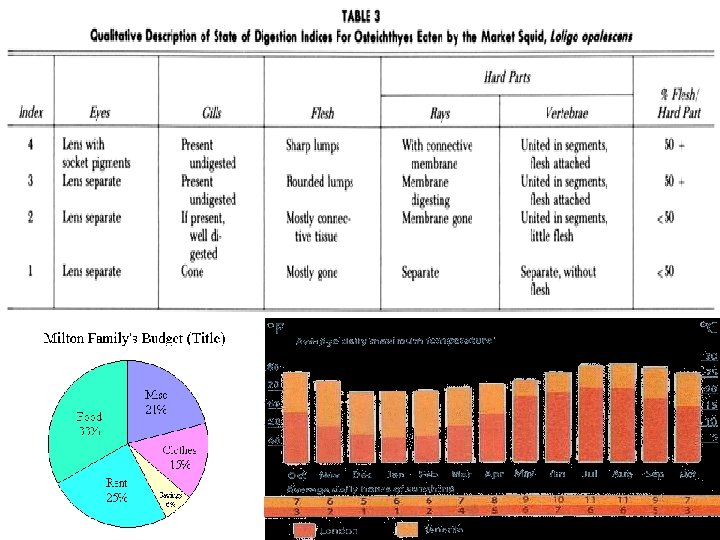
Kinds of Information • Scientific information can usually be classified into one of two main types: 1. Quantitative information 2. Qualitative information • Quantitative=numerical data Ex: graphs, tables, counts, temperatures • Scientists always report measurements in the metric system called the International System of Measurement, commonly known as SI. Ex: meter (length); gram (mass); liter (volume); second (time); Celcius degrees (temperature)
Theories & Laws • A theory is an explanation of a natural phenomenon that is supported by a large body of scientific evidence obtained from many different investigations and observations. • Scientists also recognize certain facts of nature, called laws or principles, that are generally known to be true. (Ex:
REVIEW *Identify what kind of research these are: 1. Numerical data 2. Field study of hunting behavior 3. Thermometer, stopwatch 4. Measurements from lab _______ 5. Purely observational data ______________
Scientific Method Song • http: //www. youtube. com/watch? v =MV 8 l. Sm. Io 4 Achttp: //www. yout ube. com/watch? v=MV 8 l. Sm. Io 4 Ac