
Why is Light so useful in Astronomy It
- Slides: 22
Why is Light so useful in Astronomy? • It can tell us many properties of planets and stars: – How warm / hot they are (Surface temperature) – What they’re made of (Chemical Composition) – How they’re moving (Radial Velocity and Spin) Spectrum of Mars
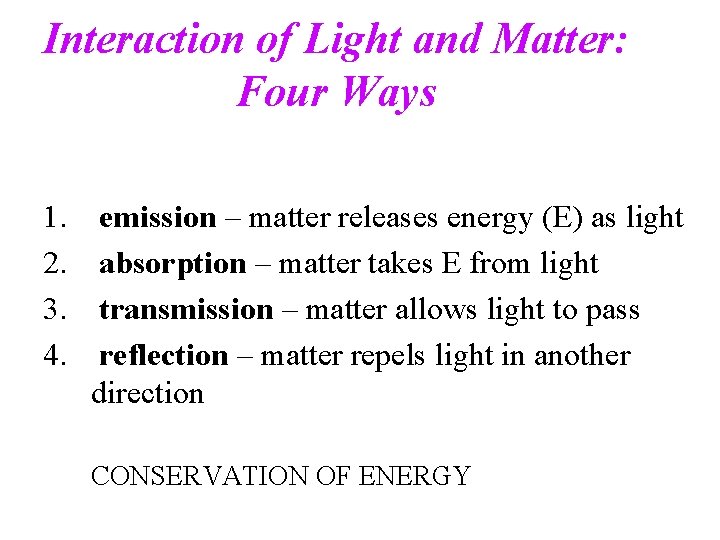
Interaction of Light and Matter: Four Ways 1. 2. 3. 4. emission – matter releases energy (E) as light absorption – matter takes E from light transmission – matter allows light to pass reflection – matter repels light in another direction CONSERVATION OF ENERGY
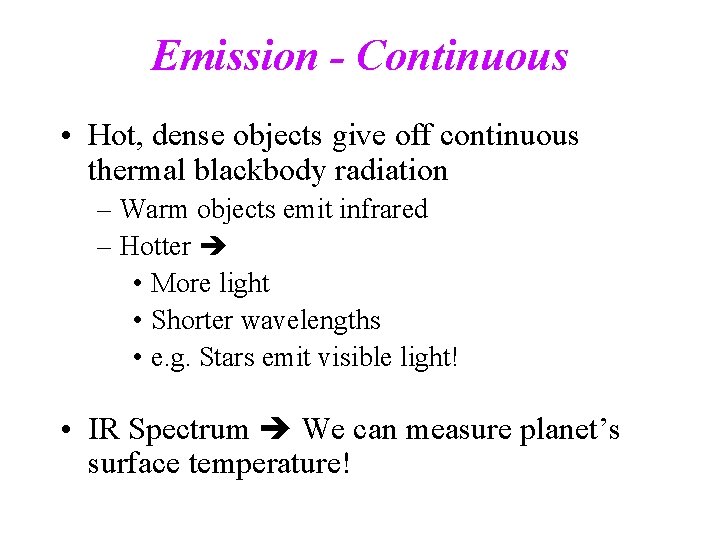
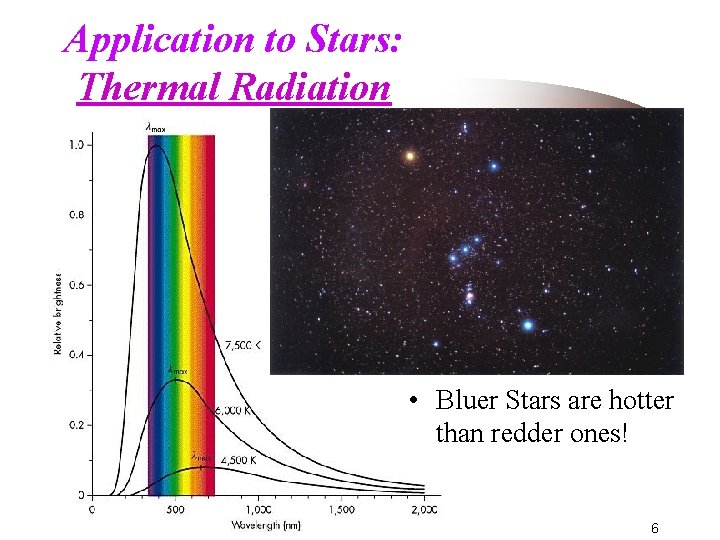
Emission - Continuous • Hot, dense objects give off continuous thermal blackbody radiation – Warm objects emit infrared – Hotter • More light • Shorter wavelengths • e. g. Stars emit visible light! • IR Spectrum We can measure planet’s surface temperature!
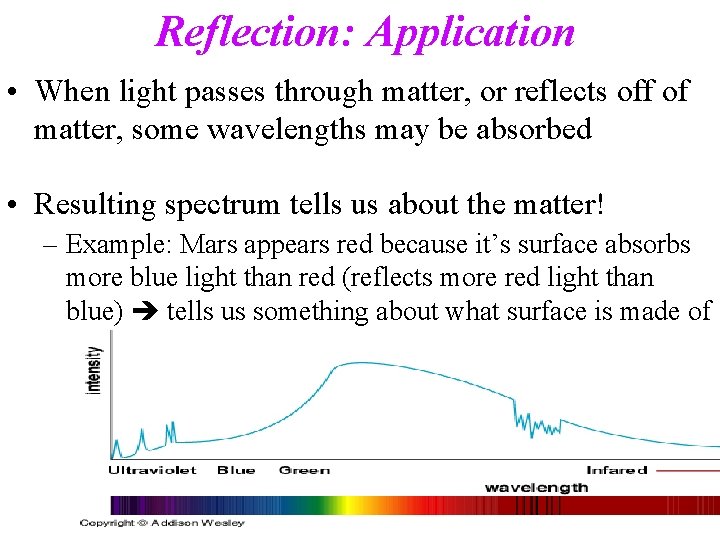
Reflection: Application • When light passes through matter, or reflects off of matter, some wavelengths may be absorbed • Resulting spectrum tells us about the matter! – Example: Mars appears red because it’s surface absorbs more blue light than red (reflects more red light than blue) tells us something about what surface is made of
Blackbody Activity 5
Application to Stars: Thermal Radiation • Bluer Stars are hotter than redder ones! 6
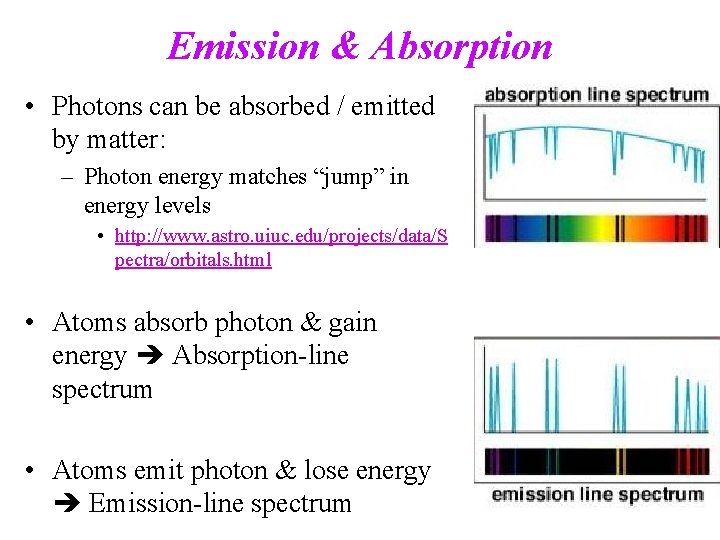
Emission & Absorption • Photons can be absorbed / emitted by matter: – Photon energy matches “jump” in energy levels • http: //www. astro. uiuc. edu/projects/data/S pectra/orbitals. html • Atoms absorb photon & gain energy Absorption-line spectrum • Atoms emit photon & lose energy Emission-line spectrum
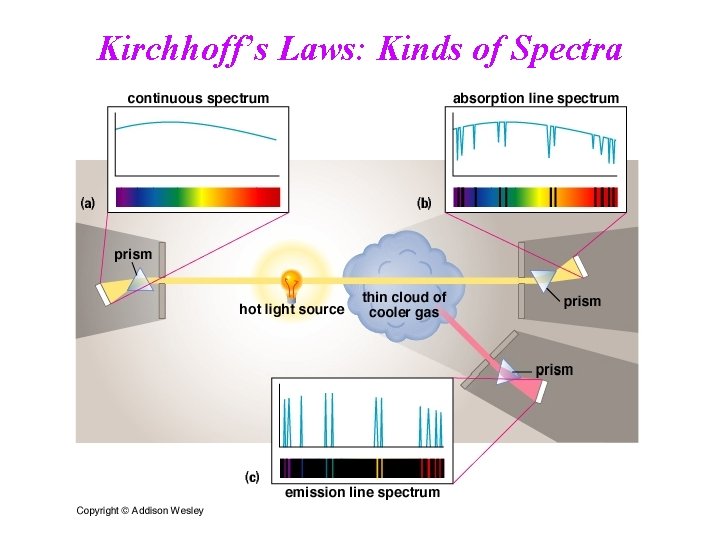
Kirchhoff’s Laws: Kinds of Spectra
Types of Spectra Activity 9
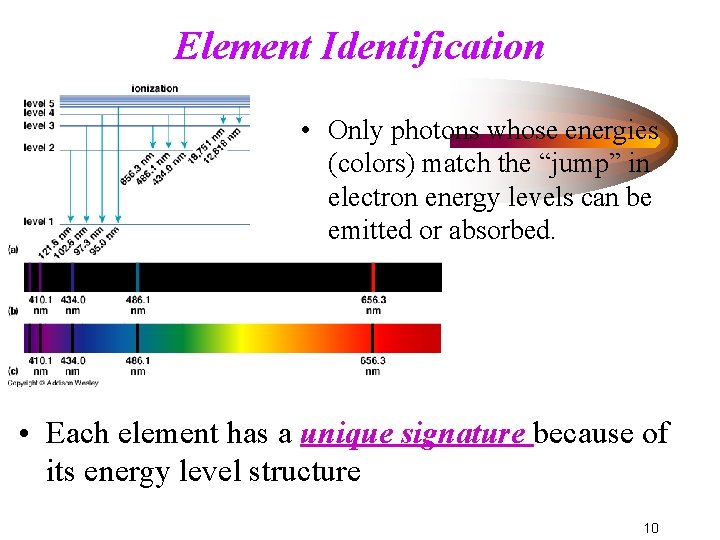
Element Identification Only • • Fig. 6. 8 photons whose energies (colors) match the “jump” in Hydrogen electron energy levels can be emitted or absorbed. • Each element has a unique signature because of its energy level structure 10
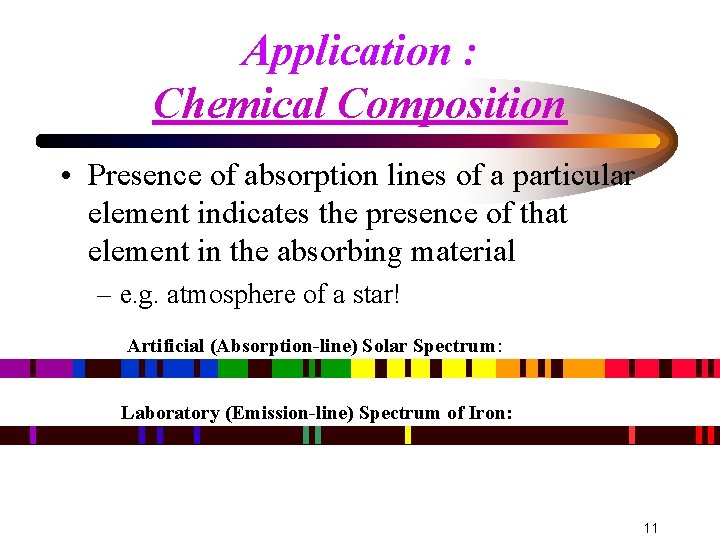
Application : Chemical Composition • Presence of absorption lines of a particular element indicates the presence of that element in the absorbing material – e. g. atmosphere of a star! Artificial (Absorption-line) Solar Spectrum: Laboratory (Emission-line) Spectrum of Iron: 11
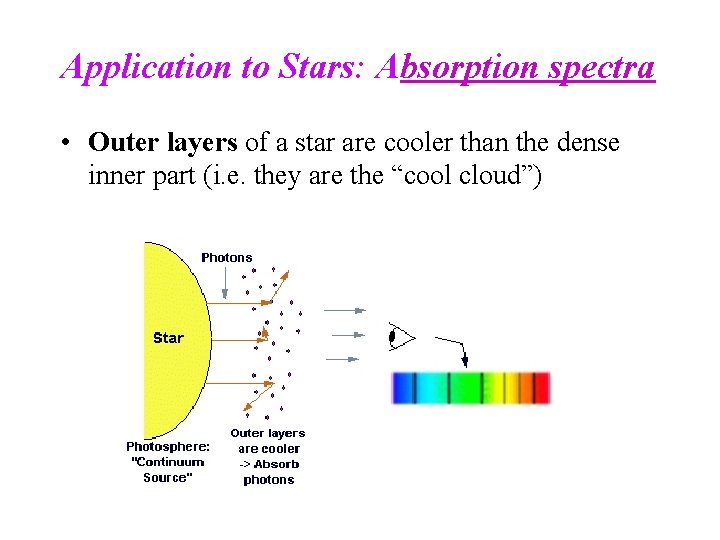
Application to Stars: Absorption spectra • Outer layers of a star are cooler than the dense inner part (i. e. they are the “cool cloud”)
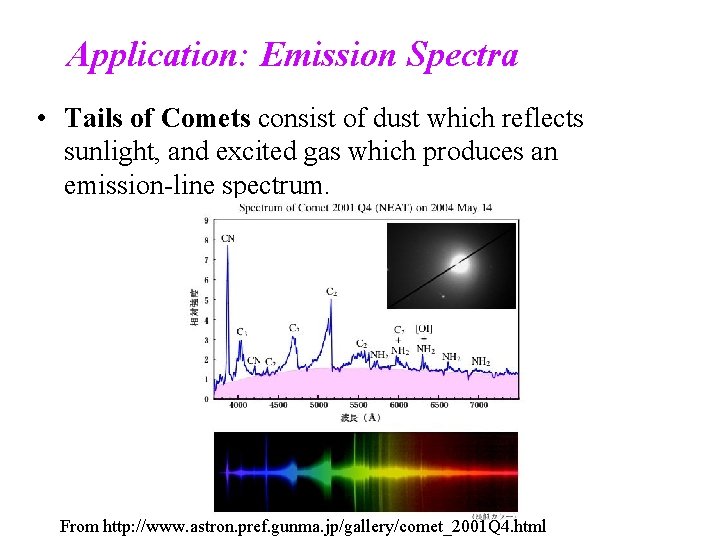
Application: Emission Spectra • Tails of Comets consist of dust which reflects sunlight, and excited gas which produces an emission-line spectrum. From http: //www. astron. pref. gunma. jp/gallery/comet_2001 Q 4. html
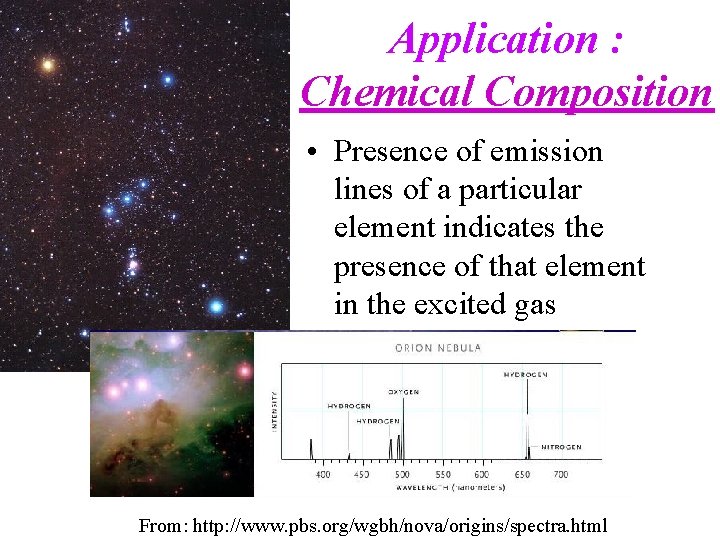
Application : Chemical Composition • Presence of emission lines of a particular element indicates the presence of that element in the excited gas From: http: //www. pbs. org/wgbh/nova/origins/spectra. html
The Doppler Effect How is light affected by the velocity of a source? (Alternate views: http: //www. fearofphysics. com/Sound/dopwhy 2. html and http: //lectureonline. cl. msu. edu/~mmp/applist/doppler/d. htm)
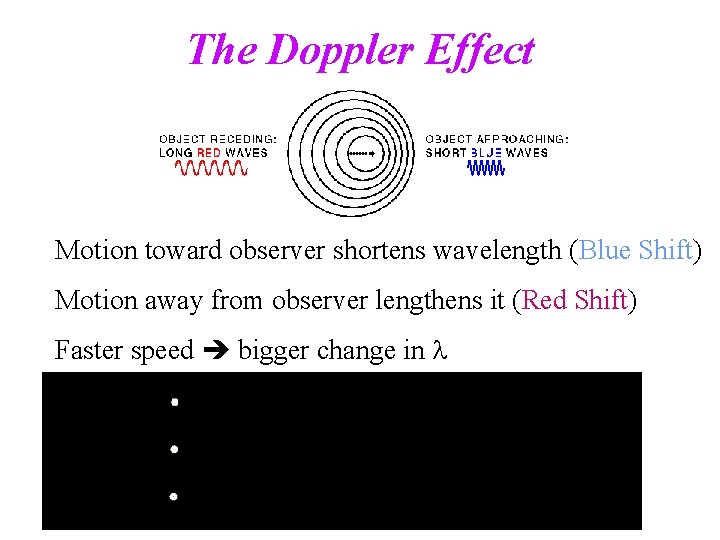
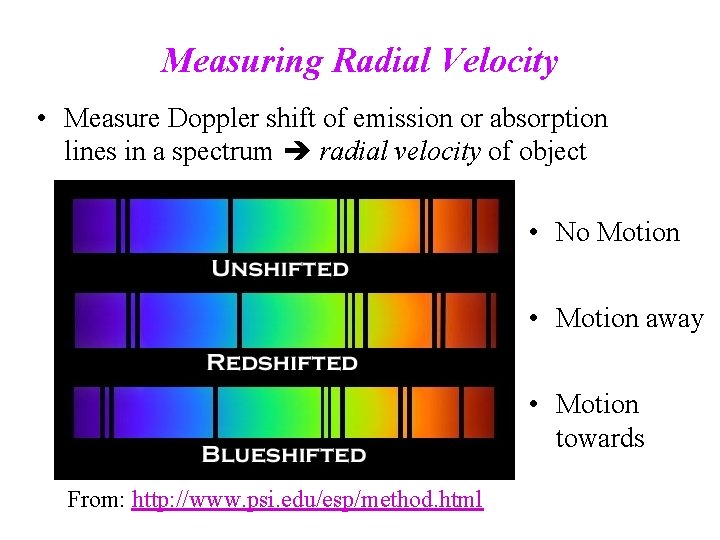
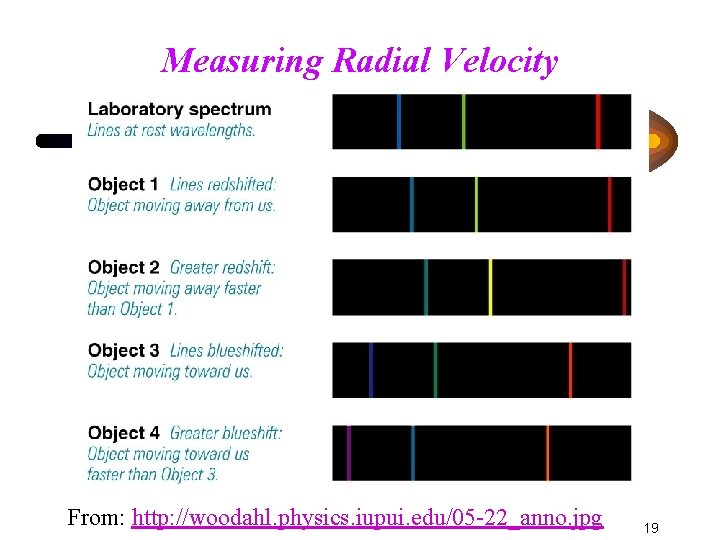
The Doppler Effect Motion toward observer shortens wavelength (Blue Shift) Motion away from observer lengthens it (Red Shift) Faster speed bigger change in
Measuring Radial Velocity • Measure Doppler shift of emission or absorption lines in a spectrum radial velocity of object • No Motion • Motion away • Motion towards From: http: //www. psi. edu/esp/method. html
Doppler Effect Activity 18
Measuring Radial Velocity From: http: //woodahl. physics. iupui. edu/05 -22_anno. jpg 19
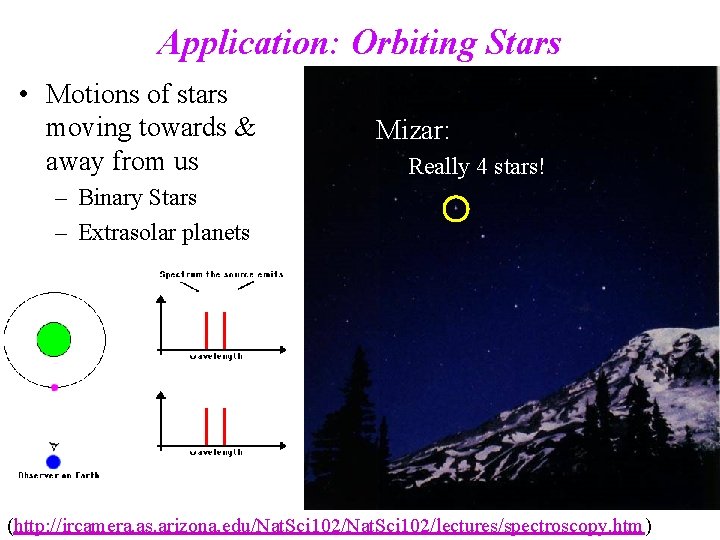
Application: Orbiting Stars • Motions of stars moving towards & away from us • Mizar: – Really 4 stars! – Binary Stars – Extrasolar planets (http: //ircamera. as. arizona. edu/Nat. Sci 102/lectures/spectroscopy. htm)
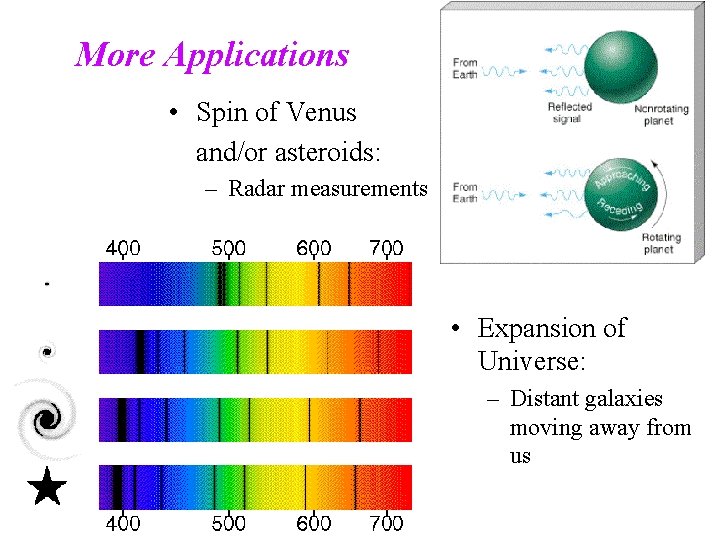
More Applications • Spin of Venus and/or asteroids: – Radar measurements • Expansion of Universe: – Distant galaxies moving away from us
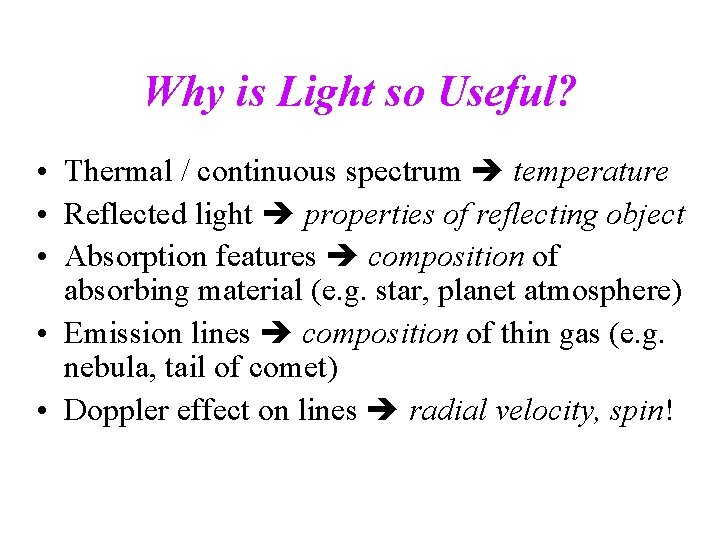
Why is Light so Useful? • Thermal / continuous spectrum temperature • Reflected light properties of reflecting object • Absorption features composition of absorbing material (e. g. star, planet atmosphere) • Emission lines composition of thin gas (e. g. nebula, tail of comet) • Doppler effect on lines radial velocity, spin!