
Why IC 50s Are Bad for You And
Why IC 50’s Are Bad for You And Other Surprises Petr Kuzmič, Ph. D. Bio. Kin, Ltd. IC 50's are bad for you
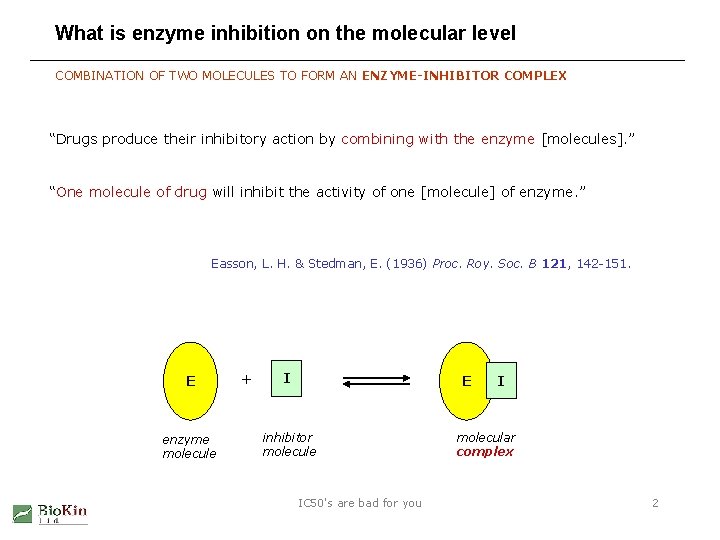
What is enzyme inhibition on the molecular level COMBINATION OF TWO MOLECULES TO FORM AN ENZYME-INHIBITOR COMPLEX “Drugs produce their inhibitory action by combining with the enzyme [molecules]. ” “One molecule of drug will inhibit the activity of one [molecule] of enzyme. ” Easson, L. H. & Stedman, E. (1936) Proc. Roy. Soc. B 121, 142 -151. E enzyme molecule + I E inhibitor molecule IC 50's are bad for you I molecular complex 2
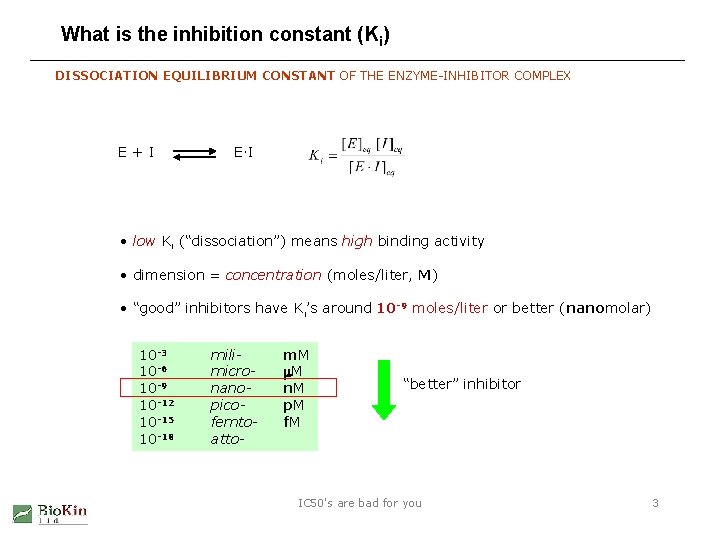
What is the inhibition constant (Ki) DISSOCIATION EQUILIBRIUM CONSTANT OF THE ENZYME-INHIBITOR COMPLEX E + I E·I • low Ki (“dissociation”) means high binding activity • dimension = concentration (moles/liter, M) • “good” inhibitors have Ki’s around 10 -9 moles/liter or better (nanomolar) 10 -3 10 -6 10 -9 10 -12 10 -15 10 -18 milimicronanopicofemtoatto- m. M n. M p. M f. M “better” inhibitor IC 50's are bad for you 3
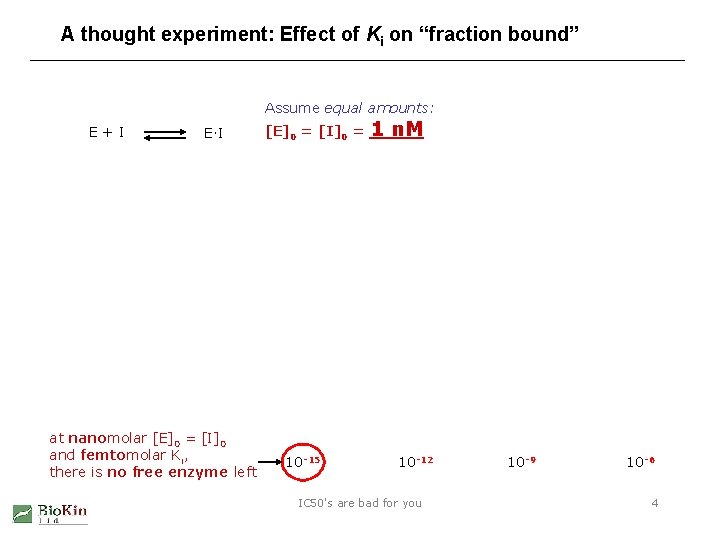
A thought experiment: Effect of Ki on “fraction bound” Assume equal amounts: E + I E·I at nanomolar [E]0 = [I]0 and femtomolar Ki, there is no free enzyme left [E]0 = [I]0 = 10 -15 1 n. M 10 -12 IC 50's are bad for you 10 -9 10 -6 4
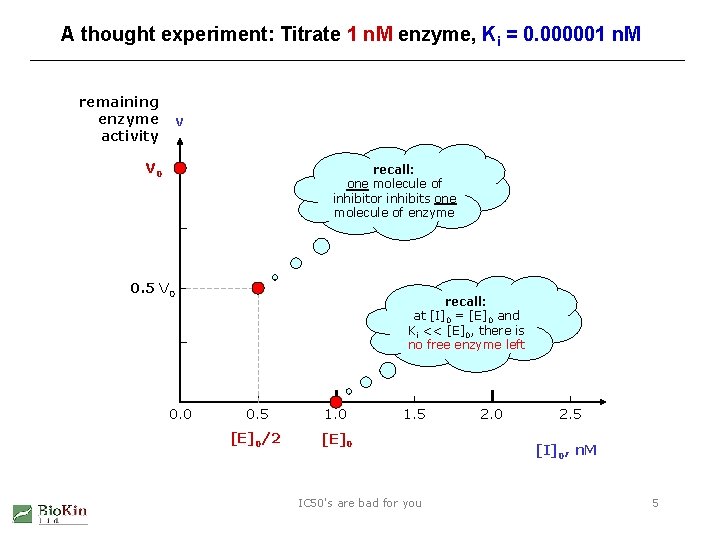
A thought experiment: Titrate 1 n. M enzyme, Ki = 0. 000001 n. M remaining enzyme activity v V 0 recall: one molecule of inhibitor inhibits one molecule of enzyme 0. 5 V 0 0. 0 recall: at [I]0 = [E]0 and Ki << [E]0, there is no free enzyme left 0. 5 1. 0 [E]0/2 [E]0 1. 5 IC 50's are bad for you 2. 0 2. 5 [I]0, n. M 5
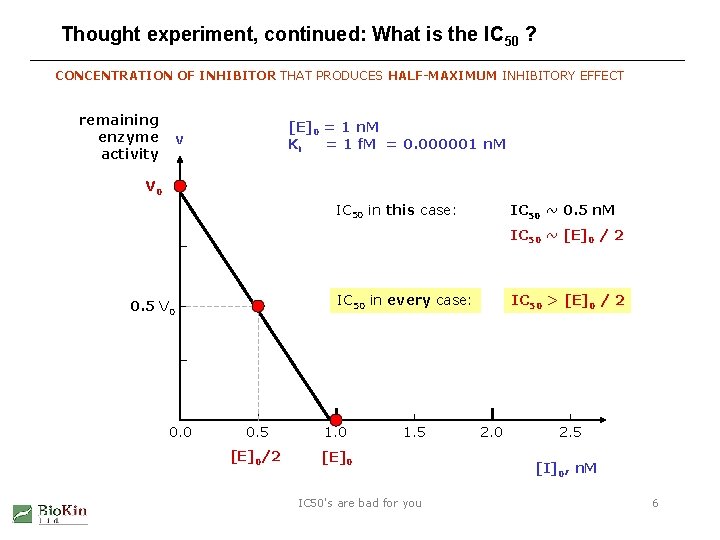
Thought experiment, continued: What is the IC 50 ? CONCENTRATION OF INHIBITOR THAT PRODUCES HALF-MAXIMUM INHIBITORY EFFECT remaining enzyme activity [E]0 = 1 n. M Ki = 1 f. M = 0. 000001 n. M v V 0 IC 50 in this case: IC 50 ~ 0. 5 n. M IC 50 ~ [E]0 / 2 IC 50 in every case: 0. 5 V 0 0. 5 1. 0 [E]0/2 [E]0 1. 5 IC 50's are bad for you IC 50 > [E]0 / 2 2. 0 2. 5 [I]0, n. M 6
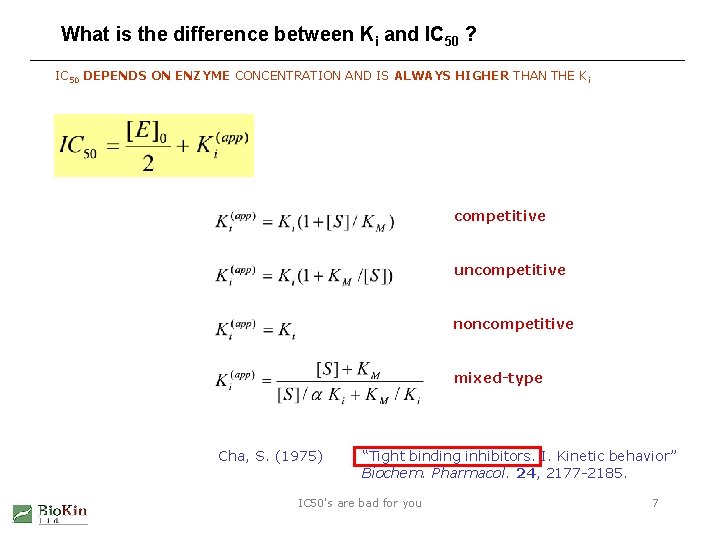
What is the difference between Ki and IC 50 ? IC 50 DEPENDS ON ENZYME CONCENTRATION AND IS ALWAYS HIGHER THAN THE Ki competitive uncompetitive noncompetitive mixed-type Cha, S. (1975) “Tight binding inhibitors. I. Kinetic behavior” Biochem. Pharmacol. 24, 2177 -2185. IC 50's are bad for you 7
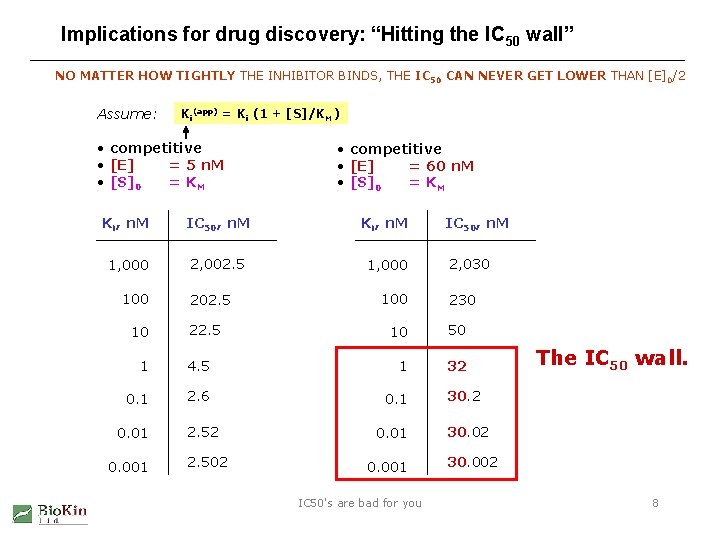
Implications for drug discovery: “Hitting the IC 50 wall” NO MATTER HOW TIGHTLY THE INHIBITOR BINDS, THE IC 50 CAN NEVER GET LOWER THAN [E]0/2 Assume: Ki(app) = Ki (1 + [S]/KM) • competitive • [E] = 5 n. M • [S]0 = KM • competitive • [E] = 60 n. M • [S]0 = KM Ki, n. M IC 50, n. M Ki, n. M 1, 000 2, 002. 5 1, 000 10 202. 5 22. 5 100 32 1 0. 1 2. 6 0. 1 0. 001 2. 502 230 50 4. 5 2. 52 2, 030 10 1 0. 01 IC 50, n. M 0. 01 0. 001 IC 50's are bad for you The IC 50 wall. 30. 2 30. 002 8
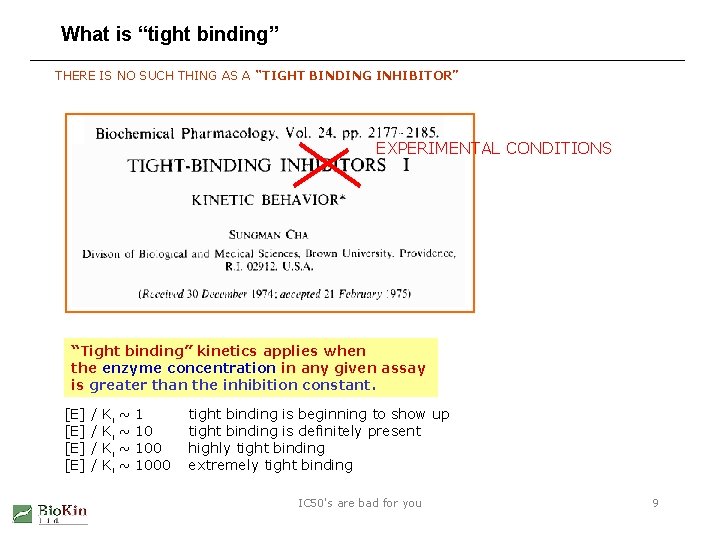
What is “tight binding” THERE IS NO SUCH THING AS A “TIGHT BINDING INHIBITOR” EXPERIMENTAL CONDITIONS “Tight binding” kinetics applies when the enzyme concentration in any given assay is greater than the inhibition constant. [E] / Ki ~ 1000 tight binding is beginning to show up tight binding is definitely present highly tight binding extremely tight binding IC 50's are bad for you 9
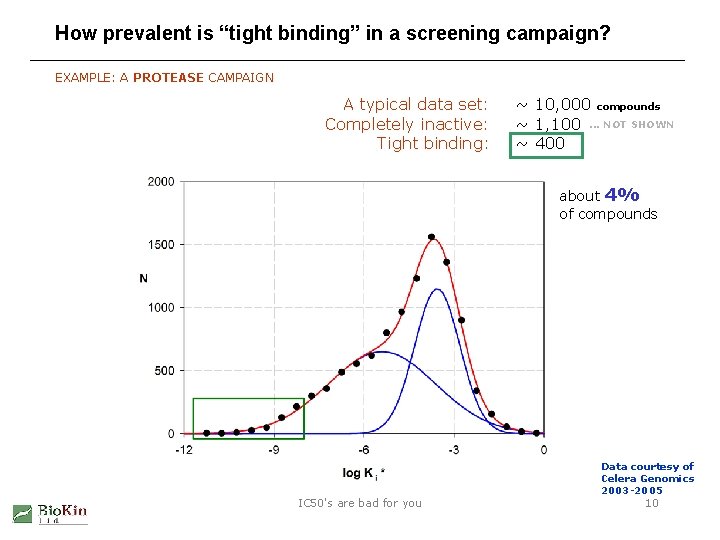
How prevalent is “tight binding” in a screening campaign? EXAMPLE: A PROTEASE CAMPAIGN A typical data set: Completely inactive: Tight binding: ~ 10, 000 compounds ~ 1, 100. . . NOT SHOWN ~ 400 about 4% of compounds IC 50's are bad for you Data courtesy of Celera Genomics 2003 -2005 10
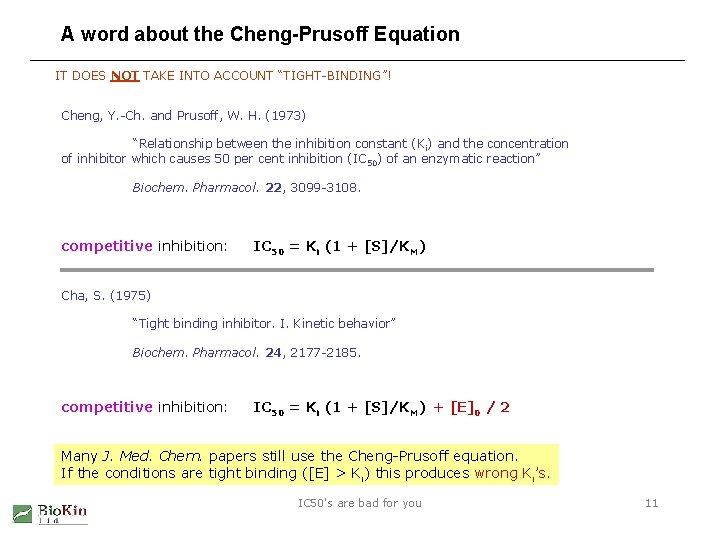
A word about the Cheng-Prusoff Equation IT DOES NOT TAKE INTO ACCOUNT “TIGHT-BINDING”! Cheng, Y. -Ch. and Prusoff, W. H. (1973) “Relationship between the inhibition constant (Ki) and the concentration of inhibitor which causes 50 per cent inhibition (IC 50) of an enzymatic reaction” Biochem. Pharmacol. 22, 3099 -3108. competitive inhibition: IC 50 = Ki (1 + [S]/KM) Cha, S. (1975) “Tight binding inhibitor. I. Kinetic behavior” Biochem. Pharmacol. 24, 2177 -2185. competitive inhibition: IC 50 = Ki (1 + [S]/KM) + [E]0 / 2 Many J. Med. Chem. papers still use the Cheng-Prusoff equation. If the conditions are tight binding ([E] > Ki) this produces wrong Ki’s. IC 50's are bad for you 11
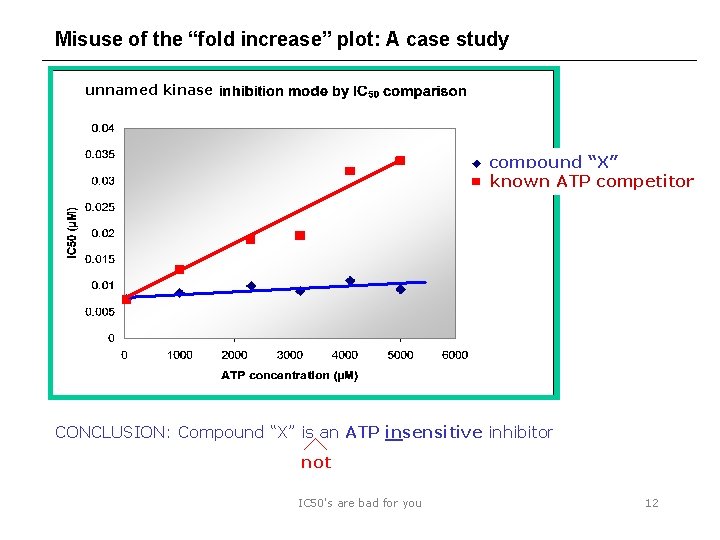
Misuse of the “fold increase” plot: A case study unnamed kinase compound “X” known ATP competitor CONCLUSION: Compound “X” is an ATP insensitive inhibitor not IC 50's are bad for you 12
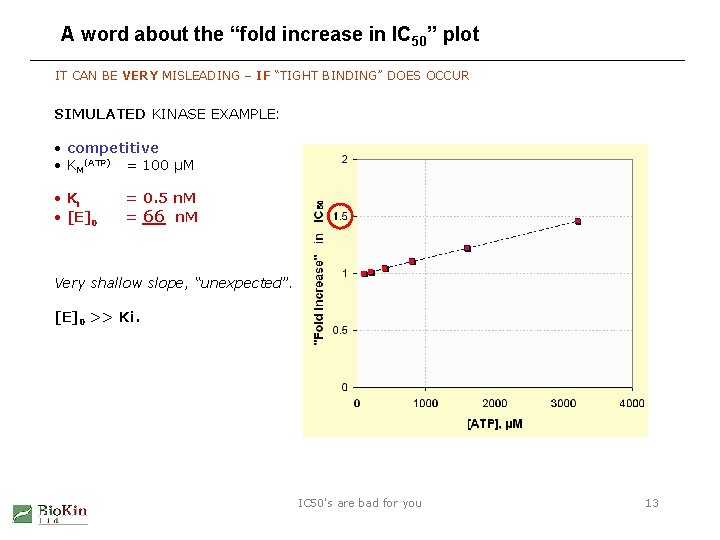
A word about the “fold increase in IC 50” plot IT CAN BE VERY MISLEADING – IF “TIGHT BINDING” DOES OCCUR SIMULATED KINASE EXAMPLE: • competitive • KM(ATP) = 100 µM • Ki • [E]0 = 0. 5 n. M = 66 n. M Very shallow slope, “unexpected”. [E]0 >> Ki. IC 50's are bad for you 13
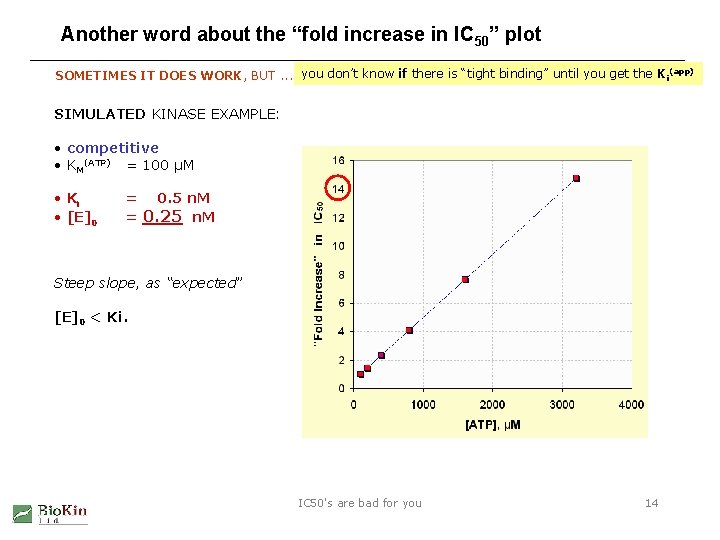
Another word about the “fold increase in IC 50” plot SOMETIMES IT DOES WORK, BUT. . . you don’t know if there is “tight binding” until you get the Ki(app) SIMULATED KINASE EXAMPLE: • competitive • KM(ATP) = 100 µM • Ki • [E]0 = 0. 5 n. M = 0. 25 n. M Steep slope, as “expected” [E]0 < Ki. IC 50's are bad for you 14
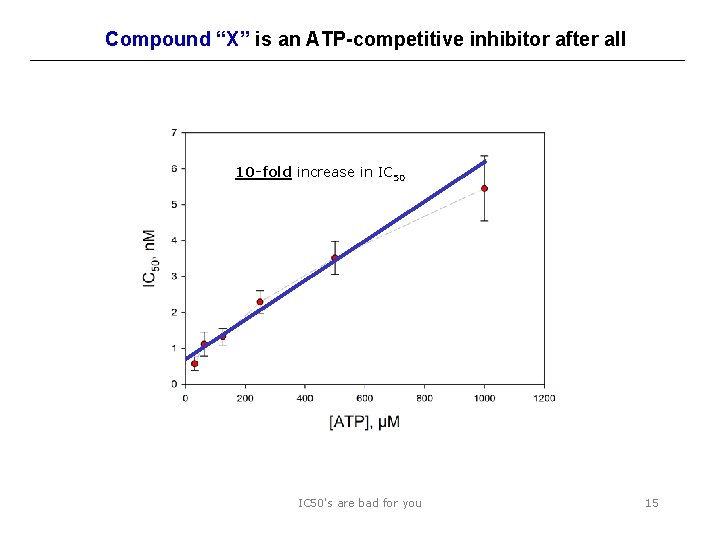
Compound “X” is an ATP-competitive inhibitor after all 10 -fold increase in IC 50's are bad for you 15
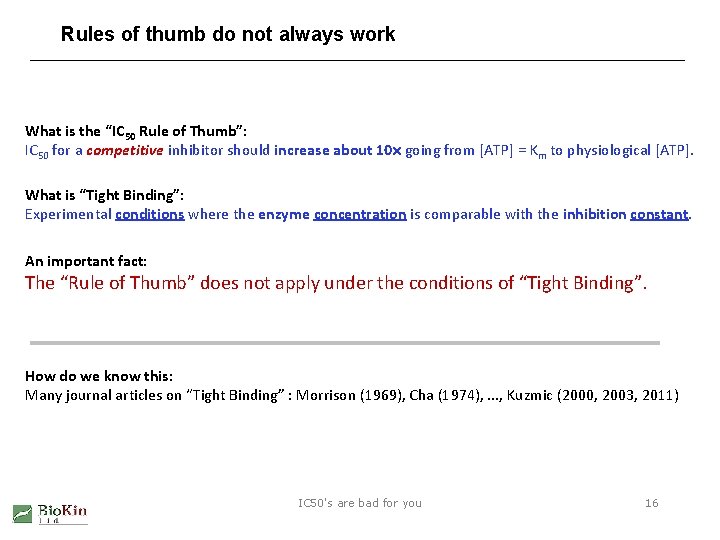
Rules of thumb do not always work What is the “IC 50 Rule of Thumb”: IC 50 for a competitive inhibitor should increase about 10 going from [ATP] = Km to physiological [ATP]. What is “Tight Binding”: Experimental conditions where the enzyme concentration is comparable with the inhibition constant. An important fact: The “Rule of Thumb” does not apply under the conditions of “Tight Binding”. How do we know this: Many journal articles on “Tight Binding” : Morrison (1969), Cha (1974), . . . , Kuzmic (2000, 2003, 2011) IC 50's are bad for you 16
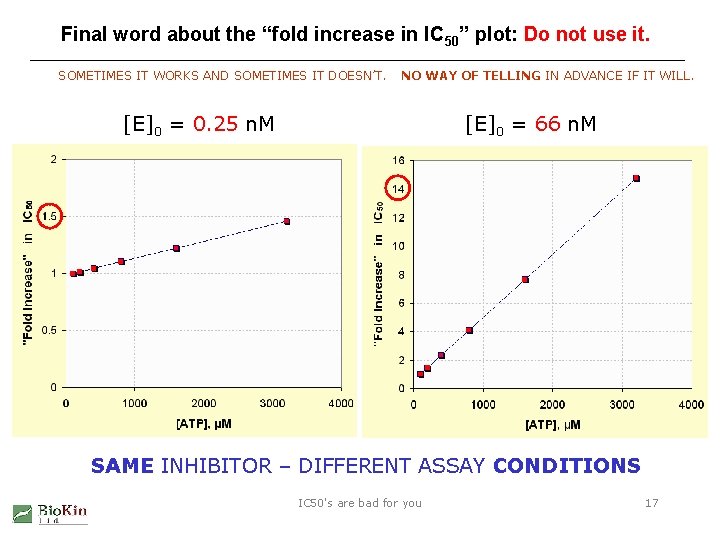
Final word about the “fold increase in IC 50” plot: Do not use it. SOMETIMES IT WORKS AND SOMETIMES IT DOESN’T. NO WAY OF TELLING IN ADVANCE IF IT WILL. [E]0 = 0. 25 n. M [E]0 = 66 n. M SAME INHIBITOR – DIFFERENT ASSAY CONDITIONS IC 50's are bad for you 17
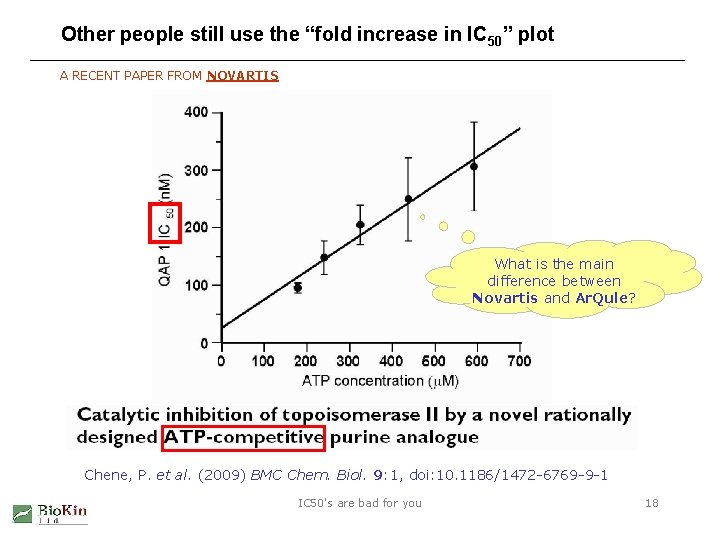
Other people still use the “fold increase in IC 50” plot A RECENT PAPER FROM NOVARTIS What is the main difference between Novartis and Ar. Qule? Chene, P. et al. (2009) BMC Chem. Biol. 9: 1, doi: 10. 1186/1472 -6769 -9 -1 IC 50's are bad for you 18
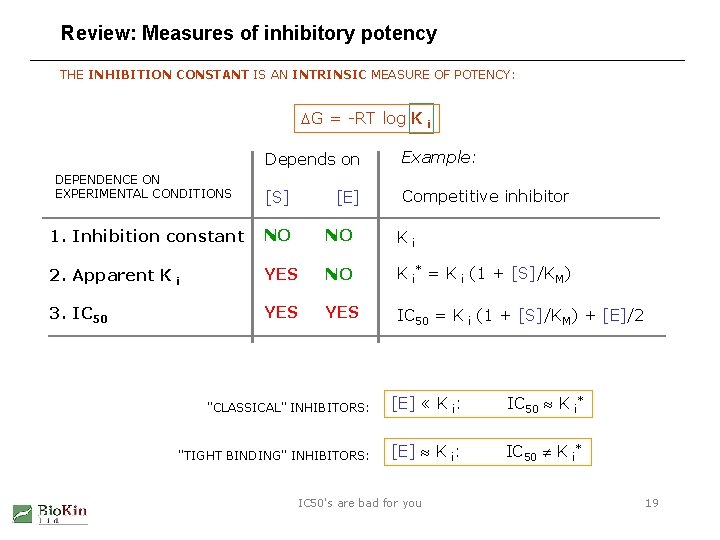
Review: Measures of inhibitory potency THE INHIBITION CONSTANT IS AN INTRINSIC MEASURE OF POTENCY: DG = -RT log K i Depends on Example: [S] [E] Competitive inhibitor 1. Inhibition constant NO NO K i 2. Apparent K i YES NO K i* = K i (1 + [S]/KM) 3. IC 50 YES IC 50 = K i (1 + [S]/KM) + [E]/2 DEPENDENCE ON EXPERIMENTAL CONDITIONS "CLASSICAL" INHIBITORS: [E] « K i: IC 50 K i* "TIGHT BINDING" INHIBITORS: [E] K i: IC 50 K i* IC 50's are bad for you 19
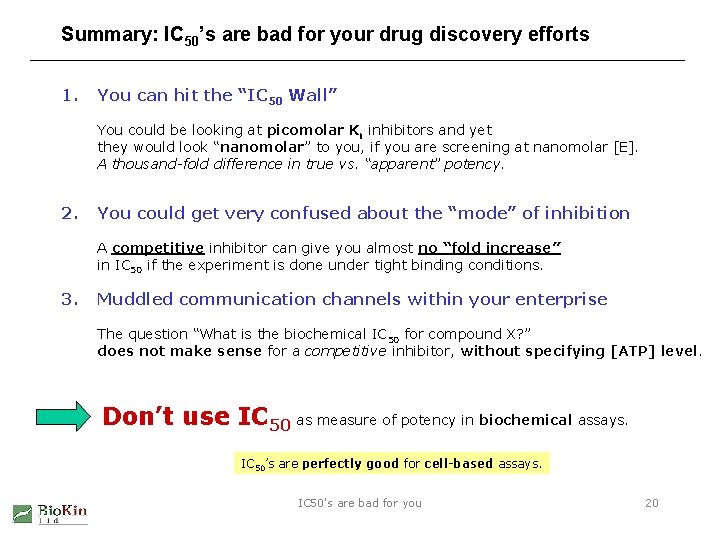
Summary: IC 50’s are bad for your drug discovery efforts 1. You can hit the “IC 50 Wall” You could be looking at picomolar Ki inhibitors and yet they would look “nanomolar” to you, if you are screening at nanomolar [E]. A thousand-fold difference in true vs. “apparent” potency. 2. You could get very confused about the “mode” of inhibition A competitive inhibitor can give you almost no “fold increase” in IC 50 if the experiment is done under tight binding conditions. 3. Muddled communication channels within your enterprise The question “What is the biochemical IC 50 for compound X? ” does not make sense for a competitive inhibitor, without specifying [ATP] level. Don’t use IC 50 as measure of potency in biochemical assays. IC 50’s are perfectly good for cell-based assays. IC 50's are bad for you 20
What else is there, other than the IC 50? Use intrinsic molecular measures of potency (Ki, . . . ) IC 50's are bad for you 21

Example: Correlation between kinact/Ki and cellular IC 50 “Molecular Underpinnings of Covalent EGFR Inhibitor Potency [. . . ]” SUBMITTED cell-based potency inhibition of EGFR-L 858 R/T 790 M autophosphorylation in H 1975 tumor cells IC 50's are bad for you kinact Ki 22
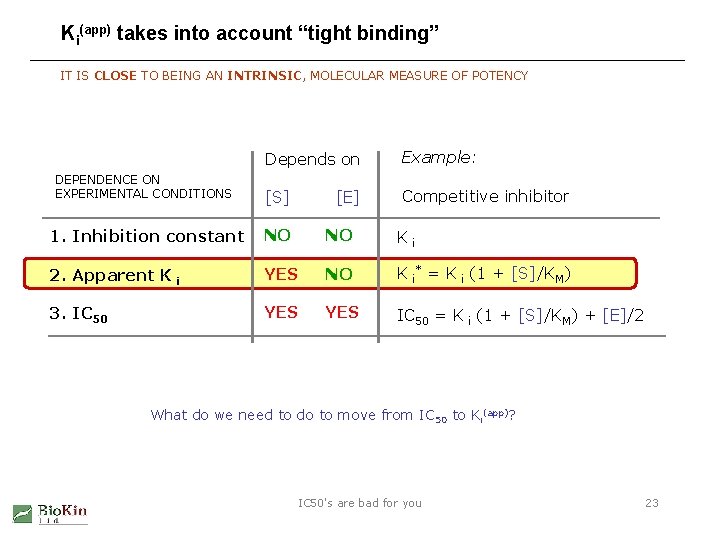
Ki(app) takes into account “tight binding” IT IS CLOSE TO BEING AN INTRINSIC, MOLECULAR MEASURE OF POTENCY Depends on Example: [S] [E] Competitive inhibitor 1. Inhibition constant NO NO K i 2. Apparent K i YES NO K i* = K i (1 + [S]/KM) 3. IC 50 YES IC 50 = K i (1 + [S]/KM) + [E]/2 DEPENDENCE ON EXPERIMENTAL CONDITIONS What do we need to do to move from IC 50 to Ki(app)? IC 50's are bad for you 23
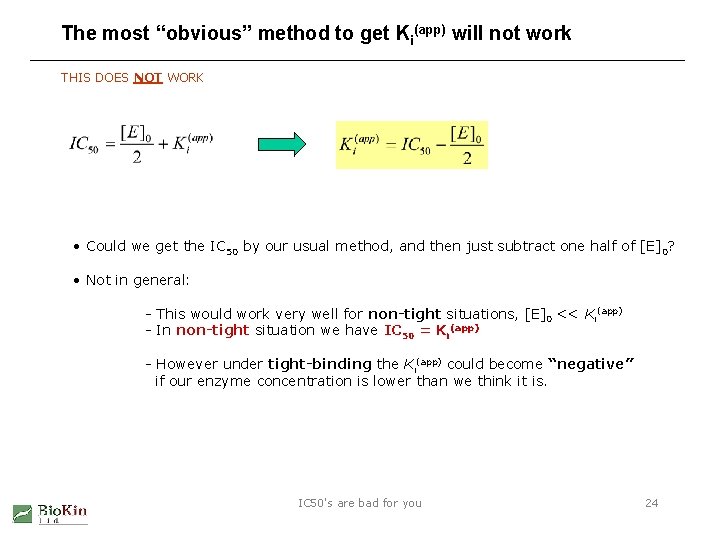
The most “obvious” method to get Ki(app) will not work THIS DOES NOT WORK • Could we get the IC 50 by our usual method, and then just subtract one half of [E] 0? • Not in general: - This would work very well for non-tight situations, [E]0 << Ki(app) - In non-tight situation we have IC 50 = Ki(app) - However under tight-binding the Ki(app) could become “negative” if our enzyme concentration is lower than we think it is. IC 50's are bad for you 24
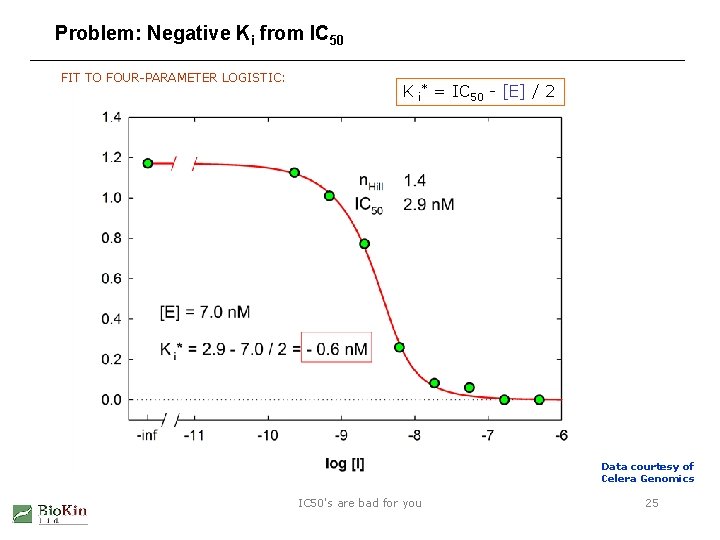
Problem: Negative Ki from IC 50 FIT TO FOUR-PARAMETER LOGISTIC: K i* = IC 50 - [E] / 2 Data courtesy of Celera Genomics IC 50's are bad for you 25
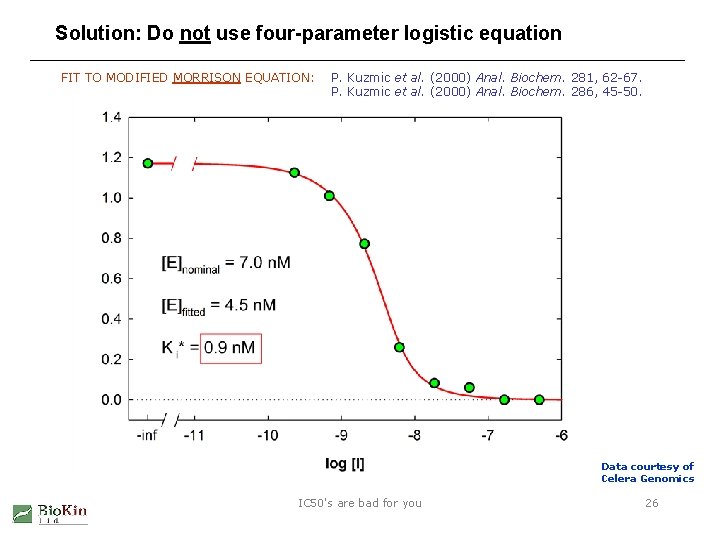
Solution: Do not use four-parameter logistic equation FIT TO MODIFIED MORRISON EQUATION: P. Kuzmic et al. (2000) Anal. Biochem. 281, 62 -67. P. Kuzmic et al. (2000) Anal. Biochem. 286, 45 -50. Data courtesy of Celera Genomics IC 50's are bad for you 26
Surprise #1: Getting the Ki(app) does not require any additional experiments We just need to change the way the “IC 50 data” are analyzed. IC 50's are bad for you 27
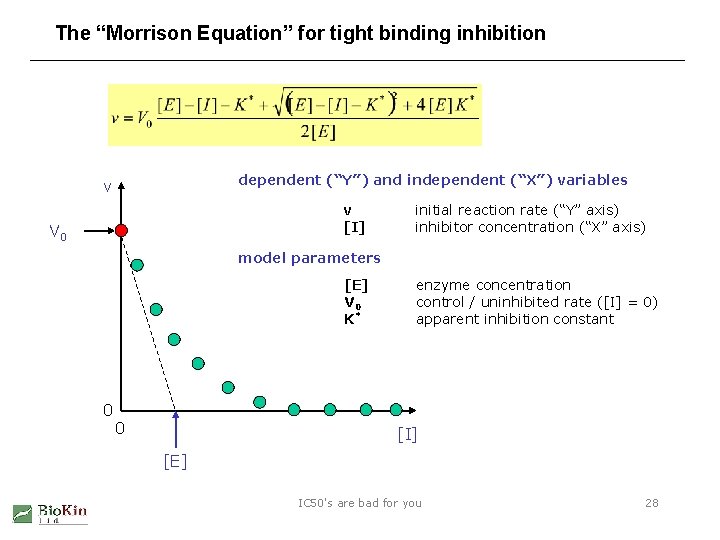
The “Morrison Equation” for tight binding inhibition dependent (“Y”) and independent (“X”) variables v v [I] V 0 initial reaction rate (“Y” axis) inhibitor concentration (“X” axis) model parameters [E] V 0 K* 0 0 enzyme concentration control / uninhibited rate ([I] = 0) apparent inhibition constant [I] [E] IC 50's are bad for you 28
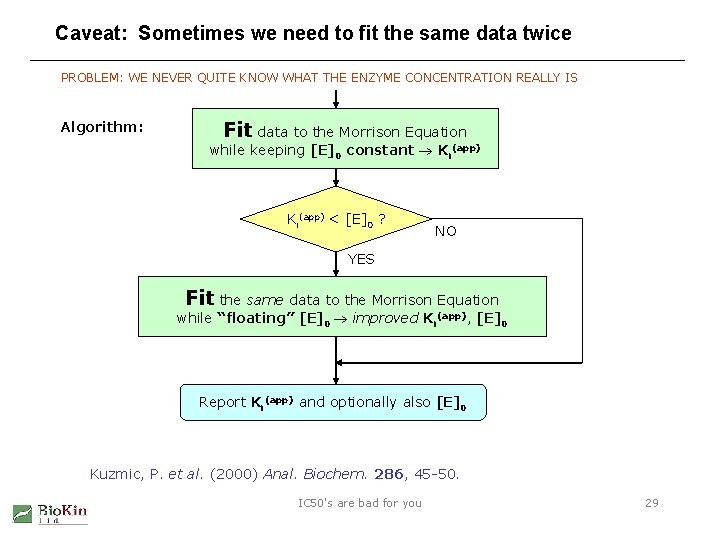
Caveat: Sometimes we need to fit the same data twice PROBLEM: WE NEVER QUITE KNOW WHAT THE ENZYME CONCENTRATION REALLY IS Algorithm: Fit data to the Morrison Equation while keeping [E]0 constant Ki(app) < [E]0 ? NO YES Fit the same data to the Morrison Equation while “floating” [E]0 improved Ki(app), [E]0 Report Ki(app) and optionally also [E]0 Kuzmic, P. et al. (2000) Anal. Biochem. 286, 45 -50. IC 50's are bad for you 29
Surprise #2: Ki(app) can be guessed from a single concentration plus control IC 50's are bad for you 30
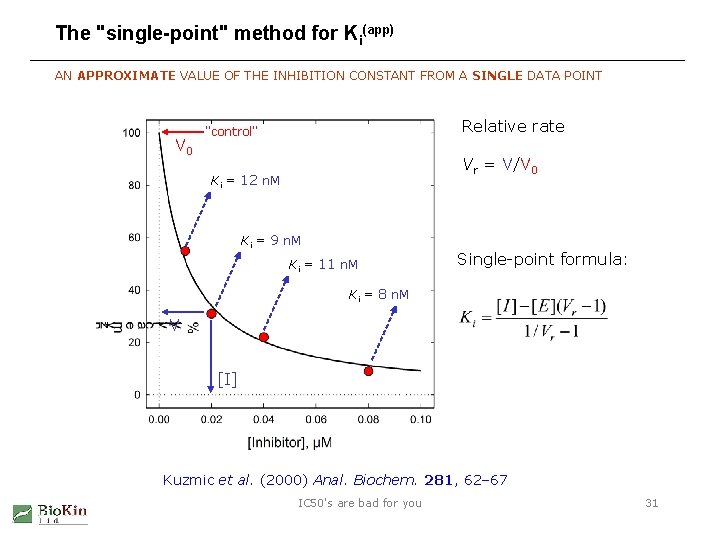
The "single-point" method for Ki(app) AN APPROXIMATE VALUE OF THE INHIBITION CONSTANT FROM A SINGLE DATA POINT V 0 Relative rate "control" Vr = V/V 0 Ki = 12 n. M Ki = 9 n. M Ki = 11 n. M Single-point formula: Ki = 8 n. M V [I] Kuzmic et al. (2000) Anal. Biochem. 281, 62– 67 IC 50's are bad for you 31
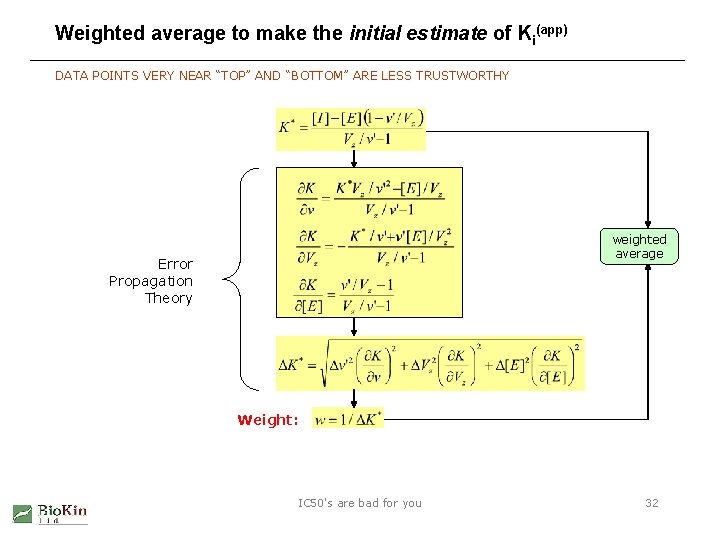
Weighted average to make the initial estimate of Ki(app) DATA POINTS VERY NEAR “TOP” AND “BOTTOM” ARE LESS TRUSTWORTHY weighted average Error Propagation Theory Weight: IC 50's are bad for you 32
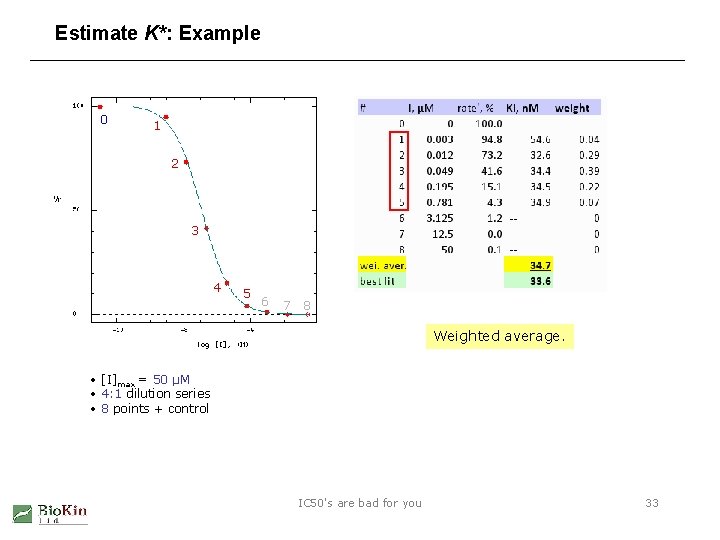
Estimate K*: Example 0 1 2 3 4 5 6 7 8 Weighted average. • [I]max = 50 µM • 4: 1 dilution series • 8 points + control IC 50's are bad for you 33
Surprise #3: We don’t need “fully developed” IC 50 curves. . . when using the Morrison Equation for Ki(app) IC 50's are bad for you 34
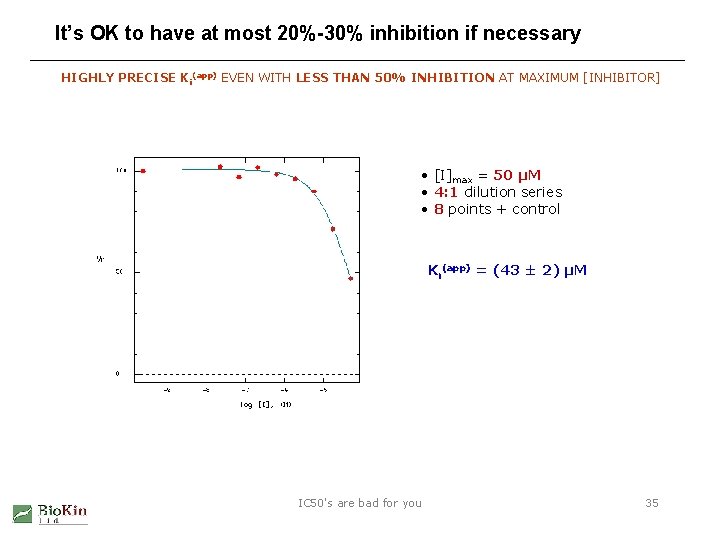
It’s OK to have at most 20%-30% inhibition if necessary HIGHLY PRECISE Ki(app) EVEN WITH LESS THAN 50% INHIBITION AT MAXIMUM [INHIBITOR] • [I]max = 50 µM • 4: 1 dilution series • 8 points + control Ki(app) = (43 ± 2) µM IC 50's are bad for you 35
Can we do even better than Ki(app)? IC 50's are bad for you 36
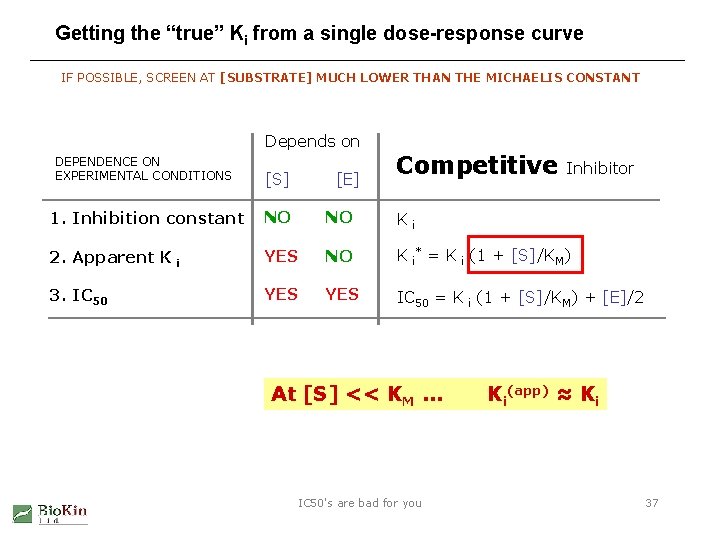
Getting the “true” Ki from a single dose-response curve IF POSSIBLE, SCREEN AT [SUBSTRATE] MUCH LOWER THAN THE MICHAELIS CONSTANT Depends on DEPENDENCE ON EXPERIMENTAL CONDITIONS [S] [E] Competitive Inhibitor 1. Inhibition constant NO NO K i 2. Apparent K i YES NO K i* = K i (1 + [S]/KM) 3. IC 50 YES IC 50 = K i (1 + [S]/KM) + [E]/2 At [S] << KM. . . IC 50's are bad for you Ki(app) ≈ Ki 37
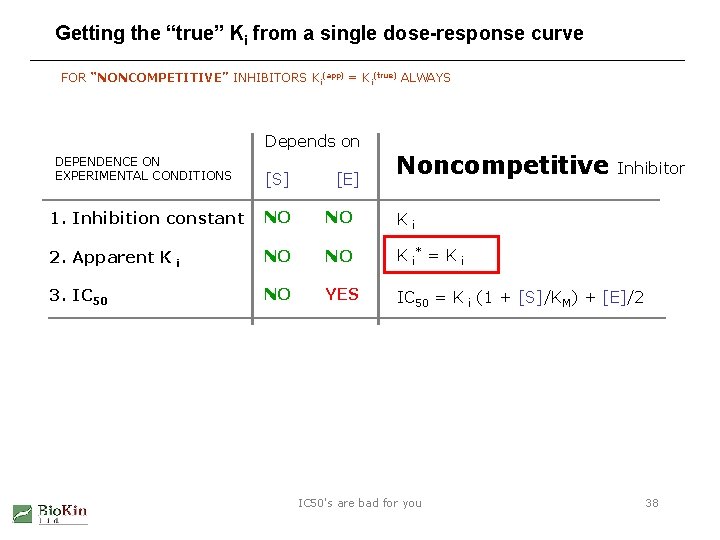
Getting the “true” Ki from a single dose-response curve FOR “NONCOMPETITIVE” INHIBITORS Ki(app) = Ki(true) ALWAYS Depends on DEPENDENCE ON EXPERIMENTAL CONDITIONS [S] [E] Noncompetitive Inhibitor 1. Inhibition constant NO NO K i 2. Apparent K i NO NO K i* = K i 3. IC 50 NO YES IC 50 = K i (1 + [S]/KM) + [E]/2 IC 50's are bad for you 38
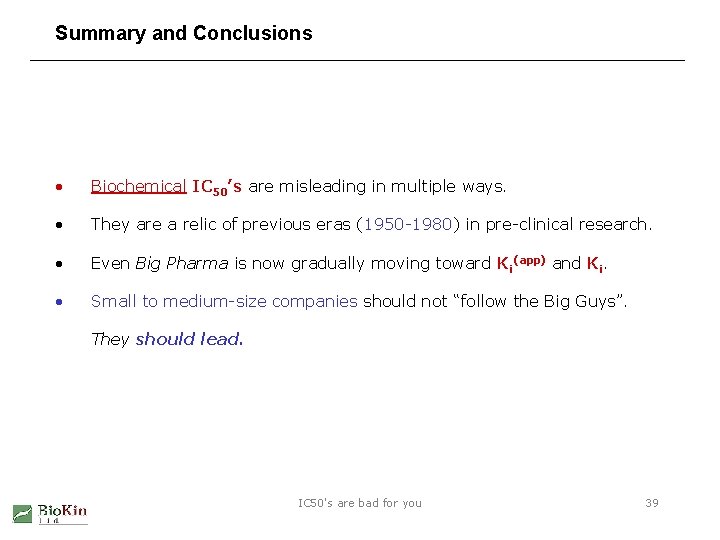
Summary and Conclusions • Biochemical IC 50’s are misleading in multiple ways. • They are a relic of previous eras (1950 -1980) in pre-clinical research. • Even Big Pharma is now gradually moving toward Ki(app) and Ki. • Small to medium-size companies should not “follow the Big Guys”. They should lead. IC 50's are bad for you 39
- Slides: 39