
Why Horizon Scanning Why Horizon Scanning And why
- Slides: 14
Why Horizon Scanning?
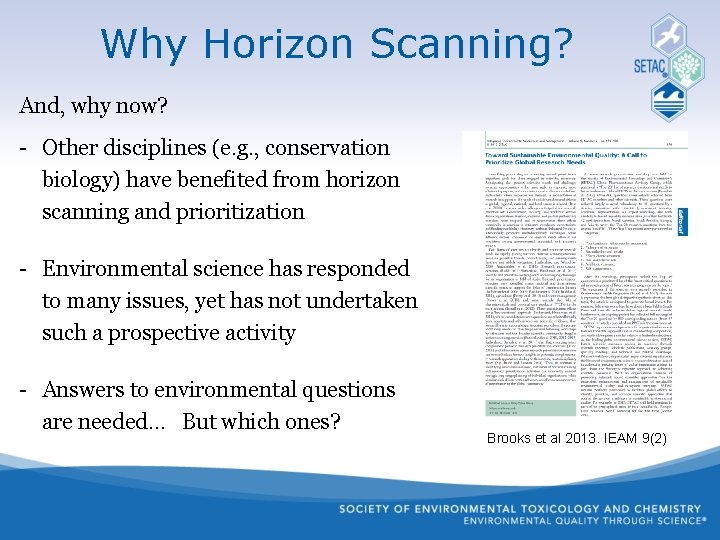
Why Horizon Scanning? And, why now? - Other disciplines (e. g. , conservation biology) have benefited from horizon scanning and prioritization - Environmental science has responded to many issues, yet has not undertaken such a prospective activity - Answers to environmental questions are needed… But which ones? Brooks et al 2013. IEAM 9(2)
Why Horizon Scanning? Why SETAC? - SETAC has always been on the forefront of environmental science - SETAC promotes balanced approaches to environmental problem solving - SETAC holds a storied history of coordinating global Pellston workshops - SETAC is the only Global Environmental Science Society - Africa, Asia-Pacific, Europe, Latin America, North America
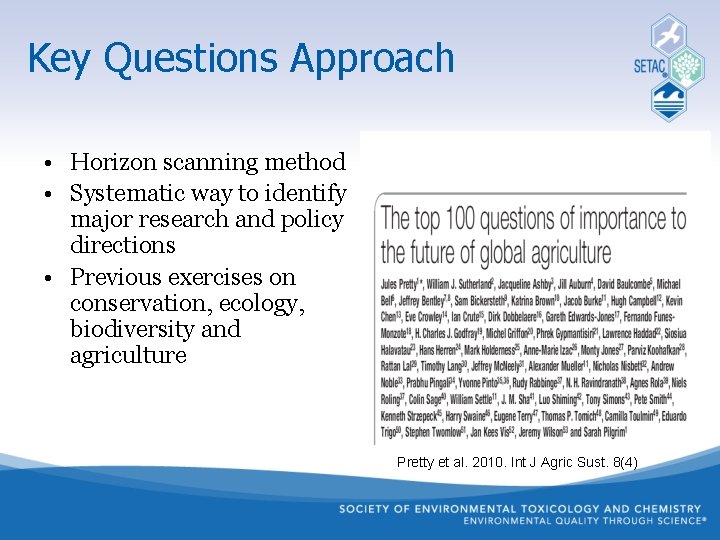
Key Questions Approach • Horizon scanning method • Systematic way to identify major research and policy directions • Previous exercises on conservation, ecology, biodiversity and agriculture Pretty et al. 2010. Int J Agric Sust. 8(4)
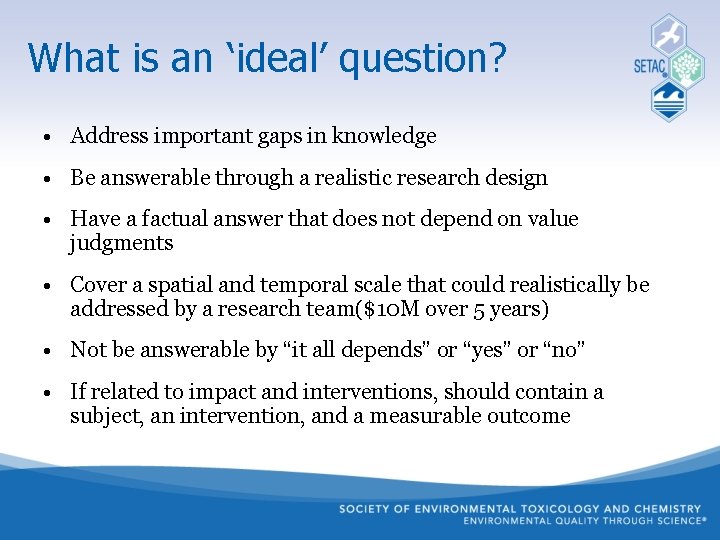
What is an ‘ideal’ question? • Address important gaps in knowledge • Be answerable through a realistic research design • Have a factual answer that does not depend on value judgments • Cover a spatial and temporal scale that could realistically be addressed by a research team($10 M over 5 years) • Not be answerable by “it all depends” or “yes” or “no” • If related to impact and interventions, should contain a subject, an intervention, and a measurable outcome
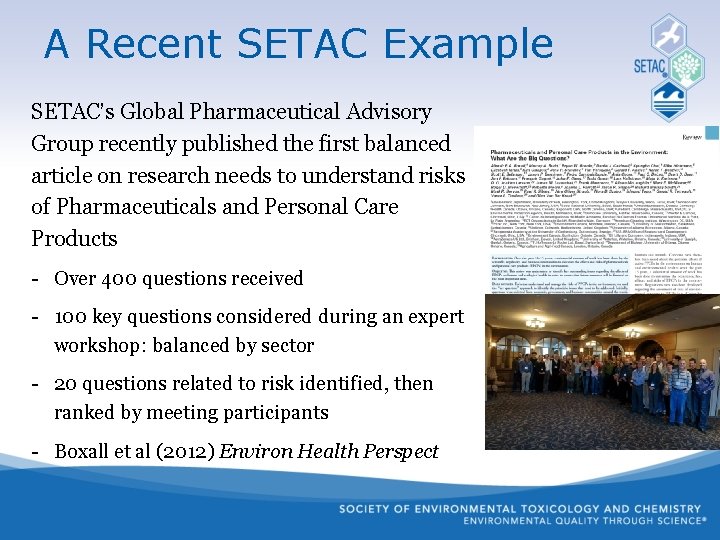
A Recent SETAC Example SETAC’s Global Pharmaceutical Advisory Group recently published the first balanced article on research needs to understand risks of Pharmaceuticals and Personal Care Products - Over 400 questions received - 100 key questions considered during an expert workshop: balanced by sector - 20 questions related to risk identified, then ranked by meeting participants - Boxall et al (2012) Environ Health Perspect
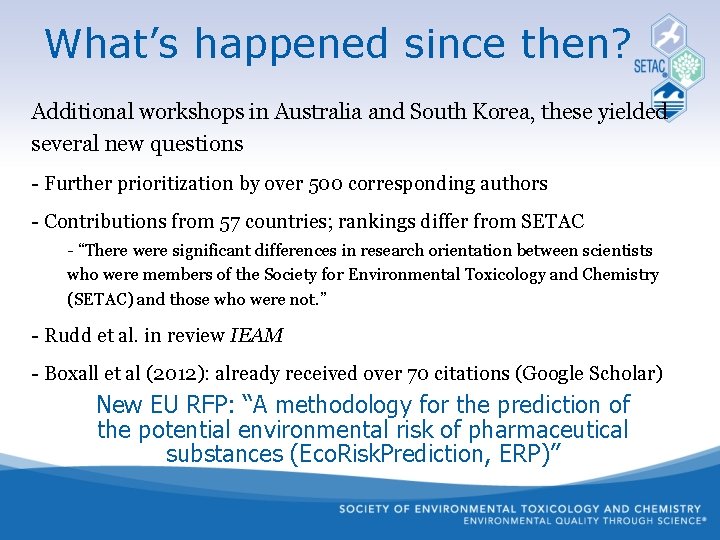
What’s happened since then? Additional workshops in Australia and South Korea, these yielded several new questions - Further prioritization by over 500 corresponding authors - Contributions from 57 countries; rankings differ from SETAC - “There were significant differences in research orientation between scientists who were members of the Society for Environmental Toxicology and Chemistry (SETAC) and those who were not. ” - Rudd et al. in review IEAM - Boxall et al (2012): already received over 70 citations (Google Scholar) New EU RFP: “A methodology for the prediction of the potential environmental risk of pharmaceutical substances (Eco. Risk. Prediction, ERP)”
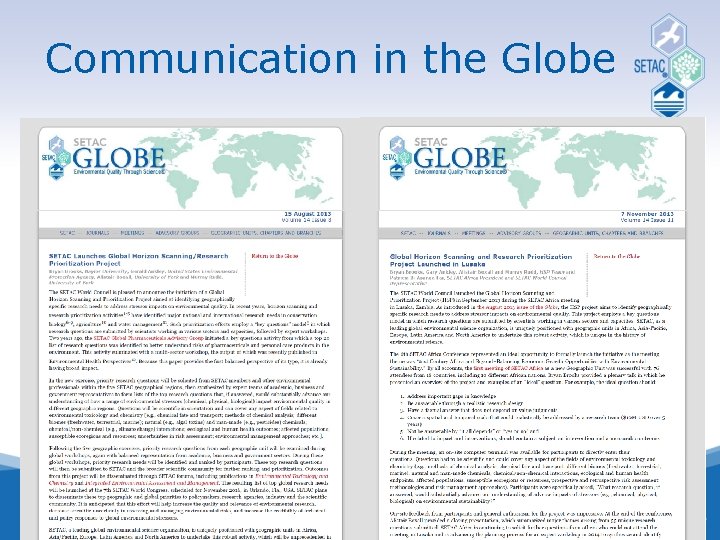
Communication in the Globe
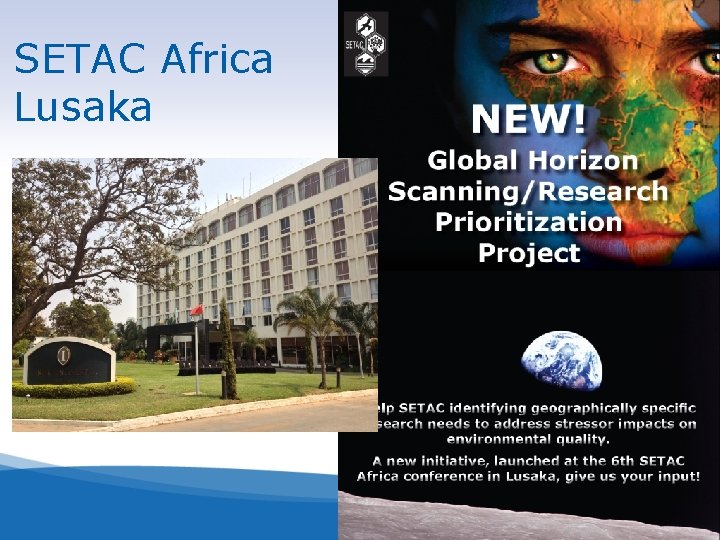
SETAC Africa Lusaka
57 questions, 40 contributors • • Risks of combined exposures in Africa Green chemistry and waste management Prioritisation of chemicals/situations of most concern Risks of legacy pollutants to environment and human health Impacts of GMOs in Africa Sensitive sub-populations in Africa to pollutants Effects of climate change on risks Weighing up environmental impacts against economic benefits
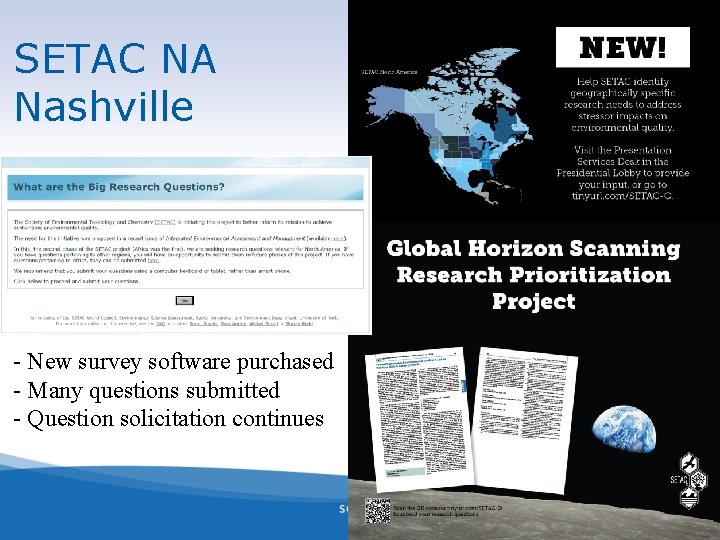
SETAC NA Nashville - New survey software purchased - Many questions submitted - Question solicitation continues
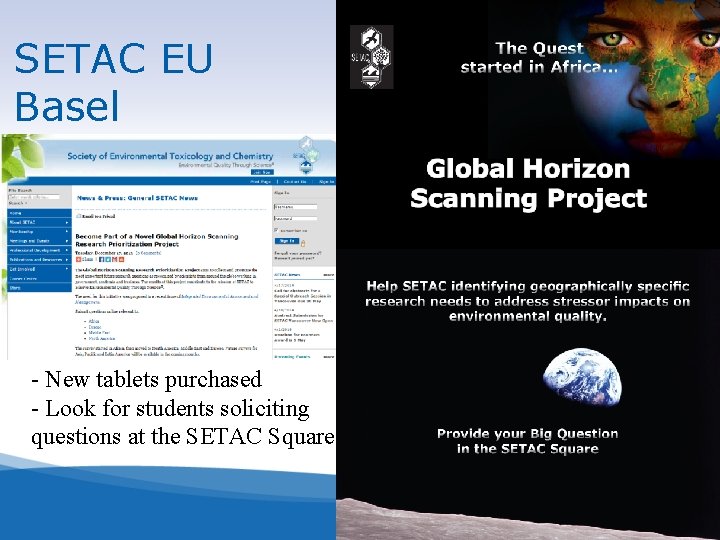
SETAC EU Basel - New tablets purchased - Look for students soliciting questions at the SETAC Square
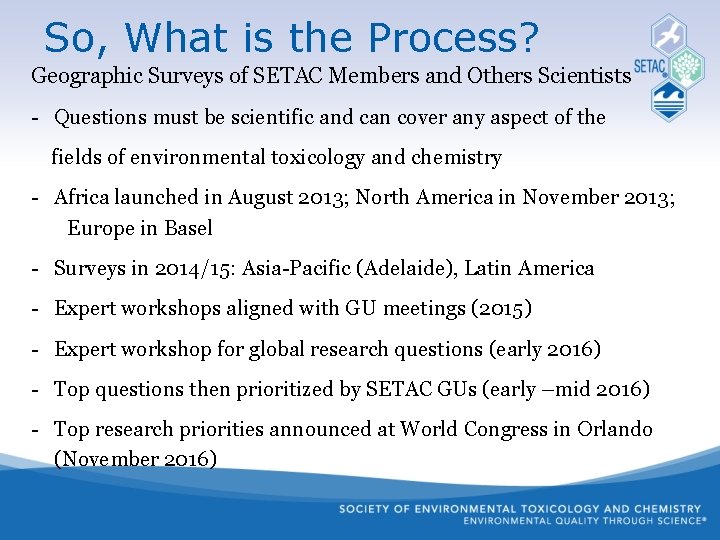
So, What is the Process? Geographic Surveys of SETAC Members and Others Scientists - Questions must be scientific and can cover any aspect of the fields of environmental toxicology and chemistry - Africa launched in August 2013; North America in November 2013; Europe in Basel - Surveys in 2014/15: Asia-Pacific (Adelaide), Latin America - Expert workshops aligned with GU meetings (2015) - Expert workshop for global research questions (early 2016) - Top questions then prioritized by SETAC GUs (early –mid 2016) - Top research priorities announced at World Congress in Orlando (November 2016)
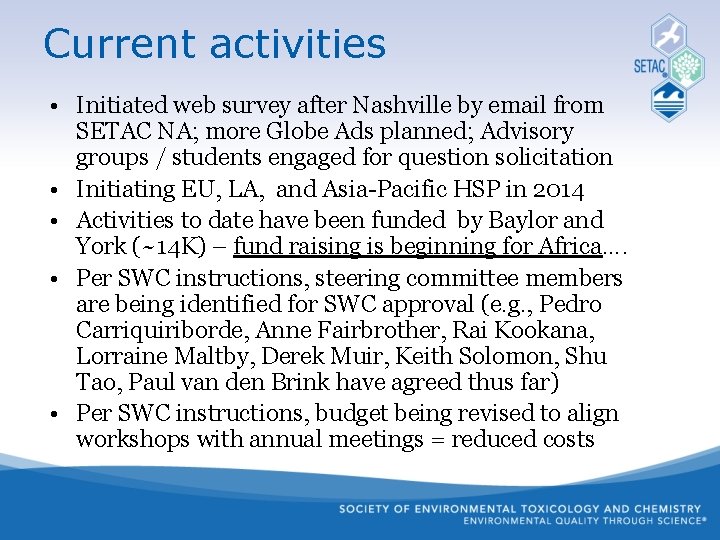
Current activities • Initiated web survey after Nashville by email from SETAC NA; more Globe Ads planned; Advisory groups / students engaged for question solicitation • Initiating EU, LA, and Asia-Pacific HSP in 2014 • Activities to date have been funded by Baylor and York (~14 K) – fund raising is beginning for Africa…. • Per SWC instructions, steering committee members are being identified for SWC approval (e. g. , Pedro Carriquiriborde, Anne Fairbrother, Rai Kookana, Lorraine Maltby, Derek Muir, Keith Solomon, Shu Tao, Paul van den Brink have agreed thus far) • Per SWC instructions, budget being revised to align workshops with annual meetings = reduced costs