
Why GrahamScan Needs to Sort Vertices Before Scanning
Why Graham-Scan Needs to Sort Vertices Before Scanning Bill Thies November 12, 2004 6. 046 Recitation Supplement
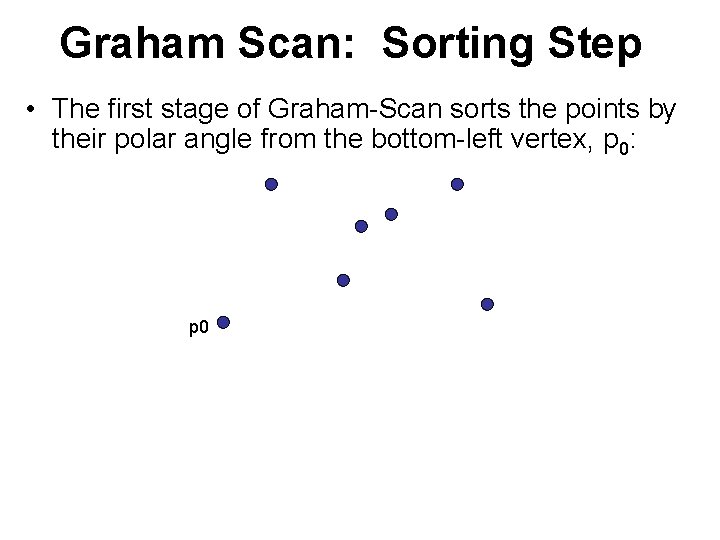
Graham Scan: Sorting Step • The first stage of Graham-Scan sorts the points by their polar angle from the bottom-left vertex, p 0: p 0 • In recitation, we asked: would the scanning phase of Graham-Scan work on any simple polygon? That is, can you omit this sorting phase if you start from a simple polygon? – The answer is NO.
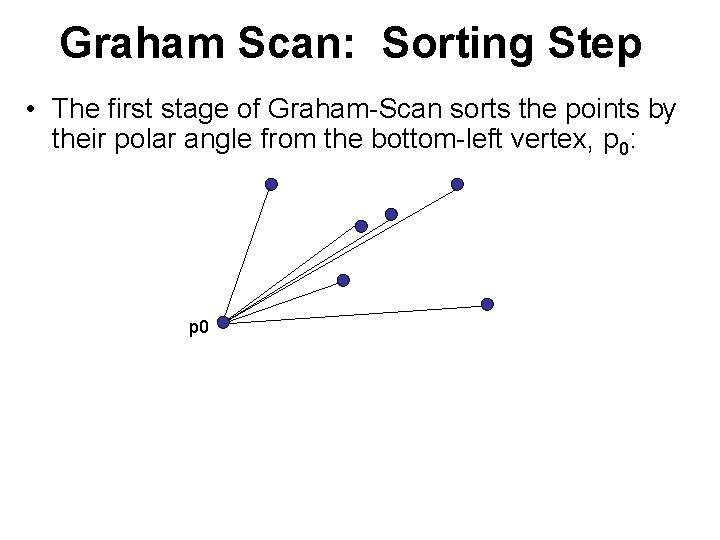
Graham Scan: Sorting Step • The first stage of Graham-Scan sorts the points by their polar angle from the bottom-left vertex, p 0: p 0 • In recitation, we asked: would the scanning phase of Graham-Scan work on any simple polygon? That is, can you omit this sorting phase if you start from a simple polygon? – The answer is NO.
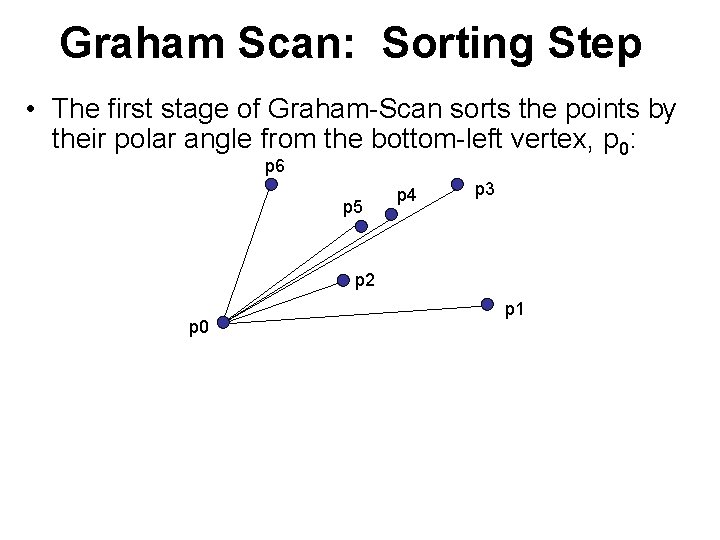
Graham Scan: Sorting Step • The first stage of Graham-Scan sorts the points by their polar angle from the bottom-left vertex, p 0: p 6 p 5 p 4 p 3 p 2 p 0 p 1 • In recitation, we asked: would the scanning phase of Graham-Scan work on any simple polygon? That is, can you omit this sorting phase if you start from a simple polygon? – The answer is NO.

Graham Scan: Sorting Step • The first stage of Graham-Scan sorts the points by their polar angle from the bottom-left vertex, p 0: p 6 p 5 p 4 p 3 Simple polygon (not convex) p 2 p 0 p 1 • In recitation, we asked: would the scanning phase of Graham-Scan work on any simple polygon? That is, can you omit this sorting phase if you start from a simple polygon? – The answer is NO.
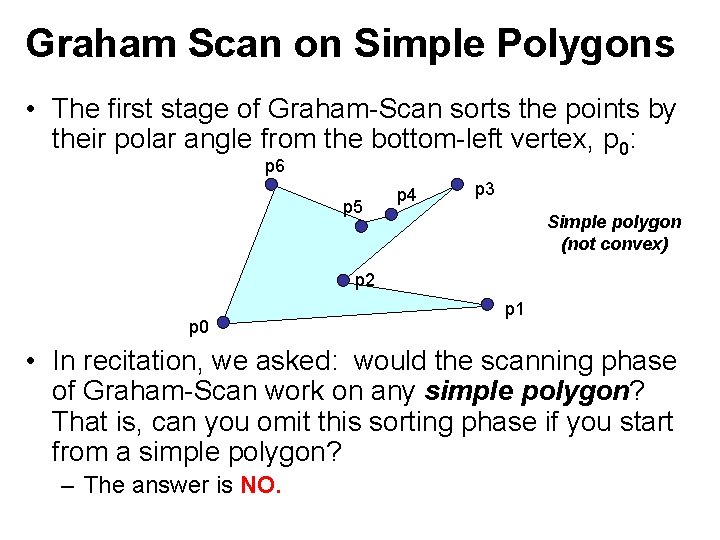
Graham Scan on Simple Polygons • The first stage of Graham-Scan sorts the points by their polar angle from the bottom-left vertex, p 0: p 6 p 5 p 4 p 3 Simple polygon (not convex) p 2 p 0 p 1 • In recitation, we asked: would the scanning phase of Graham-Scan work on any simple polygon? That is, can you omit this sorting phase if you start from a simple polygon? – The answer is NO.
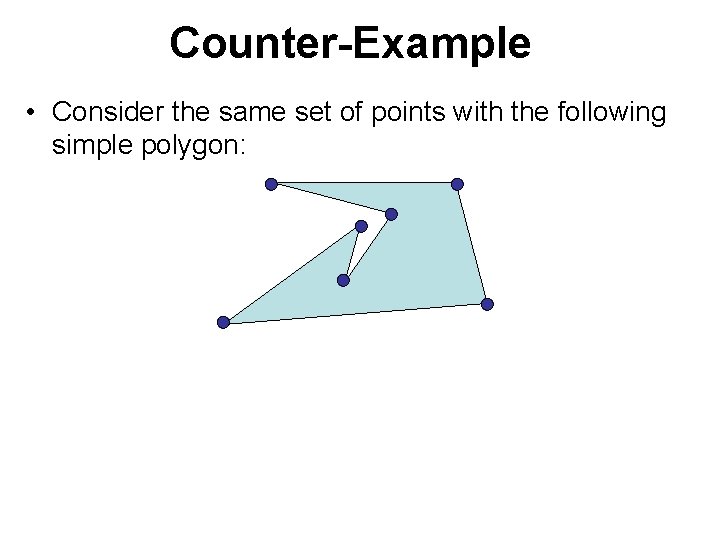
Counter-Example • Consider the same set of points with the following simple polygon:

Counter-Example • Consider the same set of points with the following simple polygon: p 3 p 2 p 4 p 6 p 5 p 0 p 1 • Run Graham’s Scan starting from p 0 Stack

Counter-Example • Consider the same set of points with the following simple polygon: p 3 p 2 p 4 p 6 p 5 p 0 p 1 • Run Graham’s Scan starting from p 0 p 2 p 1 p 0 Stack
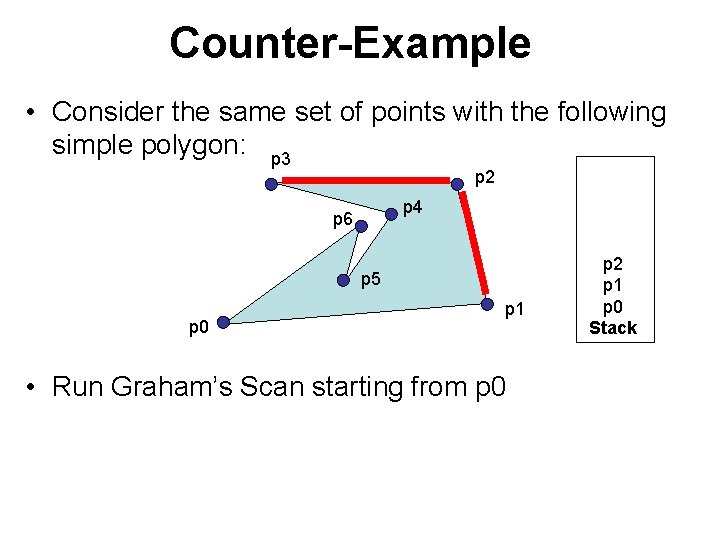
Counter-Example • Consider the same set of points with the following simple polygon: p 3 p 2 p 4 p 6 p 5 p 0 p 1 • Run Graham’s Scan starting from p 0 p 2 p 1 p 0 Stack
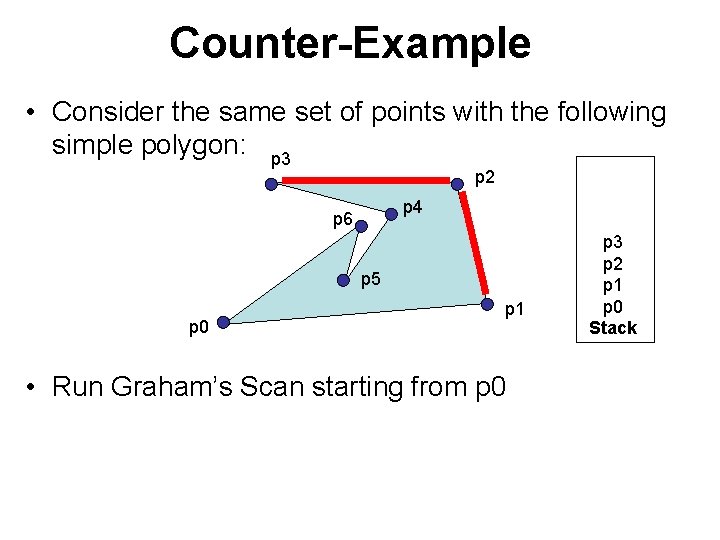
Counter-Example • Consider the same set of points with the following simple polygon: p 3 p 2 p 4 p 6 p 5 p 0 p 1 • Run Graham’s Scan starting from p 0 p 3 p 2 p 1 p 0 Stack
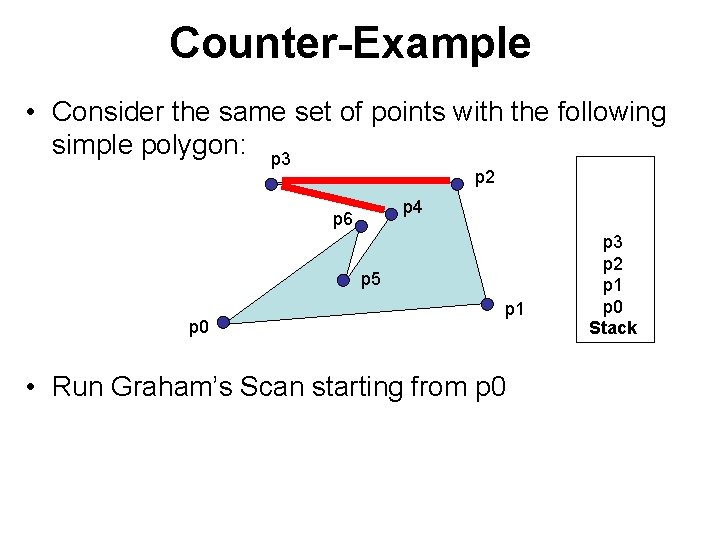
Counter-Example • Consider the same set of points with the following simple polygon: p 3 p 2 p 4 p 6 p 5 p 0 p 1 • Run Graham’s Scan starting from p 0 p 3 p 2 p 1 p 0 Stack
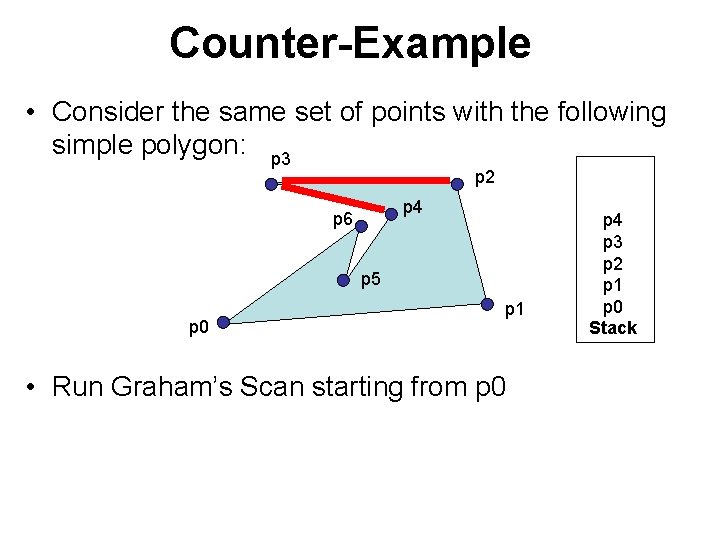
Counter-Example • Consider the same set of points with the following simple polygon: p 3 p 2 p 4 p 6 p 5 p 0 p 1 • Run Graham’s Scan starting from p 0 p 4 p 3 p 2 p 1 p 0 Stack
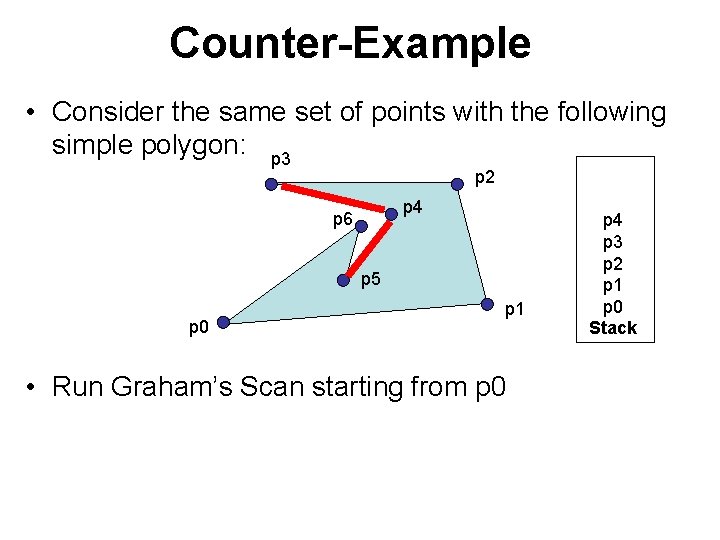
Counter-Example • Consider the same set of points with the following simple polygon: p 3 p 2 p 4 p 6 p 5 p 0 p 1 • Run Graham’s Scan starting from p 0 p 4 p 3 p 2 p 1 p 0 Stack
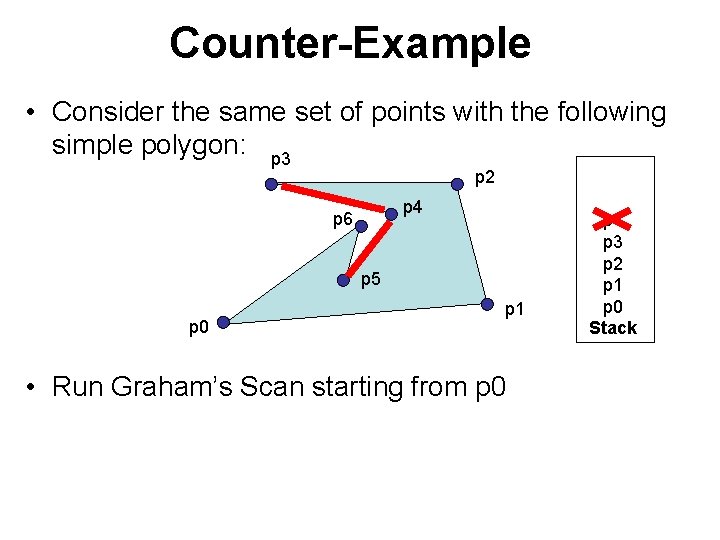
Counter-Example • Consider the same set of points with the following simple polygon: p 3 p 2 p 4 p 6 p 5 p 0 p 1 • Run Graham’s Scan starting from p 0 p 4 p 3 p 2 p 1 p 0 Stack
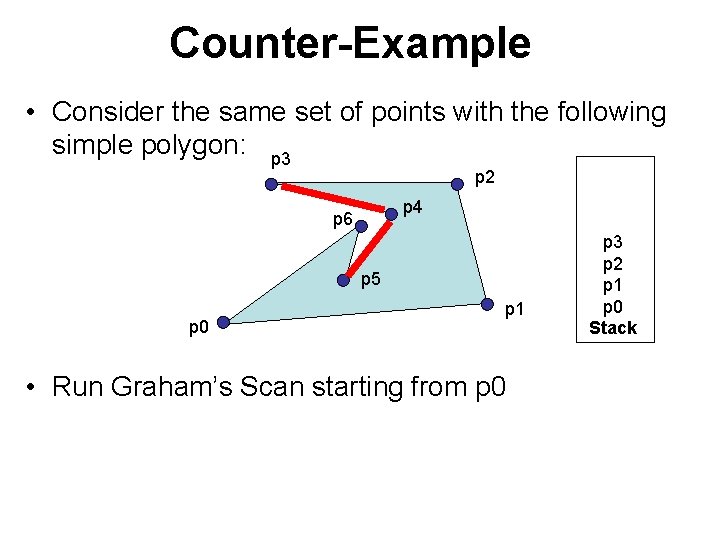
Counter-Example • Consider the same set of points with the following simple polygon: p 3 p 2 p 4 p 6 p 5 p 0 p 1 • Run Graham’s Scan starting from p 0 p 3 p 2 p 1 p 0 Stack
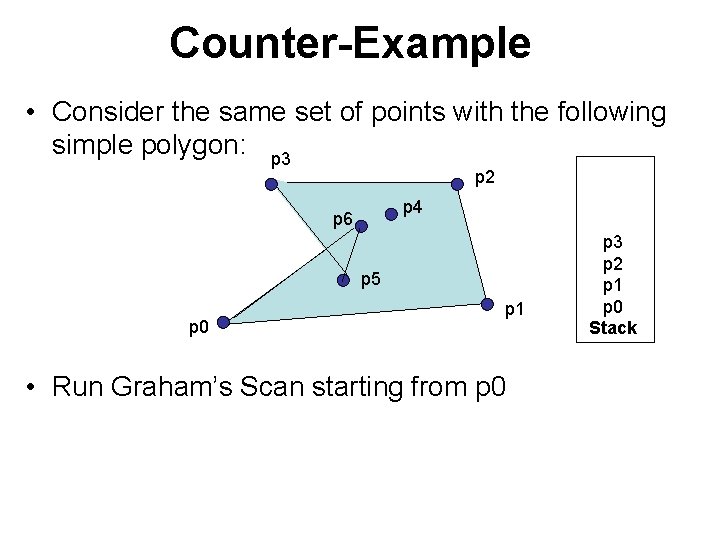
Counter-Example • Consider the same set of points with the following simple polygon: p 3 p 2 p 4 p 6 p 5 p 0 p 1 • Run Graham’s Scan starting from p 0 p 3 p 2 p 1 p 0 Stack
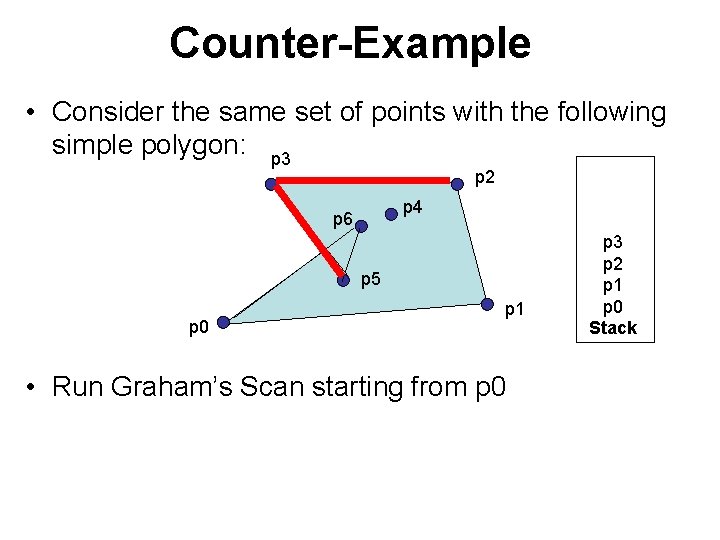
Counter-Example • Consider the same set of points with the following simple polygon: p 3 p 2 p 4 p 6 p 5 p 0 p 1 • Run Graham’s Scan starting from p 0 p 3 p 2 p 1 p 0 Stack
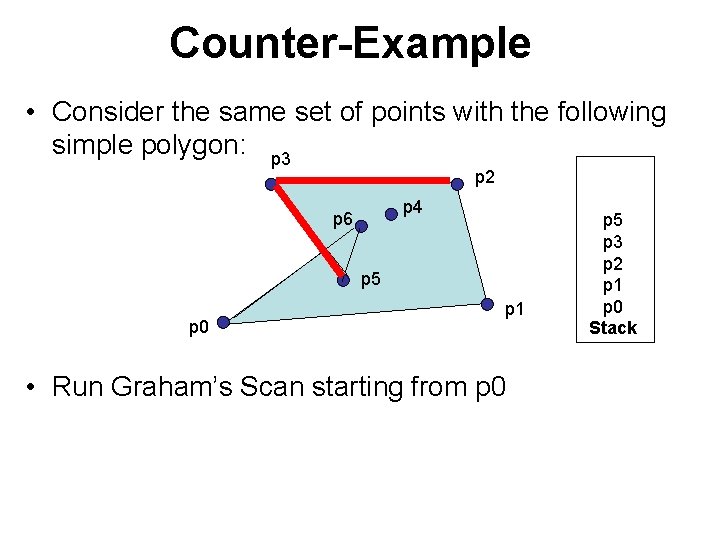
Counter-Example • Consider the same set of points with the following simple polygon: p 3 p 2 p 4 p 6 p 5 p 0 p 1 • Run Graham’s Scan starting from p 0 p 5 p 3 p 2 p 1 p 0 Stack
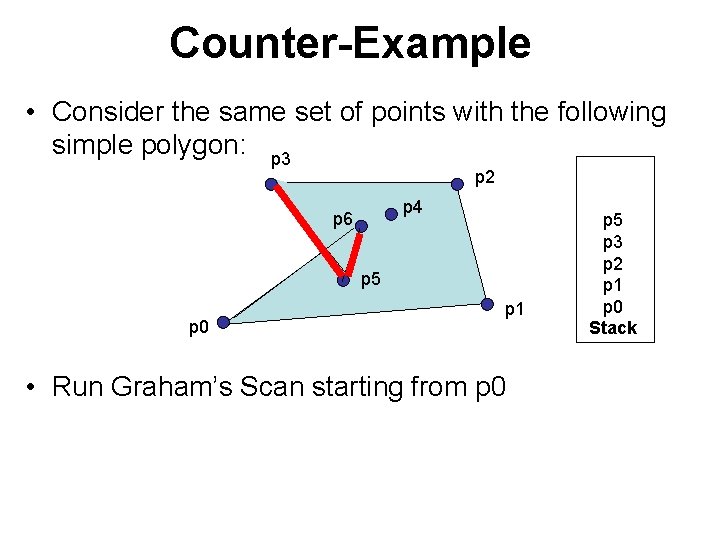
Counter-Example • Consider the same set of points with the following simple polygon: p 3 p 2 p 4 p 6 p 5 p 0 p 1 • Run Graham’s Scan starting from p 0 p 5 p 3 p 2 p 1 p 0 Stack
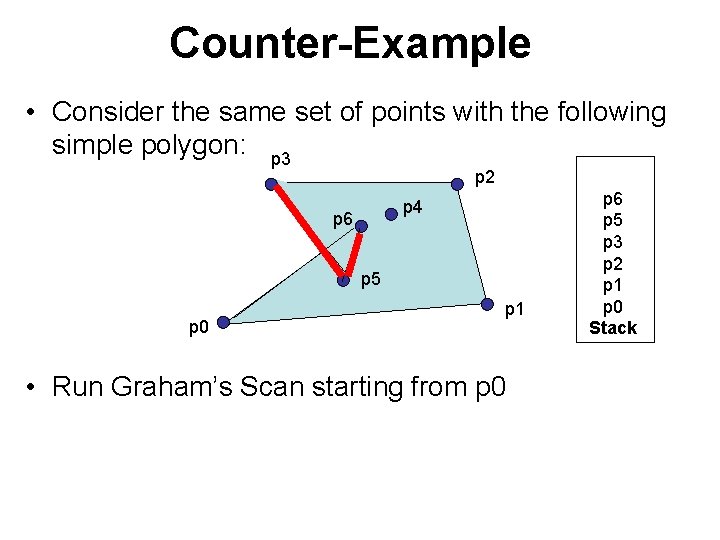
Counter-Example • Consider the same set of points with the following simple polygon: p 3 p 2 p 4 p 6 p 5 p 0 p 1 • Run Graham’s Scan starting from p 0 p 6 p 5 p 3 p 2 p 1 p 0 Stack
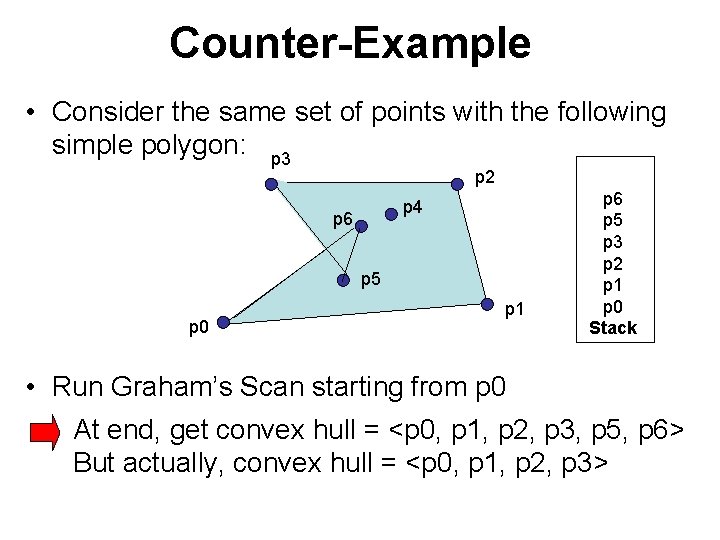
Counter-Example • Consider the same set of points with the following simple polygon: p 3 p 2 p 4 p 6 p 5 p 0 p 1 p 6 p 5 p 3 p 2 p 1 p 0 Stack • Run Graham’s Scan starting from p 0 At end, get convex hull = <p 0, p 1, p 2, p 3, p 5, p 6> But actually, convex hull = <p 0, p 1, p 2, p 3>
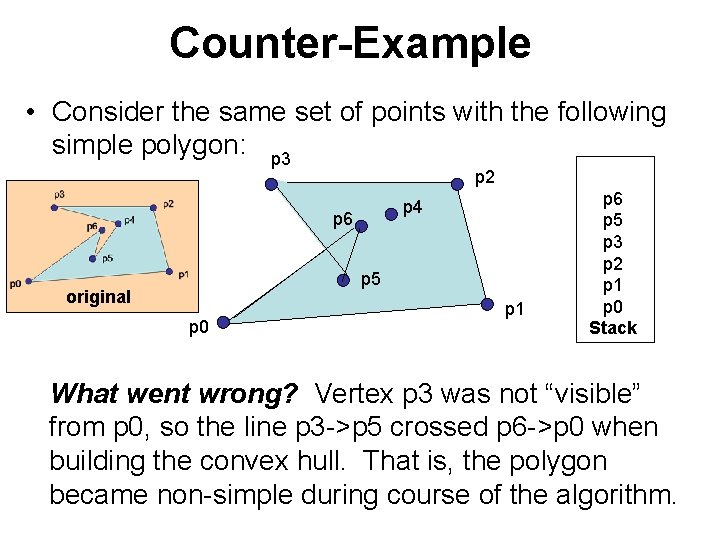
Counter-Example • Consider the same set of points with the following simple polygon: p 3 p 2 p 4 p 6 p 5 original p 0 p 1 p 6 p 5 p 3 p 2 p 1 p 0 Stack What went wrong? Vertex p 3 was not “visible” from p 0, so the line p 3 ->p 5 crossed p 6 ->p 0 when building the convex hull. That is, the polygon became non-simple during course of the algorithm.
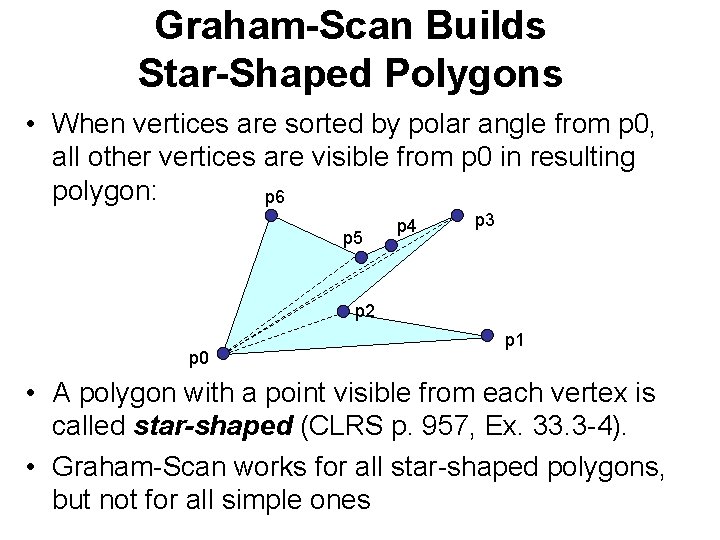
Graham-Scan Builds Star-Shaped Polygons • When vertices are sorted by polar angle from p 0, all other vertices are visible from p 0 in resulting polygon: p 6 p 5 p 4 p 3 p 2 p 0 p 1 • A polygon with a point visible from each vertex is called star-shaped (CLRS p. 957, Ex. 33. 3 -4). • Graham-Scan works for all star-shaped polygons, but not for all simple ones
For More Information • There do exist linear-time algorithms for building the convex hull of a simple polygon. Many of the first algorithms proposed were actually incorrect! See here for an interesting history: http: //cgm. cs. mcgill. ca/~athens/cs 601/intro. html • Is the question we considered a million-dollar question? Probably not, but it can be worth up to $200! Click here for a good time: http: //answers. google. com/answers/threadview? id=137349
- Slides: 25