
Why doesnt rain kill you Or at least

- Slides: 9
Why doesn’t rain kill you ? Or at least hurt when it hits you?
Scrap paper question Ø Why doesn’t rain kill you? Ø How fast is a raindrop falling when it hits you? Ø Was it in ‘freefall’? Why or why not?
If a raindrop was in freefall, what info do we need to estimate its final velocity? Ø The time it takes to fall? Ø The vertical distance it falls? Ø Simplified equations y = 5 t 2, v = 10 t
Since we can’t time it, …. Ø Get info on vertical height of rainclouds Ø The bottoms of rainclouds are generally below 2000 m or 6500 ft Ø Let’s be conservative and say that the rain falls from a height of 1500 ft or 460 m
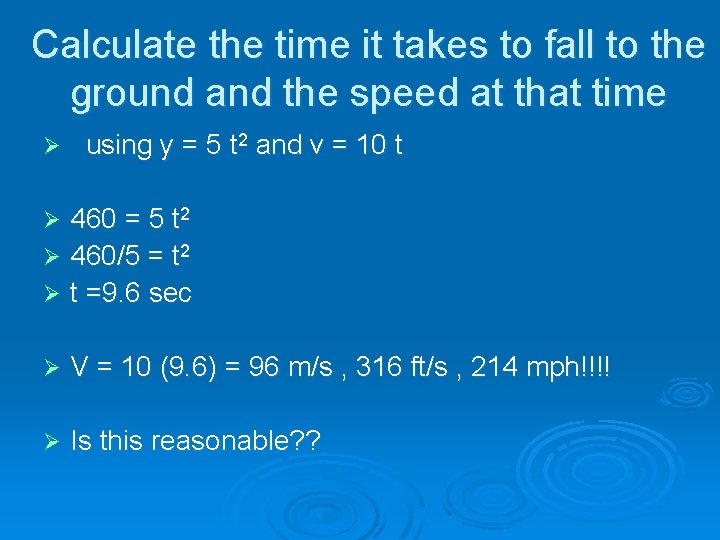
Calculate the time it takes to fall to the ground and the speed at that time Ø using y = 5 t 2 and v = 10 t 460 = 5 t 2 Ø 460/5 = t 2 Ø t =9. 6 sec Ø Ø V = 10 (9. 6) = 96 m/s , 316 ft/s , 214 mph!!!! Ø Is this reasonable? ?
So…why doesn’t rain kill you? Ø Thoughts? Ø Air drag slows it down!
How does drag work? Ø It’s complicated but it largely depends on l Ø The square of the object’s speed http: //www. grc. nasa. gov/WWW/K-12/airplane/drag 1. html Ø When the drop falls fast enough, the drag is large enough to balance the force of the earth pulling on drop Ø The drop reaches its ‘terminal velocity’ and stops speeding up or accelerating!!
What is the terminal velocity of a typical raindrop? Ø At sea level, a large raindrop about 5 millimeters across (house-fly size) Ø reaches a terminal velocity of Ø 9 meters per second (20 miles per hour). Ø That’s more like it!