
Why does the spreadsheet work and how can
- Slides: 26
Why does the spreadsheet work … … and how can we improve it? A user interface perspective on the foundations of spreadsheets. Alan Blackwell Computer Laboratory Cambridge University
Outline o Why the spreadsheet was invented o Which features were critical to success o HCI research in spreadsheet use o Where next? n Grounds for critique of current products n Possible product futures n Possible futures for spreadsheet users
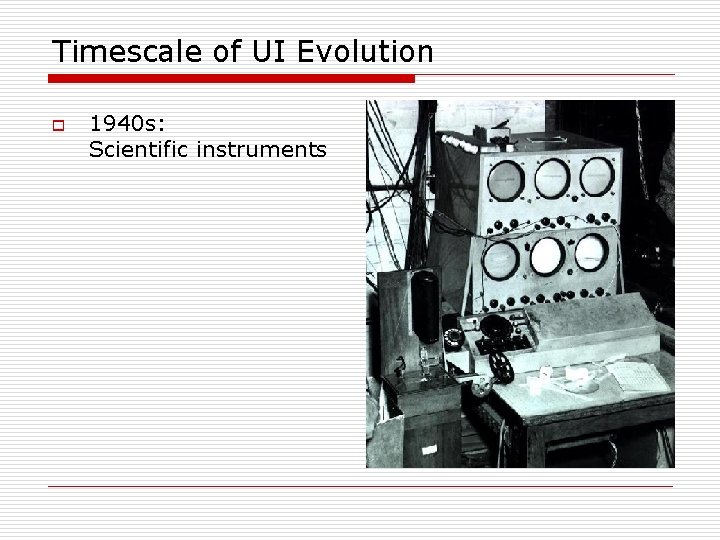
Timescale of UI Evolution o 1940 s: Scientific instruments
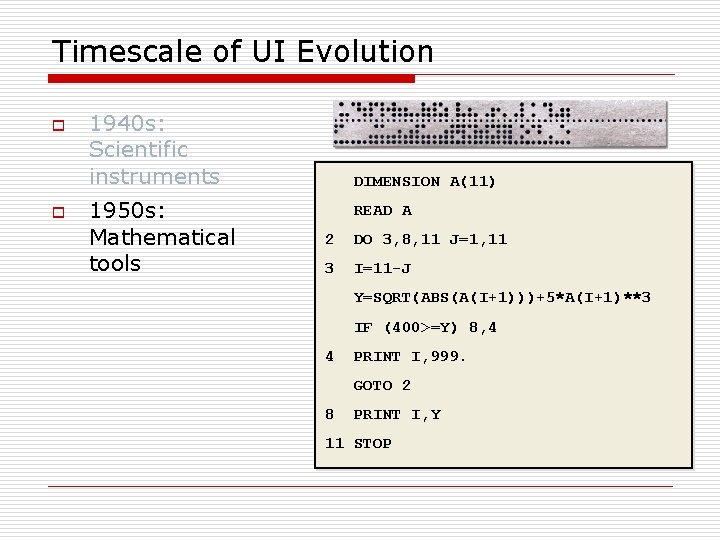
Timescale of UI Evolution o o 1940 s: Scientific instruments 1950 s: Mathematical tools DIMENSION A(11) READ A 2 DO 3, 8, 11 J=1, 11 3 I=11 -J Y=SQRT(ABS(A(I+1)))+5*A(I+1)**3 IF (400>=Y) 8, 4 4 PRINT I, 999. GOTO 2 8 PRINT I, Y 11 STOP
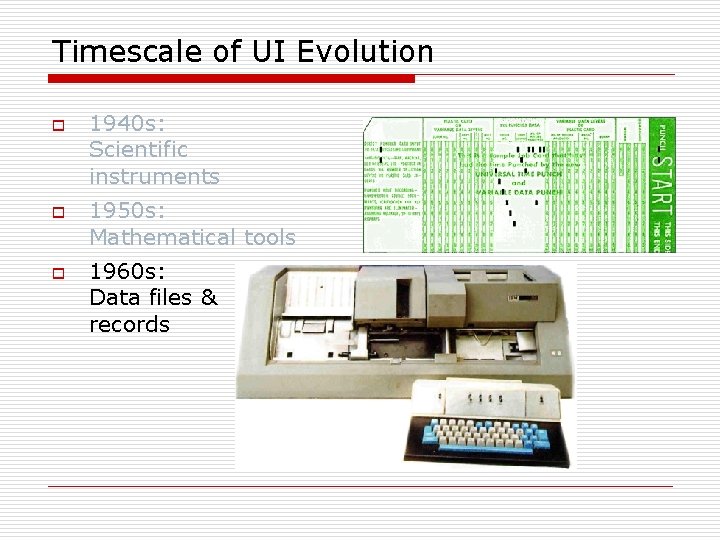
Timescale of UI Evolution o o o 1940 s: Scientific instruments 1950 s: Mathematical tools 1960 s: Data files & records
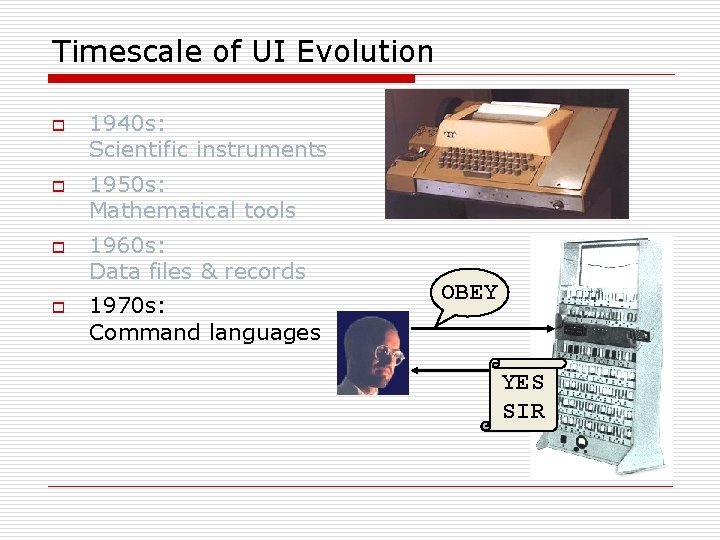
Timescale of UI Evolution o o 1940 s: Scientific instruments 1950 s: Mathematical tools 1960 s: Data files & records 1970 s: Command languages OBEY YES SIR
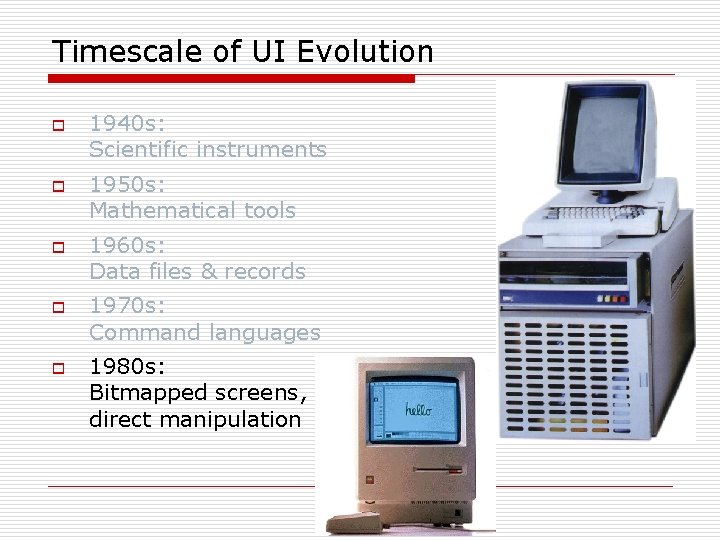
Timescale of UI Evolution o o o 1940 s: Scientific instruments 1950 s: Mathematical tools 1960 s: Data files & records 1970 s: Command languages 1980 s: Bitmapped screens, direct manipulation
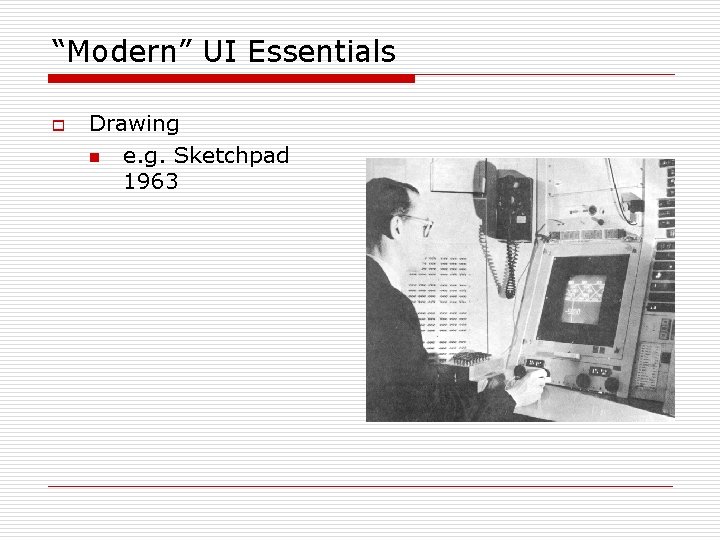
“Modern” UI Essentials o Drawing n e. g. Sketchpad 1963
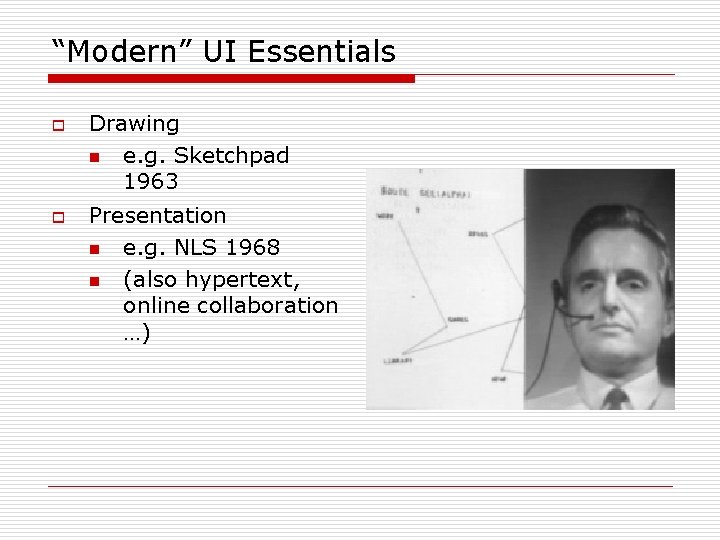
“Modern” UI Essentials o o Drawing n e. g. Sketchpad 1963 Presentation n e. g. NLS 1968 n (also hypertext, online collaboration …)
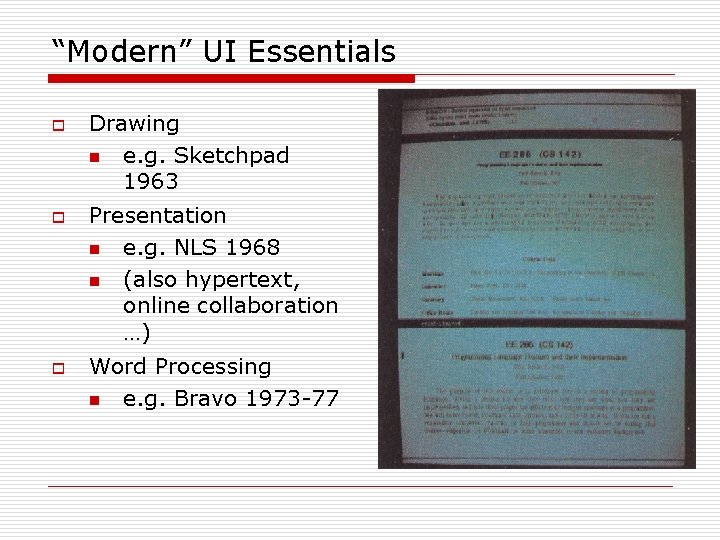
“Modern” UI Essentials o o o Drawing n e. g. Sketchpad 1963 Presentation n e. g. NLS 1968 n (also hypertext, online collaboration …) Word Processing n e. g. Bravo 1973 -77
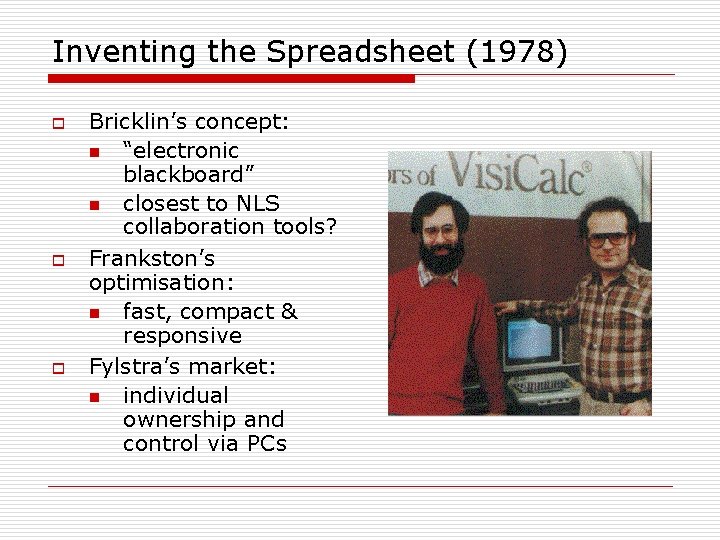
Inventing the Spreadsheet (1978) o o o Bricklin’s concept: n “electronic blackboard” n closest to NLS collaboration tools? Frankston’s optimisation: n fast, compact & responsive Fylstra’s market: n individual ownership and control via PCs
Outline o Why the spreadsheet was invented o Which features were critical to success o HCI research in spreadsheet use o Where next? n Grounds for critique of current products n Possible product futures n Possible futures for spreadsheet users
From Apple II to IBM PC / MS-DOS o o PC Functionally equivalent to the Apple II n (no mouse, no bitmapped display) Business software emphasis n simple databases n word processing n Lotus 1 -2 -3 replaced Visi. Calc, included charts and plots (as well as some database and text formatting)
Direct manipulation o o o Original Mac applications were “creative” n writing, drawing, painting n derived from Kay’s vision of creative machine Business market developments n desktop publishing created business market n Apple asked Microsoft to develop a SS Excel n offered direct manipulation benefits of the Mac n point and click, menus, windows, prompts
The Spreadsheet “Metaphor” o o HCI textbooks propose metaphor as starting point for UI design. n But there is little evidence that the paper SS ever influenced the development of SS software. Most benefits historically derived from UI features of other software categories.
Outline o Why the spreadsheet was invented o Which features were critical to success o HCI research in spreadsheet use o Where next? n Grounds for critique of current products n Possible product futures n Possible futures for spreadsheet users
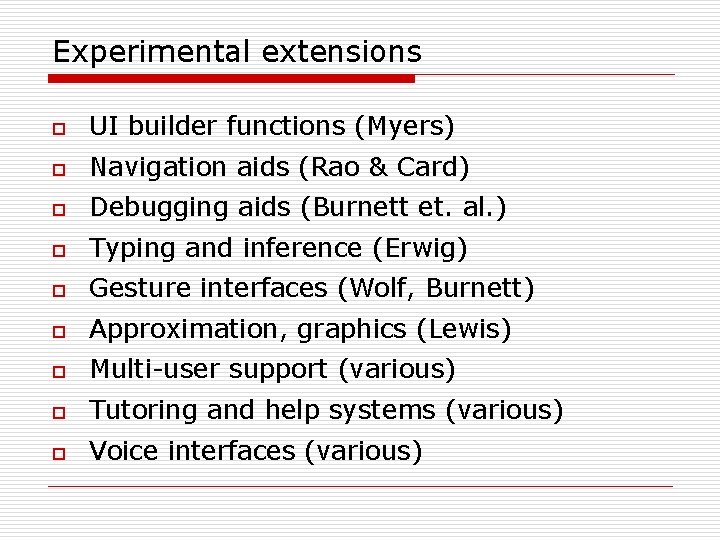
Experimental extensions o UI builder functions (Myers) o Navigation aids (Rao & Card) o Debugging aids (Burnett et. al. ) o Typing and inference (Erwig) o Gesture interfaces (Wolf, Burnett) o Approximation, graphics (Lewis) o Multi-user support (various) o Tutoring and help systems (various) o Voice interfaces (various)
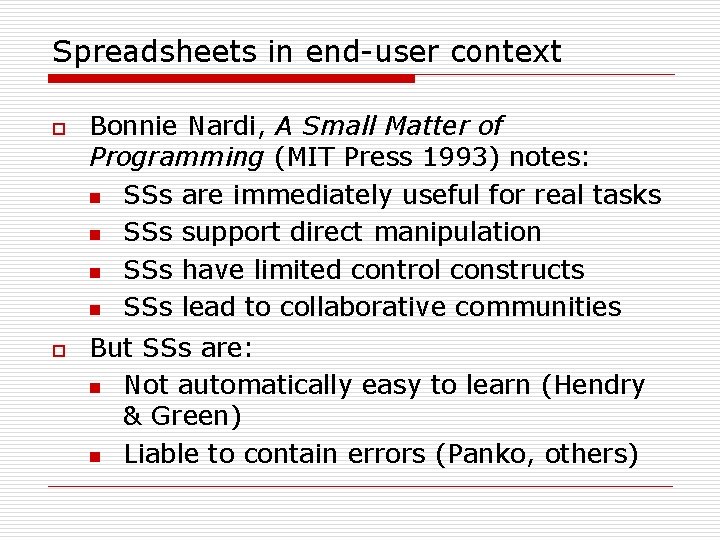
Spreadsheets in end-user context o o Bonnie Nardi, A Small Matter of Programming (MIT Press 1993) notes: n SSs are immediately useful for real tasks n SSs support direct manipulation n SSs have limited control constructs n SSs lead to collaborative communities But SSs are: n Not automatically easy to learn (Hendry & Green) n Liable to contain errors (Panko, others)
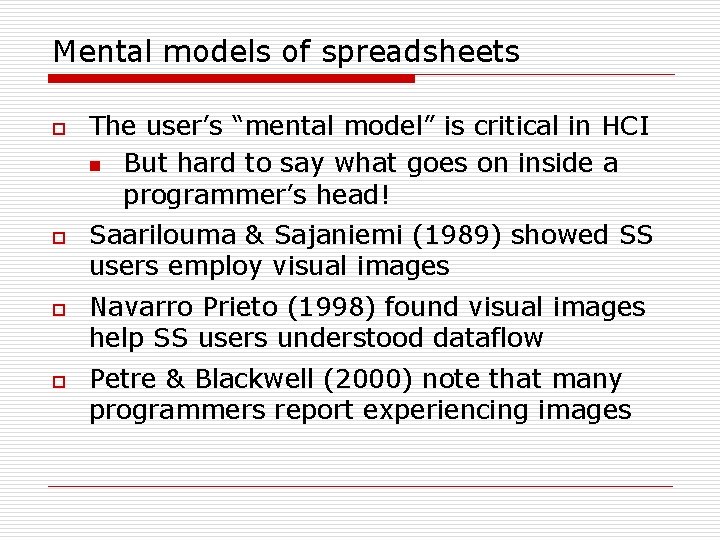
Mental models of spreadsheets o o The user’s “mental model” is critical in HCI n But hard to say what goes on inside a programmer’s head! Saarilouma & Sajaniemi (1989) showed SS users employ visual images Navarro Prieto (1998) found visual images help SS users understood dataflow Petre & Blackwell (2000) note that many programmers report experiencing images
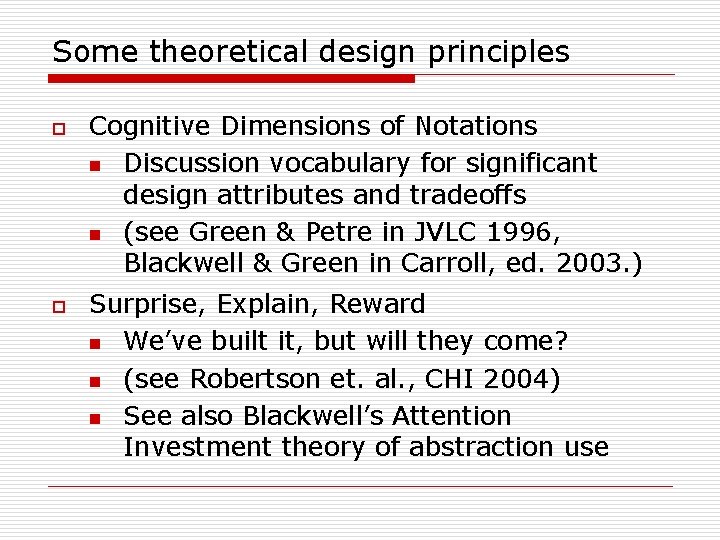
Some theoretical design principles o o Cognitive Dimensions of Notations n Discussion vocabulary for significant design attributes and tradeoffs n (see Green & Petre in JVLC 1996, Blackwell & Green in Carroll, ed. 2003. ) Surprise, Explain, Reward n We’ve built it, but will they come? n (see Robertson et. al. , CHI 2004) n See also Blackwell’s Attention Investment theory of abstraction use
Outline o Why the spreadsheet was invented o Which features were critical to success o HCI research in spreadsheet use o Where next? n Grounds for critique of current products n Possible product futures n Possible futures for spreadsheet users
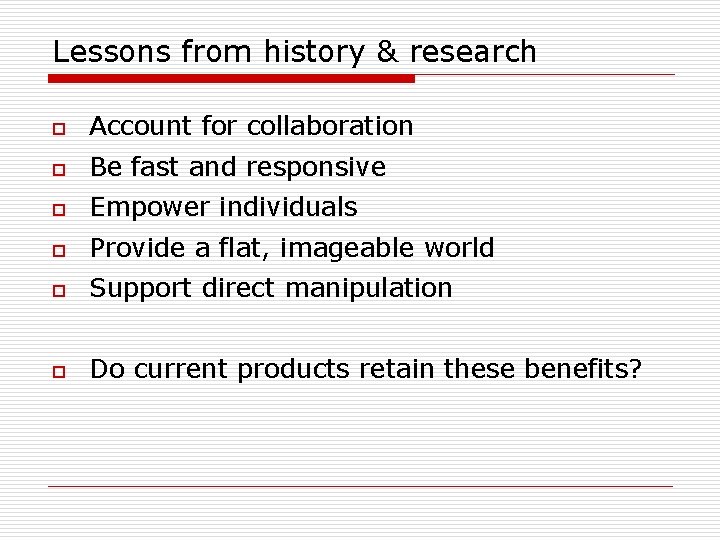
Lessons from history & research o Account for collaboration o Be fast and responsive o Empower individuals o Provide a flat, imageable world o Support direct manipulation o Do current products retain these benefits?
Outline o Why the spreadsheet was invented o Which features were critical to success o HCI research in spreadsheet use o Where next? n Grounds for critique of current products n Possible product futures n Possible futures for spreadsheet users
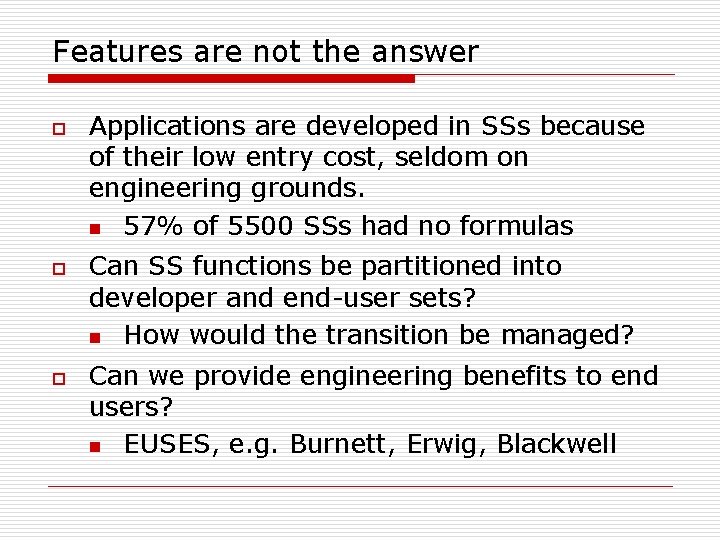
Features are not the answer o o o Applications are developed in SSs because of their low entry cost, seldom on engineering grounds. n 57% of 5500 SSs had no formulas Can SS functions be partitioned into developer and end-user sets? n How would the transition be managed? Can we provide engineering benefits to end users? n EUSES, e. g. Burnett, Erwig, Blackwell
Outline o Why the spreadsheet was invented o Which features were critical to success o HCI research in spreadsheet use o Where next? n Grounds for critique of current products n Possible product futures n Possible futures for spreadsheet users
User simplification o o If the SS has been moving away from its roots, can users (or organisations) return? n Templates n Process definitions n Reduced-feature standards n Adapt open-source products Any more options? (DISCUSS!)