
Why does money matter anyways Advocating for Income



- Slides: 47
Why does money matter anyways? Advocating for Income Supports to Reduce Poverty and Improve Health Alyssa Swartz MSW RSW Chloe Walls MSW RSW
Presenter Disclosure No specific conflicts of interest or financial disclosures. We approach this work from a privileged position as a health care providers. We do not speak on behalf of people living in poverty; we speak as allies.
Presenter Acknowledgements We would like to thank: Janet Lee-Evoy PGY 5, Dr Michaela Beder, Dr Andrew Pinto, Dr Gary Bloch, the St. Michael’s AFHT Social Determinants of Health Committee, and the Upstream Lab. We would also like to acknowledge Woodgreen Community Services for their RESP info sheets.
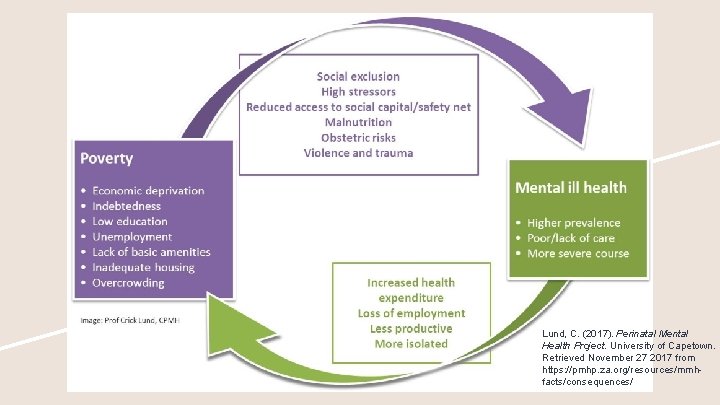
Objectives 1. Discuss how poverty affects health and mental health 2. Explore specific interventions to reduce poverty and improve health in clinical practice 3. Provide practical tips and strategies to help advocate for income supports for our patients 4. Provide a practical approach to incremental income interventions for the RESP.
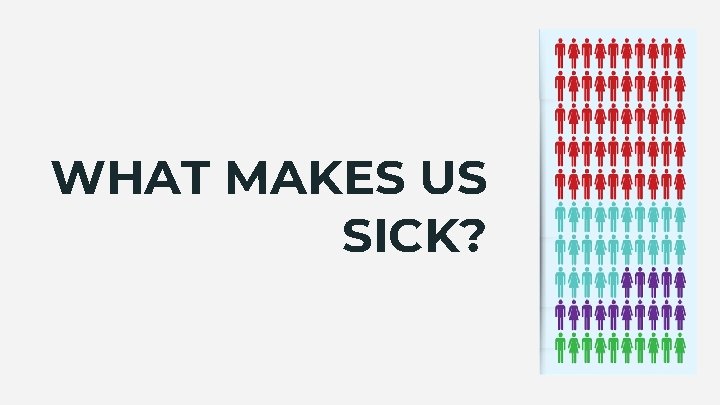
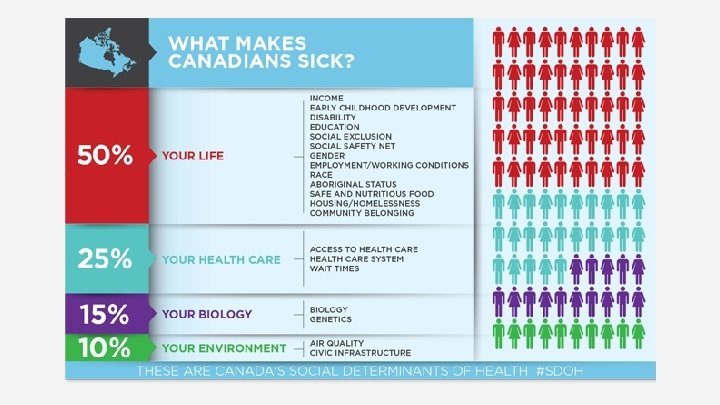
WHAT MAKES US SICK?
Lund, C. (2017). Perinatal Mental Health Project. University of Capetown. Retrieved November 27 2017 from https: //pmhp. za. org/resources/mmhfacts/consequences/
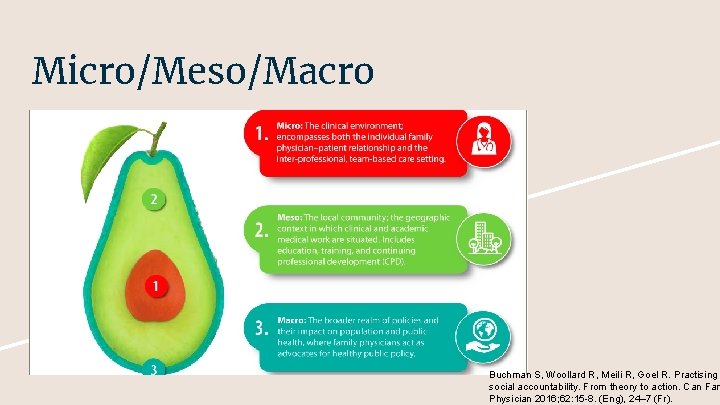
Micro/Meso/Macro Buchman S, Woollard R, Meili R, Goel R. Practising social accountability. From theory to action. Can Fam Physician 2016; 62: 15 -8. (Eng), 24– 7 (Fr).
Income Security Health Promotion ➢ Program through St. Michael’s Hospital ➢ Collaboration on a community level to provide education and training opportunities for cross discipline professional development on income related issues. ➢ Members of the Social Determinants of Health Committee at St. Michael’s Hospital. ➢ Actively engaged in the SDOH committee’s advocacy subcommittee, promoting meso and macro level advocacy efforts.
Income Security Health Promotion ➢ Train providers in income security interventions such as filling out applications and understanding which income support system may be most beneficial to their patients. ➢ Guide patients through relevant income support programs and provide continuity through the income support process and beyond. ➢ Provide time limited financial case management.
Income Security Health Promotion ➢ Staffed by 2 full time Health Promoters with experience in income support, program design, evaluation, and tenacity. ➢ NOT ONLY about filling out forms, it is about advocating, educating, and empowering our patients to take care of their income. ➢ Focuses solely on income as one of the key social determinants of health.
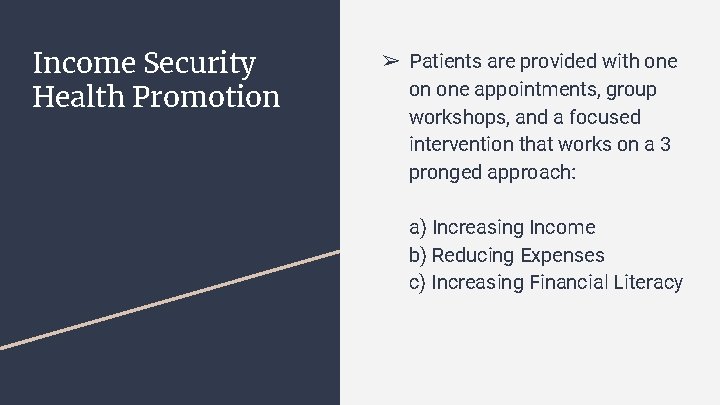
Income Security Health Promotion ➢ Patients are provided with one on one appointments, group workshops, and a focused intervention that works on a 3 pronged approach: a) Increasing Income b) Reducing Expenses c) Increasing Financial Literacy
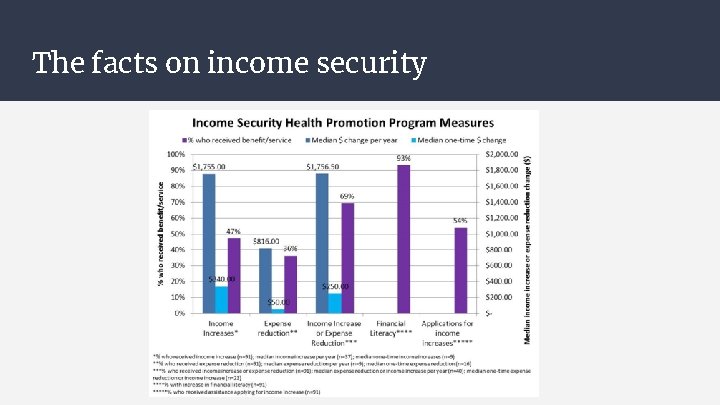
The facts on income security
Income Security in Action The story of James
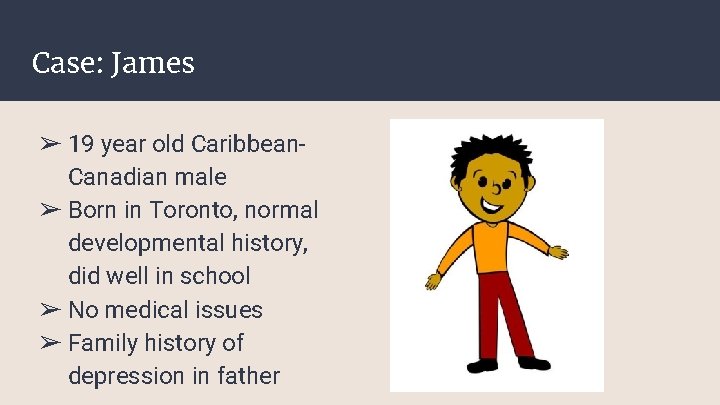
Case: James ➢ 19 year old Caribbean. Canadian male ➢ Born in Toronto, normal developmental history, did well in school ➢ No medical issues ➢ Family history of depression in father
Case: James ➢ Seen by family doctor for “anxiety and depression” after he unexpectedly left his job, saying it was “too stressful” ➢ Diagnosed with MDD ➢ APPLY FOR EMPLOYMENT INSURANCE SICK BENEFITS (EI-SB)
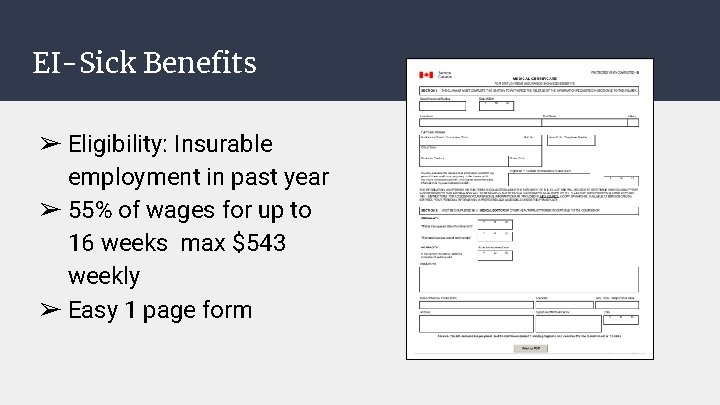
EI-Sick Benefits ➢ Eligibility: Insurable employment in past year ➢ 55% of wages for up to 16 weeks max $543 weekly ➢ Easy 1 page form
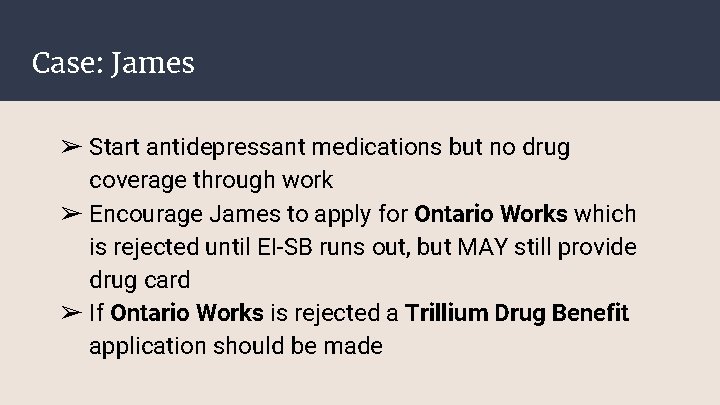
Case: James ➢ Start antidepressant medications but no drug coverage through work ➢ Encourage James to apply for Ontario Works which is rejected until EI-SB runs out, but MAY still provide drug card ➢ If Ontario Works is rejected a Trillium Drug Benefit application should be made
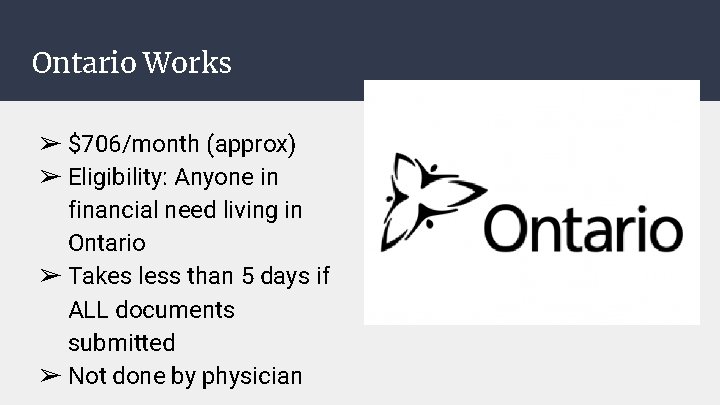
Ontario Works ➢ $706/month (approx) ➢ Eligibility: Anyone in financial need living in Ontario ➢ Takes less than 5 days if ALL documents submitted ➢ Not done by physician
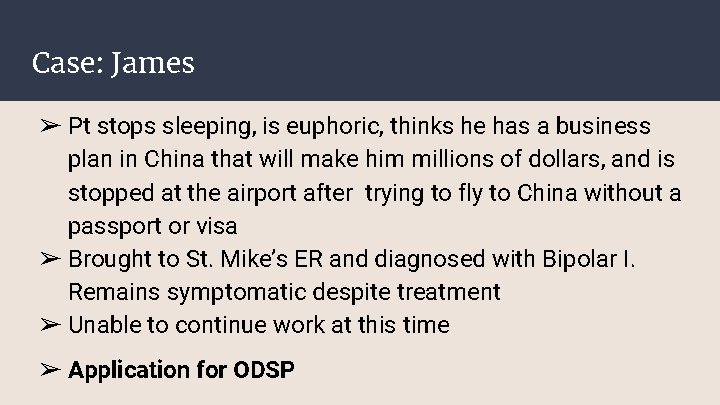
Case: James ➢ Pt stops sleeping, is euphoric, thinks he has a business plan in China that will make him millions of dollars, and is stopped at the airport after trying to fly to China without a passport or visa ➢ Brought to St. Mike’s ER and diagnosed with Bipolar I. Remains symptomatic despite treatment ➢ Unable to continue work at this time ➢ Application for ODSP
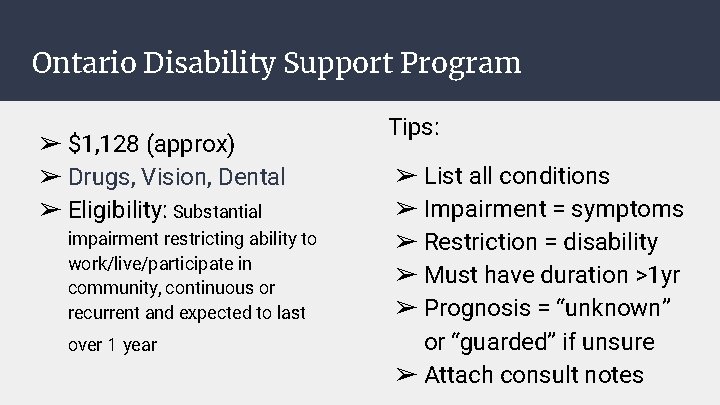
Ontario Disability Support Program ➢ $1, 128 (approx) ➢ Drugs, Vision, Dental ➢ Eligibility: Substantial impairment restricting ability to work/live/participate in community, continuous or recurrent and expected to last over 1 year Tips: ➢ List all conditions ➢ Impairment = symptoms ➢ Restriction = disability ➢ Must have duration >1 yr ➢ Prognosis = “unknown” or “guarded” if unsure ➢ Attach consult notes
Case: James ➢ ODSP approved with 5 year review date ➢ 18 months later, pt has recovered and is stable on medications ➢ Decides to apply for university and is accepted ➢ Supported by ODSP for living expenses and OSAP for tuition
Case: James ➢ After graduation, returns to work. Still has episodic relapses, but has supportive employer and overall is doing well ➢ Slow transition off ODSP until he finally has permanent work as well as drug benefits ➢ Received extended drug benefits for 1 year following being off ODSP financial support
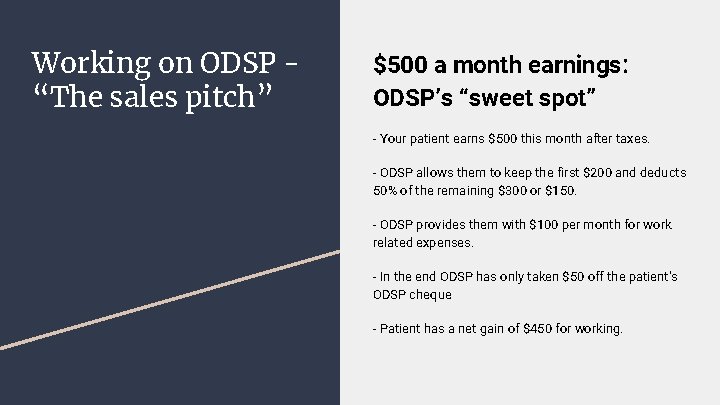
Working on ODSP “The sales pitch” $500 a month earnings: ODSP’s “sweet spot” - Your patient earns $500 this month after taxes. - ODSP allows them to keep the first $200 and deducts 50% of the remaining $300 or $150. - ODSP provides them with $100 per month for work related expenses. - In the end ODSP has only taken $50 off the patient’s ODSP cheque - Patient has a net gain of $450 for working.
Case: James - Work going well, and pt decides to start saving for retirement/illness planning - Asks his nurse about Disability Tax Credit, and family physician assists in the application - Initially rejected, but approved on reconsideration
Disability Tax Credit (DTC) ➢ 10 K tax credit ➢ Allows you to open a Registered Disability Savings Plan (RDSP) ➢ Government will contribute $3 for your $1 contribution plus a $1000 yearly grant (if income under 30 K annually) up until age 49
Disability Tax Credit - Tips and Tricks ➢ Look at cumulative effect of multiple impairments. ➢ Patient may only be markedly restricted in a number of areas which taken together provided substantive impairment. ➢ Include supporting documentation or a letter of support.
Case: James ➢ 15 years stable employment with small lapses due to recurrent illness ➢ At age 47, however, stopped medications and has major relapse resulting in hospitalization and ultimately loss of employment ➢ Denied Long Term Disability due to pre-existing condition clause ➢ Next step to re-apply for ODSP
Case: James - ODSP Eligibility ➢ Pt has 60 K in RRSP and 80 K in RDSP ➢ ODSP eligibility asset limit is 40 K for a single person (up from 5 K in September 2017) ➢ RDSP is not considered an asset, but still too much money in RRSP to apply for ODSP ➢ CAN apply for CPP-D
Canada Pension Plan - Disability ➢ Eligibility: Contributed to CPP in 4 of 6 years, age UNDER 65, severe and prolonged disability ➢ Disability: Medical condition which prevents work at any job and unlikely to improve ➢ Apply even if uncertain ➢ Include ALL medical issues ➢ Detail functional restriction ➢ Detail treatments/referrals ➢ Prognosis with uncertain time frame ➢ If denied, likely approved on appeal
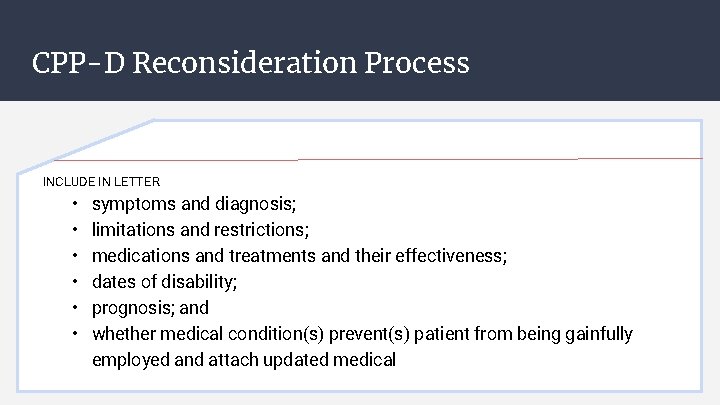
CPP-D Reconsideration Process INCLUDE IN LETTER • • • symptoms and diagnosis; limitations and restrictions; medications and treatments and their effectiveness; dates of disability; prognosis; and whether medical condition(s) prevent(s) patient from being gainfully employed and attach updated medical
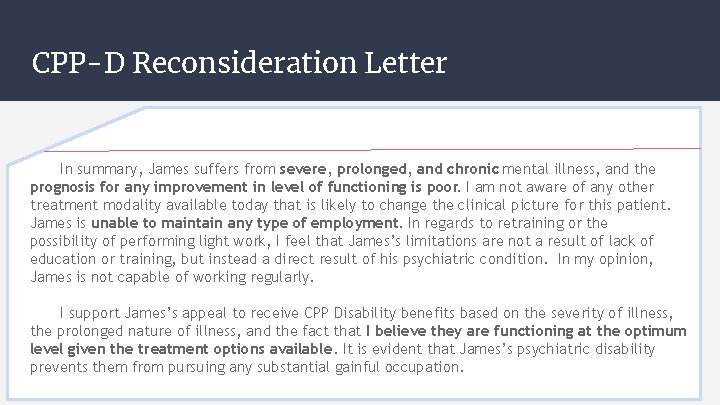
CPP-D Reconsideration Letter In summary, James suffers from severe, prolonged, and chronic mental illness, and the prognosis for any improvement in level of functioning is poor. I am not aware of any other treatment modality available today that is likely to change the clinical picture for this patient. James is unable to maintain any type of employment. In regards to retraining or the possibility of performing light work, I feel that James’s limitations are not a result of lack of education or training, but instead a direct result of his psychiatric condition. In my opinion, James is not capable of working regularly. I support James’s appeal to receive CPP Disability benefits based on the severity of illness, the prolonged nature of illness, and the fact that I believe they are functioning at the optimum level given the treatment options available. It is evident that James’s psychiatric disability prevents them from pursuing any substantial gainful occupation.
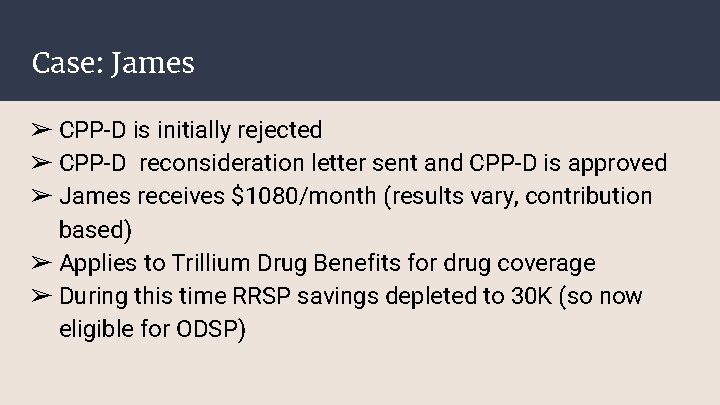
Case: James ➢ CPP-D is initially rejected ➢ CPP-D reconsideration letter sent and CPP-D is approved ➢ James receives $1080/month (results vary, contribution based) ➢ Applies to Trillium Drug Benefits for drug coverage ➢ During this time RRSP savings depleted to 30 K (so now eligible for ODSP)
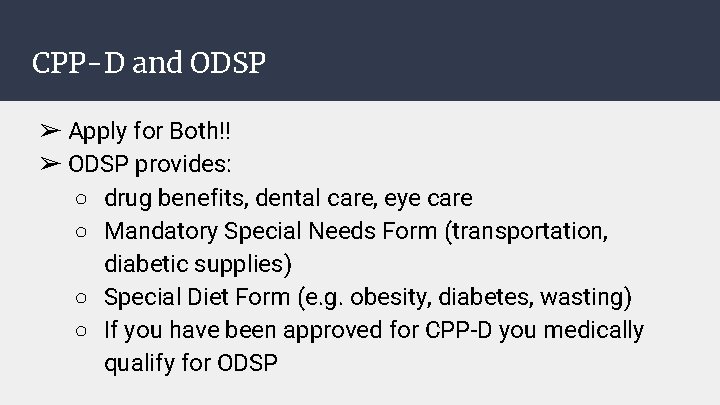
CPP-D and ODSP ➢ Apply for Both!! ➢ ODSP provides: ○ drug benefits, dental care, eye care ○ Mandatory Special Needs Form (transportation, diabetic supplies) ○ Special Diet Form (e. g. obesity, diabetes, wasting) ○ If you have been approved for CPP-D you medically qualify for ODSP
Case: James ➢ After applying for ODSP rate is now calculated at $1278 (basic needs, shelter, transportation and special diet and diabetic supplies) ➢ Compared to CPP-D entitlement of $1080, James’ monthly income has now increased by $198/month! Plus drug/dental/eye coverage
Life Goes On. . .
Happy 64 th Birthday James! ➢ At 65 he will lose ODSP and CPP-D ➢ Now time to apply for CPP, OAS GIS ○ CPP- Canada Pension Plan ○ OAS Old Age Security ○ GIS Guaranteed Income Supplement ➢ Apply one month after your 64 th birthday ODSP does not offer formal assistance in this process.
But wait there’s more - His RDSP! ➢ He was contributing $40/month for 15 years, matched by government contributions of $120/month ➢ Government grants since opening until age 49 (17 years) ➢ RDSP contains $45, 800 (not including investment income) ○ $38, 600 of this was government grants (will contribute a max of $70, 000) ➢ That’s extra money he can use now!
Incremental Income Security Work Small Steps…BIG Impact: A step by step guide to the RESP
What is an RESP? A Registered Education Savings Plan (RESP), is a special savings account to help save money for your child’s education after high school.
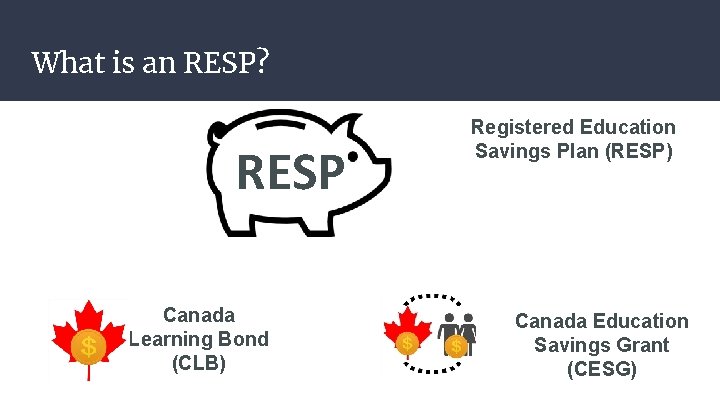
What is an RESP? RESP Canada Learning Bond (CLB) Registered Education Savings Plan (RESP) Canada Education Savings Grant (CESG)
What is the Canada Learning Bond? “free money” that the Government of Canada directly deposits into the RESP of eligible children
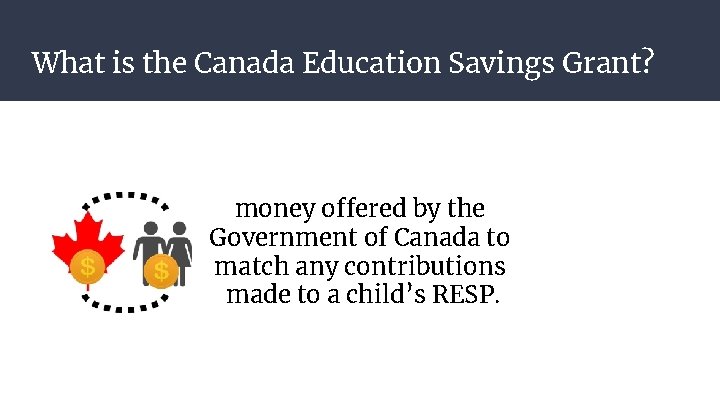
What is the Canada Education Savings Grant? money offered by the Government of Canada to match any contributions made to a child’s RESP.
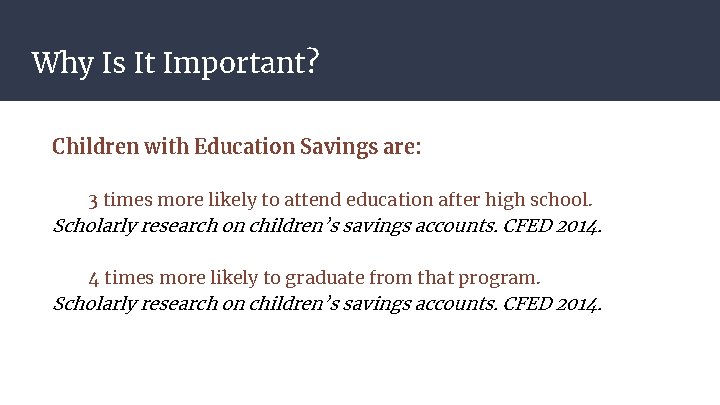
Why Is It Important? Children with Education Savings are: 3 times more likely to attend education after high school. Scholarly research on children’s savings accounts. CFED 2014. 4 times more likely to graduate from that program. Scholarly research on children’s savings accounts. CFED 2014.
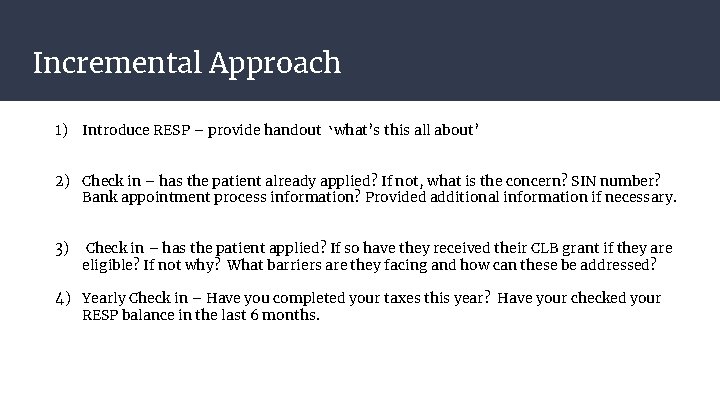
Incremental Approach 1) Introduce RESP – provide handout ‘what’s this all about’ 2) Check in – has the patient already applied? If not, what is the concern? SIN number? Bank appointment process information? Provided additional information if necessary. 3) Check in – has the patient applied? If so have they received their CLB grant if they are eligible? If not why? What barriers are they facing and how can these be addressed? 4) Yearly Check in – Have you completed your taxes this year? Have your checked your RESP balance in the last 6 months.
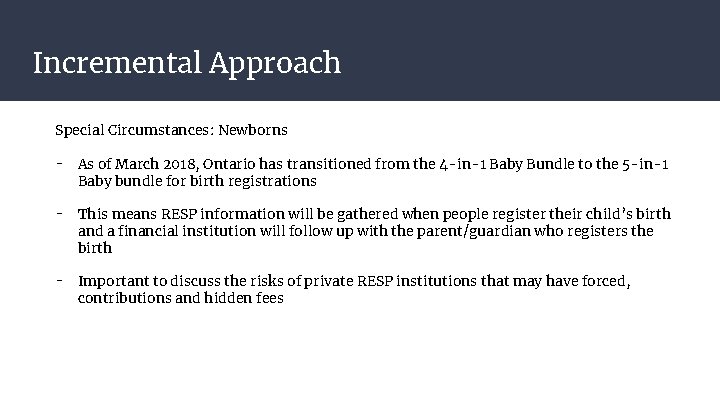
Incremental Approach Special Circumstances: Newborns - As of March 2018, Ontario has transitioned from the 4 -in-1 Baby Bundle to the 5 -in-1 Baby bundle for birth registrations - This means RESP information will be gathered when people register their child’s birth and a financial institution will follow up with the parent/guardian who registers the birth - Important to discuss the risks of private RESP institutions that may have forced, contributions and hidden fees
QUESTIONS FOR OUR INCOME EXPERTS?