
Why do we use Simple Past Tense USE
- Slides: 14
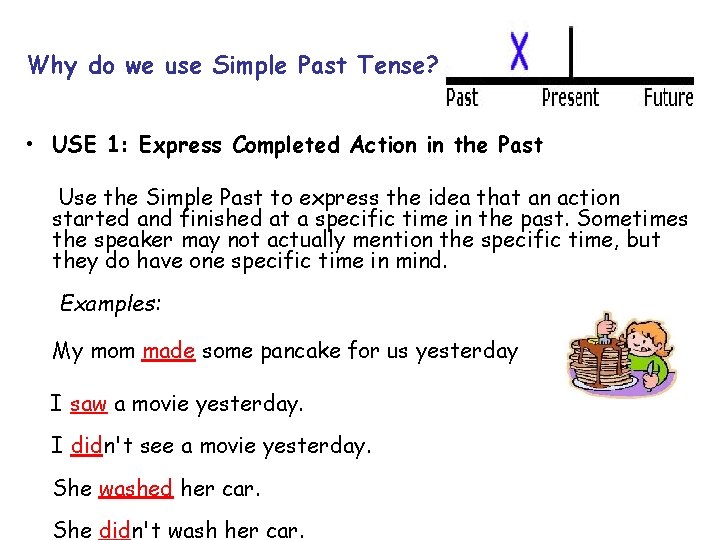
Why do we use Simple Past Tense? • USE 1: Express Completed Action in the Past Use the Simple Past to express the idea that an action started and finished at a specific time in the past. Sometimes the speaker may not actually mention the specific time, but they do have one specific time in mind. Examples: My mom made some pancake for us yesterday I saw a movie yesterday. I didn't see a movie yesterday. She washed her car. She didn't wash her car.
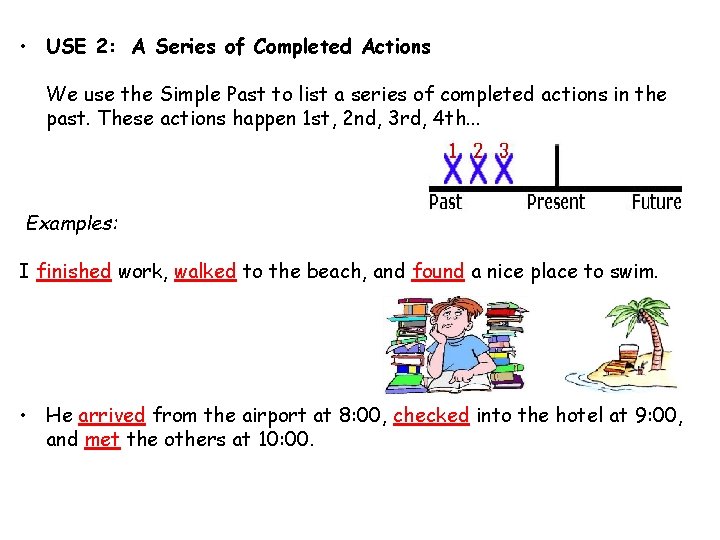
• USE 2: A Series of Completed Actions We use the Simple Past to list a series of completed actions in the past. These actions happen 1 st, 2 nd, 3 rd, 4 th. . . Examples: I finished work, walked to the beach, and found a nice place to swim. • He arrived from the airport at 8: 00, checked into the hotel at 9: 00, and met the others at 10: 00.
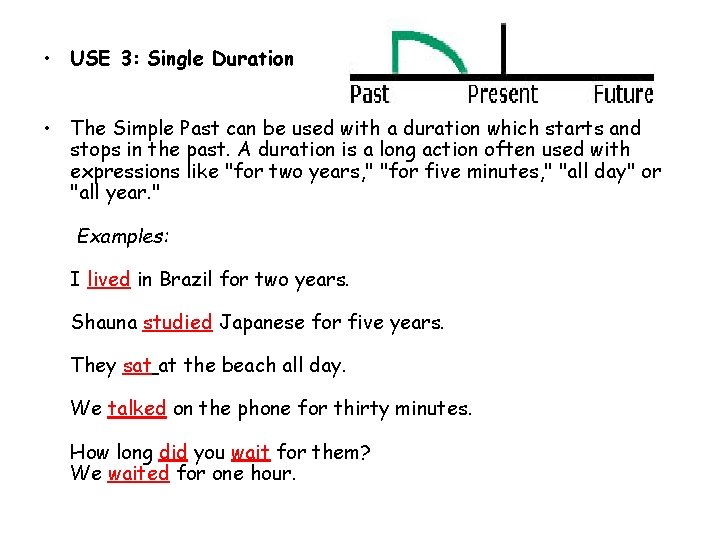
• USE 3: Single Duration • The Simple Past can be used with a duration which starts and stops in the past. A duration is a long action often used with expressions like "for two years, " "for five minutes, " "all day" or "all year. " Examples: I lived in Brazil for two years. Shauna studied Japanese for five years. They sat at the beach all day. We talked on the phone for thirty minutes. How long did you wait for them? We waited for one hour.
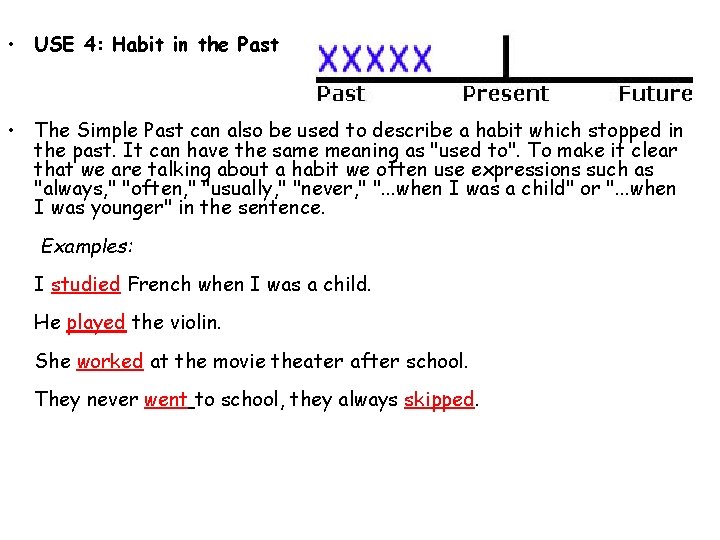
• USE 4: Habit in the Past • The Simple Past can also be used to describe a habit which stopped in the past. It can have the same meaning as "used to". To make it clear that we are talking about a habit we often use expressions such as "always, " "often, " "usually, " "never, " ". . . when I was a child" or ". . . when I was younger" in the sentence. Examples: I studied French when I was a child. He played the violin. She worked at the movie theater after school. They never went to school, they always skipped.
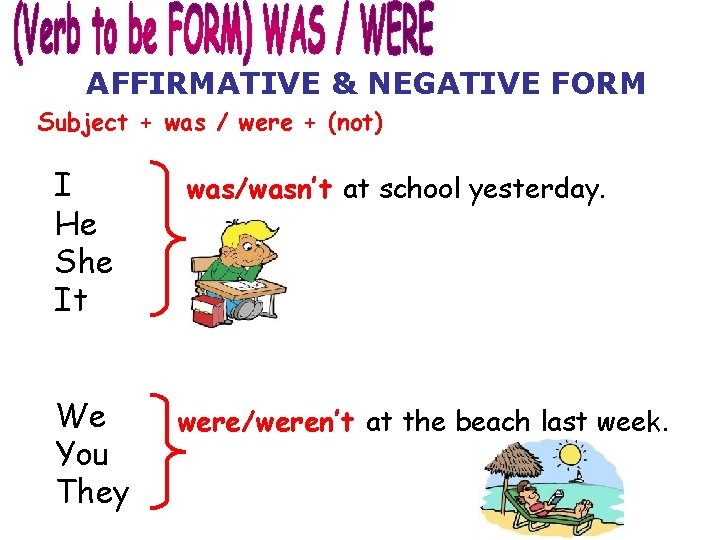
AFFIRMATIVE & NEGATIVE FORM Subject + was / were + (not) I He She It We You They was/wasn’t at school yesterday. were/weren’t at the beach last week.
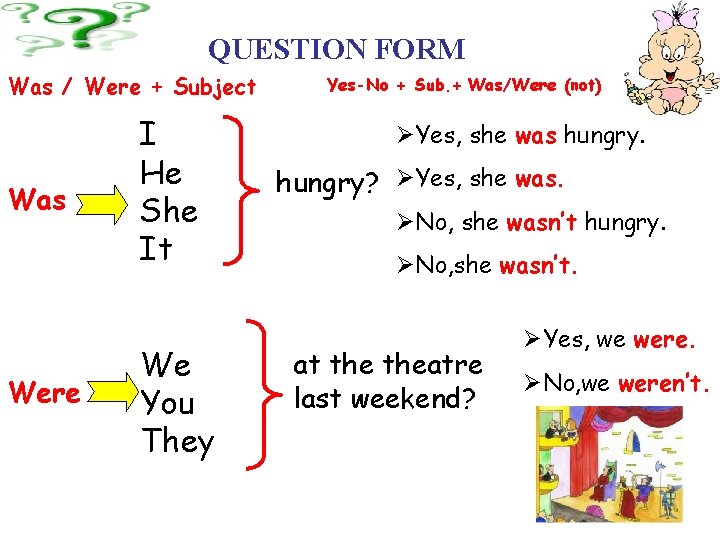
QUESTION FORM Was / Were + Subject Was Were I He She It We You They Yes-No + Sub. + Was/Were (not) ØYes, she was hungry? ØYes, she was. ØNo, she wasn’t hungry. ØNo, she wasn’t. at theatre last weekend? ØYes, we were. ØNo, we weren’t.
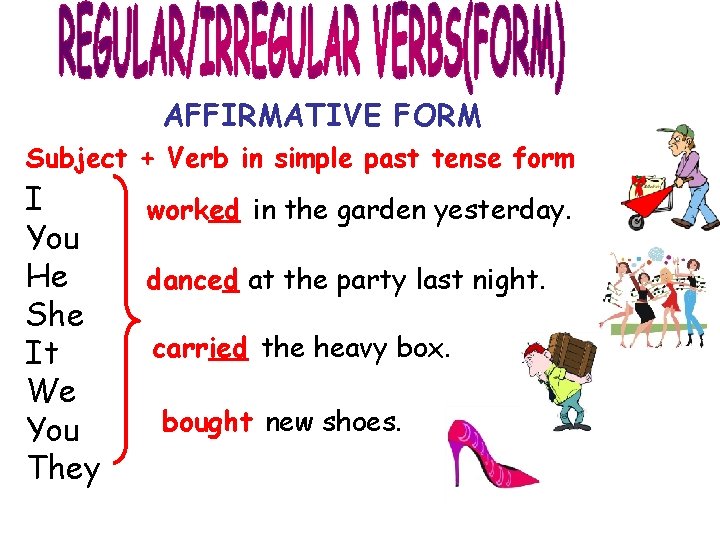
AFFIRMATIVE FORM Subject + Verb in simple past tense form I You He She It We You They worked in the garden yesterday. danced at the party last night. carried the heavy box. bought new shoes.
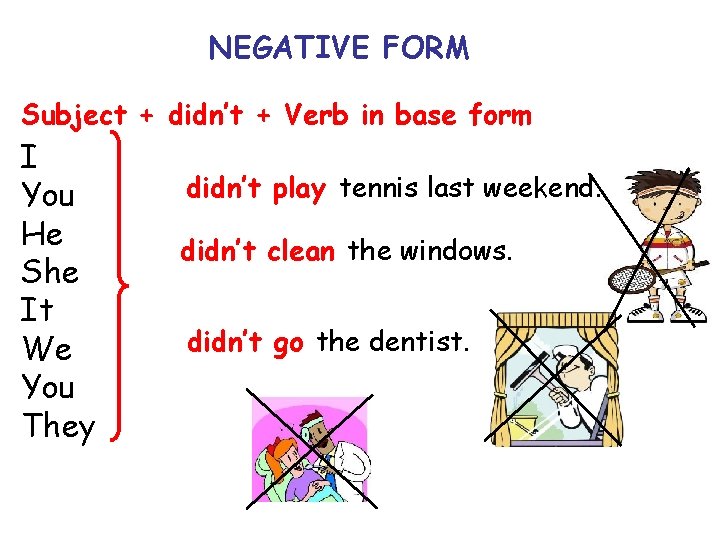
NEGATIVE FORM Subject + didn’t + Verb in base form I You He She It We You They didn’t play tennis last weekend. didn’t clean the windows. didn’t go the dentist.
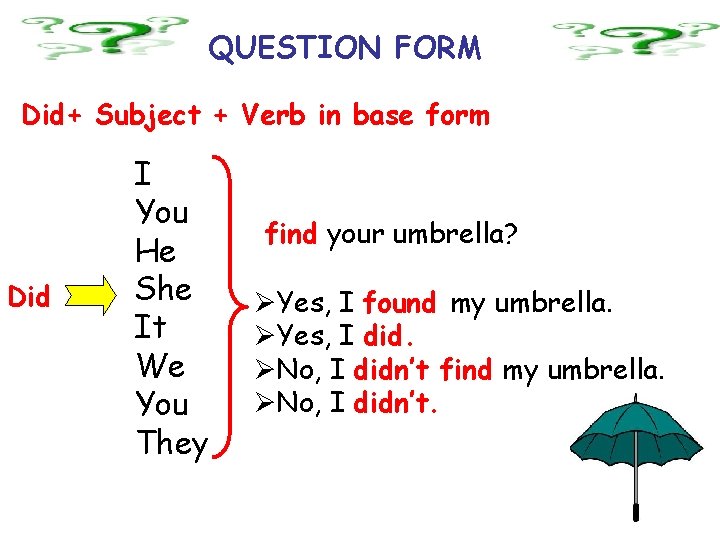
QUESTION FORM Did+ Subject + Verb in base form Did I You He She It We You They find your umbrella? ØYes, I found my umbrella. ØYes, I did. ØNo, I didn’t find my umbrella. ØNo, I didn’t.
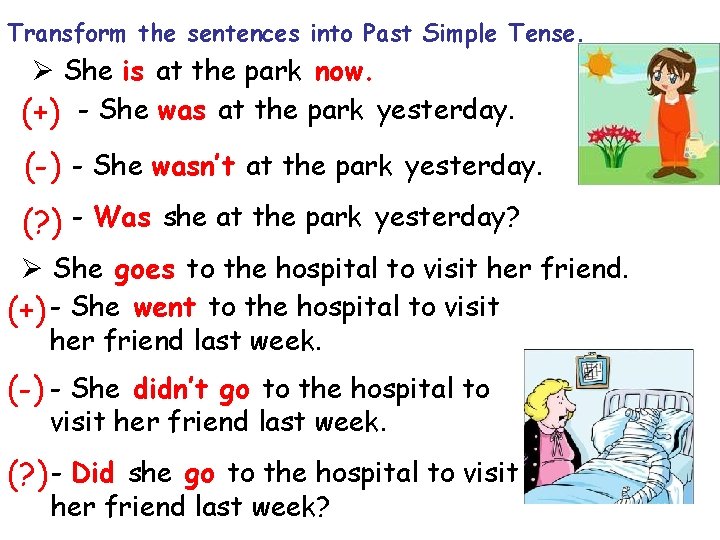
Transform the sentences into Past Simple Tense. Ø She is at the park now. (+) - She was at the park yesterday. (-) - She wasn’t at the park yesterday. (? ) - Was she at the park yesterday? Ø She goes to the hospital to visit her friend. (+) - She went to the hospital to visit her friend last week. (-) - She didn’t go to the hospital to visit her friend last week. (? ) - Did she go to the hospital to visit her friend last week?
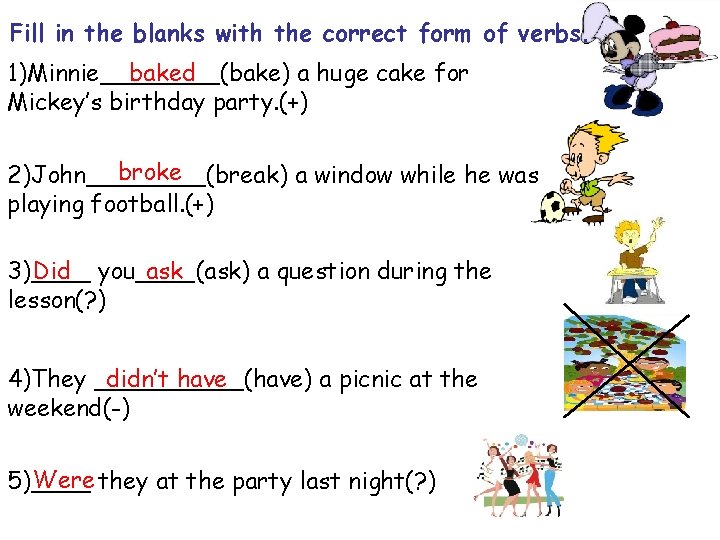
Fill in the blanks with the correct form of verbs. 1)Minnie____(bake) baked a huge cake for Mickey’s birthday party. (+) broke 2)John____(break) a window while he was playing football. (+) 3)____ Did you____(ask) ask a question during the lesson(? ) 4)They _____(have) didn’t have a picnic at the weekend(-) Were they at the party last night(? ) 5)____
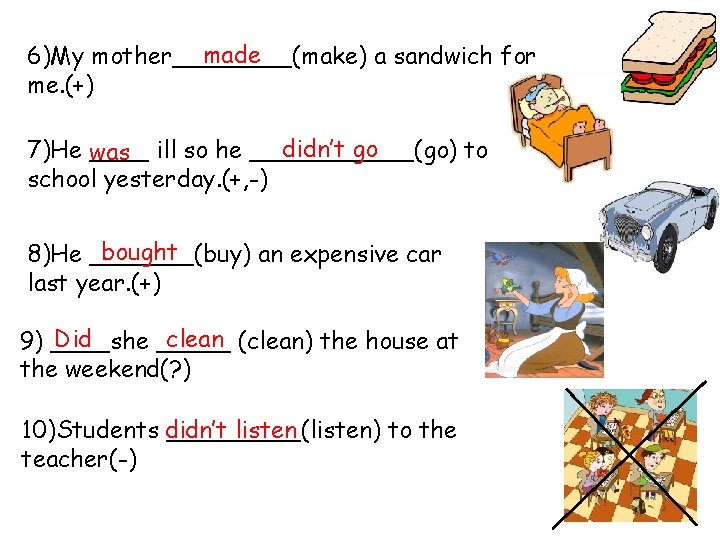
made 6)My mother____(make) a sandwich for me. (+) didn’t go 7)He ____ to was ill so he ______(go) school yesterday. (+, -) bought 8)He _______(buy) an expensive car last year. (+) Did clean (clean) the house at 9) ____she _____ the weekend(? ) 10)Students didn’t _____(listen) listen to the teacher(-)
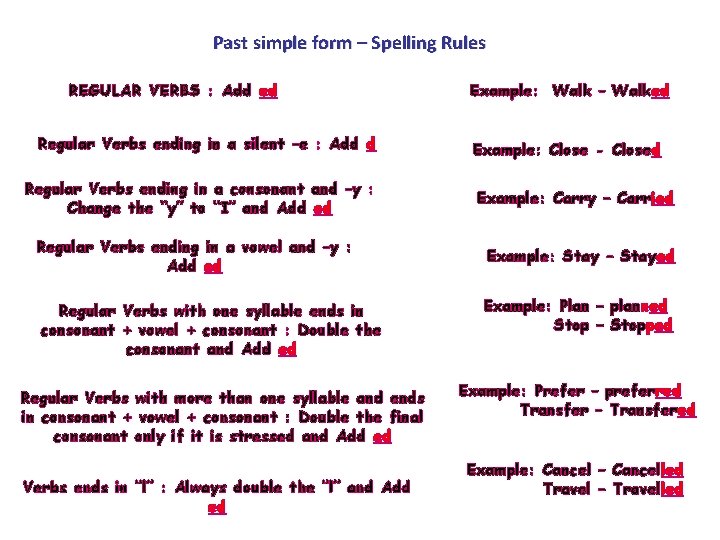
Past simple form – Spelling Rules REGULAR VERBS : Add ed Regular Verbs ending in a silent –e : Add d Regular Verbs ending in a consonant and –y : Change the “y” to “I” and Add ed Regular Verbs ending in a vowel and –y : Add ed Regular Verbs with one syllable ends in consonant + vowel + consonant : Double the consonant and Add ed Regular Verbs with more than one syllable and ends in consonant + vowel + consonant : Double the final consonant only if it is stressed and Add ed Verbs ends in “l” : Always double the “l” and Add ed Example: Walk – Walked Example: Close - Closed Example: Carry – Carried Example: Stay – Stayed Example: Plan – planned Stop – Stopped Example: Prefer – preferred Transfer – Transfered Example: Cancel – Cancelled Travel – Travelled