
Why do we need statistics To enable us
Why do we need statistics? • To enable us to test experimental hypotheses • H 0 = null hypothesis • H 1 = experimental hypothesis Lorelei Howard and Nick Wright, University College London, 2008 Edited by Dr. Spence
2 types of statistics • Descriptive Stats • e. g. , mean and standard deviation (S. D) • Inferential statistics • t-tests, ANOVAs and regression
How do we know whether the effect sample was genuine? observed in our • We don’t • Instead we use p values to indicate our level of certainty that our results represent a genuine effect present in the whole population
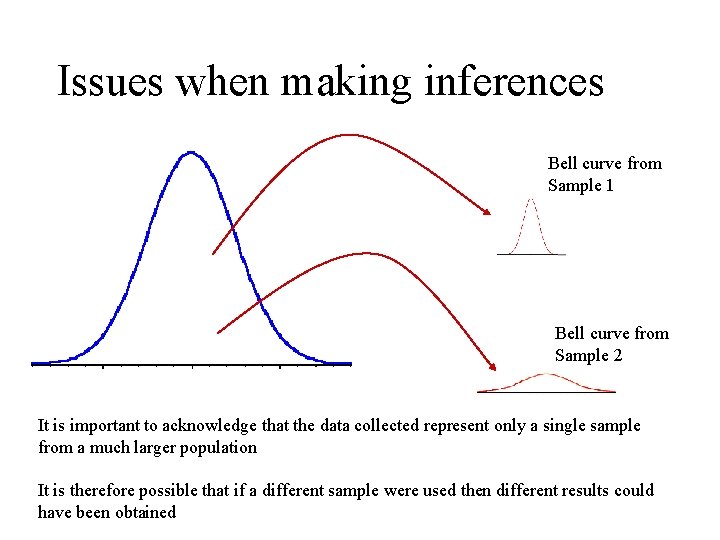
Issues when making inferences Bell curve from Sample 1 Bell curve from Sample 2 It is important to acknowledge that the data collected represent only a single sample from a much larger population It is therefore possible that if a different sample were used then different results could have been obtained
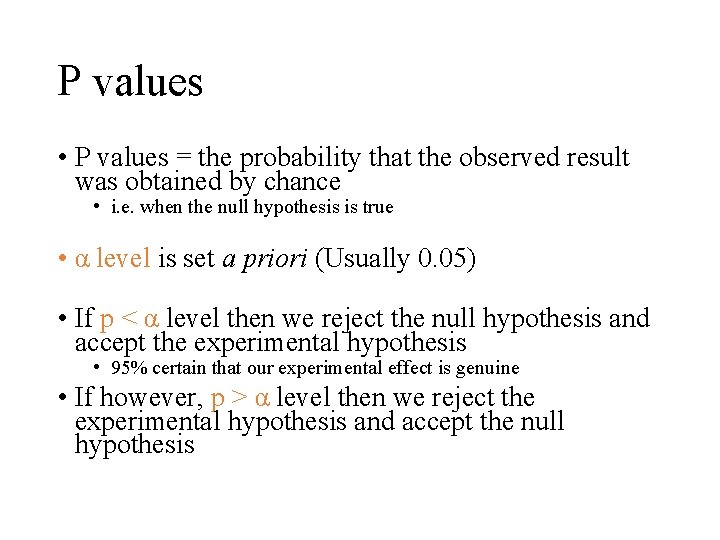
P values • P values = the probability that the observed result was obtained by chance • i. e. when the null hypothesis is true • α level is set a priori (Usually 0. 05) • If p < α level then we reject the null hypothesis and accept the experimental hypothesis • 95% certain that our experimental effect is genuine • If however, p > α level then we reject the experimental hypothesis and accept the null hypothesis
Two types of errors • Type I error = false positive • α level of 0. 05 means that there is 5% risk that a type I error will be encountered • Type II error = false negative
R 2 Correlation Regression analysis is a statistical process for estimating the relationships. The larger the R 2 value is, the better predictor exists between the two variables. For example: Is the length of time one spends studying a good predictor of earing a good grade on exam?
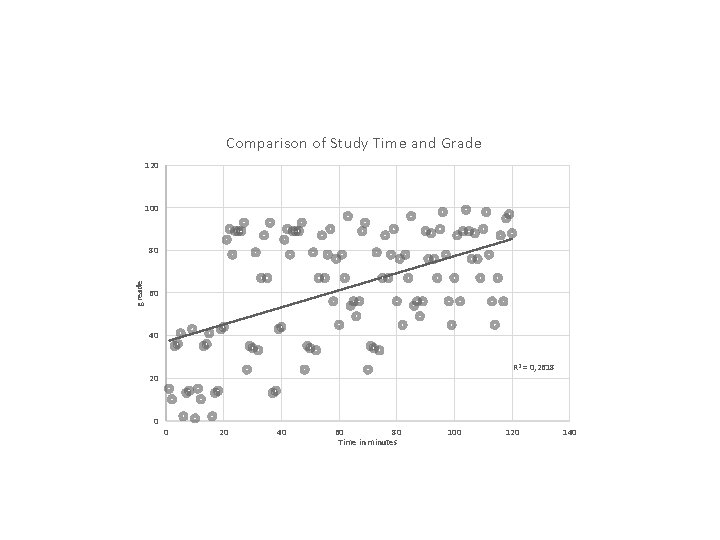
Comparison of Study Time and Grade 120 100 greade 80 60 40 R 2 = 0, 2618 20 0 0 20 40 60 80 Time in minutes 100 120 140
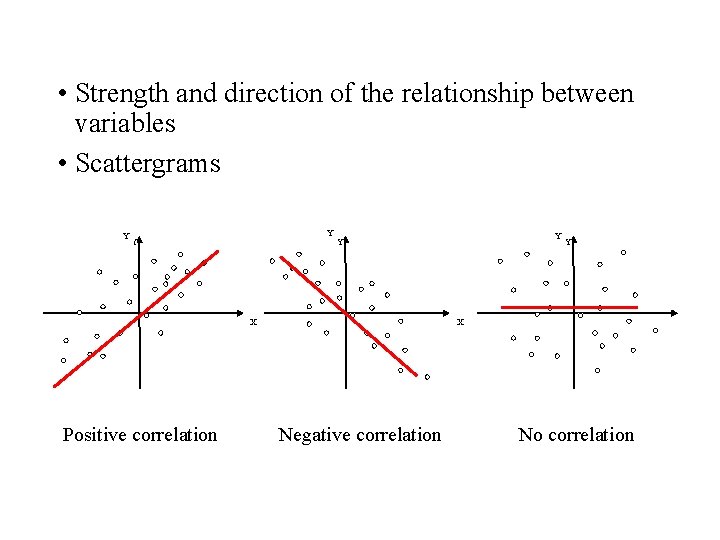
• Strength and direction of the relationship between variables • Scattergrams Y Y Y X Positive correlation Y Y Y X Negative correlation No correlation
Regression • Regression: Prediction of one variable from knowledge of one or more other variables. • Regression v. correlation: Regression allows you to predict one variable from the other (not just say if there is an association). • Linear regression aims to fit a straight line to data that for any value of x gives the best prediction of y.
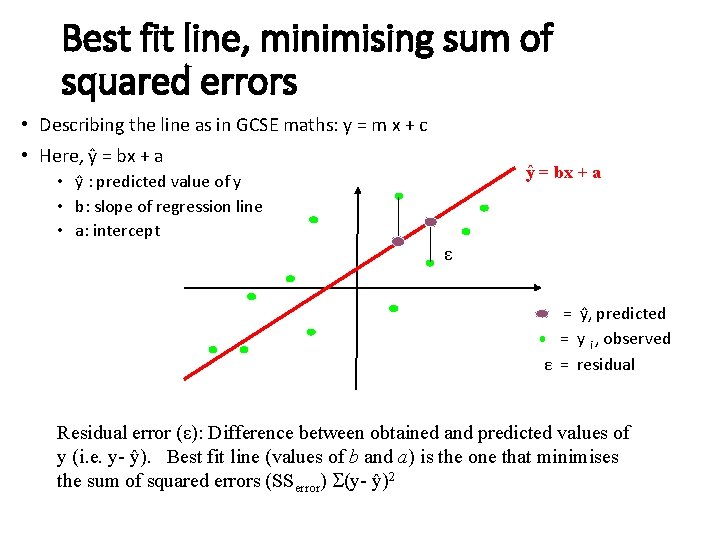
Best fit line, minimising sum of squared errors • Describing the line as in GCSE maths: y = m x + c • Here, ŷ = bx + a • ŷ : predicted value of y • b: slope of regression line • a: intercept ε = ŷ, predicted = y i , observed ε = residual Residual error (ε): Difference between obtained and predicted values of y (i. e. y- ŷ). Best fit line (values of b and a) is the one that minimises the sum of squared errors (SSerror) (y- ŷ)2
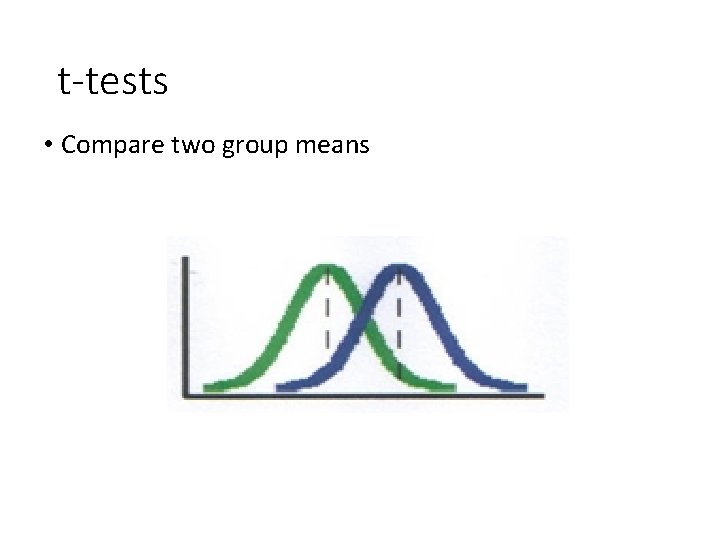
The t-test Inferences about Population Means The two sample t-test simply tests whether or not two independent populations have different mean values on some measure. Use a T-test to compare two small sets of quantitative data when samples are collected independently of one another.
T-test Background • The t-test is used to test hypotheses about means when the population variance is unknown (the usual case).
t-tests • Compare two group means
Degrees of Freedom For the t distribution, degrees of freedom are always a simple function of the sample size, where “N” is the number of observations, for the formula for the statistical test uses N -1. With 25 observations for males and 25 observations for females, the df is 25 + 25 = 50 df = 48
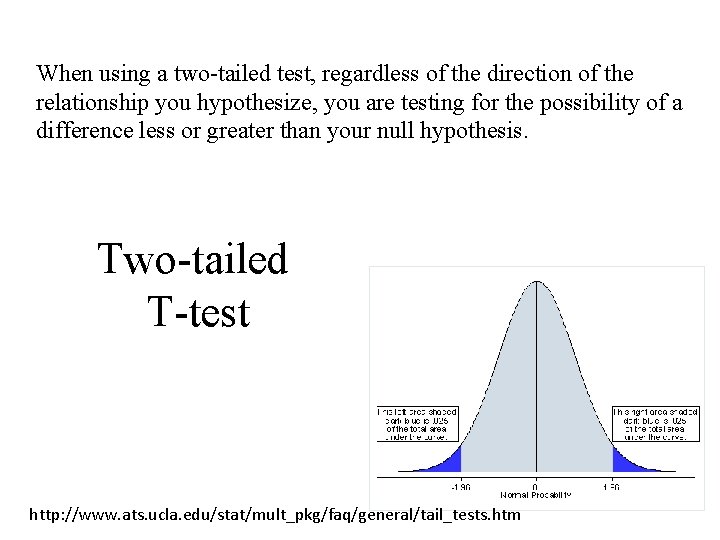
When using a two-tailed test, regardless of the direction of the relationship you hypothesize, you are testing for the possibility of a difference less or greater than your null hypothesis. Two-tailed T-test http: //www. ats. ucla. edu/stat/mult_pkg/faq/general/tail_tests. htm
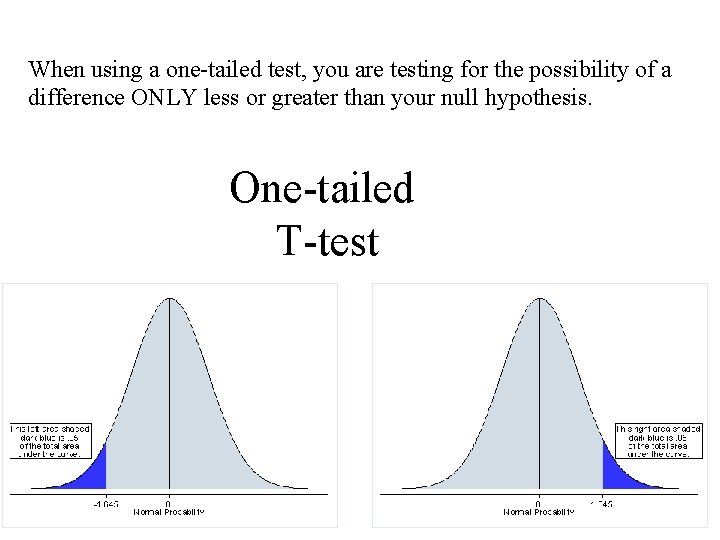
When using a one-tailed test, you are testing for the possibility of a difference ONLY less or greater than your null hypothesis. One-tailed T-test
Statistics videos https: //www. youtube. com/watch? v=p. Tm. LQv. MM-1 M Bozeman t-Tests https: //www. youtube. com/watch? v=jf 9 VT 4 V 4 a. RI General statistics https: //www. youtube. com/watch? v=h. FV 71 QPv. X 2 I Crash course Psychological Research
A t-Test uses the mean, standard deviation, and variance of two sets of data to determine if they are similar or statistically different. It generates a p-value that, when less than 0. 05, is a sign of significant difference. A regression analysis compares two continuous data sets to see if one may be a predictor.
SL Bio Internal Assessment Overview
Format • There are 5 criteria on which you will be assessed on the IA: • • • Personal engagement (2) Exploration (6) Analysis (6) Evaluation (6) Communication (4) • There are 24 total marks. • Times New Roman, 11 point font, 1. 5 spacing. • All sections titled and underlined.
Theme • The theme for your IA is the exploration of some aspect of human physiology. • Some ideas include: • How does gender affect dominant hand grip strength, measured in Newtons? • Is there a correlation between males’ body weight and their heart rate? • Does a female’s height have an effect on her tidal volume?
Equipment • The following pieces of equipment will be available for your use: • Heart rate monitors • Spirometers (measure lung capacity and flow rate) • Hand dynamometers (used to measure grip/pinch strength) • Lab Quests and Lab Pros • Laptop computers • Meter sticks • Scales
The Criteria, Explained
Personal Engagement (2) • “This criterion assesses the extent to which the student engages with the exploration and makes it their own. Personal engagement may be recognized in different attributes and skills. These could include addressing personal interest or showing evidence of independent thinking, creativity, or initiative in the designing, implementation or presentation of the investigation. ” (The internal assessment criteria, ibo. org) • This section is all about why you are choosing to explore the subject of your IA. You will need to address some kind of personal interest, independent thinking, novelty, and/or persistence in your IA.
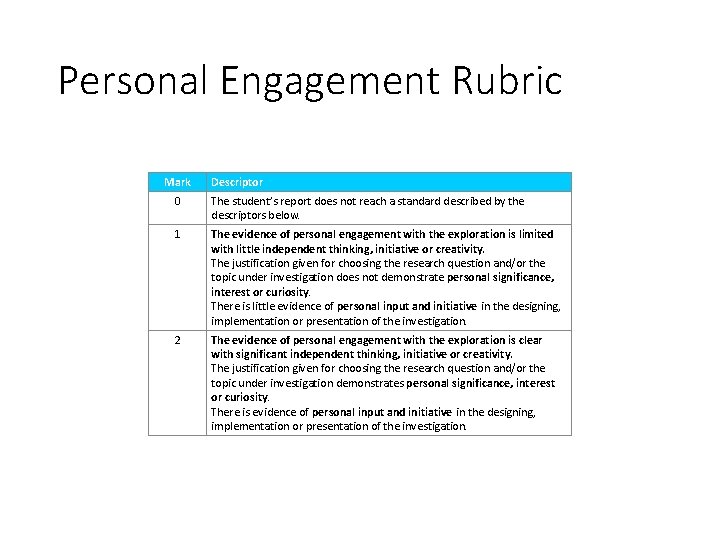
Personal Engagement Rubric Mark Descriptor 0 The student’s report does not reach a standard described by the descriptors below. 1 The evidence of personal engagement with the exploration is limited with little independent thinking, initiative or creativity. The justification given for choosing the research question and/or the topic under investigation does not demonstrate personal significance, interest or curiosity. There is little evidence of personal input and initiative in the designing, implementation or presentation of the investigation. 2 The evidence of personal engagement with the exploration is clear with significant independent thinking, initiative or creativity. The justification given for choosing the research question and/or the topic under investigation demonstrates personal significance, interest or curiosity. There is evidence of personal input and initiative in the designing, implementation or presentation of the investigation.
Exploration (Design) (6) • “ This criterion assesses the extent to which the student establishes the scientific context for the work, states a clear and focused research question and uses concepts and techniques appropriate to Diploma level. Where appropriate, this criterion also assesses awareness of safety, environmental, and ethical considerations. ” (The internal assessment criteria, ibo. org) • This was formerly known as the design component of the IA. Within this section, you must address the following: • • Background research (with at least 2 references) A clearly stated research question/purpose Hypothesis Independent, and controlled variables (present in a table format) Experimental set-up (picture(s) of your set-up with labels of IV, DV and controls Materials (detailed, with units i. e. 150 -ml graduated cylinder, 5 500 -ml beakers, etc. ) Procedure (step-by-step process to replicate your experiment, with replicates noted) Safety (ensure that no individual is placed under physical or emotional duress and how you will know and control this)
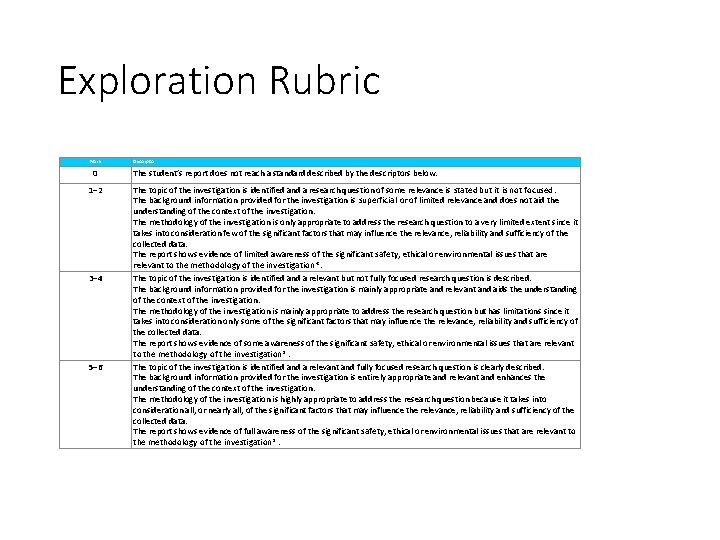
Exploration Rubric Mark 0 1– 2 3– 4 5– 6 Descriptor The student’s report does not reach a standard described by the descriptors below. The topic of the investigation is identified and a research question of some relevance is stated but it is not focused. The background information provided for the investigation is superficial or of limited relevance and does not aid the understanding of the context of the investigation. The methodology of the investigation is only appropriate to address the research question to a very limited extent since it takes into consideration few of the significant factors that may influence the relevance, reliability and sufficiency of the collected data. The report shows evidence of limited awareness of the significant safety, ethical or environmental issues that are relevant to the methodology of the investigation*. The topic of the investigation is identified and a relevant but not fully focused research question is described. The background information provided for the investigation is mainly appropriate and relevant and aids the understanding of the context of the investigation. The methodology of the investigation is mainly appropriate to address the research question but has limitations since it takes into consideration only some of the significant factors that may influence the relevance, reliability and sufficiency of the collected data. The report shows evidence of some awareness of the significant safety, ethical or environmental issues that are relevant to the methodology of the investigation*. The topic of the investigation is identified and a relevant and fully focused research question is clearly described. The background information provided for the investigation is entirely appropriate and relevant and enhances the understanding of the context of the investigation. The methodology of the investigation is highly appropriate to address the research question because it takes into consideration all, or nearly all, of the significant factors that may influence the relevance, reliability and sufficiency of the collected data. The report shows evidence of full awareness of the significant safety, ethical or environmental issues that are relevant to the methodology of the investigation*.
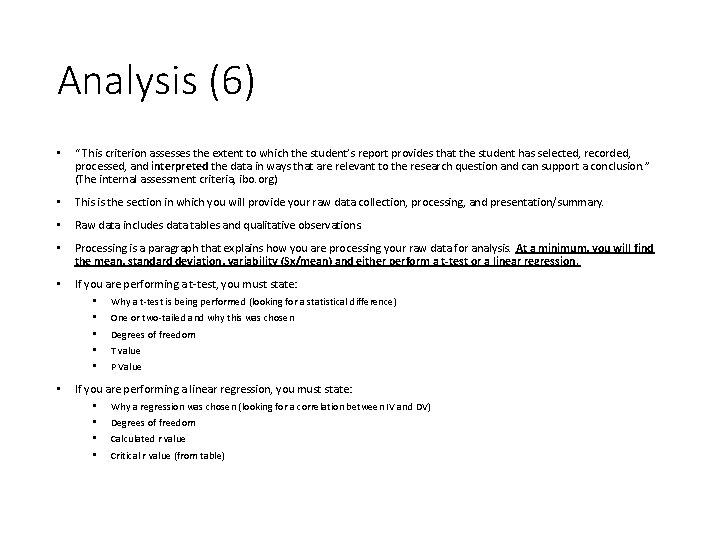
Analysis (6) • “ This criterion assesses the extent to which the student’s report provides that the student has selected, recorded, processed, and interpreted the data in ways that are relevant to the research question and can support a conclusion. ” (The internal assessment criteria, ibo. org) • This is the section in which you will provide your raw data collection, processing, and presentation/summary. • Raw data includes data tables and qualitative observations. • Processing is a paragraph that explains how you are processing your raw data for analysis. At a minimum, you will find the mean, standard deviation, variability (Sx/mean) and either perform a t-test or a linear regression. • If you are performing a t-test, you must state: • • • Why a t-test is being performed (looking for a statistical difference) One or two-tailed and why this was chosen Degrees of freedom T value P Value If you are performing a linear regression, you must state: • • Why a regression was chosen (looking for a correlation between IV and DV) Degrees of freedom Calculated r value Critical r value (from table)
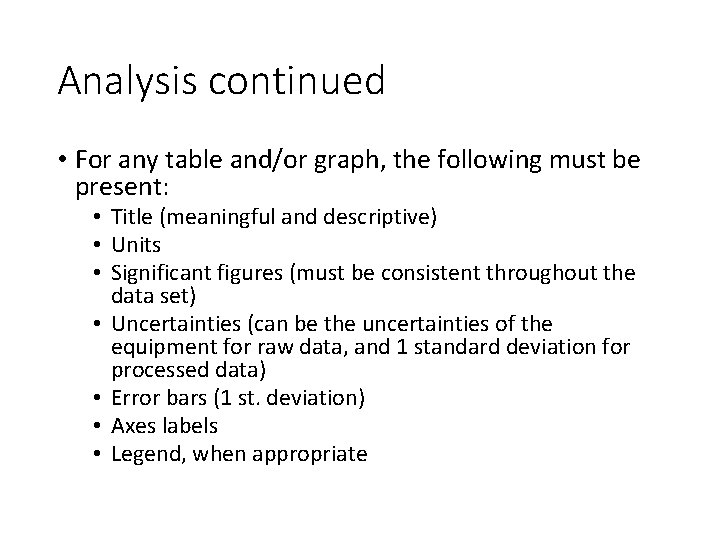
Analysis continued • For any table and/or graph, the following must be present: • Title (meaningful and descriptive) • Units • Significant figures (must be consistent throughout the data set) • Uncertainties (can be the uncertainties of the equipment for raw data, and 1 standard deviation for processed data) • Error bars (1 st. deviation) • Axes labels • Legend, when appropriate
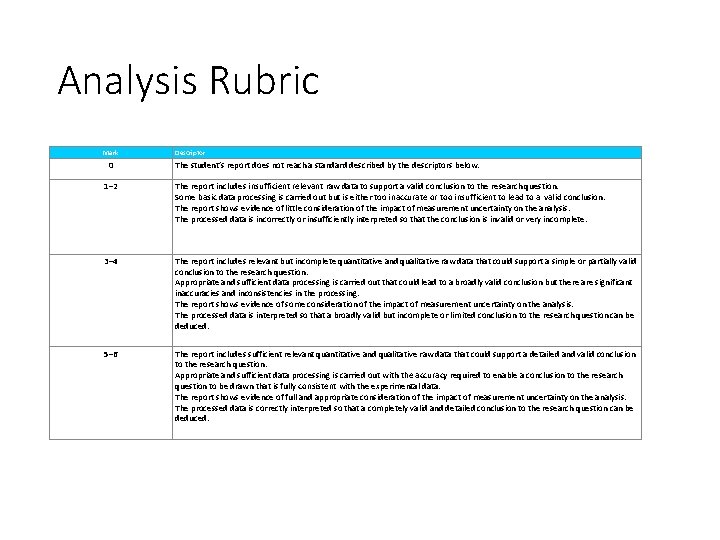
Analysis Rubric Mark 0 Descriptor The student’s report does not reach a standard described by the descriptors below. 1– 2 The report includes insufficient relevant raw data to support a valid conclusion to the research question. Some basic data processing is carried out but is either too inaccurate or too insufficient to lead to a valid conclusion. The report shows evidence of little consideration of the impact of measurement uncertainty on the analysis. The processed data is incorrectly or insufficiently interpreted so that the conclusion is invalid or very incomplete. 3– 4 The report includes relevant but incomplete quantitative and qualitative raw data that could support a simple or partially valid conclusion to the research question. Appropriate and sufficient data processing is carried out that could lead to a broadly valid conclusion but there are significant inaccuracies and inconsistencies in the processing. The report shows evidence of some consideration of the impact of measurement uncertainty on the analysis. The processed data is interpreted so that a broadly valid but incomplete or limited conclusion to the research question can be deduced. 5– 6 The report includes sufficient relevant quantitative and qualitative raw data that could support a detailed and valid conclusion to the research question. Appropriate and sufficient data processing is carried out with the accuracy required to enable a conclusion to the research question to be drawn that is fully consistent with the experimental data. The report shows evidence of full and appropriate consideration of the impact of measurement uncertainty on the analysis. The processed data is correctly interpreted so that a completely valid and detailed conclusion to the research question can be deduced.
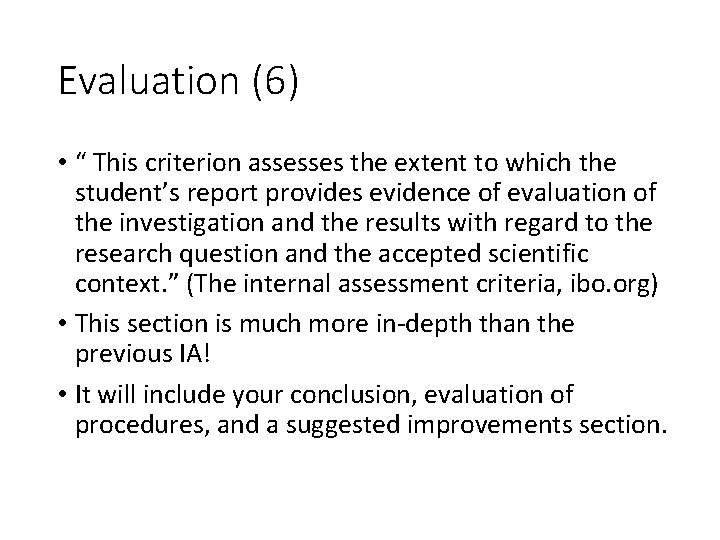
Evaluation (6) • “ This criterion assesses the extent to which the student’s report provides evidence of evaluation of the investigation and the results with regard to the research question and the accepted scientific context. ” (The internal assessment criteria, ibo. org) • This section is much more in-depth than the previous IA! • It will include your conclusion, evaluation of procedures, and a suggested improvements section.
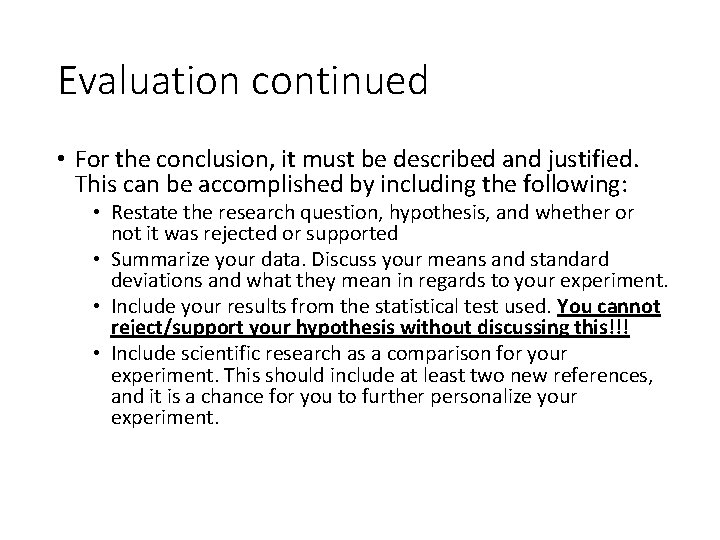
Evaluation continued • For the conclusion, it must be described and justified. This can be accomplished by including the following: • Restate the research question, hypothesis, and whether or not it was rejected or supported • Summarize your data. Discuss your means and standard deviations and what they mean in regards to your experiment. • Include your results from the statistical test used. You cannot reject/support your hypothesis without discussing this!!! • Include scientific research as a comparison for your experiment. This should include at least two new references, and it is a chance for you to further personalize your experiment.
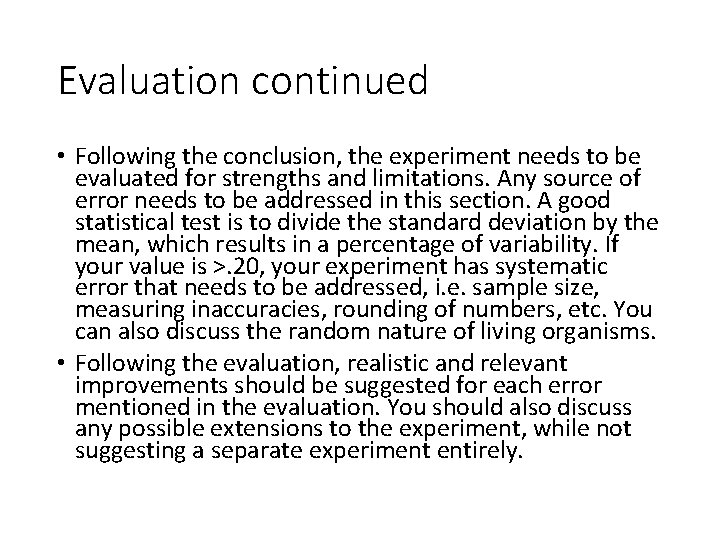
Evaluation continued • Following the conclusion, the experiment needs to be evaluated for strengths and limitations. Any source of error needs to be addressed in this section. A good statistical test is to divide the standard deviation by the mean, which results in a percentage of variability. If your value is >. 20, your experiment has systematic error that needs to be addressed, i. e. sample size, measuring inaccuracies, rounding of numbers, etc. You can also discuss the random nature of living organisms. • Following the evaluation, realistic and relevant improvements should be suggested for each error mentioned in the evaluation. You should also discuss any possible extensions to the experiment, while not suggesting a separate experiment entirely.
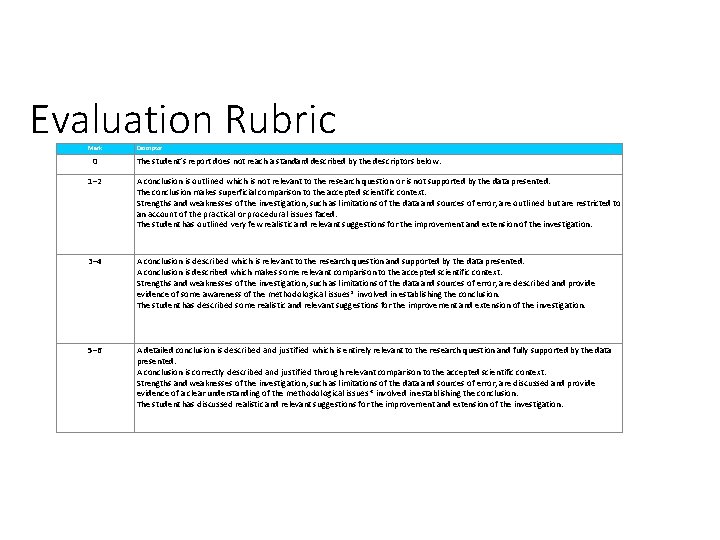
Evaluation Rubric Mark 0 Descriptor The student’s report does not reach a standard described by the descriptors below. 1– 2 A conclusion is outlined which is not relevant to the research question or is not supported by the data presented. The conclusion makes superficial comparison to the accepted scientific context. Strengths and weaknesses of the investigation, such as limitations of the data and sources of error, are outlined but are restricted to an account of the practical or procedural issues faced. The student has outlined very few realistic and relevant suggestions for the improvement and extension of the investigation. 3– 4 A conclusion is described which is relevant to the research question and supported by the data presented. A conclusion is described which makes some relevant comparison to the accepted scientific context. Strengths and weaknesses of the investigation, such as limitations of the data and sources of error, are described and provide evidence of some awareness of the methodological issues* involved in establishing the conclusion. The student has described some realistic and relevant suggestions for the improvement and extension of the investigation. 5– 6 A detailed conclusion is described and justified which is entirely relevant to the research question and fully supported by the data presented. A conclusion is correctly described and justified through relevant comparison to the accepted scientific context. Strengths and weaknesses of the investigation, such as limitations of the data and sources of error, are discussed and provide evidence of a clear understanding of the methodological issues* involved in establishing the conclusion. The student has discussed realistic and relevant suggestions for the improvement and extension of the investigation.
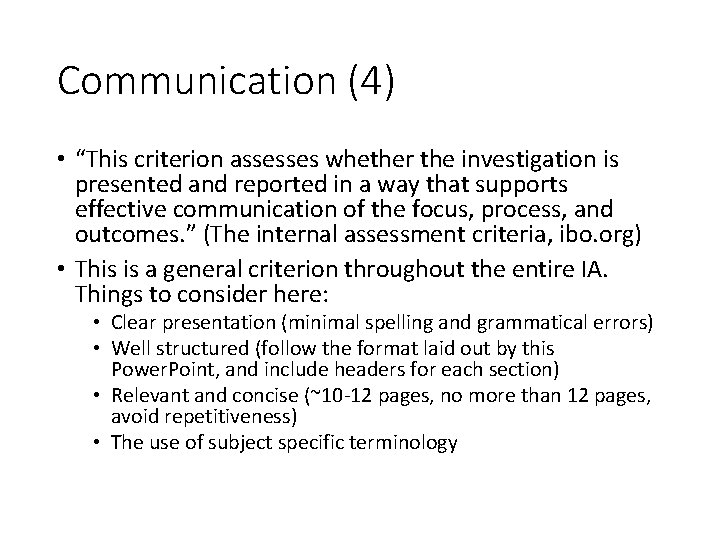
Communication (4) • “This criterion assesses whether the investigation is presented and reported in a way that supports effective communication of the focus, process, and outcomes. ” (The internal assessment criteria, ibo. org) • This is a general criterion throughout the entire IA. Things to consider here: • Clear presentation (minimal spelling and grammatical errors) • Well structured (follow the format laid out by this Power. Point, and include headers for each section) • Relevant and concise (~10 -12 pages, no more than 12 pages, avoid repetitiveness) • The use of subject specific terminology
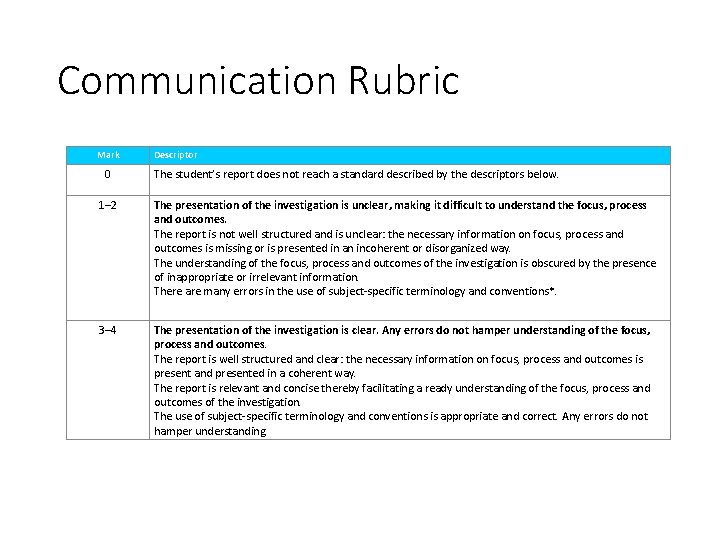
Communication Rubric Mark 0 Descriptor The student’s report does not reach a standard described by the descriptors below. 1– 2 The presentation of the investigation is unclear, making it difficult to understand the focus, process and outcomes. The report is not well structured and is unclear: the necessary information on focus, process and outcomes is missing or is presented in an incoherent or disorganized way. The understanding of the focus, process and outcomes of the investigation is obscured by the presence of inappropriate or irrelevant information. There are many errors in the use of subject-specific terminology and conventions*. 3– 4 The presentation of the investigation is clear. Any errors do not hamper understanding of the focus, process and outcomes. The report is well structured and clear: the necessary information on focus, process and outcomes is present and presented in a coherent way. The report is relevant and concise thereby facilitating a ready understanding of the focus, process and outcomes of the investigation. The use of subject-specific terminology and conventions is appropriate and correct. Any errors do not hamper understanding.
Works Cited • You must include a works cited page with your IA. For consistency, this should be in proper MLA format. For help, visit the Purdue Owl website https: //owl. english. purdue. edu/owl/resource/747/ 01/ or Ms. Murray in the media center can be of assistance as well.
Works Cited • Biology teacher support material. IB Diploma Programme. Web. 11 Nov. 2015.
Personal Engagement – This is where you explain why it is important to you. And…. How can your question provide some new understanding of this physiologic measurement can benefit human health. If you were developing an IA on human physiology and were asking a question related to maintaining homeostasis, you would want to the PE to address one of the human processes below. Once you were going to choose one of the topic areas you would test specific variables. Major topic areas: Blood pressure, Heart rate, Stamina, Visual acuity, Blood sugar level, Variables: height, gender, wrist size, exercise, stillness,
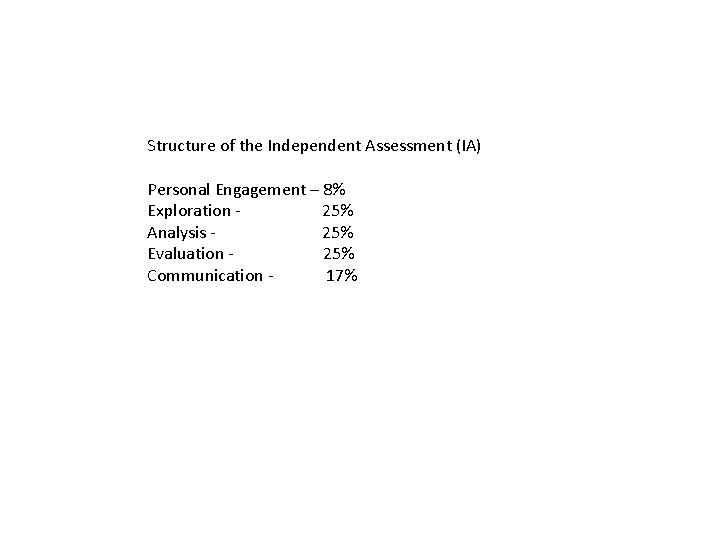
Structure of the Independent Assessment (IA) Personal Engagement – 8% Exploration 25% Analysis 25% Evaluation 25% Communication 17%
- Slides: 41