
Why do we need palliative care in the
- Slides: 22
Why do we need palliative care in the era of treatment? Dr Richard Harding Department of Palliative Care, Policy & Rehabilitation King’s College London http: //www. kcl. ac. uk/pallia tive
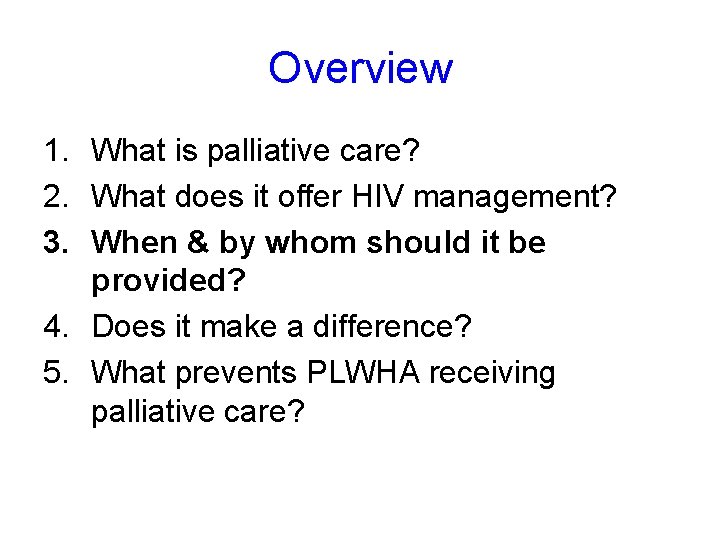
Overview 1. 2. 3. 4. 5. What is palliative care? What does it offer HIV management? When & by whom should it be provided? Does it make a difference? What prevents PLWHA receiving palliative care?
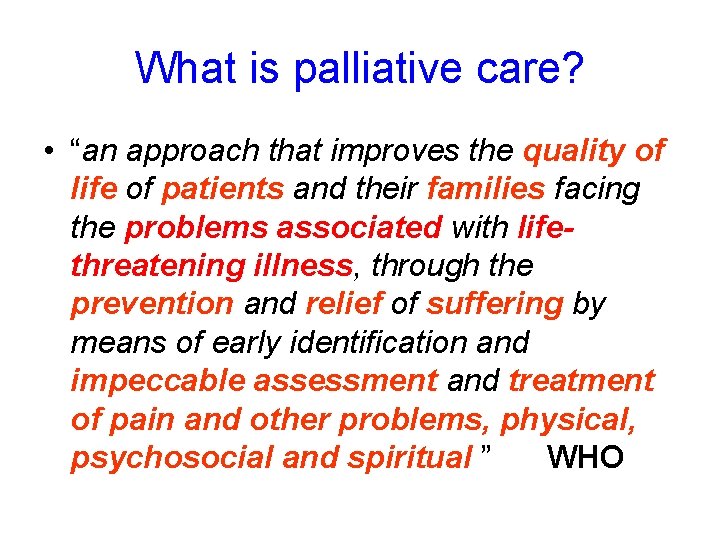
What is palliative care? • “an approach that improves the quality of life of patients and their families facing the problems associated with lifethreatening illness, through the prevention and relief of suffering by means of early identification and impeccable assessment and treatment of pain and other problems, physical, psychosocial and spiritual ” WHO
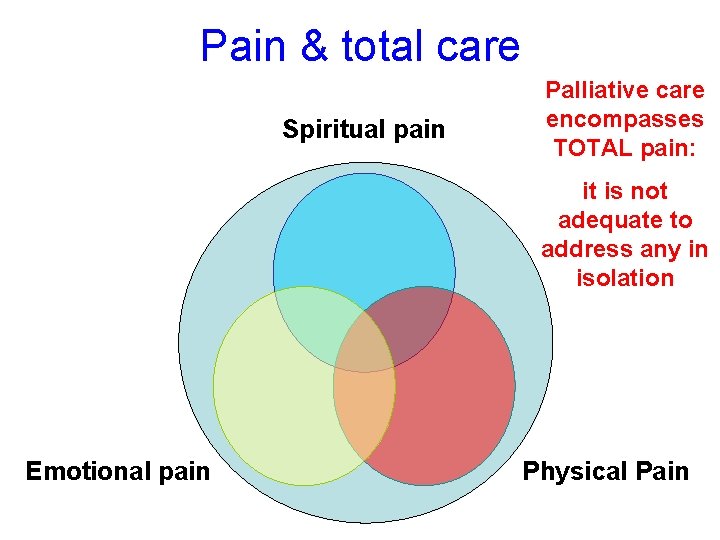
Pain & total care Spiritual pain Palliative care encompasses TOTAL pain: it is not adequate to address any in isolation Emotional pain Physical Pain
HIV Palliative care • WHO “Palliative care is an essential component of a comprehensive package of care for people living with HIV/AIDS because of the variety of symptoms they can experience - such as pain, diarrhoea, cough, shortness of breath, nausea, weakness, fatigue, fever, and confusion. ”
Overview 1. 2. 3. 4. 5. What is palliative care? What does it offer HIV management? When & by who should it be provided? Does it make a difference? What prevents PLWHA receiving palliative care?
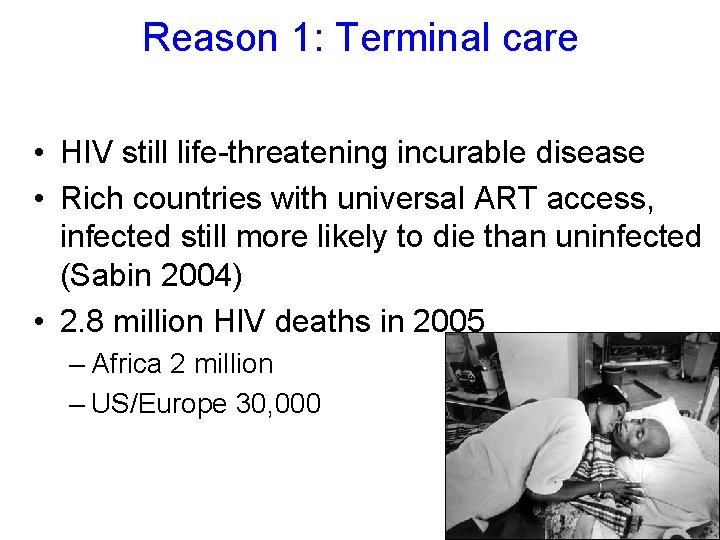
Reason 1: Terminal care • HIV still life-threatening incurable disease • Rich countries with universal ART access, infected still more likely to die than uninfected (Sabin 2004) • 2. 8 million HIV deaths in 2005 – Africa 2 million – US/Europe 30, 000
Reason 2 • ARVs not available for many; terminal care needed Reason 3 • Late presenters: advanced disease care • In Sub-Saharan Africa palliative care used to stabilise & initiate ART in advanced pts
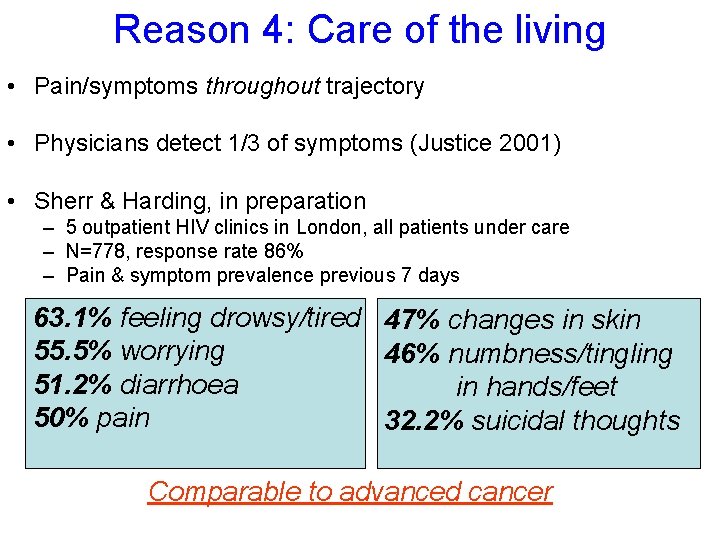
Reason 4: Care of the living • Pain/symptoms throughout trajectory • Physicians detect 1/3 of symptoms (Justice 2001) • Sherr & Harding, in preparation – 5 outpatient HIV clinics in London, all patients under care – N=778, response rate 86% – Pain & symptom prevalence previous 7 days 63. 1% feeling drowsy/tired 47% changes in skin 55. 5% worrying 46% numbness/tingling 51. 2% diarrhoea in hands/feet 50% pain 32. 2% suicidal thoughts Comparable to advanced cancer
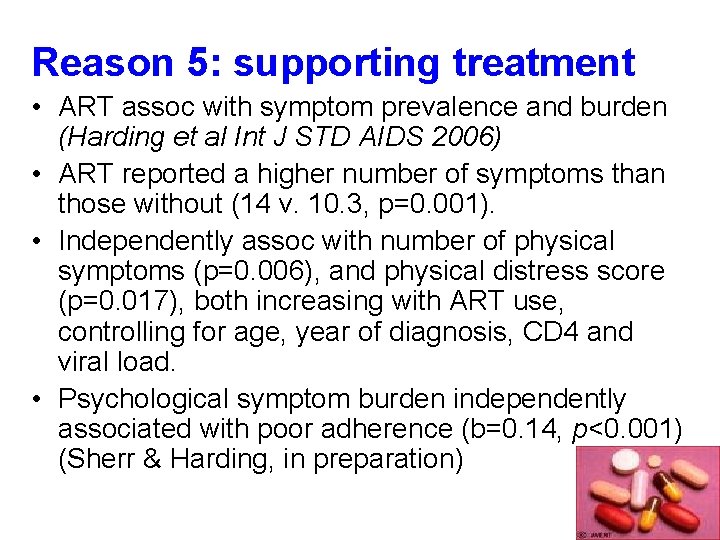
Reason 5: supporting treatment • ART assoc with symptom prevalence and burden (Harding et al Int J STD AIDS 2006) • ART reported a higher number of symptoms than those without (14 v. 10. 3, p=0. 001). • Independently assoc with number of physical symptoms (p=0. 006), and physical distress score (p=0. 017), both increasing with ART use, controlling for age, year of diagnosis, CD 4 and viral load. • Psychological symptom burden independently associated with poor adherence (b=0. 14, p<0. 001) (Sherr & Harding, in preparation)
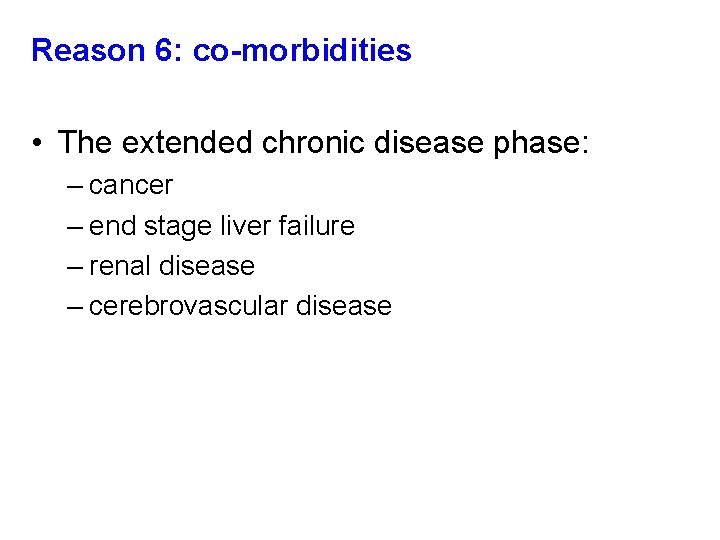
Reason 6: co-morbidities • The extended chronic disease phase: – cancer – end stage liver failure – renal disease – cerebrovascular disease
Overview 1. What is palliative care? 2. What does it offer HIV management? 3. When & by whom should it be provided? 4. Does it make a difference? 5. What prevents PLWHA receiving palliative care?
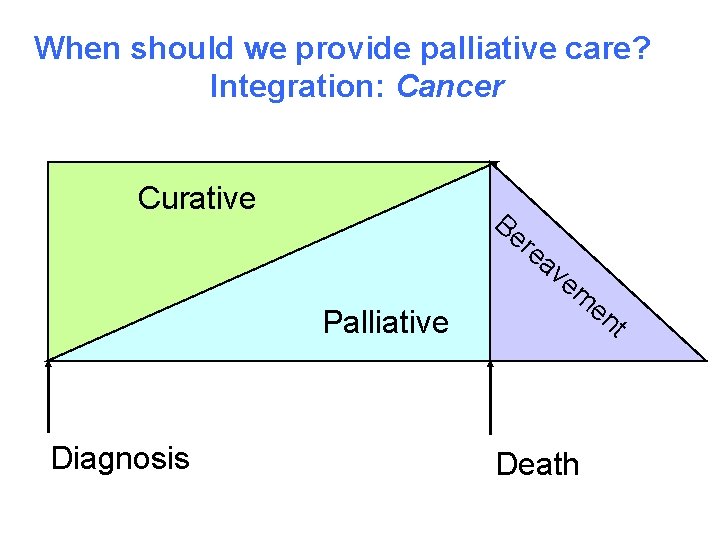
When should we provide palliative care? Integration: Cancer Curative Be r ea v em en t Palliative Diagnosis Death
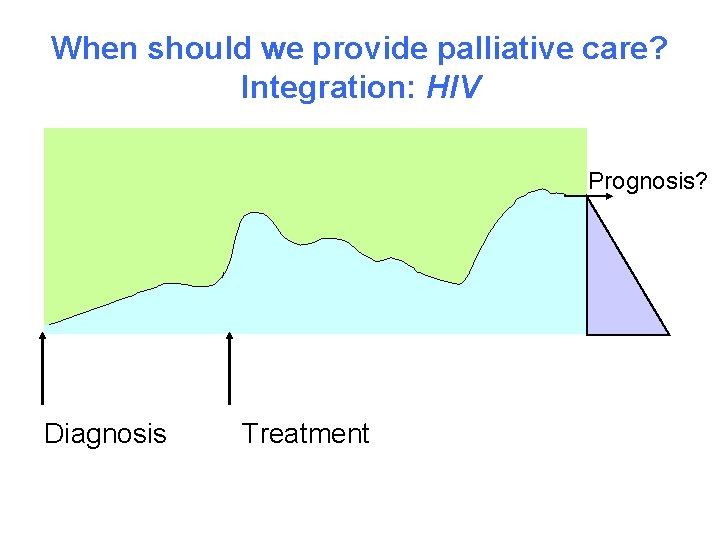
When should we provide palliative care? Integration: HIV Prognosis? Diagnosis Treatment
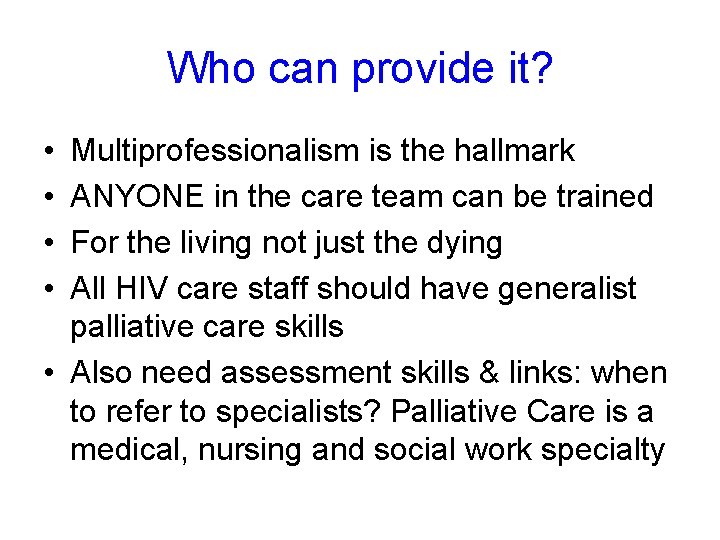
Who can provide it? • • Multiprofessionalism is the hallmark ANYONE in the care team can be trained For the living not just the dying All HIV care staff should have generalist palliative care skills • Also need assessment skills & links: when to refer to specialists? Palliative Care is a medical, nursing and social work specialty
Overview 1. 2. 3. 4. 5. What is palliative care? What does it offer HIV management? When & by who should it be provided? Does it make a difference? What prevents PLWHA receiving palliative care?
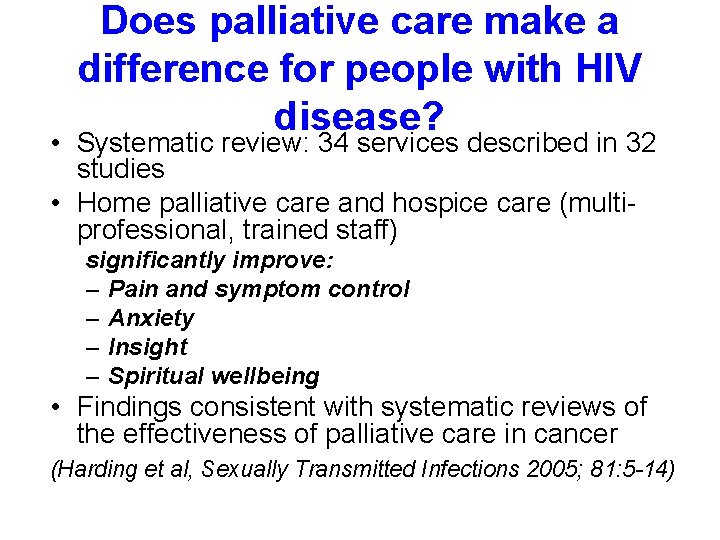
Does palliative care make a difference for people with HIV disease? • Systematic review: 34 services described in 32 studies • Home palliative care and hospice care (multiprofessional, trained staff) significantly improve: – Pain and symptom control – Anxiety – Insight – Spiritual wellbeing • Findings consistent with systematic reviews of the effectiveness of palliative care in cancer (Harding et al, Sexually Transmitted Infections 2005; 81: 5 -14)
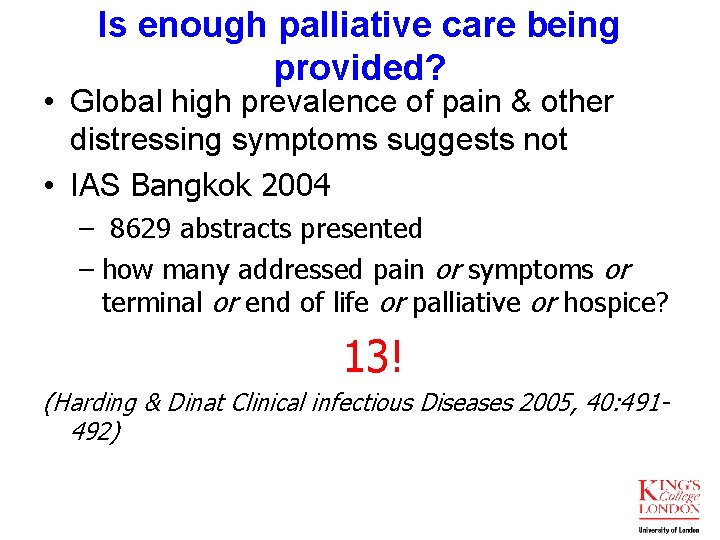
Is enough palliative care being provided? • Global high prevalence of pain & other distressing symptoms suggests not • IAS Bangkok 2004 – 8629 abstracts presented – how many addressed pain or symptoms or terminal or end of life or palliative or hospice? 13! (Harding & Dinat Clinical infectious Diseases 2005, 40: 491492)
Overview 1. 2. 3. 4. 5. What is palliative care? What does it offer HIV management? When & by who should it be provided? Does it make a difference? What prevents PLWHA receiving palliative care?
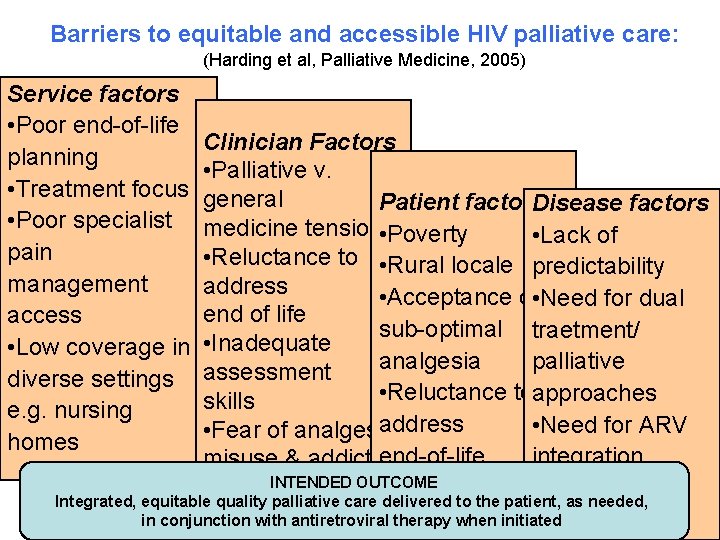
Barriers to equitable and accessible HIV palliative care: (Harding et al, Palliative Medicine, 2005) Service factors • Poor end-of-life planning • Treatment focus • Poor specialist pain management access • Low coverage in diverse settings e. g. nursing homes Clinician Factors • Palliative v. general Patient factors Disease factors medicine tension • Poverty • Lack of • Reluctance to • Rural locale predictability address • Acceptance of • Need for dual end of life sub-optimal traetment/ • Inadequate analgesia palliative assessment • Reluctance toapproaches skills address • Need for ARV • Fear of analgesia end-of-life integration misuse & addiction INTENDED OUTCOME Integrated, equitable quality palliative care delivered to the patient, as needed, in conjunction with antiretroviral therapy when initiated
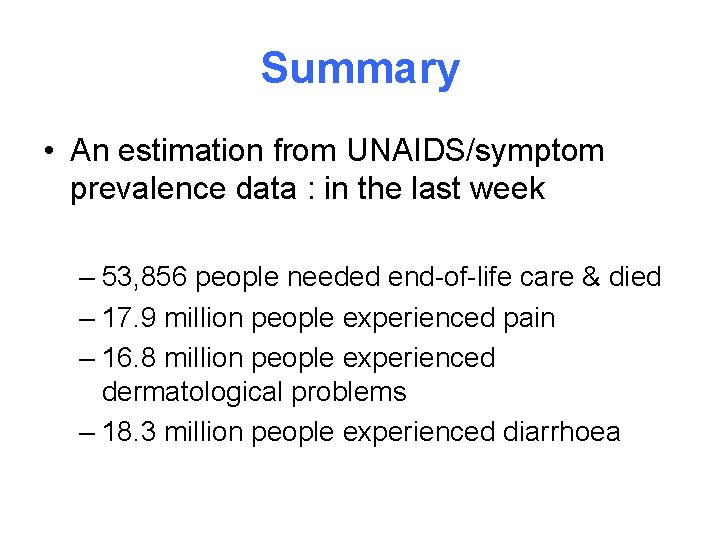
Summary • An estimation from UNAIDS/symptom prevalence data : in the last week – 53, 856 people needed end-of-life care & died – 17. 9 million people experienced pain – 16. 8 million people experienced dermatological problems – 18. 3 million people experienced diarrhoea
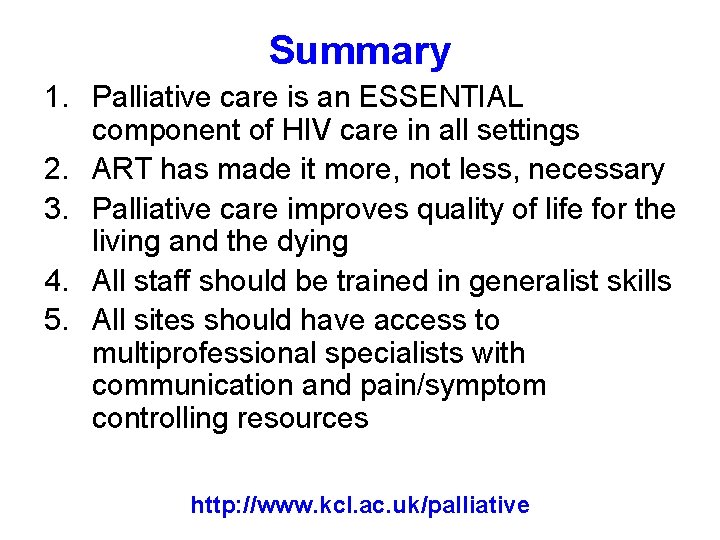
Summary 1. Palliative care is an ESSENTIAL component of HIV care in all settings 2. ART has made it more, not less, necessary 3. Palliative care improves quality of life for the living and the dying 4. All staff should be trained in generalist skills 5. All sites should have access to multiprofessional specialists with communication and pain/symptom controlling resources http: //www. kcl. ac. uk/palliative