
Why do we need data protection Current and

- Slides: 10
„Why do we need data protection? Current and forthcoming challenges in democratic societies“ Twinning Expert Workshop Podgorica, 7 February 2011 © Prof. Hannes Tretter, University of Vienna Director Ludwig Boltzmann Institute of Human Rights (BIM)
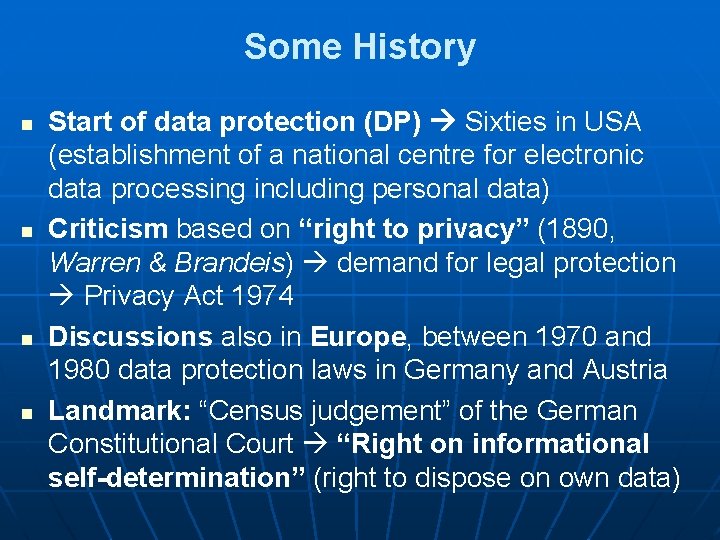
Some History n n Start of data protection (DP) Sixties in USA (establishment of a national centre for electronic data processing including personal data) Criticism based on “right to privacy” (1890, Warren & Brandeis) demand for legal protection Privacy Act 1974 Discussions also in Europe, between 1970 and 1980 data protection laws in Germany and Austria Landmark: “Census judgement” of the German Constitutional Court “Right on informational self-determination” (right to dispose on own data)
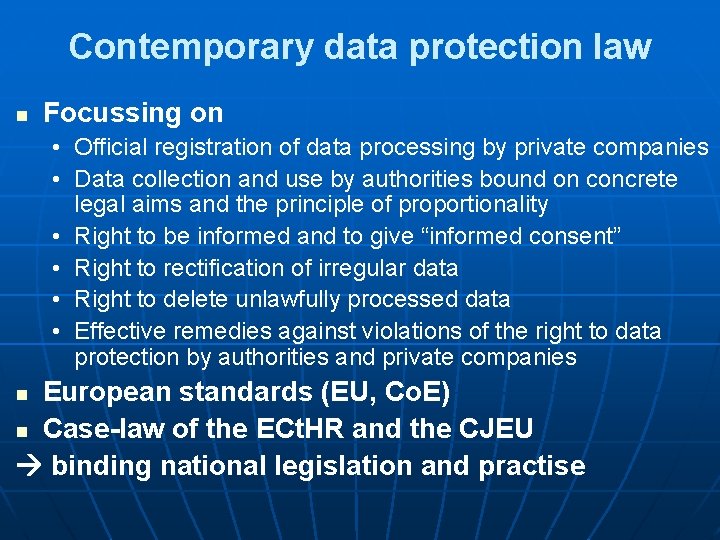
Contemporary data protection law n Focussing on • Official registration of data processing by private companies • Data collection and use by authorities bound on concrete legal aims and the principle of proportionality • Right to be informed and to give “informed consent” • Right to rectification of irregular data • Right to delete unlawfully processed data • Effective remedies against violations of the right to data protection by authorities and private companies European standards (EU, Co. E) n Case-law of the ECt. HR and the CJEU binding national legislation and practise n
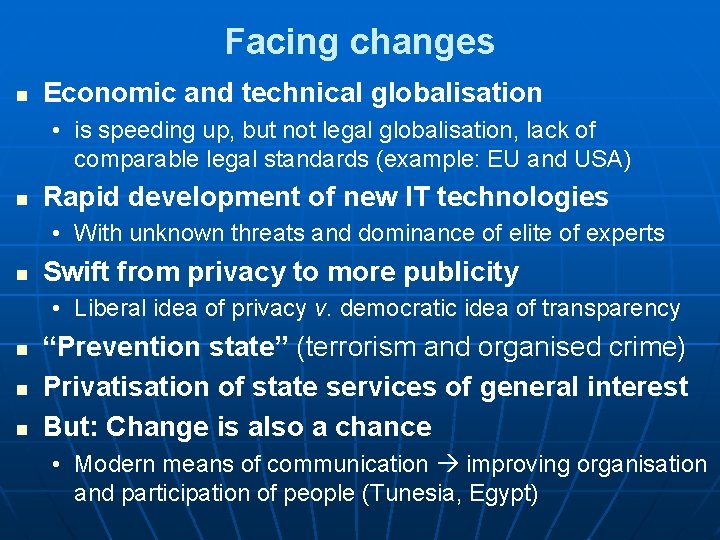
Facing changes n Economic and technical globalisation • is speeding up, but not legal globalisation, lack of comparable legal standards (example: EU and USA) n Rapid development of new IT technologies • With unknown threats and dominance of elite of experts n Swift from privacy to more publicity • Liberal idea of privacy v. democratic idea of transparency n n n “Prevention state” (terrorism and organised crime) Privatisation of state services of general interest But: Change is also a chance • Modern means of communication improving organisation and participation of people (Tunesia, Egypt)
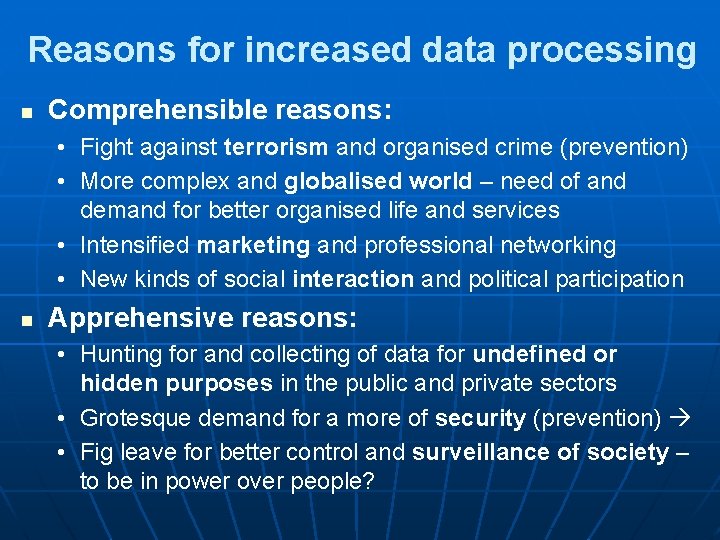
Reasons for increased data processing n Comprehensible reasons: • Fight against terrorism and organised crime (prevention) • More complex and globalised world – need of and demand for better organised life and services • Intensified marketing and professional networking • New kinds of social interaction and political participation n Apprehensive reasons: • Hunting for and collecting of data for undefined or hidden purposes in the public and private sectors • Grotesque demand for a more of security (prevention) • Fig leave for better control and surveillance of society – to be in power over people?
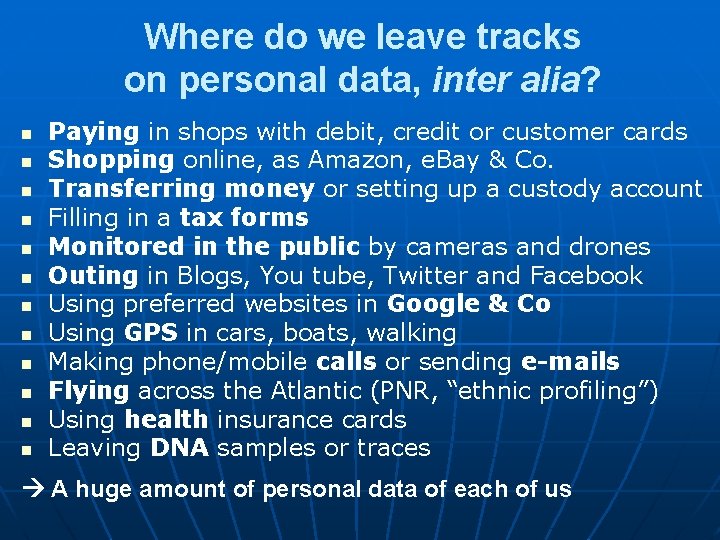
Where do we leave tracks on personal data, inter alia? n n n Paying in shops with debit, credit or customer cards Shopping online, as Amazon, e. Bay & Co. Transferring money or setting up a custody account Filling in a tax forms Monitored in the public by cameras and drones Outing in Blogs, You tube, Twitter and Facebook Using preferred websites in Google & Co Using GPS in cars, boats, walking Making phone/mobile calls or sending e-mails Flying across the Atlantic (PNR, “ethnic profiling”) Using health insurance cards Leaving DNA samples or traces A huge amount of personal data of each of us
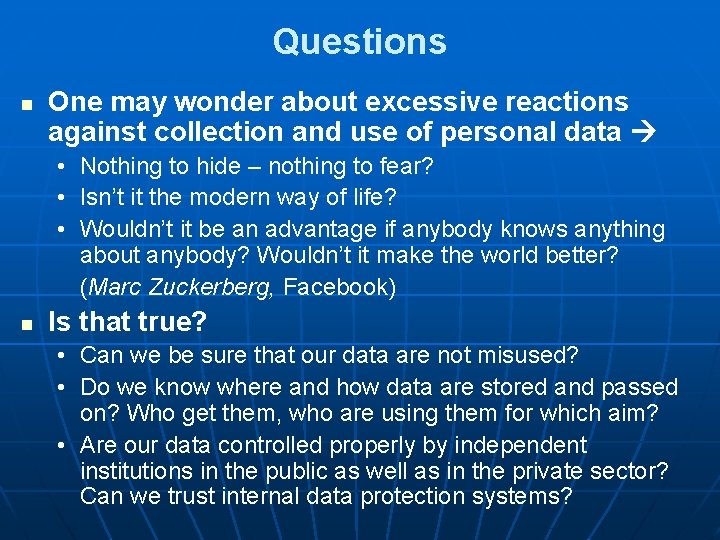
Questions n One may wonder about excessive reactions against collection and use of personal data • Nothing to hide – nothing to fear? • Isn’t it the modern way of life? • Wouldn’t it be an advantage if anybody knows anything about anybody? Wouldn’t it make the world better? (Marc Zuckerberg, Facebook) n Is that true? • Can we be sure that our data are not misused? • Do we know where and how data are stored and passed on? Who get them, who are using them for which aim? • Are our data controlled properly by independent institutions in the public as well as in the private sector? Can we trust internal data protection systems?
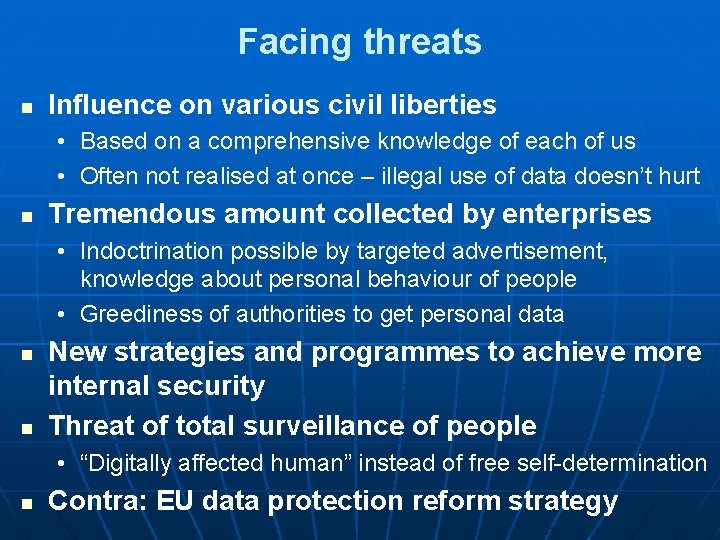
Facing threats n Influence on various civil liberties • Based on a comprehensive knowledge of each of us • Often not realised at once – illegal use of data doesn’t hurt n Tremendous amount collected by enterprises • Indoctrination possible by targeted advertisement, knowledge about personal behaviour of people • Greediness of authorities to get personal data n n New strategies and programmes to achieve more internal security Threat of total surveillance of people • “Digitally affected human” instead of free self-determination n Contra: EU data protection reform strategy
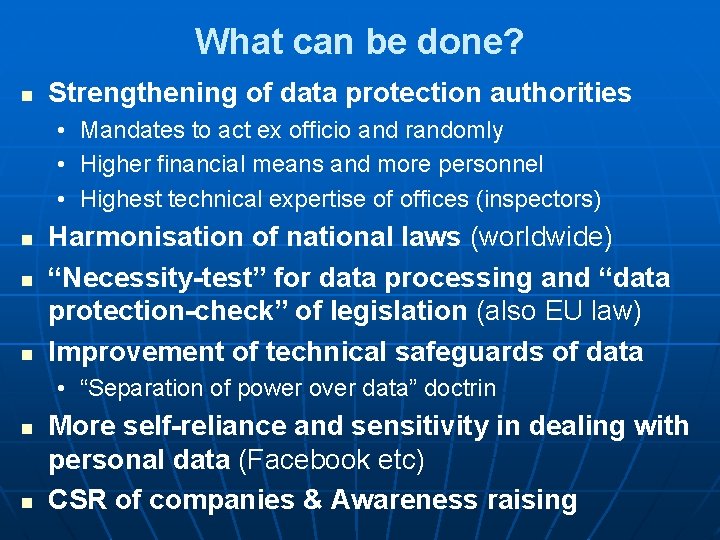
What can be done? n Strengthening of data protection authorities • Mandates to act ex officio and randomly • Higher financial means and more personnel • Highest technical expertise of offices (inspectors) n n n Harmonisation of national laws (worldwide) “Necessity-test” for data processing and “data protection-check” of legislation (also EU law) Improvement of technical safeguards of data • “Separation of power over data” doctrin n n More self-reliance and sensitivity in dealing with personal data (Facebook etc) CSR of companies & Awareness raising
Thank you for your attention! PPT available at: http: //bim. lbg. ac. at