
Why Do We Analyze Proteins Proteins play crucial

- Slides: 37
Why Do We Analyze Proteins? • Proteins play crucial roles in nearly all biological processes. These many functions of proteins are a result of the folding of proteins into many distinct 3 D structures. • Protein analysis tries to explore how amino acid sequences specify the structure of proteins and how these proteins bind to substrates and other molecules to perform their functions. • Protein analysis allows us to understand the function of the protein based on its structure. 1
Main Steps in Protein Analysis 1. Extraction of proteins. 2. Purification of the protein. 3. Structural Characterization of the protein. 2
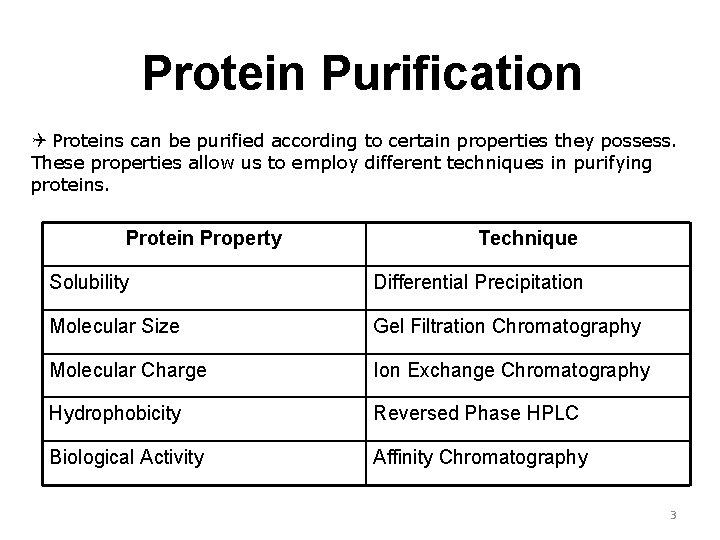
Protein Purification Q Proteins can be purified according to certain properties they possess. These properties allow us to employ different techniques in purifying proteins. Protein Property Technique Solubility Differential Precipitation Molecular Size Gel Filtration Chromatography Molecular Charge Ion Exchange Chromatography Hydrophobicity Reversed Phase HPLC Biological Activity Affinity Chromatography 3
Chromatography basically involves the separation of mixtures due to differences in the distribution coefficient of sample components between 2 different phases. One of these phases is a mobile phase and the other is a stationary phase.
Gel Filtration Gel permeation chromatography Size exclusion chromatography Separation of molecules on the basis of size (and shape)
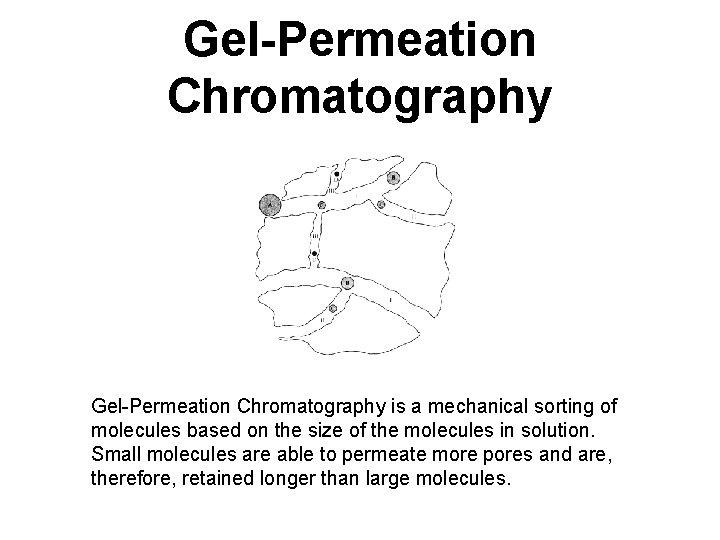
Gel-Permeation Chromatography is a mechanical sorting of molecules based on the size of the molecules in solution. Small molecules are able to permeate more pores and are, therefore, retained longer than large molecules.
How it works: A column is packed with a semi porous material – glass beads – glass wool – something that doesn’t dissolve in the solvent carrying the polymer chain – In some cases simple soap detergents like Tide are used
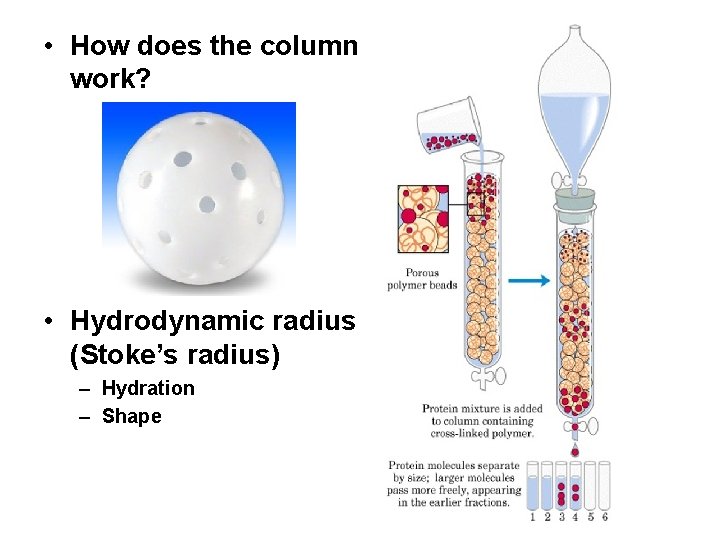
• How does the column work? • Hydrodynamic radius (Stoke’s radius) – Hydration – Shape
Gel Permeation Chromatography • Gel permeation chromatography (GPC) is used to make reasonable estimates of the molecular weight distribution of polymers • For GPC work to be reproducible you must have control over: – – flow rate temperature solvent composition tunnel size of the stationary particles (it must not change) – other reasons may be added later. . .
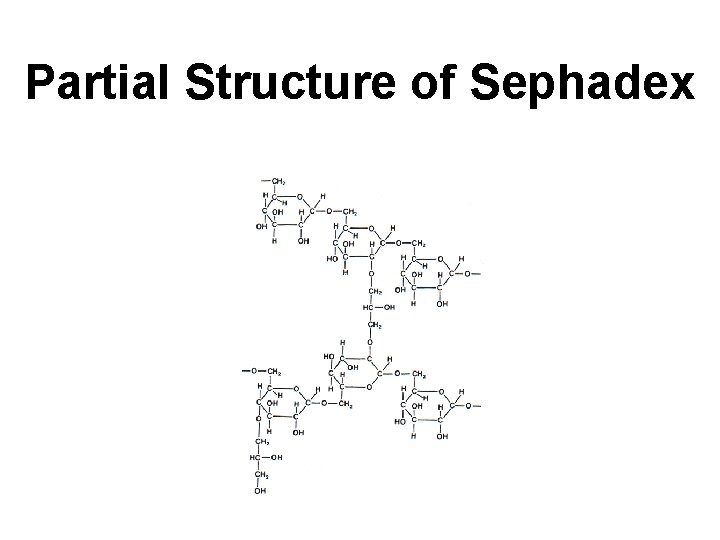
Partial Structure of Sephadex
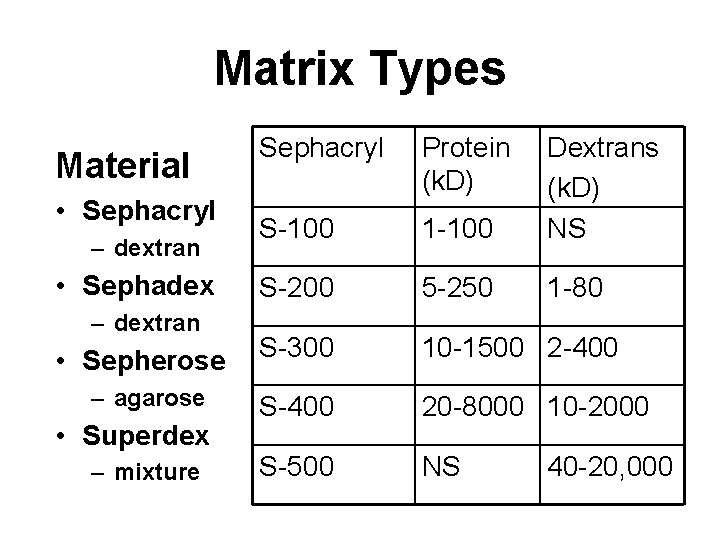
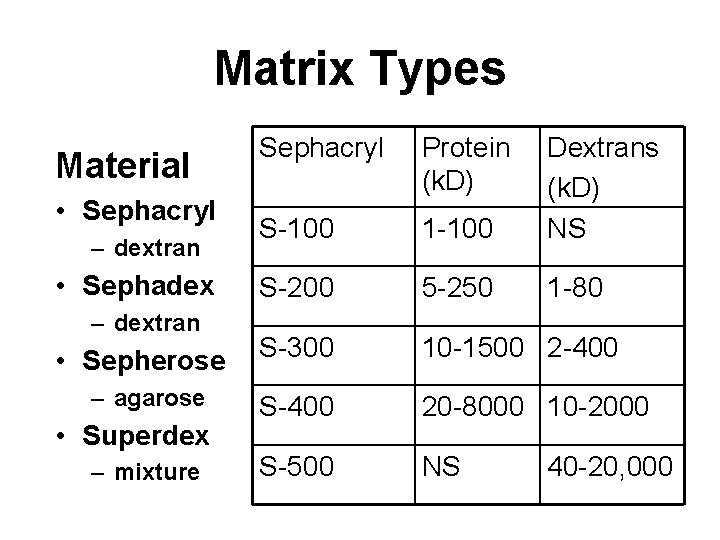
Matrix Types Material • Sephacryl – dextran • Sephadex – dextran • Sepherose – agarose • Superdex – mixture Sephacryl Protein (k. D) S-100 1 -100 Dextrans (k. D) NS S-200 5 -250 1 -80 S-300 10 -1500 2 -400 S-400 20 -8000 10 -2000 S-500 NS 40 -20, 000
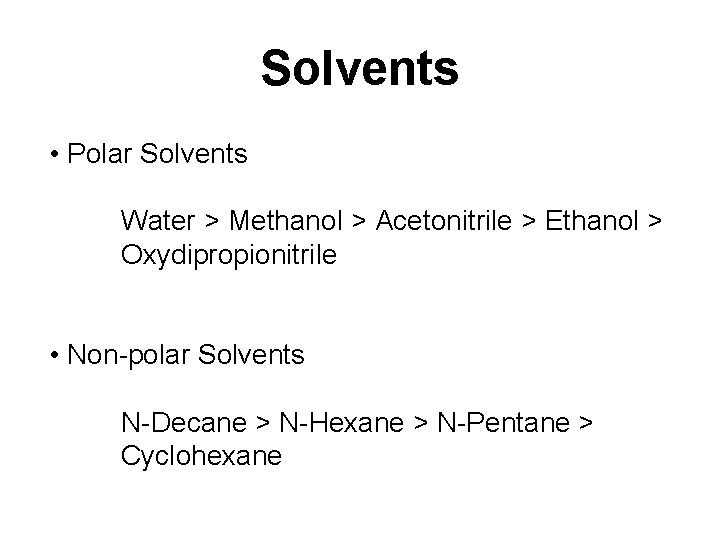
Solvents • Polar Solvents Water > Methanol > Acetonitrile > Ethanol > Oxydipropionitrile • Non-polar Solvents N-Decane > N-Hexane > N-Pentane > Cyclohexane
Detector Ultraviolet Detector 200 -400 nm 254 nm Reflective Index Detector Universal Detector
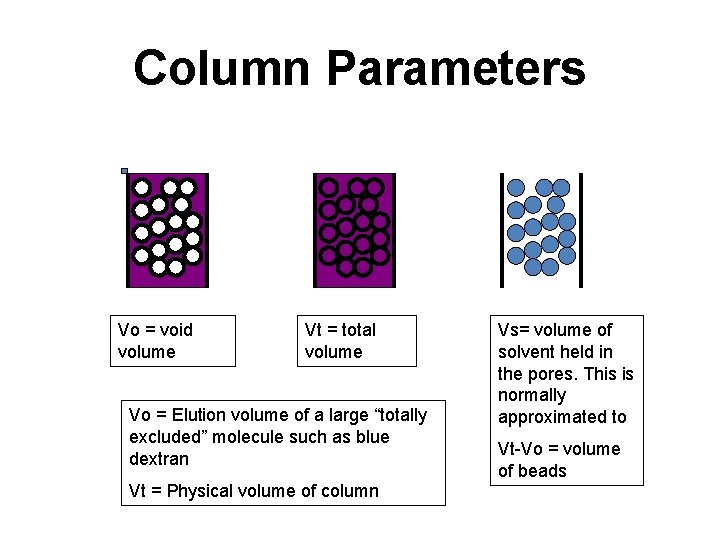
Column Parameters Vo = void volume Vt = total volume Vo = Elution volume of a large “totally excluded” molecule such as blue dextran Vt = Physical volume of column Vs= volume of solvent held in the pores. This is normally approximated to Vt-Vo = volume of beads
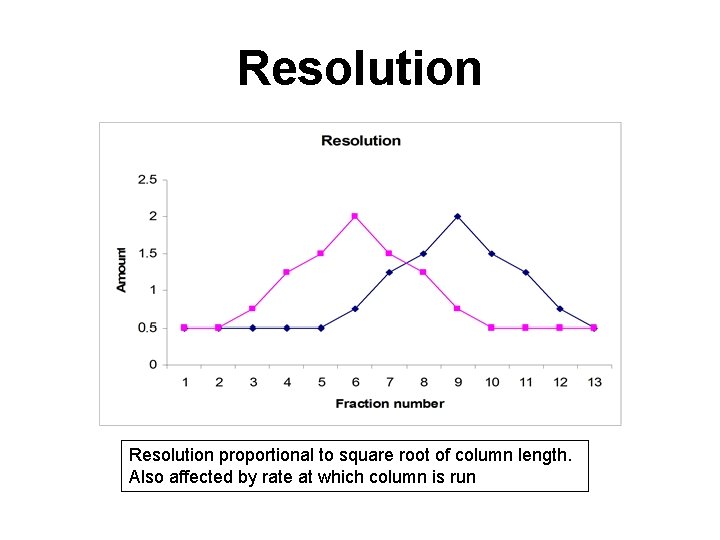
Resolution proportional to square root of column length. Also affected by rate at which column is run
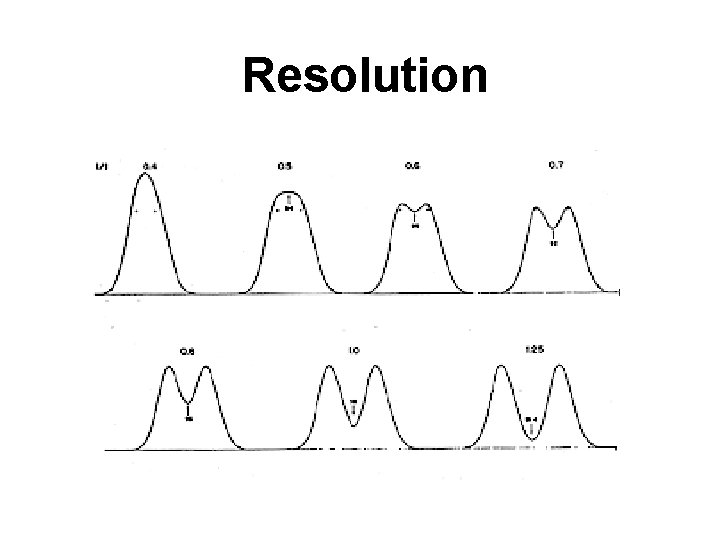
Resolution
Factors Increasing Resolution • • • Increase column length Decrease column diameter Decrease flow-rate Pack column uniformly Use uniform stationary phase (packing material) Decrease sample size Select proper stationary phase Select proper mobile phase Use proper pressure Use gradient elution
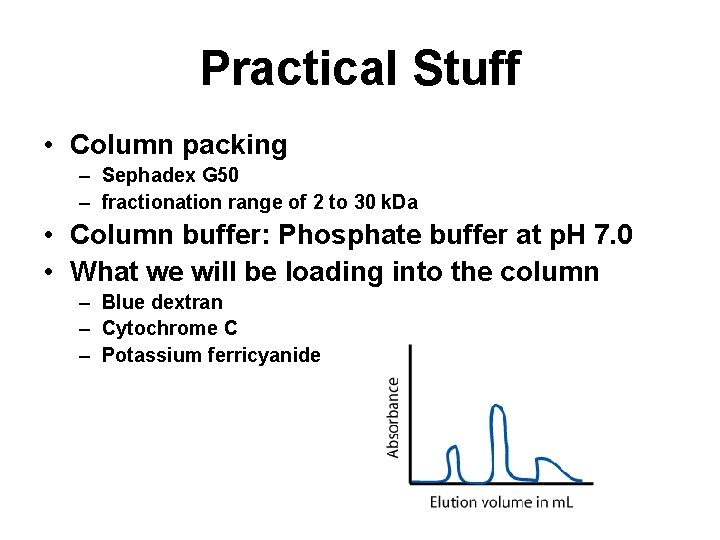
Practical Stuff • Column packing – Sephadex G 50 – fractionation range of 2 to 30 k. Da • Column buffer: Phosphate buffer at p. H 7. 0 • What we will be loading into the column – Blue dextran – Cytochrome C – Potassium ferricyanide
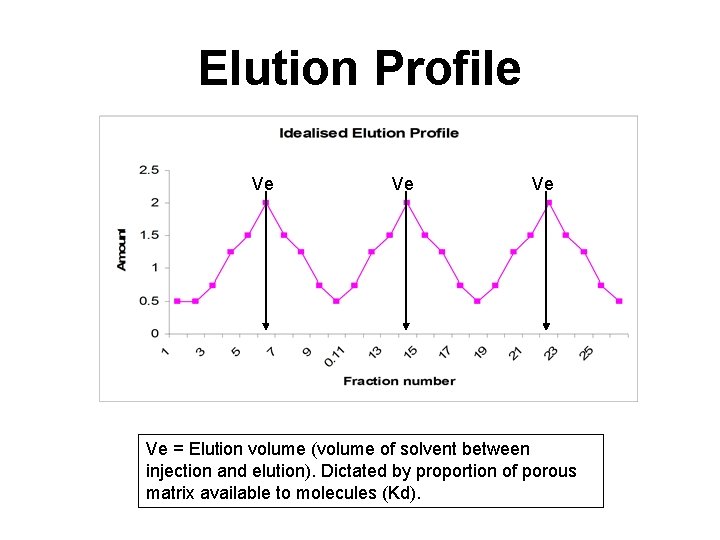
Elution Profile Ve Ve = Elution volume (volume of solvent between injection and elution). Dictated by proportion of porous matrix available to molecules (Kd).
Design of Column • Column size – Analytical or preparative • Solvent – Inert matrix most solvents OK • Matrix – Most important consideration – Many different types • Material • Pore size
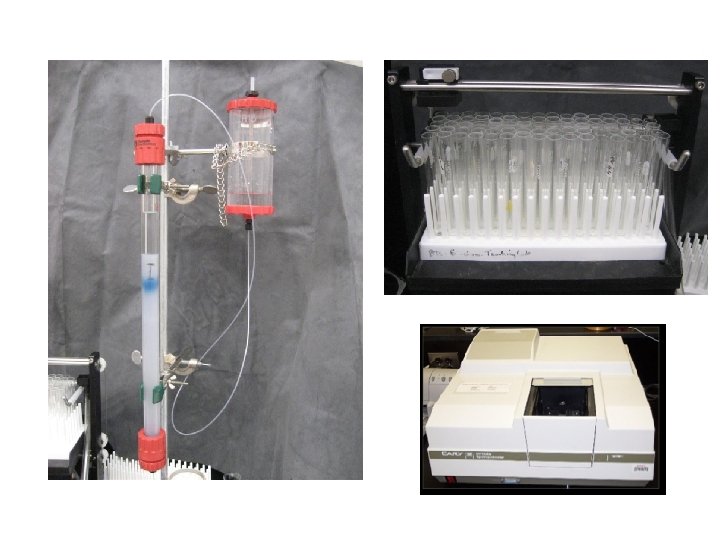
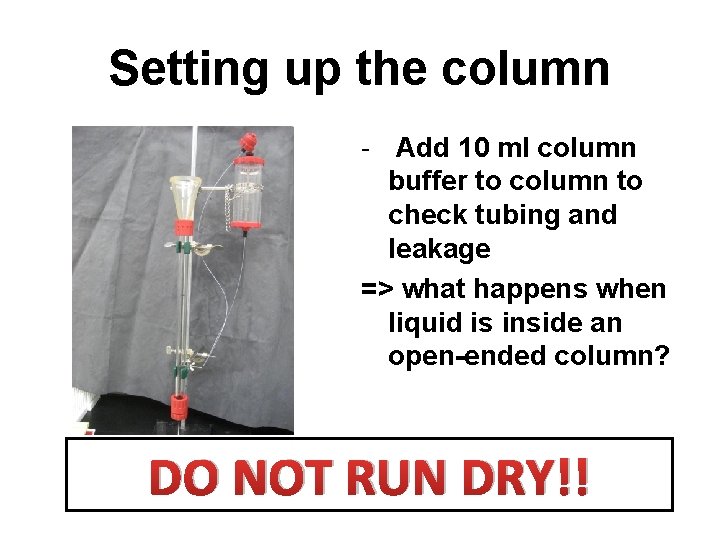
Setting up the column - Add 10 ml column buffer to column to check tubing and leakage => what happens when liquid is inside an open-ended column? DO NOT RUN DRY!!
Matrix Types Material • Sephacryl – dextran • Sephadex – dextran • Sepherose – agarose • Superdex – mixture Sephacryl Protein (k. D) S-100 1 -100 Dextrans (k. D) NS S-200 5 -250 1 -80 S-300 10 -1500 2 -400 S-400 20 -8000 10 -2000 S-500 NS 40 -20, 000
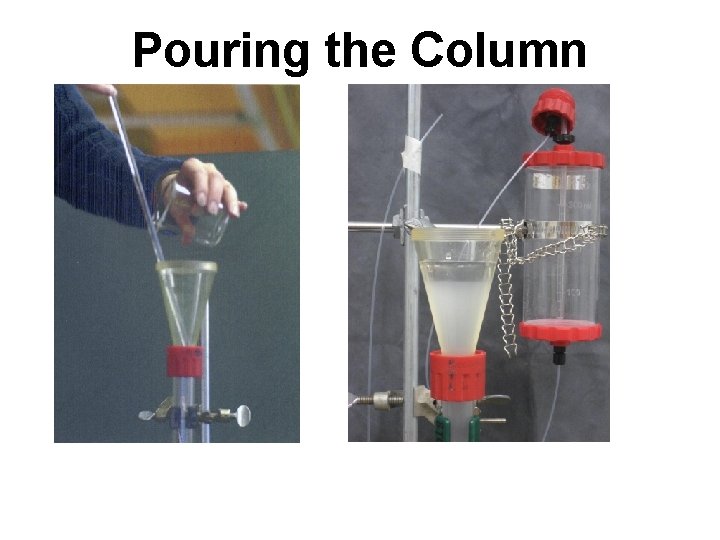
Pouring the Column
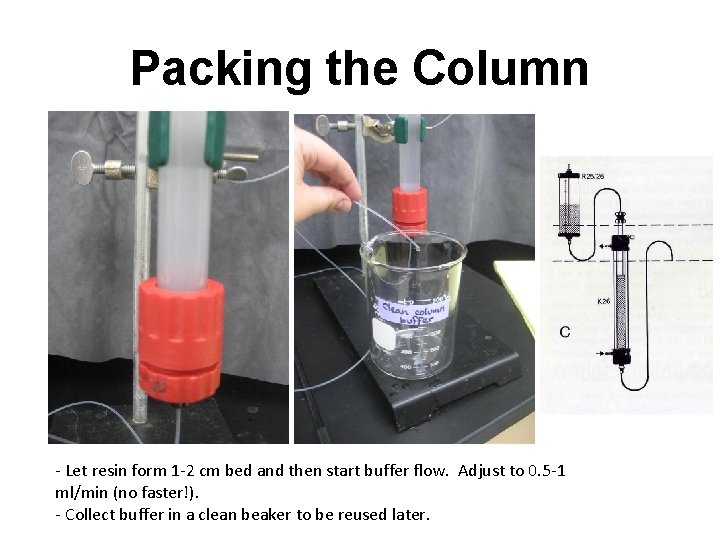
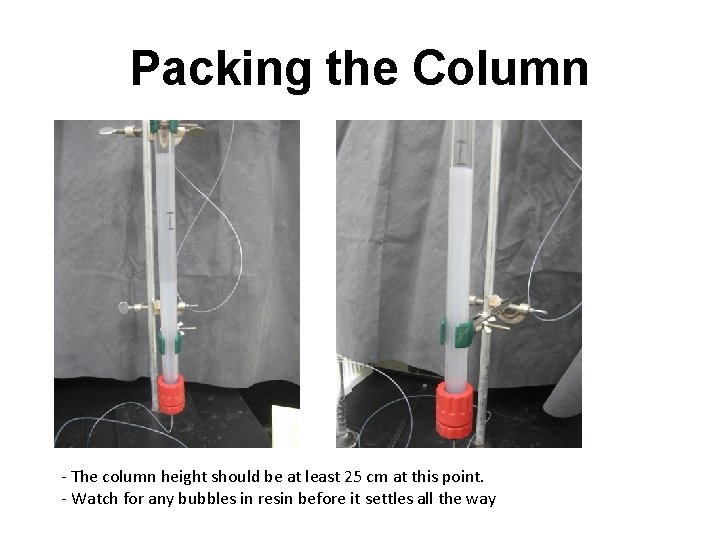
Packing the Column - Let resin form 1 -2 cm bed and then start buffer flow. Adjust to 0. 5 -1 ml/min (no faster!). - Collect buffer in a clean beaker to be reused later.
Packing the Column - The column height should be at least 25 cm at this point. - Watch for any bubbles in resin before it settles all the way
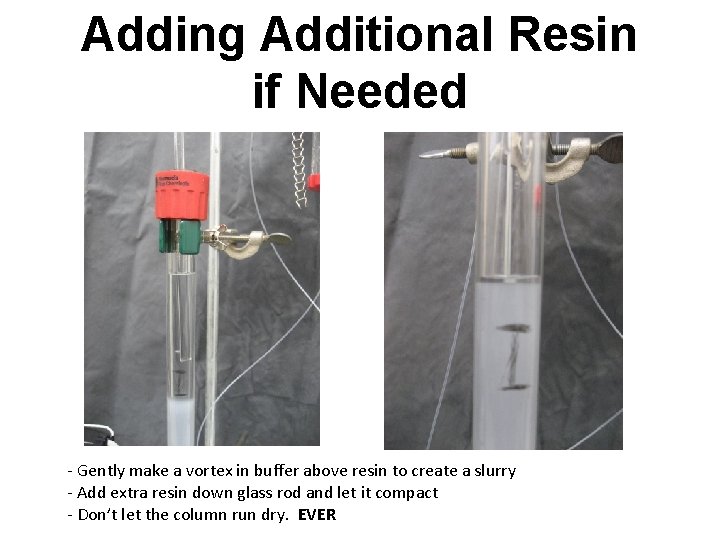
Adding Additional Resin if Needed - Gently make a vortex in buffer above resin to create a slurry - Add extra resin down glass rod and let it compact - Don’t let the column run dry. EVER
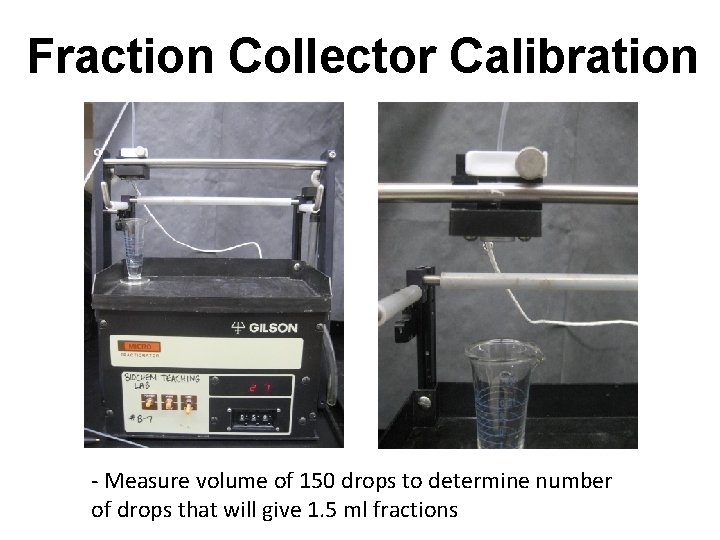
Fraction Collector Calibration - Measure volume of 150 drops to determine number of drops that will give 1. 5 ml fractions
Running the column • Sample size / Fraction size – 0. 5 – 5% of total bed volume (Vt). – Concentration limited by viscosity • Running time – Determined by “trial and error” – Slow rates allow efficient partitioning into pores and thus increase resolution – Slow rates increase diffusion of sample on column thus increasing peak width and reducing resolution. – Protein about 5 m. L cm-2. h-1
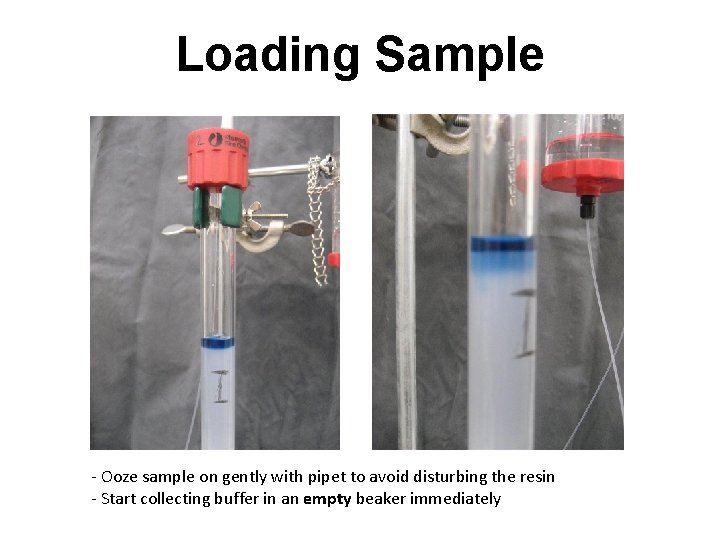
Loading Sample - Ooze sample on gently with pipet to avoid disturbing the resin - Start collecting buffer in an empty beaker immediately
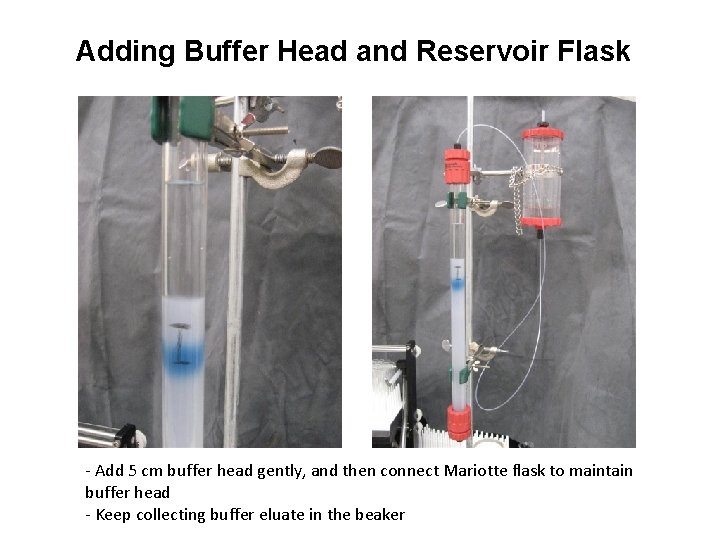
Adding Buffer Head and Reservoir Flask - Add 5 cm buffer head gently, and then connect Mariotte flask to maintain buffer head - Keep collecting buffer eluate in the beaker
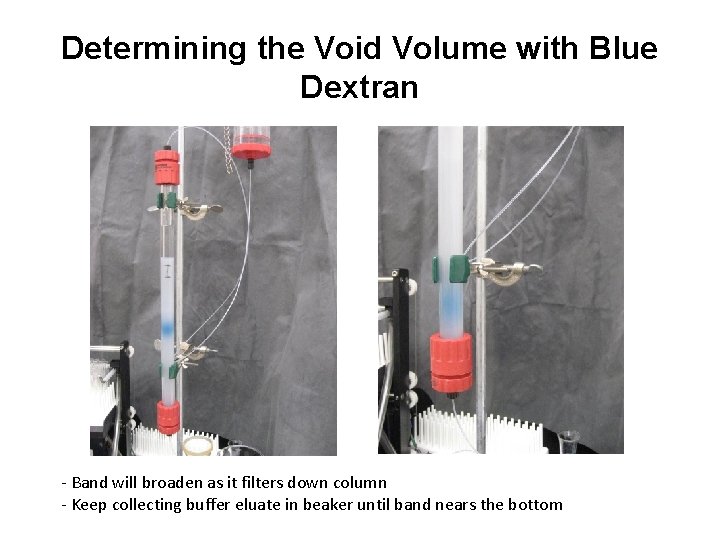
Determining the Void Volume with Blue Dextran - Band will broaden as it filters down column - Keep collecting buffer eluate in beaker until band nears the bottom
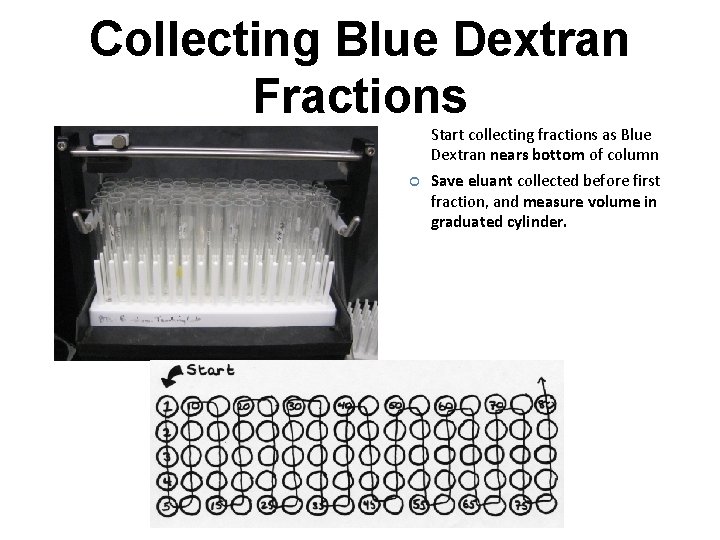
Collecting Blue Dextran Fractions Start collecting fractions as Blue Dextran nears bottom of column Save eluant collected before first fraction, and measure volume in graduated cylinder.
Absorbance Measurement • Save all column fractions. • Dilute each tube with 2 m. L of phosphate buffer. • Add 4 m. L of phosphate to cuvette to calibrate the spec 20, then measure all the absorbance in order. • Repeat the measurement for the overlapping tubes but change wavelength
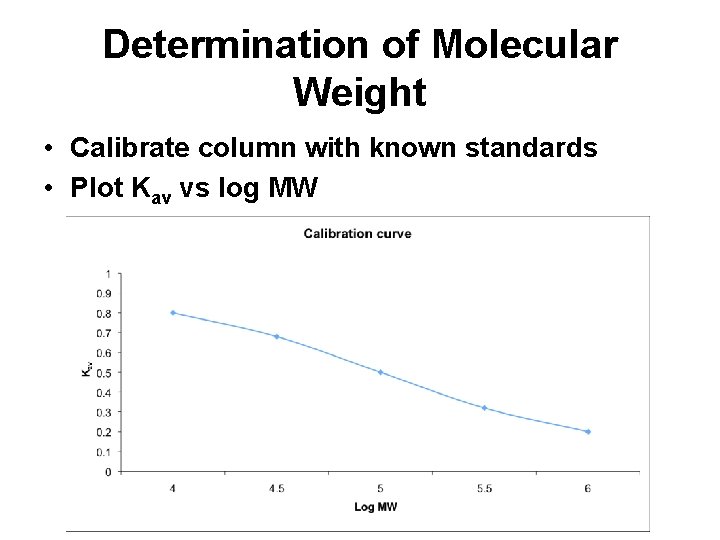
Determination of Molecular Weight • Calibrate column with known standards • Plot Kav vs log MW
Summary Each group will receive 100 m. L of blue dextran, 150 m. L of cytochrome C and 70 m. L of potassium ferricyanide. Turn on the switch to let the buffer drip until the top buffer is almost gone, then pipet the mixture of sample to the top of column evenly. use a beaker to collect all the buffer from the bottom of the column, when the sample layer is empty, add 1 m. L of buffer to the top, repeat the process 3 to 5 times until the top layer is colorless, then add at least 3 cm length of buffer on top of the column and connect the column to a buffer reservoir. Take a test tube and mark a 1 m. L line by transfering 1 m. L of solution to it. Then count the number of drops of the buffer to fit exactly 1 m. L volume, then pour the buffer back to the beak. When blue dextran is approaching the bottom of column, switch beaker to test tube and collect 2 m. L of buffer to each test tube until all the color bands drain out of the column. Meanwhile, measure the volume of buffer collected in the beaker by a graduate cylinder. add 2 m. L of buffer to each test tube, and measure the absorbance of each fraction at relevant wavelength. Be sure to repeat the overlapping tubes.
Requirements for Lab Report Lab report should have a table to show all the absorbance of each tube, as well as the overlapping absorbance v Should include a figure to correspond the absorbance to tube number (or elution volume), whichever is good for you. v should have a figure to show the relationship between the elution volume and log MW. v