
Why do regulated assets sell for more than


- Slides: 14
Why do regulated assets sell for more than the RAB? IPART 25 th Anniversary Conference October 2017
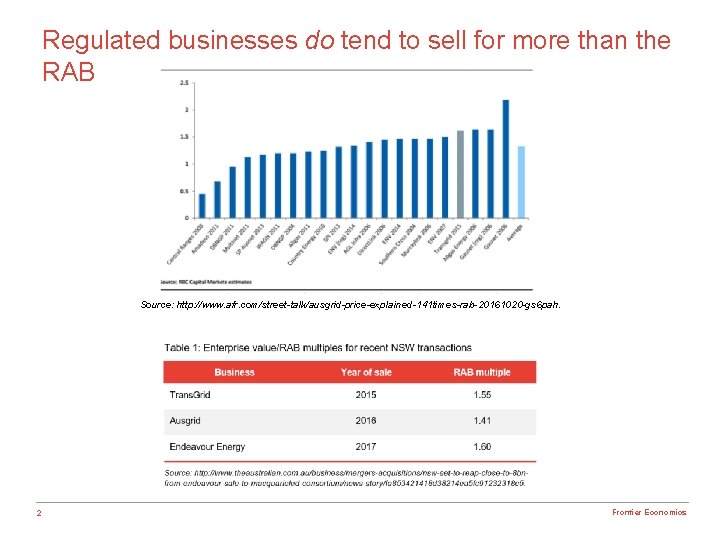
Regulated businesses do tend to sell for more than the RAB Source: http: //www. afr. com/street-talk/ausgrid-price-explained-141 times-rab-20161020 -gs 6 pah. 2 Frontier Economics
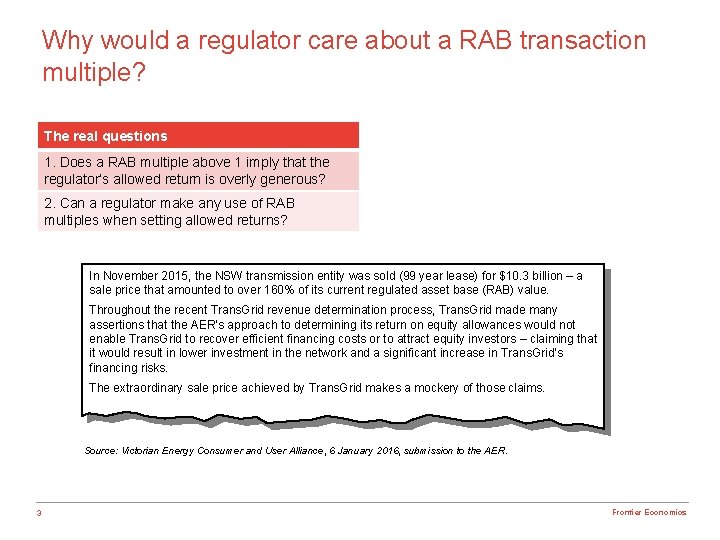
Why would a regulator care about a RAB transaction multiple? The real questions 1. Does a RAB multiple above 1 imply that the regulator’s allowed return is overly generous? 2. Can a regulator make any use of RAB multiples when setting allowed returns? In November 2015, the NSW transmission entity was sold (99 year lease) for $10. 3 billion – a sale price that amounted to over 160% of its current regulated asset base (RAB) value. Throughout the recent Trans. Grid revenue determination process, Trans. Grid made many assertions that the AER’s approach to determining its return on equity allowances would not enable Trans. Grid to recover efficient financing costs or to attract equity investors – claiming that it would result in lower investment in the network and a significant increase in Trans. Grid’s financing risks. The extraordinary sale price achieved by Trans. Grid makes a mockery of those claims. Source: Victorian Energy Consumer and User Alliance, 6 January 2016, submission to the AER. 3 Frontier Economics
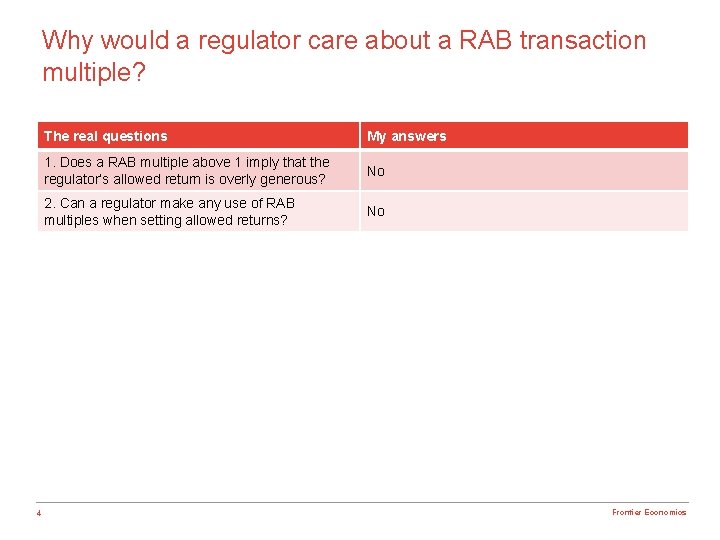
Why would a regulator care about a RAB transaction multiple? 4 The real questions My answers 1. Does a RAB multiple above 1 imply that the regulator’s allowed return is overly generous? No 2. Can a regulator make any use of RAB multiples when setting allowed returns? No Frontier Economics
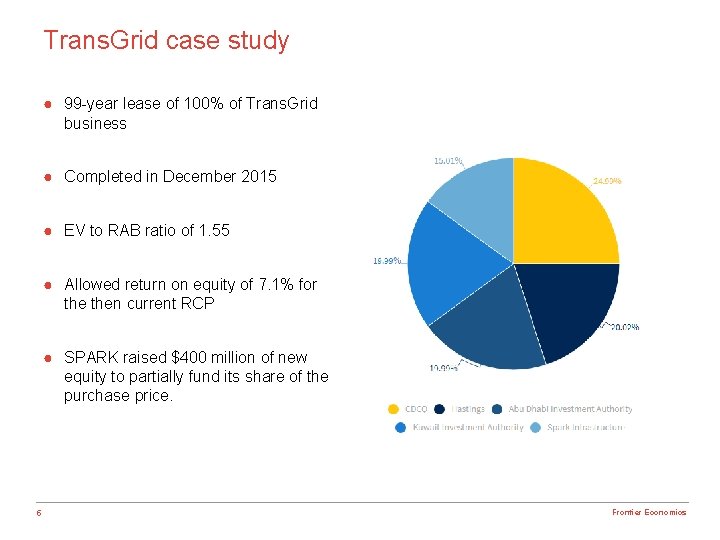
Trans. Grid case study ● 99 -year lease of 100% of Trans. Grid business ● Completed in December 2015 ● EV to RAB ratio of 1. 55 ● Allowed return on equity of 7. 1% for then current RCP ● SPARK raised $400 million of new equity to partially fund its share of the purchase price. 5 Frontier Economics
The 99 -year lease term ● 4 years remaining in current regulatory period. Only 95 to go. . . ● Merits review process was already underway. ● AER’s long-standing approach had been to add a constant fixed risk premium to the prevailing risk free rate. Submissions that this leads to under-compensation when rates are low, over-compensation when rates are high. Current under-compensation, but may be expected to average out in the long-run. ● Can’t conclude much at all about the generosity of the allowed return for the first 4 years. 6 Frontier Economics
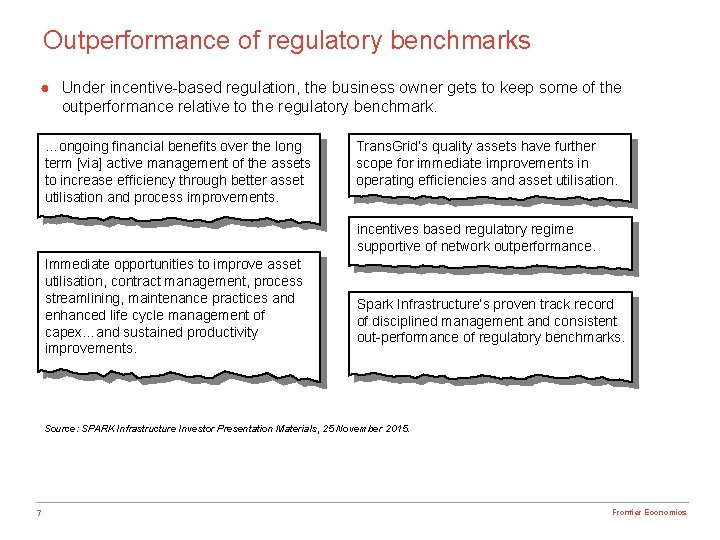
Outperformance of regulatory benchmarks ● Under incentive-based regulation, the business owner gets to keep some of the outperformance relative to the regulatory benchmark. …ongoing financial benefits over the long term [via] active management of the assets to increase efficiency through better asset utilisation and process improvements. Trans. Grid’s quality assets have further scope for immediate improvements in operating efficiencies and asset utilisation. incentives based regulatory regime supportive of network outperformance. Immediate opportunities to improve asset utilisation, contract management, process streamlining, maintenance practices and enhanced life cycle management of capex…and sustained productivity improvements. Spark Infrastructure’s proven track record of disciplined management and consistent out-performance of regulatory benchmarks. Source: SPARK Infrastructure Investor Presentation Materials, 25 November 2015. 7 Frontier Economics
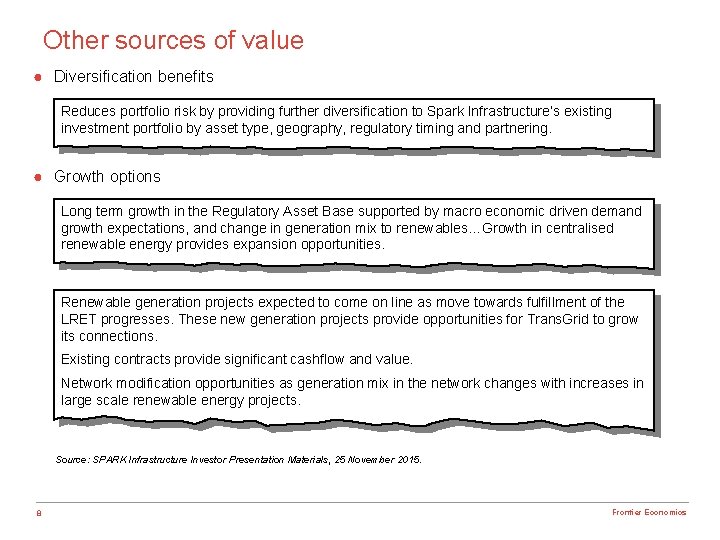
Other sources of value ● Diversification benefits Reduces portfolio risk by providing further diversification to Spark Infrastructure’s existing investment portfolio by asset type, geography, regulatory timing and partnering. ● Growth options Long term growth in the Regulatory Asset Base supported by macro economic driven demand growth expectations, and change in generation mix to renewables…Growth in centralised renewable energy provides expansion opportunities. Renewable generation projects expected to come on line as move towards fulfillment of the LRET progresses. These new generation projects provide opportunities for Trans. Grid to grow its connections. Existing contracts provide significant cashflow and value. Network modification opportunities as generation mix in the network changes with increases in large scale renewable energy projects. Source: SPARK Infrastructure Investor Presentation Materials, 25 November 2015. 8 Frontier Economics
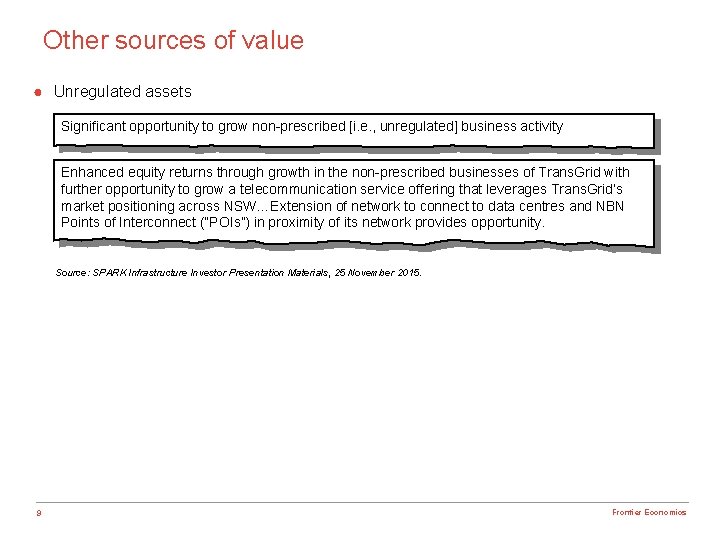
Other sources of value ● Unregulated assets Significant opportunity to grow non-prescribed [i. e. , unregulated] business activity Enhanced equity returns through growth in the non-prescribed businesses of Trans. Grid with further opportunity to grow a telecommunication service offering that leverages Trans. Grid’s market positioning across NSW…Extension of network to connect to data centres and NBN Points of Interconnect (“POIs”) in proximity of its network provides opportunity. Source: SPARK Infrastructure Investor Presentation Materials, 25 November 2015. 9 Frontier Economics
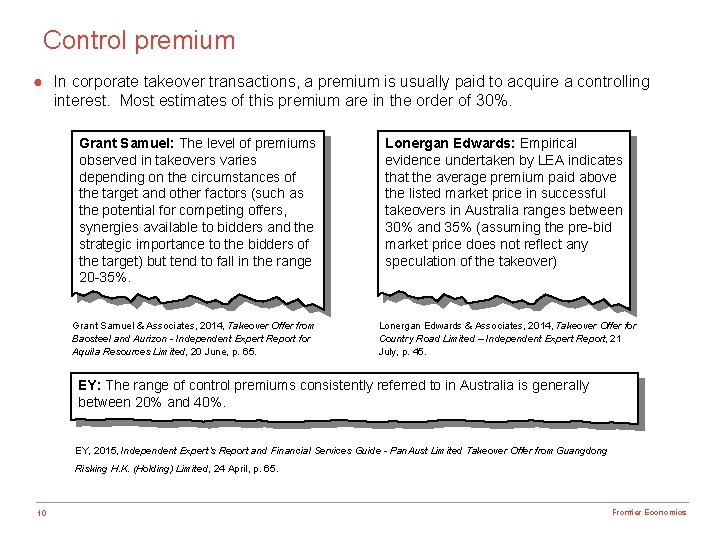
Control premium ● In corporate takeover transactions, a premium is usually paid to acquire a controlling interest. Most estimates of this premium are in the order of 30%. Grant Samuel: The level of premiums observed in takeovers varies depending on the circumstances of the target and other factors (such as the potential for competing offers, synergies available to bidders and the strategic importance to the bidders of the target) but tend to fall in the range 20 -35%. Grant Samuel & Associates, 2014, Takeover Offer from Baosteel and Aurizon - Independent Expert Report for Aquila Resources Limited, 20 June, p. 65. Lonergan Edwards: Empirical evidence undertaken by LEA indicates that the average premium paid above the listed market price in successful takeovers in Australia ranges between 30% and 35% (assuming the pre-bid market price does not reflect any speculation of the takeover) Lonergan Edwards & Associates, 2014, Takeover Offer for Country Road Limited – Independent Expert Report, 21 July, p. 45. EY: The range of control premiums consistently referred to in Australia is generally between 20% and 40%. EY, 2015, Independent Expert’s Report and Financial Services Guide - Pan. Aust Limited Takeover Offer from Guangdong . Risking H. K. (Holding) Limited, 24 April, p. 65 10 Frontier Economics
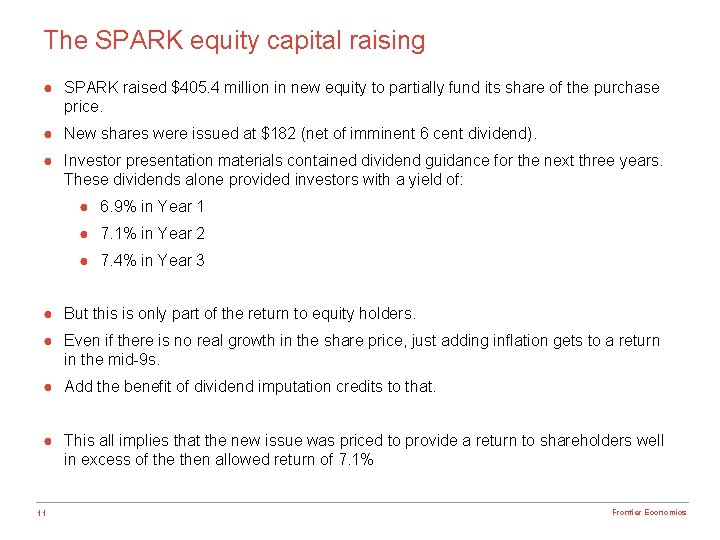
The SPARK equity capital raising ● SPARK raised $405. 4 million in new equity to partially fund its share of the purchase price. ● New shares were issued at $182 (net of imminent 6 cent dividend). ● Investor presentation materials contained dividend guidance for the next three years. These dividends alone provided investors with a yield of: ● 6. 9% in Year 1 ● 7. 1% in Year 2 ● 7. 4% in Year 3 ● But this is only part of the return to equity holders. ● Even if there is no real growth in the share price, just adding inflation gets to a return in the mid-9 s. ● Add the benefit of dividend imputation credits to that. ● This all implies that the new issue was priced to provide a return to shareholders well in excess of then allowed return of 7. 1% 11 Frontier Economics
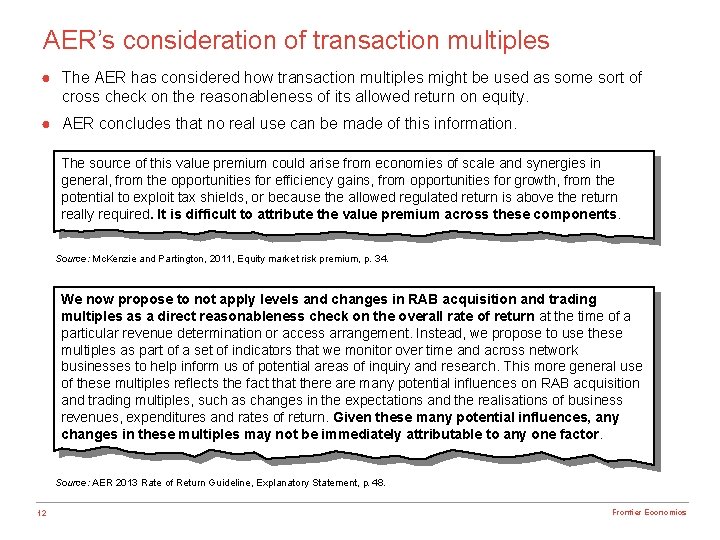
AER’s consideration of transaction multiples ● The AER has considered how transaction multiples might be used as some sort of cross check on the reasonableness of its allowed return on equity. ● AER concludes that no real use can be made of this information. The source of this value premium could arise from economies of scale and synergies in general, from the opportunities for efficiency gains, from opportunities for growth, from the potential to exploit tax shields, or because the allowed regulated return is above the return really required. It is difficult to attribute the value premium across these components. Source: Mc. Kenzie and Partington, 2011, Equity market risk premium, p. 34. We now propose to not apply levels and changes in RAB acquisition and trading multiples as a direct reasonableness check on the overall rate of return at the time of a particular revenue determination or access arrangement. Instead, we propose to use these multiples as part of a set of indicators that we monitor over time and across network businesses to help inform us of potential areas of inquiry and research. This more general use of these multiples reflects the fact that there are many potential influences on RAB acquisition and trading multiples, such as changes in the expectations and the realisations of business revenues, expenditures and rates of return. Given these many potential influences, any changes in these multiples may not be immediately attributable to any one factor. Source: AER 2013 Rate of Return Guideline, Explanatory Statement, p. 48. 12 Frontier Economics
Frontier Economics Pty Ltd in Australia is a member of the Frontier Economics network, which consists of separate companies based in Australia (Brisbane, Melbourne & Sydney) and Europe (Brussels, Cologne, London and Madrid). The companies are independently owned, and legal commitments entered into by any one company do not impose any obligations on other companies in the network. All views expressed in this document are the views of Frontier Economics Pty Ltd. 13 Frontier Economics
FRONTIER ECONOMICS PTY. LTD. BRISBANE | MELBOURNE | SINGAPORE | SYDNEY Frontier Economics Pty Ltd, 395 Collins Street, Melbourne, Vic 3000 14 Tel. +61 (0)3 9620 4488 Fax. +61 (0)3 9620 4499 www. frontier-economics. com. au Frontier Economics