
Why do Organisms need Skeletons enable organisms to

Why do Organisms need Skeletons? { enable organisms to support and carry weight of their bodies and that structure involved in vertebrates is skeleton { aquatic animals receive some lift from surrounding water called buoyancy
{ support is more important to terrestrial animals since they are under the influence of gravity, without support, they will collapse { ALL vertebrates have an endoskeleton which means their bones are inside the body { the bones form a supporting framework which offers a firm base for muscle attachment
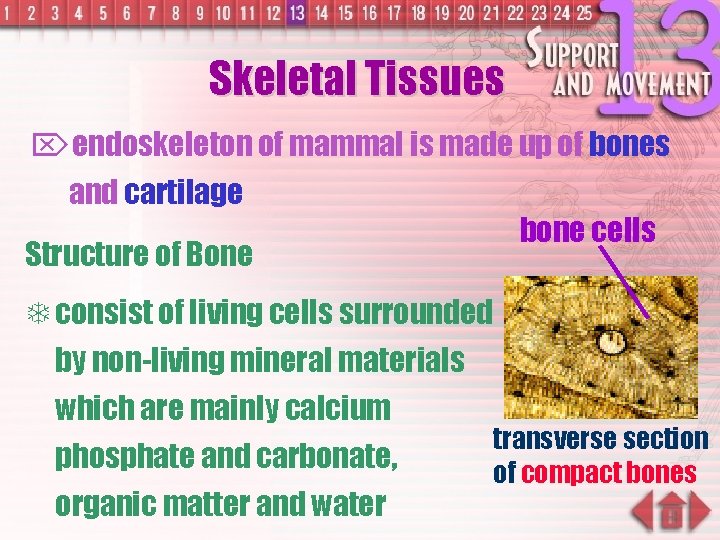
Skeletal Tissues Öendoskeleton of mammal is made up of bones and cartilage bone cells Structure of Bone T consist of living cells surrounded by non-living mineral materials which are mainly calcium transverse section phosphate and carbonate, of compact bones organic matter and water
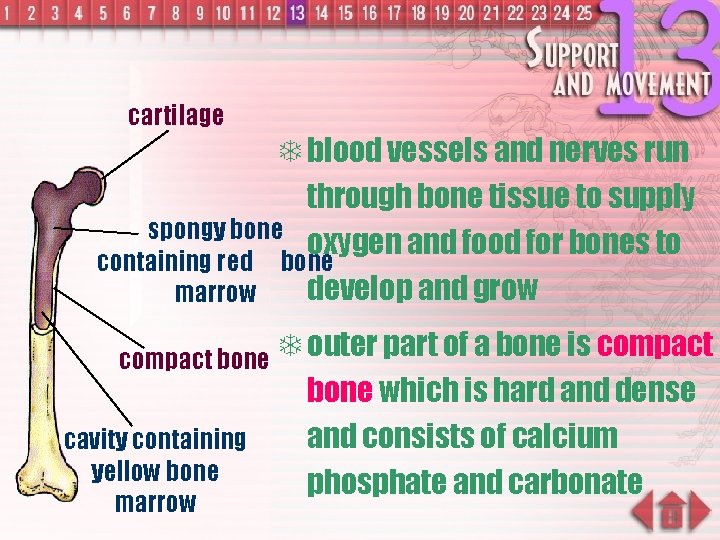
cartilage T blood vessels and nerves run through bone tissue to supply spongy bone oxygen and food for bones to containing red bone develop and grow marrow T outer part of a bone is compact bone which is hard and dense and consists of calcium cavity containing yellow bone phosphate and carbonate marrow
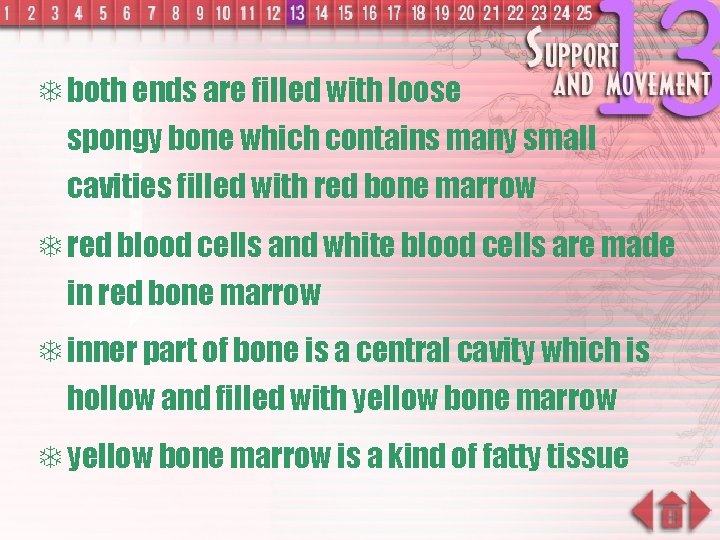
T both ends are filled with loose spongy bone which contains many small cavities filled with red bone marrow T red blood cells and white blood cells are made in red bone marrow T inner part of bone is a central cavity which is hollow and filled with yellow bone marrow T yellow bone marrow is a kind of fatty tissue

To find out How the Chemical Components of Bone Affects its Properties
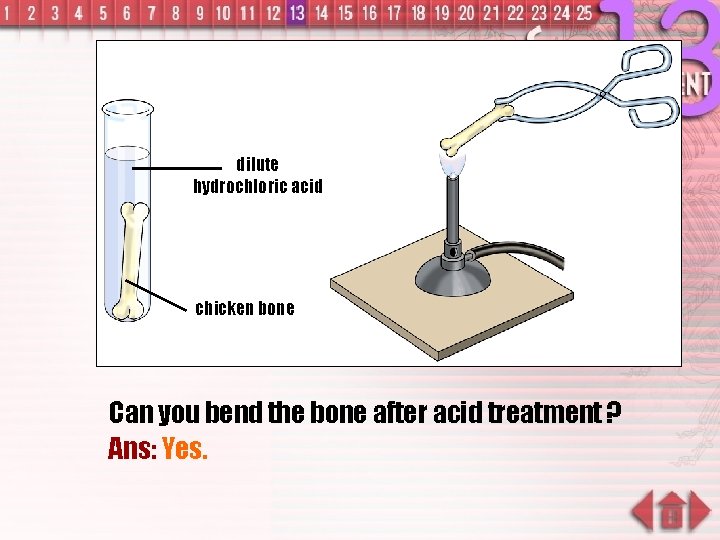
dilute hydrochloric acid chicken bone Can you bend the bone after acid treatment ? Ans: Yes.

dilute hydrochloric acid chicken bone What effect does the acid have on the bone ? Ans: It dissolves away calcium salt, cause bone to lose its strength and rigidity.
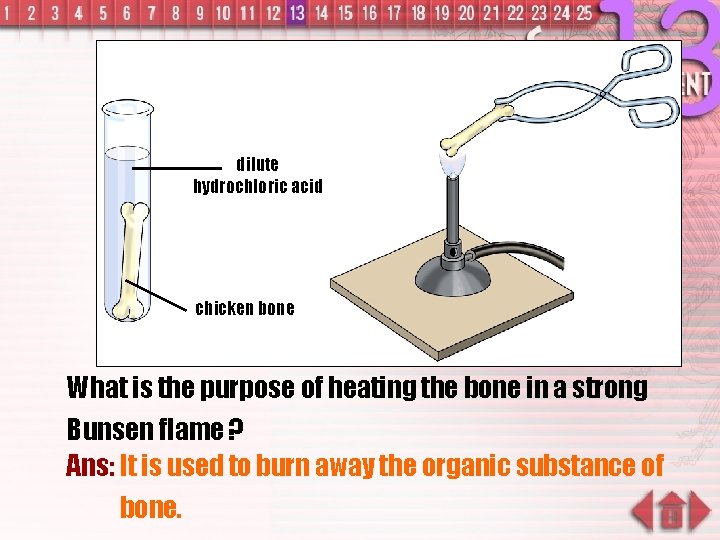
dilute hydrochloric acid chicken bone What is the purpose of heating the bone in a strong Bunsen flame ? Ans: It is used to burn away the organic substance of bone.
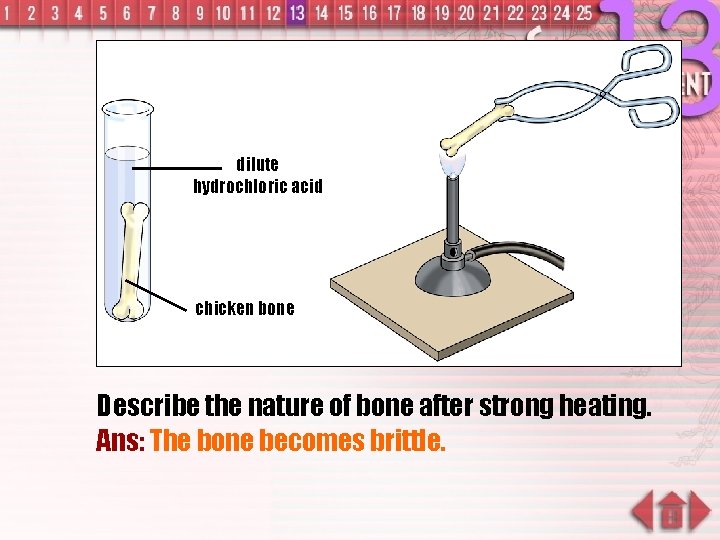
dilute hydrochloric acid chicken bone Describe the nature of bone after strong heating. Ans: The bone becomes brittle.
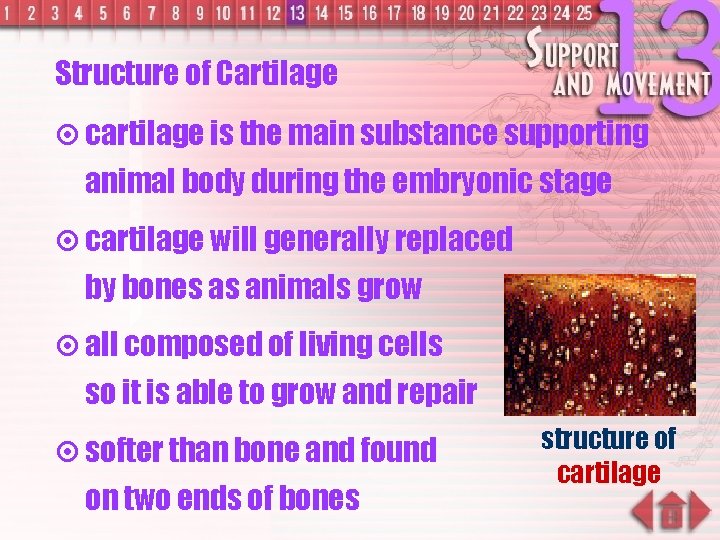
Structure of Cartilage ¤ cartilage is the main substance supporting animal body during the embryonic stage ¤ cartilage will generally replaced by bones as animals grow ¤ all composed of living cells so it is able to grow and repair ¤ softer than bone and found on two ends of bones structure of cartilage
Functions of Cartilage ¥ cushion-like and acts as a shock-absorber ¥ reduces friction between two bones during movement ¥ prevent wearing of bones ¥ cartilage are also found in cartilage in the pinna of ears and in the end of nose to give shape of the organs
General Plan of Mammalian Skeleton skeleton of a mammal is divided into two main parts: F Axial Skeleton: - lies in the centre of the body - include skull, vertebral column, ribs and sternum
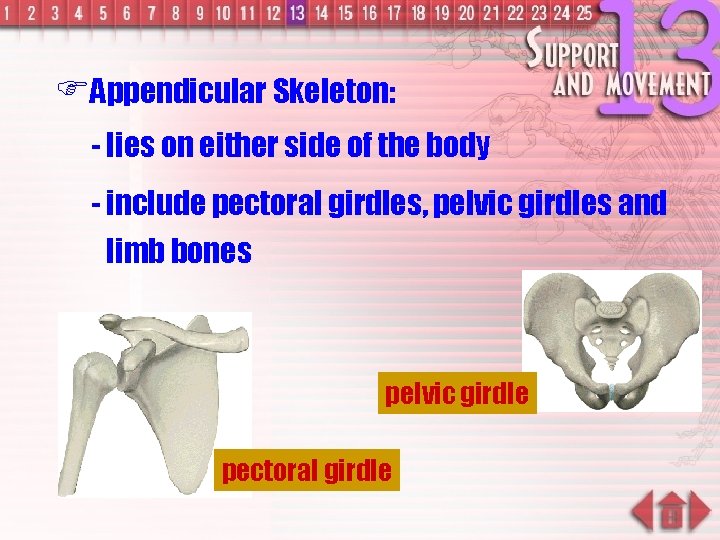
FAppendicular Skeleton: - lies on either side of the body - include pectoral girdles, pelvic girdles and limb bones pelvic girdle pectoral girdle
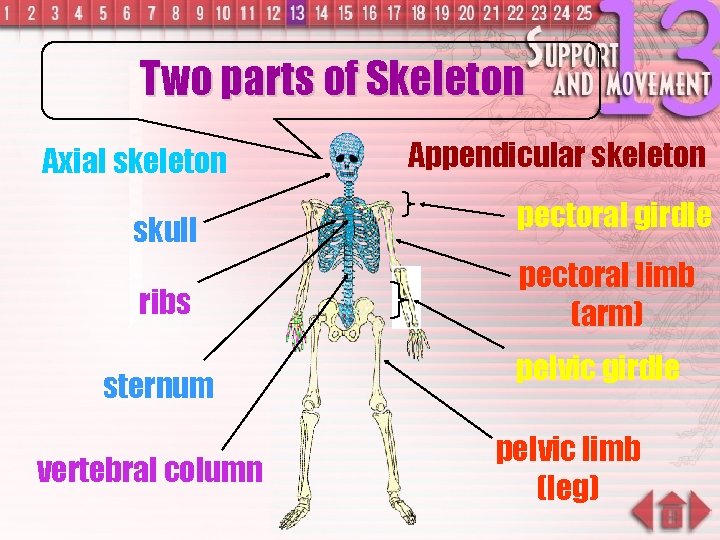
Two parts of Skeleton Axial skeleton Appendicular skeleton skull pectoral girdle ribs pectoral limb (arm) sternum vertebral column pelvic girdle pelvic limb (leg)
Functions of Skeleton Support and Maintenance of Body Shape f skeleton holds body upright and gives animal shape and form f provide a framework for tissues and organs
Attachment of Muscles for Movement f muscles are attached across joints to bone surfaces f with alternate contraction and relaxation of muscles, body can move Protection of Internal Organs f lungs and heart are protected by rib cage f spinal cord is protected by vertebral column
Production of Blood Cells f red blood cells and white blood cells are made by red bone marrow of certain long bones Storage f yellow marrow stores fat f compact bone tissue stores calcium and phosphorus
Joints joint is formed wherever two or more bones meet two types of joints: immovable and movable joints movable joints which allow a lot of movement is synovial joints examples of synovial joints: elbow joint and shoulder joint
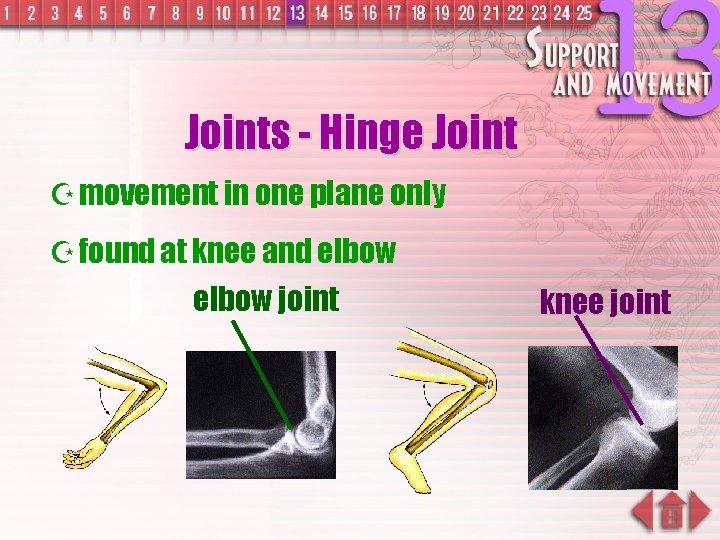
Joints - Hinge Joint Z movement in one plane only Z found at knee and elbow joint knee joint
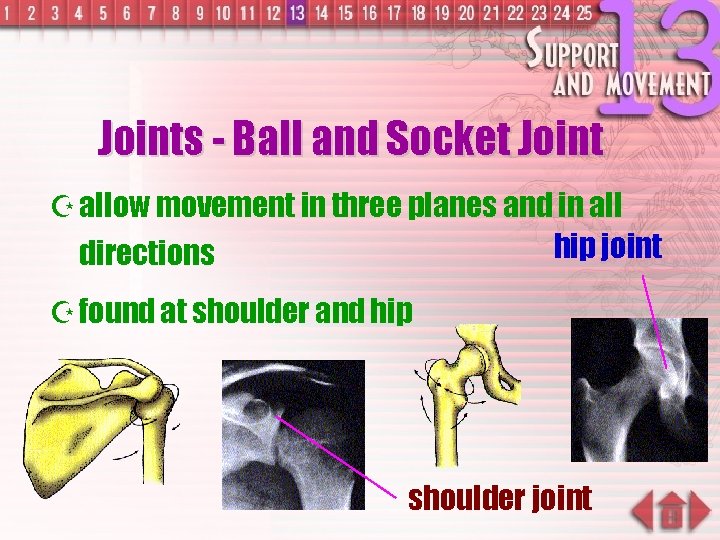
Joints - Ball and Socket Joint Z allow movement in three planes and in all hip joint directions Z found at shoulder and hip shoulder joint
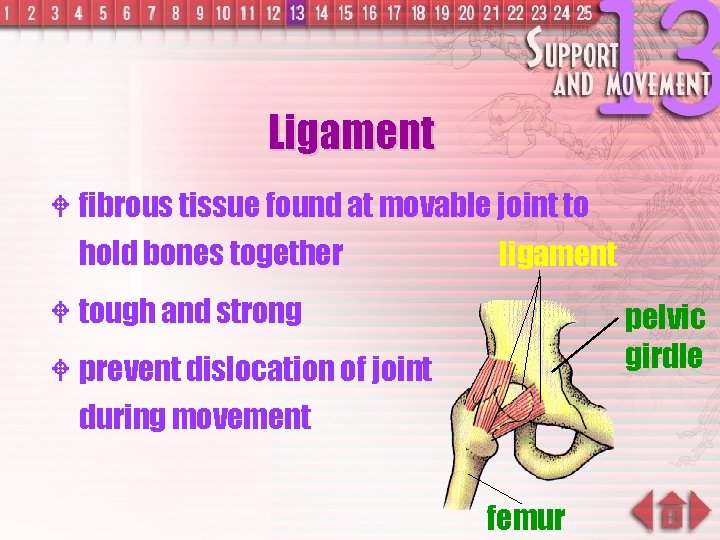
Ligament W fibrous tissue found at movable joint to hold bones together ligament W tough and strong pelvic girdle W prevent dislocation of joint during movement femur
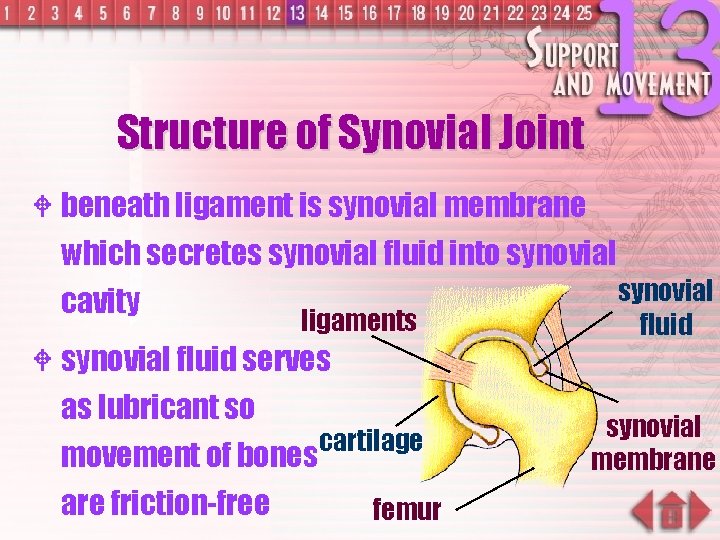
Structure of Synovial Joint W beneath ligament is synovial membrane which secretes synovial fluid into synovial cavity ligaments W synovial fluid serves as lubricant so cartilage movement of bones are friction-free femur synovial fluid synovial membrane
W ends of bones are covered with articular cartilage W it is softer and can act as shock-absorber to protect bones at the joint W it is also used to minimize friction between bones and to ensure bone surfaces will not be worn away when bones move against one another
Muscles T muscles are attached to bone surface T bones in mammals are joined to form a lever system T force in a lever comes from muscle contraction which energy results from respiration but energy does not require when muscle relaxes
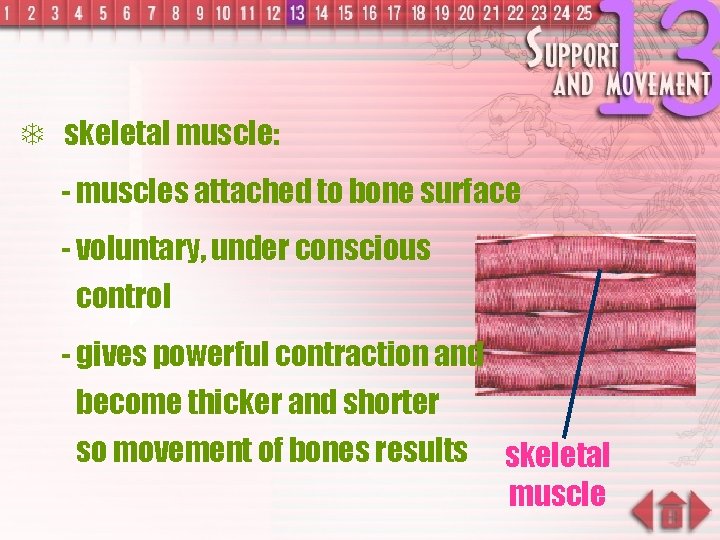
T skeletal muscle: - muscles attached to bone surface - voluntary, under conscious control - gives powerful contraction and become thicker and shorter so movement of bones results skeletal muscle
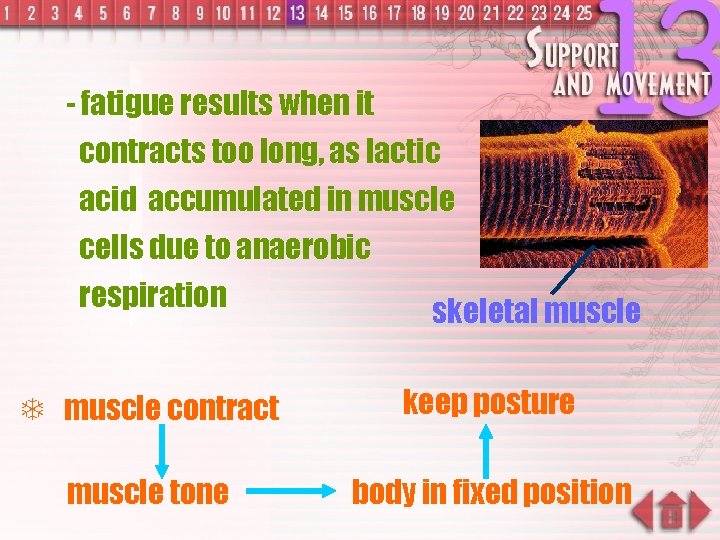
- fatigue results when it contracts too long, as lactic acid accumulated in muscle cells due to anaerobic respiration skeletal muscle T muscle contract keep posture muscle tone body in fixed position
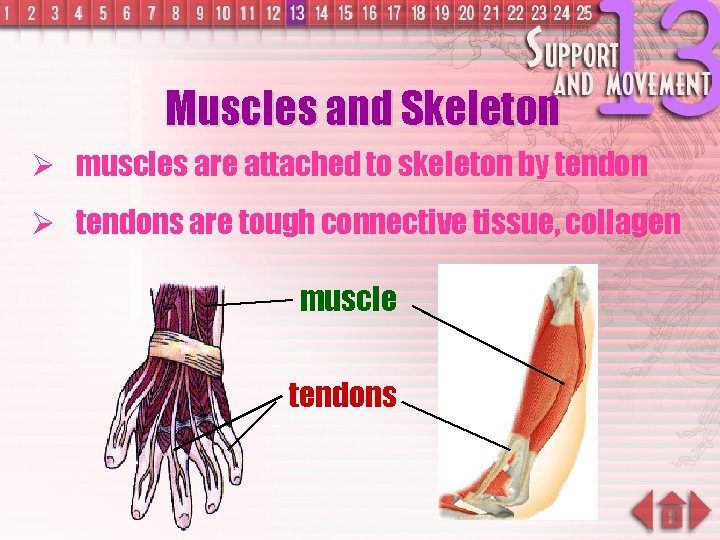
Muscles and Skeleton Ø muscles are attached to skeleton by tendon Ø tendons are tough connective tissue, collagen muscle tendons
Ø begins inside bone and penetrates deep into muscle Ø cannot stretch Ø insertion is the end of muscle attached to a movable bone during muscle contraction while origin is the end attached to a fixed bone during muscle contraction
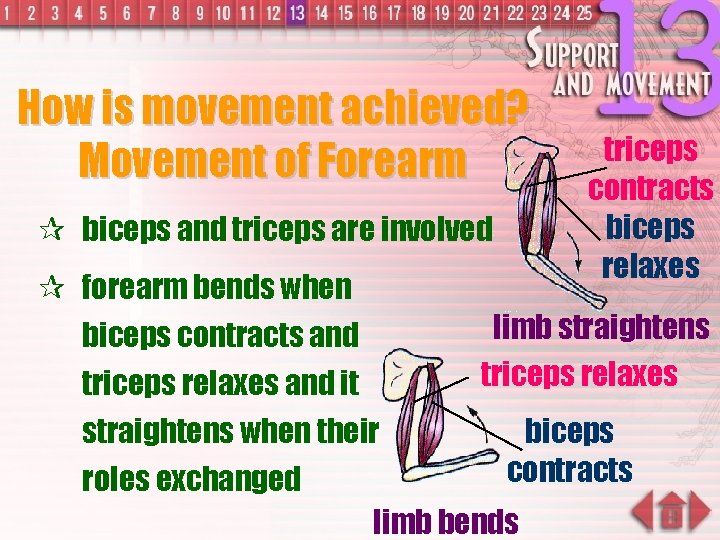
How is movement achieved? Movement of Forearm ¶ biceps and triceps are involved ¶ forearm bends when triceps contracts biceps relaxes limb straightens biceps contracts and triceps relaxes and it straightens when their biceps contracts roles exchanged limb bends
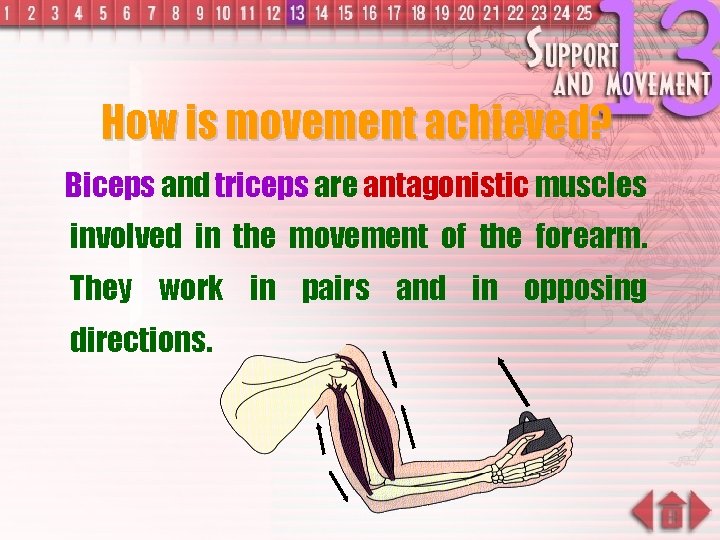
How is movement achieved? Biceps and triceps are antagonistic muscles involved in the movement of the forearm. They work in pairs and in opposing directions.
¶ members in antagonistic pair are flexor and extensor ¶ flexor contracts to bend the limb while extensor straightens the limb when it contracts
¶ biceps attach to its origin and insertion by two tendons while triceps attach to origin and insertion with three tendons ¶ contraction of biceps together with relaxation of triceps make forearm to move close to upper arm and vice versa for straightening of the limb
To show the Action of Opposing Muscles by using a Model of the Forelimb
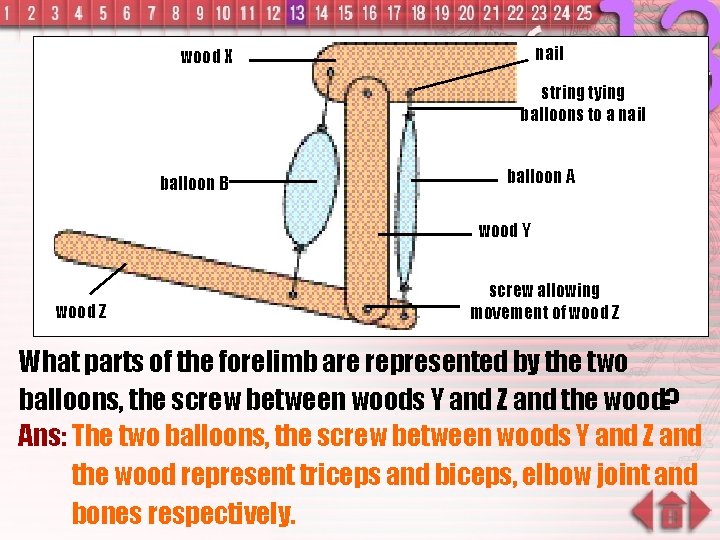
nail wood X string tying balloons to a nail balloon B balloon A wood Y wood Z screw allowing movement of wood Z What parts of the forelimb are represented by the two balloons, the screw between woods Y and Z and the wood? Ans: The two balloons, the screw between woods Y and Z and the wood represent triceps and biceps, elbow joint and bones respectively.
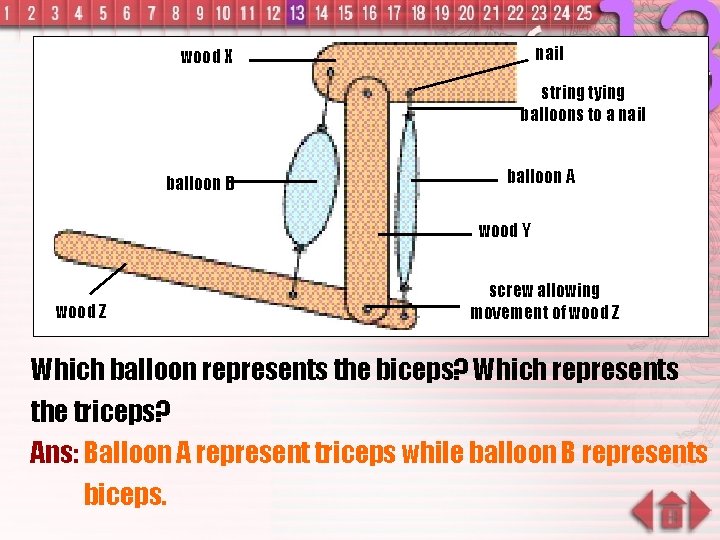
nail wood X string tying balloons to a nail balloon B balloon A wood Y wood Z screw allowing movement of wood Z Which balloon represents the biceps? Which represents the triceps? Ans: Balloon A represent triceps while balloon B represents biceps.
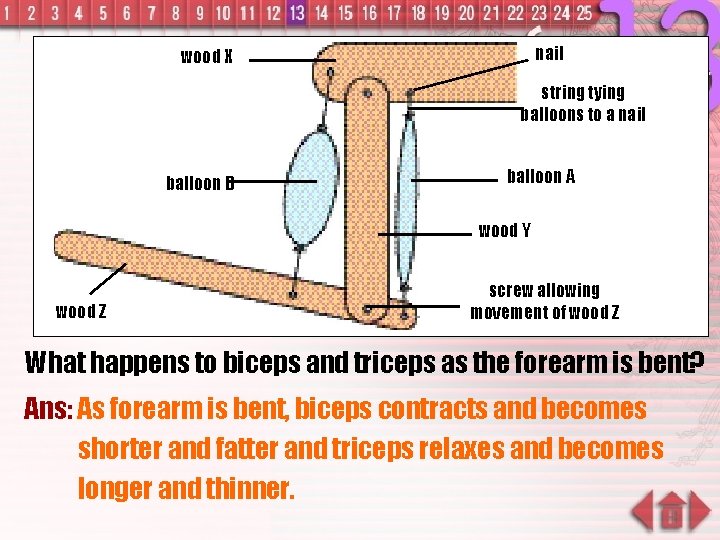
nail wood X string tying balloons to a nail balloon B balloon A wood Y wood Z screw allowing movement of wood Z What happens to biceps and triceps as the forearm is bent? Ans: As forearm is bent, biceps contracts and becomes shorter and fatter and triceps relaxes and becomes longer and thinner.
Lever Ñ lever is a bar which is turned about a fixed point which is called fulcrum Ñ on one side of fulcrum is load and effort is applied on the other side. Force is transmitted along lever to the load Ñ e. g. elbow joint
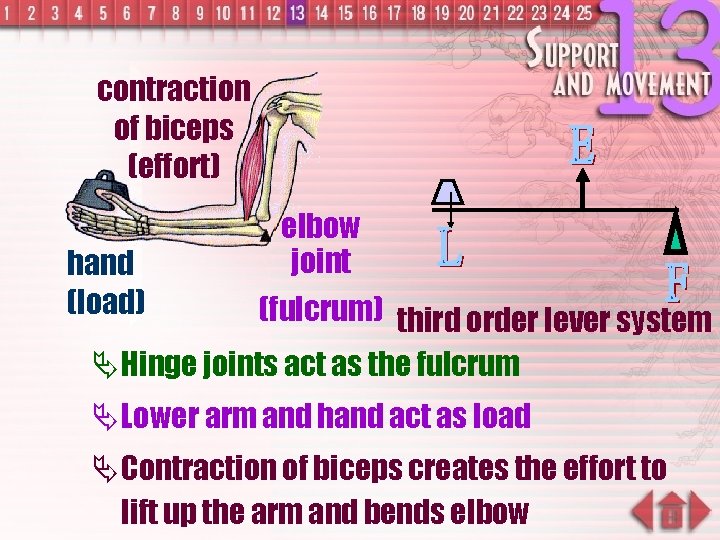
contraction of biceps (effort) hand (load) elbow joint (fulcrum) third order lever system Ä Hinge joints act as the fulcrum Ä Lower arm and hand act as load Ä Contraction of biceps creates the effort to lift up the arm and bends elbow
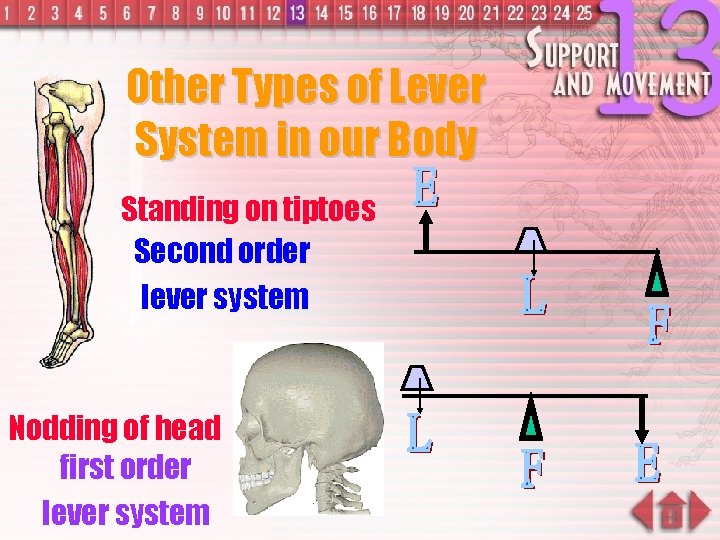
Other Types of Lever System in our Body Standing on tiptoes Second order lever system Nodding of head first order lever system

Importance of Support in Plants > display leaves in the best position to absorb enough light for photosynthesis > lift flowers to higher positions so fruits and seeds can be dispersed over a wide area. This helps species to propagate to new area
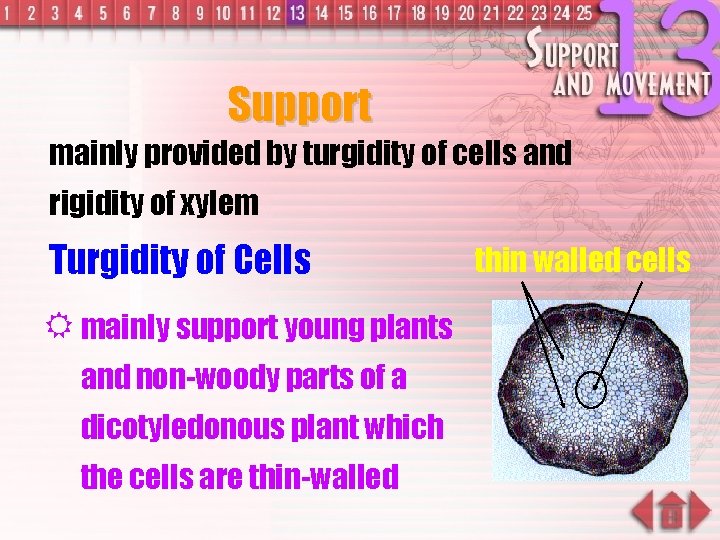
Support mainly provided by turgidity of cells and rigidity of xylem Turgidity of Cells R mainly support young plants and non-woody parts of a dicotyledonous plant which the cells are thin-walled thin walled cells
R thin-walled cells absorb water by osmosis and become turgid R turgid cells then press against each other and keep the whole stem upright R if cells lose water and become flaccid, plant will wilt and becomes soft and droopy

R on hot days, when transpiration proceeds faster than water absorption In this case, transpiration is faster than absorption of water wilting occurs
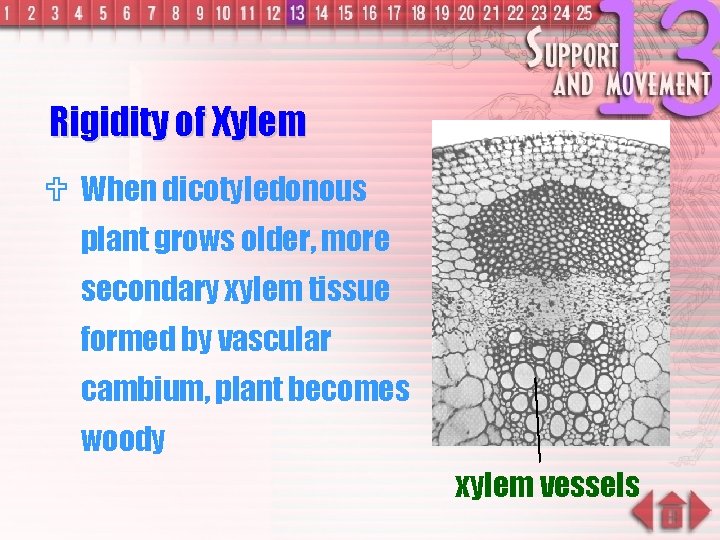
Rigidity of Xylem U When dicotyledonous plant grows older, more secondary xylem tissue formed by vascular cambium, plant becomes woody xylem vessels
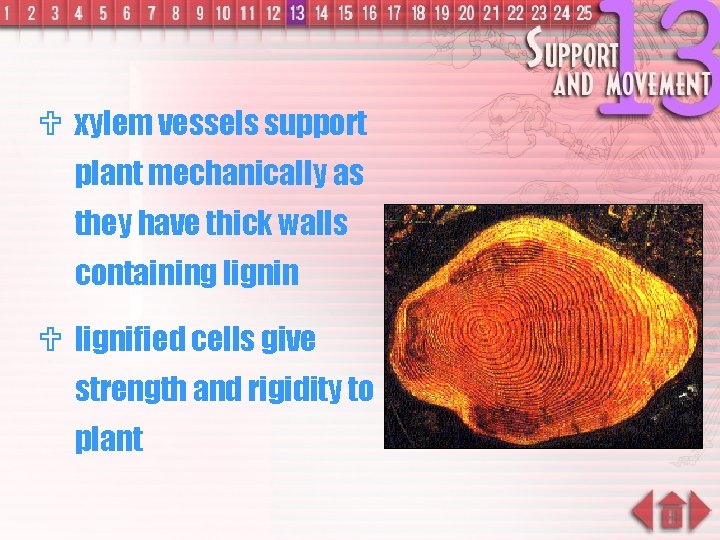
U xylem vessels support plant mechanically as they have thick walls containing lignin U lignified cells give strength and rigidity to plant
~ END ~
- Slides: 48