
Why Do I Need to Do Science Fair

- Slides: 24
Why Do I Need to Do Science Fair? Real Research in the Real World!
Benefits • Get practice in planning, organizing and implementing a project. • Increase knowledge about surroundings. • Learn the Scientific Method (Conduct an experiment, Collect Data, and Analyze the Data, and make a Conclusion based on Data Analysis)
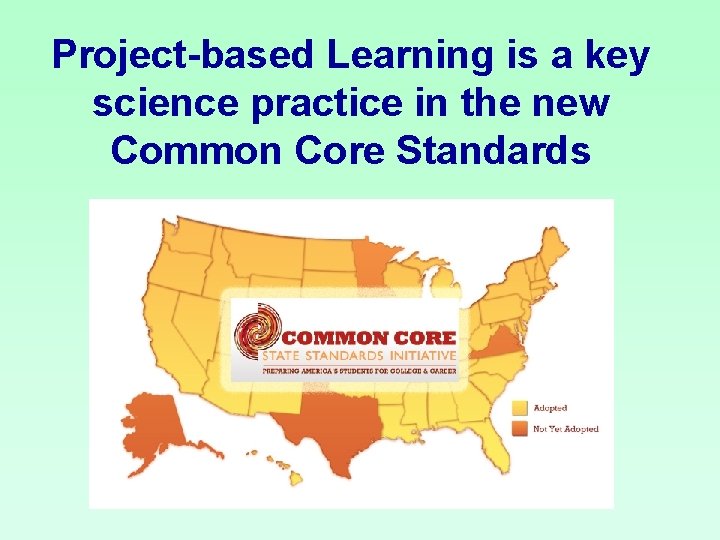
Project-based Learning is a key science practice in the new Common Core Standards
Project Based Learning • Increasing confidence through oral presentations. • Creating a reason to learn and understand essential content. • Requiring inquiry as part of the process of learning
5 -E Model v. Doing a Science fair Project incorporates the all phases of 5 -E Model, a model of science instruction relevant to teaching science as inquiry. üEngagement üExploration üExplanation üElaboration üEvaluation
Interdisciplinary • The Science Fair Integrates-Analysis Base Reading and Writing -Critical Thinking and Math -Scientific Methodology -Computer Science -Statistics -Graphic Arts -Self-learning
Inquiry, Collaboration and Parental Support Students have the opportunity to get help, work with an advisor, and utilize the facilities and equipments provided by advisors. Parental support is often a critical component of a great science fair project.
How to Choose a Topic • Encourage students to choose a topic that matches their interest. • Avoid topics that: v. Are too general v. Require too much time v. Don’t involve experiment (surveys) v. Present replicas or models v. Involve experiments that merely find out “What happens if I do this? ” v. Involve experiments that presents results without analysis
JR Science Fair Categories • • • Environmental Management Materials Science Mathematics & Computer Sciences Microbiology Pharmacology Physics-Aerodynamics/Hydrodynamics Physics - Electricity & Magnetism Physics - General Plant Biology Plant Physiology Product Science
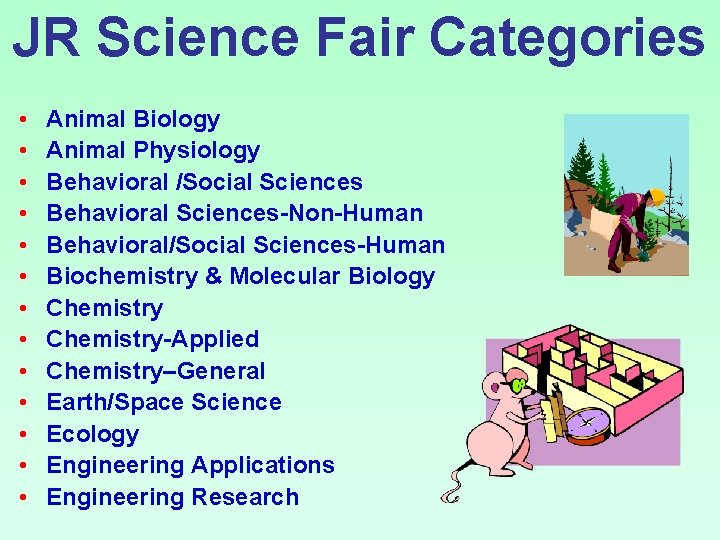
JR Science Fair Categories • • • • Animal Biology Animal Physiology Behavioral /Social Sciences Behavioral Sciences-Non-Human Behavioral/Social Sciences-Human Biochemistry & Molecular Biology Chemistry-Applied Chemistry–General Earth/Space Science Ecology Engineering Applications Engineering Research
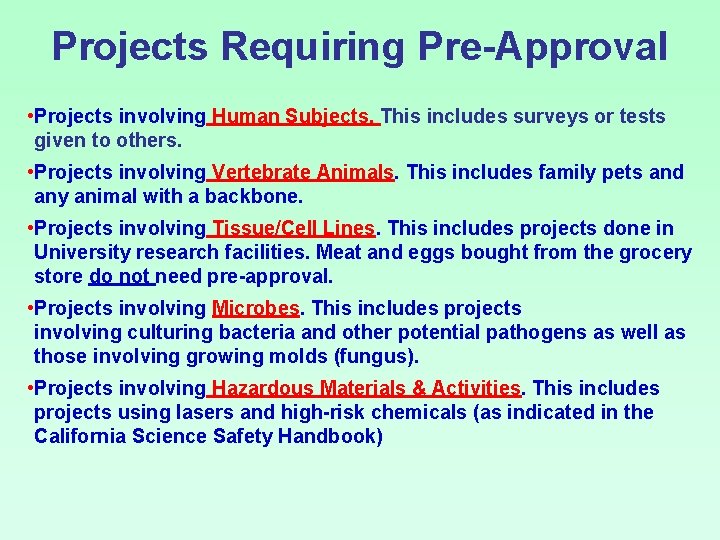
Projects Requiring Pre-Approval • Projects involving Human Subjects. This includes surveys or tests given to others. • Projects involving Vertebrate Animals. This includes family pets and any animal with a backbone. • Projects involving Tissue/Cell Lines. This includes projects done in University research facilities. Meat and eggs bought from the grocery store do not need pre-approval. • Projects involving Microbes. This includes projects involving culturing bacteria and other potential pathogens as well as those involving growing molds (fungus). • Projects involving Hazardous Materials & Activities. This includes projects using lasers and high-risk chemicals (as indicated in the California Science Safety Handbook)
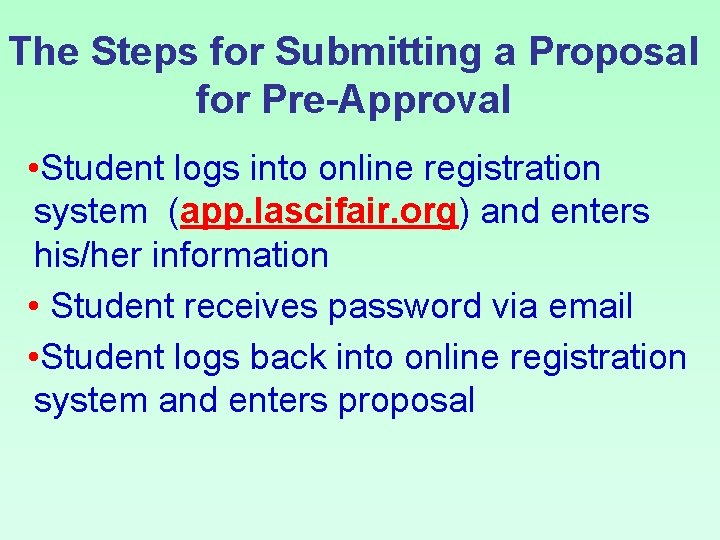
The Steps for Submitting a Proposal for Pre-Approval • Student logs into online registration system (app. lascifair. org) and enters his/her information • Student receives password via email • Student logs back into online registration system and enters proposal
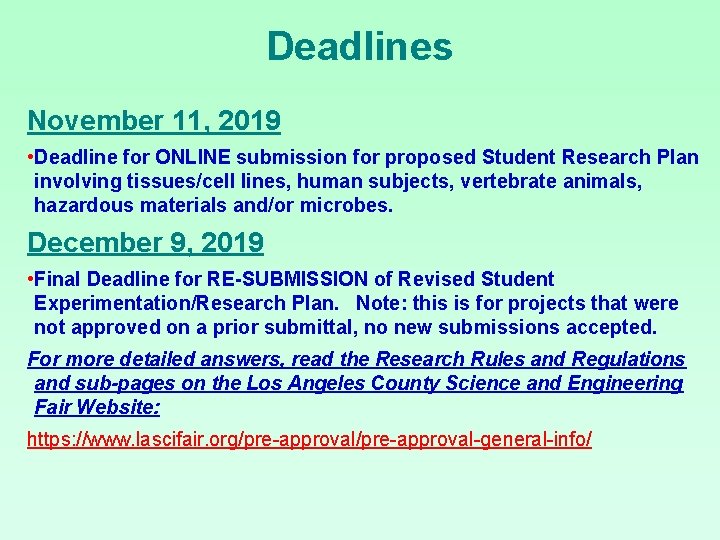
Deadlines November 11, 2019 • Deadline for ONLINE submission for proposed Student Research Plan involving tissues/cell lines, human subjects, vertebrate animals, hazardous materials and/or microbes. December 9, 2019 • Final Deadline for RE-SUBMISSION of Revised Student Experimentation/Research Plan. Note: this is for projects that were not approved on a prior submittal, no new submissions accepted. For more detailed answers, read the Research Rules and Regulations and sub-pages on the Los Angeles County Science and Engineering Fair Website: https: //www. lascifair. org/pre-approval-general-info/
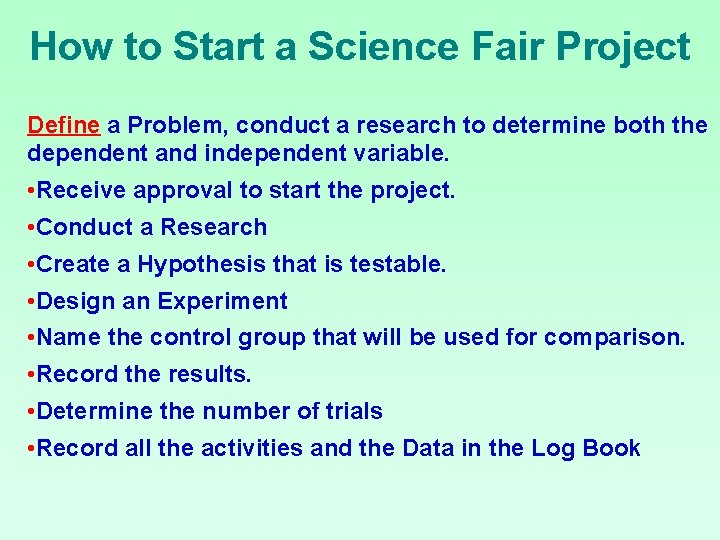
How to Start a Science Fair Project Define a Problem, conduct a research to determine both the dependent and independent variable. • Receive approval to start the project. • Conduct a Research • Create a Hypothesis that is testable. • Design an Experiment • Name the control group that will be used for comparison. • Record the results. • Determine the number of trials • Record all the activities and the Data in the Log Book
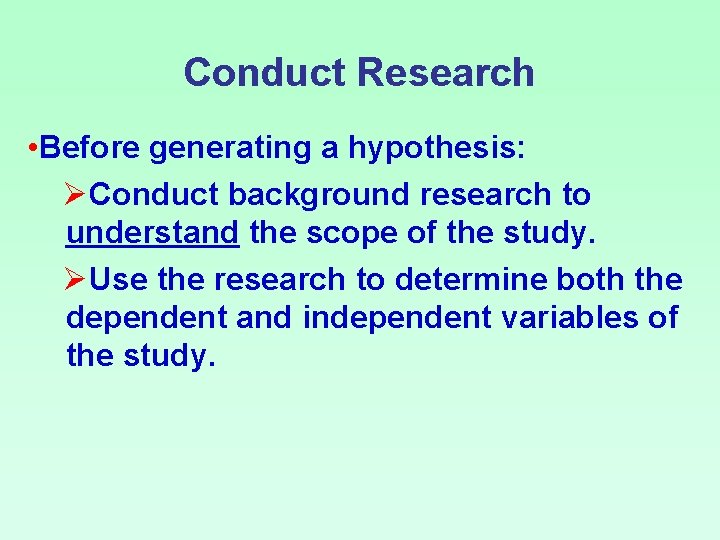
Conduct Research • Before generating a hypothesis: ØConduct background research to understand the scope of the study. ØUse the research to determine both the dependent and independent variables of the study.
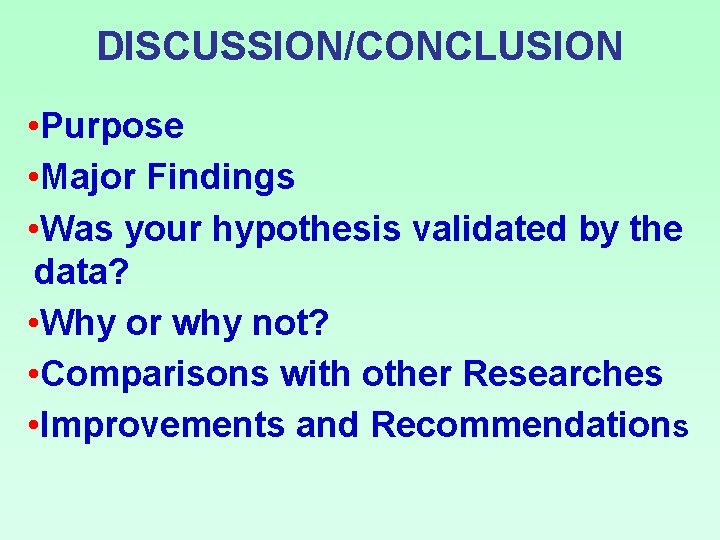
DISCUSSION/CONCLUSION • Purpose • Major Findings • Was your hypothesis validated by the data? • Why or why not? • Comparisons with other Researches • Improvements and Recommendations
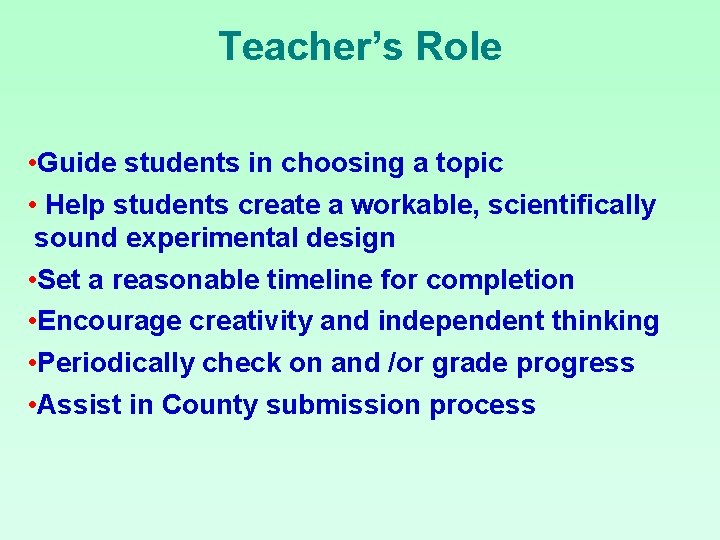
Teacher’s Role • Guide students in choosing a topic • Help students create a workable, scientifically sound experimental design • Set a reasonable timeline for completion • Encourage creativity and independent thinking • Periodically check on and /or grade progress • Assist in County submission process
School Judging Procedure • Preliminary Judging The projects are viewed by the judging panel. The students are selected for the interview. Students are not present in this process. • Final Judging Students must be present for the interviews. Selected students will present Chamlian School at the Los Angeles County Science Fair.
• The Los Angeles County Science Fair is open to all students, grades 6 -12, who have been selected as winners from a local school or district Science Fair. • Each school may send a total of 13 entries, three of which may be Team Projects (2 -3 students. )
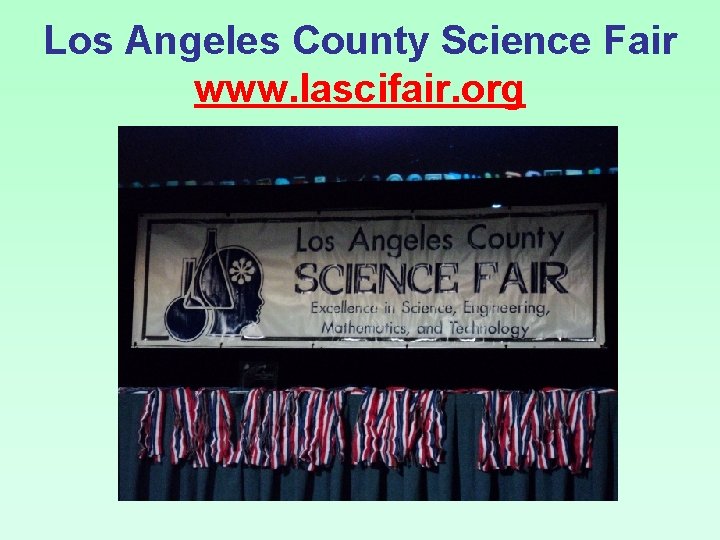
Los Angeles County Science Fair www. lascifair. org
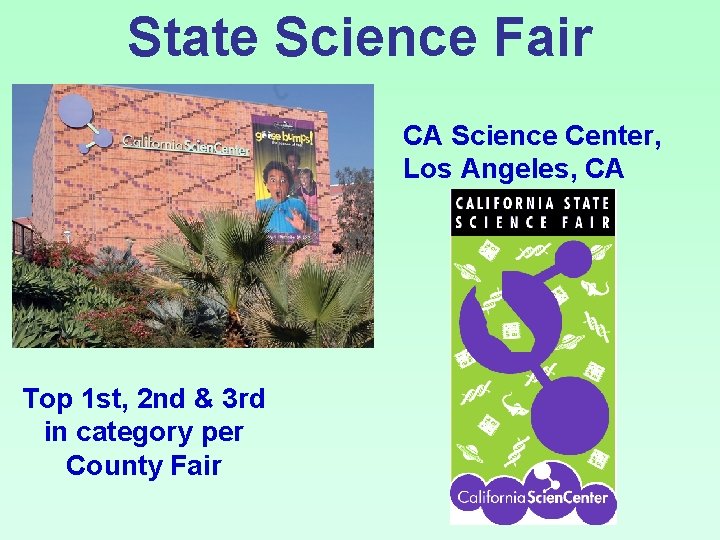
State Science Fair CA Science Center, Los Angeles, CA Top 1 st, 2 nd & 3 rd in category per County Fair
Science Fair Calendar Los Angeles County Science & Engineering Fair March 19 -21, 2019 Californian State Science and Engineering Fair April 20 -21, 2020
Grading Policy • Students’ work will be graded periodically. • Science Fair project assessments will be part of the second and third quarter grade.
Remember… No matter how fancy & eyecatching the display … It can’t take the place of solid, well-documented analyzed research