
Why do cells divide QUIZ 1 Where does





- Slides: 73
Why do cells divide?
QUIZ 1. Where does DNA synthesis occur ? (what organelle? ) 2. What does Helicase do? DNA polymerase do? 3. What is the purpose of DNA synthesis? 4. Write down this DNA’s complimentary strand 1. G A T A C A
Since we say family members are “blood” relatives, does that mean we share the same blood? • You share no blood with anyone. . not even your mother and father! Your family shares DNA. • 1⁄2 of your DNA came from your mother (egg) and 1⁄2 from your father (sperm). • The process that made this possible is MEIOSIS which makes the sperm and egg. • A fertilized egg then grows into an organism by a different process of cell division called MITOSIS.
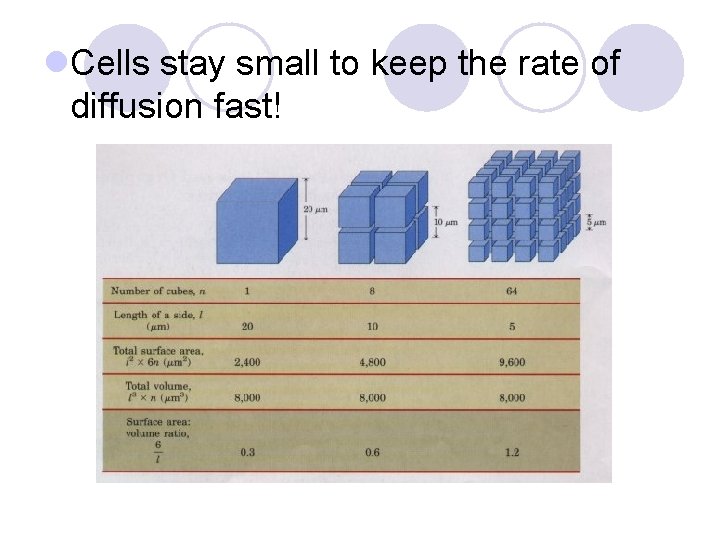
l Cells divide to maintain a workable volume to surface area ratio
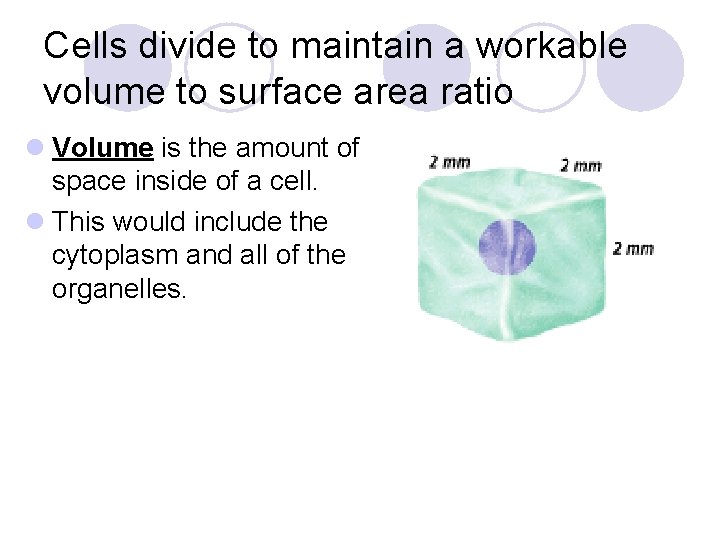
Cells divide to maintain a workable volume to surface area ratio l Volume is the amount of space inside of a cell. l This would include the cytoplasm and all of the organelles.
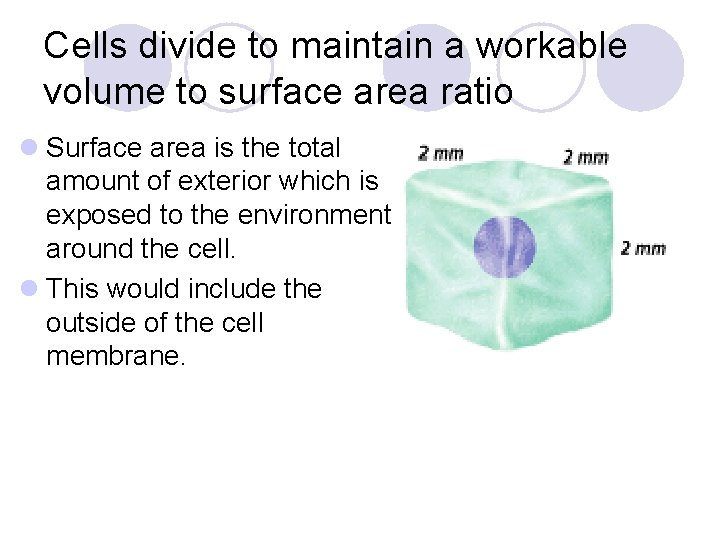
Cells divide to maintain a workable volume to surface area ratio l Surface area is the total amount of exterior which is exposed to the environment around the cell. l This would include the outside of the cell membrane.
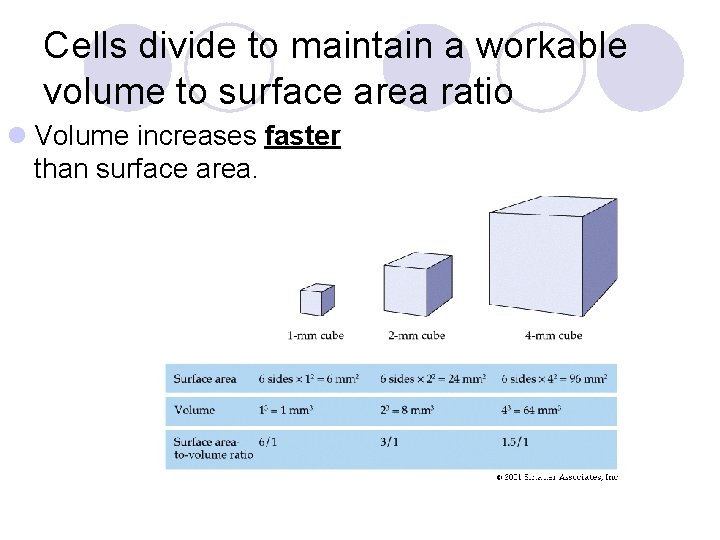
Cells divide to maintain a workable volume to surface area ratio l Volume increases faster than surface area.
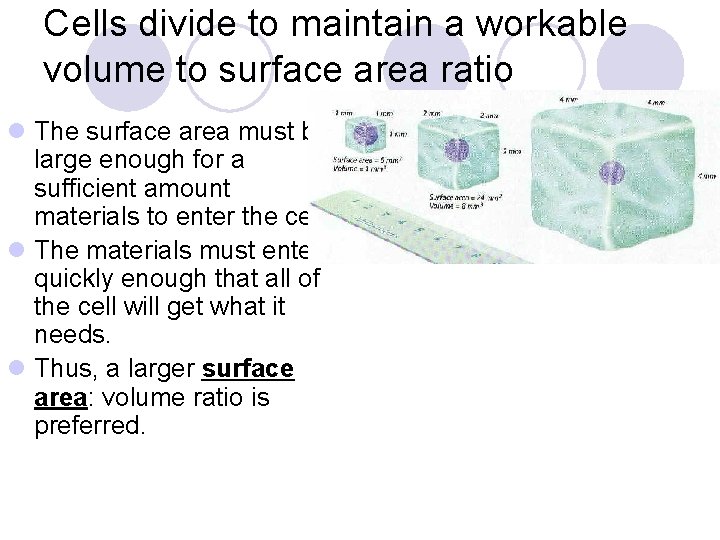
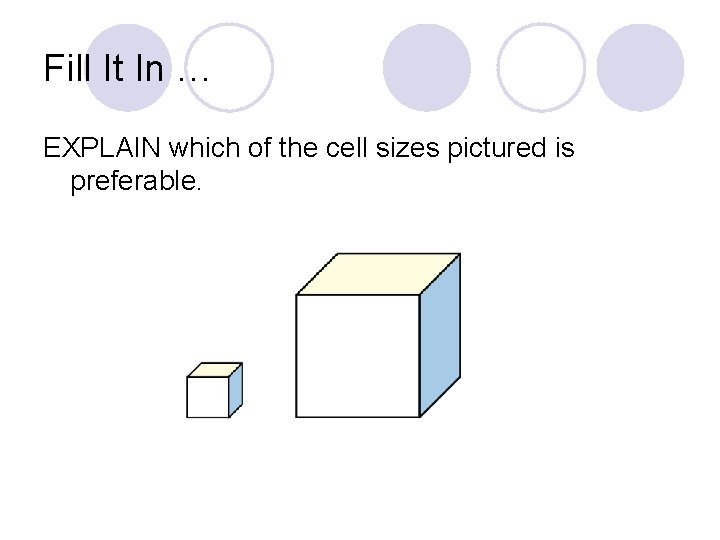
Cells divide to maintain a workable volume to surface area ratio l The surface area must be large enough for a sufficient amount materials to enter the cell. l The materials must enter quickly enough that all of the cell will get what it needs. l Thus, a larger surface area: volume ratio is preferred.
l. Cells stay small to keep the rate of diffusion fast!
Fill It In … EXPLAIN which of the cell sizes pictured is preferable.
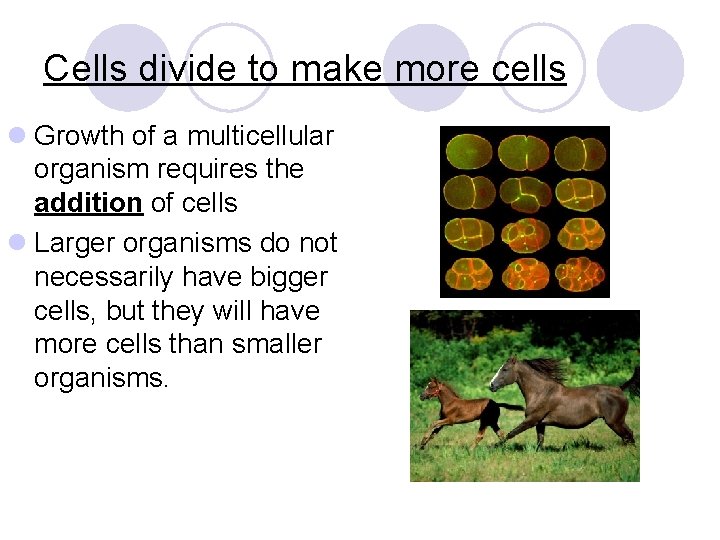
Cells divide to make more cells l Growth of a multicellular organism requires the addition of cells l Larger organisms do not necessarily have bigger cells, but they will have more cells than smaller organisms.
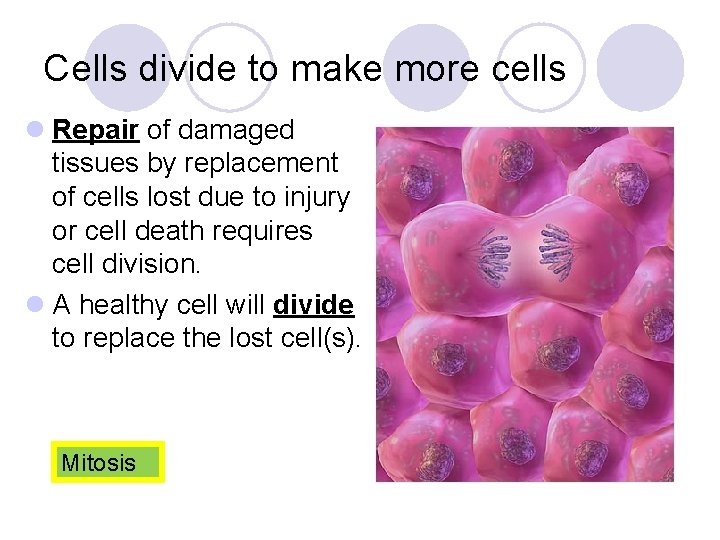
Cells divide to make more cells l Repair of damaged tissues by replacement of cells lost due to injury or cell death requires cell division. l A healthy cell will divide to replace the lost cell(s). Mitosis
Fill It In … 2 reasons that cells need to divide: 1. 2.
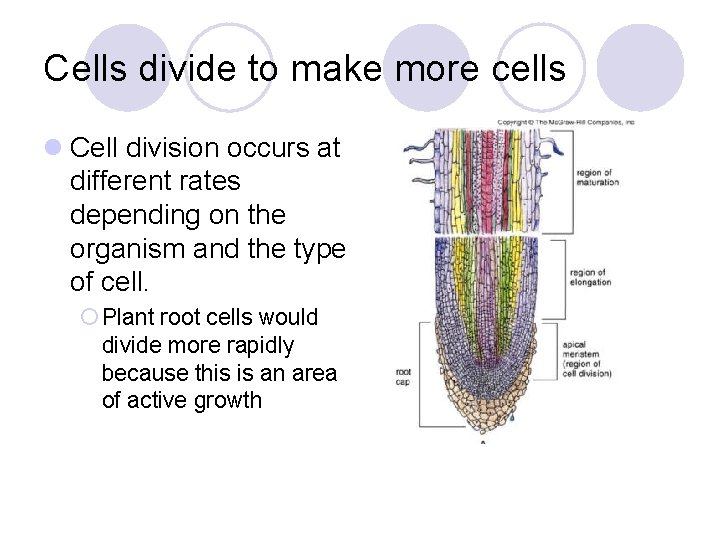
Cells divide to make more cells l Cell division occurs at different rates depending on the organism and the type of cell. ¡ Plant root cells would divide more rapidly because this is an area of active growth
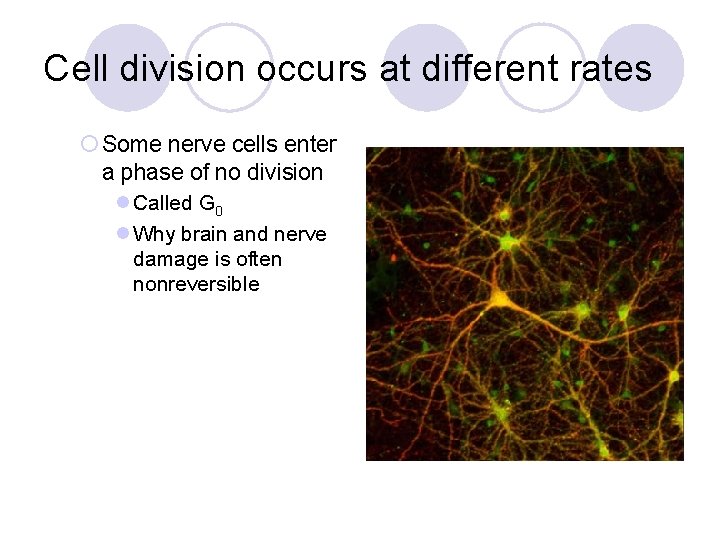
Cell division occurs at different rates ¡ Some nerve cells enter a phase of no division l Called G 0 l Why brain and nerve damage is often nonreversible
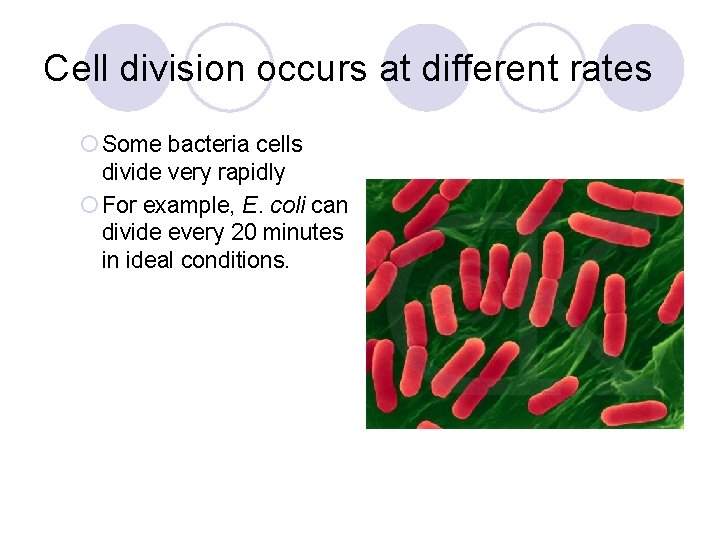
Cell division occurs at different rates ¡ Some bacteria cells divide very rapidly ¡ For example, E. coli can divide every 20 minutes in ideal conditions.
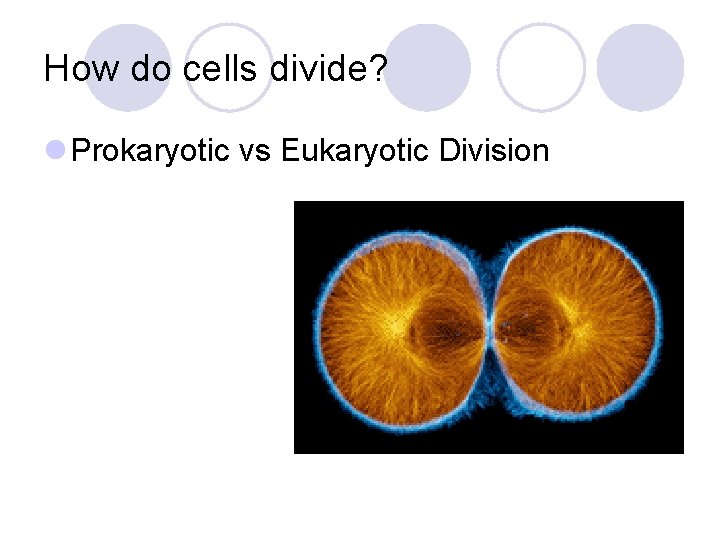
How do cells divide? l Prokaryotic vs Eukaryotic Division
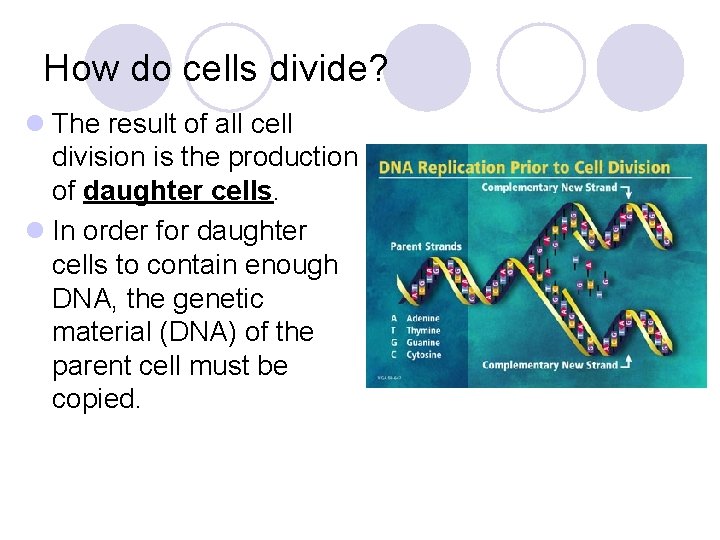
How do cells divide? l The result of all cell division is the production of daughter cells. l In order for daughter cells to contain enough DNA, the genetic material (DNA) of the parent cell must be copied.
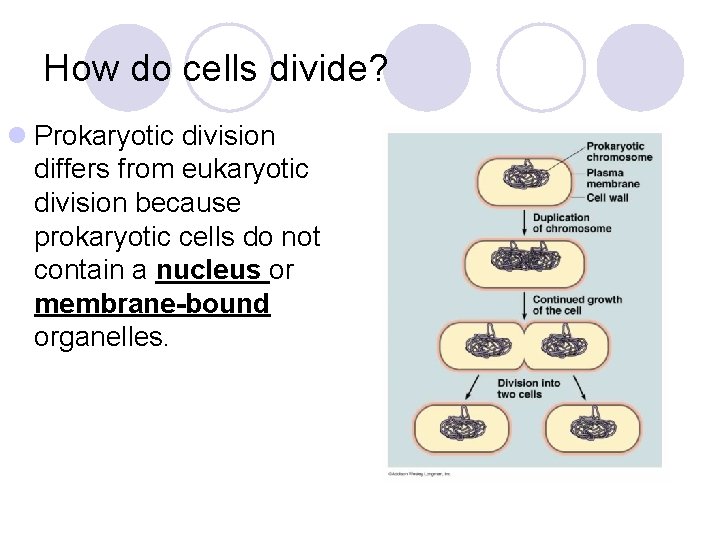
How do cells divide? l Prokaryotic division differs from eukaryotic division because prokaryotic cells do not contain a nucleus or membrane-bound organelles.
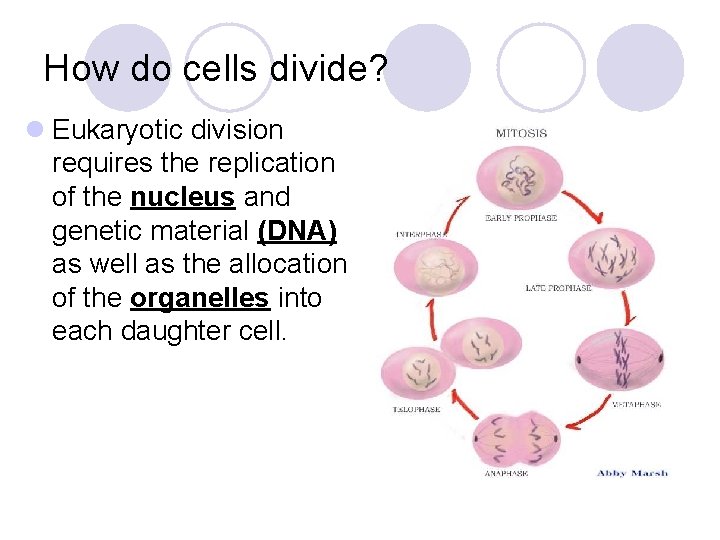
How do cells divide? l Eukaryotic division requires the replication of the nucleus and genetic material (DNA) as well as the allocation of the organelles into each daughter cell.
Fill It In … Reason that prokaryotic cell division is simpler than eukaryotic cell division …
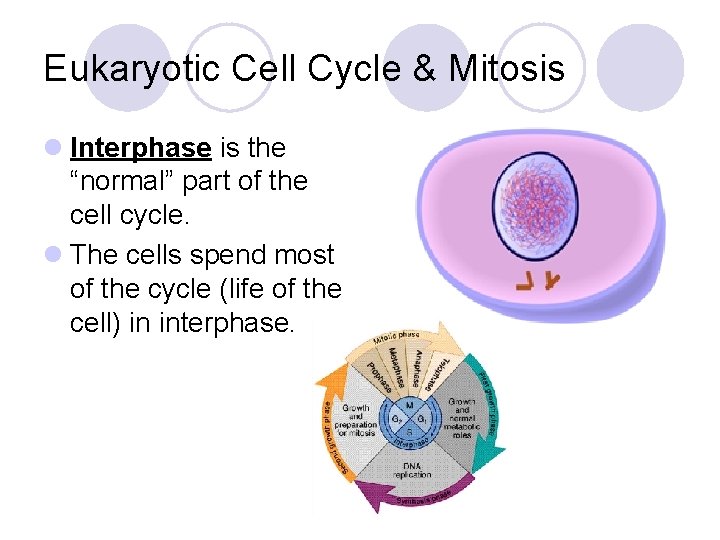
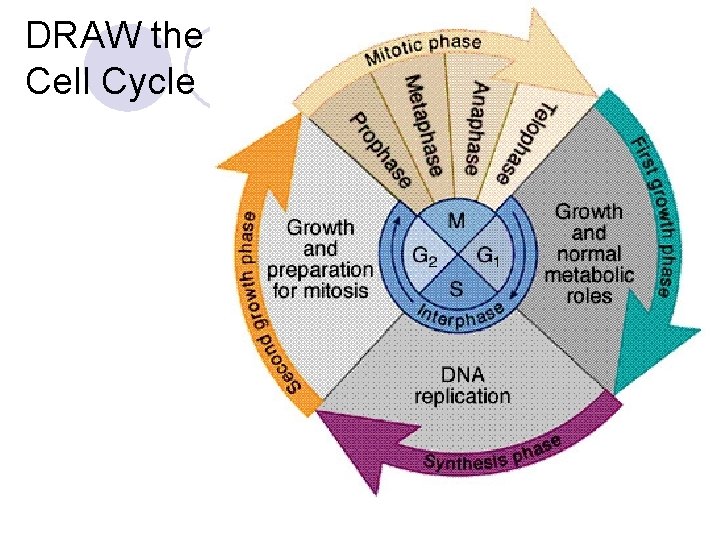
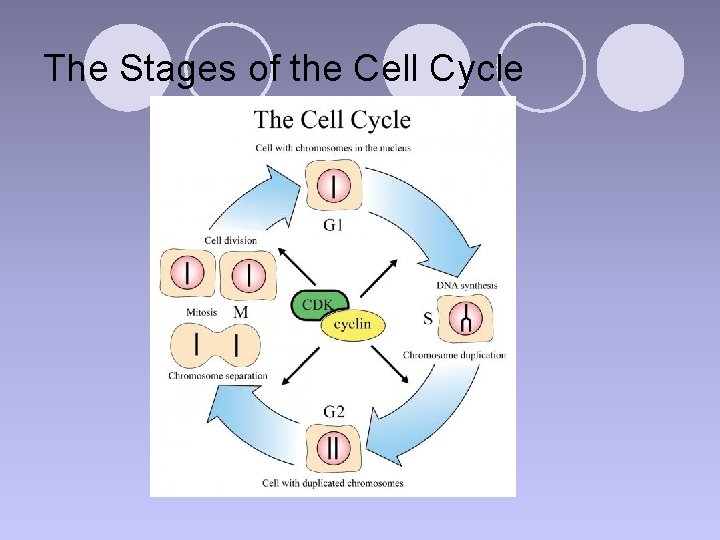
Eukaryotic Cell Cycle & Mitosis l Interphase is the “normal” part of the cell cycle. l The cells spend most of the cycle (life of the cell) in interphase.
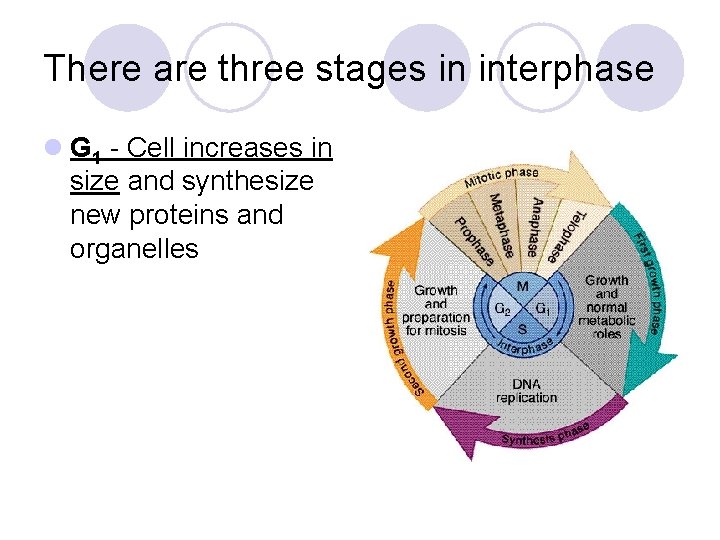
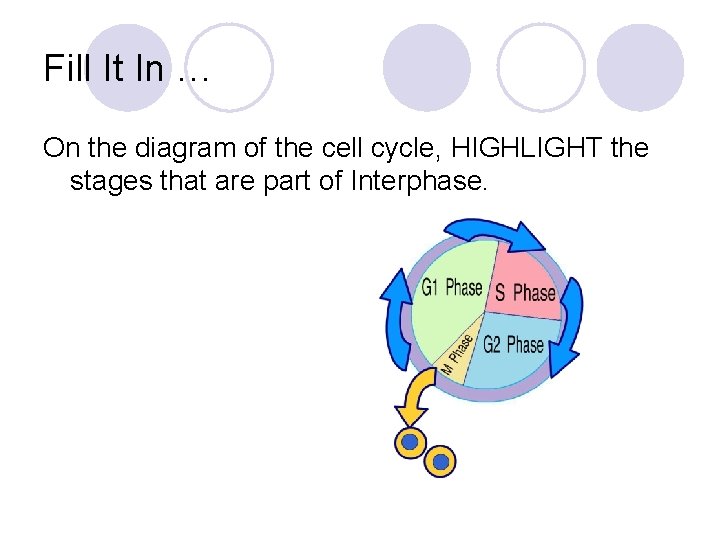
There are three stages in interphase l G 1 - Cell increases in size and synthesize new proteins and organelles
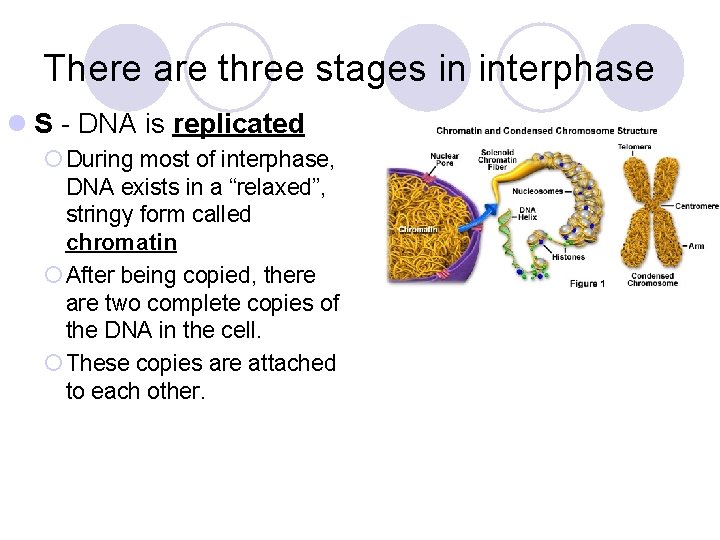
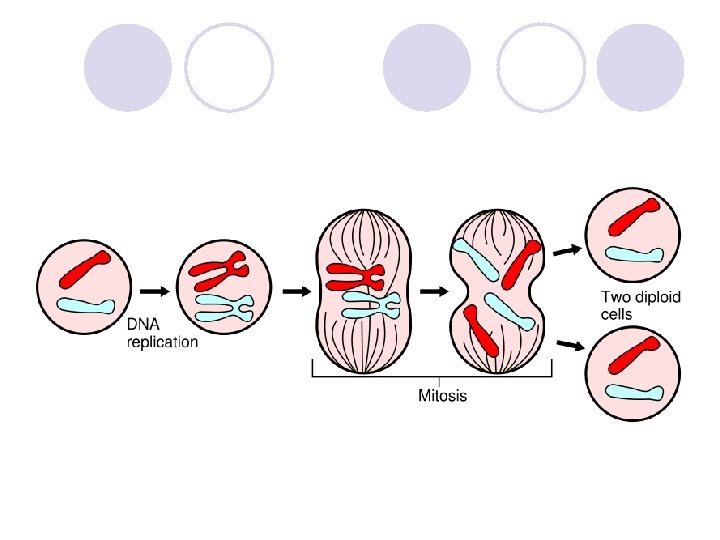
There are three stages in interphase l S - DNA is replicated ¡ During most of interphase, DNA exists in a “relaxed”, stringy form called chromatin ¡ After being copied, there are two complete copies of the DNA in the cell. ¡ These copies are attached to each other.
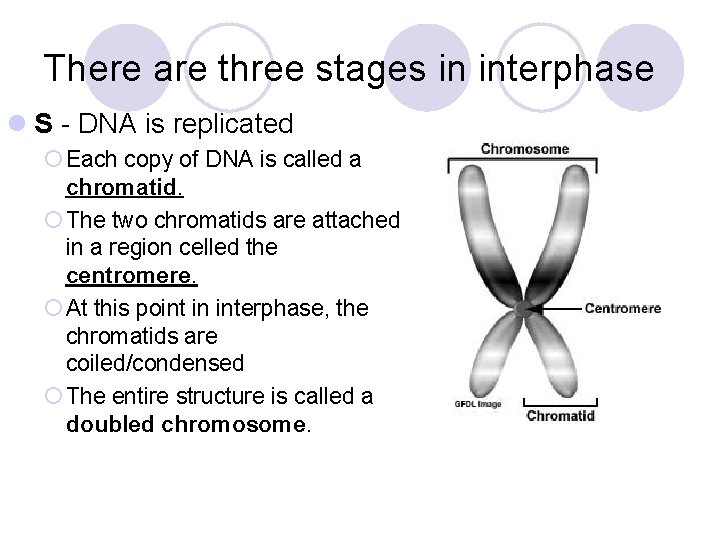
There are three stages in interphase l S - DNA is replicated ¡ Each copy of DNA is called a chromatid. ¡ The two chromatids are attached in a region celled the centromere. ¡ At this point in interphase, the chromatids are coiled/condensed ¡ The entire structure is called a doubled chromosome.
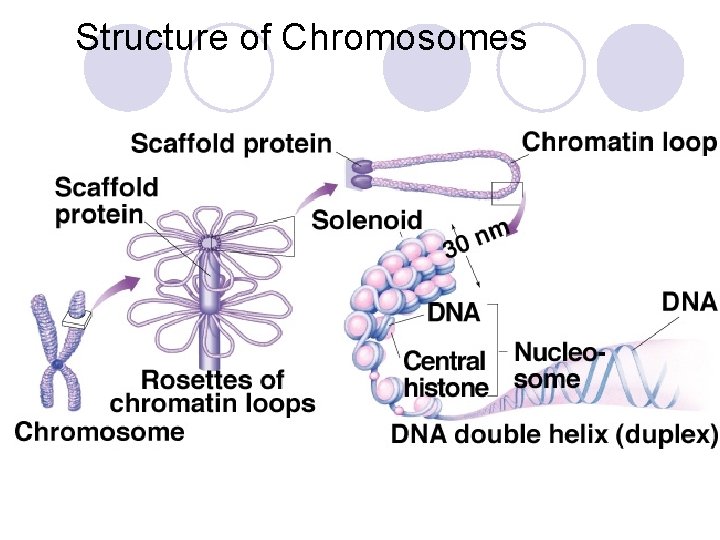
Structure of Chromosomes
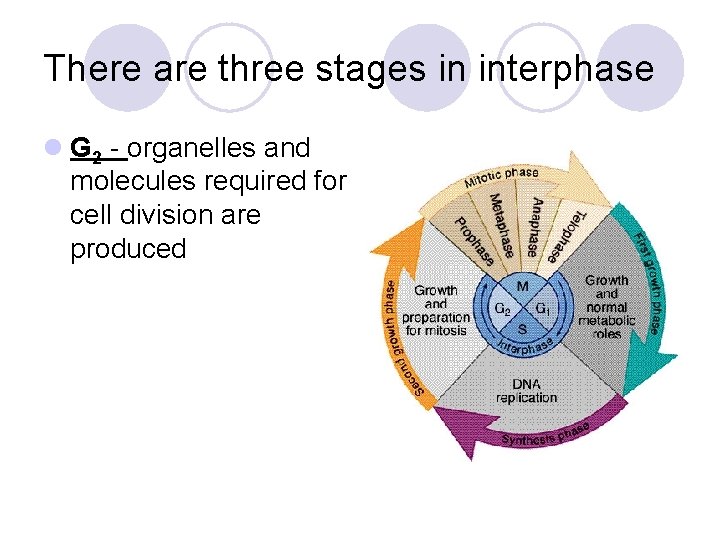
There are three stages in interphase l G 2 - organelles and molecules required for cell division are produced
Fill It In … Differentiate between … Chromatin Chromatid Chromosome -
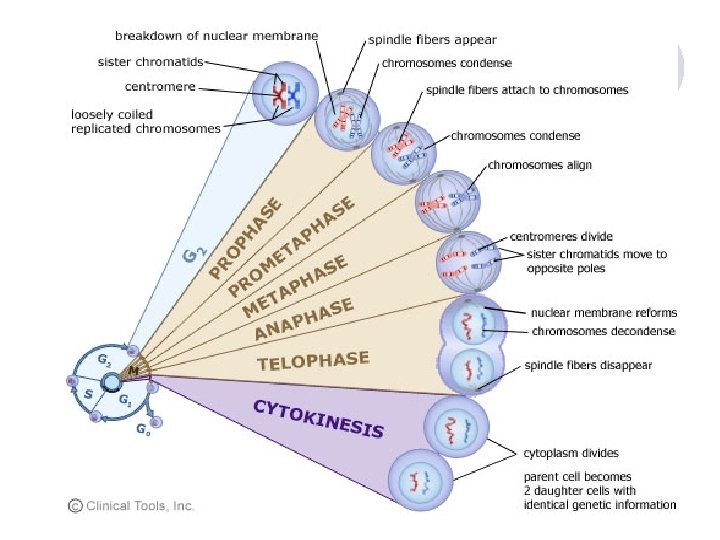
Fill It In … On the diagram of the cell cycle, HIGHLIGHT the stages that are part of Interphase.
DRAW the Cell Cycle
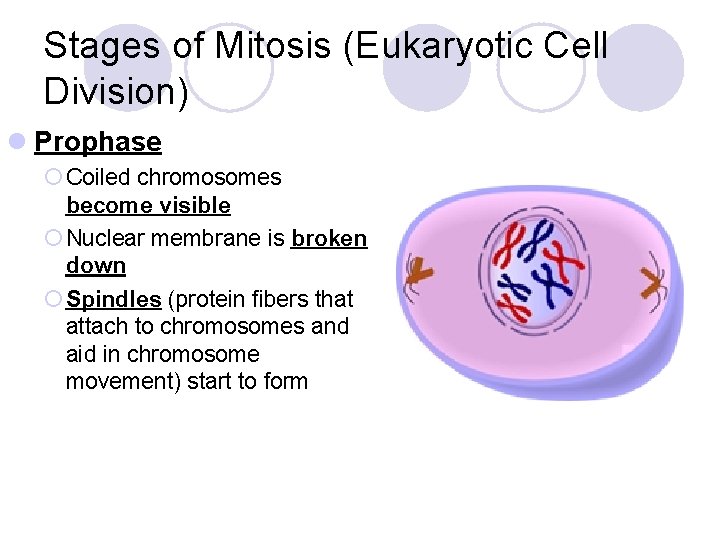
Stages of Mitosis (Eukaryotic Cell Division) l Prophase ¡ Coiled chromosomes become visible ¡ Nuclear membrane is broken down ¡ Spindles (protein fibers that attach to chromosomes and aid in chromosome movement) start to form
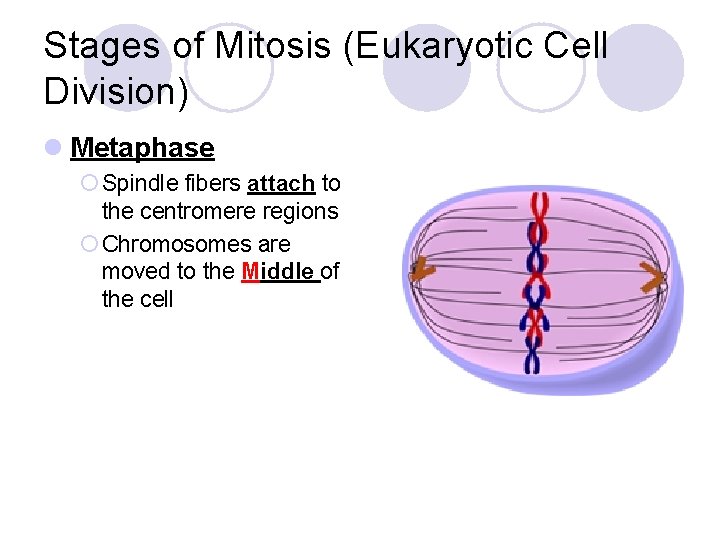
Stages of Mitosis (Eukaryotic Cell Division) l Metaphase ¡ Spindle fibers attach to the centromere regions ¡ Chromosomes are moved to the Middle of the cell
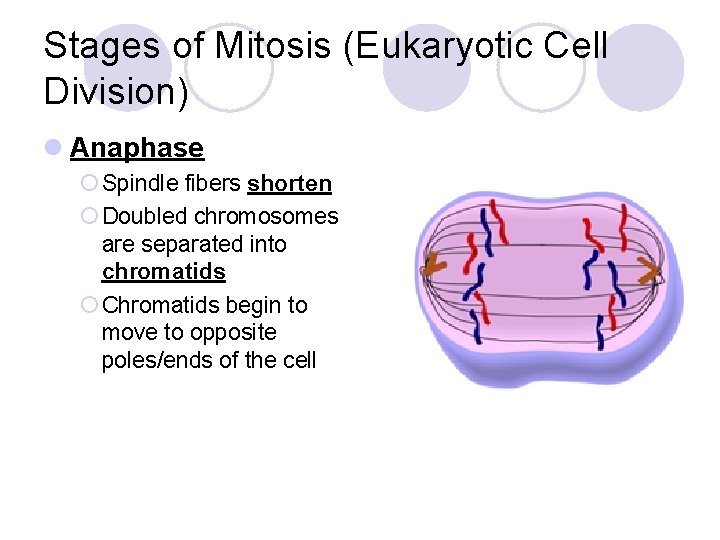
Stages of Mitosis (Eukaryotic Cell Division) l Anaphase ¡ Spindle fibers shorten ¡ Doubled chromosomes are separated into chromatids ¡ Chromatids begin to move to opposite poles/ends of the cell
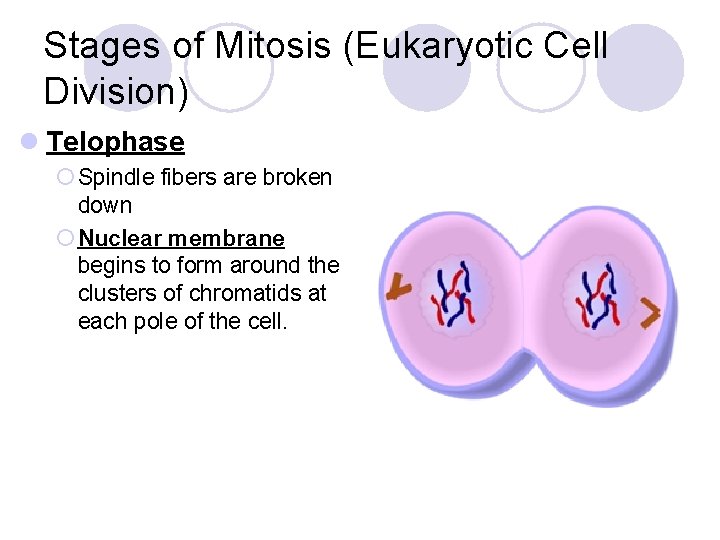
Stages of Mitosis (Eukaryotic Cell Division) l Telophase ¡ Spindle fibers are broken down ¡ Nuclear membrane begins to form around the clusters of chromatids at each pole of the cell.
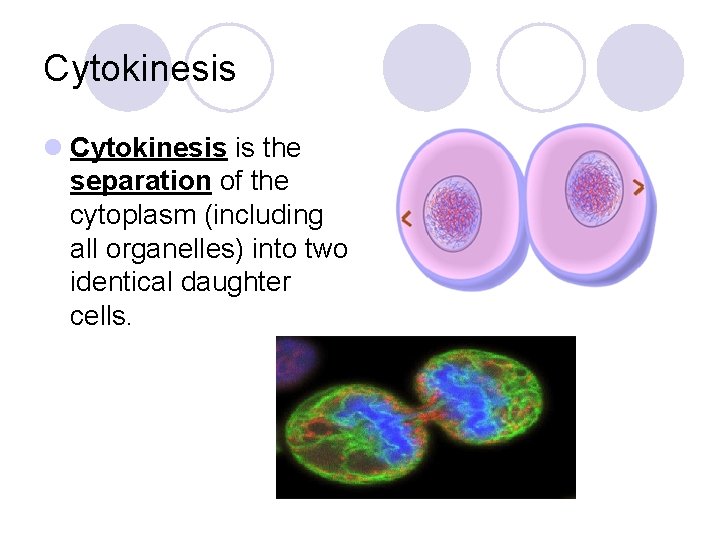
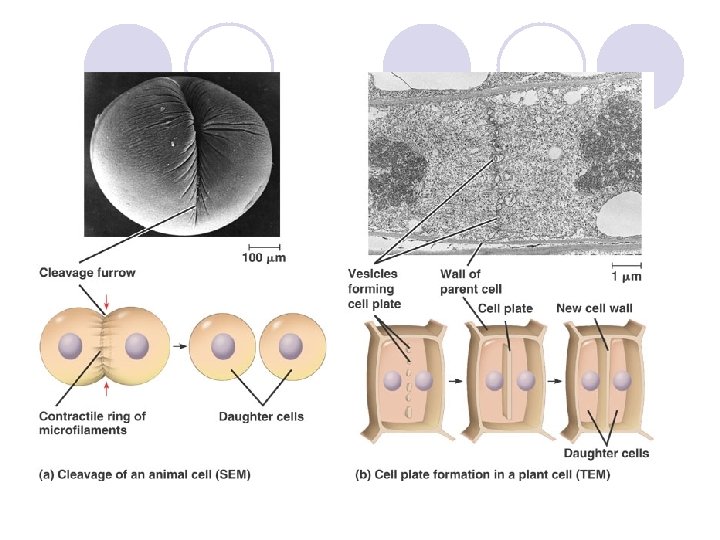
Cytokinesis l Cytokinesis is the separation of the cytoplasm (including all organelles) into two identical daughter cells.
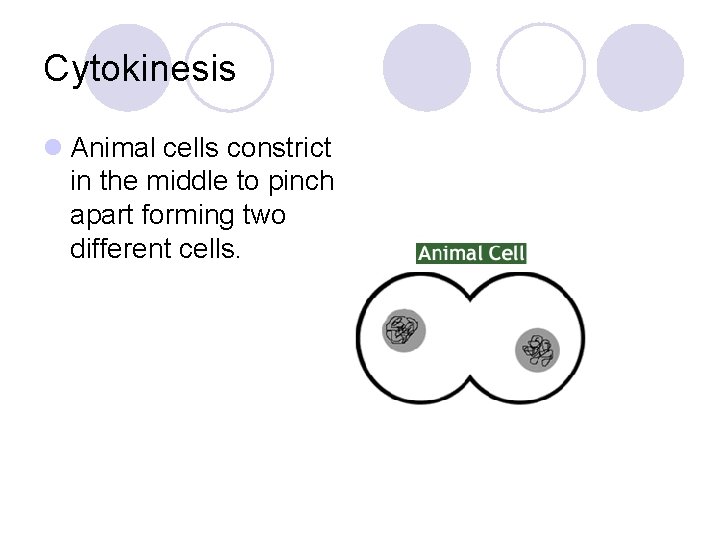
Cytokinesis l Animal cells constrict in the middle to pinch apart forming two different cells.
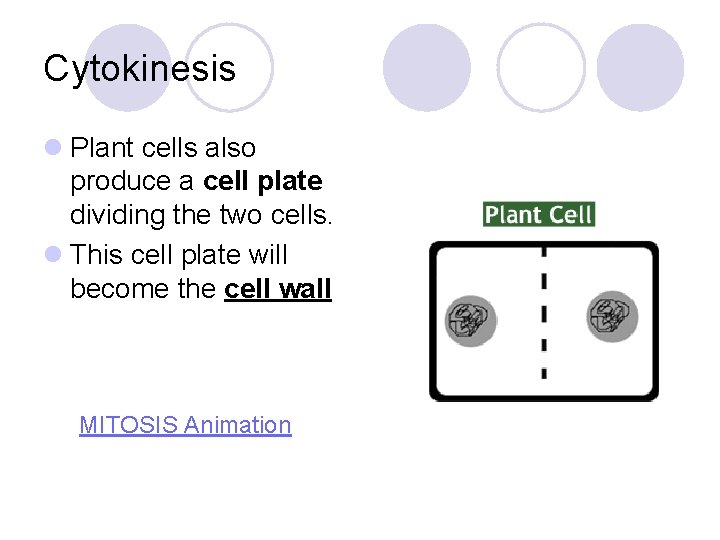
Cytokinesis l Plant cells also produce a cell plate dividing the two cells. l This cell plate will become the cell wall MITOSIS Animation
Fill It In … Summary of the cell cycle 1. Interphase 1. . 2. . 3. . 2. Mitosis 1. 2. 3. 4. 3. . .
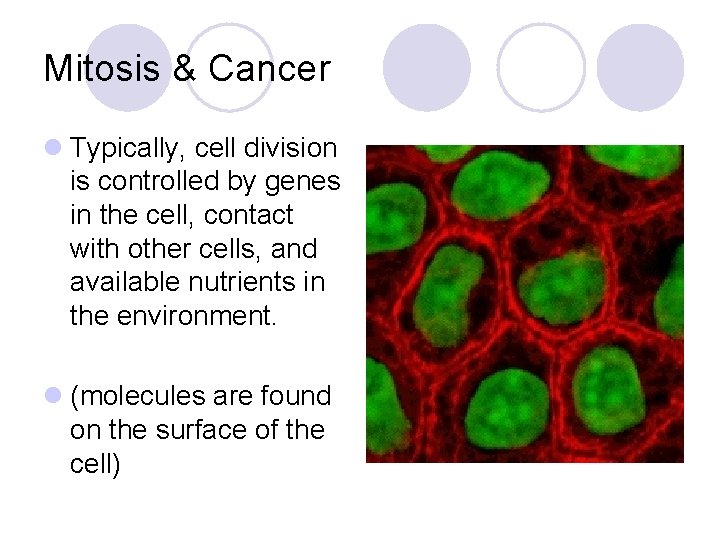
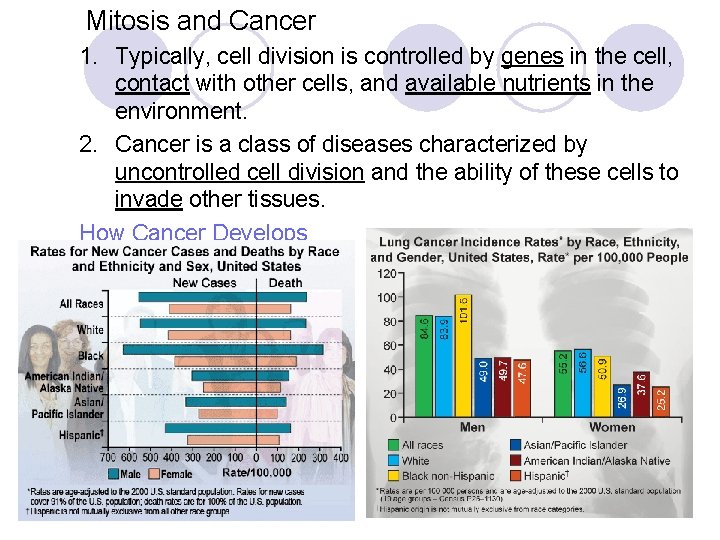
Mitosis & Cancer l Typically, cell division is controlled by genes in the cell, contact with other cells, and available nutrients in the environment. l (molecules are found on the surface of the cell)
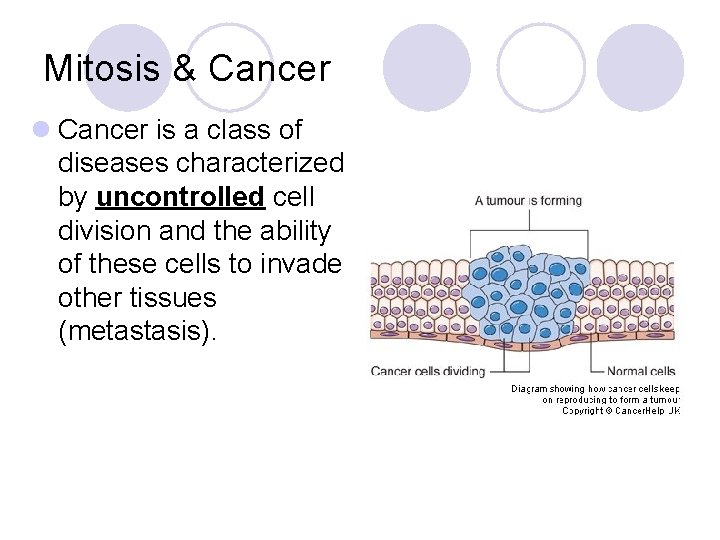
Mitosis & Cancer l Cancer is a class of diseases characterized by uncontrolled cell division and the ability of these cells to invade other tissues (metastasis).
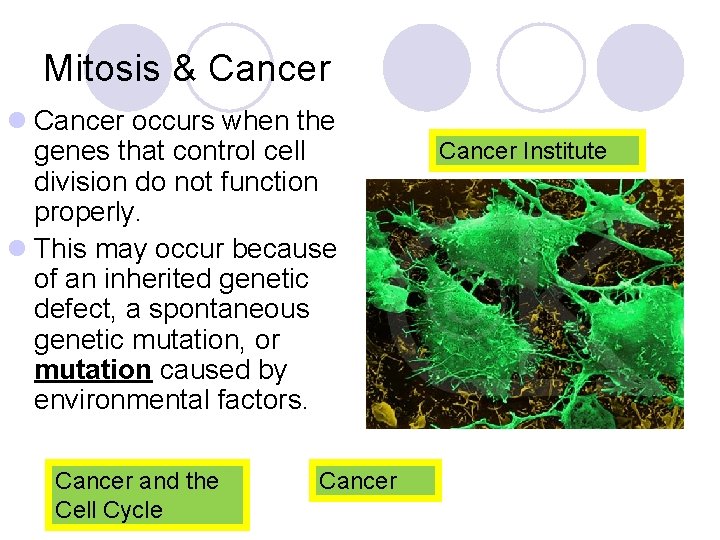
Mitosis & Cancer l Cancer occurs when the genes that control cell division do not function properly. l This may occur because of an inherited genetic defect, a spontaneous genetic mutation, or mutation caused by environmental factors. Cancer and the Cell Cycle Cancer Institute
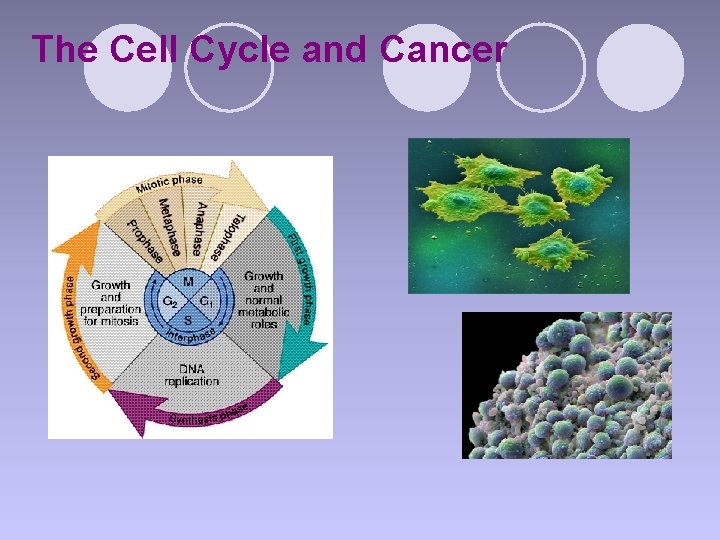
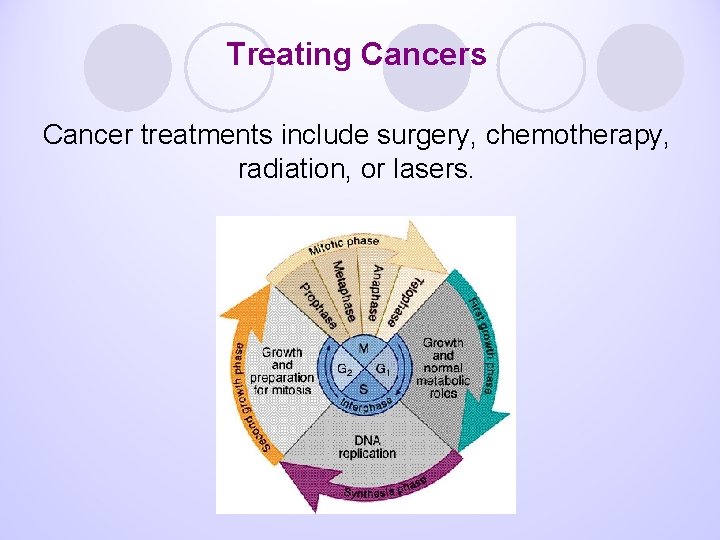
The Cell Cycle and Cancer
The Stages of the Cell Cycle
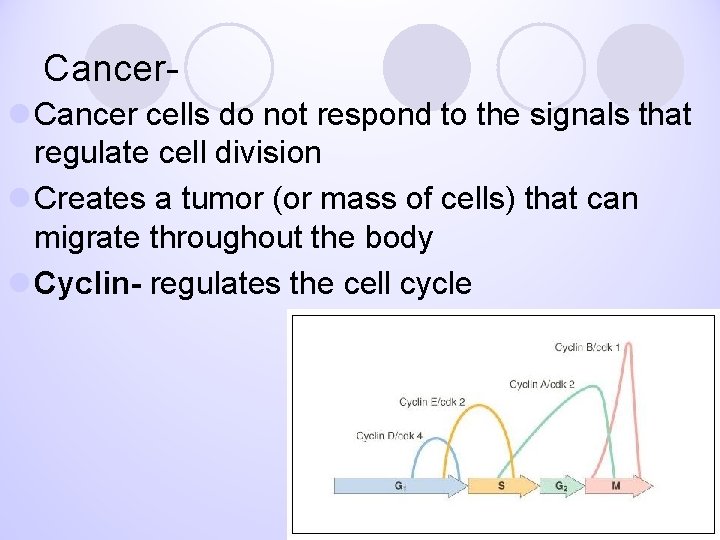
Cancerl Cancer cells do not respond to the signals that regulate cell division l Creates a tumor (or mass of cells) that can migrate throughout the body l Cyclin- regulates the cell cycle
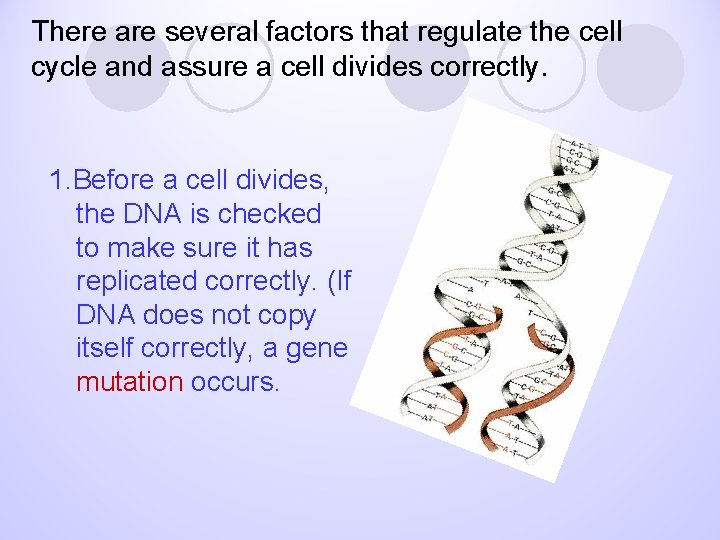
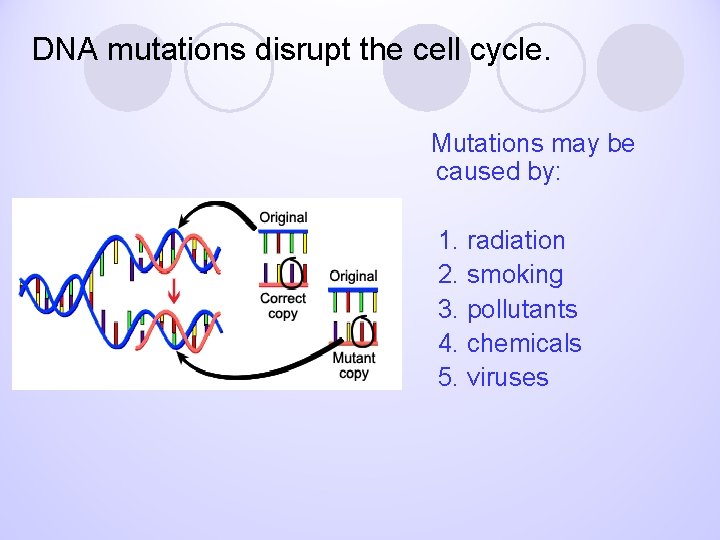
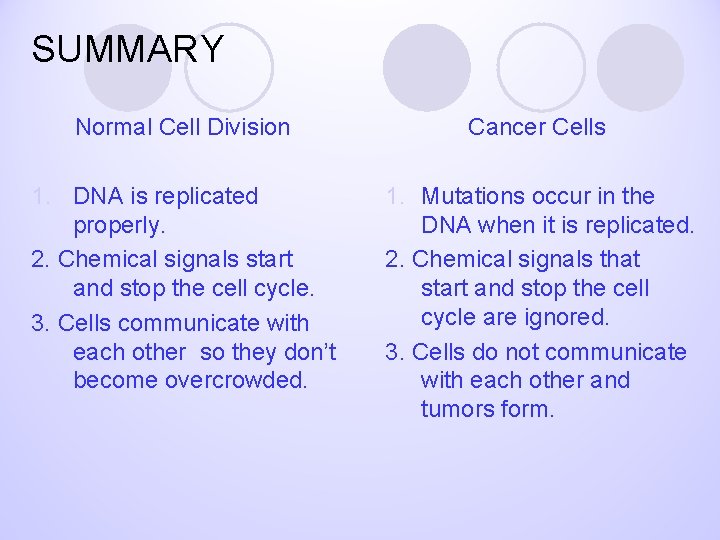
There are several factors that regulate the cell cycle and assure a cell divides correctly. 1. Before a cell divides, the DNA is checked to make sure it has replicated correctly. (If DNA does not copy itself correctly, a gene mutation occurs.
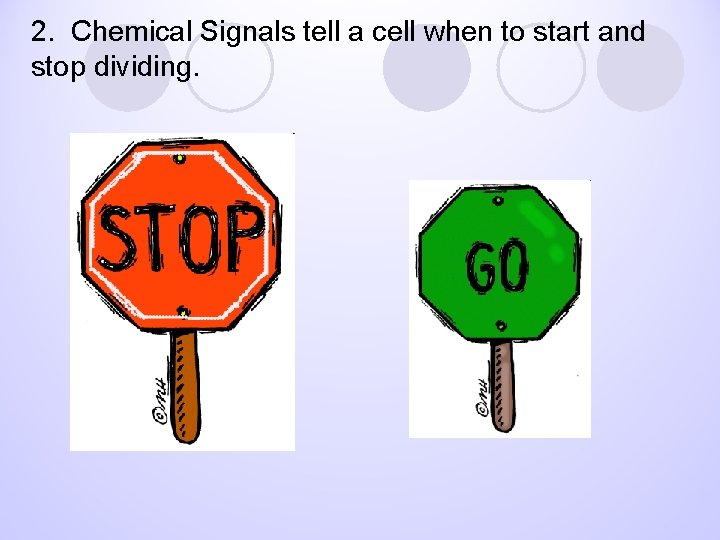
2. Chemical Signals tell a cell when to start and stop dividing.
Neighboring cells communicate with dividing cells to regulate their growth also.
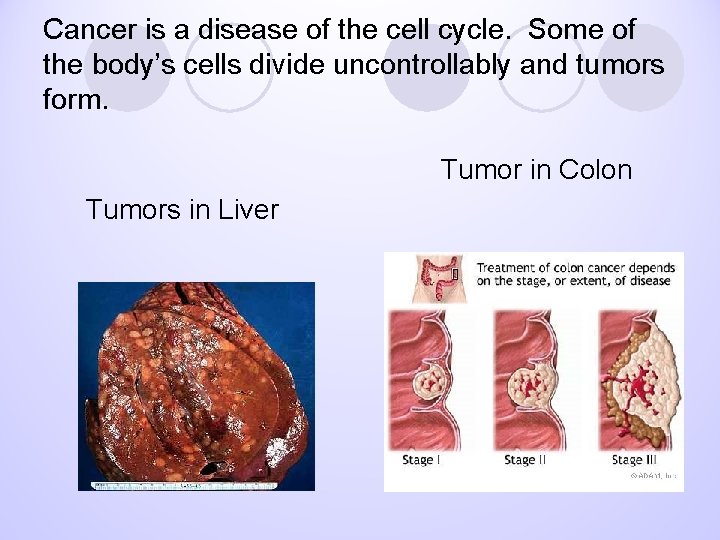
Cancer is a disease of the cell cycle. Some of the body’s cells divide uncontrollably and tumors form. Tumor in Colon Tumors in Liver
DNA mutations disrupt the cell cycle. Mutations may be caused by: 1. radiation 2. smoking 3. pollutants 4. chemicals 5. viruses
While normal cells will stop dividing if there is a mutation in the DNA, cancer cells will continue to divide with mutation.
Cell Suicide or Apoptosis Cell damage— no repair First mutation Second mutation Third mutation Fourth or later mutation Uncontrolled growth
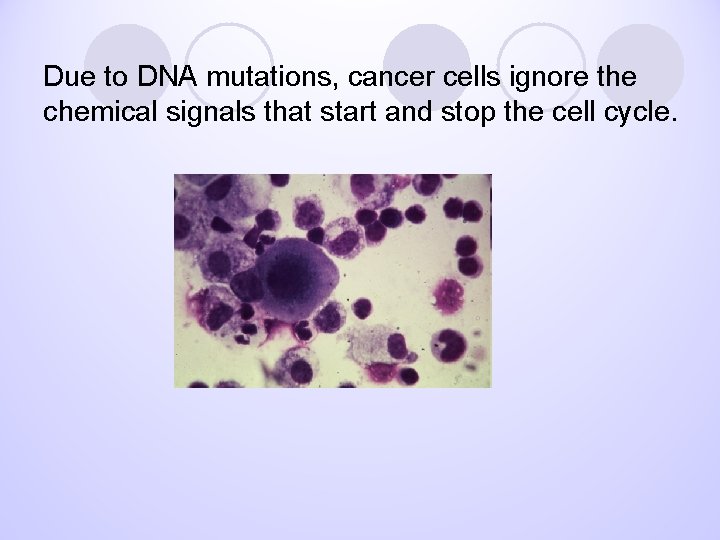
Due to DNA mutations, cancer cells ignore the chemical signals that start and stop the cell cycle.
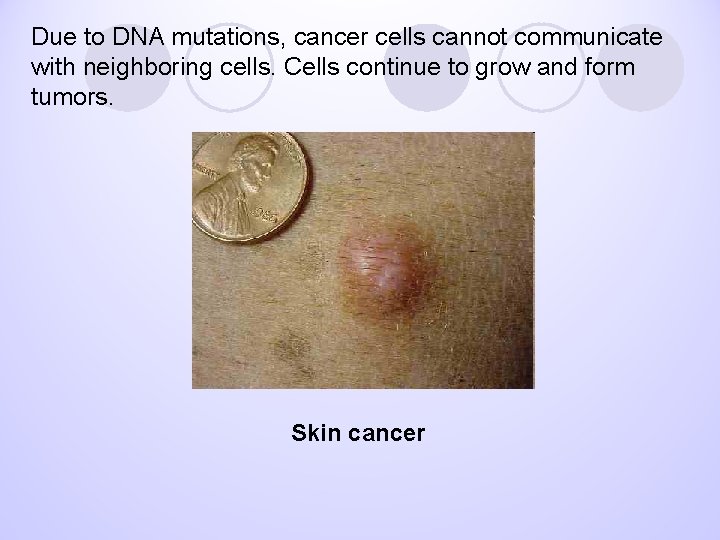
Due to DNA mutations, cancer cells cannot communicate with neighboring cells. Cells continue to grow and form tumors. Skin cancer
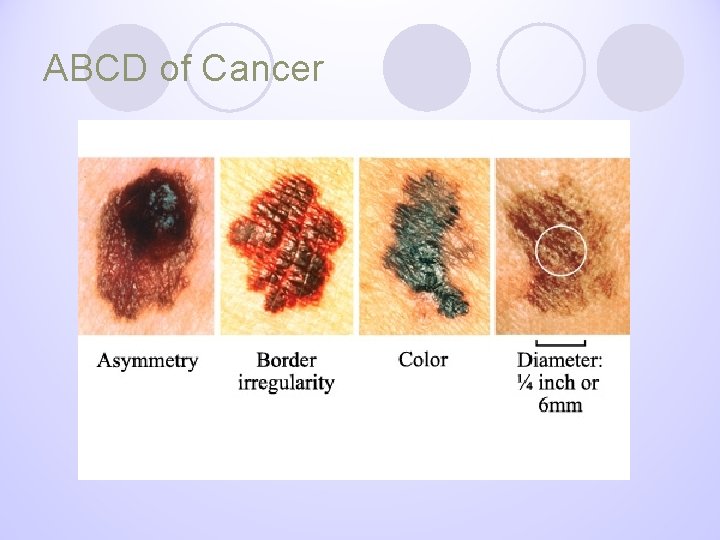
ABCD of Cancer
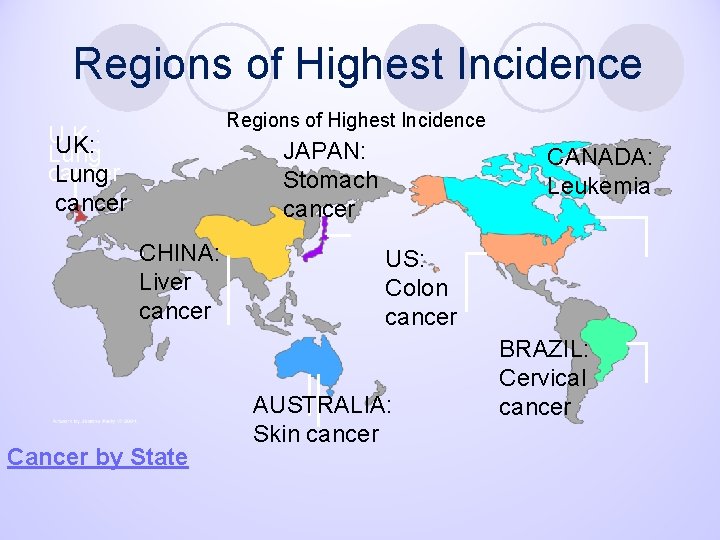
Regions of Highest Incidence U. K. : UK: Lung cancer JAPAN: Stomach cancer CHINA: Liver cancer Cancer by State CANADA: Leukemia US: Colon cancer AUSTRALIA: Skin cancer BRAZIL: Cervical cancer
Mitosis and Cancer 1. Typically, cell division is controlled by genes in the cell, contact with other cells, and available nutrients in the environment. 2. Cancer is a class of diseases characterized by uncontrolled cell division and the ability of these cells to invade other tissues. How Cancer Develops
Treating Cancers Cancer treatments include surgery, chemotherapy, radiation, or lasers.
SUMMARY Normal Cell Division Cancer Cells 1. DNA is replicated properly. 2. Chemical signals start and stop the cell cycle. 3. Cells communicate with each other so they don’t become overcrowded. 1. Mutations occur in the DNA when it is replicated. 2. Chemical signals that start and stop the cell cycle are ignored. 3. Cells do not communicate with each other and tumors form.
Vocabulary l cancer: term used to indicate a disease characterized by abnormal cell growth l mutagen: environmental factor that causes mutations l carcinogen: cancer-causing agent l tumor: mass of growing tissue ¡benign: does NOT invade surrounding cells ¡malignant: spreads into nearby tissues l metastasis: spread of malignant cells l oncogene: gene that causes cancerous growth
Fill It In … Cancer is caused by uncontrolled ___________, which may occur because of 1. 2. 3.
Check Yourself! 1. Why is a large surface area: volume ratio preferable? 2. Name three reasons cells must divide. 3. Why is eukaryotic cell division more complex than prokaryotic cell division? 4. What are the two basic stages of the cell cycle? 5. How is the genetic material “prepared” for cell division during interphase? 6. How many daughter cells are produced as a result of mitosis, and how do these cells compare to the parent cell? 7. How are mitosis and cancer connected?
Check Yourself! 1. Why is a large surface area: volume ratio preferable? KEEPS THE RATE OF CELL DIFFUSION FAST
Check Yourself! 2. Name three reasons cells must divide. GROWTH REPAIR (ASEXUAL REPRODUCTION)
Check Yourself! 3. Why is eukaryotic cell division more complex than prokaryotic cell division? EUKARYOTIC CELLS CONTAIN A NUCLEUS AND MEMBRANE-BOUND ORGANELLES
Check Yourself! 4. What are the two basic stages of the cell cycle? INTERPHASE & MITOSIS
Check Yourself! 5. How is the genetic material “prepared” for cell division during interphase? CHROMATIN CONDENSES AND FORMS TWO CHROMATIDS CONNECTED BY A CENTROMERE THIS FORMS A DOUBLED CHROMOSOME
Check Yourself! 6. How many daughter cells are produced as a result of mitosis, and how do these cells compare to the parent cell? 2 CELLS ARE PRODUCED THEY ARE GENETICALLY IDENTICAL TO THE PARENT CELL
Check Yourself! 7. How are mitosis and cancer connected? CANCER IS CHARACTERIZED BY UNCONTROLLED CELL DIVISION