
Why do atoms combine 1 Atomic Structures At
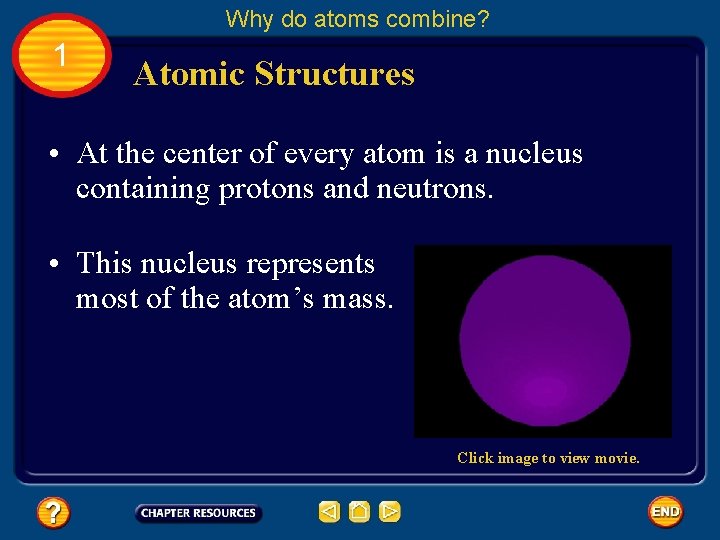
Why do atoms combine? 1 Atomic Structures • At the center of every atom is a nucleus containing protons and neutrons. • This nucleus represents most of the atom’s mass. Click image to view movie.
Why do atoms combine? 1 Atomic Structures • The rest of the atom is empty except for the atom’s electrons. • The atom’s electrons travel in an area of space around the nucleus called the electron cloud.
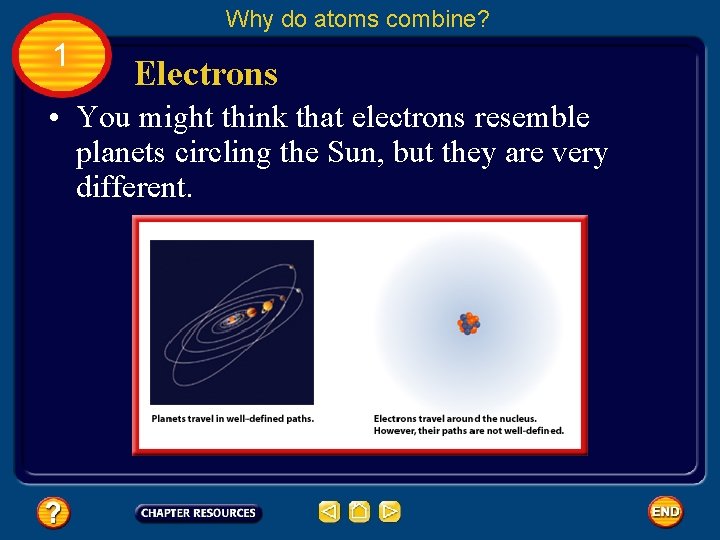
Why do atoms combine? 1 Electrons • You might think that electrons resemble planets circling the Sun, but they are very different.
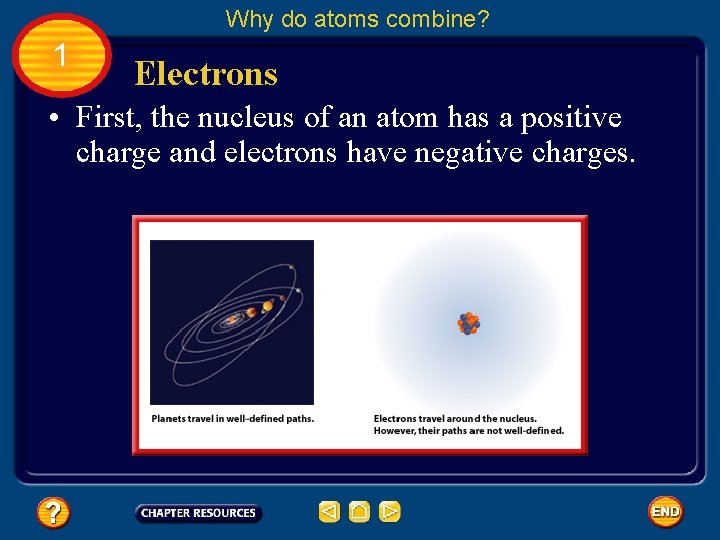
Why do atoms combine? 1 Electrons • First, the nucleus of an atom has a positive charge and electrons have negative charges.
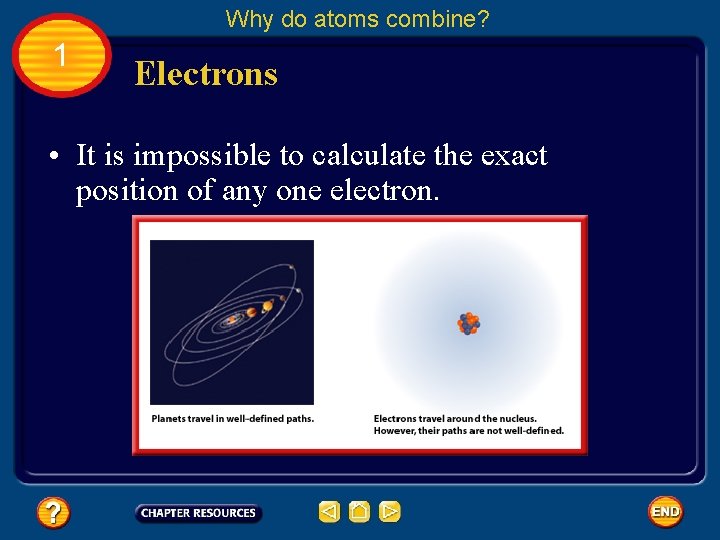
Why do atoms combine? 1 Electrons • It is impossible to calculate the exact position of any one electron.
Why do atoms combine? 1 Element Structure • Each element has a different atomic structure consisting of a specific number of protons, neutrons, and electrons. • The number of protons and electrons is always the same for a neutral atom of a given element.

Why do atoms combine? 1 Element Structure • This neutral lithium atom has three positively charged protons, three negatively charged electrons, and four neutral neutrons.

Why do atoms combine? 1 Electron Arrangement— Electron Energy • The different areas for an electron in an atom are called energy levels.
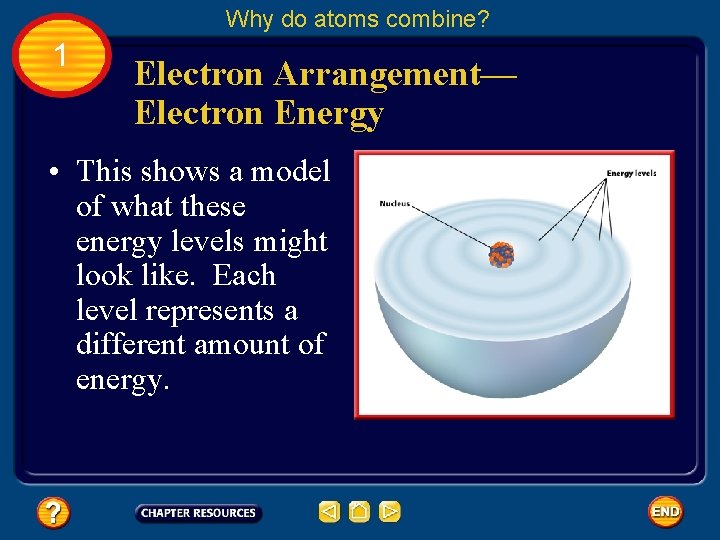
Why do atoms combine? 1 Electron Arrangement— Electron Energy • This shows a model of what these energy levels might look like. Each level represents a different amount of energy.
Why do atoms combine? 1 Number of Electrons • The farther an energy level is from the nucleus, the more electrons it can hold. • The first energy level, energy level 1, can hold one or two electrons, the second, energy level 2, can hold up to eight, the third can hold up to 18, and the fourth energy level can hold a maximum of 32 electrons.
Why do atoms combine? 1 Energy Steps • Electrons in the level closest to the nucleus have the lowest amount of energy and are said to be in energy level one. • Electrons farthest from the nucleus have the highest amount of energy and are the easiest to remove.
Why do atoms combine? 1 Energy Steps • The closer a negatively charged electron is to the positively charged nucleus, the more strongly it is attracted to the nucleus. Therefore, removing electrons that are close to the nucleus takes more energy than removing those that are farther away from the nucleus.
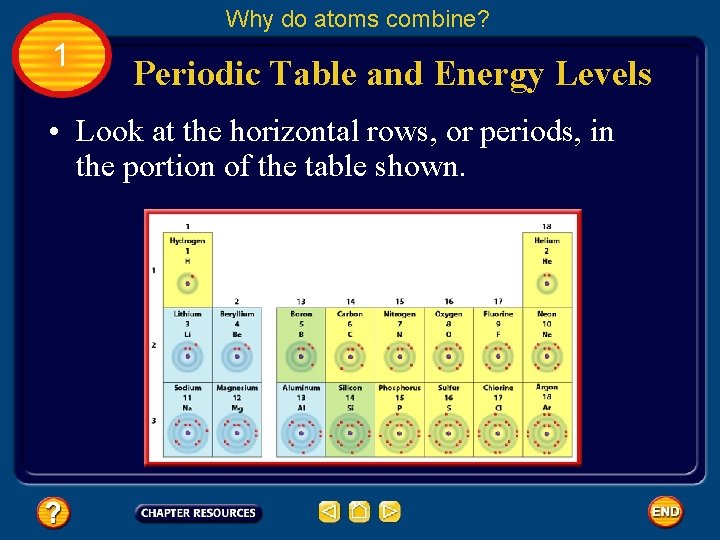
Why do atoms combine? 1 Periodic Table and Energy Levels • Look at the horizontal rows, or periods, in the portion of the table shown.
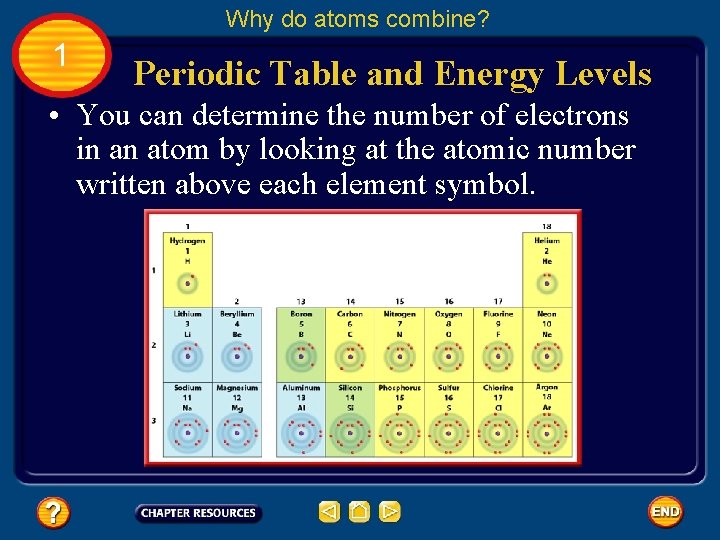
Why do atoms combine? 1 Periodic Table and Energy Levels • You can determine the number of electrons in an atom by looking at the atomic number written above each element symbol.
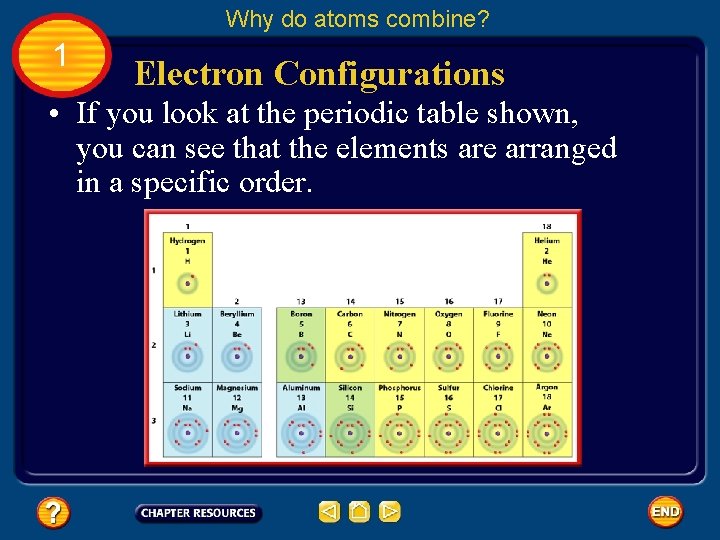
Why do atoms combine? 1 Electron Configurations • If you look at the periodic table shown, you can see that the elements are arranged in a specific order. Fig. 5, p. 467
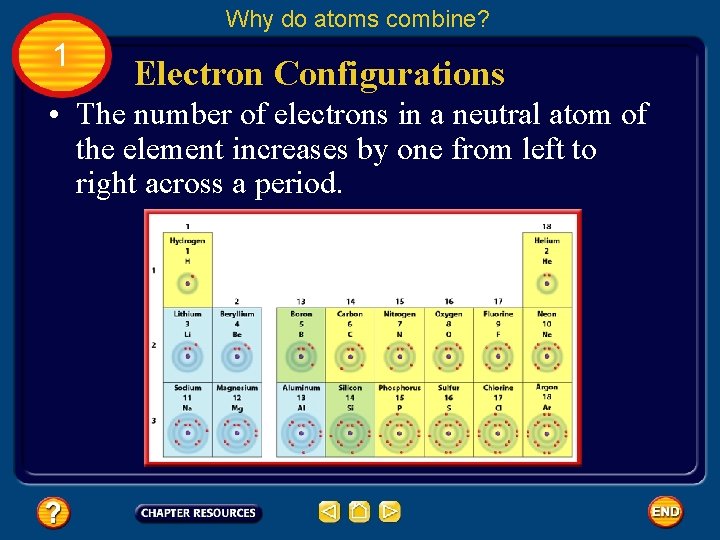
Why do atoms combine? 1 Electron Configurations • The number of electrons in a neutral atom of the element increases by one from left to right across a period. Fig. 5, p. 467
Section Check 1 Question 1 Electrons are now known to swarm around the nucleus of an atom in a configuration known as the _______. A. electron circle B. electron cloud C. electron configuration D. electron swarm FL: SC. A. 2. 3. 2
Section Check 1 Answer The answer is B. The “cloud” includes all the regions where an electron might be found. FL: SC. A. 2. 3. 2
Section Check 1 Question 3 The _______ an energy level is from the nucleus, the _______ electrons it can hold. A. closer, more B. closer, less C. farther, less D. farther, more FL: SC. A. 2. 3. 2
Section Check 1 Answer The answer is D. The farthest shells contain the greatest number of electrons. FL: SC. A. 2. 3. 2

End of Chapter Summary File
- Slides: 21