
Why Differentiate A Look at the Pros the



- Slides: 43
Why Differentiate? A Look at the Pros, the Cons, & the Philosophy Behind
Objectives: v. Articulate the philosophy behind differentiation v. State the arguments for differentiating instruction in the classroom v. Cite research demonstrating the success of differentiation v. Explain the criticisms of and challenges of differentiating instruction
Things to Note about this Session: �This session was created in direct response to survey comments received in October… ◦ Responses requested more information about the philosophy behind DI ◦ Responses questioned what research supports DI ◦ Responses questioned whether cons had been considered
Things to Note about this Session: �This is not a differentiated session. ◦ We will not be modeling differentiated instruction in this session. ◦ Differentiated Instruction should be used when it makes sense. �It does not make sense all of the time. �To achieve our objectives, direct instruction (a more formal presentation) makes more sense for communicating general information.
Things to Note about this Session: �Pair/Group work that occurs in this session is based on intentional pairings. ◦ The purpose of these pairings is to expose participants to: �People outside of their department/division �It is our hope that these pairing will lead to exposure to new perspectives and ideas
PHILOSOPHY OF DIFFRENTIATED INSTRUCTION
Differentiated Instruction is… “A systematic approach to planning curriculum and It is not instruction for academically WHAT we diverse learners” that teach, provides students of it is HOW different abilities, interests, we teach. or learning needs equally appropriate ways to learn (Tomlinson & Strickland, 2005).
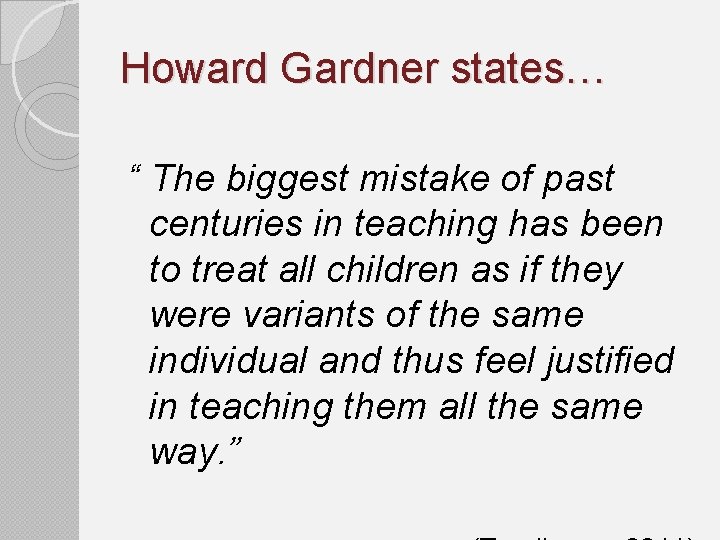
Howard Gardner states… “ The biggest mistake of past centuries in teaching has been to treat all children as if they were variants of the same individual and thus feel justified in teaching them all the same way. ”
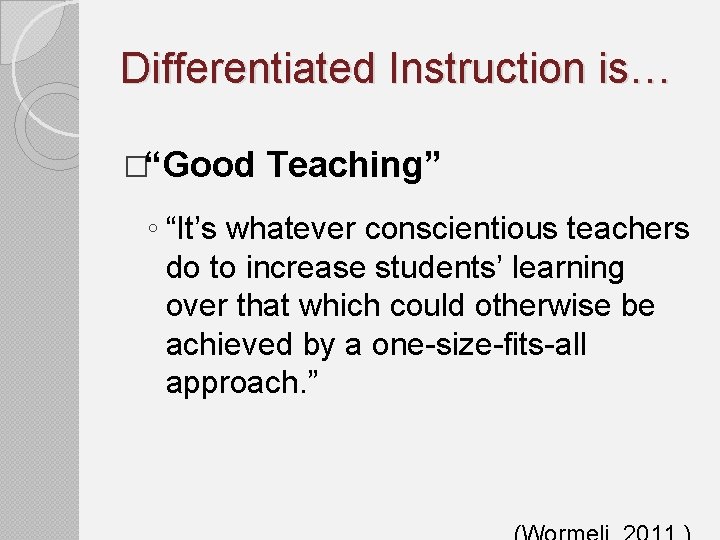
Differentiated Instruction is… �“Good Teaching” ◦ “It’s whatever conscientious teachers do to increase students’ learning over that which could otherwise be achieved by a one-size-fits-all approach. ”
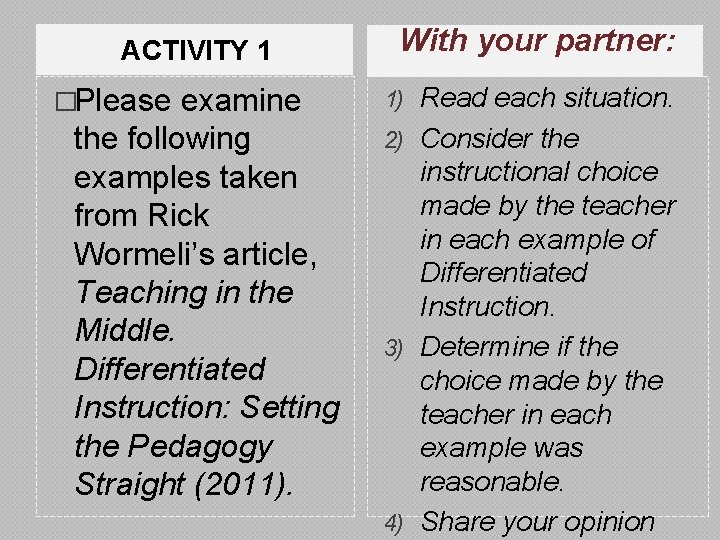
ACTIVITY 1 �Please examine the following examples taken from Rick Wormeli’s article, Teaching in the Middle. Differentiated Instruction: Setting the Pedagogy Straight (2011). With your partner: Read each situation. 2) Consider the instructional choice made by the teacher in each example of Differentiated Instruction. 3) Determine if the choice made by the teacher in each example was reasonable. 4) Share your opinion 1)
Were the Instructional Choices made in each scenario appropriate/reasonable?
Differentiated Instruction is… �Responsive Teaching ◦ “We respond to what we perceive students need in order to learn, and if that differs from child to child, we adjust instruction accordingly rather than leaving them floundering. ” ( Wormeli, 2011. )
Differentiated Instruction is… �A Mindset ◦ Based on the belief that students can and will grow ◦ Growth will occur if lessons are structured to “meet each student’s learning needs and maximize each student’s learning capacity. ” ( Tomlinson & Strickland, 2005. )
Differentiated Instruction… �“relates more to addressing students’ different phases of learning from novice to capable to proficient rather than merely providing different activities to different groups or students”(Hattie, 2012) �Lessons should be structured so “all students are working at or “+1” from where they start” (Strickland, 2012)
Differentiated Instruction is based upon 5 Principles ØQuality Curriculum ØQuality Tasks ØRespectful Community ØContinual Assessment ØFlexible Grouping ( Tomlinson & Strickland, 2005. )
RESEARCH
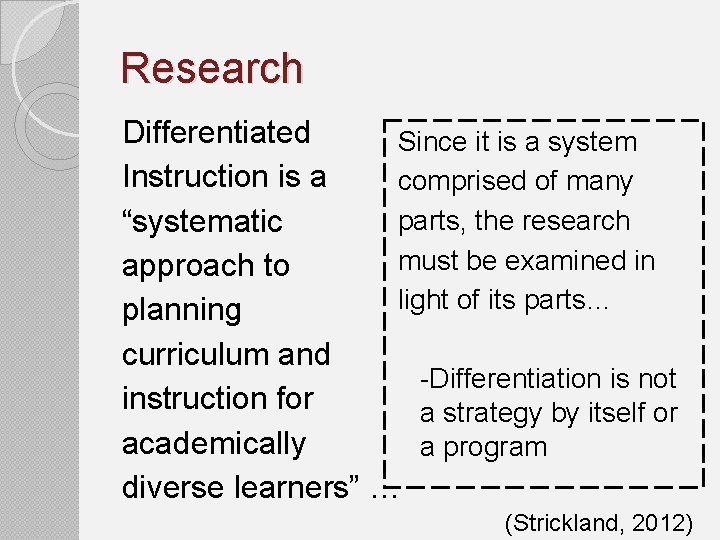
Research Differentiated Since it is a system Instruction is a comprised of many parts, the research “systematic must be examined in approach to light of its parts… planning curriculum and -Differentiation is not instruction for a strategy by itself or academically a program diverse learners” … (Strickland, 2012)
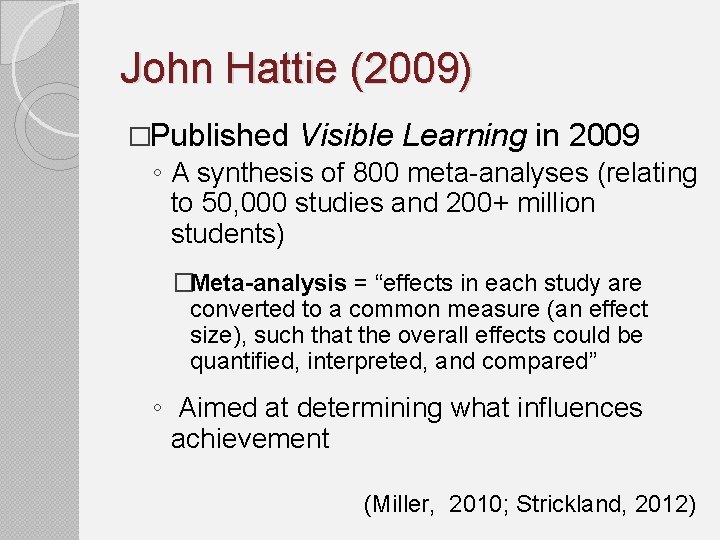
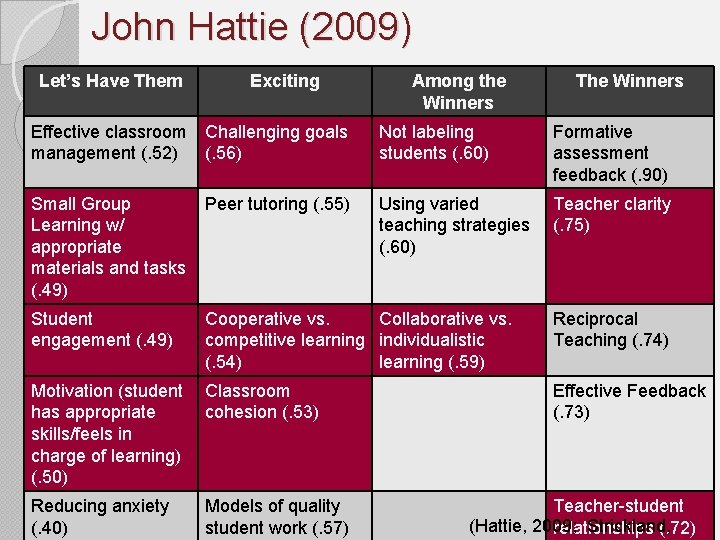
John Hattie (2009) �Published Visible Learning in 2009 ◦ A synthesis of 800 meta-analyses (relating to 50, 000 studies and 200+ million students) �Meta-analysis = “effects in each study are converted to a common measure (an effect size), such that the overall effects could be quantified, interpreted, and compared” ◦ Aimed at determining what influences achievement (Miller, 2010; Strickland, 2012)
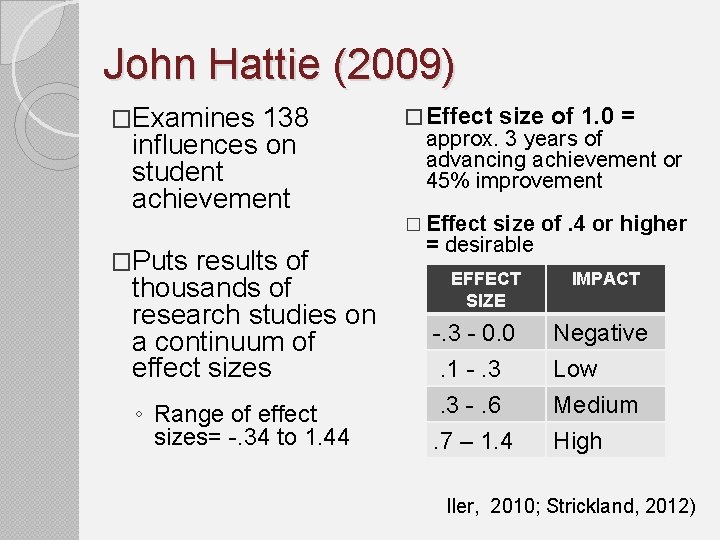
John Hattie (2009) �Examines 138 influences on student achievement �Puts results of thousands of research studies on a continuum of effect sizes ◦ Range of effect sizes= -. 34 to 1. 44 � Effect size of 1. 0 = approx. 3 years of advancing achievement or 45% improvement � Effect size of. 4 or higher = desirable EFFECT SIZE -. 3 - 0. 0. 1 -. 3. 3 -. 6. 7 – 1. 4 IMPACT Negative Low Medium High ller, 2010; Strickland, 2012)
John Hattie (2009) Let’s Have Them Exciting Among the Winners The Winners Effective classroom management (. 52) Challenging goals (. 56) Not labeling students (. 60) Formative assessment feedback (. 90) Small Group Learning w/ appropriate materials and tasks (. 49) Peer tutoring (. 55) Using varied teaching strategies (. 60) Teacher clarity (. 75) Student engagement (. 49) Cooperative vs. Collaborative vs. competitive learning individualistic (. 54) learning (. 59) Reciprocal Teaching (. 74) Motivation (student has appropriate skills/feels in charge of learning) (. 50) Classroom cohesion (. 53) Effective Feedback (. 73) Reducing anxiety (. 40) Models of quality student work (. 57) Teacher-student (Hattie, 2009; Strickland, relationships (. 72)
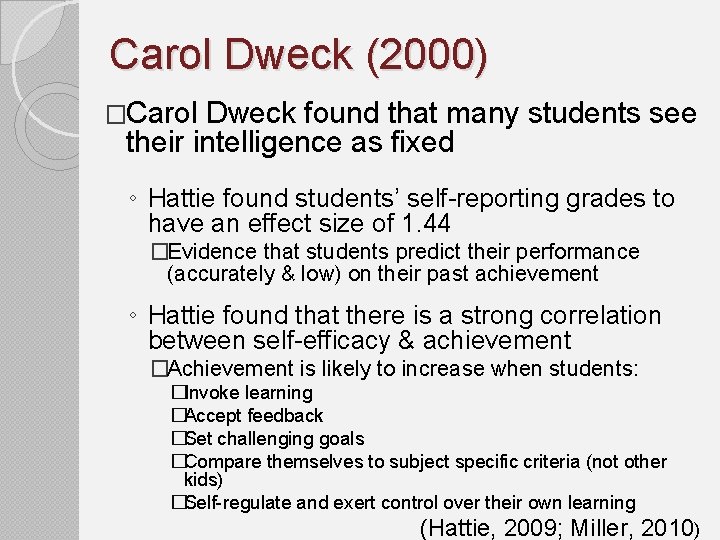
Carol Dweck (2000) �Carol Dweck found that many students see their intelligence as fixed ◦ Hattie found students’ self-reporting grades to have an effect size of 1. 44 �Evidence that students predict their performance (accurately & low) on their past achievement ◦ Hattie found that there is a strong correlation between self-efficacy & achievement �Achievement is likely to increase when students: �Invoke learning �Accept feedback �Set challenging goals �Compare themselves to subject specific criteria (not other kids) �Self-regulate and exert control over their own learning (Hattie, 2009; Miller, 2010)
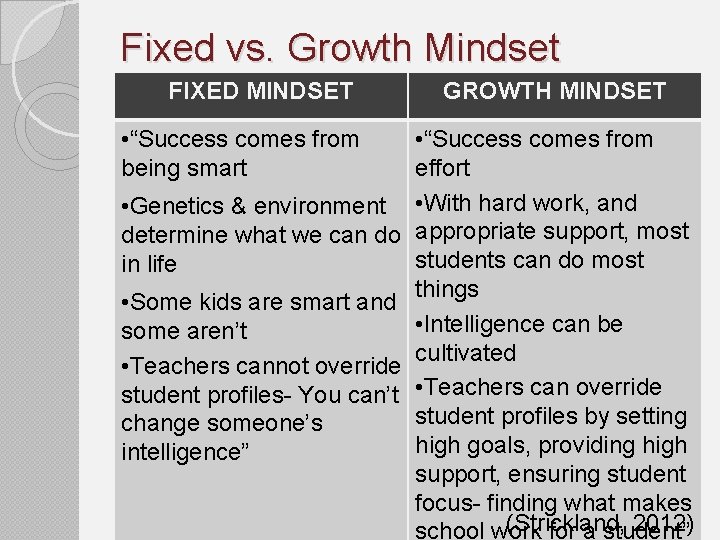
Fixed vs. Growth Mindset FIXED MINDSET • “Success comes from being smart • Genetics & environment determine what we can do in life • Some kids are smart and some aren’t • Teachers cannot override student profiles- You can’t change someone’s intelligence” GROWTH MINDSET • “Success comes from effort • With hard work, and appropriate support, most students can do most things • Intelligence can be cultivated • Teachers can override student profiles by setting high goals, providing high support, ensuring student focus- finding what makes (Strickland, 2012) school work for a student”
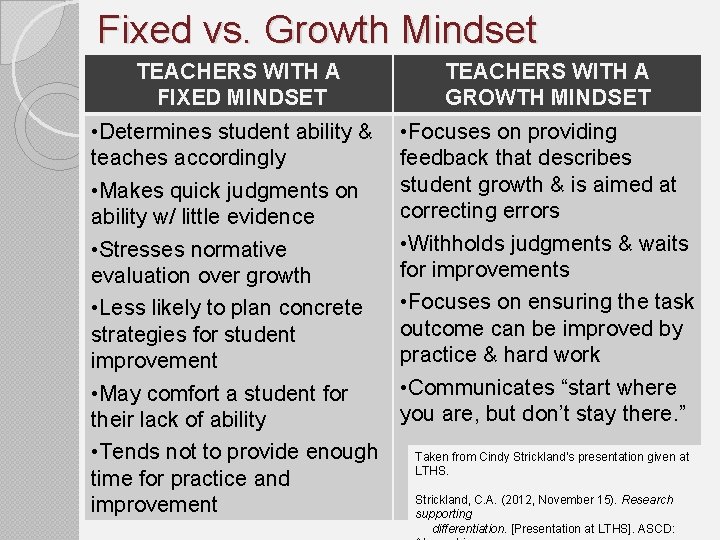
Fixed vs. Growth Mindset TEACHERS WITH A FIXED MINDSET TEACHERS WITH A GROWTH MINDSET • Determines student ability & teaches accordingly • Makes quick judgments on ability w/ little evidence • Stresses normative evaluation over growth • Less likely to plan concrete strategies for student improvement • May comfort a student for their lack of ability • Tends not to provide enough time for practice and improvement • Focuses on providing feedback that describes student growth & is aimed at correcting errors • Withholds judgments & waits for improvements • Focuses on ensuring the task outcome can be improved by practice & hard work • Communicates “start where you are, but don’t stay there. ” Taken from Cindy Strickland’s presentation given at LTHS. Strickland, C. A. (2012, November 15). Research supporting differentiation. [Presentation at LTHS]. ASCD:
ACTIVITY 2 �Directions: Please consider the following scenarios from the perspective of a teacher with a fixed mindset, growth mindset, and your own perspective. Read each situation with your partner and: With your partner: � Determine how a teacher with a fixed mindset would respond and record your opinion in the relevant box. � Determine how a teacher with a growth mindset would respond and record your opinion in the relevant box. � Determine how you would respond (in your own classroom) and record your opinion in the relevant box.
Growth Mindset is at the heart of Differentiation �“John Hattie suggests that teachers would have mores success if they addressed students’ low self-efficacy before trying to raise their achievement. ” �Carol Dweck believes this can be done “by promoting a growth mindset in the classroom. ” ◦ Teachers acting as a change-agent (Miller, 2010)
CRITICISMS Learning Style II. “Observed Chaos” III. Catering too much to students IV. Implementation Challenges I.
Learner Profile � One of the three types of differentiation is differentiation by LEARNER PROFILE � Can include, but not limited to, information concerning learning styles Ø Learner Profile = observations about a student that affects his/her learning including … Ø Family dynamics Ø Health (physical & emotional) Ø Technological skills Ø Personal interests Ø Gender Ø Learning Styles (Wormeli, 2011. )
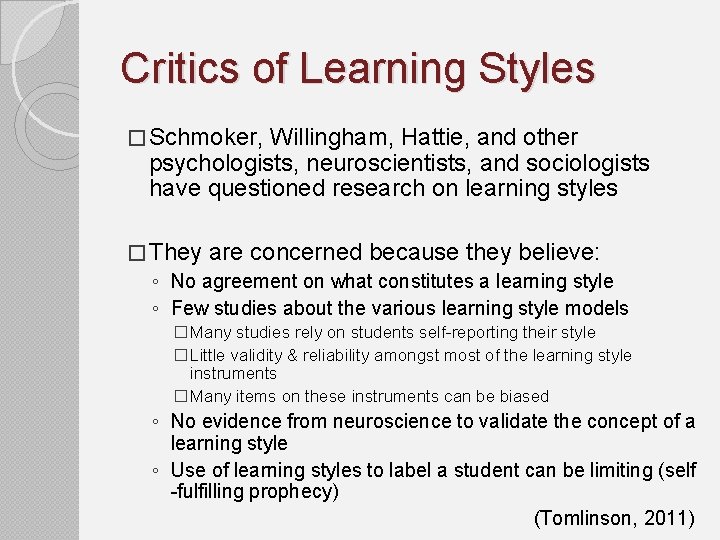
Critics of Learning Styles � Schmoker, Willingham, Hattie, and other psychologists, neuroscientists, and sociologists have questioned research on learning styles � They are concerned because they believe: ◦ No agreement on what constitutes a learning style ◦ Few studies about the various learning style models �Many studies rely on students self-reporting their style �Little validity & reliability amongst most of the learning style instruments �Many items on these instruments can be biased ◦ No evidence from neuroscience to validate the concept of a learning style ◦ Use of learning styles to label a student can be limiting (self -fulfilling prophecy) (Tomlinson, 2011)
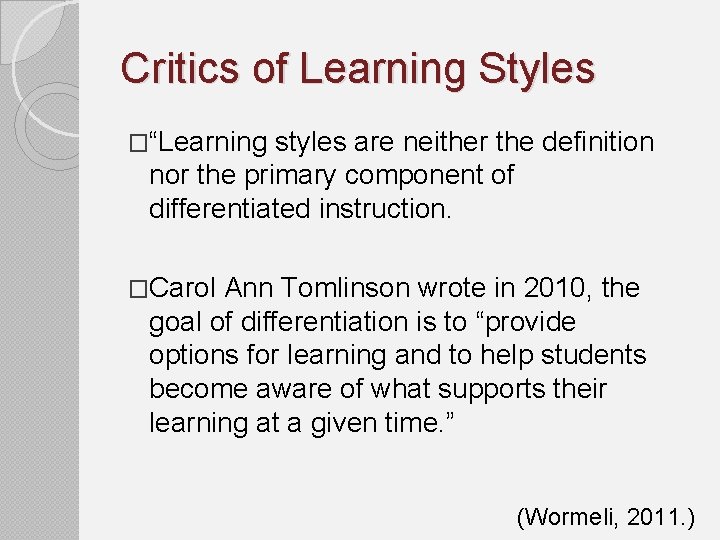
Critics of Learning Styles �“Learning styles are neither the definition nor the primary component of differentiated instruction. �Carol Ann Tomlinson wrote in 2010, the goal of differentiation is to “provide options for learning and to help students become aware of what supports their learning at a given time. ” (Wormeli, 2011. )
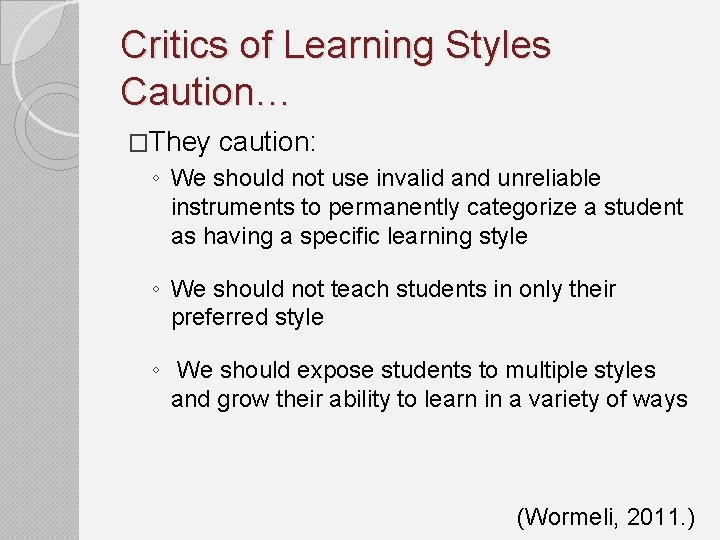
Critics of Learning Styles Caution… �They caution: ◦ We should not use invalid and unreliable instruments to permanently categorize a student as having a specific learning style ◦ We should not teach students in only their preferred style ◦ We should expose students to multiple styles and grow their ability to learn in a variety of ways (Wormeli, 2011. )
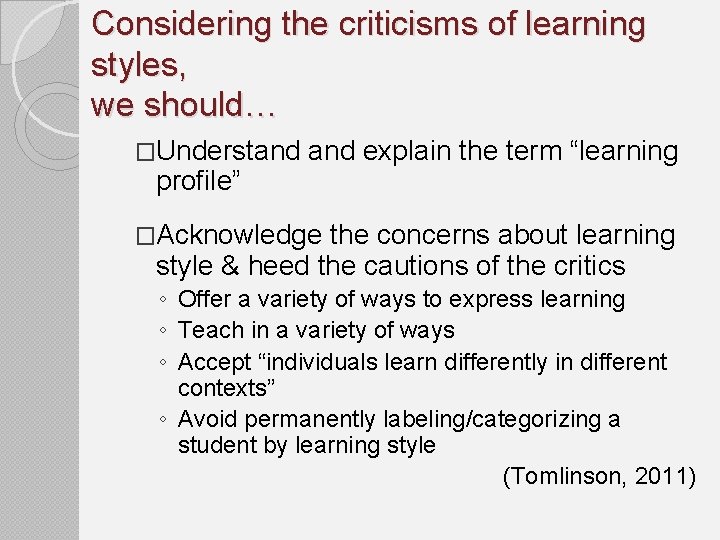
Considering the criticisms of learning styles, we should… �Understand profile” and explain the term “learning �Acknowledge the concerns about learning style & heed the cautions of the critics ◦ Offer a variety of ways to express learning ◦ Teach in a variety of ways ◦ Accept “individuals learn differently in different contexts” ◦ Avoid permanently labeling/categorizing a student by learning style (Tomlinson, 2011)
A Critic of Observed Chaos �In 2010, Mike Schmoker criticized Differentiated Instruction , “I saw frustrated teachers trying to provide materials that matched each student’s or group’s presumed ability level, interest, preferred ‘modality’ and learning style. The attempt often devolved into a frantically assemble collection of worksheets, coloring exercises, and specious ‘kinesthetic’
Good Instruction Schmoker believes the following must be present for good instruction: 1) Content-rich guaranteed curriculum 2) Reading, writing, and discussion in analytical and argumentative modes in all disciplines 3) Curriculum-based objective and assessment w/ guided practice, check for understanding, and ongoing adjustment to instruction Tomlinson argues there are 4 non-negotiable to DI: 1) Challenging and supportive learning environment 2) Quality curriculum (KUD) 3) Formative assessment 4) Adaption of instruction to the formative assessment data so the success ( Wormeli, of each learner is
In light of the criticism of “observed chaos, ” we should… �Adhere to the 5 Principles of Differentiation ◦ Teach a Quality Curriculum ◦ Design Quality Tasks � aligned to the same KUD ◦ Cultivate a Respectful Community ◦ Continually Assess Students �design activities to propel students ahead from where they are currently ◦ Employ Flexible Grouping �Differentiate when it makes sense
Criticism: Catering too Much to Students �A concern raised after October’s Institute Day was a fear that students would not be prepared to succeed on their own (in college) if they were constantly receiving differentiated instruction ◦ Options ◦ Their “needs catered to” � DI is responsive teaching � DI offers students options so students can: ◦ Advocate for themselves ◦ Learn what works for them ◦ Build their own learner dexterity ◦ Handle that which is not differentiated (Wormeli, 2011. )
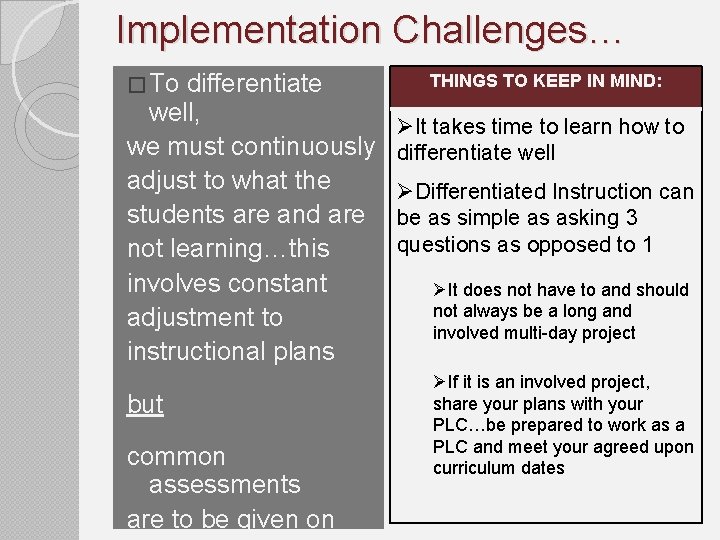
Implementation Challenges… � To differentiate well, we must continuously adjust to what the students are and are not learning…this involves constant adjustment to instructional plans but common assessments are to be given on THINGS TO KEEP IN MIND: ØIt takes time to learn how to differentiate well ØDifferentiated Instruction can be as simple as asking 3 questions as opposed to 1 ØIt does not have to and should not always be a long and involved multi-day project ØIf it is an involved project, share your plans with your PLC…be prepared to work as a PLC and meet your agreed upon curriculum dates
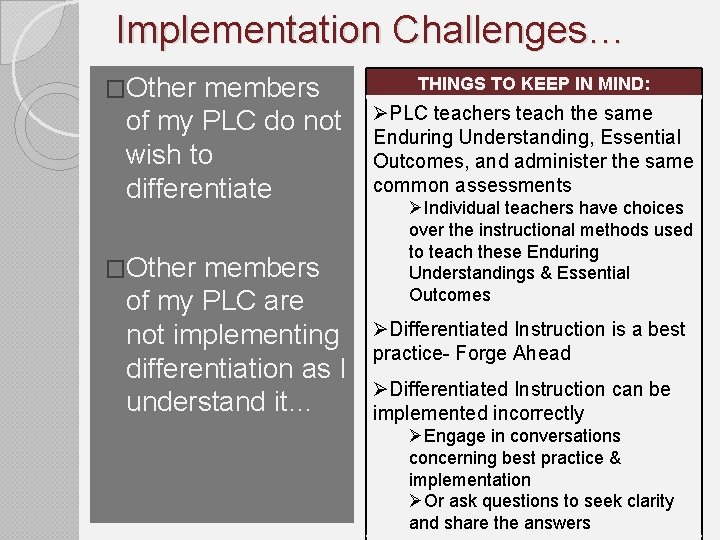
Implementation Challenges… �Other members of my PLC do not wish to differentiate �Other members of my PLC are not implementing differentiation as I understand it… THINGS TO KEEP IN MIND: ØPLC teachers teach the same Enduring Understanding, Essential Outcomes, and administer the same common assessments ØIndividual teachers have choices over the instructional methods used to teach these Enduring Understandings & Essential Outcomes ØDifferentiated Instruction is a best practice- Forge Ahead ØDifferentiated Instruction can be implemented incorrectly ØEngage in conversations concerning best practice & implementation ØOr ask questions to seek clarity and share the answers
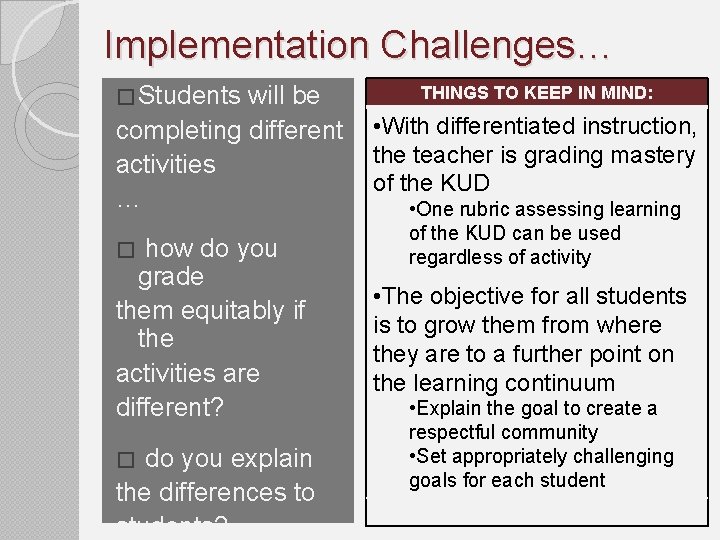
Implementation Challenges… � Students will be completing different activities … • With differentiated instruction, the teacher is grading mastery of the KUD how do you grade them equitably if the activities are different? • The objective for all students is to grow them from where they are to a further point on the learning continuum � do you explain the differences to students? � THINGS TO KEEP IN MIND: • One rubric assessing learning of the KUD can be used regardless of activity • Explain the goal to create a respectful community • Set appropriately challenging goals for each student
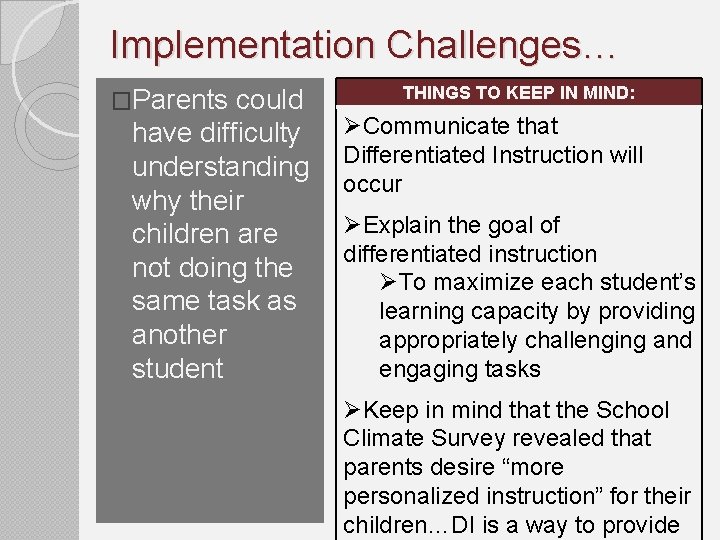
Implementation Challenges… �Parents could have difficulty understanding why their children are not doing the same task as another student THINGS TO KEEP IN MIND: ØCommunicate that Differentiated Instruction will occur ØExplain the goal of differentiated instruction ØTo maximize each student’s learning capacity by providing appropriately challenging and engaging tasks ØKeep in mind that the School Climate Survey revealed that parents desire “more personalized instruction” for their children…DI is a way to provide
IN CONCLUSION…
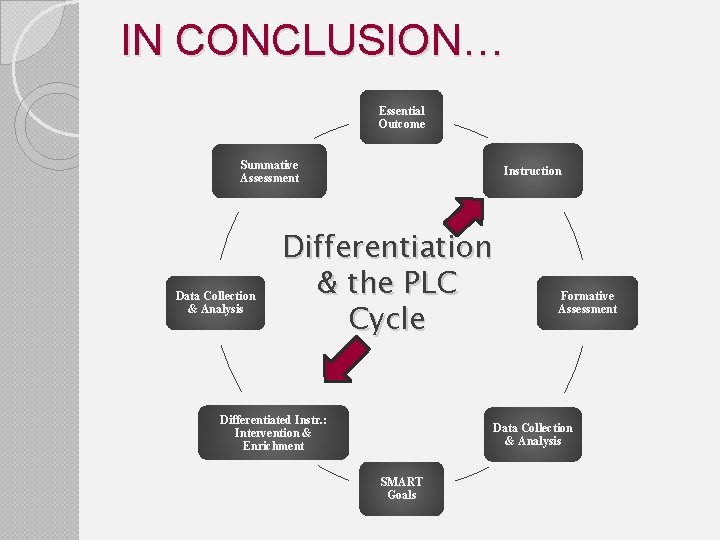
IN CONCLUSION… Essential Outcome Summative Assessment Data Collection & Analysis Instruction Differentiation & the PLC Cycle Differentiated Instr. : Intervention & Enrichment Formative Assessment Data Collection & Analysis SMART Goals
EXIT TICKET � On your way out, please let us know: 1) What questions you have concerning Differentiated Instruction that were not answered today? 2) What support you would like as you differentiate? 3) Other comments
References � Hattie, J. (2012). Visible learning for teachers: Maximizing impact on learning. New York: Routledge, p. 97. � Miller, G. (2010, April 21). Summary (Summary of the book Visible Learning). Retrieved from http: //www. google. com/#hl=en&sugexp=les%3 B&gs_rn=1&gs_ri=hp&gs_mss =Sumam ry%20 Visible%20 Learning&cp=11&gs_id=2 u&xhr=t&q=summary+of+visible+l earning +by+john+hattie&pf=p&safe=active&tbo=d&sclient=psyab&oq=Sumamry+of+Visible+Learning&gs_l=&pbx=1&bav=on. 2, or. r_gc. r_pw. r_qf. &b vm=bv. 1355534169, d. a. Wc&fp=a 4 c 147812 de 756 a 9&bpcl=40096503&biw=16 00&bih= 719 � Strickland, C. A. (2012, November 15. ). Research supporting differentiation. [Presentation at LTHS]. ASCD: Alexandria: , Virginia. � Tomlinson, C. A. & Strickland, C. A. (2005). Differentiation in practice: A resource guide for differentiating curriculum – Grades 9 -12. ASCD: Alexandria, Virginia. � Tomlinson, C. A. (2011). Learning Profile: What we Know, What we Don’t Know, What we Need to Know- What we Should Do. University of Virginia. � Wormeli, Rick. (2011). Teaching in the middle. Differentiated instruction: setting the pedagogy straight. Middle Ground, October 2011, p. 39 -40.