
Why Deep Learning Deeper is Better Layer X
Why Deep Learning?
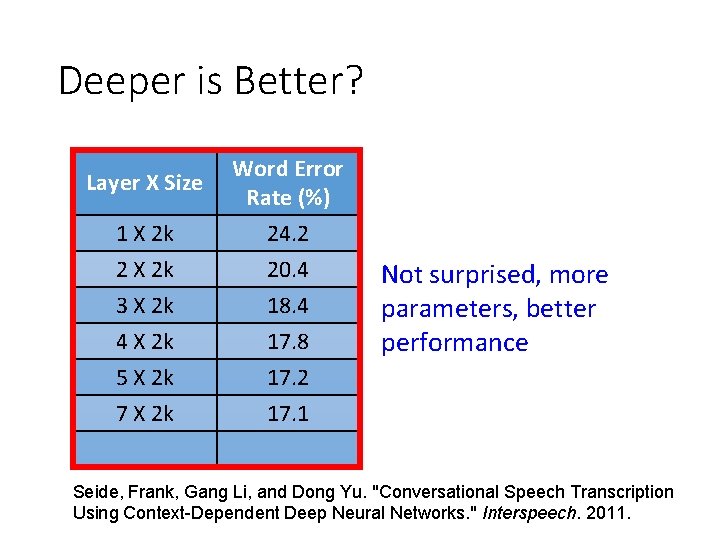
Deeper is Better? Layer X Size Word Error Rate (%) 1 X 2 k 24. 2 20. 4 3 X 2 k 4 X 2 k 5 X 2 k 7 X 2 k 18. 4 17. 8 17. 2 17. 1 Layer X Size Word Error Rate (%) Not surprised, more parameters, better performance 1 X 3772 1 X 4634 1 X 16 k 22. 5 22. 6 22. 1 Seide, Frank, Gang Li, and Dong Yu. "Conversational Speech Transcription Using Context-Dependent Deep Neural Networks. " Interspeech. 2011.
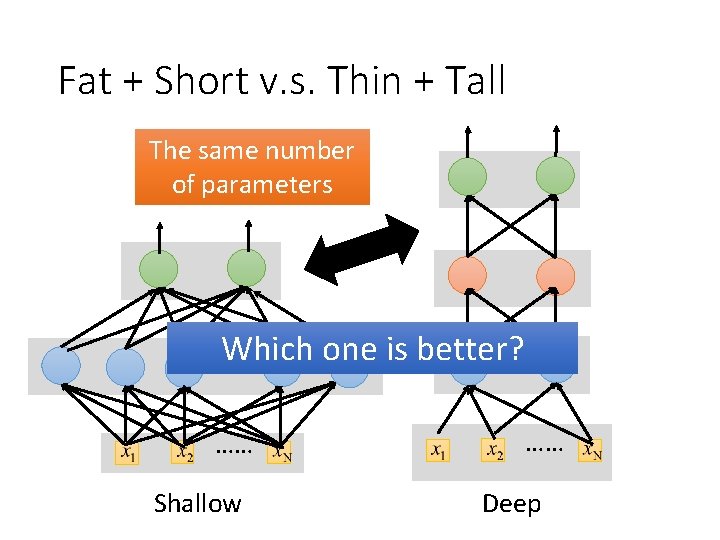
Fat + Short v. s. Thin + Tall The same number of parameters Which one is better? …… …… Shallow …… Deep
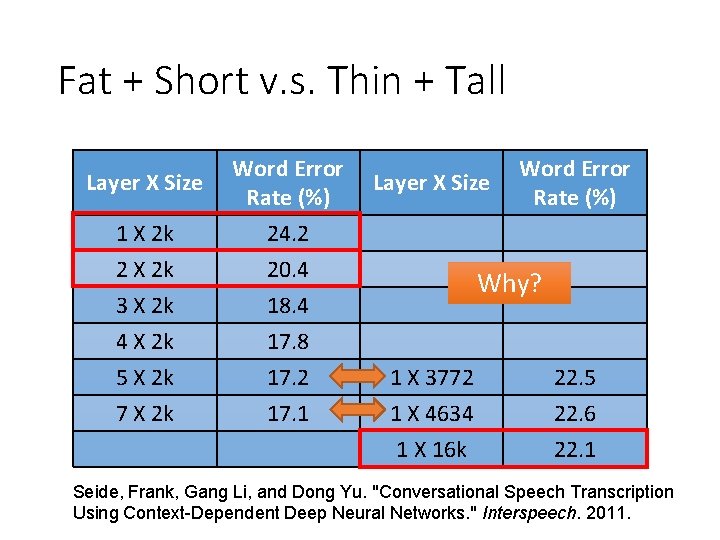
Fat + Short v. s. Thin + Tall Layer X Size Word Error Rate (%) 1 X 2 k 24. 2 20. 4 3 X 2 k 4 X 2 k 5 X 2 k 7 X 2 k 18. 4 17. 8 17. 2 17. 1 Layer X Size Word Error Rate (%) Why? 1 X 3772 1 X 4634 1 X 16 k 22. 5 22. 6 22. 1 Seide, Frank, Gang Li, and Dong Yu. "Conversational Speech Transcription Using Context-Dependent Deep Neural Networks. " Interspeech. 2011.
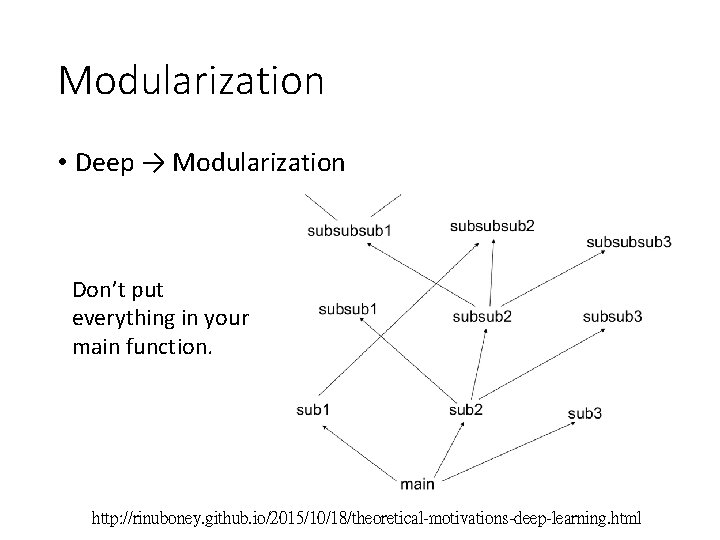
Modularization • Deep → Modularization Don’t put everything in your main function. http: //rinuboney. github. io/2015/10/18/theoretical-motivations-deep-learning. html
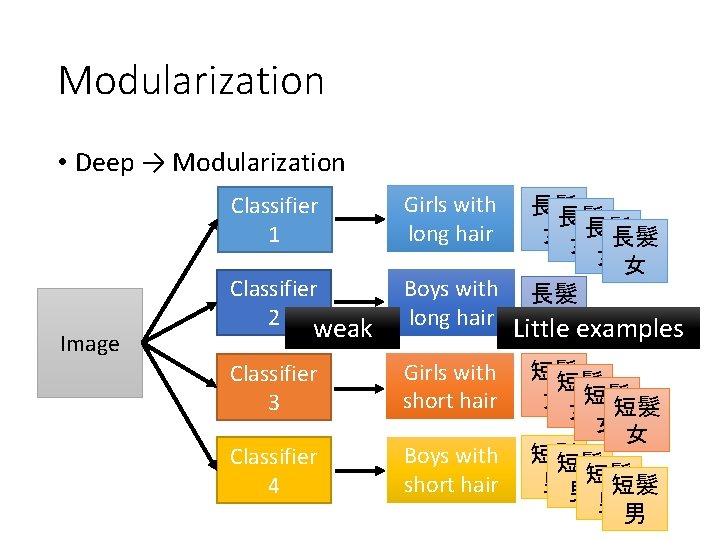
Modularization • Deep → Modularization Classifier 1 Image Girls with long hair Classifier 2 weak 長髮 長髮 女 女長髮 長髮 女女 Boys with 長髮 long hair 男 examples Little Classifier 3 Girls with short hair Classifier 4 Boys with short hair 短髮 短髮 女 女短髮 短髮 女女 短髮 短髮 男 男短髮 短髮 男男
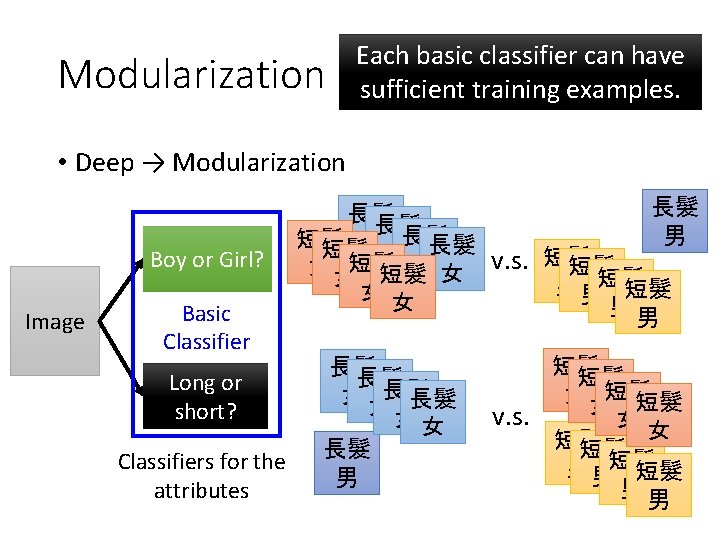
Modularization Each basic classifier can have sufficient training examples. • Deep → Modularization Boy or Girl? Image Basic Classifier Long or short? Classifiers for the attributes 長髮 長髮 長髮 男 長髮 短髮 女 短髮 v. s. 女 短髮 女 女短髮 短髮 女 男 男短髮 短髮 女女 男男 長髮 長髮 女 女長髮 長髮 女女 長髮 男 短髮 短髮 女 女短髮 短髮 v. s. 女女 短髮 短髮 男 男短髮 短髮 男男

Modularization can be trained by little data • Deep → Modularization Boy or Girl? Image Basic Classifier Long or short? Sharing by the following classifiers as module Classifier 1 Girls with long hair Classifier 2 fine Boys with long Little hair data Classifier 3 Girls with short hair Classifier 4 Boys with short hair

Modularization • Deep → Modularization → Less training data? …… …… …… The modularization is automatically learned from data. …… The most basic classifiers Use 1 st layer as module to build classifiers Use 2 nd layer as module ……

Modularization - Image • Deep → Modularization …… …… The most basic classifiers Use 1 st layer as module to build classifiers Use 2 nd layer as module …… Reference: Zeiler, M. D. , & Fergus, R. (2014). Visualizing and understanding convolutional networks. In Computer Vision–ECCV 2014 (pp. 818 -833)
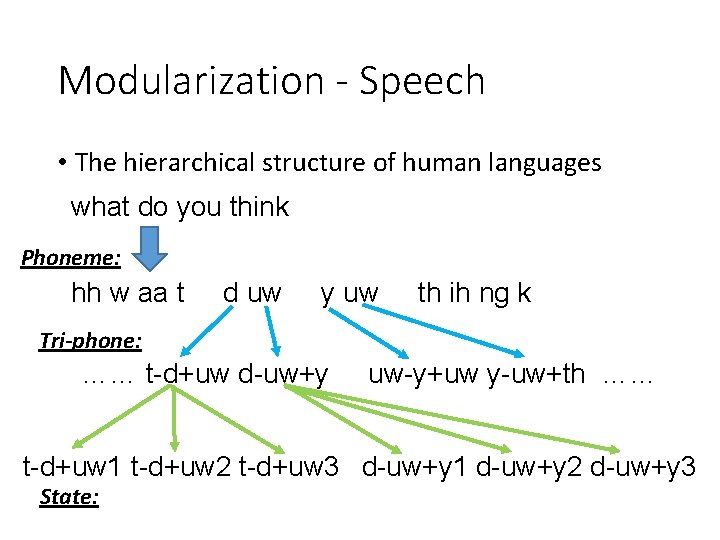
Modularization - Speech • The hierarchical structure of human languages what do you think Phoneme: hh w aa t d uw y uw th ih ng k Tri-phone: …… t-d+uw d-uw+y uw-y+uw y-uw+th …… t-d+uw 1 t-d+uw 2 t-d+uw 3 d-uw+y 1 d-uw+y 2 d-uw+y 3 State:
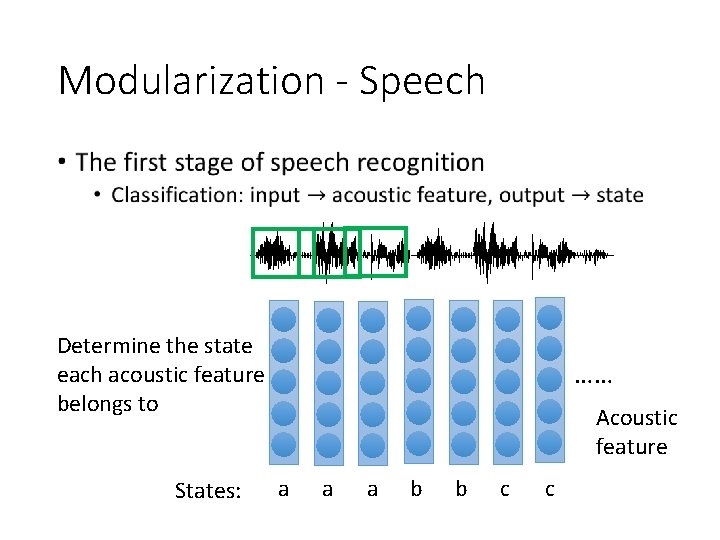
Modularization - Speech • Determine the state each acoustic feature belongs to States: …… Acoustic feature a a a b b c c
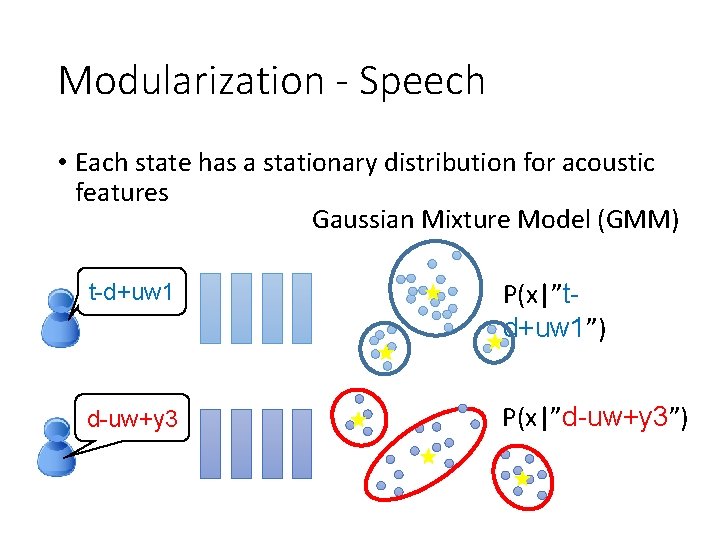
Modularization - Speech • Each state has a stationary distribution for acoustic features Gaussian Mixture Model (GMM) t-d+uw 1 P(x|”td+uw 1”) d-uw+y 3 P(x|”d-uw+y 3”)
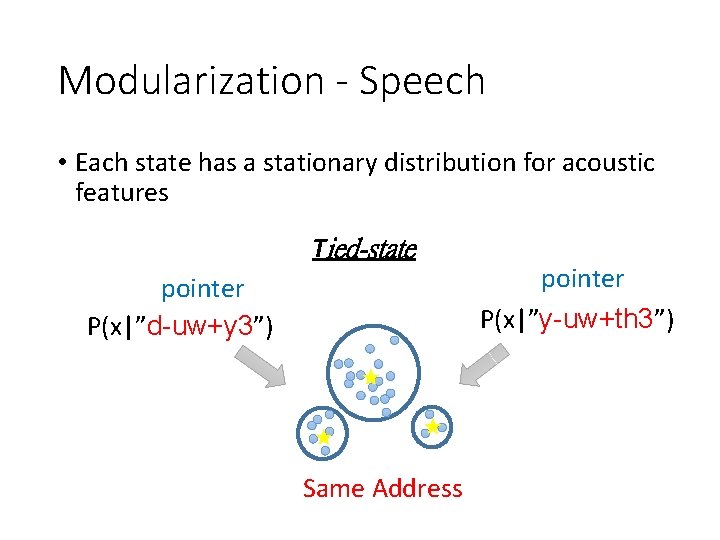
Modularization - Speech • Each state has a stationary distribution for acoustic features Tied-state pointer P(x|”d-uw+y 3”) Same Address pointer P(x|”y-uw+th 3”)
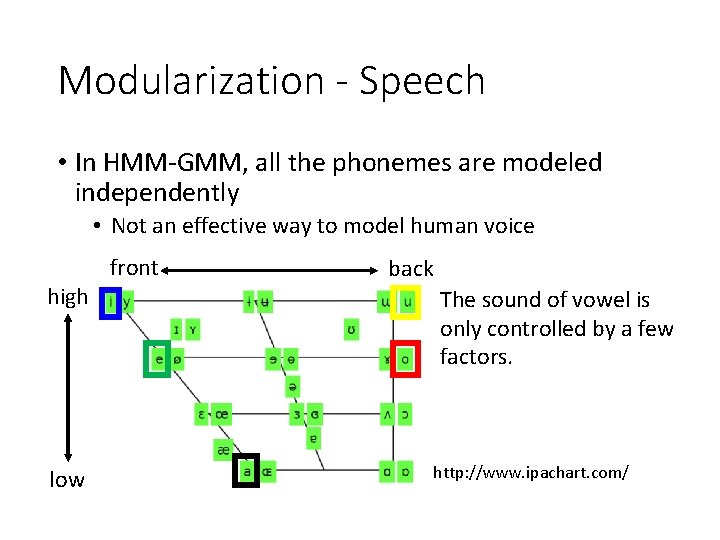
Modularization - Speech • In HMM-GMM, all the phonemes are modeled independently • Not an effective way to model human voice high low front back The sound of vowel is only controlled by a few factors. http: //www. ipachart. com/
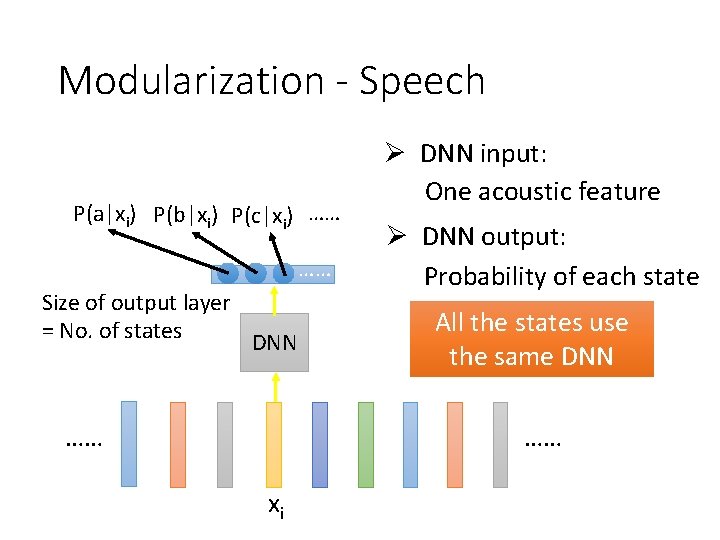
Modularization - Speech P(a|xi) P(b|xi) P(c|xi) …… …… Size of output layer = No. of states DNN …… Ø DNN input: One acoustic feature Ø DNN output: Probability of each state All the states use the same DNN …… xi
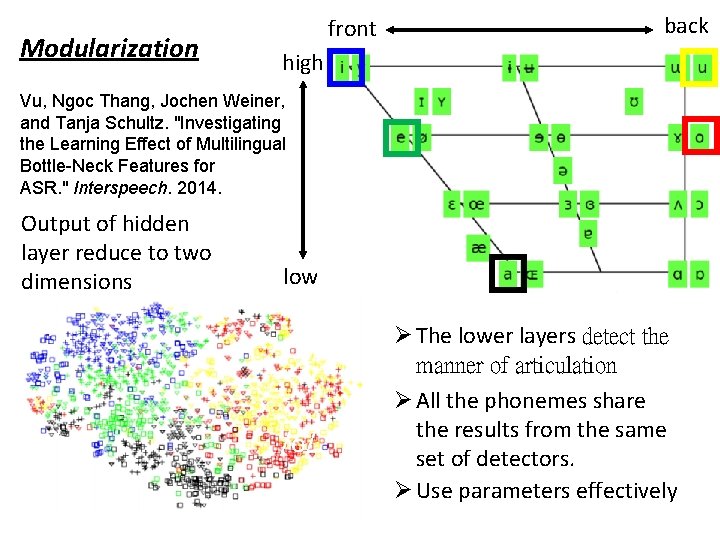
Modularization front back high Vu, Ngoc Thang, Jochen Weiner, and Tanja Schultz. "Investigating the Learning Effect of Multilingual Bottle-Neck Features for ASR. " Interspeech. 2014. Output of hidden layer reduce to two dimensions /i/ low /u/ /e/ /o/ /a/ Ø The lower layers detect the manner of articulation Ø All the phonemes share the results from the same set of detectors. Ø Use parameters effectively
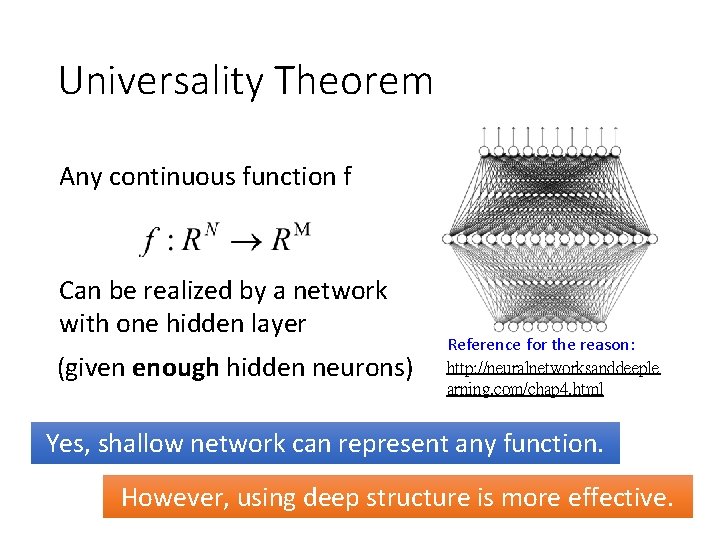
Universality Theorem Any continuous function f Can be realized by a network with one hidden layer (given enough hidden neurons) Reference for the reason: http: //neuralnetworksanddeeple arning. com/chap 4. html Yes, shallow network can represent any function. However, using deep structure is more effective.
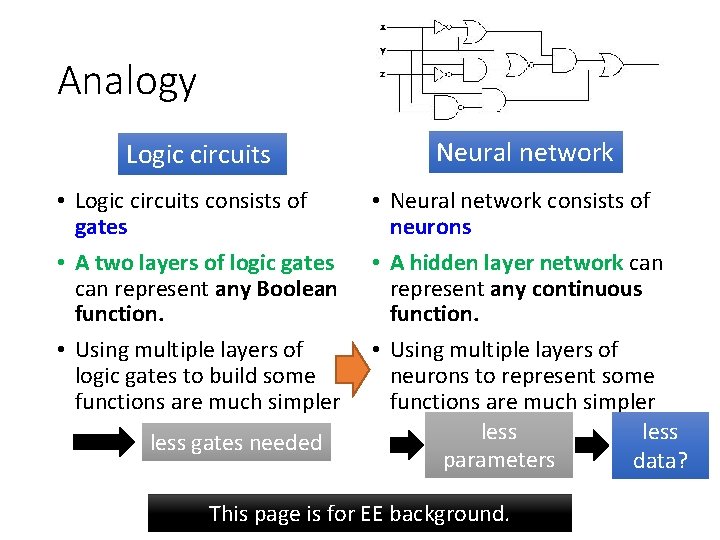
Analogy Logic circuits Neural network • Logic circuits consists of gates • A two layers of logic gates can represent any Boolean function. • Using multiple layers of logic gates to build some functions are much simpler • Neural network consists of neurons • A hidden layer network can represent any continuous function. • Using multiple layers of neurons to represent some functions are much simpler less parameters data? less gates needed This page is for EE background.
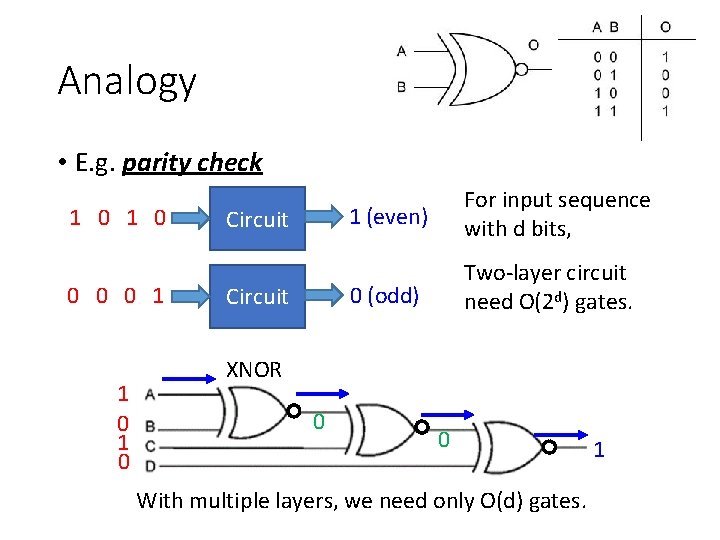
Analogy • E. g. parity check 1 0 0 0 0 1 1 0 Circuit 1 (even) For input sequence with d bits, 0 (odd) Two-layer circuit need O(2 d) gates. XNOR 0 0 With multiple layers, we need only O(d) gates. 1
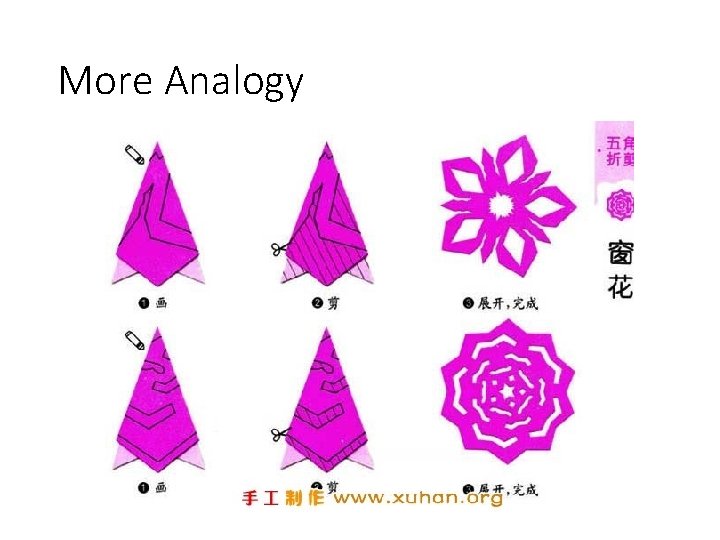
More Analogy
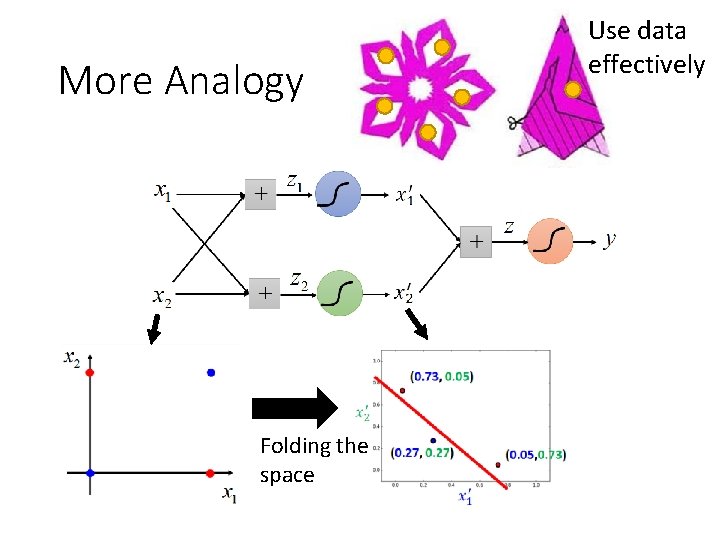
More Analogy Folding the space Use data effectively
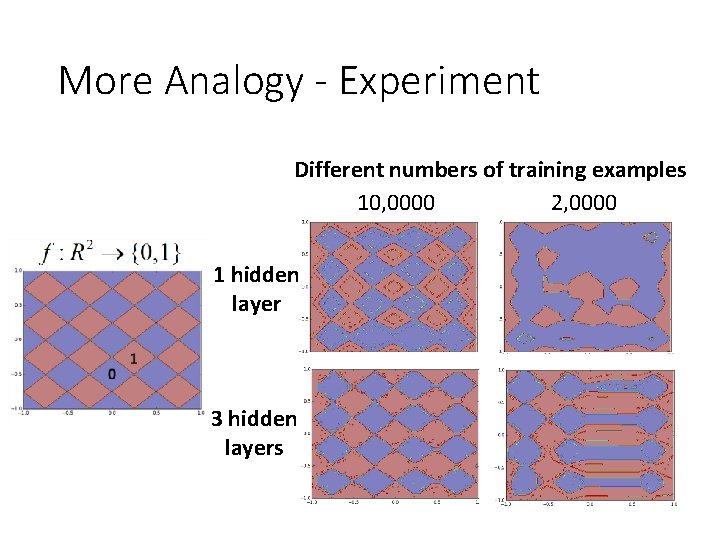
More Analogy - Experiment Different numbers of training examples 10, 0000 2, 0000 1 hidden layer 3 hidden layers
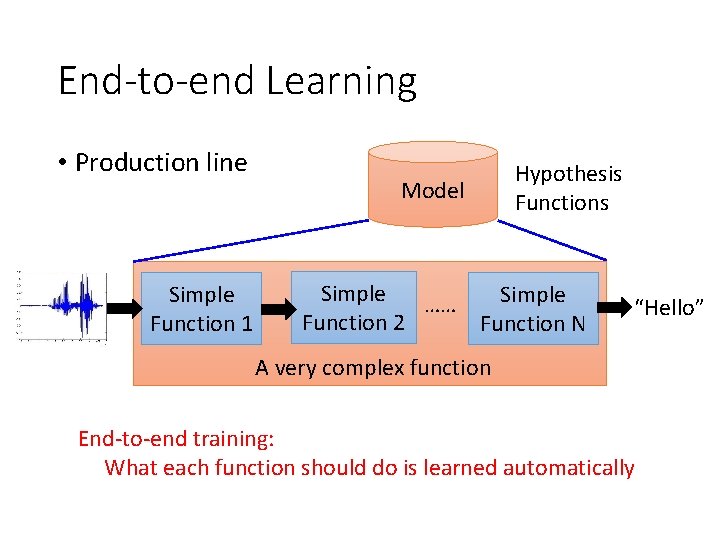
End-to-end Learning • Production line Simple Function 1 Model Hypothesis Functions Simple …… Function 2 Function N “Hello” A very complex function End-to-end training: What each function should do is learned automatically
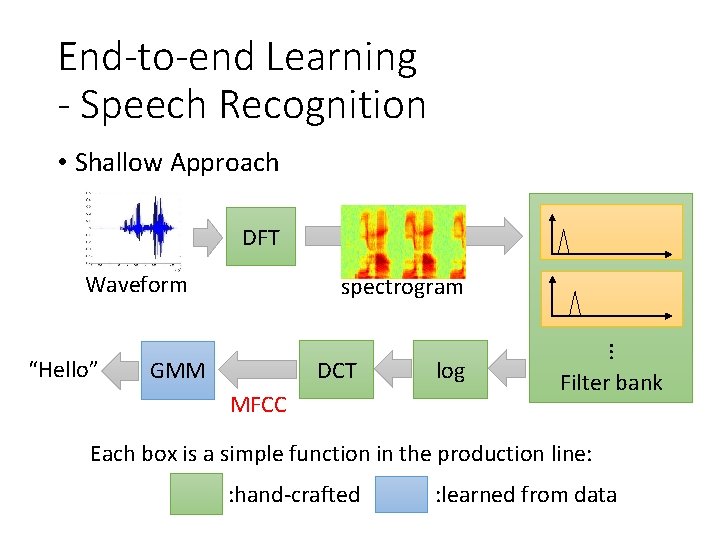
End-to-end Learning - Speech Recognition • Shallow Approach DFT Waveform DCT GMM MFCC log … “Hello” spectrogram Filter bank Each box is a simple function in the production line: : hand-crafted : learned from data
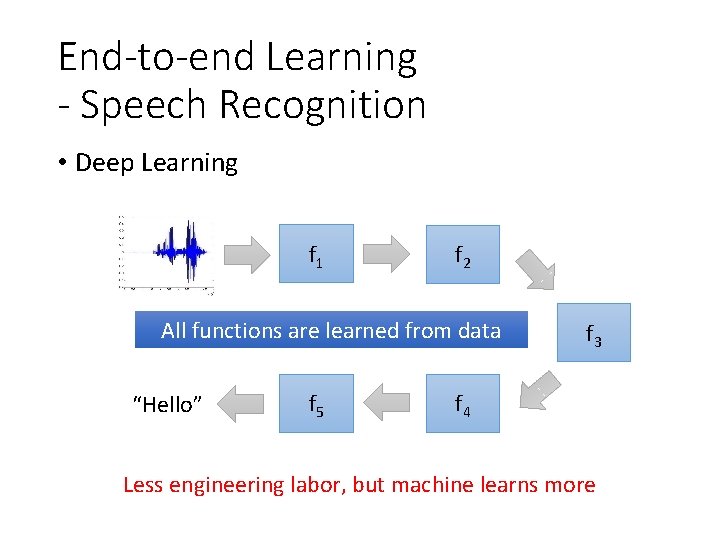
End-to-end Learning - Speech Recognition • Deep Learning f 1 f 2 All functions are learned from data “Hello” f 5 f 3 f 4 Less engineering labor, but machine learns more
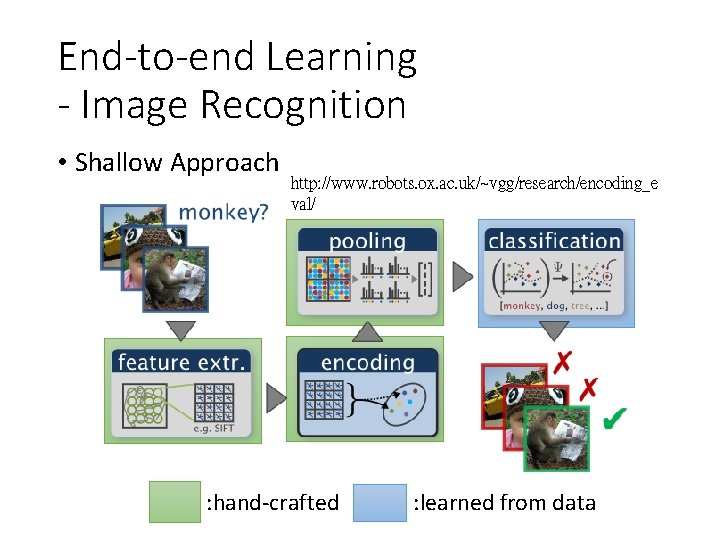
End-to-end Learning - Image Recognition • Shallow Approach http: //www. robots. ox. ac. uk/~vgg/research/encoding_e val/ : hand-crafted : learned from data
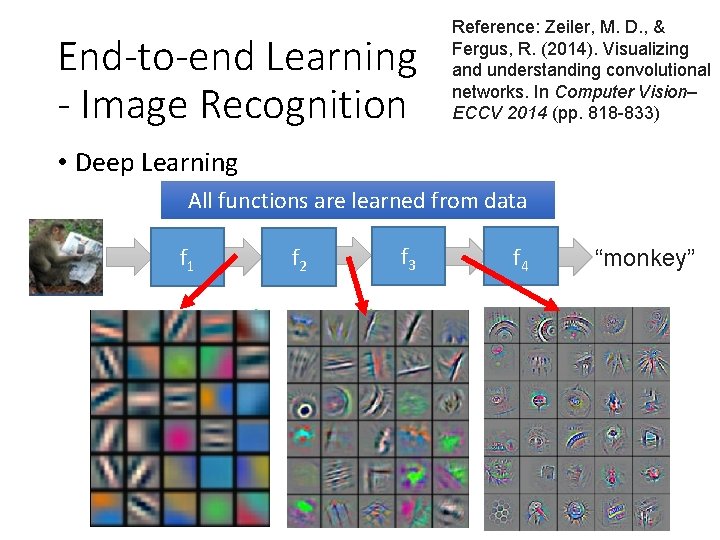
End-to-end Learning - Image Recognition Reference: Zeiler, M. D. , & Fergus, R. (2014). Visualizing and understanding convolutional networks. In Computer Vision– ECCV 2014 (pp. 818 -833) • Deep Learning All functions are learned from data f 1 f 2 f 3 f 4 “monkey”
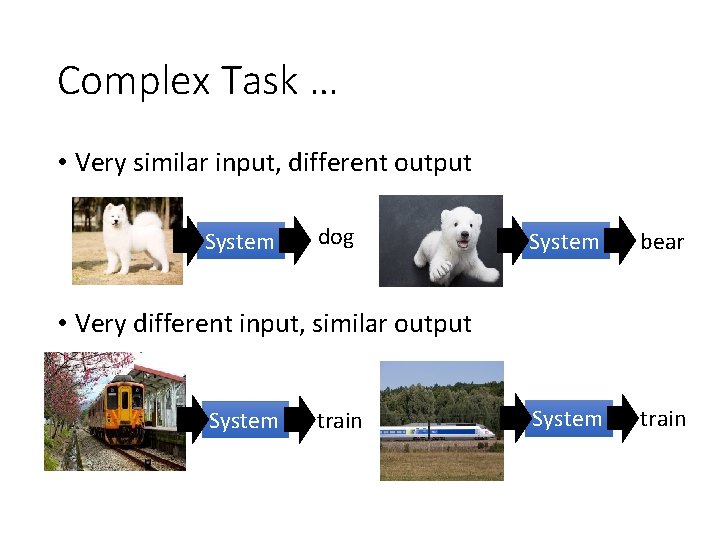
Complex Task … • Very similar input, different output System dog System bear System train • Very different input, similar output System train
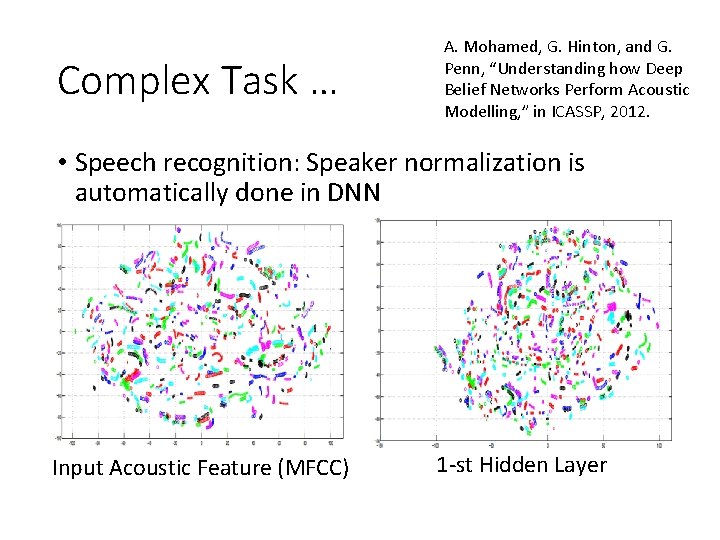
Complex Task … A. Mohamed, G. Hinton, and G. Penn, “Understanding how Deep Belief Networks Perform Acoustic Modelling, ” in ICASSP, 2012. • Speech recognition: Speaker normalization is automatically done in DNN Input Acoustic Feature (MFCC) 1 -st Hidden Layer
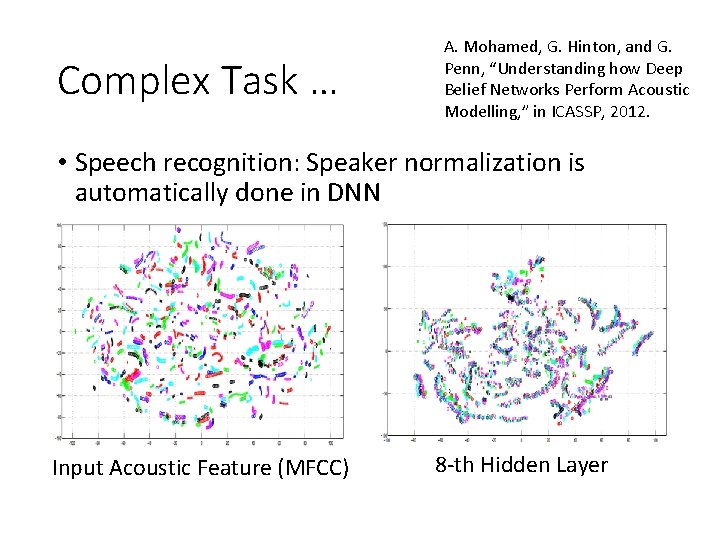
Complex Task … A. Mohamed, G. Hinton, and G. Penn, “Understanding how Deep Belief Networks Perform Acoustic Modelling, ” in ICASSP, 2012. • Speech recognition: Speaker normalization is automatically done in DNN Input Acoustic Feature (MFCC) 8 -th Hidden Layer
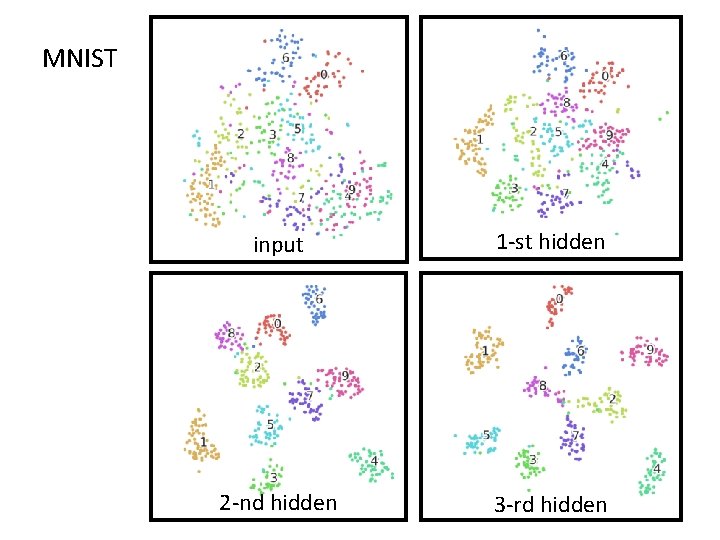
MNIST input 1 -st hidden 2 -nd hidden 3 -rd hidden
To learn more … • Do Deep Nets Really Need To Be Deep? (by Rich Caruana) • http: //research. microsoft. com/apps/video/default. aspx? id= 232373&r=1 keynote of Rich Caruana at ASRU 2015
To learn more … • Deep Learning: Theoretical Motivations (Yoshua Bengio) • http: //videolectures. net/deeplearning 2015_bengio_the oretical_motivations/ • Connections between physics and deep learning • https: //www. youtube. com/watch? v=5 Md. SE-N 0 bxs • Why Deep Learning Works: Perspectives from Theoretical Chemistry • https: //www. youtube. com/watch? v=k. Ib. KHIPbxi. U
- Slides: 34