
Why Computer Security The past decade has seen
- Slides: 105
Why Computer Security • The past decade has seen an explosion in the concern for the security of information – Malicious codes (viruses, worms, etc. ) caused over $28 billion in economic losses in 2003 • Security specialists markets are expanding ! – “Salary Premiums for Security Certifications Increasing” (Computerworld 2007) • Up to 15% more salary • Demand is being driven not only by compliance and government regulation, but also by customers who are "demanding more security" from companies 1
Why Computer Security (cont’d) • Internet attacks are increasing in frequency, severity and sophistication • Denial of service (Do. S) attacks – Cost $1. 2 billion in 2000 – 1999 CSI/FBI survey 32% of respondents detected Do. S attacks directed to their systems – Thousands of attacks per week in 2001 – Yahoo, Amazon, e. Bay, Microsoft, White House, etc. , attacked 2
Why Computer Security (cont’d) • Virus and worms faster and powerful – Cause over $28 billion in economic losses in 2003, growing to over $75 billion in economic losses by 2007. – Code Red (2001): 13 hours infected >360 K machines $2. 4 billion loss – Slammer (2003): 15 minutes infected > 75 K machines $1 billion loss • Spams, phishing … • New Internet security landscape emerging: BOTNETS ! – Conficker/Downadup (2008): infected > 10 M machines • MSFT offering $250 K reward 3
Outline • History of Security and Definitions • Overview of Cryptography • Symmetric Cipher – Classical Symmetric Cipher – Modern Symmetric Ciphers (DES and AES) • Asymmetric Cipher • One-way Hash Functions and Message Digest 4
The History of Computing • For a long time, security was largely ignored in the community – The computer industry was in “survival mode”, struggling to overcome technological and economic hurdles – As a result, a lot of comers were cut and many compromises made – There was lots of theory, and even examples of systems built with very good security, but were largely ignored or unsuccessful • E. g. , ADA language vs. C (powerful and easy to use) 5
Computing Today is Very Different • Computers today are far from “survival mode” – Performance is abundant and the cost is very cheap – As a result, computers now ubiquitous at every facet of society • Internet – Computers are all connected and interdependent – This codependency magnifies the effects of any failures 6
Biological Analogy • Computing today is very homogeneous. – A single architecture and a handful of OS dominates • In biology, homogeneous populations are in danger – A single disease or virus can wipe them out overnight because they all share the same weakness – The disease only needs a vector to travel among hosts • Computers are like the animals, the Internet provides the vector. – It is like having only one kind of cow in the world, and having them drink from one single pool of water! 7
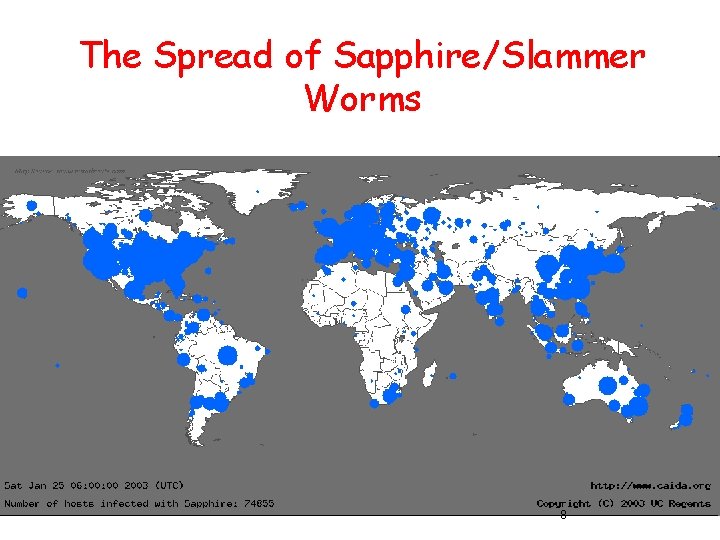
The Spread of Sapphire/Slammer Worms 8
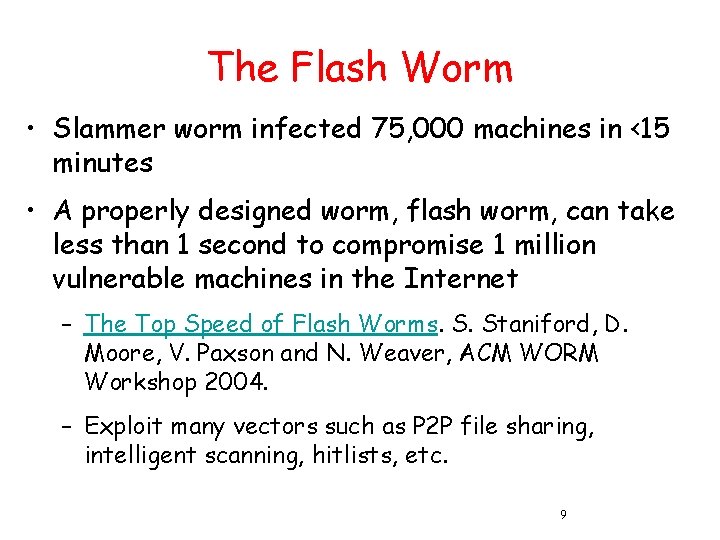
The Flash Worm • Slammer worm infected 75, 000 machines in <15 minutes • A properly designed worm, flash worm, can take less than 1 second to compromise 1 million vulnerable machines in the Internet – The Top Speed of Flash Worms. S. Staniford, D. Moore, V. Paxson and N. Weaver, ACM WORM Workshop 2004. – Exploit many vectors such as P 2 P file sharing, intelligent scanning, hitlists, etc. 9
The Definition of Computer Security • Security is a state of well-being of information and infrastructures in which the possibility of successful yet undetected theft, tampering, and disruption of information and services is kept low or tolerable • Security rests on confidentiality, authenticity, integrity, and availability 10
The Basic Components • Confidentiality is the concealment of information or resources. – E. g. , only sender, intended receiver should “understand” message contents • Authenticity is the identification and assurance of the origin of information. • Integrity refers to the trustworthiness of data or resources in terms of preventing improper and unauthorized changes. • Availability refers to the ability to use the information or resource desired. 11
Security Threats and Attacks • A threat/vulnerability is a potential violation of security. – Flaws in design, implementation, and operation. • An attack is any action that violates security. – Active adversary • An attack has an implicit concept of “intent” – Router mis-configuration or server crash can also cause loss of availability, but they are not attacks 12
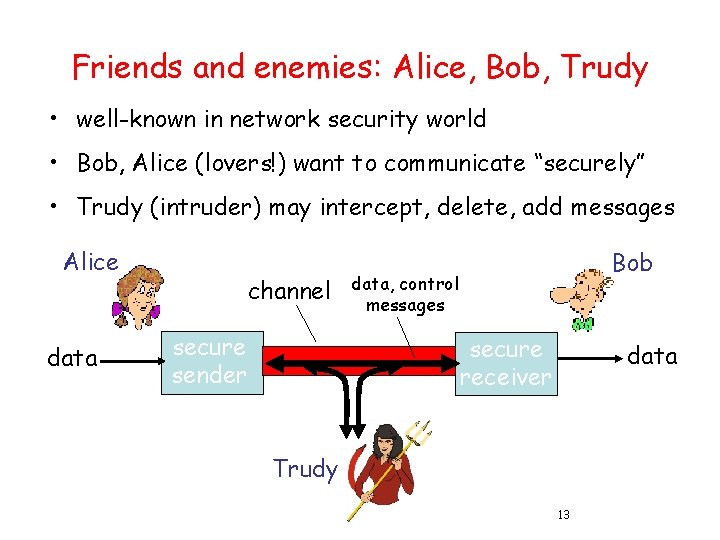
Friends and enemies: Alice, Bob, Trudy • well-known in network security world • Bob, Alice (lovers!) want to communicate “securely” • Trudy (intruder) may intercept, delete, add messages Alice data channel secure sender Bob data, control messages secure receiver data Trudy 13
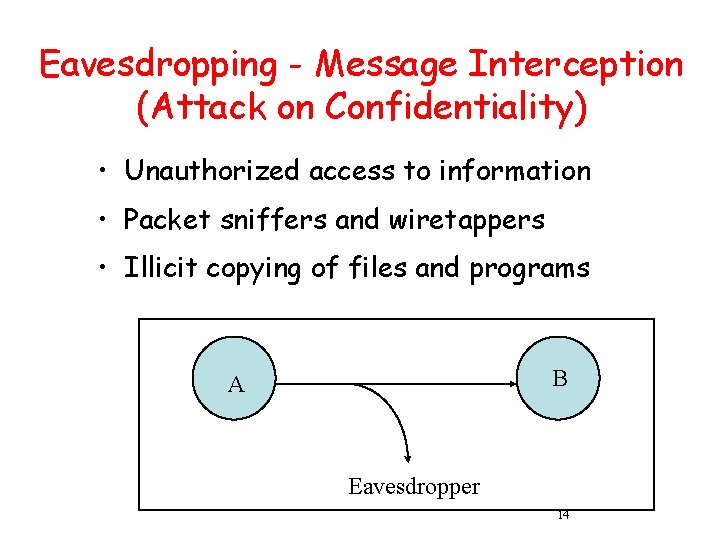
Eavesdropping - Message Interception (Attack on Confidentiality) • Unauthorized access to information • Packet sniffers and wiretappers • Illicit copying of files and programs B A Eavesdropper 14
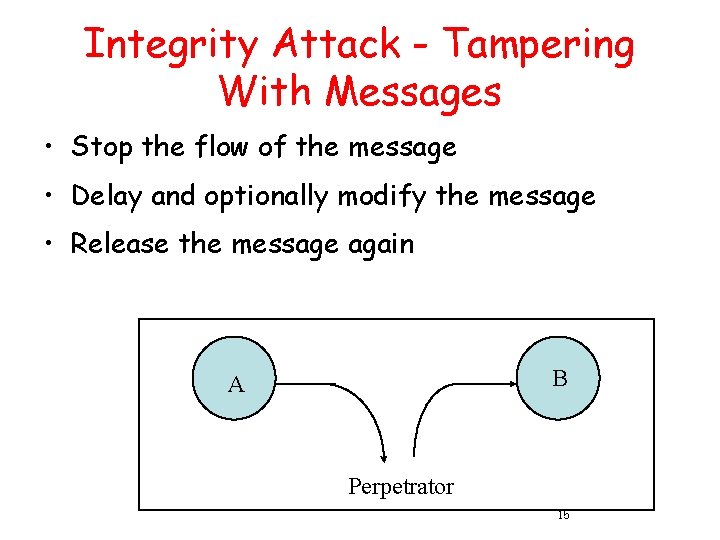
Integrity Attack - Tampering With Messages • Stop the flow of the message • Delay and optionally modify the message • Release the message again B A Perpetrator 15
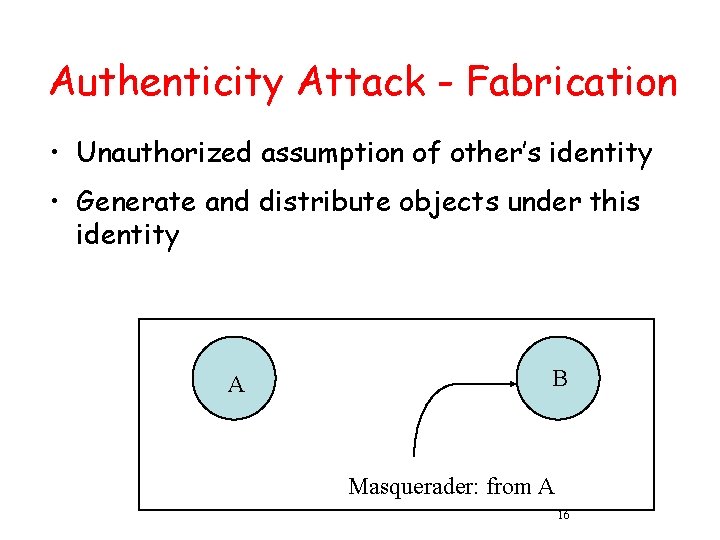
Authenticity Attack - Fabrication • Unauthorized assumption of other’s identity • Generate and distribute objects under this identity A B Masquerader: from A 16
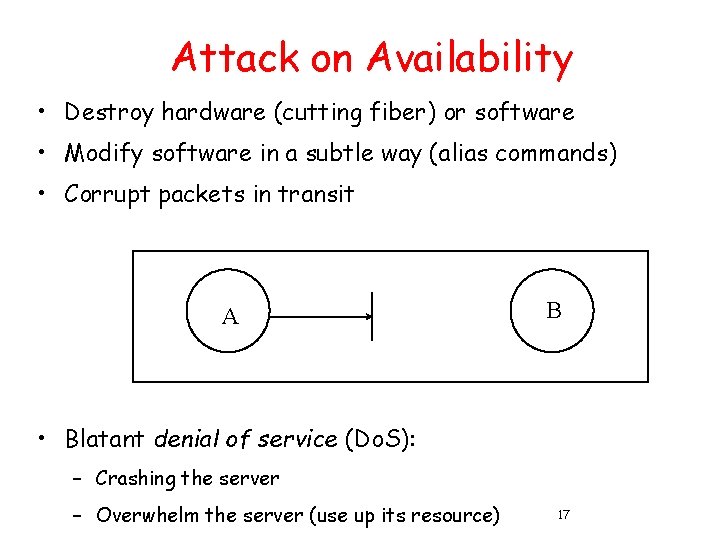
Attack on Availability • Destroy hardware (cutting fiber) or software • Modify software in a subtle way (alias commands) • Corrupt packets in transit A B • Blatant denial of service (Do. S): – Crashing the server – Overwhelm the server (use up its resource) 17
Classify Security Attacks as • Passive attacks - eavesdropping on, or monitoring of, transmissions to: – obtain message contents, or – monitor traffic flows • Active attacks – modification of data stream to: – masquerade of one entity as some other – replay previous messages – modify messages in transit – denial of service 18
Outline • Overview of Cryptography • Symmetric Cipher – Classical Symmetric Cipher – Modern Symmetric Ciphers (DES and AES) • Asymmetric Cipher • One-way Hash Functions and Message Digest 19
Basic Terminology • plaintext - the original message • ciphertext - the coded message • cipher - algorithm for transforming plaintext to ciphertext • key - info used in cipher known only to sender/receiver • encipher (encrypt) - converting plaintext to ciphertext • decipher (decrypt) - recovering ciphertext from plaintext • cryptography - study of encryption principles/methods • cryptanalysis (codebreaking) - the study of principles/ methods of deciphering ciphertext without knowing key • cryptology - the field of both cryptography and cryptanalysis 20
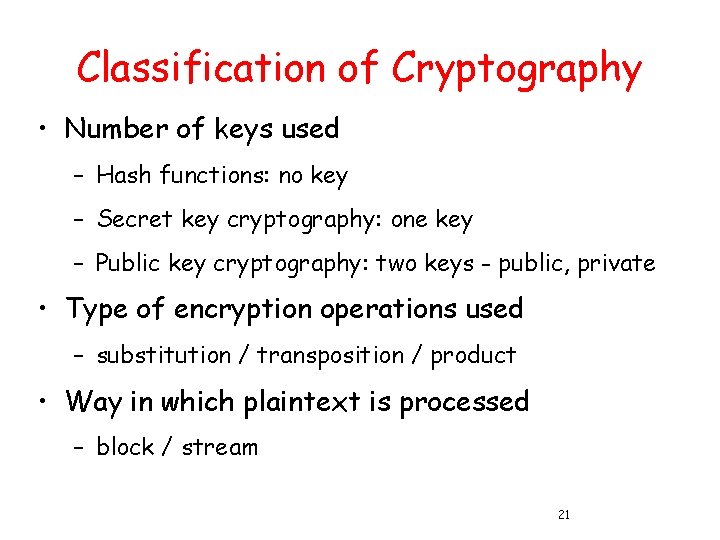
Classification of Cryptography • Number of keys used – Hash functions: no key – Secret key cryptography: one key – Public key cryptography: two keys - public, private • Type of encryption operations used – substitution / transposition / product • Way in which plaintext is processed – block / stream 21
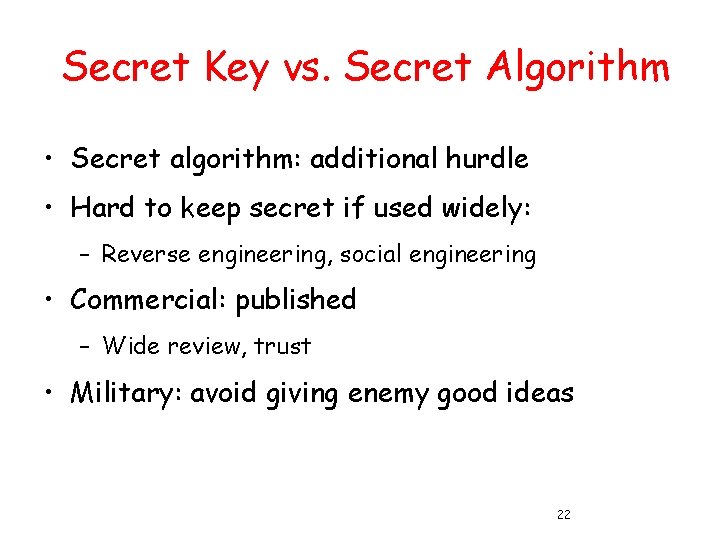
Secret Key vs. Secret Algorithm • Secret algorithm: additional hurdle • Hard to keep secret if used widely: – Reverse engineering, social engineering • Commercial: published – Wide review, trust • Military: avoid giving enemy good ideas 22
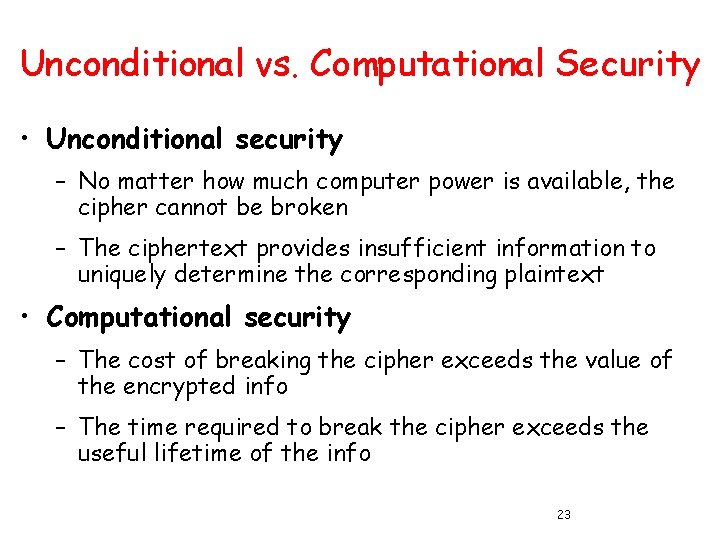
Unconditional vs. Computational Security • Unconditional security – No matter how much computer power is available, the cipher cannot be broken – The ciphertext provides insufficient information to uniquely determine the corresponding plaintext • Computational security – The cost of breaking the cipher exceeds the value of the encrypted info – The time required to break the cipher exceeds the useful lifetime of the info 23
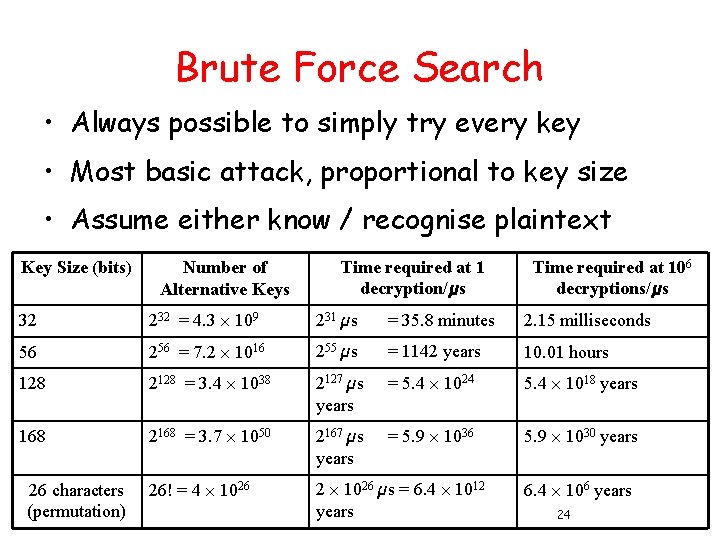
Brute Force Search • Always possible to simply try every key • Most basic attack, proportional to key size • Assume either know / recognise plaintext Key Size (bits) Number of Alternative Keys Time required at 1 decryption/µs Time required at 106 decryptions/µs 32 232 = 4. 3 109 231 µs = 35. 8 minutes 2. 15 milliseconds 56 256 = 7. 2 1016 255 µs = 1142 years 10. 01 hours 128 2128 = 3. 4 1038 2127 µs years = 5. 4 1024 5. 4 1018 years 168 2168 = 3. 7 1050 2167 µs years = 5. 9 1036 5. 9 1030 years 26! = 4 1026 2 1026 µs = 6. 4 1012 years 26 characters (permutation) 6. 4 106 years 24
Outline • Overview of Cryptography • Classical Symmetric Cipher – Substitution Cipher – Transposition Cipher • Modern Symmetric Ciphers (DES and AES) • Asymmetric Cipher • One-way Hash Functions and Message Digest 25
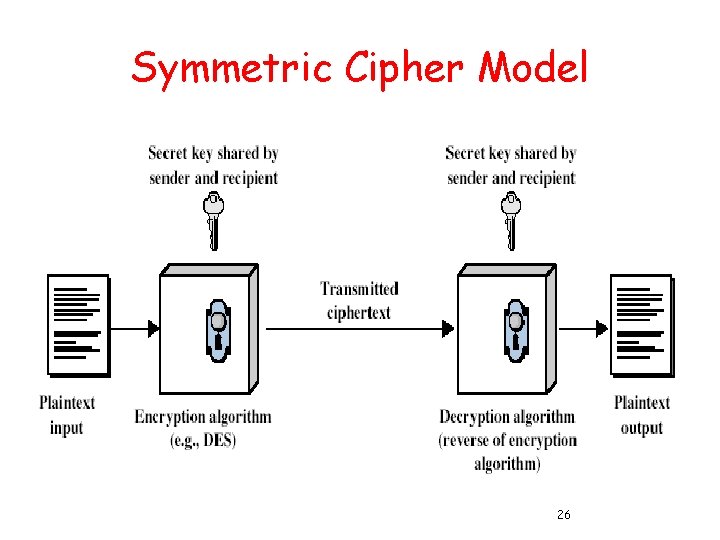
Symmetric Cipher Model 26
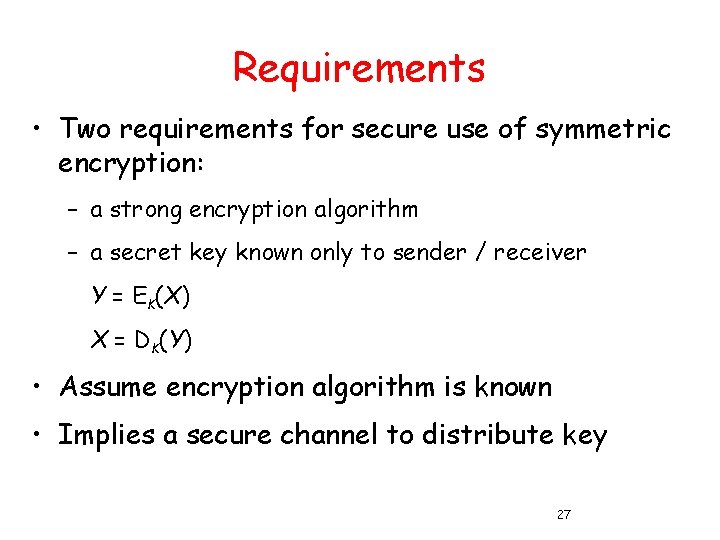
Requirements • Two requirements for secure use of symmetric encryption: – a strong encryption algorithm – a secret key known only to sender / receiver Y = EK(X) X = DK(Y) • Assume encryption algorithm is known • Implies a secure channel to distribute key 27
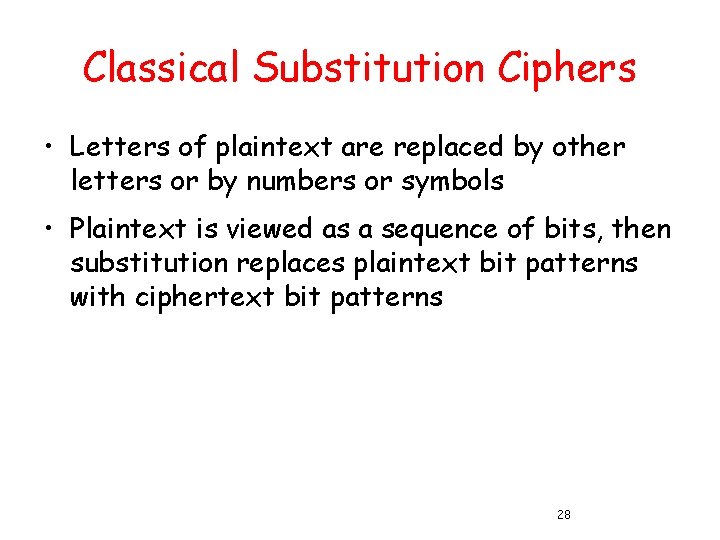
Classical Substitution Ciphers • Letters of plaintext are replaced by other letters or by numbers or symbols • Plaintext is viewed as a sequence of bits, then substitution replaces plaintext bit patterns with ciphertext bit patterns 28
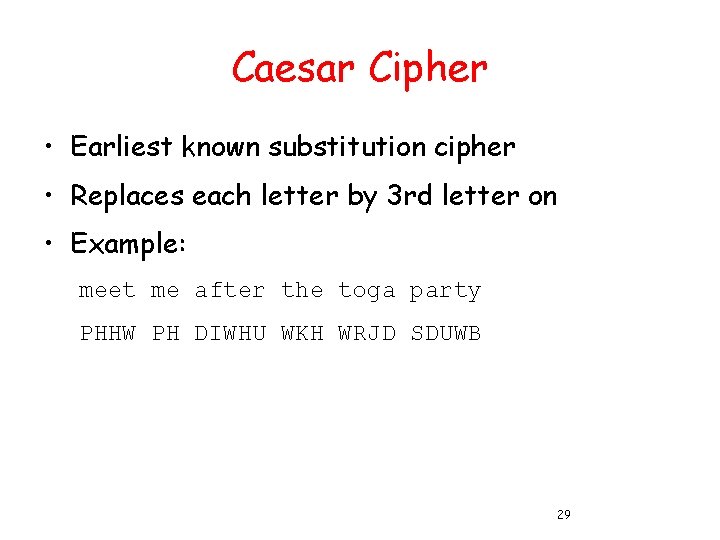
Caesar Cipher • Earliest known substitution cipher • Replaces each letter by 3 rd letter on • Example: meet me after the toga party PHHW PH DIWHU WKH WRJD SDUWB 29
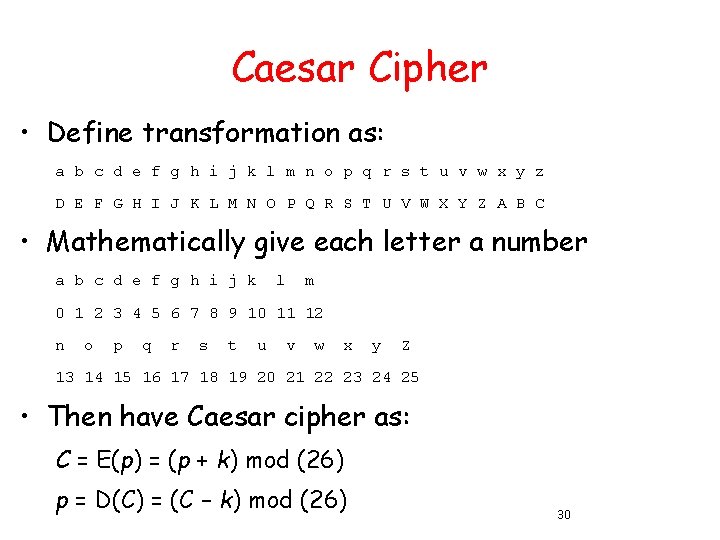
Caesar Cipher • Define transformation as: a b c d e f g h i j k l m n o p q r s t u v w x y z D E F G H I J K L M N O P Q R S T U V W X Y Z A B C • Mathematically give each letter a number a b c d e f g h i j k l m 0 1 2 3 4 5 6 7 8 9 10 11 12 n o p q r s t u v w x y Z 13 14 15 16 17 18 19 20 21 22 23 24 25 • Then have Caesar cipher as: C = E(p) = (p + k) mod (26) p = D(C) = (C – k) mod (26) 30
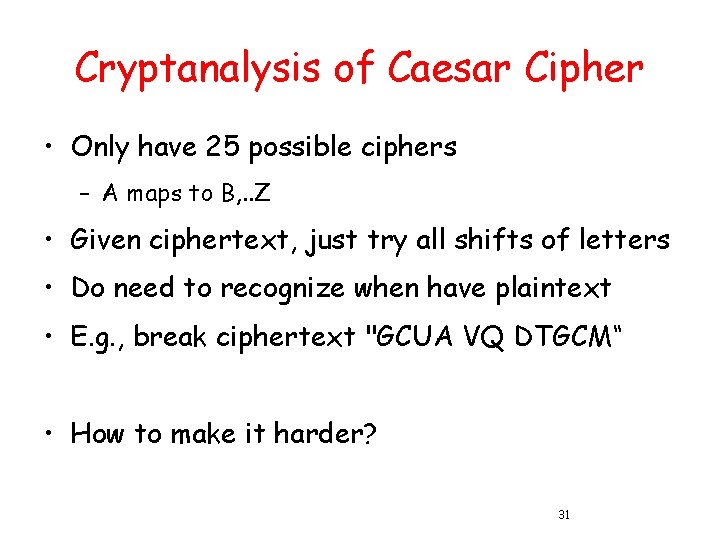
Cryptanalysis of Caesar Cipher • Only have 25 possible ciphers – A maps to B, . . Z • Given ciphertext, just try all shifts of letters • Do need to recognize when have plaintext • E. g. , break ciphertext "GCUA VQ DTGCM“ • How to make it harder? 31
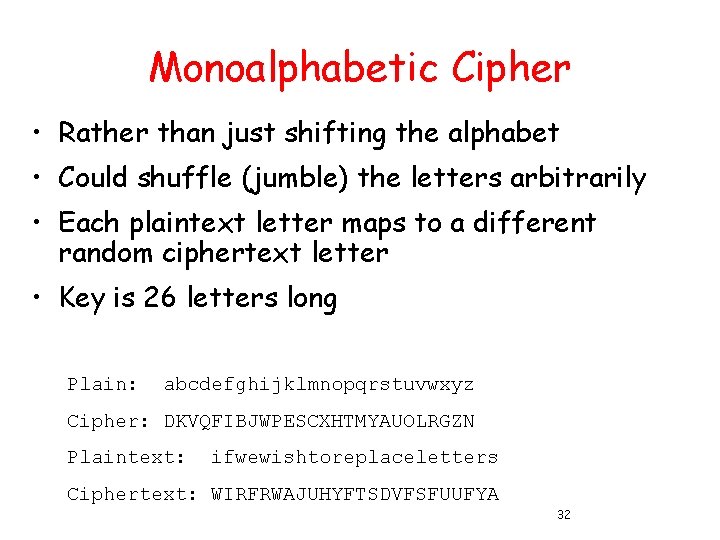
Monoalphabetic Cipher • Rather than just shifting the alphabet • Could shuffle (jumble) the letters arbitrarily • Each plaintext letter maps to a different random ciphertext letter • Key is 26 letters long Plain: abcdefghijklmnopqrstuvwxyz Cipher: DKVQFIBJWPESCXHTMYAUOLRGZN Plaintext: ifwewishtoreplaceletters Ciphertext: WIRFRWAJUHYFTSDVFSFUUFYA 32
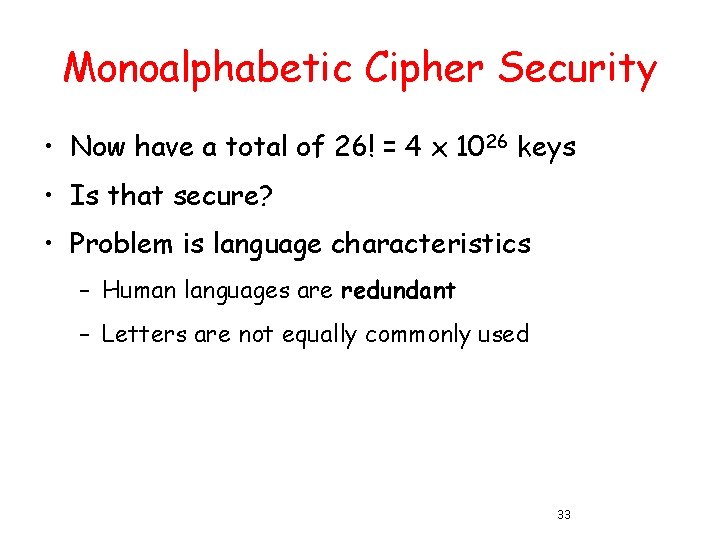
Monoalphabetic Cipher Security • Now have a total of 26! = 4 x 1026 keys • Is that secure? • Problem is language characteristics – Human languages are redundant – Letters are not equally commonly used 33
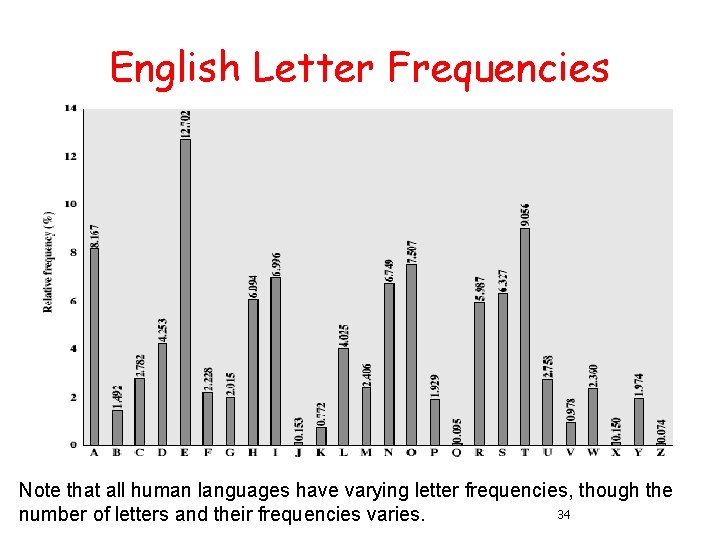
English Letter Frequencies Note that all human languages have varying letter frequencies, though the 34 number of letters and their frequencies varies.
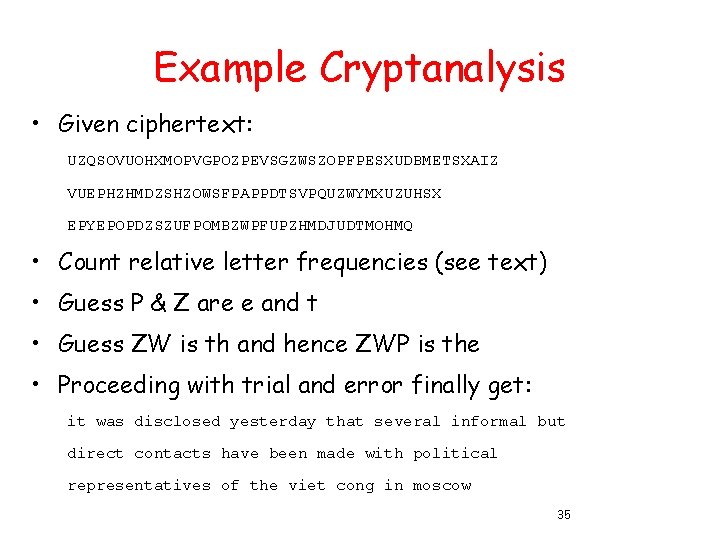
Example Cryptanalysis • Given ciphertext: UZQSOVUOHXMOPVGPOZPEVSGZWSZOPFPESXUDBMETSXAIZ VUEPHZHMDZSHZOWSFPAPPDTSVPQUZWYMXUZUHSX EPYEPOPDZSZUFPOMBZWPFUPZHMDJUDTMOHMQ • Count relative letter frequencies (see text) • Guess P & Z are e and t • Guess ZW is th and hence ZWP is the • Proceeding with trial and error finally get: it was disclosed yesterday that several informal but direct contacts have been made with political representatives of the viet cong in moscow 35
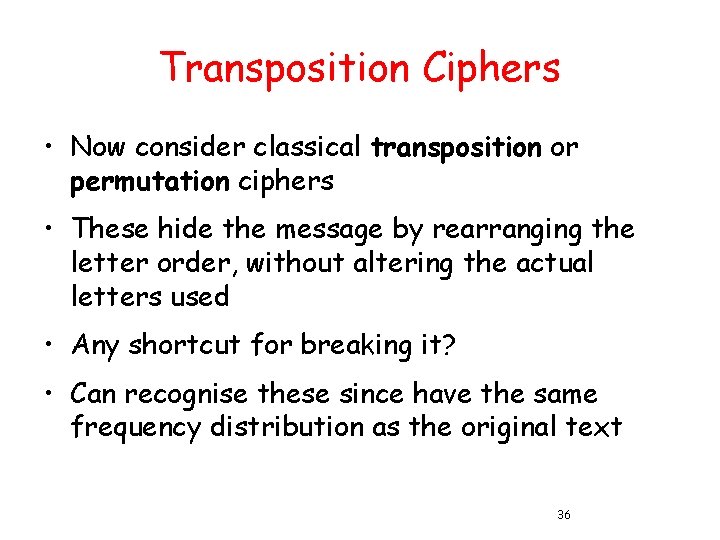
Transposition Ciphers • Now consider classical transposition or permutation ciphers • These hide the message by rearranging the letter order, without altering the actual letters used • Any shortcut for breaking it? • Can recognise these since have the same frequency distribution as the original text 36
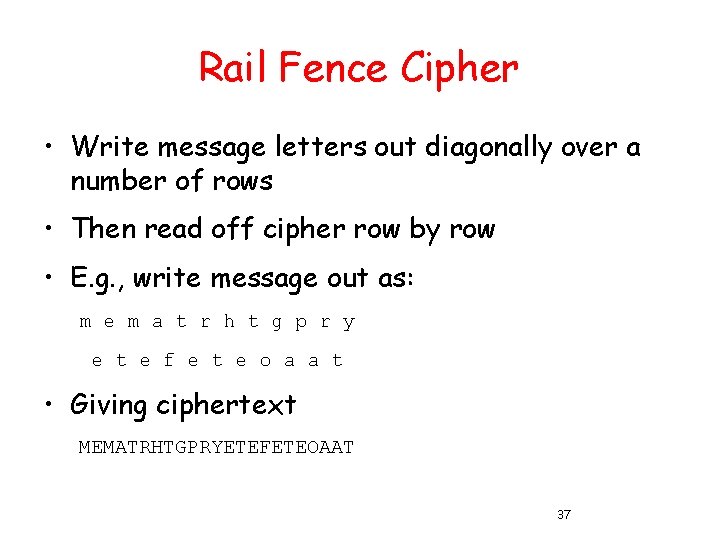
Rail Fence Cipher • Write message letters out diagonally over a number of rows • Then read off cipher row by row • E. g. , write message out as: m e m a t r h t g p r y e t e f e t e o a a t • Giving ciphertext MEMATRHTGPRYETEFETEOAAT 37
Product Ciphers • Ciphers using substitutions or transpositions are not secure because of language characteristics • Hence consider using several ciphers in succession to make harder, but: – Two substitutions make another substitution – Two transpositions make a more complex transposition – But a substitution followed by a transposition makes a new much harder cipher • This is bridge from classical to modern ciphers 38
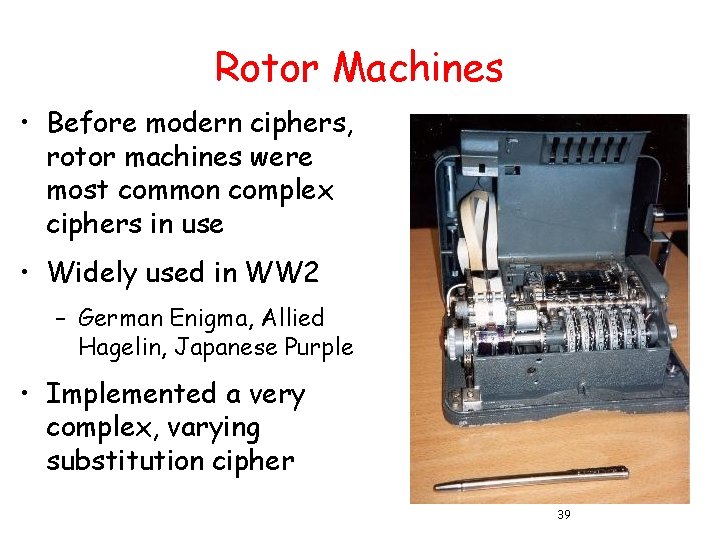
Rotor Machines • Before modern ciphers, rotor machines were most common complex ciphers in use • Widely used in WW 2 – German Enigma, Allied Hagelin, Japanese Purple • Implemented a very complex, varying substitution cipher 39
Outline • Overview of Cryptography • Classical Symmetric Cipher • Modern Symmetric Ciphers (DES/AES) • Asymmetric Cipher • One-way Hash Functions and Message Digest 40
Block vs Stream Ciphers • Block ciphers process messages in into blocks, each of which is then en/decrypted • Like a substitution on very big characters – 64 -bits or more • Stream ciphers process messages a bit or byte at a time when en/decrypting • Many current ciphers are block ciphers, one of the most widely used types of cryptographic algorithms 41
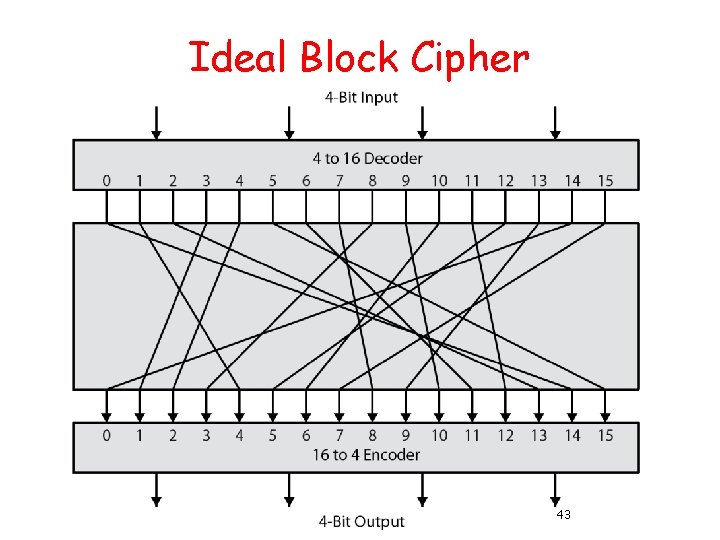
Block Cipher Principles • Most symmetric block ciphers are based on a Feistel Cipher Structure • Block ciphers look like an extremely large substitution • Would need table of 264 entries for a 64 -bit block • Instead create from smaller building blocks • Using idea of a product cipher 42
Ideal Block Cipher 43
Substitution-Permutation Ciphers • Substitution-permutation (S-P) networks [Shannon, 1949] – modern substitution-transposition product cipher • These form the basis of modern block ciphers • S-P networks are based on the two primitive cryptographic operations – substitution (S-box) – permutation (P-box) • provide confusion and diffusion of message 44
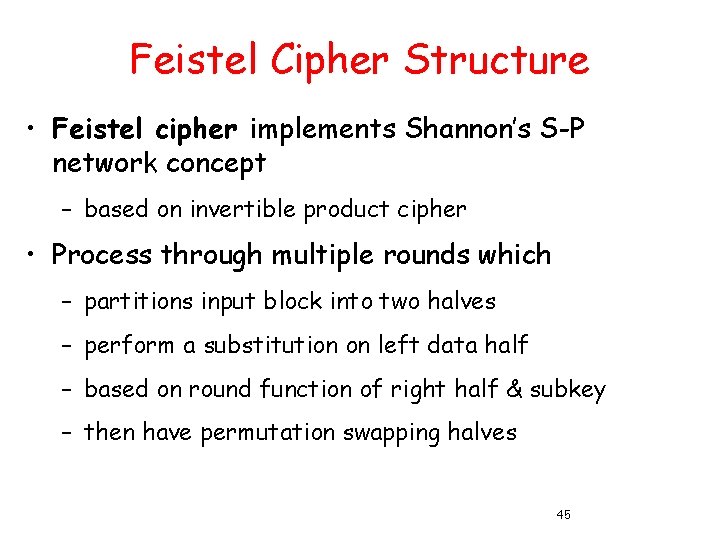
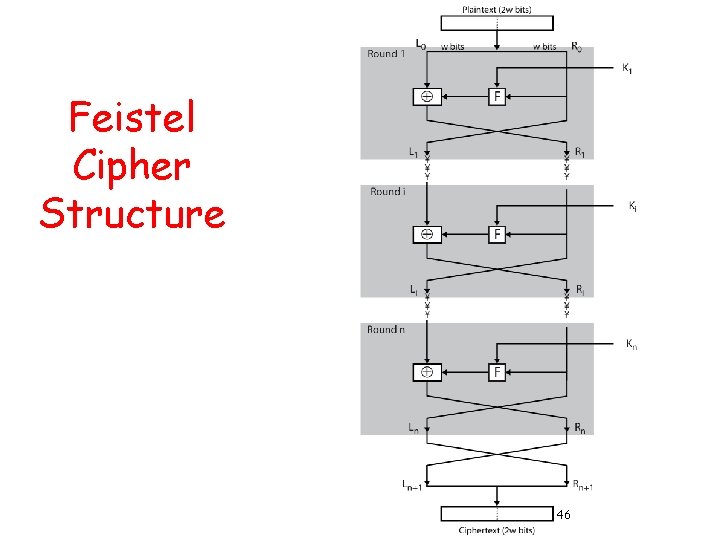
Feistel Cipher Structure • Feistel cipher implements Shannon’s S-P network concept – based on invertible product cipher • Process through multiple rounds which – partitions input block into two halves – perform a substitution on left data half – based on round function of right half & subkey – then have permutation swapping halves 45
Feistel Cipher Structure 46
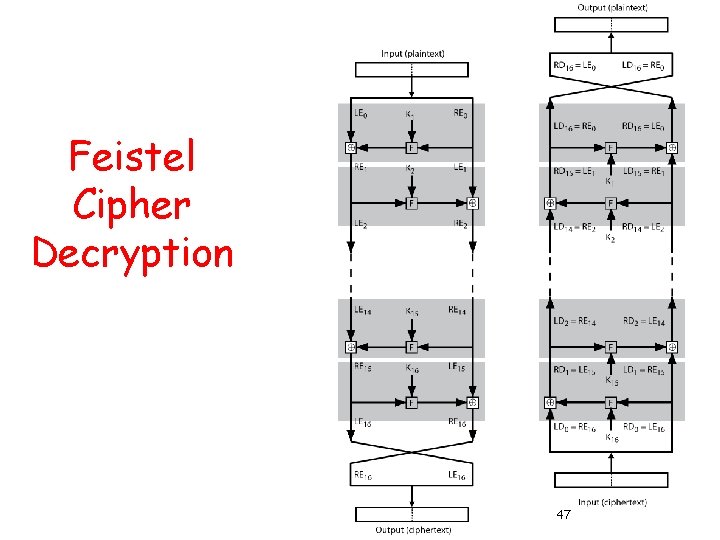
Feistel Cipher Decryption 47
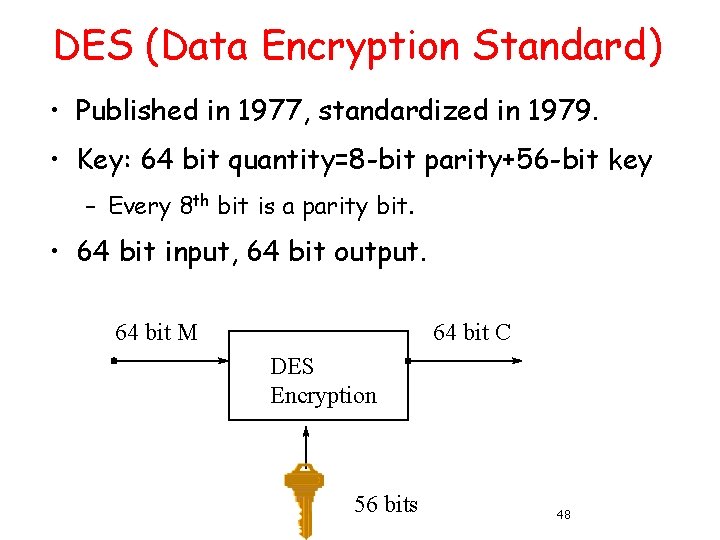
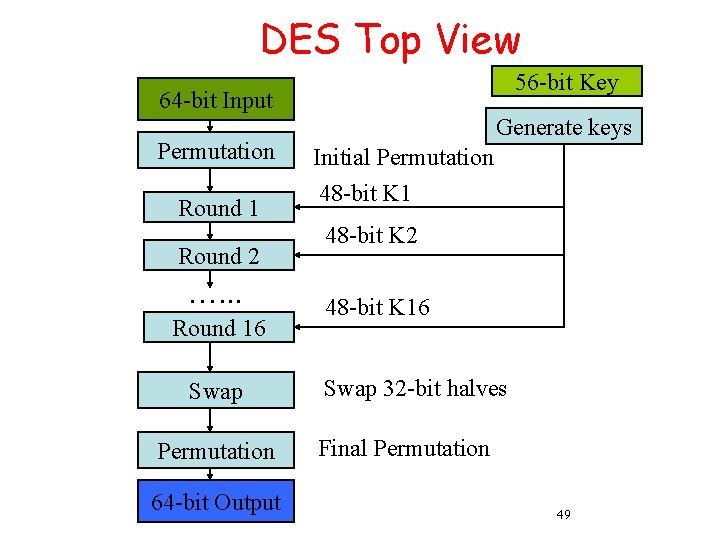
DES (Data Encryption Standard) • Published in 1977, standardized in 1979. • Key: 64 bit quantity=8 -bit parity+56 -bit key – Every 8 th bit is a parity bit. • 64 bit input, 64 bit output. 64 bit M 64 bit C DES Encryption 56 bits 48
DES Top View 56 -bit Key 64 -bit 48 -bit. Input K 1 Permutation Round 1 Round 2 …. . . Round 16 Swap Permutation 64 -bit Output Generate keys Initial Permutation 48 -bit K 1 48 -bit K 2 48 -bit K 16 Swap 32 -bit halves Final Permutation 49
DES Summary • Simple, easy to implement: – Hardware/gigabits/second, software/megabits/second • 56 -bit key DES may be acceptable for noncritical applications but triple DES (DES 3) should be secure for most applications today • Supports several operation modes (ECB CBC, OFB, CFB) for different applications 50
Avalanche Effect • Key desirable property of encryption alg • Where a change of one input or key bit results in changing more than half output bits • DES exhibits strong avalanche 51
Strength of DES – Key Size • 56 -bit keys have 256 = 7. 2 x 10¹⁶ values • Brute force search looks hard • Recent advances have shown is possible – in 1997 on a huge cluster of computers over the Internet in a few months – in 1998 on dedicated hardware called “DES cracker” by EFF in a few days ($220, 000) – in 1999 above combined in 22 hrs! • Still must be able to recognize plaintext • No big flaw for DES algorithms 52
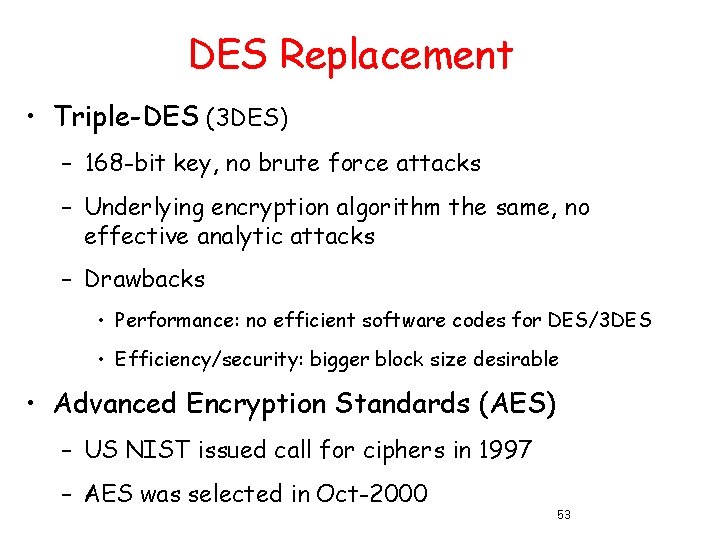
DES Replacement • Triple-DES (3 DES) – 168 -bit key, no brute force attacks – Underlying encryption algorithm the same, no effective analytic attacks – Drawbacks • Performance: no efficient software codes for DES/3 DES • Efficiency/security: bigger block size desirable • Advanced Encryption Standards (AES) – US NIST issued call for ciphers in 1997 – AES was selected in Oct-2000 53
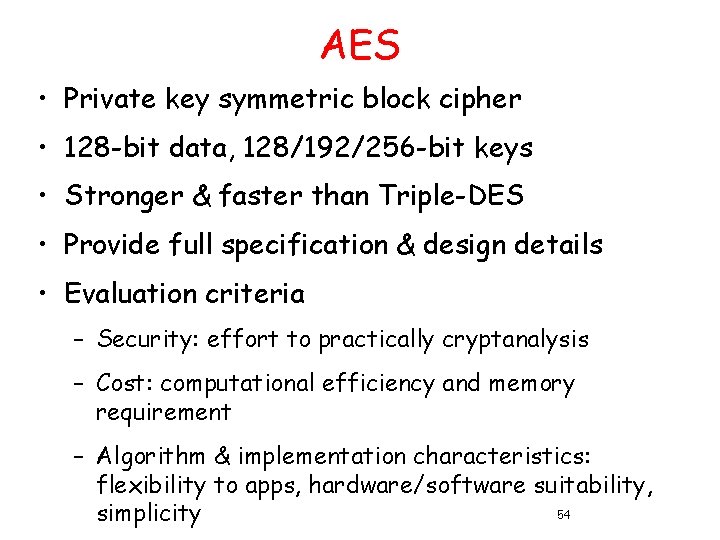
AES • Private key symmetric block cipher • 128 -bit data, 128/192/256 -bit keys • Stronger & faster than Triple-DES • Provide full specification & design details • Evaluation criteria – Security: effort to practically cryptanalysis – Cost: computational efficiency and memory requirement – Algorithm & implementation characteristics: flexibility to apps, hardware/software suitability, 54 simplicity
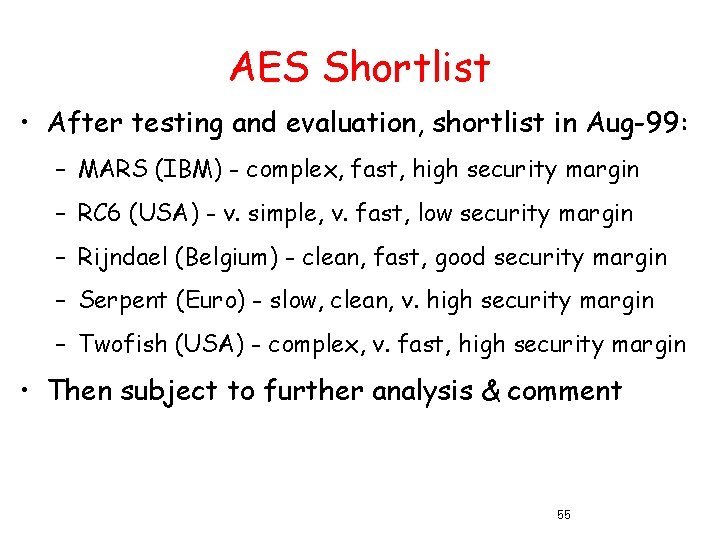
AES Shortlist • After testing and evaluation, shortlist in Aug-99: – MARS (IBM) - complex, fast, high security margin – RC 6 (USA) - v. simple, v. fast, low security margin – Rijndael (Belgium) - clean, fast, good security margin – Serpent (Euro) - slow, clean, v. high security margin – Twofish (USA) - complex, v. fast, high security margin • Then subject to further analysis & comment 55
Outlines • Symmetric Cipher – Classical Symmetric Cipher – Modern Symmetric Ciphers (DES and AES) • Asymmetric Cipher • One-way Hash Functions and Message Digest 56
Private-Key Cryptography • Private/secret/single key cryptography uses one key • Shared by both sender and receiver • If this key is disclosed communications are compromised • Also is symmetric, parties are equal • Hence does not protect sender from receiver forging a message & claiming is sent by sender 57
Public-Key Cryptography • Probably most significant advance in the 3000 year history of cryptography • Uses two keys – a public & a private key • Asymmetric since parties are not equal • Uses clever application of number theoretic concepts to function • Complements rather than replaces private key crypto 58
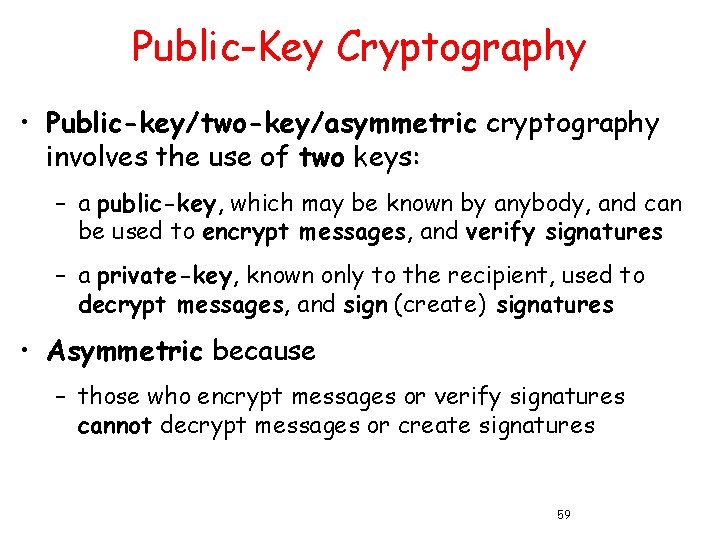
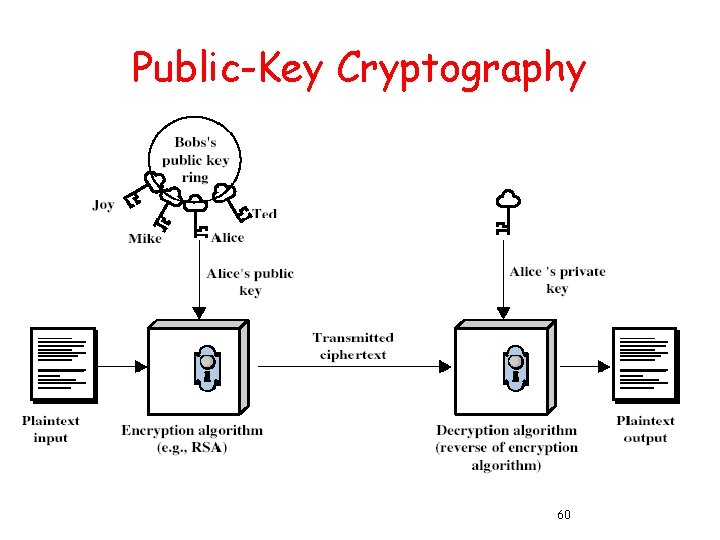
Public-Key Cryptography • Public-key/two-key/asymmetric cryptography involves the use of two keys: – a public-key, which may be known by anybody, and can be used to encrypt messages, and verify signatures – a private-key, known only to the recipient, used to decrypt messages, and sign (create) signatures • Asymmetric because – those who encrypt messages or verify signatures cannot decrypt messages or create signatures 59
Public-Key Cryptography 60
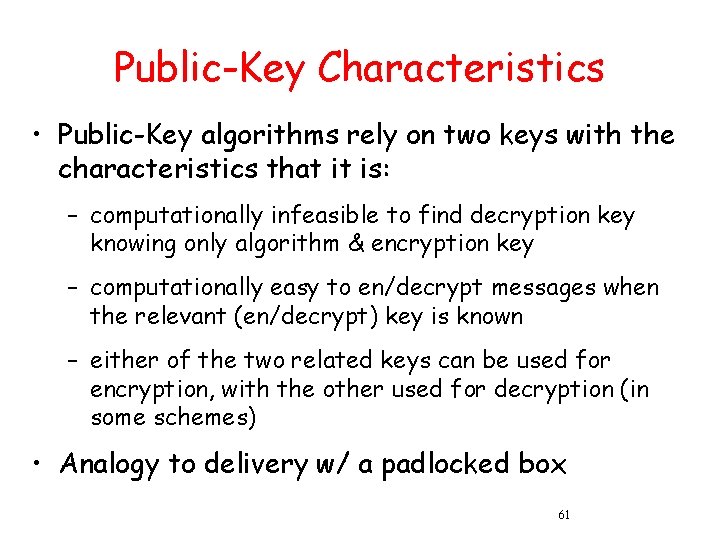
Public-Key Characteristics • Public-Key algorithms rely on two keys with the characteristics that it is: – computationally infeasible to find decryption key knowing only algorithm & encryption key – computationally easy to en/decrypt messages when the relevant (en/decrypt) key is known – either of the two related keys can be used for encryption, with the other used for decryption (in some schemes) • Analogy to delivery w/ a padlocked box 61
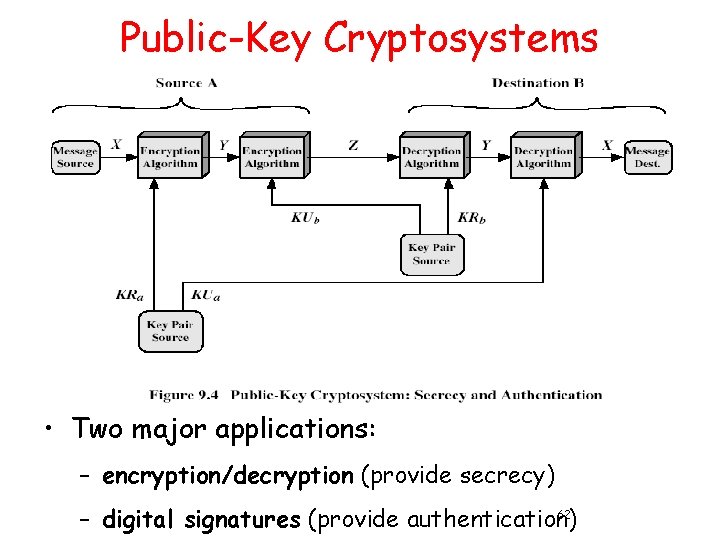
Public-Key Cryptosystems • Two major applications: – encryption/decryption (provide secrecy) 62 – digital signatures (provide authentication)
RSA (Rivest, Shamir, Adleman) • The most popular one. • Support both public key encryption and digital signature. • Assumption/theoretical basis: – Factoring a big number is hard. • Variable key length (usually 512 bits). • Variable plaintext block size. – Plaintext must be “smaller” than the key. – Ciphertext block size is the same as the key length. 63
What Is RSA? • To generate key pair: – Pick large primes (>= 512 bits each) p and q – Let n = p*q, keep your p and q to yourself! – For public key, choose e that is relatively prime to ø(n) =(p-1)(q-1), let pub = <e, n> – For private key, find d that is the multiplicative inverse of e mod ø(n), i. e. , e*d = 1 mod ø(n), let priv = <d, n> 64
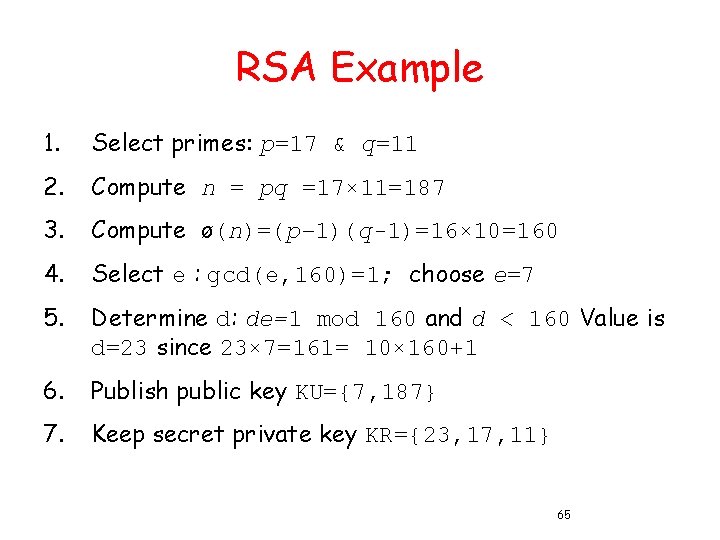
RSA Example 1. Select primes: p=17 & q=11 2. Compute n = pq =17× 11=187 3. Compute ø(n)=(p– 1)(q-1)=16× 10=160 4. Select e : gcd(e, 160)=1; choose e=7 5. Determine d: de=1 mod 160 and d < 160 Value is d=23 since 23× 7=161= 10× 160+1 6. Publish public key KU={7, 187} 7. Keep secret private key KR={23, 17, 11} 65
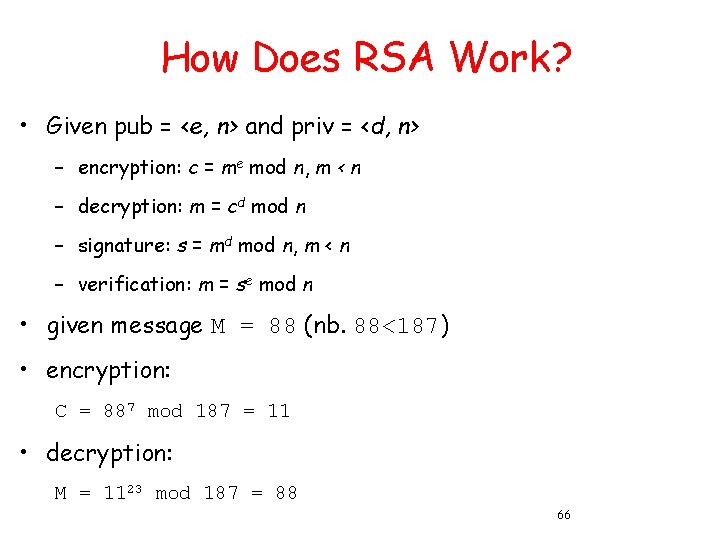
How Does RSA Work? • Given pub = <e, n> and priv = <d, n> – encryption: c = me mod n, m < n – decryption: m = cd mod n – signature: s = md mod n, m < n – verification: m = se mod n • given message M = 88 (nb. 88<187) • encryption: C = 887 mod 187 = 11 • decryption: M = 1123 mod 187 = 88 66
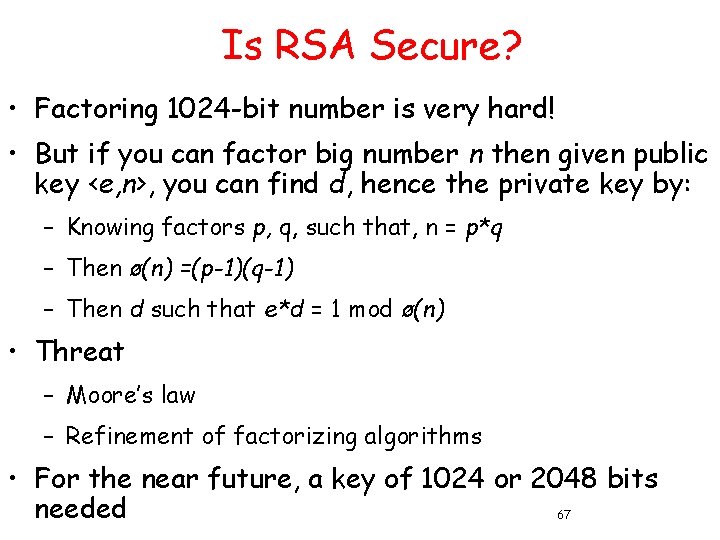
Is RSA Secure? • Factoring 1024 -bit number is very hard! • But if you can factor big number n then given public key <e, n>, you can find d, hence the private key by: – Knowing factors p, q, such that, n = p*q – Then ø(n) =(p-1)(q-1) – Then d such that e*d = 1 mod ø(n) • Threat – Moore’s law – Refinement of factorizing algorithms • For the near future, a key of 1024 or 2048 bits needed 67
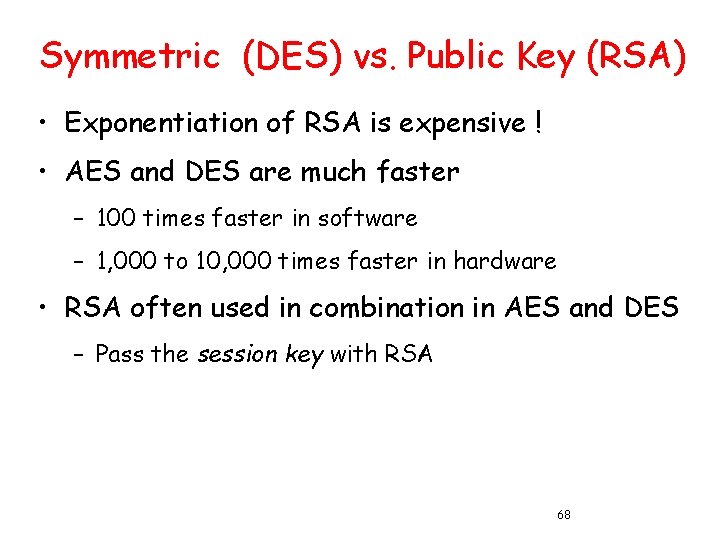
Symmetric (DES) vs. Public Key (RSA) • Exponentiation of RSA is expensive ! • AES and DES are much faster – 100 times faster in software – 1, 000 to 10, 000 times faster in hardware • RSA often used in combination in AES and DES – Pass the session key with RSA 68
Outline • History of Security and Definitions • Overview of Cryptography • Symmetric Cipher – Classical Symmetric Cipher – Modern Symmetric Ciphers (DES and AES) • Asymmetric Cipher • One-way Hash Functions and Message Digest 69
Confidentiality => Authenticity ? • Symmetric cipher ? – Shared key problem – Plaintext has to be intelligible/understandable • Asymmetric cipher? – Too expensive – Plaintext has to be intelligible/understandable – Desirable to cipher on a much smaller size of data which uniquely represents the long message 70
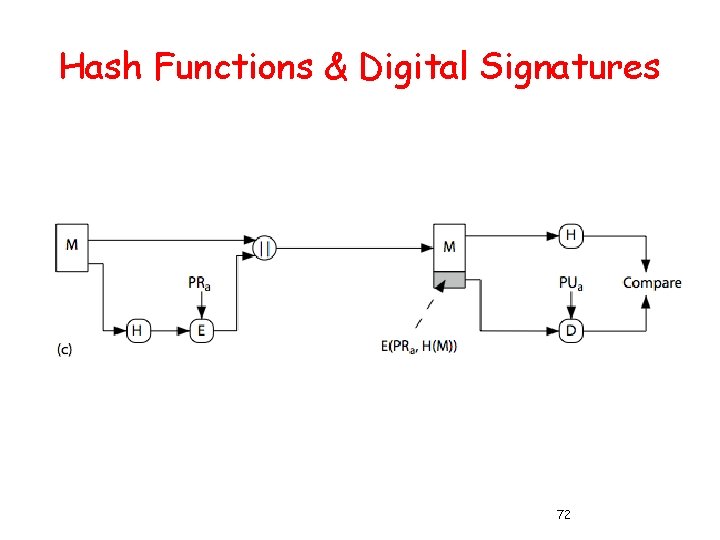
Hash Functions • Condenses arbitrary message to fixed size h = H(M) • Usually assume that the hash function is public and not keyed • Hash used to detect changes to message • Can use in various ways with message • Most often to create a digital signature 71
Hash Functions & Digital Signatures 72
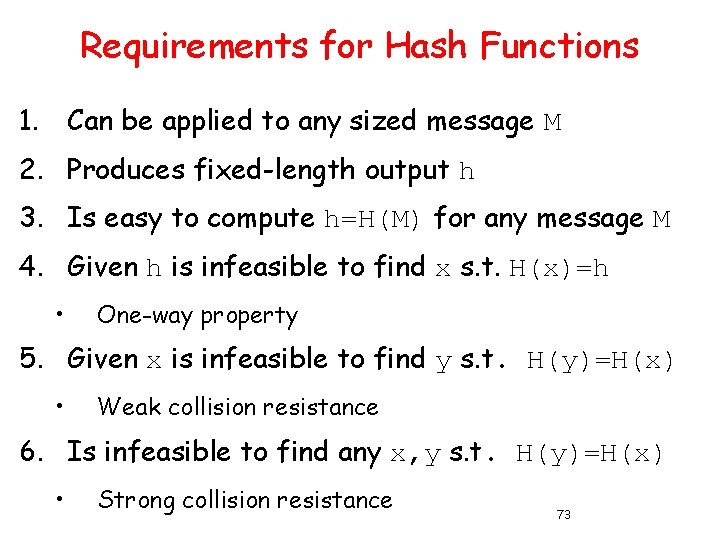
Requirements for Hash Functions 1. Can be applied to any sized message M 2. Produces fixed-length output h 3. Is easy to compute h=H(M) for any message M 4. Given h is infeasible to find x s. t. H(x)=h • One-way property 5. Given x is infeasible to find y s. t. H(y)=H(x) • Weak collision resistance 6. Is infeasible to find any x, y s. t. H(y)=H(x) • Strong collision resistance 73
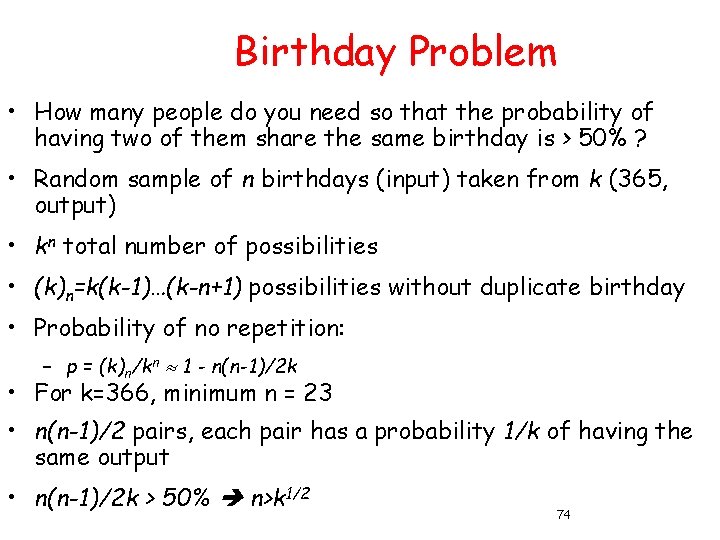
Birthday Problem • How many people do you need so that the probability of having two of them share the same birthday is > 50% ? • Random sample of n birthdays (input) taken from k (365, output) • kn total number of possibilities • (k)n=k(k-1)…(k-n+1) possibilities without duplicate birthday • Probability of no repetition: – p = (k)n/kn 1 - n(n-1)/2 k • For k=366, minimum n = 23 • n(n-1)/2 pairs, each pair has a probability 1/k of having the same output • n(n-1)/2 k > 50% n>k 1/2 74
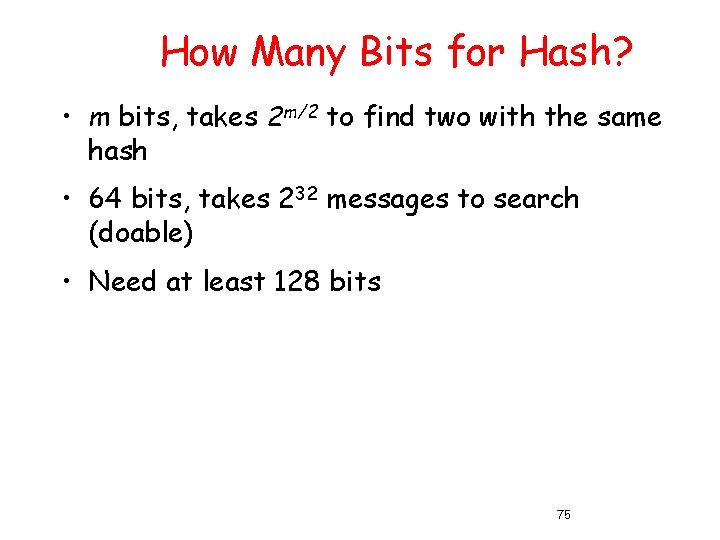
How Many Bits for Hash? • m bits, takes 2 m/2 to find two with the same hash • 64 bits, takes 232 messages to search (doable) • Need at least 128 bits 75
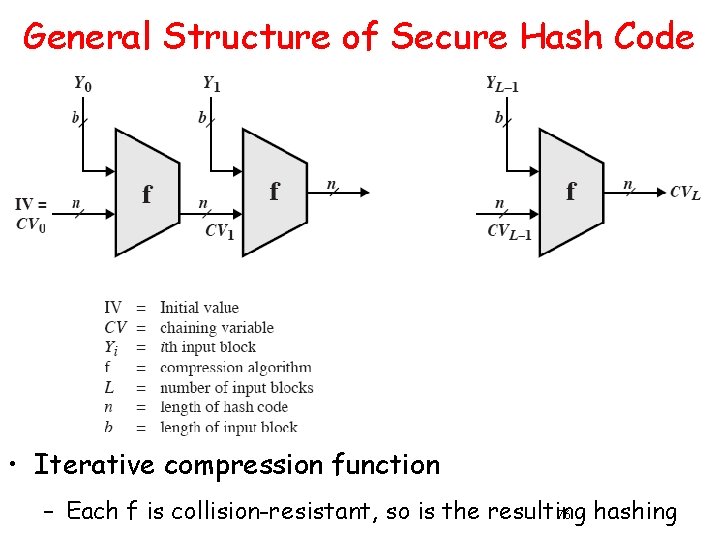
General Structure of Secure Hash Code • Iterative compression function – Each f is collision-resistant, so is the resulting hashing 76
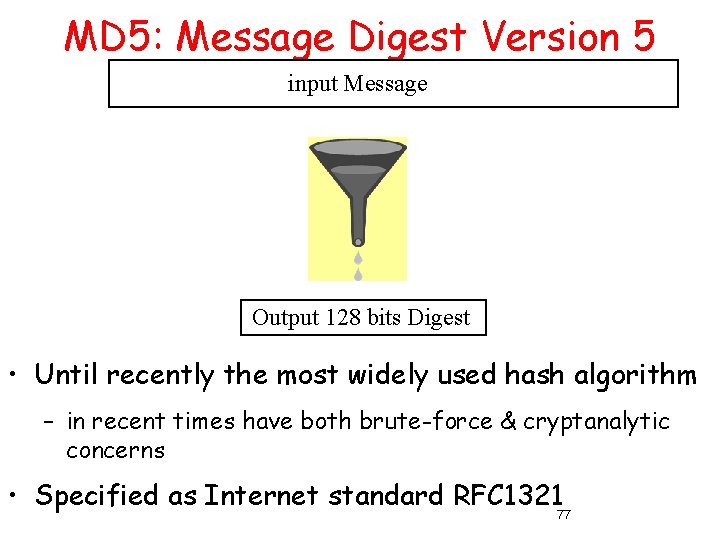
MD 5: Message Digest Version 5 input Message Output 128 bits Digest • Until recently the most widely used hash algorithm – in recent times have both brute-force & cryptanalytic concerns • Specified as Internet standard RFC 132177
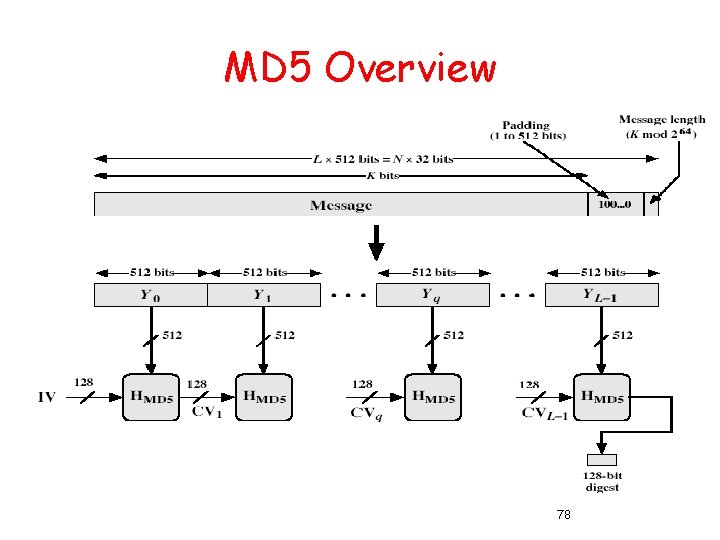
MD 5 Overview 78
MD 5 Overview 1. Pad message so its length is 448 mod 512 2. Append a 64 -bit original length value to message 3. Initialise 4 -word (128 -bit) MD buffer (A, B, C, D) 4. Process message in 16 -word (512 -bit) blocks: – Using 4 rounds of 16 bit operations on message block & buffer – Add output to buffer input to form new buffer value 5. Output hash value is the final buffer value 79
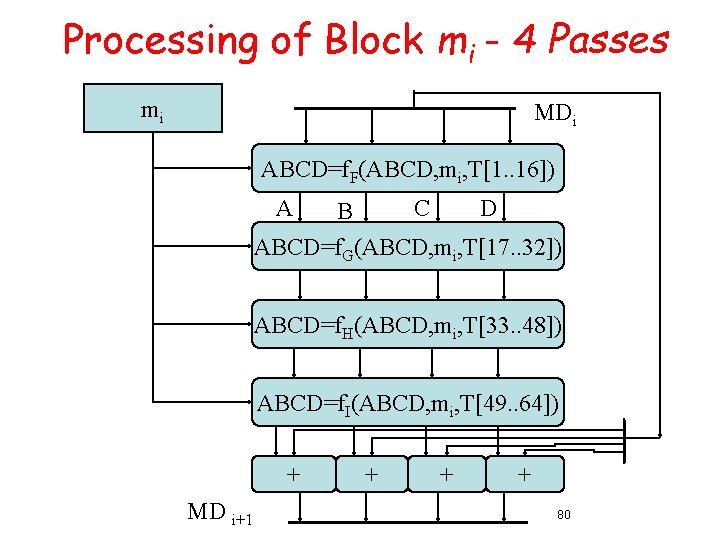
Processing of Block mi - 4 Passes mi MDi ABCD=f. F(ABCD, mi, T[1. . 16]) A C B D ABCD=f. G(ABCD, mi, T[17. . 32]) ABCD=f. H(ABCD, mi, T[33. . 48]) ABCD=f. I(ABCD, mi, T[49. . 64]) + MD i+1 + + + 80
Secure Hash Algorithm • SHA is specified as the hash algorithm in the Digital Signature Standard (DSS), NIST, 1993 • Input message must be < 264 bits – not really a problem • Message is processed in 512 -bit blocks sequentially • Message digest is 160 bits 81
SHA-1 verses MD 5 • Brute force attack is harder (160 vs 128 bits for MD 5) • A little slower than MD 5 (80 vs 64 steps) – Both work well on a 32 -bit architecture • Both designed as simple and compact for implementation • Cryptanalytic attacks – MD 4/5: vulnerability discovered since its design – SHA-1: no until recent 2005 results raised concerns on its use in future applications 82
Revised Secure Hash Standard • NIST have issued a revision in 2002 • Adds 3 additional hash algorithms • SHA-256, SHA-384, SHA-512 – Collectively called SHA-2 • Designed for compatibility with increased security provided by the AES cipher • Structure & detail are similar to SHA-1 • Hence analysis should be similar, but security levels are rather higher 83
Backup Slides 84
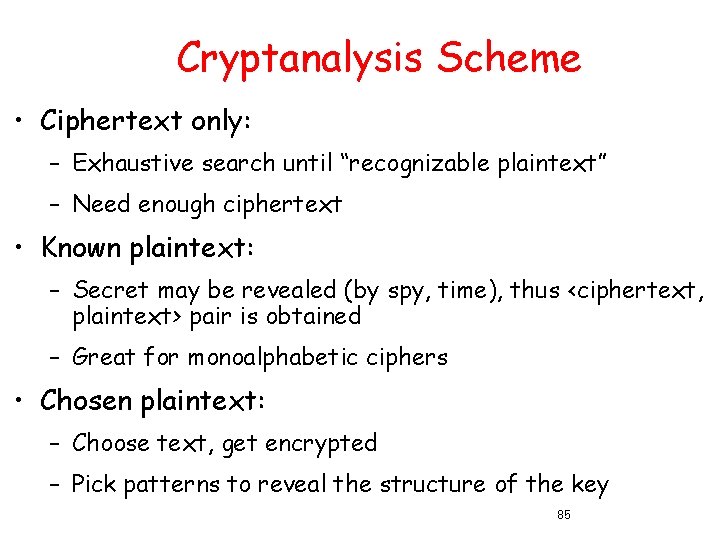
Cryptanalysis Scheme • Ciphertext only: – Exhaustive search until “recognizable plaintext” – Need enough ciphertext • Known plaintext: – Secret may be revealed (by spy, time), thus <ciphertext, plaintext> pair is obtained – Great for monoalphabetic ciphers • Chosen plaintext: – Choose text, get encrypted – Pick patterns to reveal the structure of the key 85
One-Time Pad • If a truly random key as long as the message is used, the cipher will be secure - One-Time pad • E. g. , a random sequence of 0’s and 1’s XORed to plaintext, no repetition of keys • Unbreakable since ciphertext bears no statistical relationship to the plaintext • For any plaintext, it needs a random key of the same length – Hard to generate large amount of keys • Have problem of safe distribution of key 86
Confusion and Diffusion • Cipher needs to completely obscure statistical properties of original message • A one-time pad does this • More practically Shannon suggested S-P networks to obtain: • Diffusion – dissipates statistical structure of plaintext over bulk of ciphertext • Confusion – makes relationship between ciphertext and key as complex as possible 87
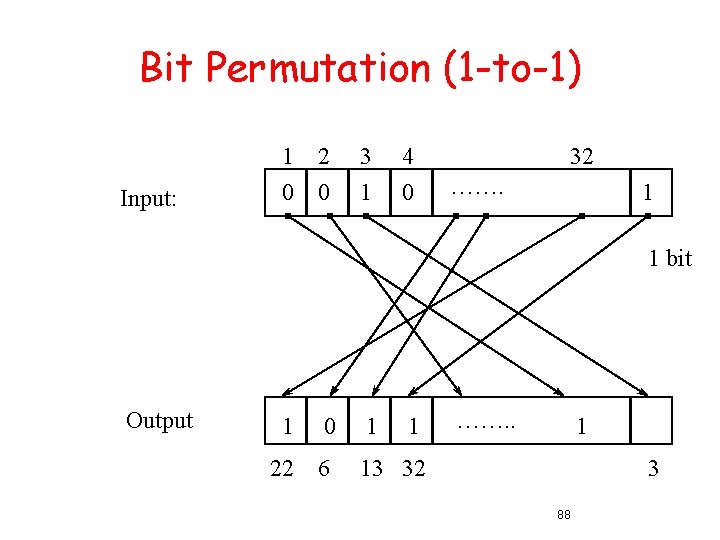
Bit Permutation (1 -to-1) Input: 1 2 0 0 3 1 4 0 32 ……. 1 1 bit Output 1 0 1 1 22 6 13 32 ……. . 1 3 88
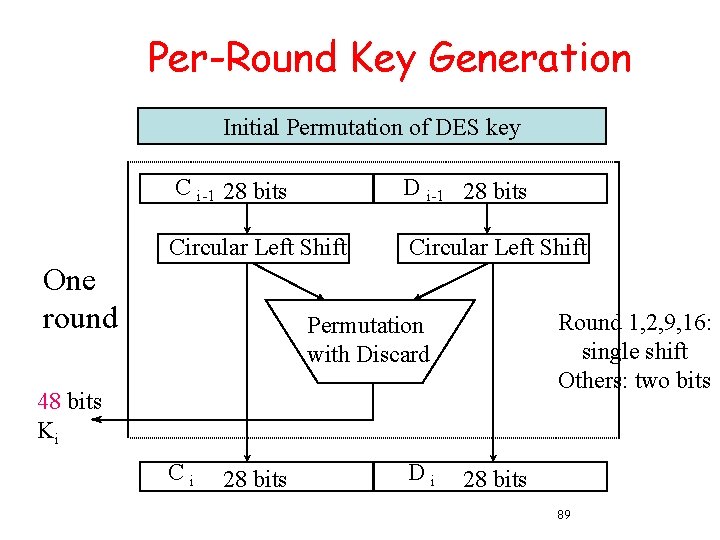
Per-Round Key Generation Initial Permutation of DES key C i-1 28 bits D i-1 28 bits Circular Left Shift One round Round 1, 2, 9, 16: single shift Others: two bits Permutation with Discard 48 bits Ki Ci 28 bits Di 28 bits 89
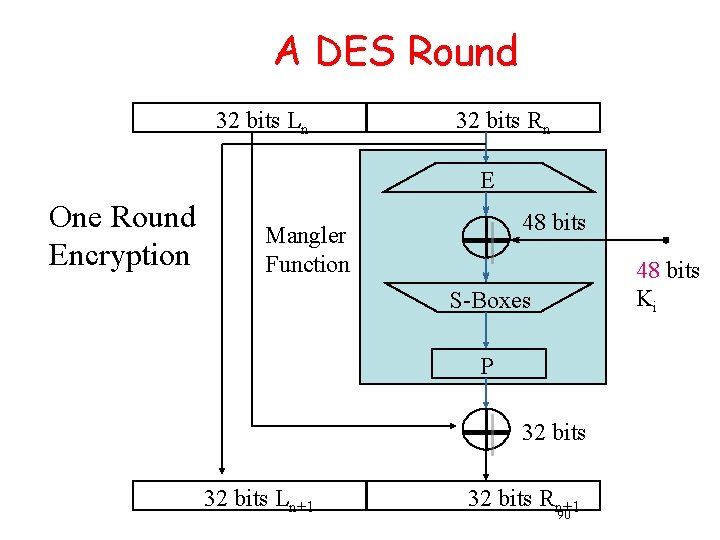
A DES Round 32 bits Ln 32 bits Rn E One Round Encryption 48 bits Mangler Function 48 bits Ki S-Boxes P 32 bits Ln+1 32 bits Rn+1 90
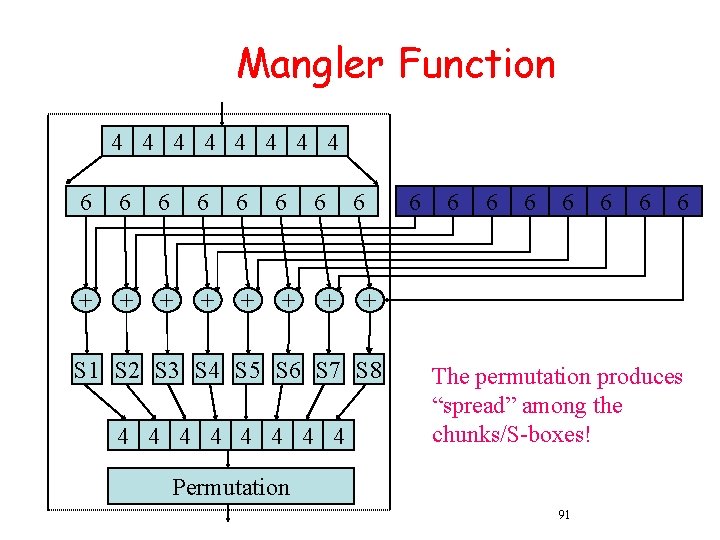
Mangler Function 4 4 4 4 6 6 6 + + + 6 + 6 6 6 6 + S 1 S 2 S 3 S 4 S 5 S 6 S 7 S 8 4 4 4 4 6 The permutation produces “spread” among the chunks/S-boxes! Permutation 91
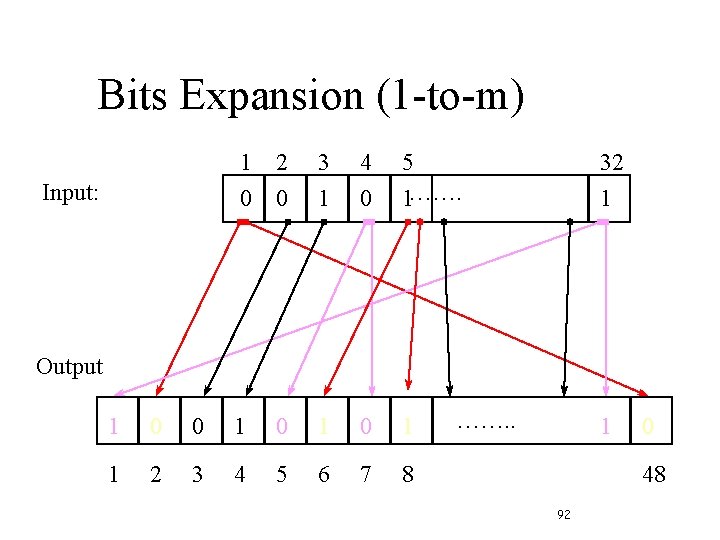
Bits Expansion (1 -to-m) Input: 1 0 2 0 3 1 4 0 5 1……. 32 1 Output 1 0 0 1 0 1 1 2 3 4 5 6 7 8 ……. . 1 0 48 92
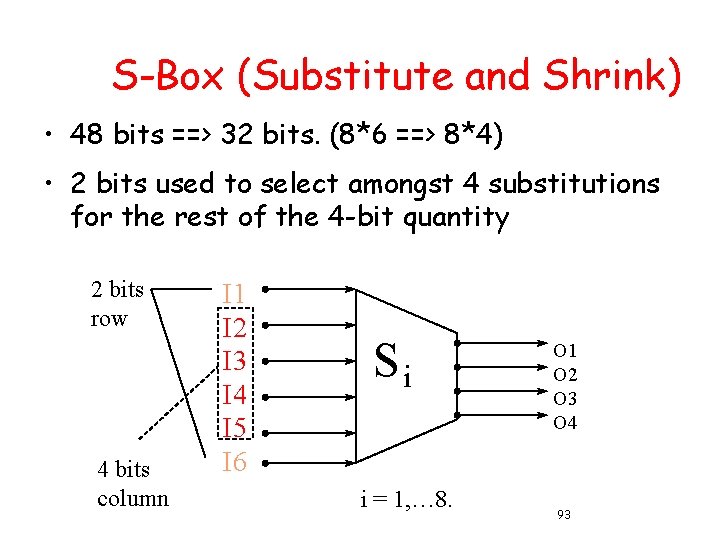
S-Box (Substitute and Shrink) • 48 bits ==> 32 bits. (8*6 ==> 8*4) • 2 bits used to select amongst 4 substitutions for the rest of the 4 -bit quantity 2 bits row 4 bits column I 1 I 2 I 3 I 4 I 5 I 6 Si i = 1, … 8. O 1 O 2 O 3 O 4 93
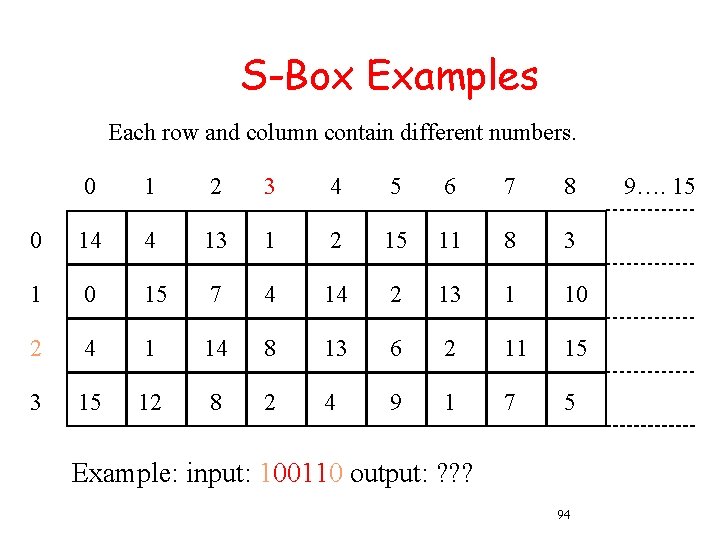
S-Box Examples Each row and column contain different numbers. 0 1 2 3 4 5 6 7 8 0 14 4 13 1 2 15 11 8 3 1 0 15 7 4 14 2 13 1 10 2 4 1 14 8 13 6 2 11 15 3 15 12 8 2 4 9 1 7 5 Example: input: 100110 output: ? ? ? 94 9…. 15
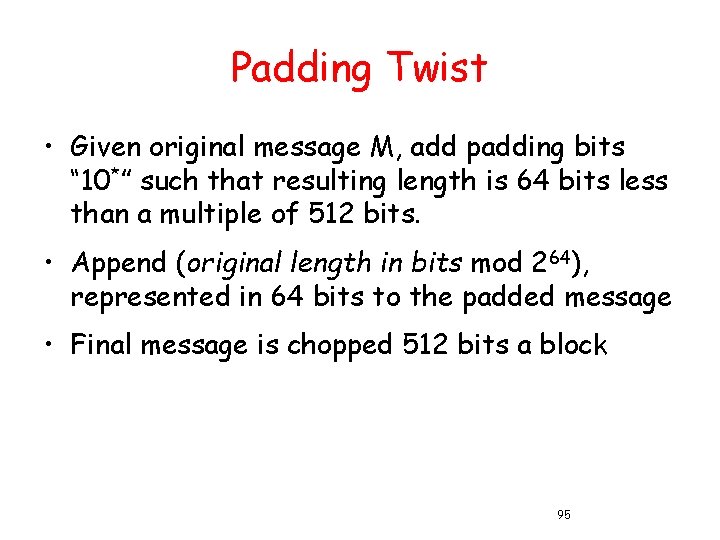
Padding Twist • Given original message M, add padding bits “ 10*” such that resulting length is 64 bits less than a multiple of 512 bits. • Append (original length in bits mod 264), represented in 64 bits to the padded message • Final message is chopped 512 bits a block 95
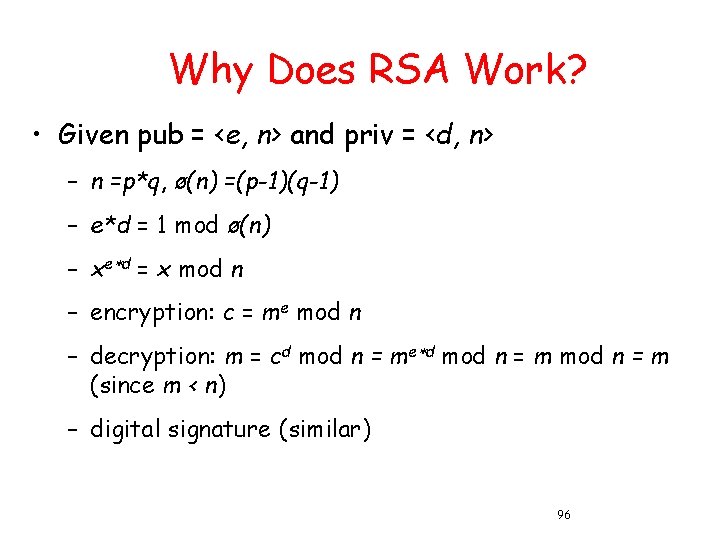
Why Does RSA Work? • Given pub = <e, n> and priv = <d, n> – n =p*q, ø(n) =(p-1)(q-1) – e*d = 1 mod ø(n) – xe d = x mod n – encryption: c = me mod n – decryption: m = cd mod n = me d mod n = m (since m < n) – digital signature (similar) 96
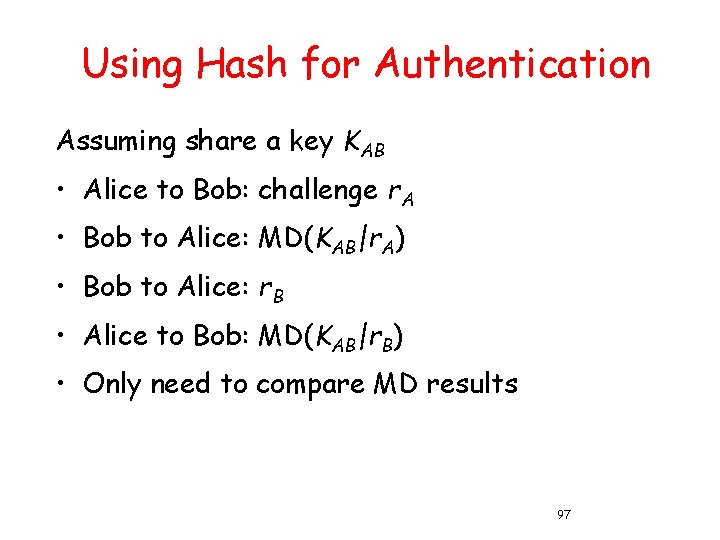
Using Hash for Authentication Assuming share a key KAB • Alice to Bob: challenge r. A • Bob to Alice: MD(KAB|r. A) • Bob to Alice: r. B • Alice to Bob: MD(KAB|r. B) • Only need to compare MD results 97
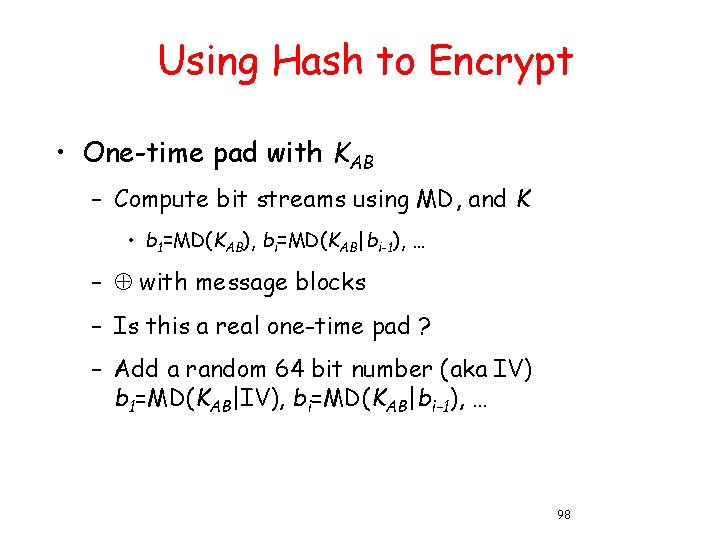
Using Hash to Encrypt • One-time pad with KAB – Compute bit streams using MD, and K • b 1=MD(KAB), bi=MD(KAB|bi-1), … – with message blocks – Is this a real one-time pad ? – Add a random 64 bit number (aka IV) b 1=MD(KAB|IV), bi=MD(KAB|bi-1), … 98
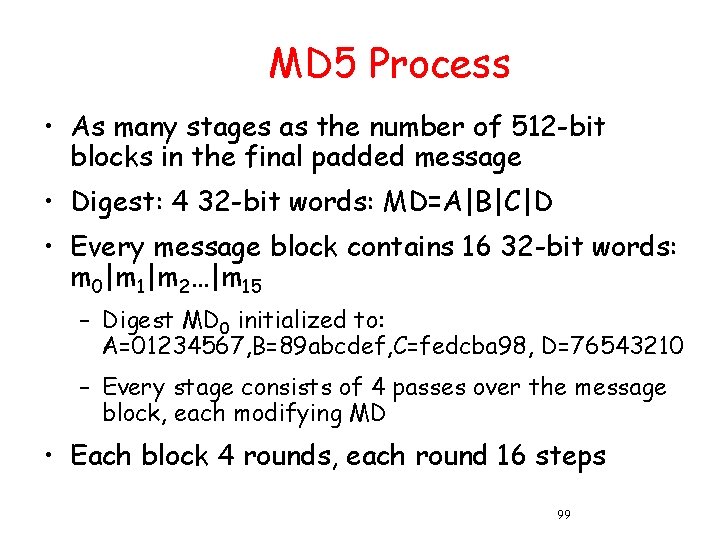
MD 5 Process • As many stages as the number of 512 -bit blocks in the final padded message • Digest: 4 32 -bit words: MD=A|B|C|D • Every message block contains 16 32 -bit words: m 0|m 1|m 2…|m 15 – Digest MD 0 initialized to: A=01234567, B=89 abcdef, C=fedcba 98, D=76543210 – Every stage consists of 4 passes over the message block, each modifying MD • Each block 4 rounds, each round 16 steps 99
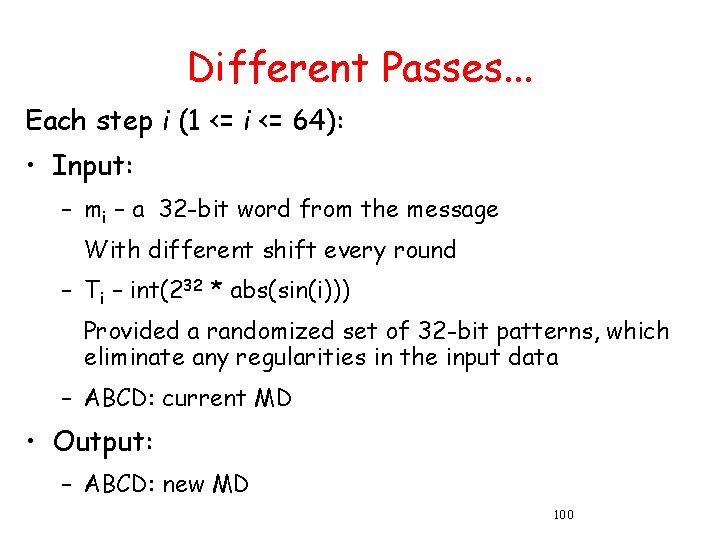
Different Passes. . . Each step i (1 <= i <= 64): • Input: – mi – a 32 -bit word from the message With different shift every round – Ti – int(232 * abs(sin(i))) Provided a randomized set of 32 -bit patterns, which eliminate any regularities in the input data – ABCD: current MD • Output: – ABCD: new MD 100
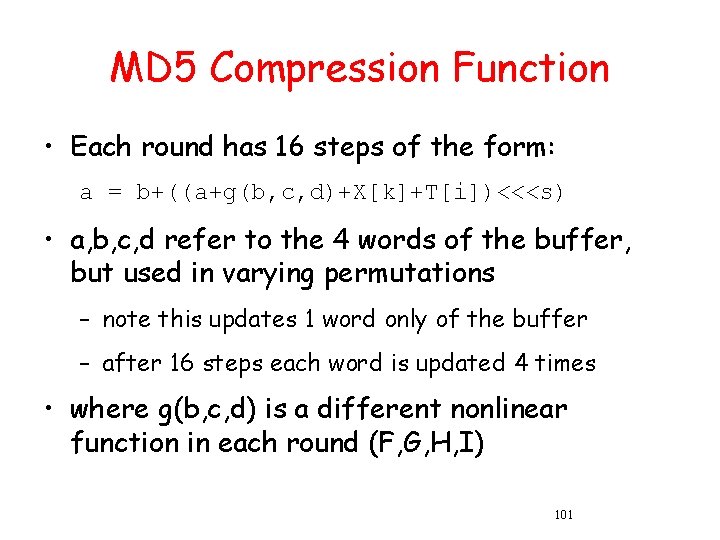
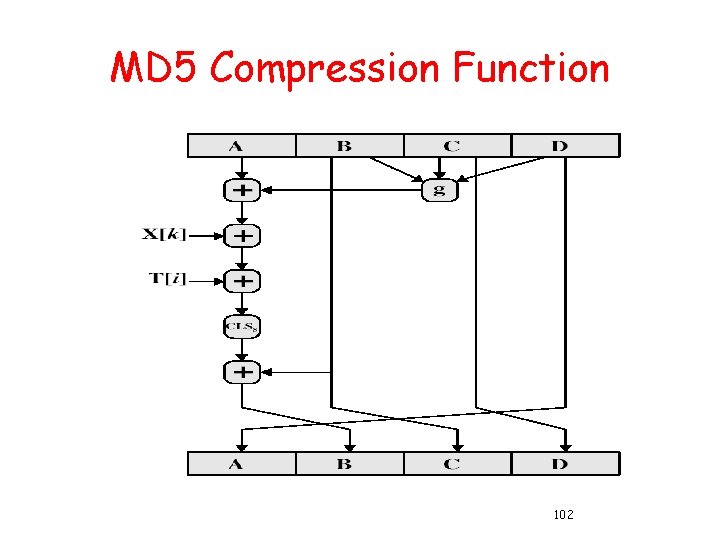
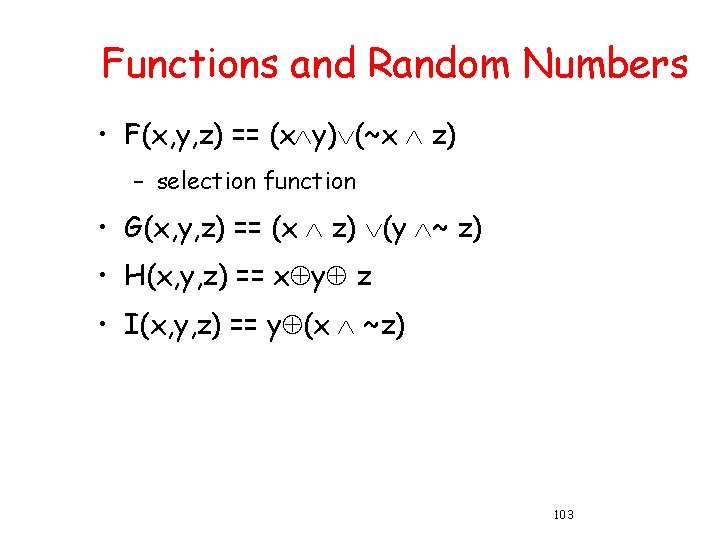
MD 5 Compression Function • Each round has 16 steps of the form: a = b+((a+g(b, c, d)+X[k]+T[i])<<<s) • a, b, c, d refer to the 4 words of the buffer, but used in varying permutations – note this updates 1 word only of the buffer – after 16 steps each word is updated 4 times • where g(b, c, d) is a different nonlinear function in each round (F, G, H, I) 101
MD 5 Compression Function 102
Functions and Random Numbers • F(x, y, z) == (x y) (~x z) – selection function • G(x, y, z) == (x z) (y ~ z) • H(x, y, z) == x y z • I(x, y, z) == y (x ~z) 103
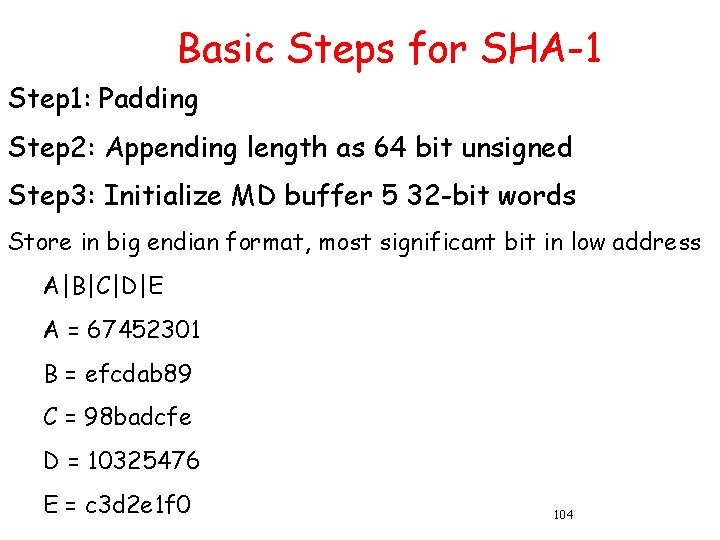
Basic Steps for SHA-1 Step 1: Padding Step 2: Appending length as 64 bit unsigned Step 3: Initialize MD buffer 5 32 -bit words Store in big endian format, most significant bit in low address A|B|C|D|E A = 67452301 B = efcdab 89 C = 98 badcfe D = 10325476 E = c 3 d 2 e 1 f 0 104
Basic Steps. . . Step 4: the 80 -step processing of 512 -bit blocks – 4 rounds, 20 steps each. Each step t (0 <= t <= 79): – Input: • Wt – a 32 -bit word from the message • Kt – a constant. • ABCDE: current MD. – Output: • ABCDE: new MD. 105