
WHY COMPLEXITY IN NATURE LEADS TO MANY CAREERS
- Slides: 30
WHY COMPLEXITY IN NATURE LEADS TO MANY CAREERS FOR PHYSICISTS Dr Graham S Mc. Donald Head of Materials & Physics Research Centre University of Salford KS 4 Teachers’ Conference MMU June 2010
OUTLINE ● ● Motivation challenges ● Hands-on demos / projects (note: flashing lights in videos) ● Key Stage 4 relevance "Complexity" – what is it ? – subject / career areas ? – how can it work ?
● Motivation challenges … Career possibilities ? … Relevance to modern society ? … Just technical ? Boys' subject versus attractions of biology, environment, health & 'helping people' … What can be hands-on in class ? … Links to modern multi-media ?
● “Complexity” - what is it ? … a subject bridging across diverse fields … common aspects identified, due to similar processes … transferring knowledge and techniques between these diverse fields
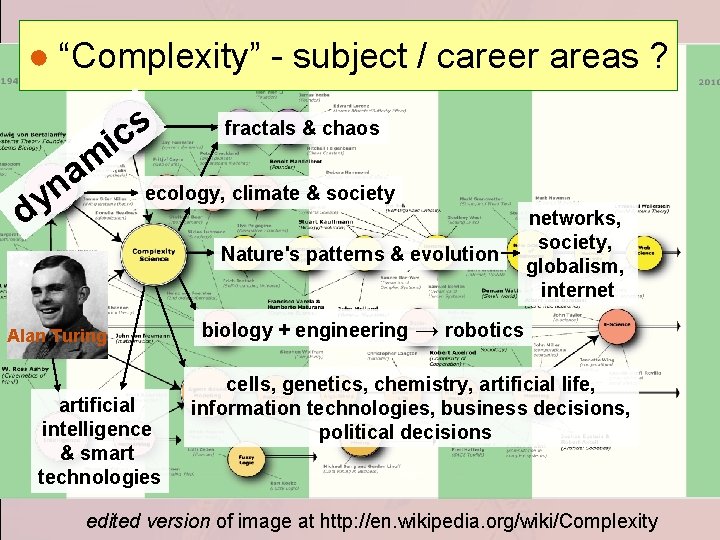
● “Complexity” - subject / career areas ? i m a n dy s c fractals & chaos ecology, climate & society Nature's patterns & evolution Alan Turing artificial intelligence & smart technologies networks, society, globalism, internet biology + engineering → robotics cells, genetics, chemistry, artificial life, information technologies, business decisions, political decisions edited version of image at http: //en. wikipedia. org/wiki/Complexity
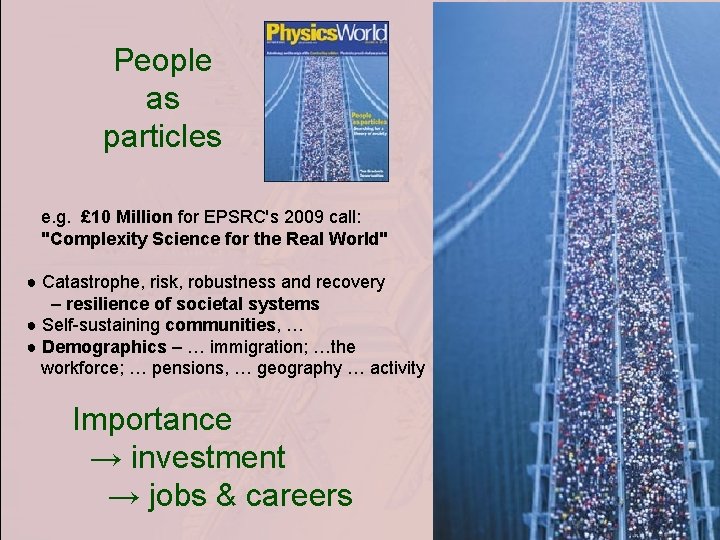
People as particles e. g. £ 10 Million for EPSRC's 2009 call: "Complexity Science for the Real World" ● Catastrophe, risk, robustness and recovery – resilience of societal systems ● Self-sustaining communities, … ● Demographics – … immigration; …the workforce; … pensions, … geography … activity Importance → investment → jobs & careers
● “Complexity” - how can it work ? For example, Similar processes in very complicated ("complex") systems tend to result in … 1. SIMPLE PATTERNS or 2. VERY COMPLEX PATTERNS (“fractals”)
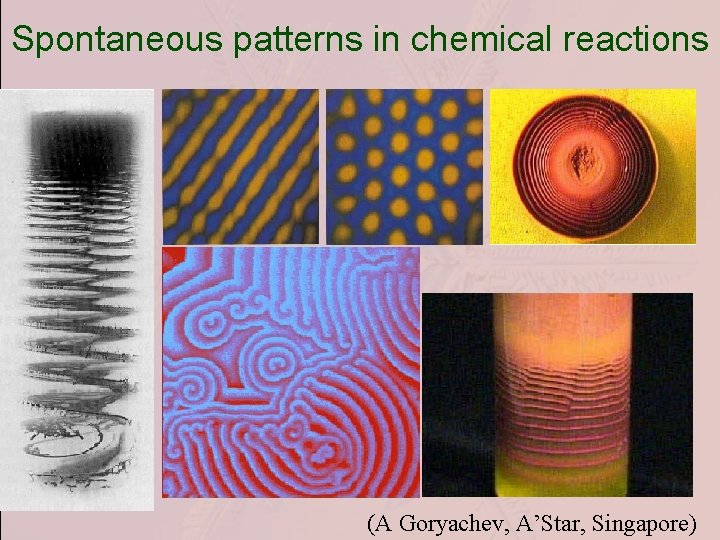
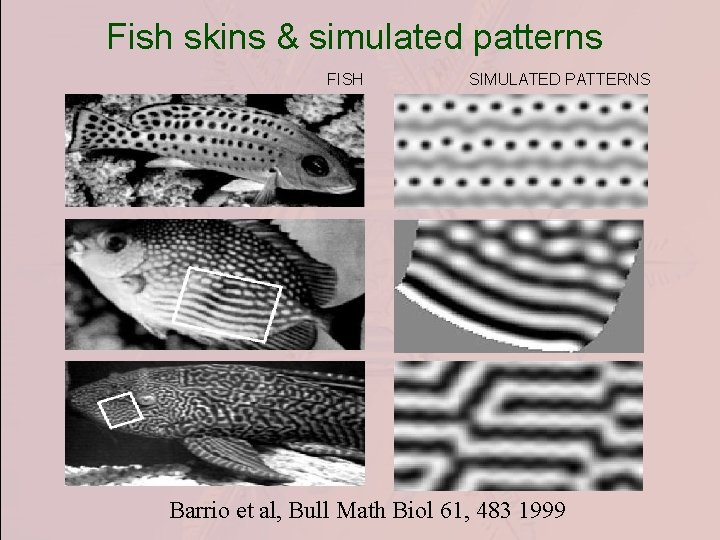
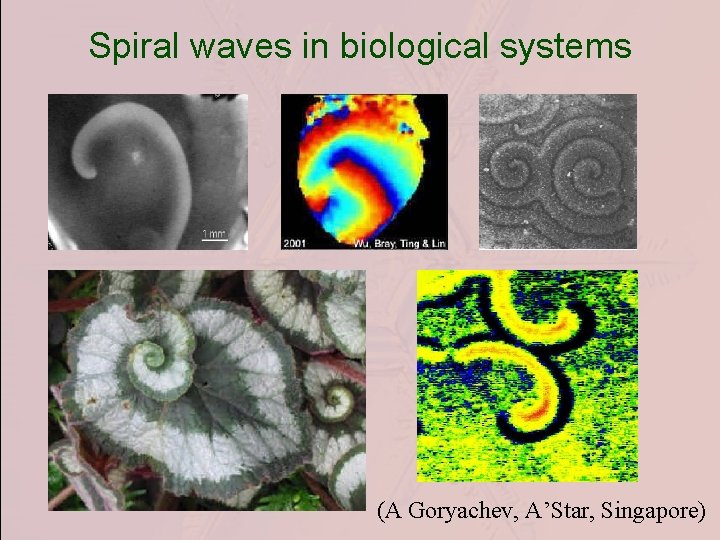
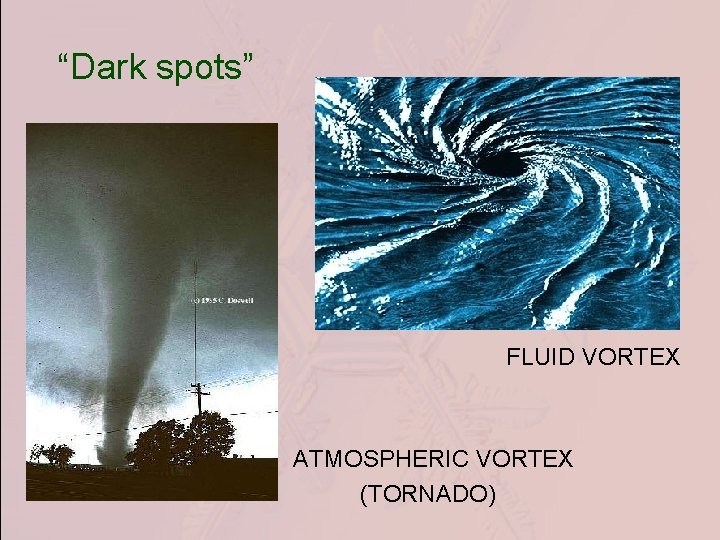
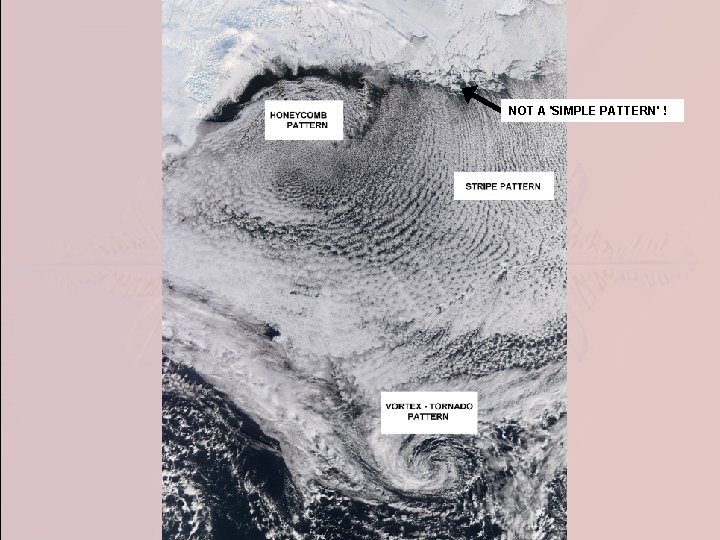
1. SIMPLE PATTERNS (e. g. single spots, vortices, spirals, hexagons/honeycombs, stripes, …)
Spontaneous patterns in chemical reactions (A Goryachev, A’Star, Singapore)
Fish skins & simulated patterns FISH SIMULATED PATTERNS Barrio et al, Bull Math Biol 61, 483 1999
Spiral waves in biological systems (A Goryachev, A’Star, Singapore)
“Dark spots” FLUID VORTEX ATMOSPHERIC VORTEX (TORNADO)
NOT A 'SIMPLE PATTERN' !
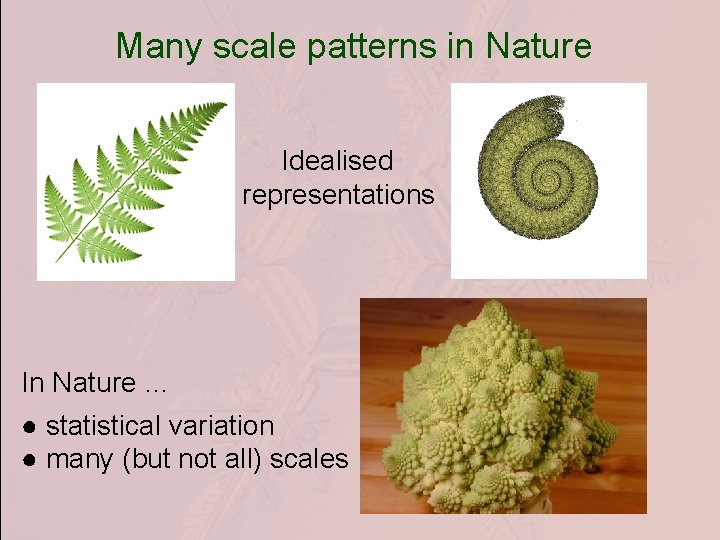
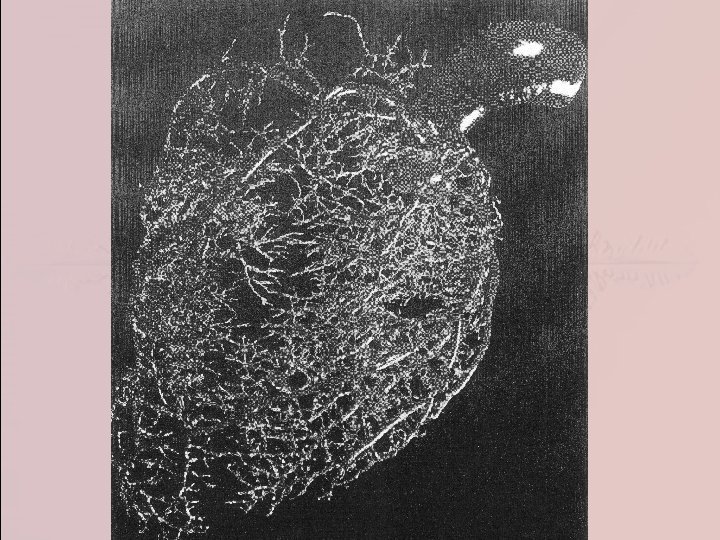
2. VERY COMPLEX PATTERNS ( “fractals”: patterns with more & more detail evident when you look closer & closer )
Many scale patterns in Nature Idealised representations In Nature … ● statistical variation ● many (but not all) scales
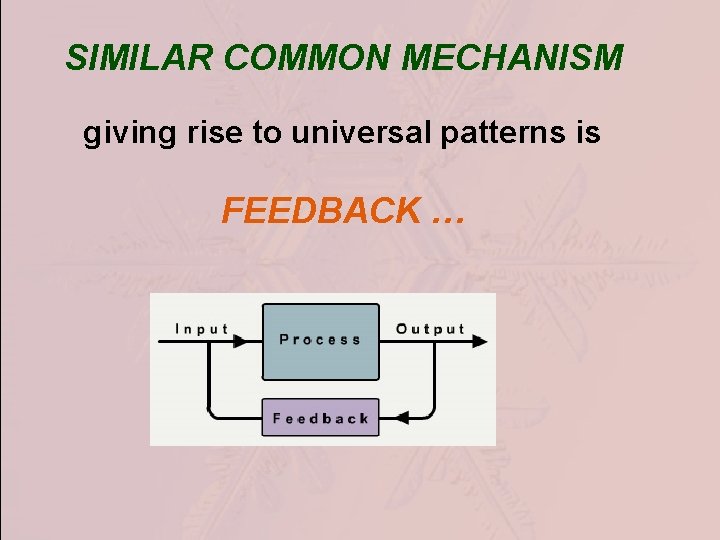
SIMILAR COMMON MECHANISM giving rise to universal patterns is FEEDBACK …
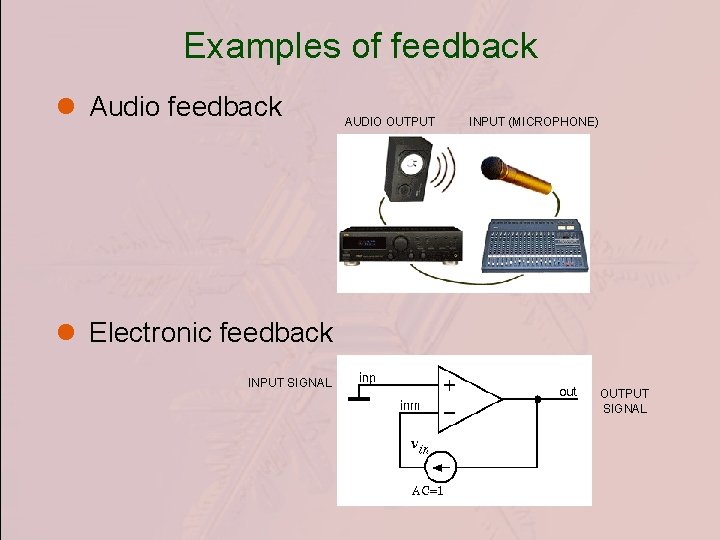
Examples of feedback ● Audio feedback ● Electronic feedback INPUT SIGNAL AUDIO OUTPUT INPUT (MICROPHONE) OUTPUT SIGNAL
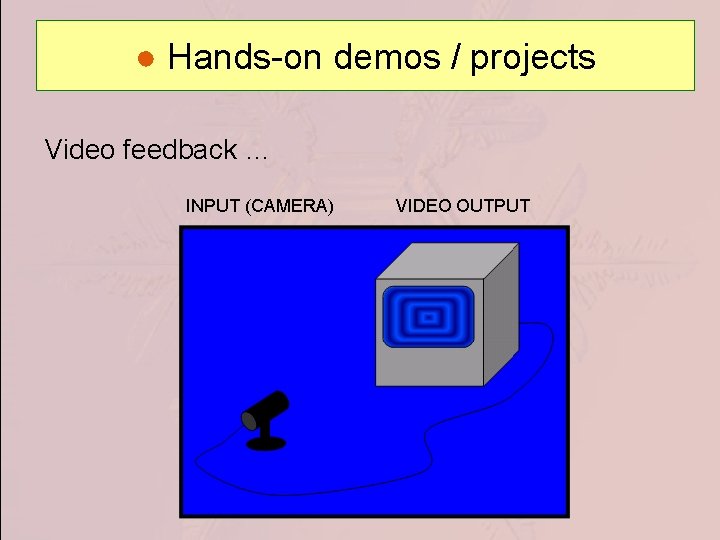
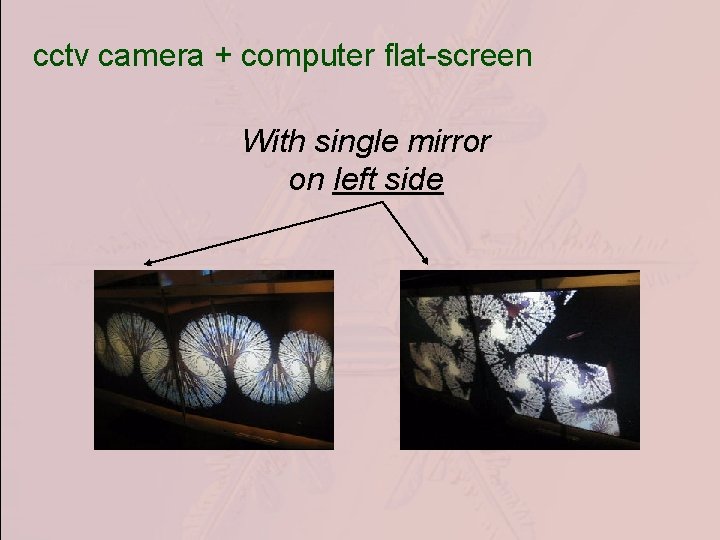
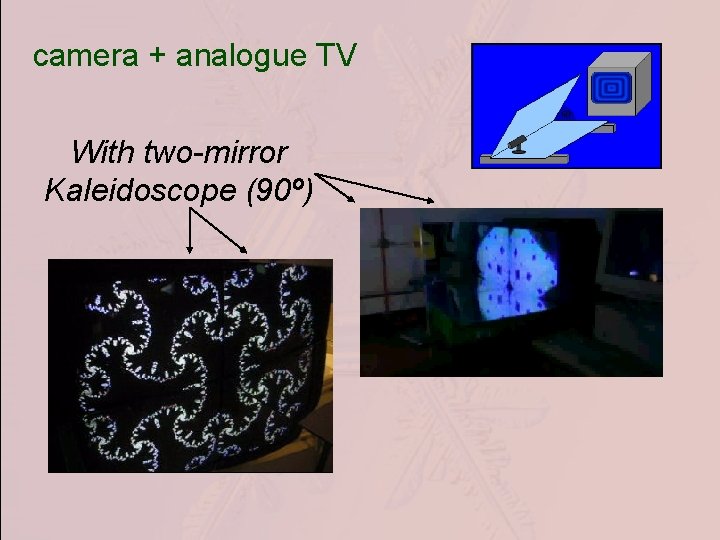
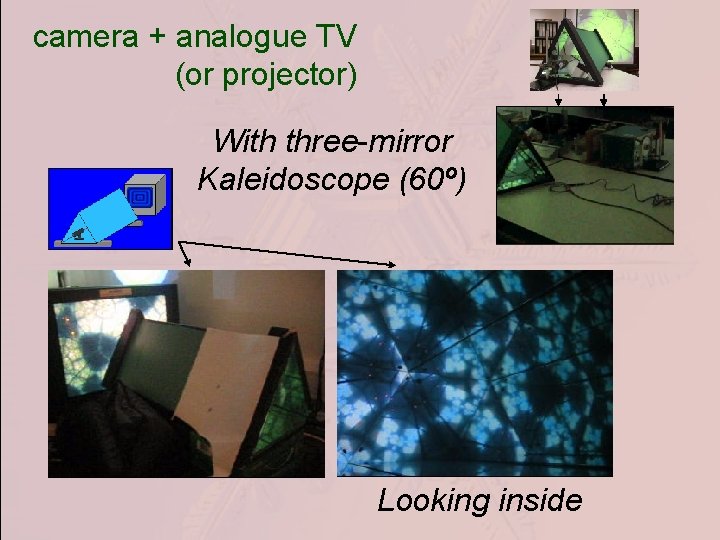
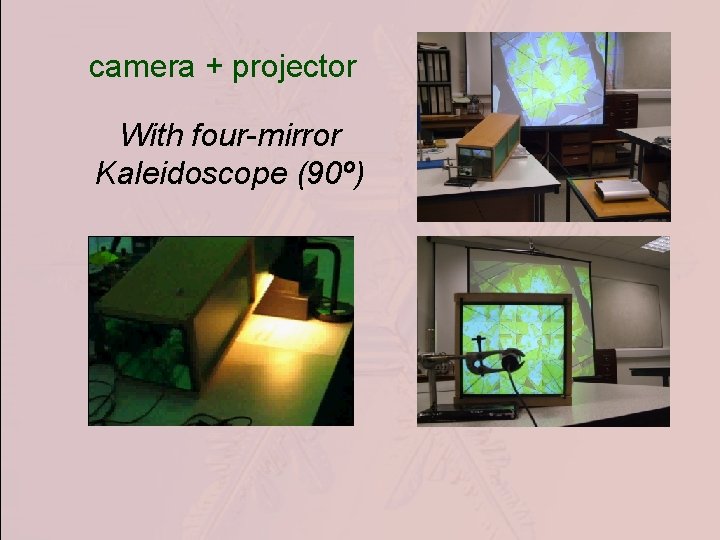
● Hands-on demos / projects Video feedback … INPUT (CAMERA) VIDEO OUTPUT
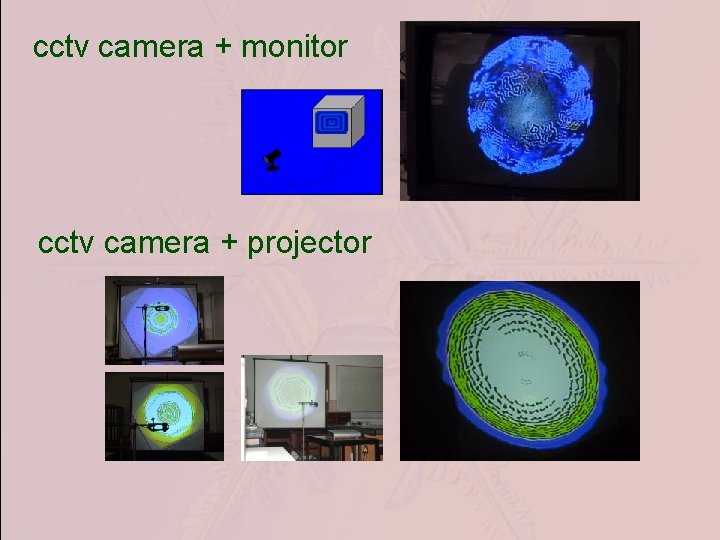
cctv camera + monitor cctv camera + projector
cctv camera + computer flat-screen With single mirror on left side
camera + analogue TV With two-mirror Kaleidoscope (90º)
camera + analogue TV (or projector) With three-mirror Kaleidoscope (60º) Looking inside
camera + projector With four-mirror Kaleidoscope (90º)
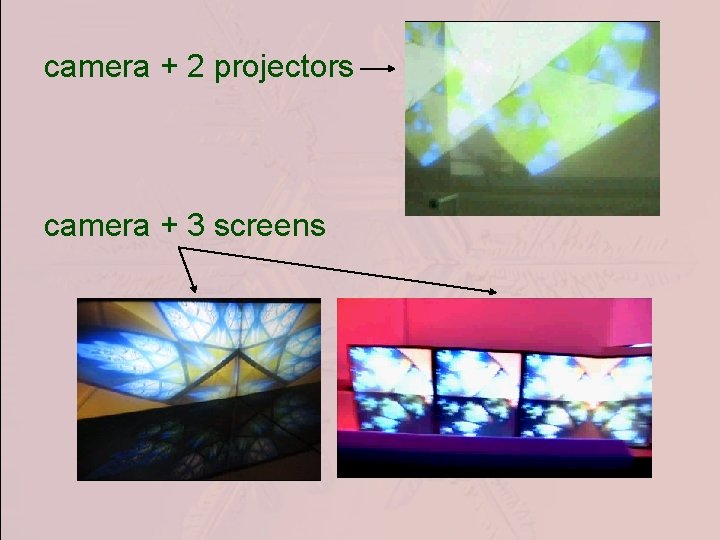
camera + 2 projectors camera + 3 screens
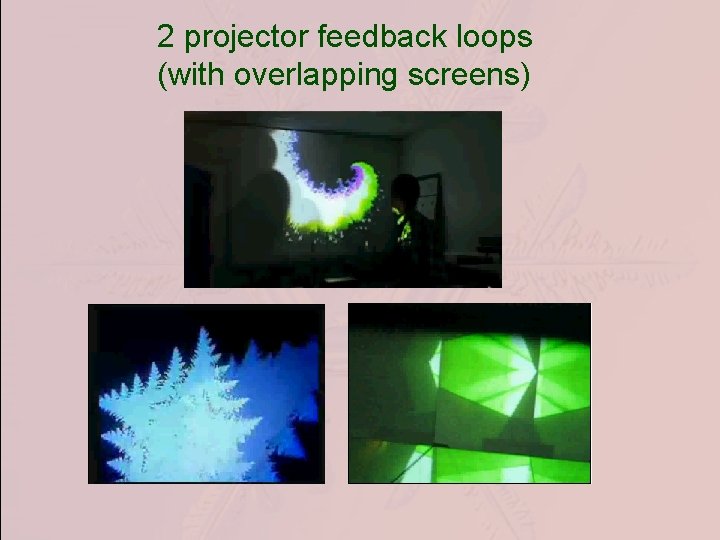
2 projector feedback loops (with overlapping screens)
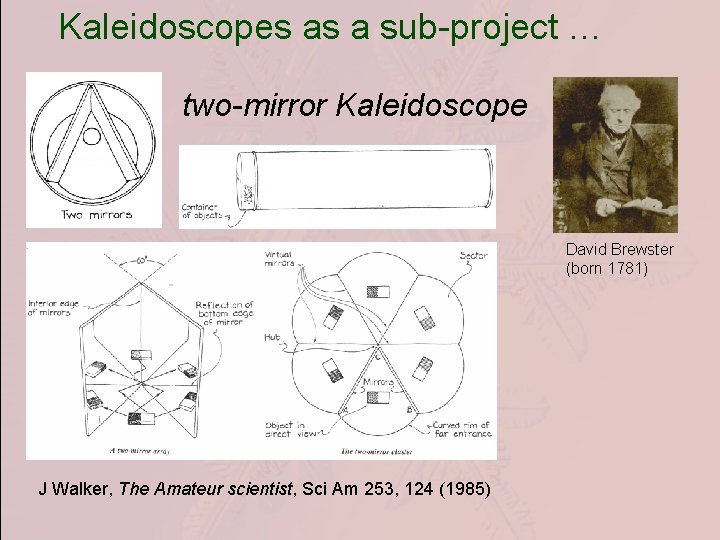
Kaleidoscopes as a sub-project … two-mirror Kaleidoscope David Brewster (born 1781) J Walker, The Amateur scientist, Sci Am 253, 124 (1985)
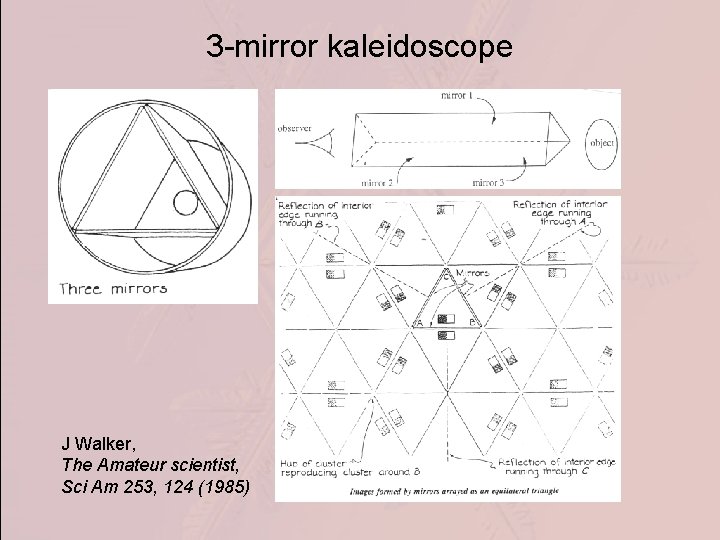
3 -mirror kaleidoscope J Walker, The Amateur scientist, Sci Am 253, 124 (1985)
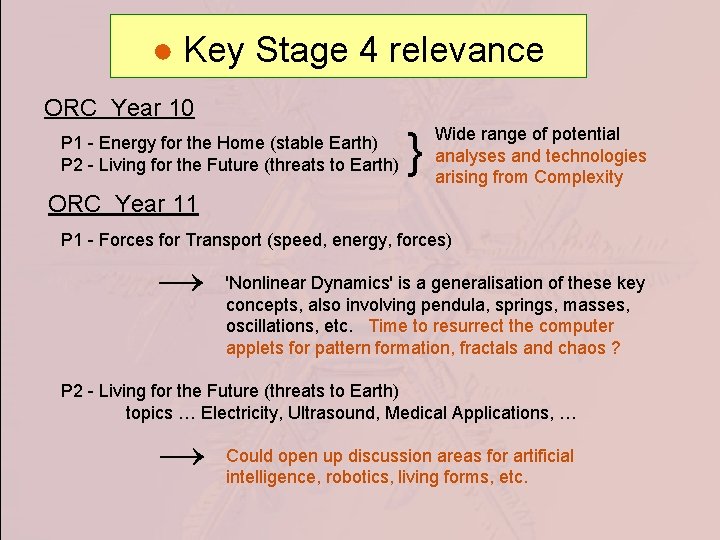
● Key Stage 4 relevance ORC Year 10 P 1 - Energy for the Home (stable Earth) P 2 - Living for the Future (threats to Earth) } Wide range of potential analyses and technologies arising from Complexity ORC Year 11 P 1 - Forces for Transport (speed, energy, forces) → 'Nonlinear Dynamics' is a generalisation of these key concepts, also involving pendula, springs, masses, oscillations, etc. Time to resurrect the computer applets for pattern formation, fractals and chaos ? P 2 - Living for the Future (threats to Earth) topics … Electricity, Ultrasound, Medical Applications, … → Could open up discussion areas for artificial intelligence, robotics, living forms, etc.
Conclusion Stephen Hawking prediction: this 21 st century will be “the century of complexity”