
Why Cells divide In unicellular organisms division of
- Slides: 29
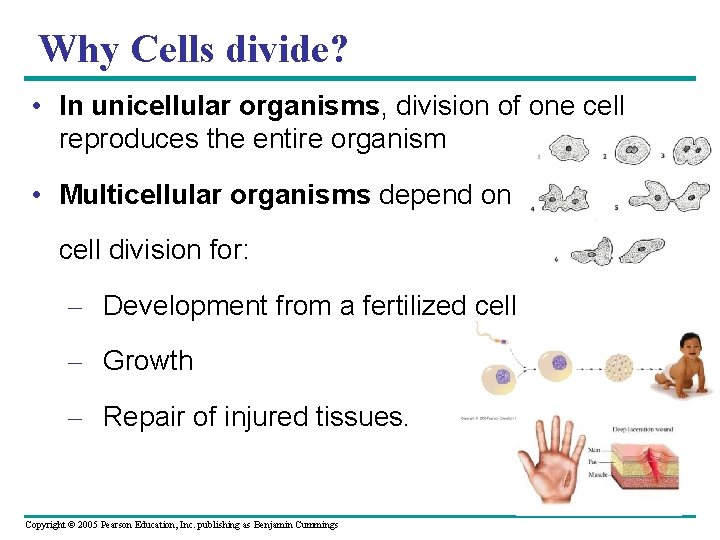
Why Cells divide? • In unicellular organisms, division of one cell reproduces the entire organism • Multicellular organisms depend on cell division for: – Development from a fertilized cell – Growth – Repair of injured tissues. Copyright © 2005 Pearson Education, Inc. publishing as Benjamin Cummings
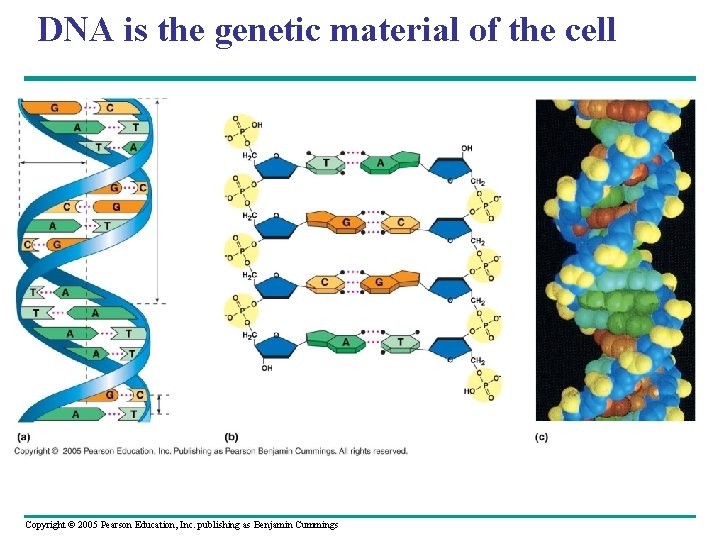
DNA is the genetic material of the cell Copyright © 2005 Pearson Education, Inc. publishing as Benjamin Cummings
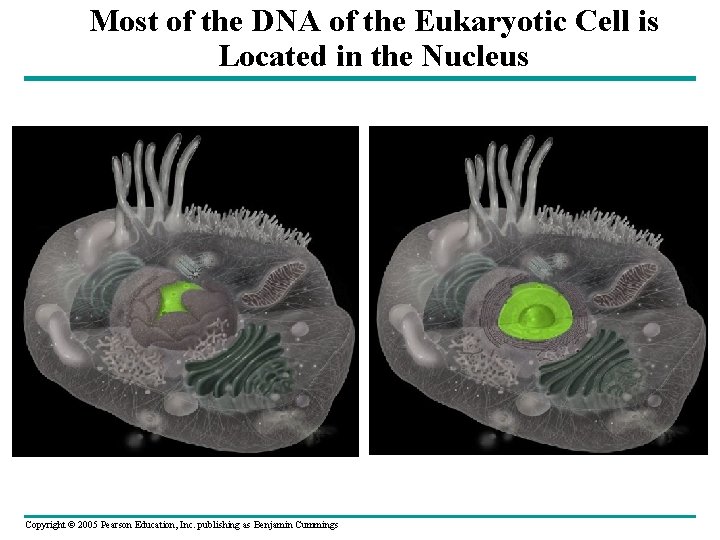
Most of the DNA of the Eukaryotic Cell is Located in the Nucleus Copyright © 2005 Pearson Education, Inc. publishing as Benjamin Cummings
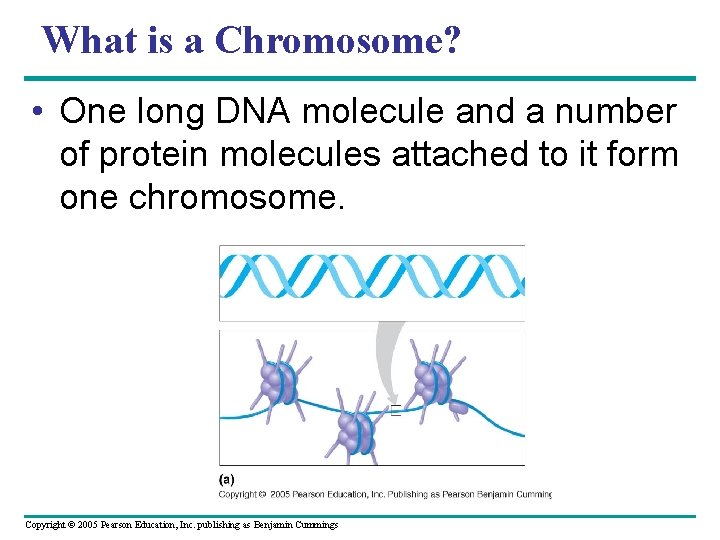
Cellular Organization of the Genetic Material • A cell’s endowment of DNA (its genetic information) is called its genome • DNA molecules in a cell are packaged into chromosomes. • The number of chromosomes in a eukaryotic cell depends on the species. For example, a human body cell has 46 chromosomes. A dog’s body cell has 78 chromosomes. Copyright © 2005 Pearson Education, Inc. publishing as Benjamin Cummings
What is a Chromosome? • One long DNA molecule and a number of protein molecules attached to it form one chromosome. Copyright © 2005 Pearson Education, Inc. publishing as Benjamin Cummings
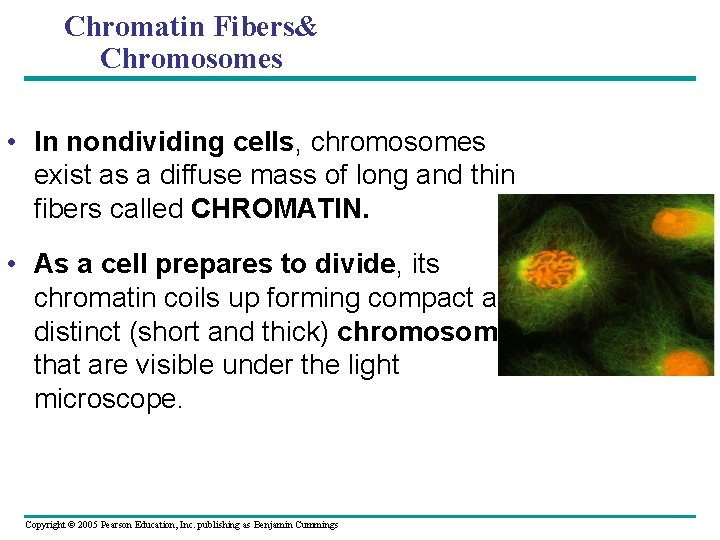
Chromatin Fibers& Chromosomes • In nondividing cells, chromosomes exist as a diffuse mass of long and thin fibers called CHROMATIN. • As a cell prepares to divide, its chromatin coils up forming compact and distinct (short and thick) chromosomes that are visible under the light microscope. Copyright © 2005 Pearson Education, Inc. publishing as Benjamin Cummings
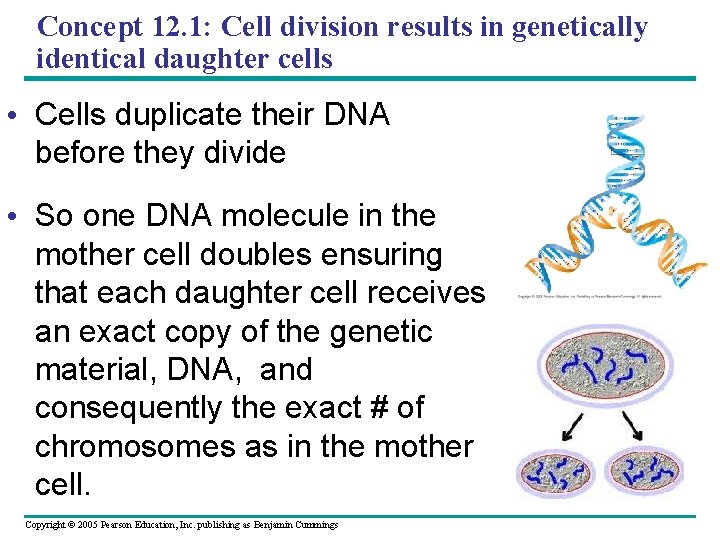
Concept 12. 1: Cell division results in genetically identical daughter cells • Cells duplicate their DNA before they divide • So one DNA molecule in the mother cell doubles ensuring that each daughter cell receives an exact copy of the genetic material, DNA, and consequently the exact # of chromosomes as in the mother cell. Copyright © 2005 Pearson Education, Inc. publishing as Benjamin Cummings
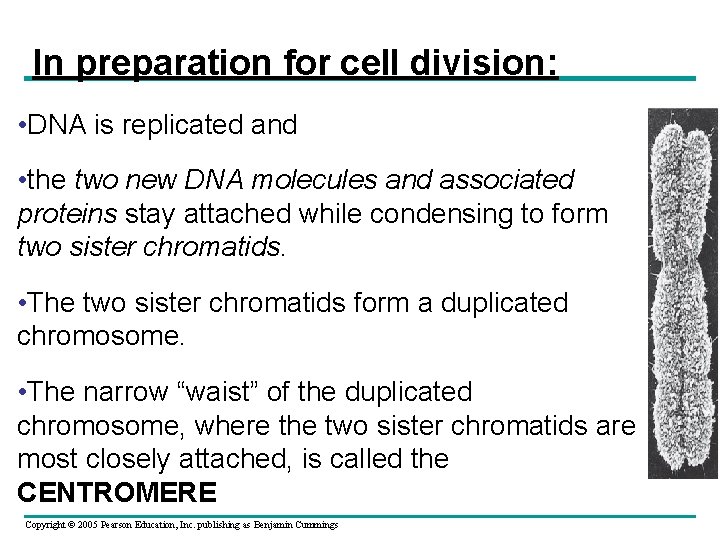
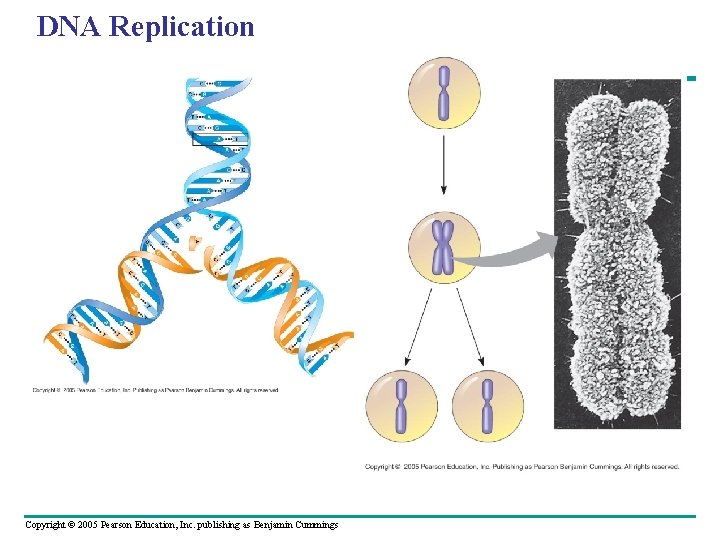
In preparation for cell division: • DNA is replicated and • the two new DNA molecules and associated proteins stay attached while condensing to form two sister chromatids. • The two sister chromatids form a duplicated chromosome. • The narrow “waist” of the duplicated chromosome, where the two sister chromatids are most closely attached, is called the CENTROMERE Copyright © 2005 Pearson Education, Inc. publishing as Benjamin Cummings
DNA Replication Copyright © 2005 Pearson Education, Inc. publishing as Benjamin Cummings
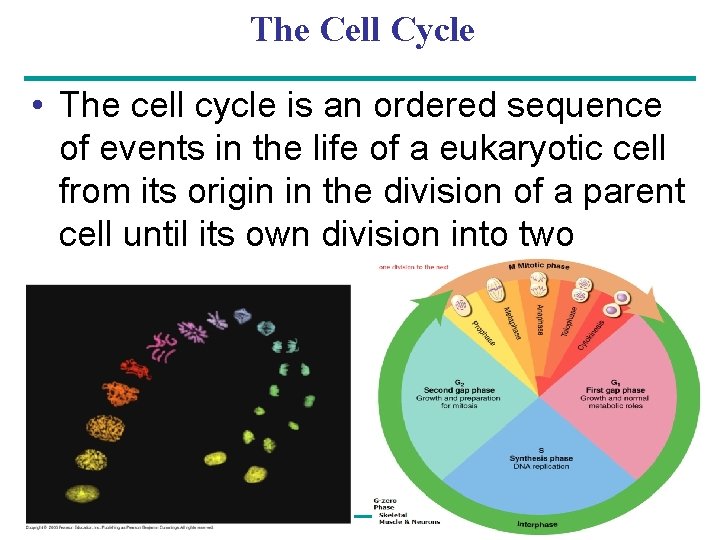
The Cell Cycle • The cell cycle is an ordered sequence of events in the life of a eukaryotic cell from its origin in the division of a parent cell until its own division into two Copyright © 2005 Pearson Education, Inc. publishing as Benjamin Cummings
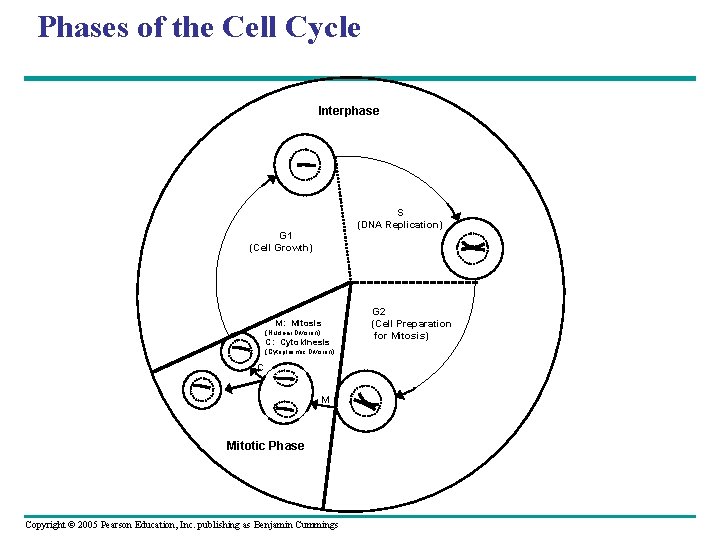
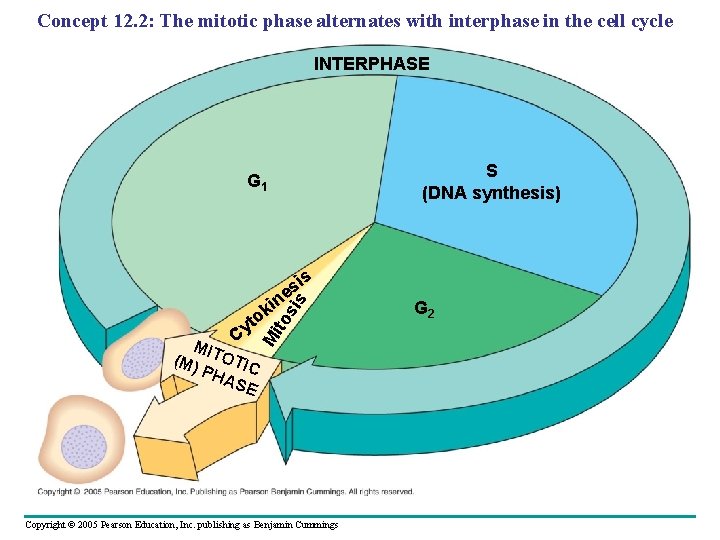
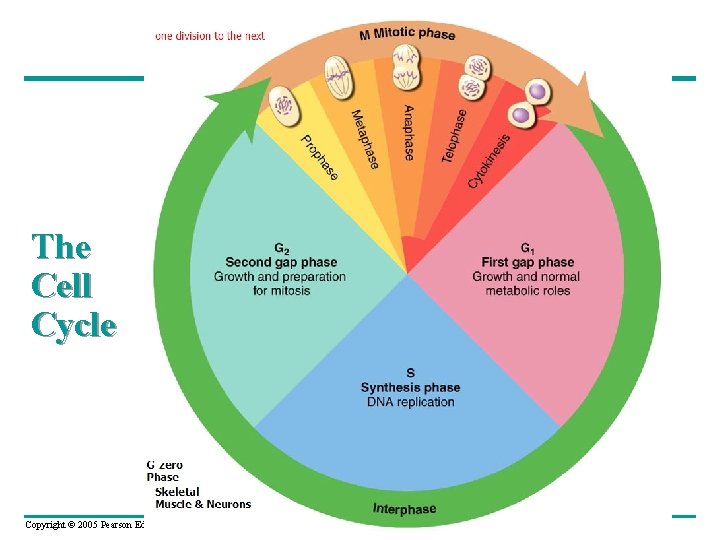
Phases of the Cell Cycle: – The Interphase (about 90% of the cell cycle) has three subphases: • G 1 phase (“first gap”) centers on the growth of the cell. • S phase (“synthesis”) duplicates the chromosomes. • G 2 phase (“second gap”) completes the preparation for cell division before the mitotic phase starts. – The Mitotic (M) phase has two subphases: • Mitosis (the nuclear division) • Cytokinesis (the cytoplasmic division) Copyright © 2005 Pearson Education, Inc. publishing as Benjamin Cummings
Phases of the Cell Cycle Interphase S (DNA Replication) G 1 (Cell Growth) M: Mitosis (Nuclear Division) C: Cytokinesis (Cytoplasmic Division) C M Mitotic Phase Copyright © 2005 Pearson Education, Inc. publishing as Benjamin Cummings G 2 (Cell Preparation for Mitosis)
Concept 12. 2: The mitotic phase alternates with interphase in the cell cycle INTERPHASE S (DNA synthesis) G 1 is s e to Mi t y C sis in k o MIT (M) OTIC PHA SE Copyright © 2005 Pearson Education, Inc. publishing as Benjamin Cummings G 2
The Cell Cycle Copyright © 2005 Pearson Education, Inc. publishing as Benjamin Cummings
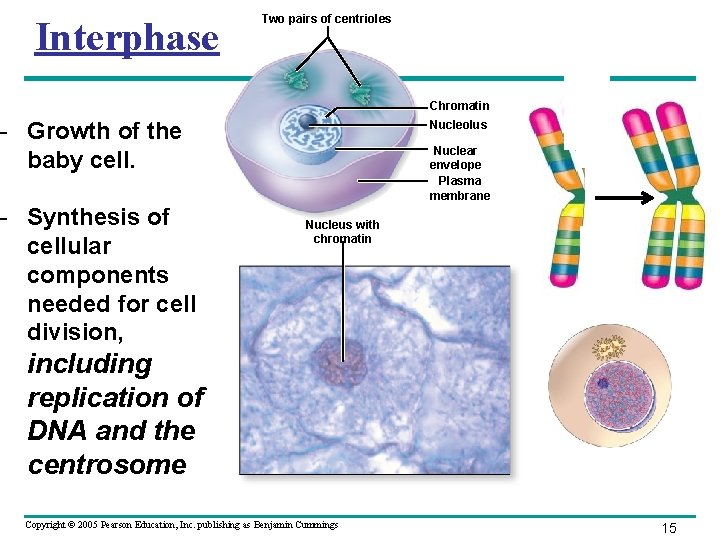
Interphase Two pairs of centrioles Chromatin - Growth of the baby cell. - Synthesis of cellular components needed for cell division, Nucleolus Nuclear envelope Plasma membrane Nucleus with chromatin including replication of DNA and the centrosome Copyright © 2005 Pearson Education, Inc. publishing as Benjamin Cummings 15
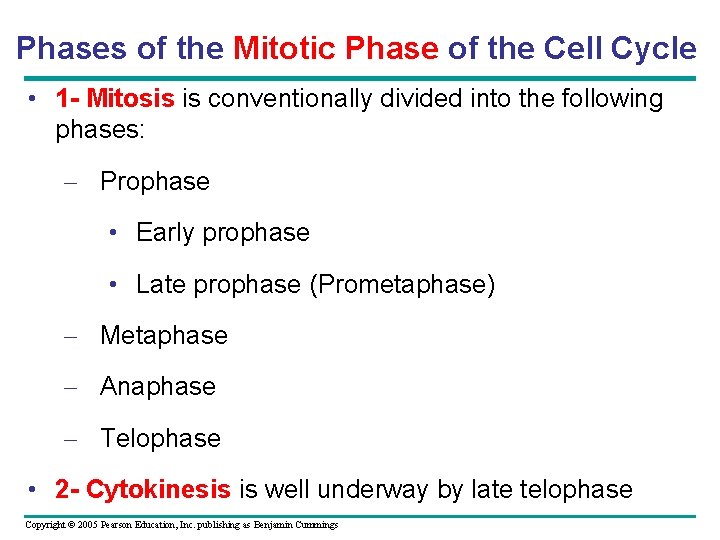
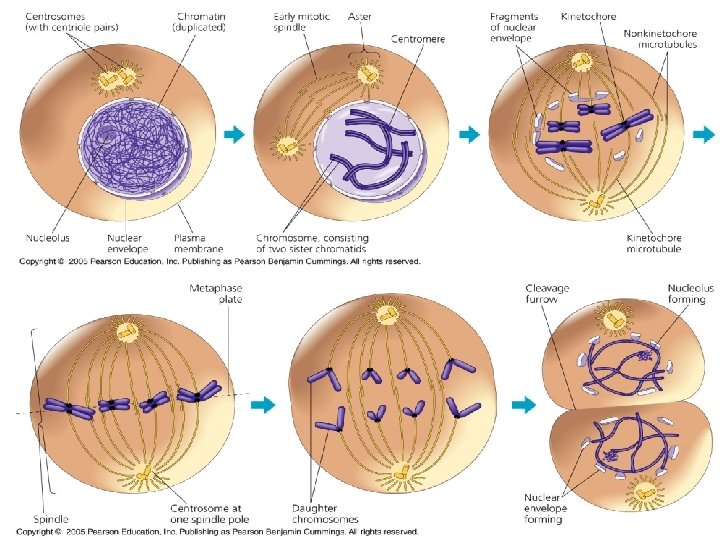
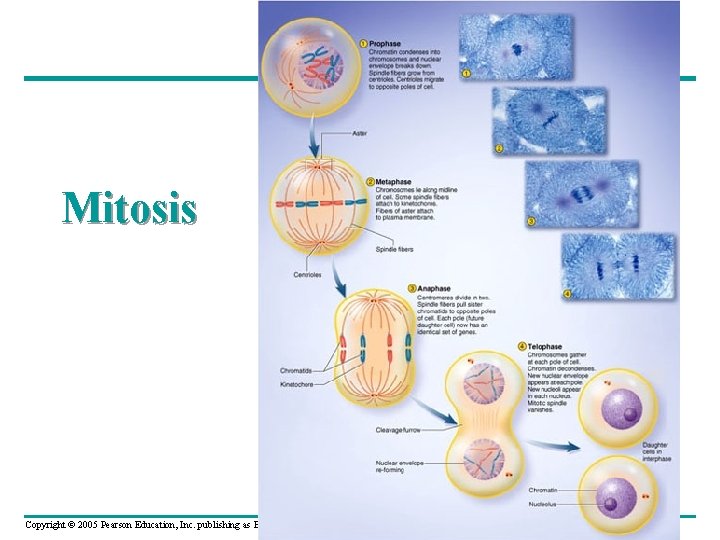
Phases of the Mitotic Phase of the Cell Cycle • 1 - Mitosis is conventionally divided into the following phases: – Prophase • Early prophase • Late prophase (Prometaphase) – Metaphase – Anaphase – Telophase • 2 - Cytokinesis is well underway by late telophase Copyright © 2005 Pearson Education, Inc. publishing as Benjamin Cummings
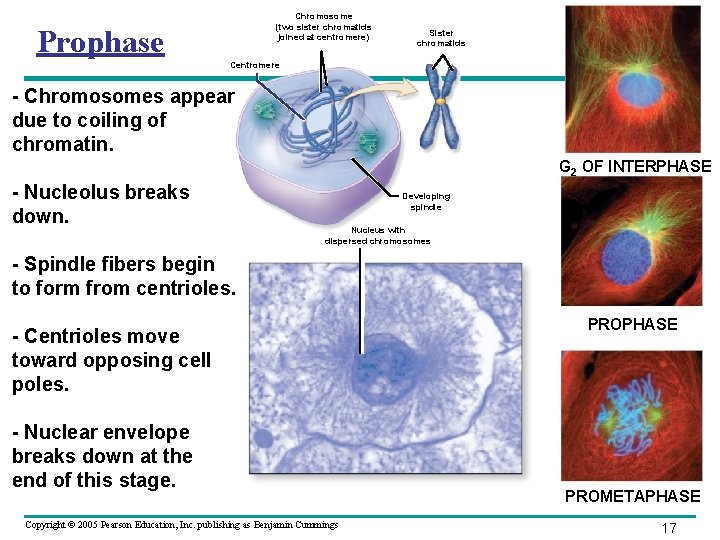
Chromosome (two sister chromatids joined at centromere) Prophase Sister chromatids Centromere - Chromosomes appear due to coiling of chromatin. G 2 OF INTERPHASE - Nucleolus breaks down. Developing spindle Nucleus with dispersed chromosomes - Spindle fibers begin to form from centrioles. - Centrioles move toward opposing cell poles. - Nuclear envelope breaks down at the end of this stage. Copyright © 2005 Pearson Education, Inc. publishing as Benjamin Cummings PROPHASE PROMETAPHASE 17
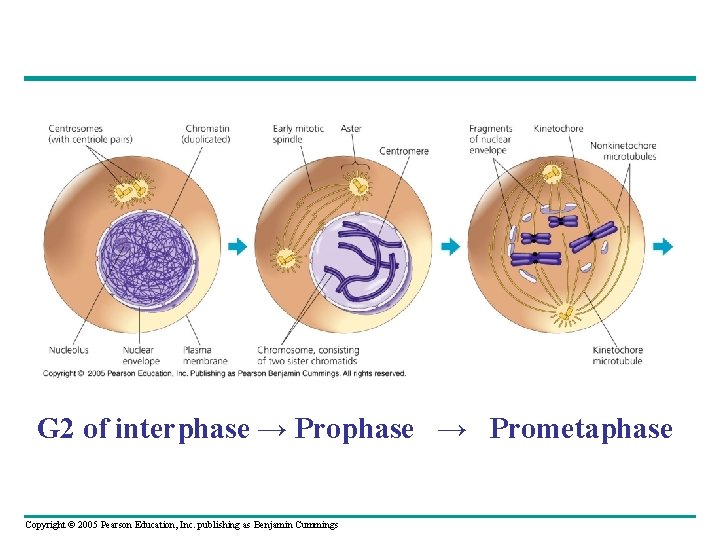
G 2 of interphase → Prometaphase Copyright © 2005 Pearson Education, Inc. publishing as Benjamin Cummings
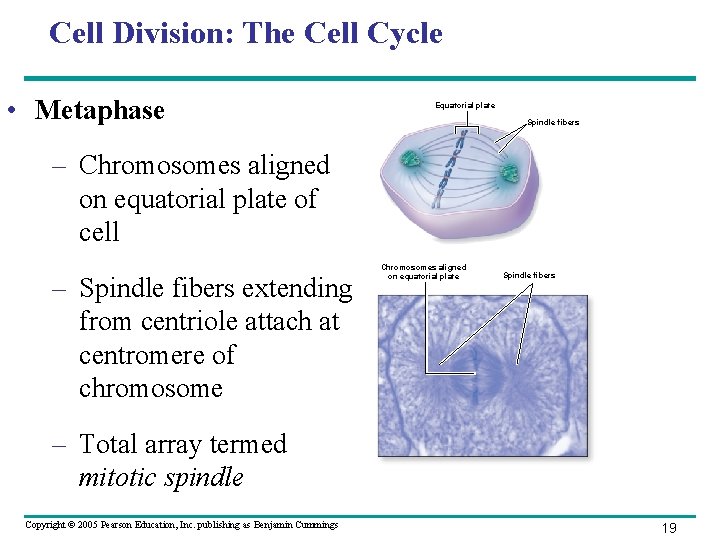
Cell Division: The Cell Cycle • Metaphase Equatorial plate Spindle fibers – Chromosomes aligned on equatorial plate of cell – Spindle fibers extending from centriole attach at centromere of chromosome Chromosomes aligned on equatorial plate Spindle fibers – Total array termed mitotic spindle Copyright © 2005 Pearson Education, Inc. publishing as Benjamin Cummings 19
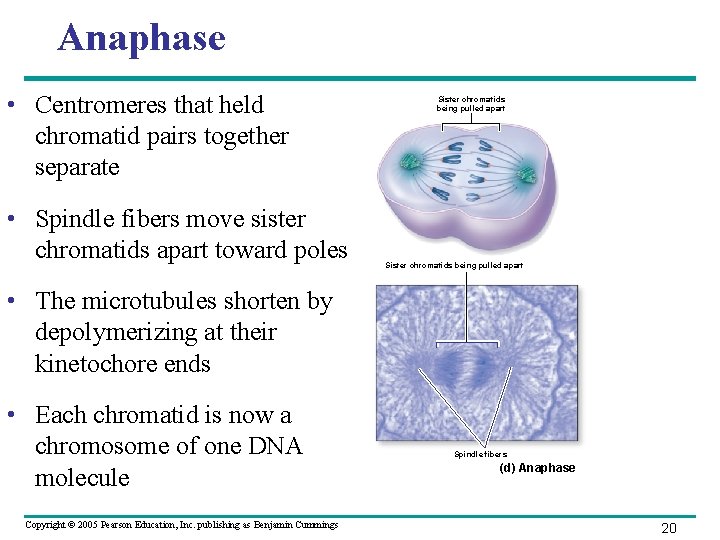
Anaphase • Centromeres that held chromatid pairs together separate • Spindle fibers move sister chromatids apart toward poles Sister chromatids being pulled apart • The microtubules shorten by depolymerizing at their kinetochore ends • Each chromatid is now a chromosome of one DNA molecule Copyright © 2005 Pearson Education, Inc. publishing as Benjamin Cummings Spindle fibers (d) Anaphase 20
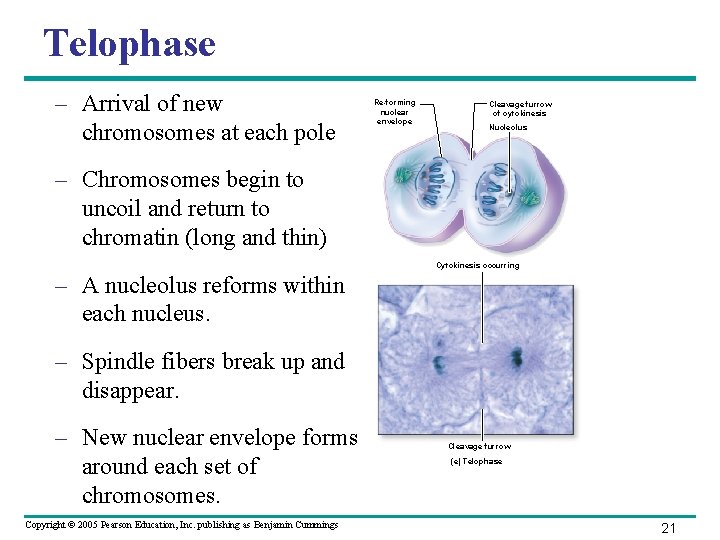
Telophase – Arrival of new chromosomes at each pole Re-forming nuclear envelope Cleavage furrow of cytokinesis Nucleolus – Chromosomes begin to uncoil and return to chromatin (long and thin) Cytokinesis occurring – A nucleolus reforms within each nucleus. – Spindle fibers break up and disappear. – New nuclear envelope forms around each set of chromosomes. Copyright © 2005 Pearson Education, Inc. publishing as Benjamin Cummings Cleavage furrow (e) Telophase 21
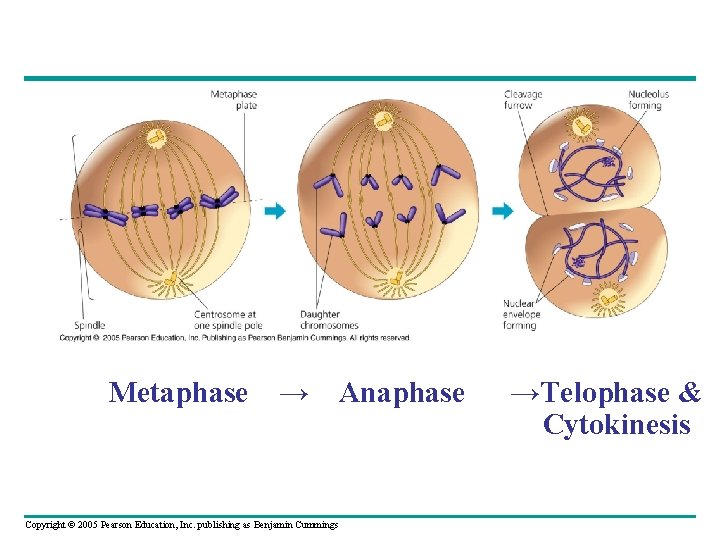
Metaphase → Anaphase Copyright © 2005 Pearson Education, Inc. publishing as Benjamin Cummings →Telophase & Cytokinesis
Copyright © 2005 Pearson Education, Inc. publishing as Benjamin Cummings
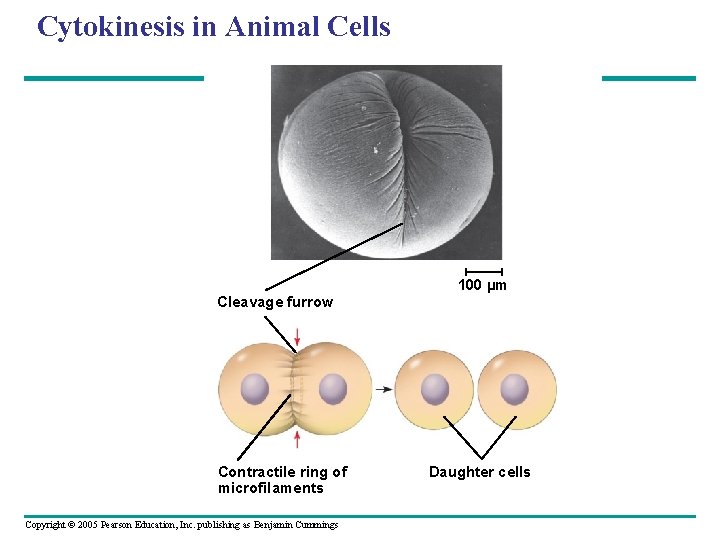
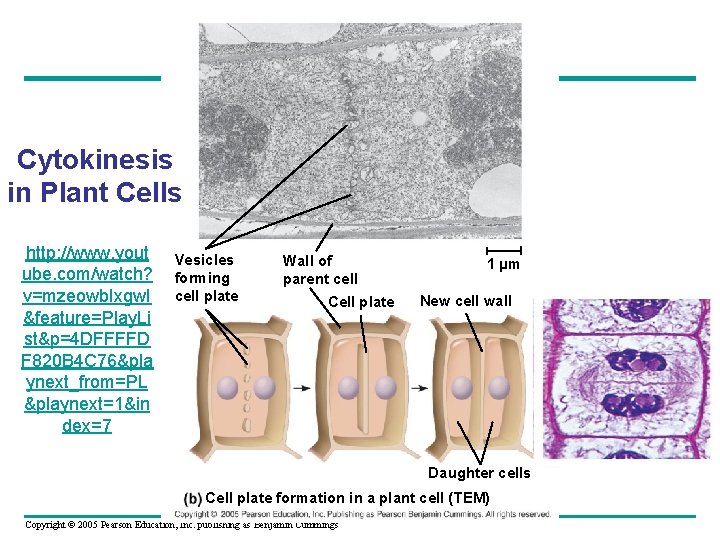
Cytokinesis (Cytoplasmic Division) • In animal cells, cytokinesis occurs by a forming a cleavage furrow • In plant cells, cytokinesis occurs by a forming a cell plate. Copyright © 2005 Pearson Education, Inc. publishing as Benjamin Cummings
Cytokinesis in Animal Cells 100 µm Cleavage furrow Contractile ring of microfilaments Copyright © 2005 Pearson Education, Inc. publishing as Benjamin Cummings Daughter cells
Cytokinesis in Plant Cells http: //www. yout ube. com/watch? v=mzeowb. Ixgw. I &feature=Play. Li st&p=4 DFFFFD F 820 B 4 C 76&pla ynext_from=PL &playnext=1&in dex=7 Vesicles forming cell plate Wall of parent cell Cell plate 1 µm New cell wall Daughter cells Cell plate formation in a plant cell (TEM) Copyright © 2005 Pearson Education, Inc. publishing as Benjamin Cummings
Mitosis Copyright © 2005 Pearson Education, Inc. publishing as Benjamin Cummings
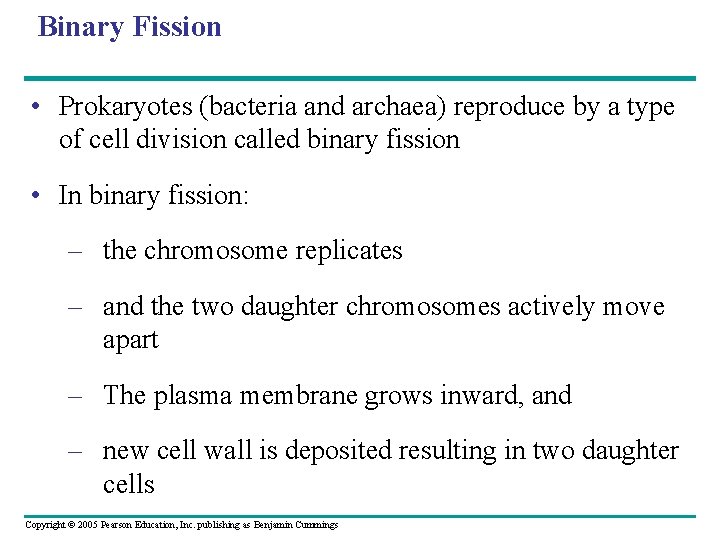
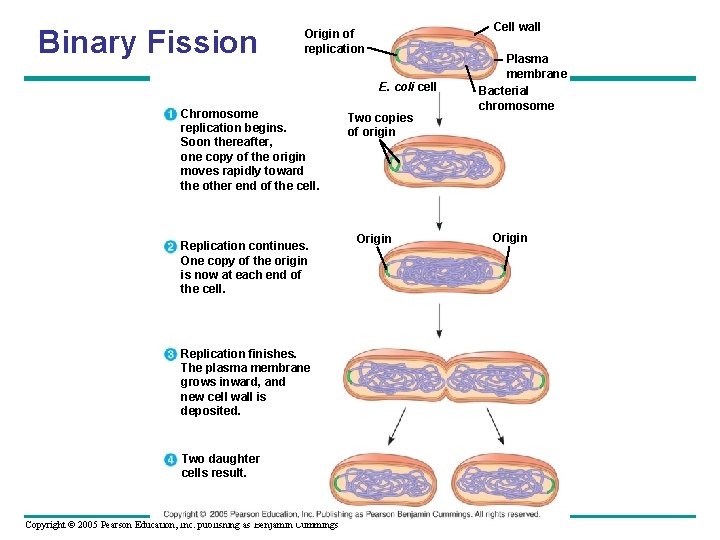
Binary Fission • Prokaryotes (bacteria and archaea) reproduce by a type of cell division called binary fission • In binary fission: – the chromosome replicates – and the two daughter chromosomes actively move apart – The plasma membrane grows inward, and – new cell wall is deposited resulting in two daughter cells Copyright © 2005 Pearson Education, Inc. publishing as Benjamin Cummings
Binary Fission Cell wall Origin of replication E. coli cell Chromosome replication begins. Soon thereafter, one copy of the origin moves rapidly toward the other end of the cell. Replication continues. One copy of the origin is now at each end of the cell. Replication finishes. The plasma membrane grows inward, and new cell wall is deposited. Two daughter cells result. Copyright © 2005 Pearson Education, Inc. publishing as Benjamin Cummings Two copies of origin Origin Plasma membrane Bacterial chromosome Origin