
Why Bearings Fail How do Bearings Fail Not
Why Bearings Fail?
How do Bearings Fail? Not always due to Natural Causes
How do Bearings Fail? Not always due to Natural Causes Only of bearings fail due to Fatigue, which is the basis of life calculation.
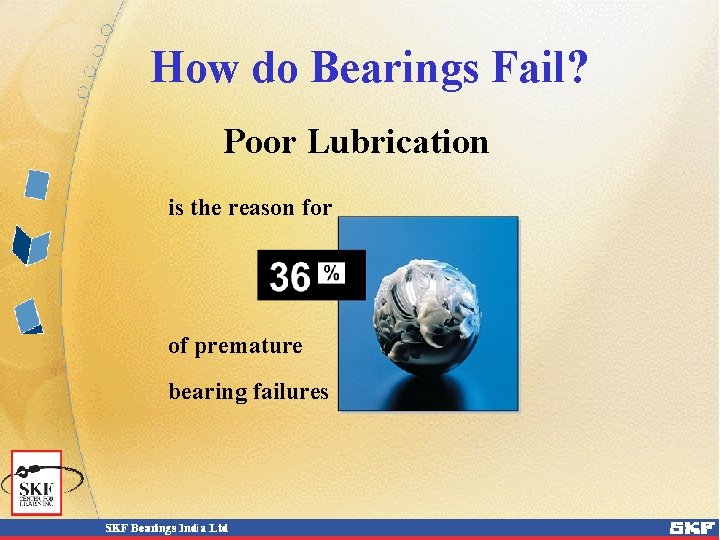
How do Bearings Fail? Poor Lubrication is the reason for of premature bearing failures
How do Bearings Fail? Contamination is the reason for of premature bearing failures
How do Bearings Fail? Poor Installation is the reason for of premature bearing failures
Design Life of Bearing Depends on 4 Assumptions Ø Good and clean Lubrication in adequate amount will always be available to the bearing Ø The bearing will be mounted without damage Ø Dimensions of parts related to the bearings will be correct Ø There are no defects inherent in the bearing
How do Bearings Fail? Fatigue of Bearing Material Ø Spalling Ø Produced by normal end to useful life Ø Improper Lubrication Ø Mechanical Damage Ø Material Defect
Design Life of Bearing Definition Ø The life of a rolling bearing is defined as the number of revolutions ( or operating hours at a given constant speed) which the bearing is capable of enduring before the first sign of fatigue (Flaking , spalling or crack )occurs on one of its rings or rolling elements
Failure mode Classification Fatigue Wear Corrosion Electrical erosion Plastic deformation Fracture
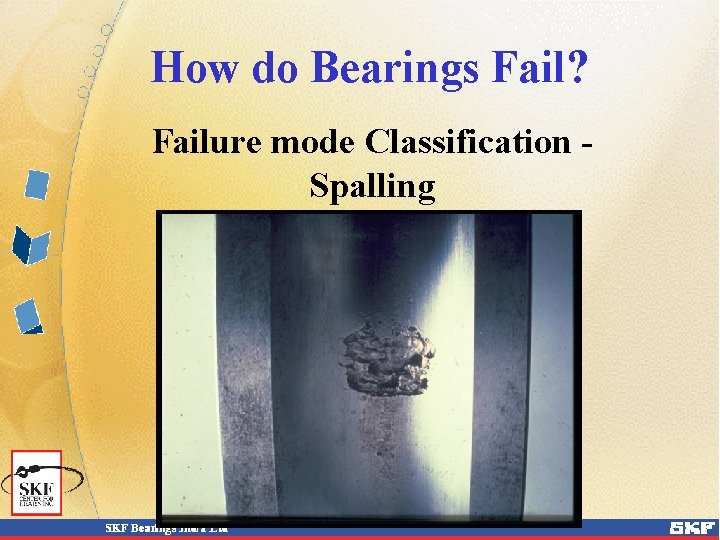
How do Bearings Fail? Failure mode Classification Spalling
Why Bearings Fail? Symptoms of Failures
Bearing Failures & Their Causes Unusual operating behaviour indicating damage : Subjective damage recognition In the vast majority of bearing applications it is sufficient when machine operators watch out for uneven running or unusual noise in the bearing system
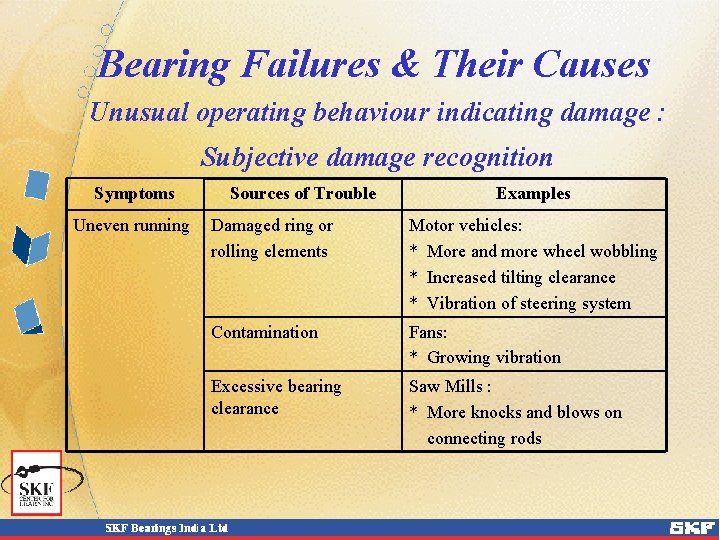
Bearing Failures & Their Causes Unusual operating behaviour indicating damage : Subjective damage recognition Symptoms Uneven running Sources of Trouble Examples Damaged ring or rolling elements Motor vehicles: * More and more wheel wobbling * Increased tilting clearance * Vibration of steering system Contamination Fans: * Growing vibration Excessive bearing clearance Saw Mills : * More knocks and blows on connecting rods
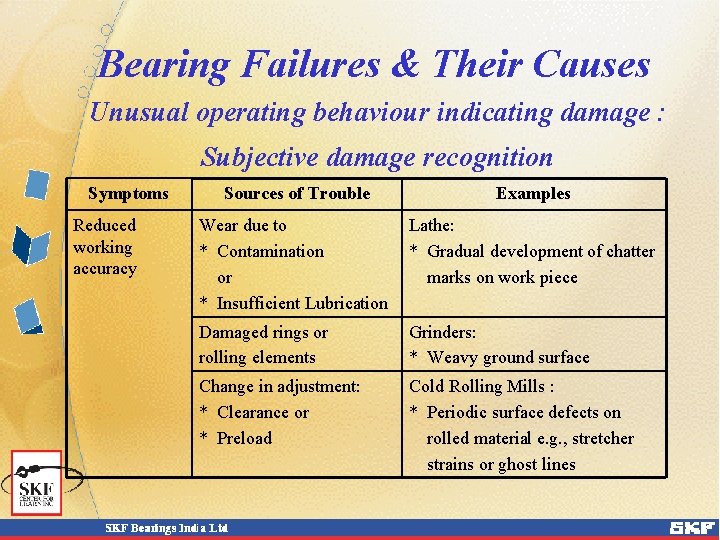
Bearing Failures & Their Causes Unusual operating behaviour indicating damage : Subjective damage recognition Symptoms Reduced working accuracy Sources of Trouble Examples Wear due to * Contamination or * Insufficient Lubrication Lathe: * Gradual development of chatter marks on work piece Damaged rings or rolling elements Grinders: * Weavy ground surface Change in adjustment: * Clearance or * Preload Cold Rolling Mills : * Periodic surface defects on rolled material e. g. , stretcher strains or ghost lines
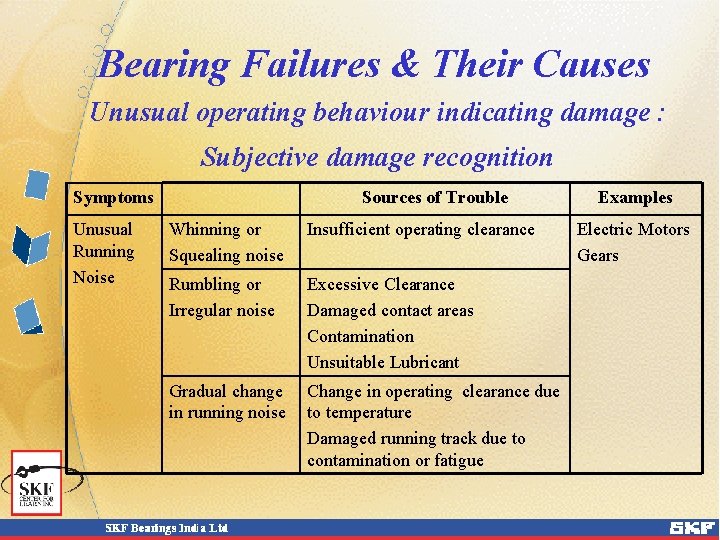
Bearing Failures & Their Causes Unusual operating behaviour indicating damage : Subjective damage recognition Symptoms Unusual Running Noise Sources of Trouble Whinning or Squealing noise Insufficient operating clearance Rumbling or Irregular noise Excessive Clearance Damaged contact areas Contamination Unsuitable Lubricant Gradual change in running noise Change in operating clearance due to temperature Damaged running track due to contamination or fatigue Examples Electric Motors Gears
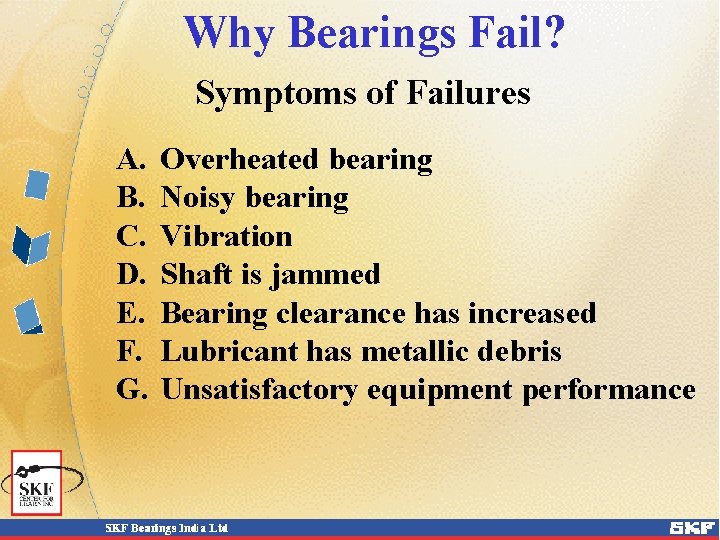
Why Bearings Fail? Symptoms of Failures A. B. C. D. E. F. G. Overheated bearing Noisy bearing Vibration Shaft is jammed Bearing clearance has increased Lubricant has metallic debris Unsatisfactory equipment performance
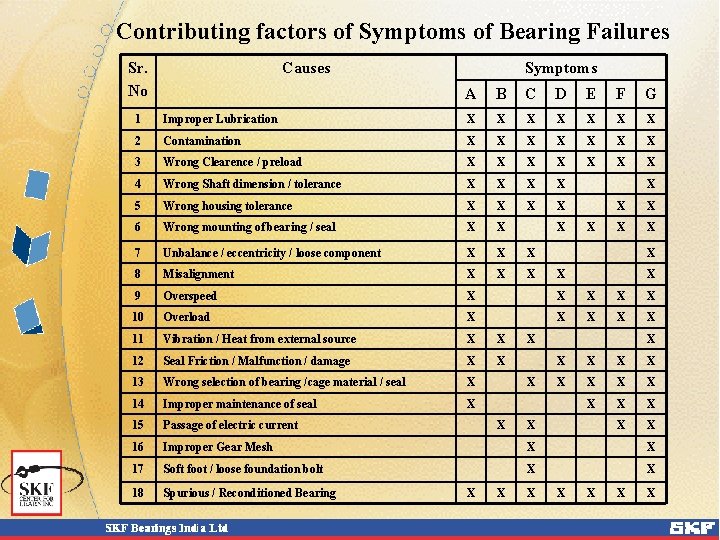
Contributing factors of Symptoms of Bearing Failures Sr. No Causes Symptoms A B C D E F G 1 Improper Lubrication X X X X 2 Contamination X X X X 3 Wrong Clearence / preload X X X X 4 Wrong Shaft dimension / tolerance X X 5 Wrong housing tolerance X X 6 Wrong mounting of bearing / seal X X 7 Unbalance / eccentricity / loose component X X X 8 Misalignment X X X 9 Overspeed X X X 10 Overload X X X 11 Vibration / Heat from external source X X 12 Seal Friction / Malfunction / damage X X 13 Wrong selection of bearing /cage material / seal X 14 Improper maintenance of seal X 15 Passage of electric current 16 Improper Gear Mesh X X 17 Soft foot / loose foundation bolt X X 18 Spurious / Reconditioned Bearing X X X X X X X X X
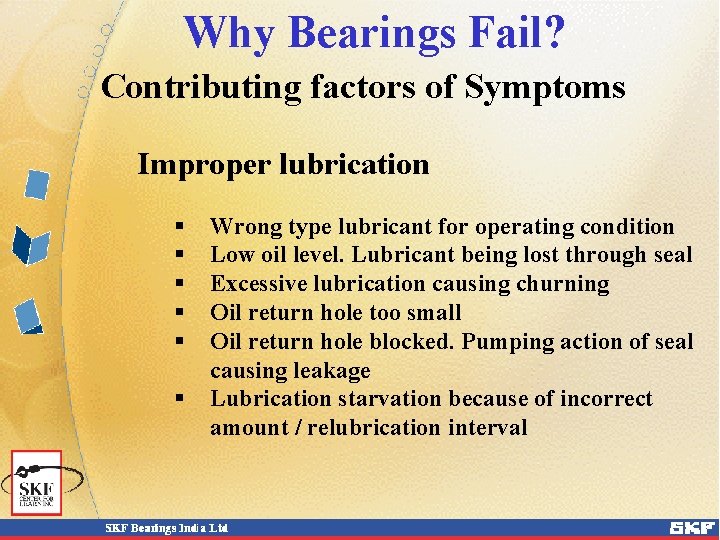
Why Bearings Fail? Contributing factors of Symptoms Improper lubrication § § § Wrong type lubricant for operating condition Low oil level. Lubricant being lost through seal Excessive lubrication causing churning Oil return hole too small Oil return hole blocked. Pumping action of seal causing leakage Lubrication starvation because of incorrect amount / relubrication interval
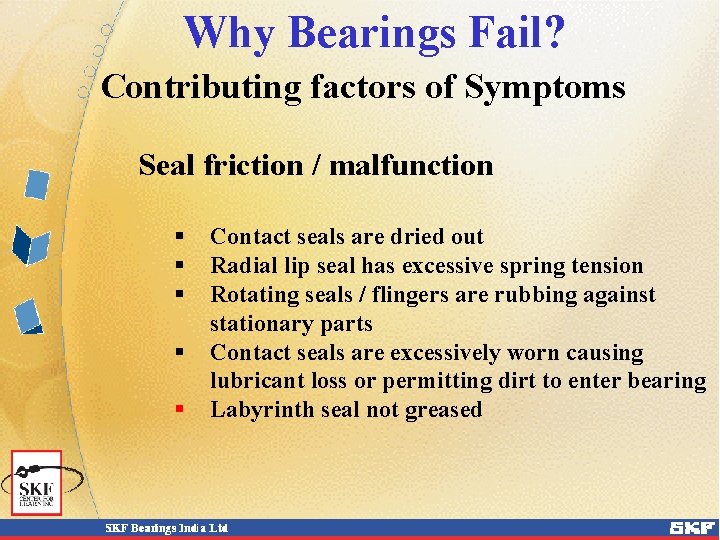
Why Bearings Fail? Contributing factors of Symptoms Seal friction / malfunction § § § Contact seals are dried out Radial lip seal has excessive spring tension Rotating seals / flingers are rubbing against stationary parts Contact seals are excessively worn causing lubricant loss or permitting dirt to enter bearing Labyrinth seal not greased
Why Bearings Fail? Contributing factors of Symptoms Wrong housing / shaft size / tolerance § § § § § Housing bore is out of round / undersized Housing is warped / distorted Bore surface uneven Housing bore too large Housing material too soft. Resulting pounding enlarges bore allowing outer ring to spin. Shaft diameter is out of round / oversized Shaft shoulder diameter too large, rubbing against seal / cage Shaft is bending due to incorrect shoulder dia Shaft is distorted Shaft shoulder out-of-square
Why Bearings Fail? Contributing factors of Symptoms Wrong mounting / preload § § § Bearings are axially preloaded Both bearings are located Adapter sleeve is tightened excessively Washer prong is rubbing against bearing Incorrect mounting method § hammer blow § Impact of roller edge on raceway Adapter sleeve is loose – shaft undersized
- Slides: 22