
Why Application Availability Matters And how to achieve
Why Application Availability Matters And how to achieve increased availability through the use of App. Metrics® www. xtremesoft. com +1 781 -759 -1220
Current Trends in Application Development In order to remain competitive, organizations must build new, mission critical applications that automate and enhance their business processes Ø Consequently, a shift is underway from ‘stovepipe’ internal applications, to web enabled, transaction-based applications Today off-the-shelf technologies are being used for this custom application development Ø Transaction based application servers for business logic: Ø Microsoft COM+ and Microsoft. NET Serviced Components IBM Web. Sphere (J 2 EE) and BEA Web. Logic (J 2 EE) XML Messaging servers for EAI/B 2 B document interchange: Microsoft Biz. Talk Server web. Methods and IBM MQ Series
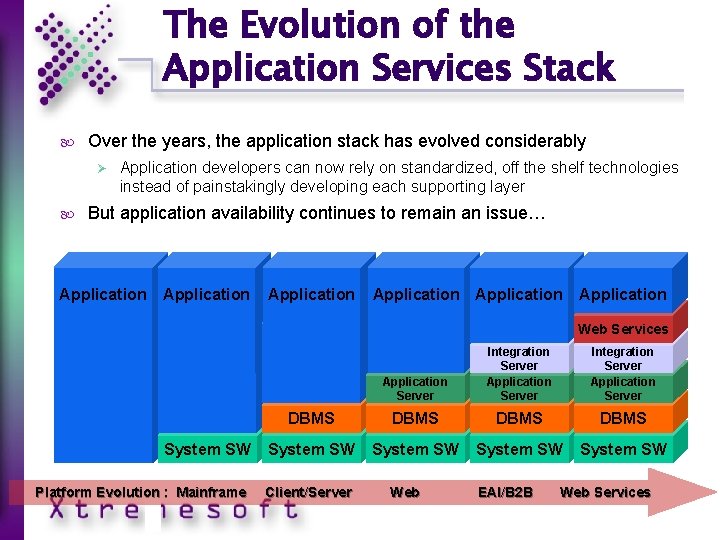
The Evolution of the Application Services Stack Over the years, the application stack has evolved considerably Ø Application developers can now rely on standardized, off the shelf technologies instead of painstakingly developing each supporting layer But application availability continues to remain an issue… Application Application Web. Services Web Application System SW Platform Evolution : Mainframe Application Server Integration Server Application Server DBMS DBMS System SW System. SW SW System Application Client/Server Web EAI/B 2 B Web Services
Why Does Application Availability Even Matter? “As business becomes increasingly dependent on technology and information, availability is a universal concern for every business, in every industry… And globalization means there are no more periods of ‘acceptable’ downtime. At any time of the day or night, somewhere in the world, customers and vendors need access to your corporate information. If they can't get it, they'll go elsewhere – creating an opportunity for your competition. ” Application Availability: An Approach to Measurement David M. Fishman, Sun Microsystems http: //www. nextslm. org
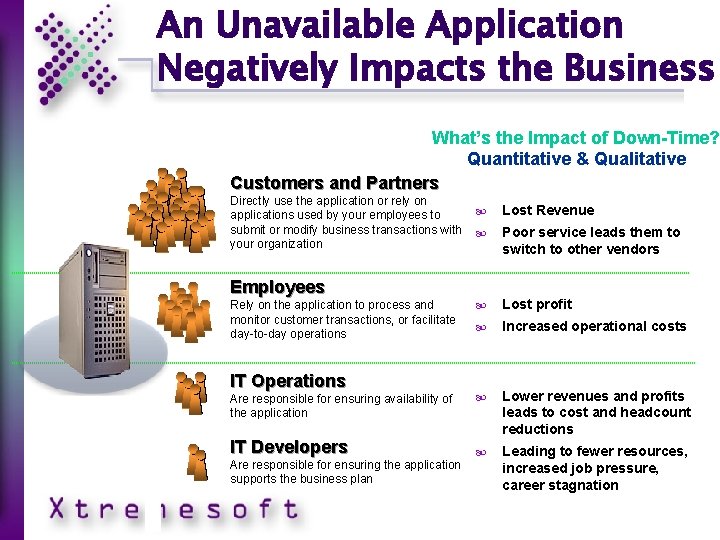
An Unavailable Application Negatively Impacts the Business What’s the Impact of Down-Time? Quantitative & Qualitative Customers and Partners Directly use the application or rely on applications used by your employees to submit or modify business transactions with your organization Lost Revenue Poor service leads them to switch to other vendors Lost profit Increased operational costs Lower revenues and profits leads to cost and headcount reductions Leading to fewer resources, increased job pressure, career stagnation Employees Rely on the application to process and monitor customer transactions, or facilitate day-to-day operations IT Operations Are responsible for ensuring availability of the application IT Developers Are responsible for ensuring the application supports the business plan
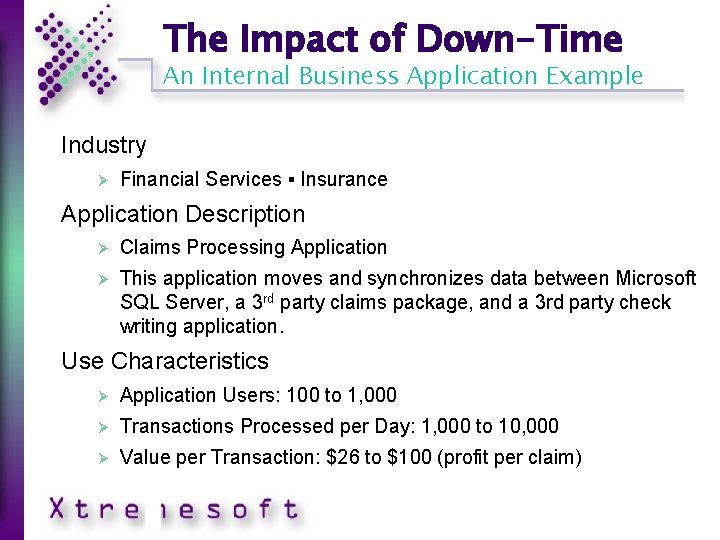
The Impact of Down-Time An Internal Business Application Example Industry Ø Financial Services ▪ Insurance Application Description Ø Claims Processing Application Ø This application moves and synchronizes data between Microsoft SQL Server, a 3 rd party claims package, and a 3 rd party check writing application. Use Characteristics Ø Application Users: 100 to 1, 000 Ø Transactions Processed per Day: 1, 000 to 10, 000 Ø Value per Transaction: $26 to $100 (profit per claim)
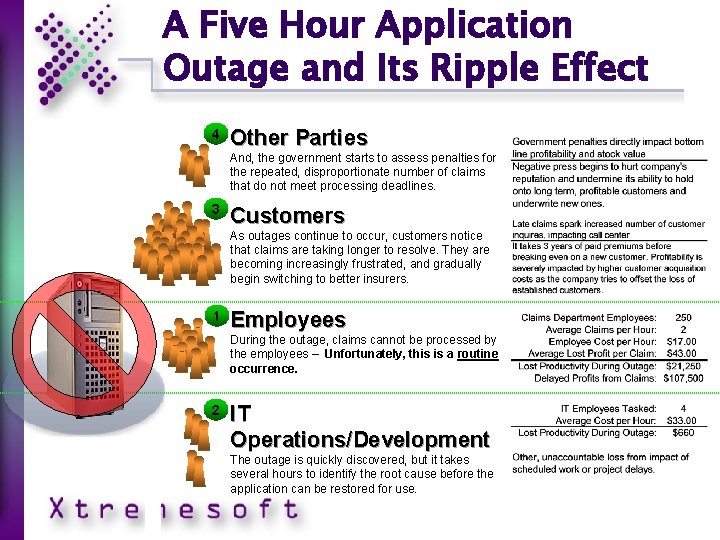
A Five Hour Application Outage and Its Ripple Effect 4 Other Parties And, the government starts to assess penalties for the repeated, disproportionate number of claims that do not meet processing deadlines. 3 Customers As outages continue to occur, customers notice that claims are taking longer to resolve. They are becoming increasingly frustrated, and gradually begin switching to better insurers. 1 Employees During the outage, claims cannot be processed by the employees – Unfortunately, this is a routine occurrence. 2 IT Operations/Development The outage is quickly discovered, but it takes several hours to identify the root cause before the application can be restored for use.
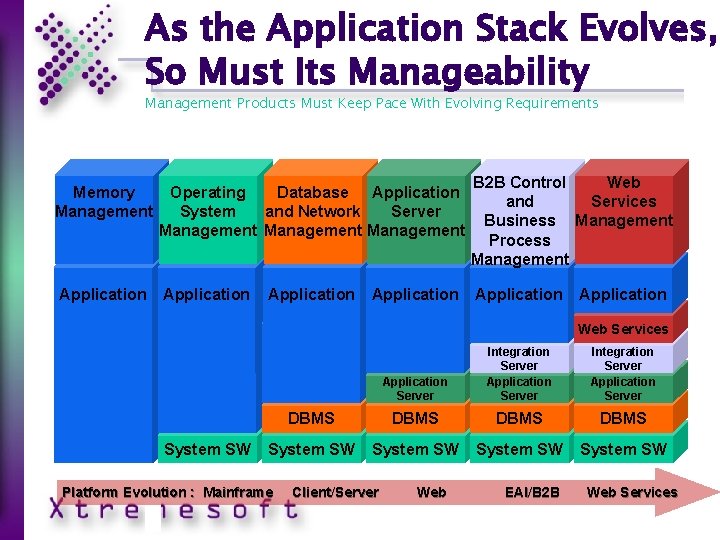
As the Application Stack Evolves, So Must Its Manageability Management Products Must Keep Pace With Evolving Requirements Memory Management Operating Database Application System and Network Server Management Application Web B 2 B Control Services and Business Management Process Management Application Web. Services Web Application System SW Application Server Integration Server Application Server DBMS DBMS System SW System. SW SW System Application Platform Evolution : Mainframe Client/Server Web EAI/B 2 B Web Services
What Role Do Management Frameworks and Consoles Play? Their key strength is gathering a broad array of events and metrics (a distributed event manager) from: Ø Operating Systems Ø Network Protocols Ø DHCP, DNS, RAS, WINS Microsoft Technologies Windows 2000 Server, Windows 2003 Server, Windows 2008 Server, UNIX, Linux Active Directory, IIS, Terminal Services, MSCS, MSMQ They are also geared towards managing packaged applications: Ø Microsoft Exchange Server & Lotus Notes Ø Microsoft SQL Server, Oracle 8 i, IBM DB 2 Ø Siebel CRM, People. Soft HR, etc…
How Do You Manage Custom Developed Business Applications? You need to know what’s going on underneath your application, in the operating system Ø Management frameworks and consoles do this well But you really need to know whether or not your custom code is successfully transacting the business as intended Ø Microsoft Operations Manager, BMC Patrol, Tivoli Enterprise, Computer Associates Uni. Center TNG, Hewlett-Packard Open. View, Net. IQ App. Manager This is outside their realm of expertise! Even Microsoft is relying on other vendors to provide ‘expert knowledge’ and tools for complex management problems Ø Which is why, when it comes to managing custom developed business applications, Xtremesoft’s App. Metrics is the solution
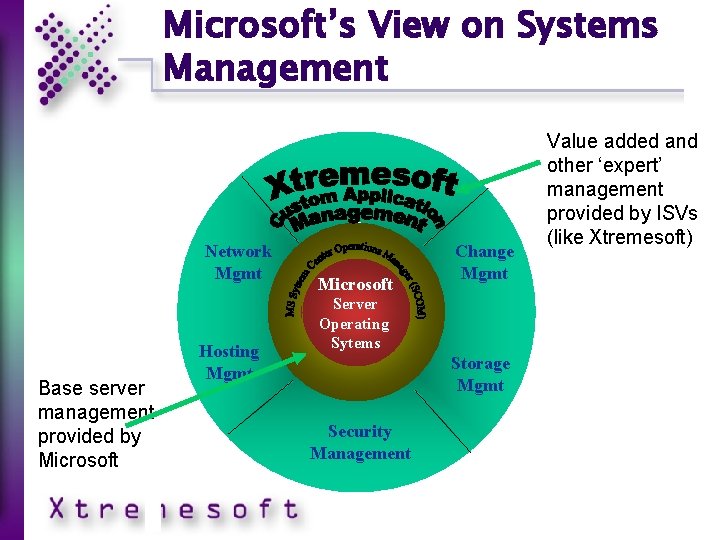
Microsoft’s View on Systems Management Network Mgmt Base server management provided by Microsoft Hosting Mgmt Microsoft Change Mgmt Server Operating Sytems Storage Mgmt Security Management Value added and other ‘expert’ management provided by ISVs (like Xtremesoft)
Xtremesoft’s App. Metrics is a Focused Solution A solution geared towards explicitly managing: Ø COM+ and. NET Serviced Components App. Metrics collects detailed, application specific events and metrics for your custom business applications Ø Aggregates events from multiple underlying technologies Ø Collates them from the perspective of your application Ø Gives you a view that corresponds to your businesses Ø Enables you to measure and maximize a specific custom application’s effectiveness and availability
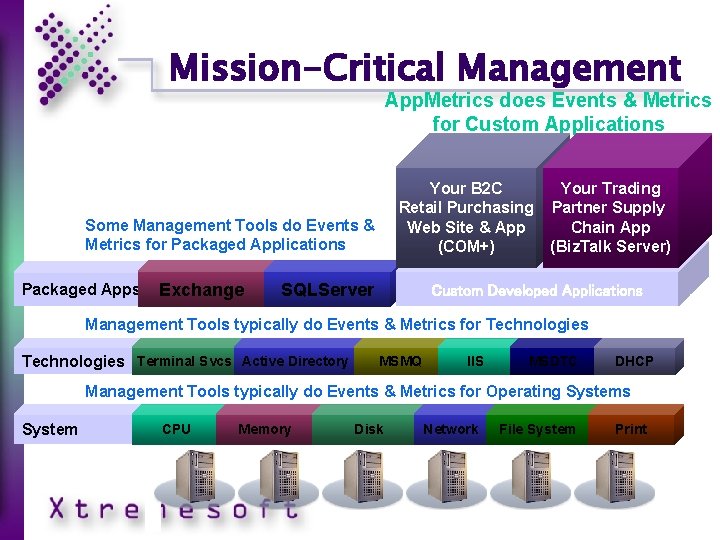
Mission-Critical Management App. Metrics does Events & Metrics for Custom Applications Your B 2 C Retail Purchasing Web Site & App (COM+) Some Management Tools do Events & Metrics for Packaged Applications Packaged Apps Exchange Your Trading Partner Supply Chain App (Biz. Talk Server) Custom. Developed. Apps Custom Developed Applications SQLServer Management Tools typically do Events & Metrics for Technologies Terminal Svcs Active Directory MSMQ IIS MSDTC DHCP Management Tools typically do Events & Metrics for Operating Systems System CPU Memory Disk Network File System Print
What Does This Mean? Traditional management tools are general practitioners Ø They provide cursory information on your application server Ø Information that can tell you that a single server the application is hosted on is non-functional Ø The server’s CPU is thrashing, server memory use exceeding 80%, or a server and its application has crashed Often too late, and unable to answer the real question, “Why? ” Xtremesoft App. Metrics is the specialist Ø It can diagnose and pinpoint “Why? ” and do so proactively An application’s CPU or memory use exceeding threshold, a designated kind of transaction taking too long, a particular component is aborting, a components method accessing a database repeatedly hangs Ø And on a per application basis, across a server farm, not just per server Ø And give you detailed reporting for capacity planning and analysis
Custom Application Key Business Events & Metrics Traditional management tools and frameworks won’t tell you about business transactions: Ø Shopping cart transaction count? Ø Purchase order approval duration? Ø Credit card approval abort count? Ø Invoice transmission failed? (Show it be automatically resubmitted? ) These are your front office business transactions, and represent real dollars and opportunities Ø Not your back office infrastructure! You need to manage both!
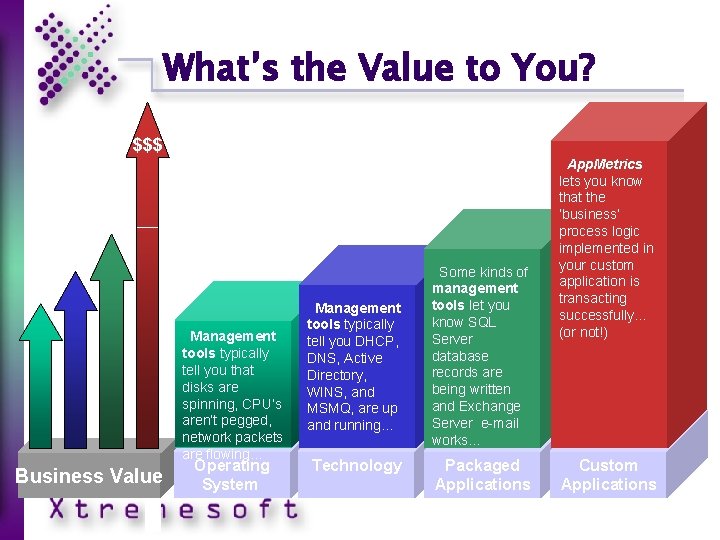
What’s the Value to You? $$$ Business Value Management tools typically tell you that disks are spinning, CPU’s aren’t pegged, network packets System are flowing… System Operating System Management tools typically tell you DHCP, DNS, Active Directory, WINS, and MSMQ, are up and running… System Technology Some kinds of management tools let you know SQL Server database records are being written and Exchange Server e-mail works… System Packaged Applications App. Metrics lets you know that the ‘business’ process logic implemented in your custom application is transacting successfully… (or not!) System Custom Applications
How Does that Value Translate into Real Money? “By using App. Metrics, the availability of the application has increased by a few percentage points. Considering for every one percentage point of additional availability a thousand man-hours of down-time is saved and hence results in millions of dollars in improved efficiency throughout the organization. ”
www. xtremesoft. com +1 781 -759 -1220 “Maximize the availability of your applications on the Microsoft platform”
- Slides: 18