
Why and where do drugs work Drug targets
- Slides: 25
Why and where do drugs work? “Drug targets”
Why do drugs work? • Drugs are chemicals – Interact with the body’s chemicals • How/where will they interact? - Binding through intermolecular forces
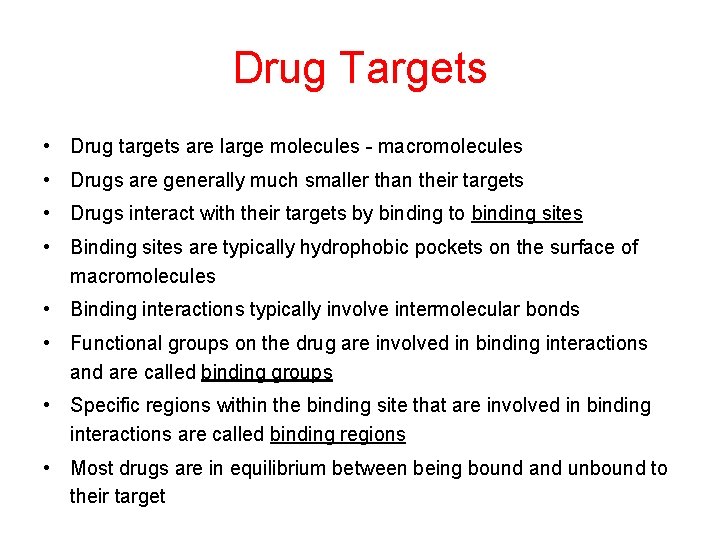
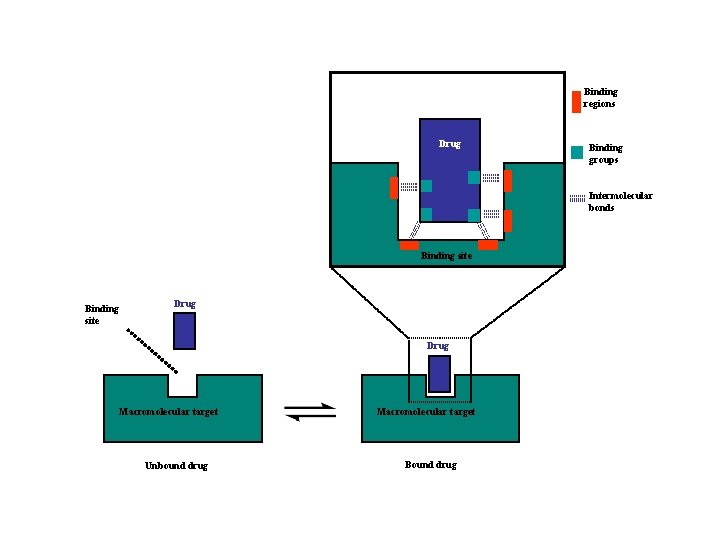
Drug Targets • Drug targets are large molecules - macromolecules • Drugs are generally much smaller than their targets • Drugs interact with their targets by binding to binding sites • Binding sites are typically hydrophobic pockets on the surface of macromolecules • Binding interactions typically involve intermolecular bonds • Functional groups on the drug are involved in binding interactions and are called binding groups • Specific regions within the binding site that are involved in binding interactions are called binding regions • Most drugs are in equilibrium between being bound and unbound to their target
Binding regions Drug Binding groups Intermolecular bonds Binding site Drug Macromolecular target Unbound drug Macromolecular target Bound drug
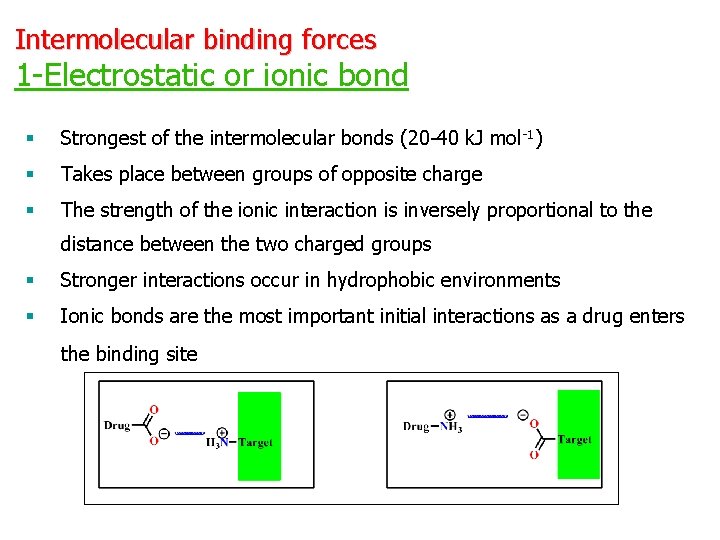
Intermolecular binding forces 1 -Electrostatic or ionic bond § Strongest of the intermolecular bonds (20 -40 k. J mol-1) § Takes place between groups of opposite charge § The strength of the ionic interaction is inversely proportional to the distance between the two charged groups § Stronger interactions occur in hydrophobic environments § Ionic bonds are the most important initial interactions as a drug enters the binding site
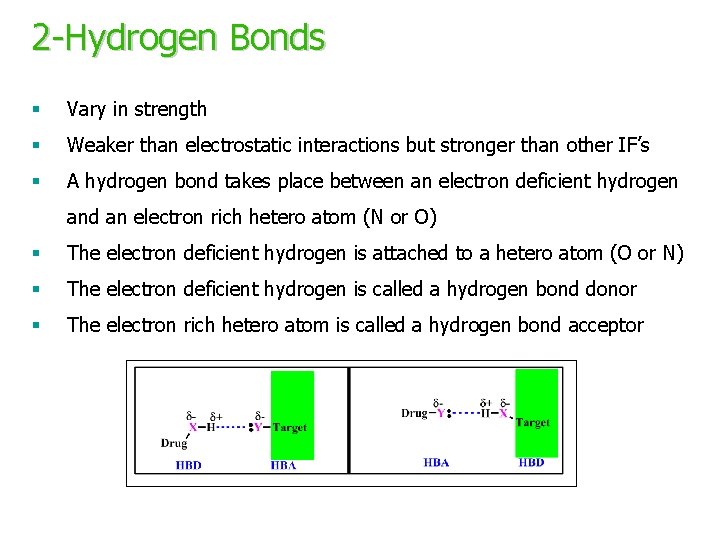
2 -Hydrogen Bonds § Vary in strength § Weaker than electrostatic interactions but stronger than other IF’s § A hydrogen bond takes place between an electron deficient hydrogen and an electron rich hetero atom (N or O) § The electron deficient hydrogen is attached to a hetero atom (O or N) § The electron deficient hydrogen is called a hydrogen bond donor § The electron rich hetero atom is called a hydrogen bond acceptor
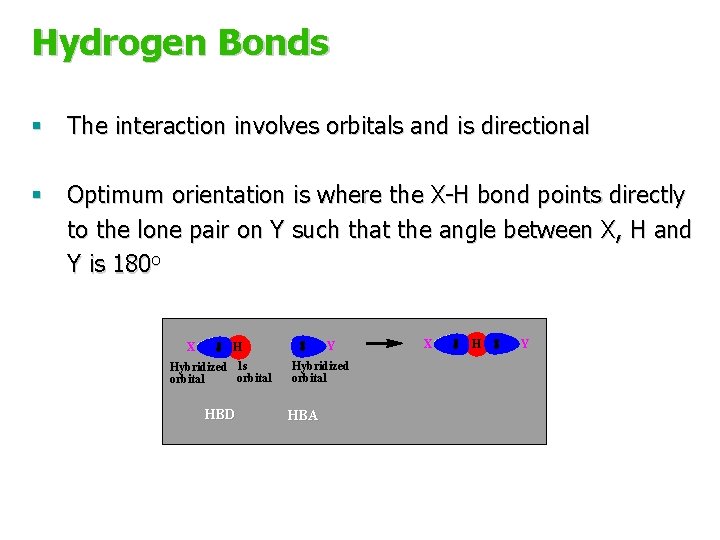
Hydrogen Bonds § The interaction involves orbitals and is directional § Optimum orientation is where the X-H bond points directly to the lone pair on Y such that the angle between X, H and Y is 180 o X Y H Hybridized 1 s orbital HBD Hybridized orbital HBA X H Y
Hydrogen Bonds § Examples of strong hydrogen bond acceptors - carboxylate ion, phosphate ion, tertiary amine § Examples of moderate hydrogen bond acceptors - carboxylic acid, amide oxygen, ketone, ester, ether, alcohol § Examples of poor hydrogen bond acceptors - sulfur, fluorine, chlorine, aromatic ring, amide nitrogen, aromatic amine § Example of good hydrogen bond donors - Quaternary ammonium ion
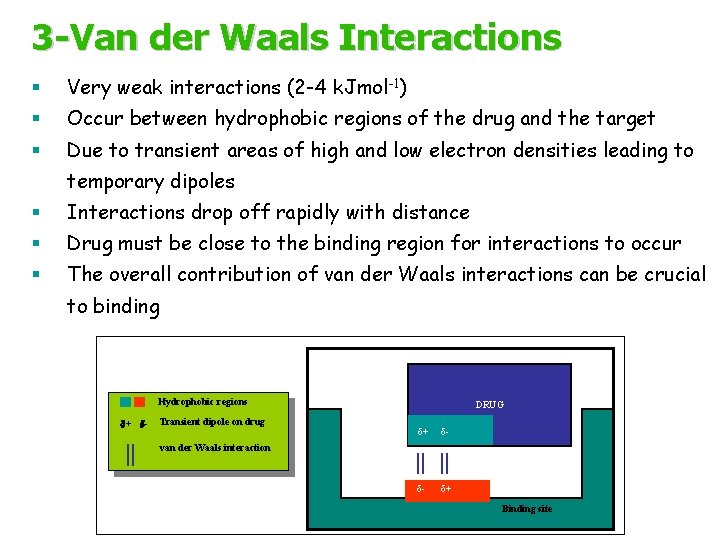
3 -Van der Waals Interactions § Very weak interactions (2 -4 k. Jmol-1) § Occur between hydrophobic regions of the drug and the target § Due to transient areas of high and low electron densities leading to temporary dipoles § Interactions drop off rapidly with distance § Drug must be close to the binding region for interactions to occur § The overall contribution of van der Waals interactions can be crucial to binding Hydrophobic regions d+ d- Transient dipole on drug DRUG d+ d- d- d+ van der Waals interaction Binding site
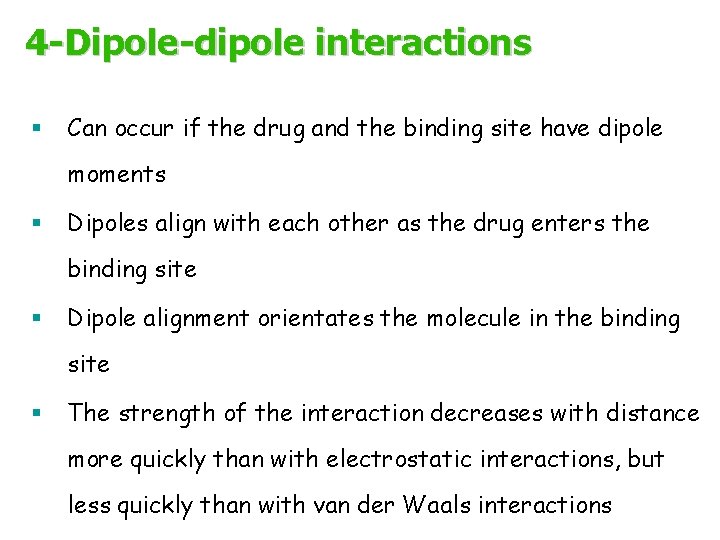
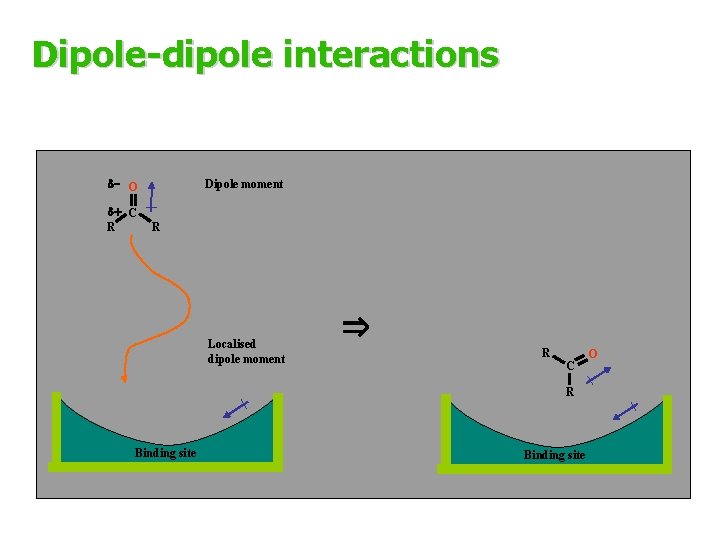
4 -Dipole-dipole interactions § Can occur if the drug and the binding site have dipole moments § Dipoles align with each other as the drug enters the binding site § Dipole alignment orientates the molecule in the binding site § The strength of the interaction decreases with distance more quickly than with electrostatic interactions, but less quickly than with van der Waals interactions
Dipole-dipole interactions d- O d+ C R Dipole moment R Localised dipole moment R C R Binding site O
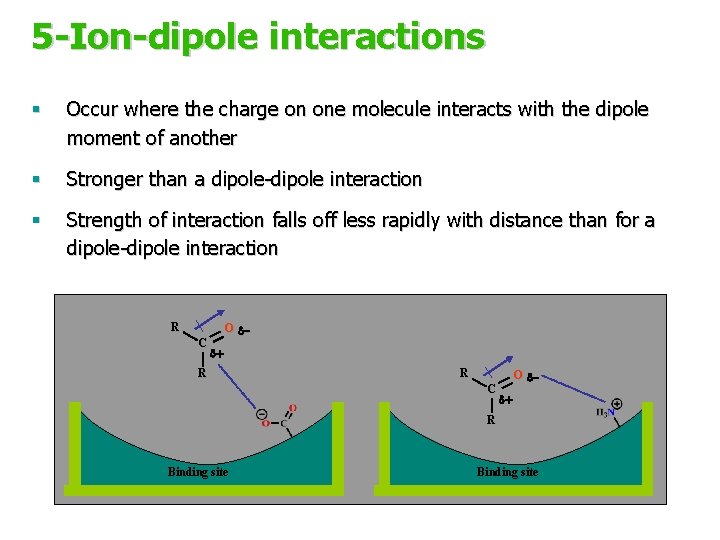
5 -Ion-dipole interactions § Occur where the charge on one molecule interacts with the dipole moment of another § Stronger than a dipole-dipole interaction § Strength of interaction falls off less rapidly with distance than for a dipole-dipole interaction R C O dd+ R Binding site
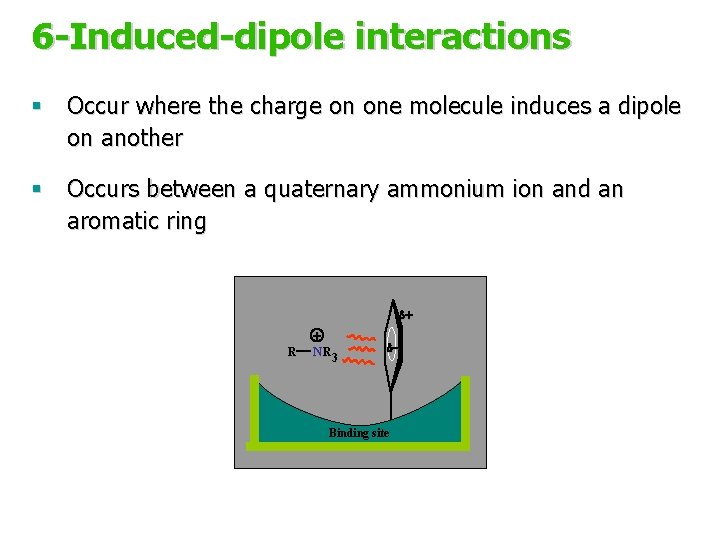
6 -Induced-dipole interactions § Occur where the charge on one molecule induces a dipole on another § Occurs between a quaternary ammonium ion and an aromatic ring d+ R + N R 3 d- Binding site
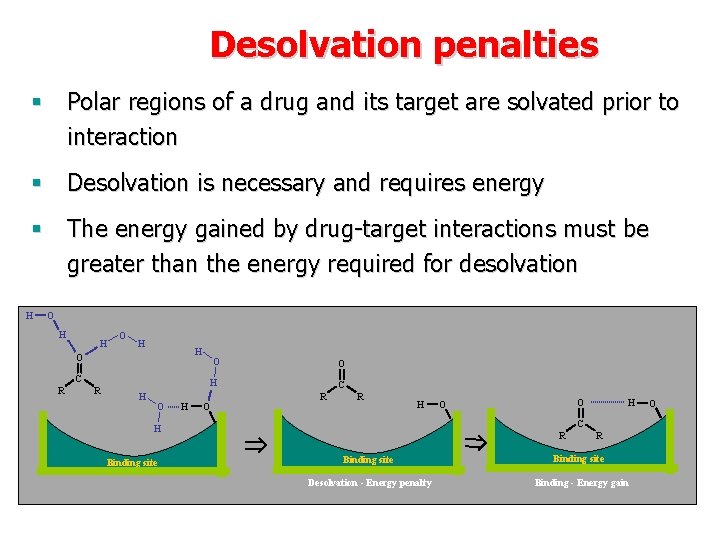
Desolvation penalties § Polar regions of a drug and its target are solvated prior to interaction § Desolvation is necessary and requires energy § The energy gained by drug-target interactions must be greater than the energy required for desolvation H O H H O O C R R O H H O C R R H H C H Binding site O O R Binding site Desolvation - Energy penalty R Binding site Binding - Energy gain O
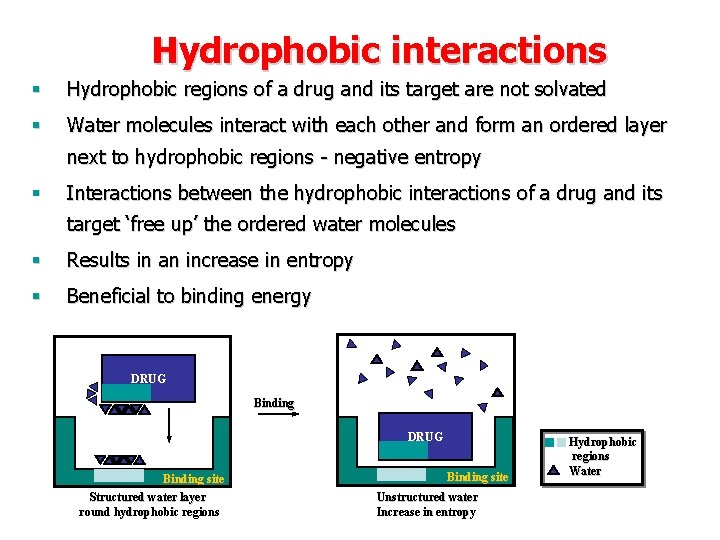
Hydrophobic interactions § Hydrophobic regions of a drug and its target are not solvated § Water molecules interact with each other and form an ordered layer next to hydrophobic regions - negative entropy § Interactions between the hydrophobic interactions of a drug and its target ‘free up’ the ordered water molecules § Results in an increase in entropy § Beneficial to binding energy DRUG Drug Binding site Structured water layer round hydrophobic regions Binding site Unstructured water Increase in entropy Hydrophobic regions Water
Where do drugs interact? • • Cells Four main targets: 1. 2. 3. 4. Lipids Carbohydrates Nucleic acids Proteins
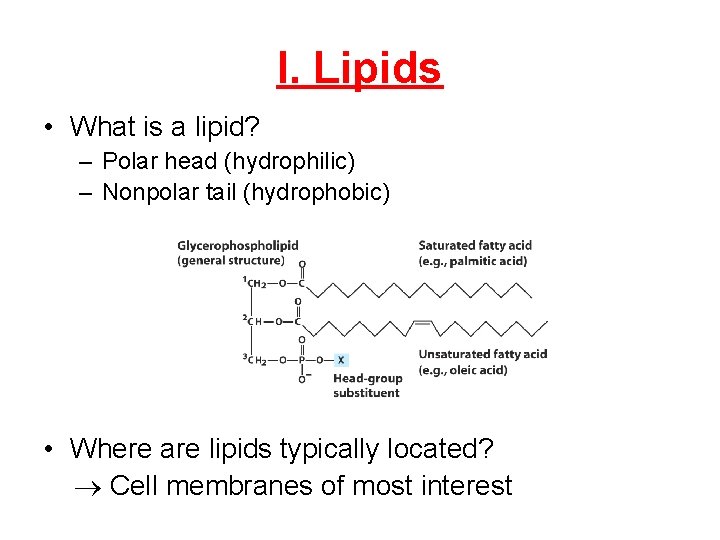
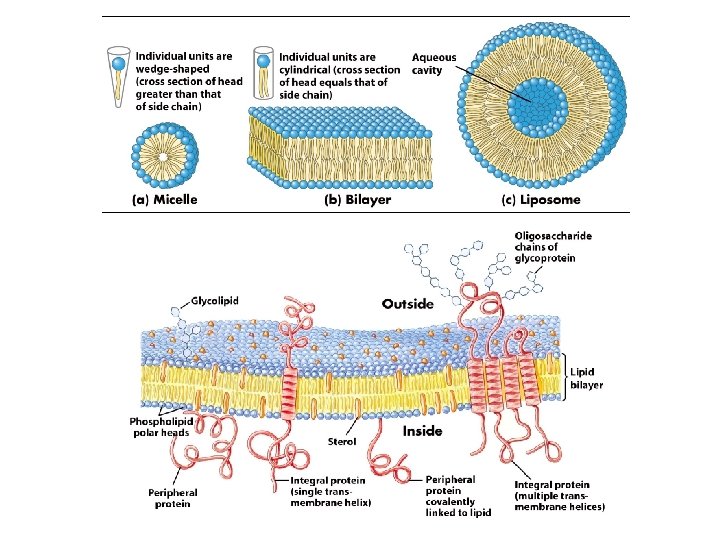
I. Lipids • What is a lipid? – Polar head (hydrophilic) – Nonpolar tail (hydrophobic) • Where are lipids typically located? Cell membranes of most interest
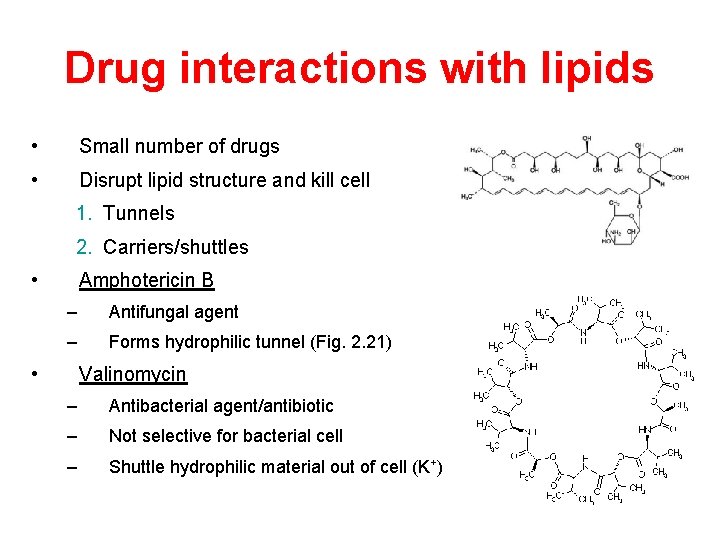
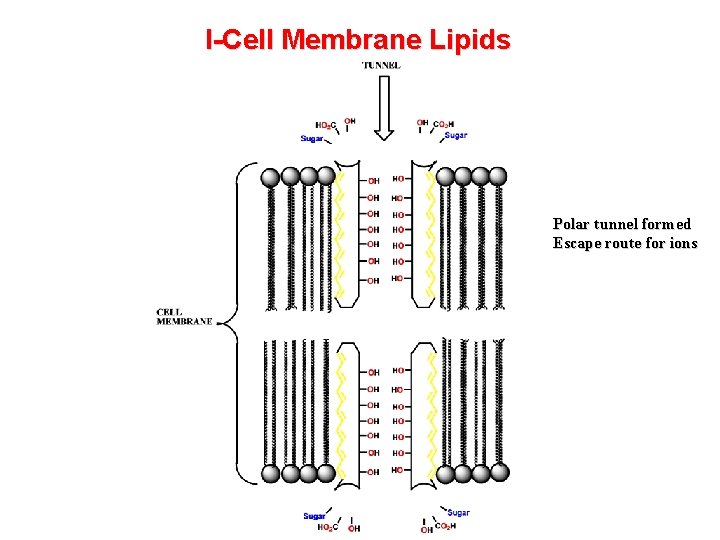
Drug interactions with lipids • Small number of drugs • Disrupt lipid structure and kill cell 1. Tunnels 2. Carriers/shuttles • Amphotericin B – Antifungal agent – Forms hydrophilic tunnel (Fig. 2. 21) • Valinomycin – Antibacterial agent/antibiotic – Not selective for bacterial cell – Shuttle hydrophilic material out of cell (K+)
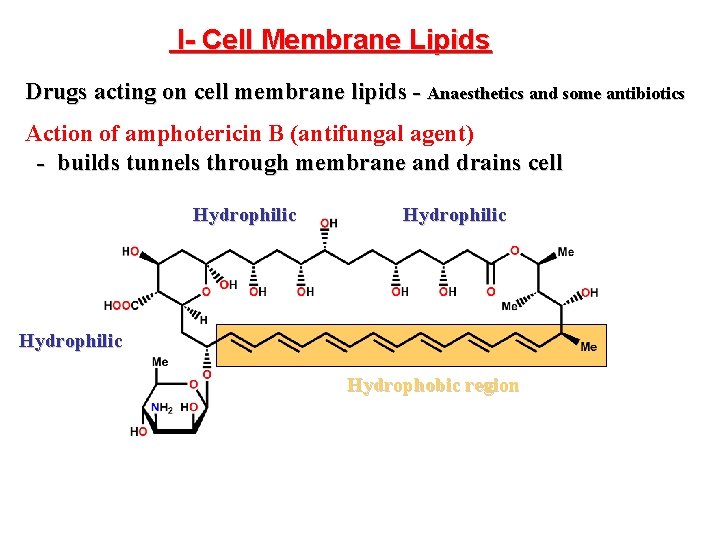
I- Cell Membrane Lipids Drugs acting on cell membrane lipids - Anaesthetics and some antibiotics Action of amphotericin B (antifungal agent) - builds tunnels through membrane and drains cell Hydrophilic Hydrophobic region
I-Cell Membrane Lipids Polar tunnel formed Escape route for ions
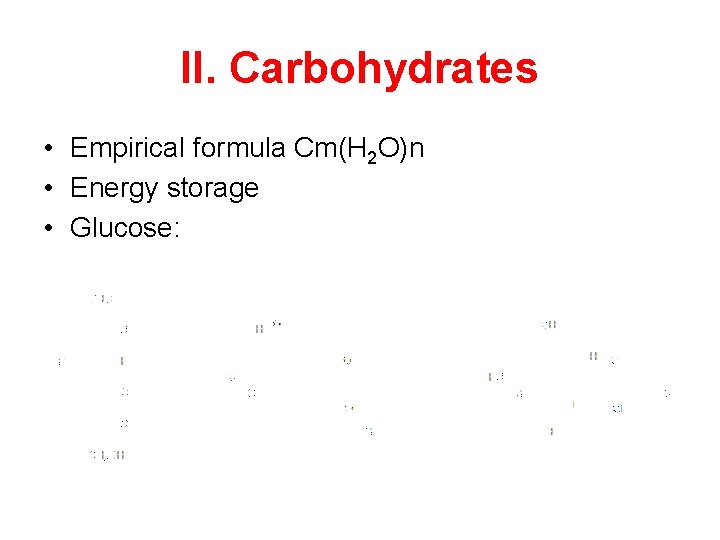
II. Carbohydrates • Empirical formula Cm(H 2 O)n • Energy storage • Glucose:
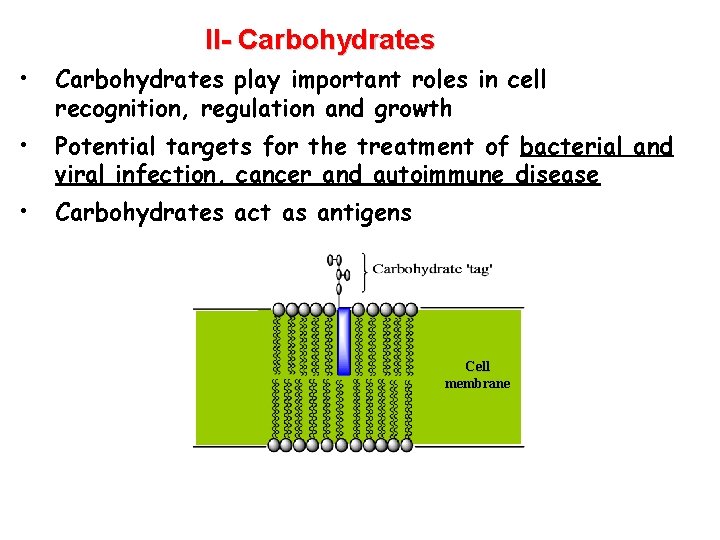
II- Carbohydrates • Carbohydrates play important roles in cell recognition, regulation and growth • Potential targets for the treatment of bacterial and viral infection, cancer and autoimmune disease • Carbohydrates act as antigens Cell membrane
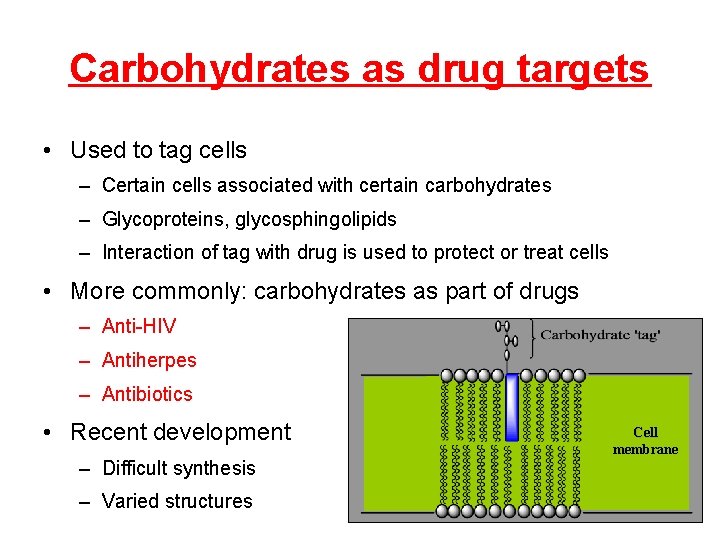
Carbohydrates as drug targets • Used to tag cells – Certain cells associated with certain carbohydrates – Glycoproteins, glycosphingolipids – Interaction of tag with drug is used to protect or treat cells • More commonly: carbohydrates as part of drugs – Anti-HIV – Antiherpes – Antibiotics • Recent development – Difficult synthesis – Varied structures Cell membrane
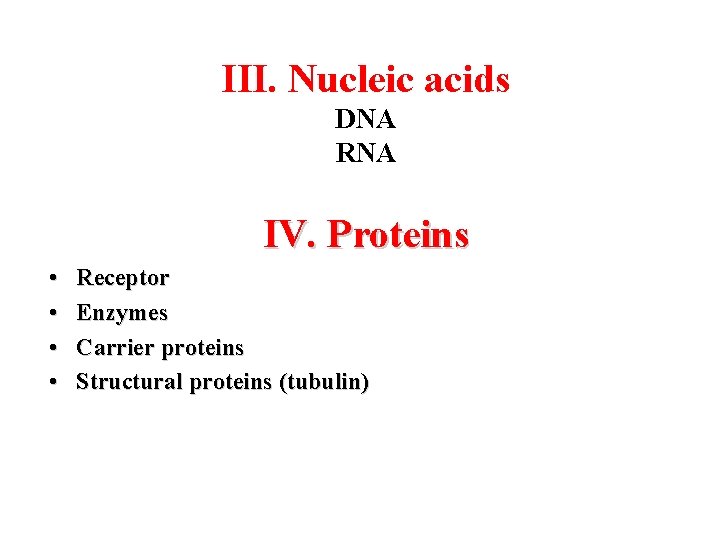
III. Nucleic acids DNA RNA IV. Proteins • • Receptor Enzymes Carrier proteins Structural proteins (tubulin)