
Why and how develop new accelerators In a
- Slides: 35
Why and how develop new accelerators? In a Nordic perspective 2012 -01 -06 Spaatind 2012 Tord Ekelöf - Uppsala University 1
After a pioneering period 1920 -1960 accelerator development has been the domain, not of HEP researchers, but of accelerator specialists who primarily see the new accelerators themselves as the interesting objects, not also their use for physic research. Certainly, accelerator technology specialists are absolutely necessary for the development of new accelerators, but one can now also see a trend in High Energy Physics for experimental HEP researchers to again taking an interest in the challenging technical problems of the development of, not only new particle detectors, by also of new particle accelerators. This is probably so because it has become so evident that we will have to go to even higher energies and luminosities in order to advance the in the field of High Energy Physics research. I my talk I will give a brief and selective overview of the status and potentialities of ongoing accelerator development projects in Europe with special emphasis on the Nordic countries. 2012 -01 -06 Spaatind 2012 Tord Ekelöf - Uppsala University 2
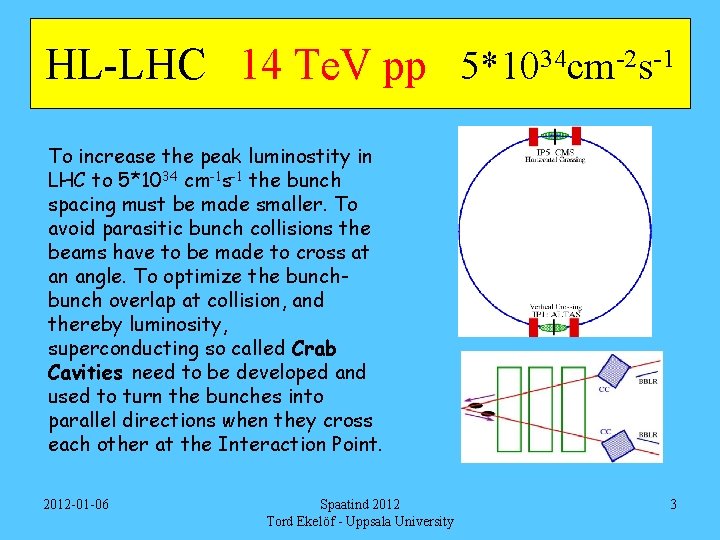
HL-LHC 14 Te. V pp 5*1034 cm-2 s-1 To increase the peak luminostity in LHC to 5*1034 cm-1 s-1 the bunch spacing must be made smaller. To avoid parasitic bunch collisions the beams have to be made to cross at an angle. To optimize the bunch overlap at collision, and thereby luminosity, superconducting so called Crab Cavities need to be developed and used to turn the bunches into parallel directions when they cross each other at the Interaction Point. 2012 -01 -06 Spaatind 2012 Tord Ekelöf - Uppsala University 3
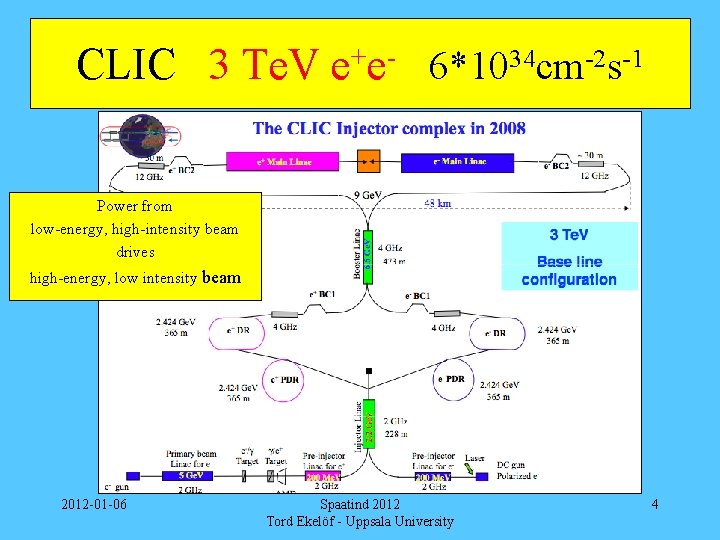
CLIC 3 Te. V e+e- 6*1034 cm-2 s-1 Power from low-energy, high-intensity beam drives high-energy, low intensity beam 2012 -01 -06 Spaatind 2012 Tord Ekelöf - Uppsala University 4
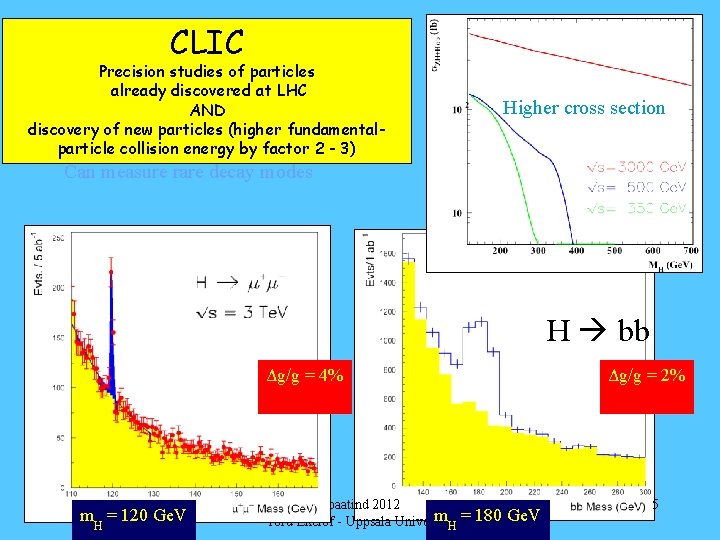
CLIC Precision studies of particles already discovered at LHC AND discovery of new particles (higher fundamentalparticle collision energy by factor 2 - 3) Higher cross section Can measure rare decay modes H bb Δg/g = 4% 2012 -01 -06 m. H = 120 Ge. V Spaatind 2012 m. H Tord Ekelöf - Uppsala University Δg/g = 2% = 180 Ge. V 5
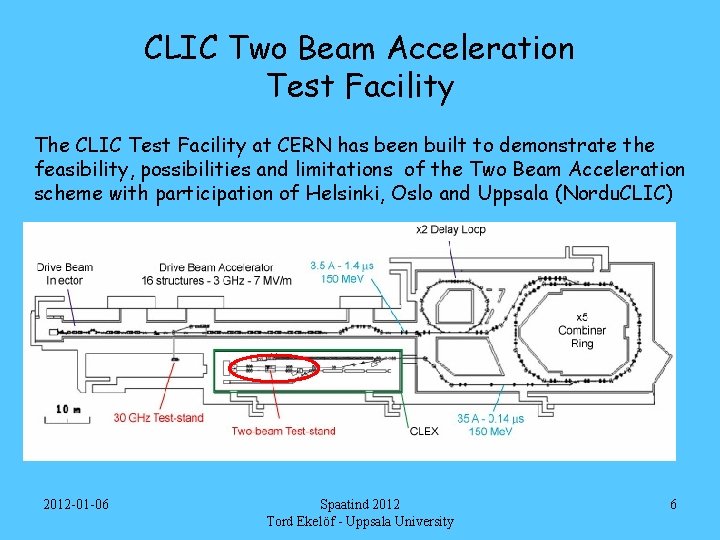
CLIC Two Beam Acceleration Test Facility The CLIC Test Facility at CERN has been built to demonstrate the feasibility, possibilities and limitations of the Two Beam Acceleration scheme with participation of Helsinki, Oslo and Uppsala (Nordu. CLIC) 2012 -01 -06 Spaatind 2012 Tord Ekelöf - Uppsala University 6
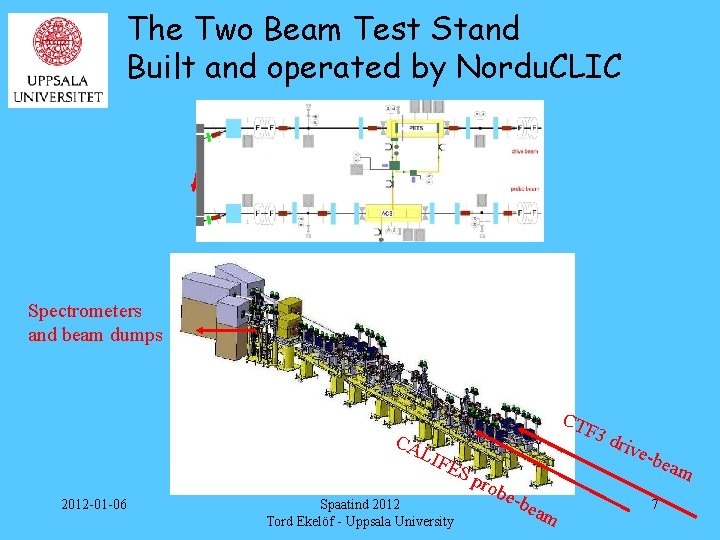
The Two Beam Test Stand Built and operated by Nordu. CLIC Spectrometers and beam dumps CA CT F 3 LIF 2012 -01 -06 ES Spaatind 2012 Tord Ekelöf - Uppsala University pro be- bea m driv e-b eam 7
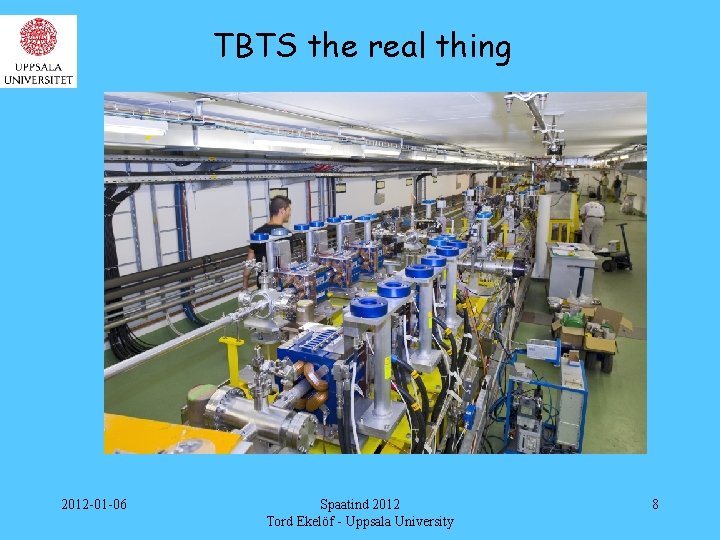
TBTS the real thing 2012 -01 -06 Spaatind 2012 Tord Ekelöf - Uppsala University 8
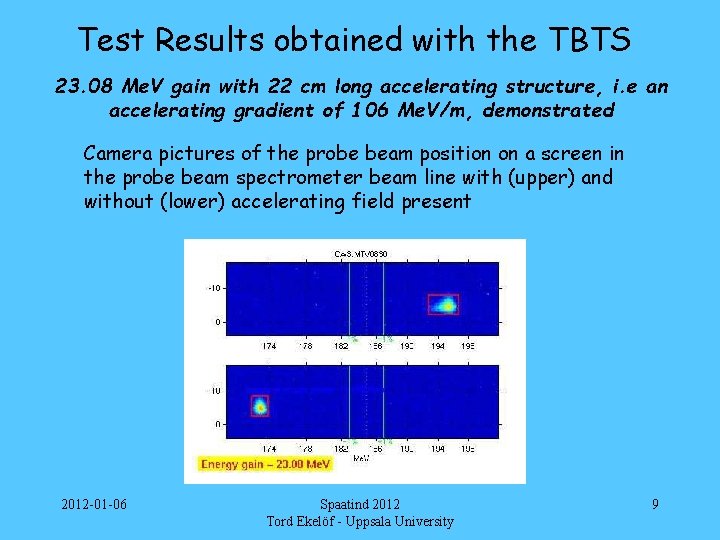
Test Results obtained with the TBTS 23. 08 Me. V gain with 22 cm long accelerating structure, i. e an accelerating gradient of 106 Me. V/m, demonstrated Camera pictures of the probe beam position on a screen in the probe beam spectrometer beam line with (upper) and without (lower) accelerating field present 2012 -01 -06 Spaatind 2012 Tord Ekelöf - Uppsala University 9
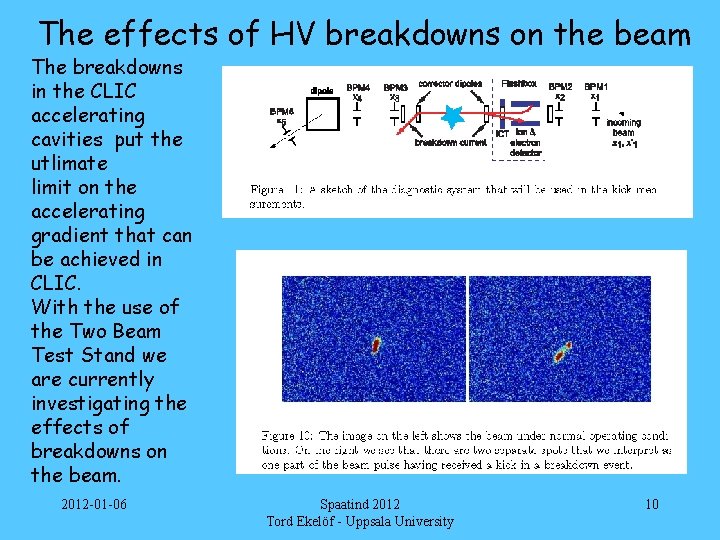
The effects of HV breakdowns on the beam The breakdowns in the CLIC accelerating cavities put the utlimate limit on the accelerating gradient that can be achieved in CLIC. With the use of the Two Beam Test Stand we are currently investigating the effects of breakdowns on the beam. 2012 -01 -06 Spaatind 2012 Tord Ekelöf - Uppsala University 10
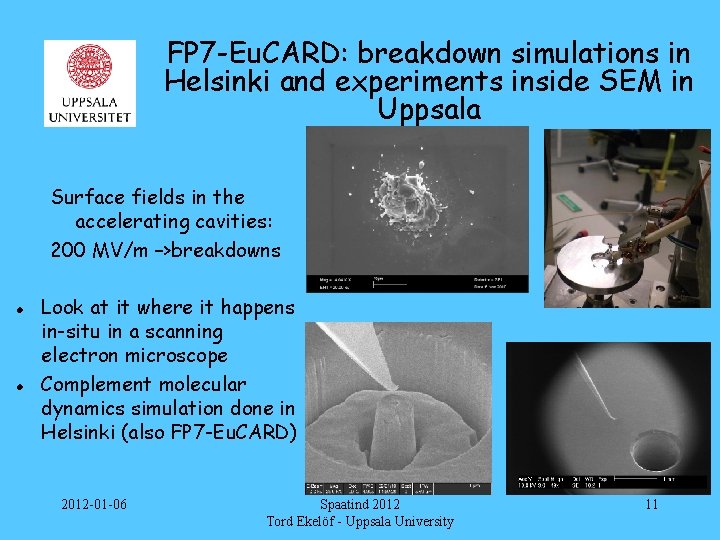
FP 7 -Eu. CARD: breakdown simulations in Helsinki and experiments inside SEM in Uppsala Surface fields in the accelerating cavities: 200 MV/m –>breakdowns Look at it where it happens in-situ in a scanning electron microscope Complement molecular dynamics simulation done in Helsinki (also FP 7 -Eu. CARD) 2012 -01 -06 Spaatind 2012 Tord Ekelöf - Uppsala University 11
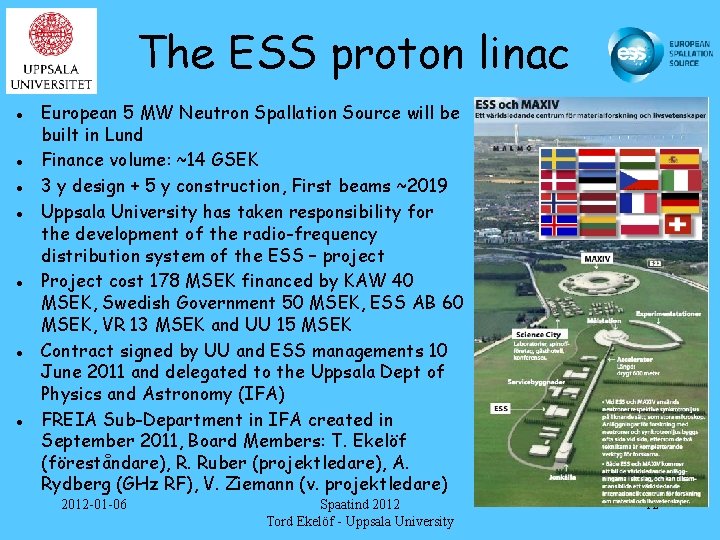
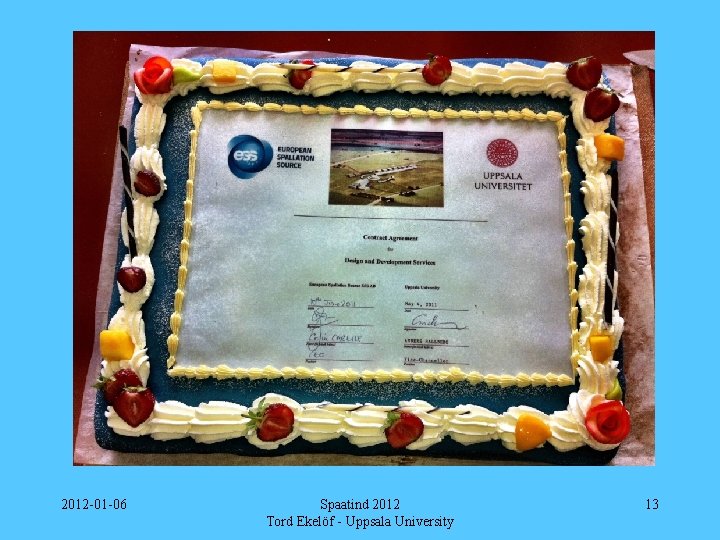
The ESS proton linac European 5 MW Neutron Spallation Source will be built in Lund Finance volume: ~14 GSEK 3 y design + 5 y construction, First beams ~2019 Uppsala University has taken responsibility for the development of the radio-frequency distribution system of the ESS – project Project cost 178 MSEK financed by KAW 40 MSEK, Swedish Government 50 MSEK, ESS AB 60 MSEK, VR 13 MSEK and UU 15 MSEK Contract signed by UU and ESS managements 10 June 2011 and delegated to the Uppsala Dept of Physics and Astronomy (IFA) FREIA Sub-Department in IFA created in September 2011, Board Members: T. Ekelöf (föreståndare), R. Ruber (projektledare), A. Rydberg (GHz RF), V. Ziemann (v. projektledare) 2012 -01 -06 Spaatind 2012 Tord Ekelöf - Uppsala University 12
2012 -01 -06 Spaatind 2012 Tord Ekelöf - Uppsala University 13
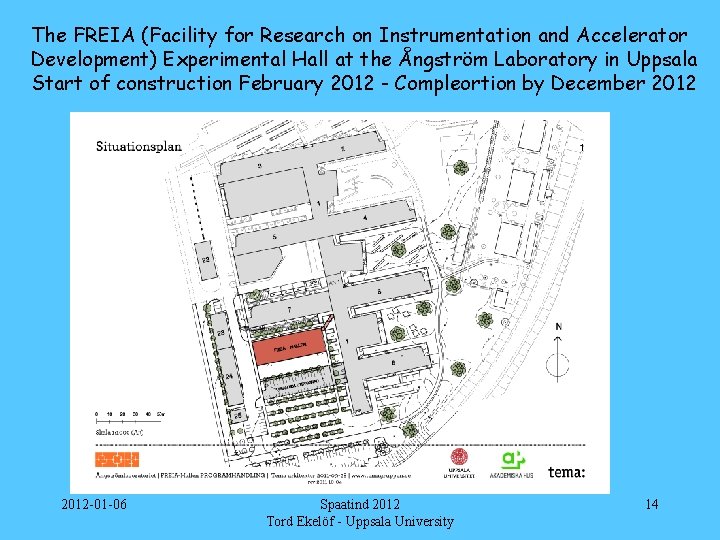
The FREIA (Facility for Research on Instrumentation and Accelerator Development) Experimental Hall at the Ångström Laboratory in Uppsala Start of construction February 2012 - Compleortion by December 2012 -01 -06 Spaatind 2012 Tord Ekelöf - Uppsala University 14
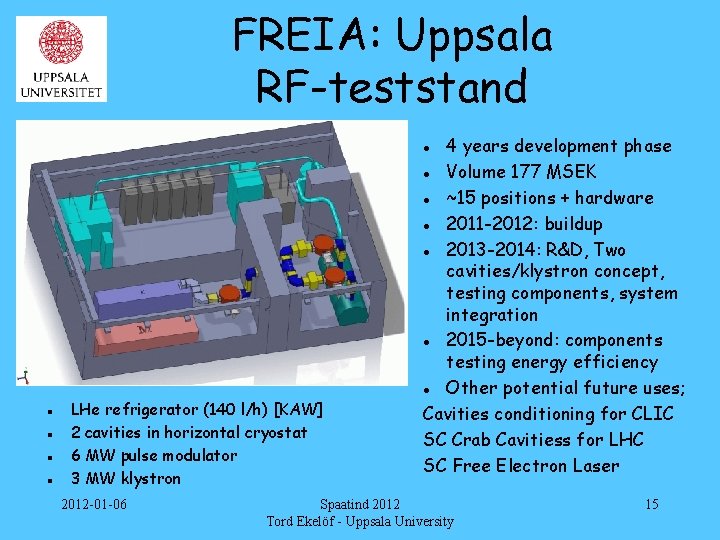
FREIA: Uppsala RF-teststand 4 years development phase Volume 177 MSEK ~15 positions + hardware 2011 -2012: buildup 2013 -2014: R&D, Two cavities/klystron concept, testing components, system integration 2015 -beyond: components testing energy efficiency Other potential future uses; Cavities conditioning for CLIC SC Crab Cavitiess for LHC SC Free Electron Laser LHe refrigerator (140 l/h) [KAW] 2 cavities in horizontal cryostat 6 MW pulse modulator 3 MW klystron 2012 -01 -06 Spaatind 2012 Tord Ekelöf - Uppsala University 15
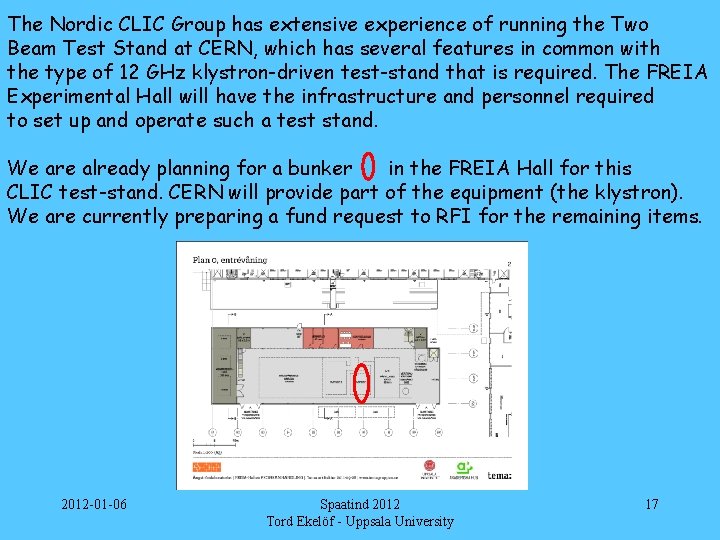
Which is the potential of the FREIA project for Nordic High Energy Physics? 1. FREIA as a test laboratory for CLIC will contain of the order of 105 accelerating cavity structures. In order for that the operation of the CLIC at 100 MV/m be feasible it must be possible to operate the accelerating-cavity structures with a spark rate at 100 MV/m gradient that is less than one spark in 10 7 pulses (as a spark will imply that the beam is lost this is equivalent to requiring a 99% efficiency). In order to achieve such a low spark rate each cavity has to be conditioned by running it at high gradient near break-down for several weeks. To condition and test large series of CLIC accelerating-cavity structure prototypes over the next few years will require the running of 6 -8 conditioning 12 GHz klystron-driven test-benches in parallel. CERN is planning to build 4 such test-benches and is relying on collaborating groups to provide the others. 2012 -01 -06 Spaatind 2012 Tord Ekelöf - Uppsala University 16
The Nordic CLIC Group has extensive experience of running the Two Beam Test Stand at CERN, which has several features in common with the type of 12 GHz klystron-driven test-stand that is required. The FREIA Experimental Hall will have the infrastructure and personnel required to set up and operate such a test stand. We are already planning for a bunker in the FREIA Hall for this CLIC test-stand. CERN will provide part of the equipment (the klystron). We are currently preparing a fund request to RFI for the remaining items. 2012 -01 -06 Spaatind 2012 Tord Ekelöf - Uppsala University 17
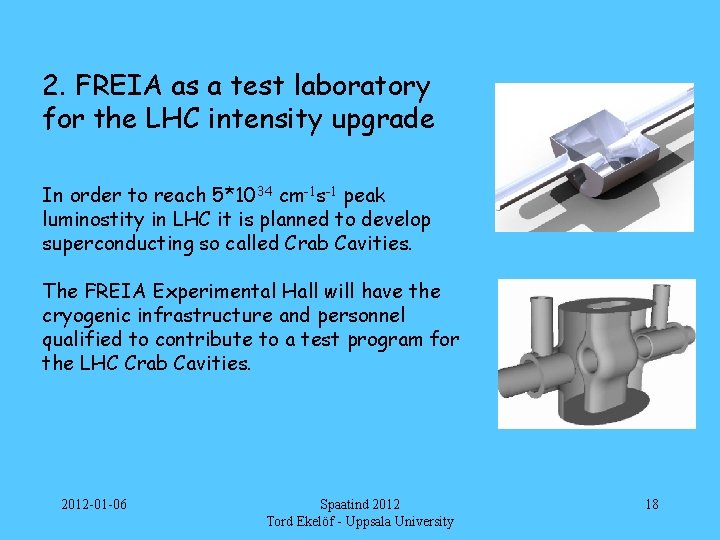
2. FREIA as a test laboratory for the LHC intensity upgrade In order to reach 5*1034 cm-1 s-1 peak luminostity in LHC it is planned to develop superconducting so called Crab Cavities. The FREIA Experimental Hall will have the cryogenic infrastructure and personnel qualified to contribute to a test program for the LHC Crab Cavities. 2012 -01 -06 Spaatind 2012 Tord Ekelöf - Uppsala University 18
3. FREIA as a node in the European Accelerator Development Network TIARA (Test Infrastructure and Accelerator Research Area ) is an EU Preparatory Phase Project that has as objective to propose a European network that will integrate national and international accelerator R&D infrastructures into a single distributed European R&D facility. Member institutes: CEA, CERN, DESY, GSI, INFN. PSI, RAL. . . , UU Coordinator: Roy Aleksan, CEA Uppsala University is representing Scandinavian partners at Helsinki HIP, Stockholm U. , Oslo U. , Lund U. and Aarhus U. Preparatory phase: propose governance, inventory of needs, existing infrastructures, collaboration with industry and education The FREIA Laboratory will have the infrastructure and personnel required to constitute an effective node in the future TIARA accelerator development laboratory network. 2012 -01 -06 Spaatind 2012 Tord Ekelöf - Uppsala University 19
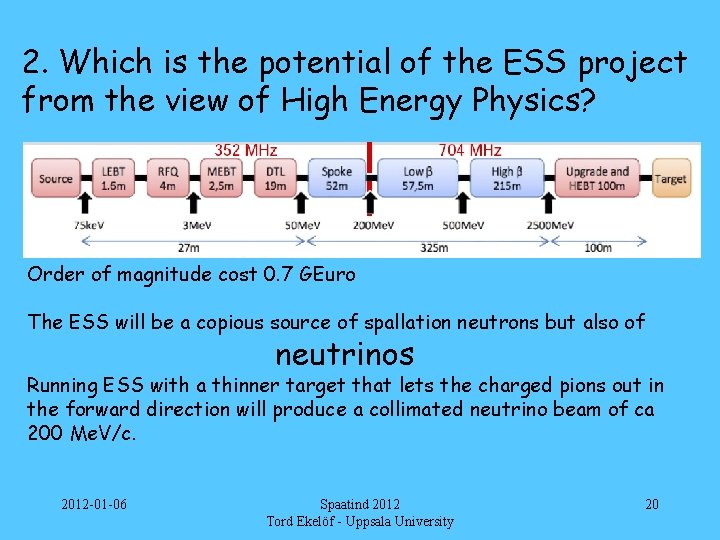
2. Which is the potential of the ESS project from the view of High Energy Physics? Order of magnitude cost 0. 7 GEuro The ESS will be a copious source of spallation neutrons but also of neutrinos Running ESS with a thinner target that lets the charged pions out in the forward direction will produce a collimated neutrino beam of ca 200 Me. V/c. 2012 -01 -06 Spaatind 2012 Tord Ekelöf - Uppsala University 20
Additions to the present ESS proton linac required for the generation of such a beam; 1. A special (thinner) neutrino target with a neutrino horn (studied in detail in EUROν) 2. A 2. 5 Ge. V accumulator ring to compress the ca 3 ms long ESS pulse to a few microseconds pulse (to reduce the cosmic ray background in the underground ν detector) 3. Acceleration of H- pulses in the ca 70 ms long empty buckets between the ESS proton 3 ms pulses (70 ms spacing is needed for the TOF measurement of the spallation neutrons) requiering more rf power generation capacity 4. A very large Kton neutrino detector + a smaller near detector. 2012 -01 -06 Spaatind 2012 Tord Ekelöf - Uppsala University 21
There are two EU FP 7 projects studying future options for neutrino physics in Europe; EUROν (http: //www. euronu. org/) 2008 -2012 and LAGUNA (Large Apparatus for Grand Unification and Neutrino Astrophysics, http: //laguna. ethz. ch: 8080/Plone) 2008 -2010 The LAGUNA EU neutrino study is proposing long and short base line neutrino detectors i Europe based on proton beams from the CERN SPS and the CERN Super Proton Linac (SPL), respectively. However, CERN’s plan to construct the 4 MW, 4. 5 Me. V SPL has been postponed, whereas the ESS 5 MW, 2. 5 Me. V proton linac will be built 2015 -2019 as a unique facility in the world 2012 -01 -06 Spaatind 2012 Tord Ekelöf - Uppsala University 22
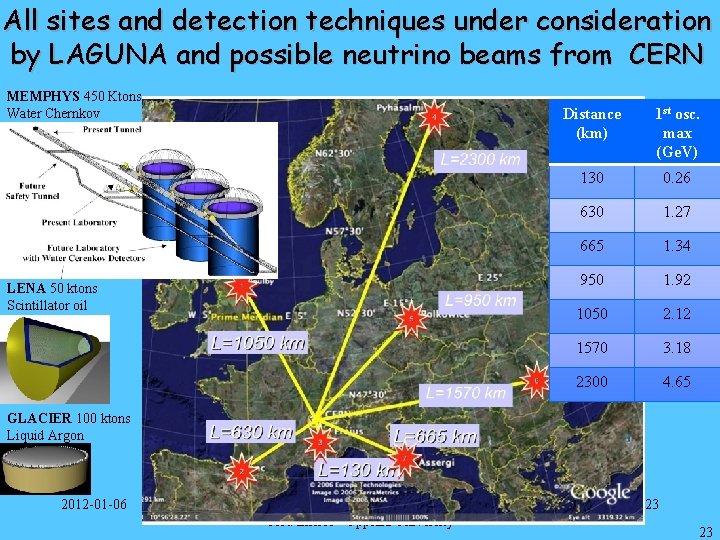
All sites and detection techniques under consideration by LAGUNA and possible neutrino beams from CERN MEMPHYS 450 Ktons Water Chernkov LENA 50 ktons Scintillator oil Distance (km) 1 st osc. max (Ge. V) 130 0. 26 630 1. 27 665 1. 34 950 1. 92 1050 2. 12 1570 3. 18 2300 4. 65 GLACIER 100 ktons Liquid Argon 2012 -01 -06 Spaatind 2012 Tord Ekelöf - Uppsala University 23 23
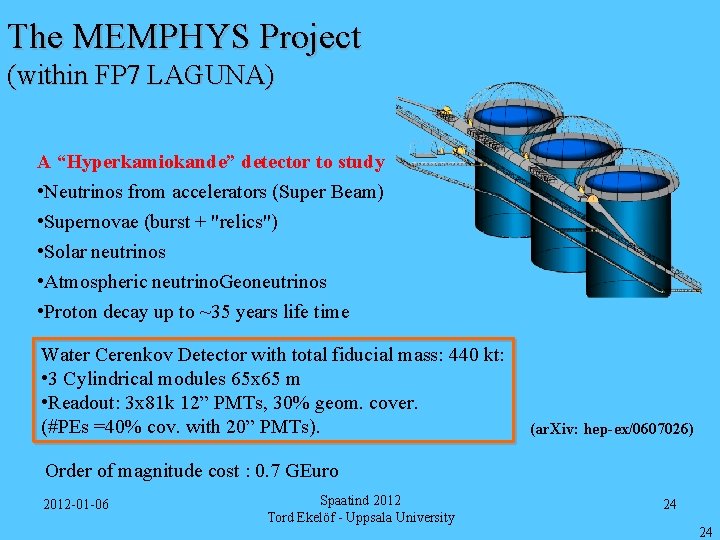
The MEMPHYS Project (within FP 7 LAGUNA) A “Hyperkamiokande” detector to study • Neutrinos from accelerators (Super Beam) • Supernovae (burst + "relics") • Solar neutrinos • Atmospheric neutrino. Geoneutrinos • Proton decay up to ~35 years life time Water Cerenkov Detector with total fiducial mass: 440 kt: • 3 Cylindrical modules 65 x 65 m • Readout: 3 x 81 k 12” PMTs, 30% geom. cover. (#PEs =40% cov. with 20” PMTs). (ar. Xiv: hep-ex/0607026) Order of magnitude cost : 0. 7 GEuro 2012 -01 -06 Spaatind 2012 Tord Ekelöf - Uppsala University 24 24
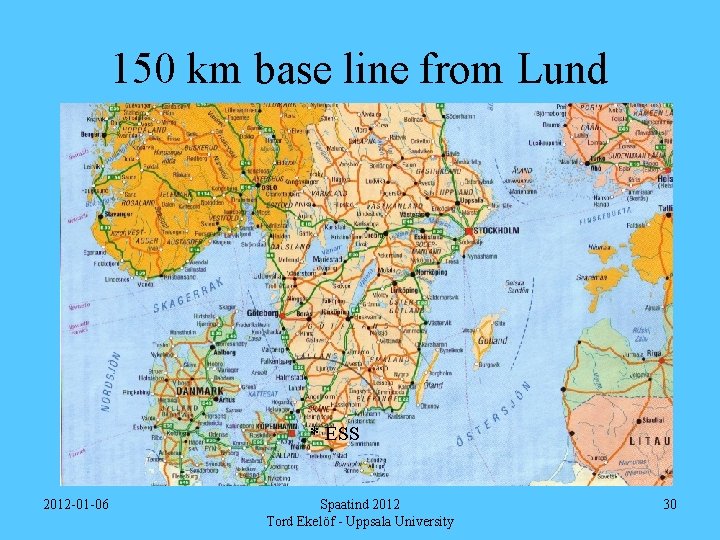
An alternative to the EUROν option of One shorter (~150 km) base line neutrino detector in Fréjus (~0. 7 MEuro) with the CERN SPL as accelerator (~ 0. 7 Meuro) and one long (~2000 km) base line neutrino detector in northen Finland (~ 0. 7 Meuro) with CERN SPS as accelerator could be A single large neutrino detector (~0. 7 Meuro) being fed with two different neutrino beams, one from the EES linac (~150 km) and one from the CERN SPS (~2000 km) 2012 -01 -06 Spaatind 2012 Tord Ekelöf - Uppsala University 25
Considering the magnitude the cost of excavating three cylindrical caverns , each 75 m high and 75 m in diameter, at 1500 m depth (of order 100 Meuro) the construction cost of the transport shaft needed to bring up the excavation debris is not dominant (order 10 Meuro), the gain to place the detector in an excisting mine is marginal. The position of the detector may therefore be chosen considering primarily the optimal distance to the neutrino source and the geological structure of the underground. So, where would be the optimal position of the single large neutrino detector? 2012 -01 -06 Spaatind 2012 Tord Ekelöf - Uppsala University 26
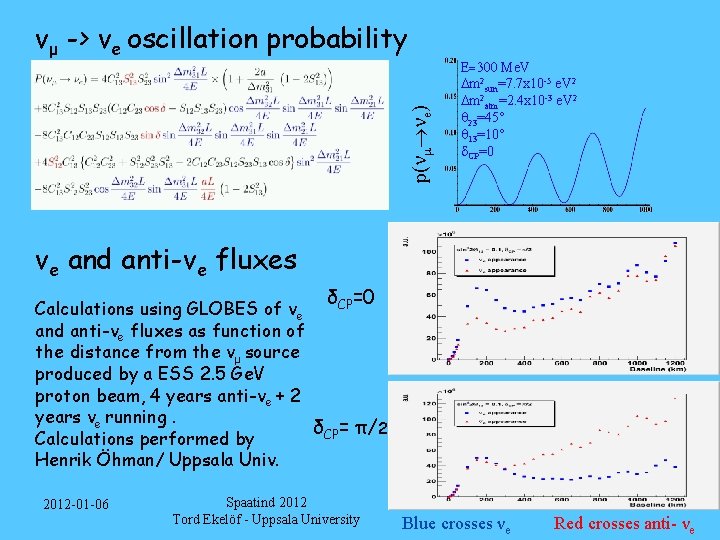
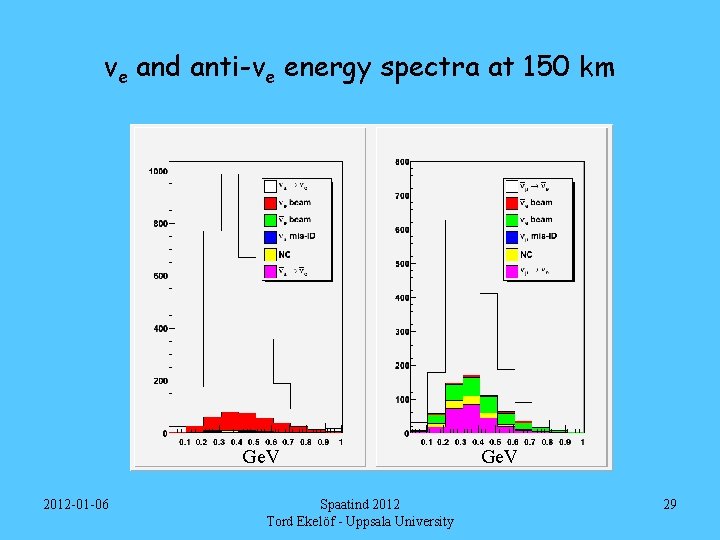
p(nm ne) νμ -> νe oscillation probability E=300 Me. V Dm 2 sun=7. 7 x 10 -5 e. V 2 Dm 2 atm=2. 4 x 10 -3 e. V 2 q 23=45° q 13=10° d. CP=0 νe and anti-νe fluxes δ =0 CP Calculations using GLOBES of νe and anti-νe fluxes as function of the distance from the νμ source produced by a ESS 2. 5 Ge. V proton beam, 4 years anti-νe + 2 years νe running. δCP= π/2 Calculations performed by Henrik Öhman/ Uppsala Univ. 2012 -01 -06 Spaatind 2012 Tord Ekelöf - Uppsala University 27 Blue crosses νe Red crosses anti- νe
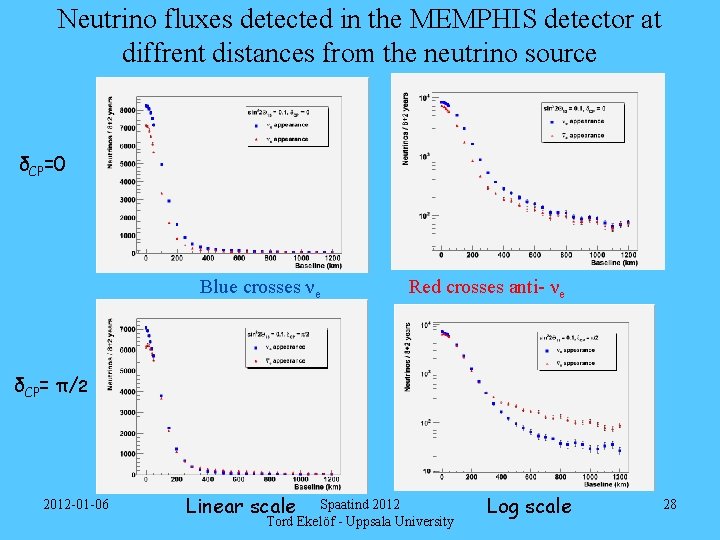
Neutrino fluxes detected in the MEMPHIS detector at diffrent distances from the neutrino source δCP=0 Blue crosses νe Red crosses anti- νe δCP= π/2 2012 -01 -06 Linear scale Spaatind 2012 Tord Ekelöf - Uppsala University Log scale 28
νe and anti-νe energy spectra at 150 km Ge. V 2012 -01 -06 Spaatind 2012 Tord Ekelöf - Uppsala University Ge. V 29
150 km base line from Lund * ESS 2012 -01 -06 Spaatind 2012 Tord Ekelöf - Uppsala University 30
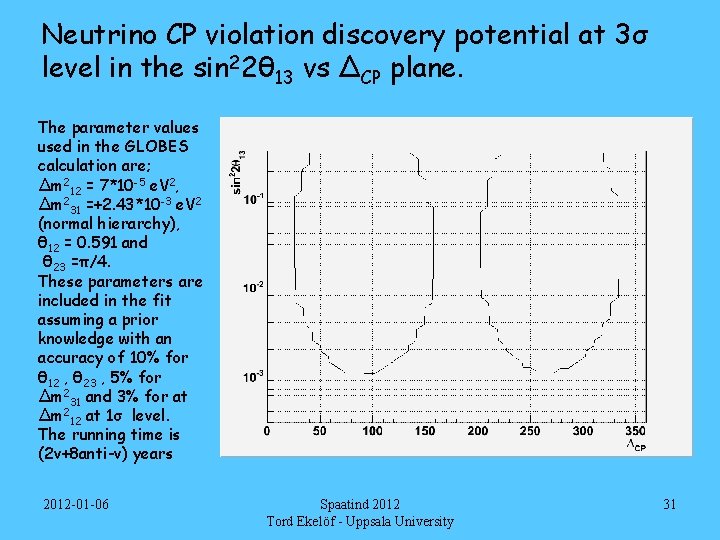
Neutrino CP violation discovery potential at 3σ level in the sin 22θ 13 vs ΔCP plane. The parameter values used in the GLOBES calculation are; Δm 212 = 7*10 -5 e. V 2, Δm 231 =+2. 43*10 -3 e. V 2 (normal hierarchy), θ 12 = 0. 591 and θ 23 =π/4. These parameters are included in the fit assuming a prior knowledge with an accuracy of 10% for θ 12 , θ 23 , 5% for Δm 231 and 3% for at Δm 212 at 1σ level. The running time is (2ν+8 anti-ν) years 2012 -01 -06 Spaatind 2012 Tord Ekelöf - Uppsala University 31
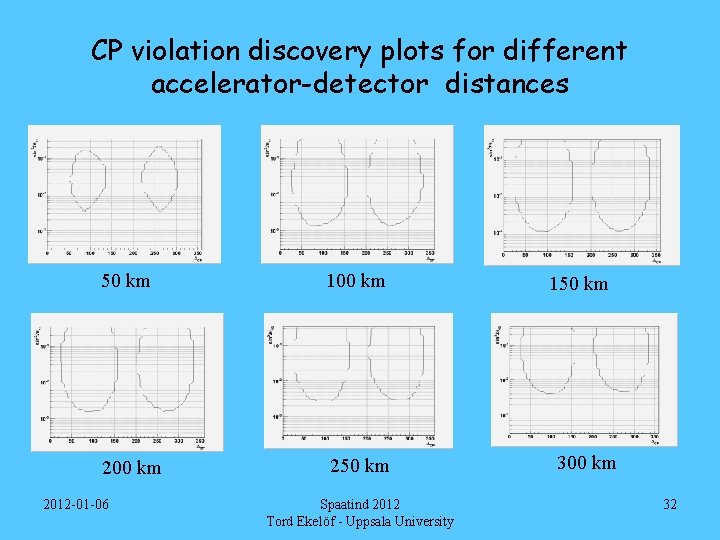
CP violation discovery plots for different accelerator-detector distances 50 km 100 km 250 km 2012 -01 -06 Spaatind 2012 Tord Ekelöf - Uppsala University 150 km 300 km 32
Concluding remarks • The future of High Energy Phyiscs relies to significant extent the innovative development of future high energy, high intensity accelerators like LH-LHC, CLIC, ESS linac… • There is a lively accelerator development activity in Europe to which Nordic physicist contribute actively and which offers truely challenging problems for young High Energy physicists • The ESS project was propose by the Swedish Government without much consultation with the Nordic scientific community. • Even so, the superconducting linear proton accelerator of the ESS project will, in view of its high power of 5 MW, be a world unique facility in the Nordic countries with high potential also for High Energy Physics. 2012 -01 -06 Spaatind 2012 Tord Ekelöf - Uppsala University 33
• The large investment in accelerator development infrastucture required in order to assure the success of the ESS project opens the possibility for the Nordic countries to contribute to the development of several cutting-edge accelerator development projects also for High Energy Physics like CLIC and SLHC which would not have been possible without the ESS project. • Moreover, the high power ESS proton linac in combination with a large neutrino detector offers the possibility to make a world leading study one of the oustanding problems in modern physics, that of neutrino CP violation and the matter-antimatter symmetry in the Universe. 2012 -01 -06 Spaatind 2012 Tord Ekelöf - Uppsala University 34
THANK YOU Poul Damgaard, Alberto Guffanti, Sarah Pearson, Peter Hansen… for wonderful physics, skiing and food at Spaatind 2012 -01 -06 Spaatind 2012 Tord Ekelöf - Uppsala University 35